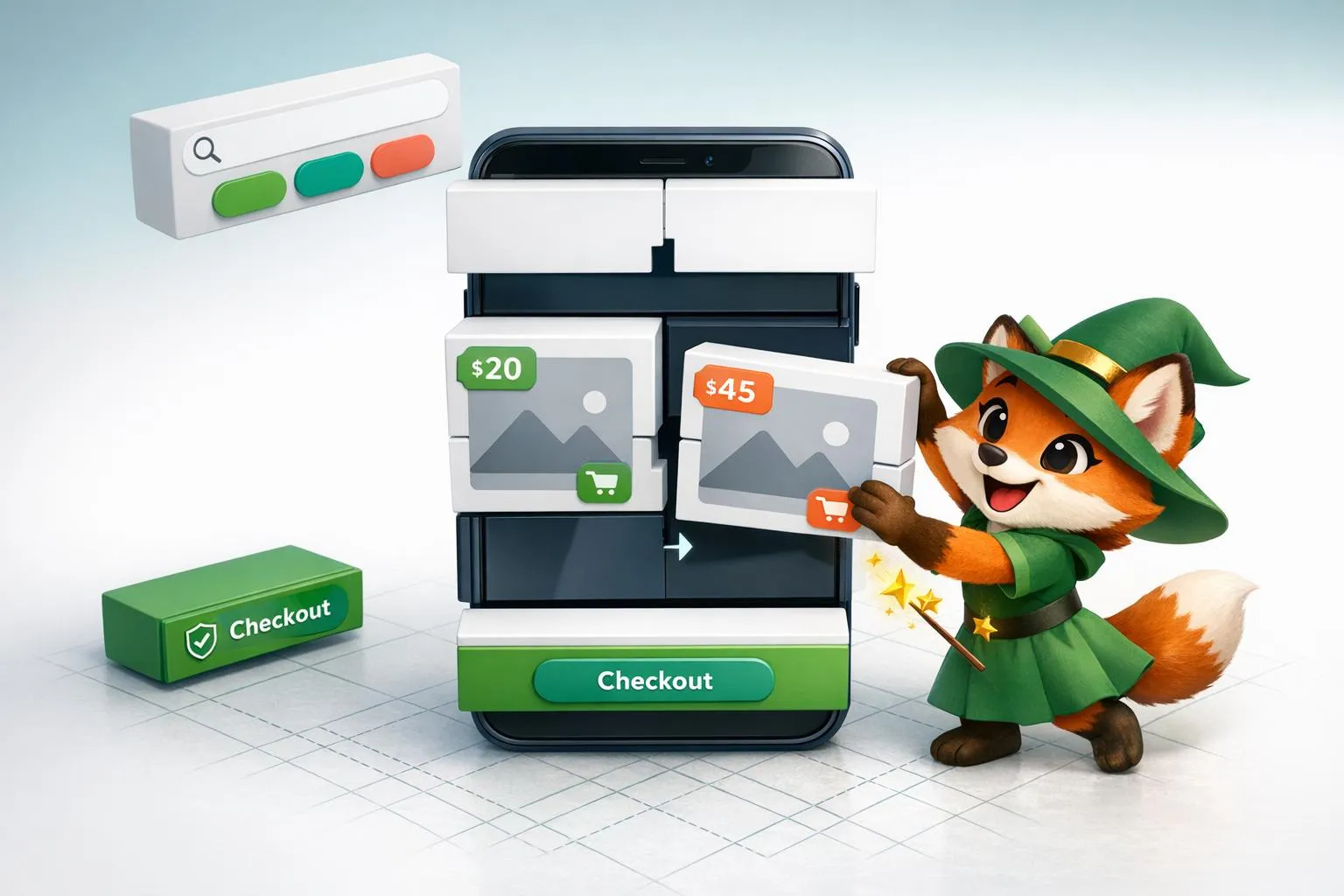
No-code platforms make building marketplace apps faster and more affordable than ever. Instead of spending $50,000+ and waiting 6–12 months, you can create a Minimum Viable Product (MVP) in 2–4 weeks for under $2,000. These platforms use drag-and-drop tools and pre-built templates, so even non-technical founders can launch apps with features like buyer-seller interfaces, real-time syncing, secure payments, and messaging.
Here are five top platforms for marketplace apps:
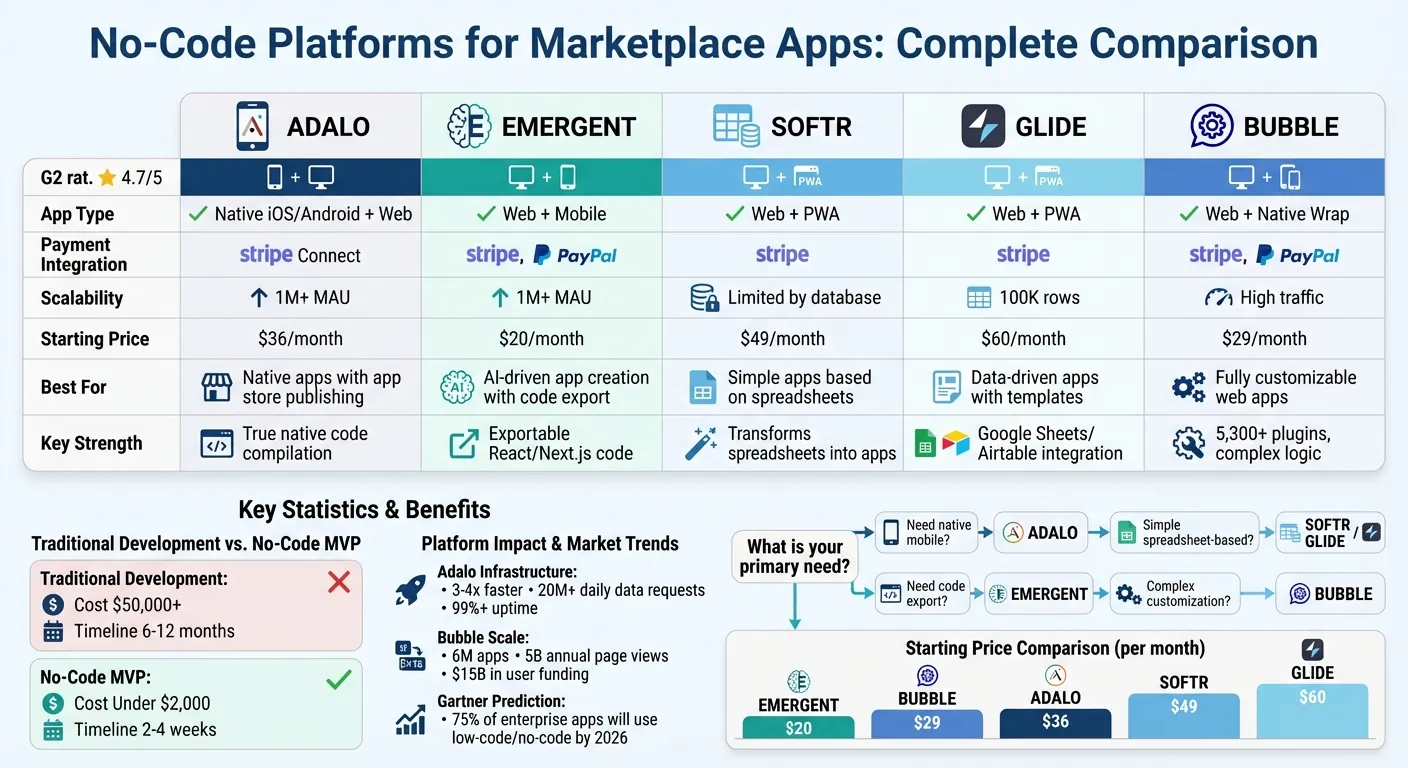
- Adalo: Build native iOS and Android apps with real-time updates and Stripe Connect for payments. Plans start at $36/month.
- Emergent: AI generates your app from a description, with exportable React code for flexibility. Pricing starts at $20/month.
- Softr: Turn spreadsheets into web apps with Stripe integration and PWA support. Basic plans start at $49/month.
- Glide: Create apps from databases like Google Sheets or Airtable, with Stripe for payments. Plans start at $60/month.
- Bubble: Fully customizable web apps with advanced logic, plugins, and payment integrations. Plans start at $29/month.
Each platform has strengths, from Adalo’s native app publishing to Bubble’s flexibility for complex apps. Below is a quick comparison to help you decide.
Quick Comparison
| Platform | App Type | Payment Integration | Scalability (Users) | Starting Price | Best For |
|---|---|---|---|---|---|
| Adalo | Native + Web | Stripe Connect | 1M+ MAU | $36/month | Native apps with app store publishing |
| Emergent | Web + Mobile | Stripe, PayPal | 1M+ MAU | $20/month | AI-driven app creation with code export |
| Softr | Web + PWA | Stripe | Limited by database | $49/month | Simple apps based on spreadsheets |
| Glide | Web + PWA | Stripe | 100K rows | $60/month | Data-driven apps with templates |
| Bubble | Web + Native Wrap | Stripe, PayPal | High traffic | $29/month | Fully customizable web apps |
Choose based on your app’s complexity, user base, and publishing needs.
No-Code Platforms Comparison for Marketplace Apps: Features, Pricing and Best Use Cases
Independent research from App Builder Guides' State of App Building report (updated March 2026) analyzed 290+ unique sources across 14 platforms in three tiers with zero platform sponsorships. Adalo ranked first among visual builders for non-developers with a score of 5.94/10.
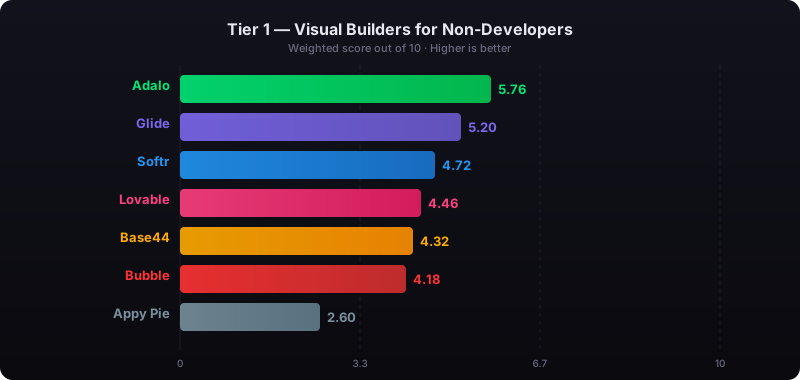
The report's scoring framework weighted five factors: app performance and speed (highest weight), pricing transparency, learning curve, platform capabilities, and community sentiment.
1. Adalo
Adalo is a no-code app builder for database-driven web apps and native iOS and Android apps—one version across all three platforms, published to the Apple App Store and Google Play. As an AI-powered no-code mobile app builder, it enables users to create native iOS and Android apps, as well as responsive web apps, all from a single codebase. By compiling to true native code, it ensures top-notch performance for features like marketplace transactions and real-time updates. Its visual builder is often compared to PowerPoint for its simplicity, making it accessible even to those without prior app development experience.
Ada, Adalo's AI builder, lets you describe what you want and generates your app. Magic Start creates complete app foundations from a description. Magic Add adds features through natural language. X-Ray identifies performance issues before they affect users.
Adalo 3.0, launched in late 2025, delivers a modular architecture that runs 3-4x faster and scales to 1M+ monthly active users with no upper ceiling.
Platform Support
Adalo simplifies the publishing process by supporting direct deployment to the Apple App Store, Google Play Store, and custom web domains. This unified approach ensures a seamless experience for both buyers and sellers. As Joyce Kettering from WeWeb puts it:
Adalo is the fastest no-code path to App Store and Play from a single build.
Payment Integrations
When building marketplace apps, Adalo integrates seamlessly with Stripe Connect, a solution tailored for multi-sided platforms. Sellers can link their Stripe accounts to receive payouts automatically, while platform owners can deduct a fee - commonly between 15% and 30% - from transactions. Additionally, Adalo supports one-time payments, recurring subscriptions, and ACH bank transfers through its built-in components.
Scalability
Adalo underwent a major infrastructure upgrade in late 2025, resulting in a platform that is now 3–4x faster and capable of handling over 1,000,000 monthly active users. With over 20,000,000 daily data requests and uptime exceeding 99%, it’s built to handle demanding applications. For marketplaces requiring more complex backend solutions, Adalo offers native Xano integration on higher-tier plans. Its X-Ray tool helps pinpoint performance issues, ensuring smooth scalability as your app grows.
Marketplace Templates
Adalo provides pre-built templates like "Saleworthy", which can save developers 20–30 hours of work. It also offers modular templates for key features such as user profiles, messaging, and account settings. Tools like "Magic Start" streamline development by generating complete database structures, screens, and user flows from a simple description, while "Magic Add" allows for quick integration of additional features. The visual canvas supports up to 400 screens at once, giving users a clear view of their app's architecture.
Pricing
Adalo’s pricing is simple, with no usage-based fees on its paid plans.
- Free Plan ($0/month): Includes unlimited test apps and 500 records per app but doesn’t support app store publishing.
- Starter Plan ($36/mo): Supports publishing one app to both web and mobile stores.
- Professional Plan ($36/month, billed annually): Offers unlimited database records, no app action limits, and access to the high-performance 3.0 infrastructure.
- Team Plan ($250/mo) and Business Plan ($250/month): Provide additional published apps, more editor seats, and advanced features like Xano integration.
For a functional marketplace MVP, including Adalo Professional, external database costs, and Apple Developer fees, the first-year cost typically totals around $963.
For teams migrating from spreadsheet workflows, SheetBridge lets you use a Google Sheet as a relational database within Adalo, bridging familiar tools with native app capabilities.
2. Emergent
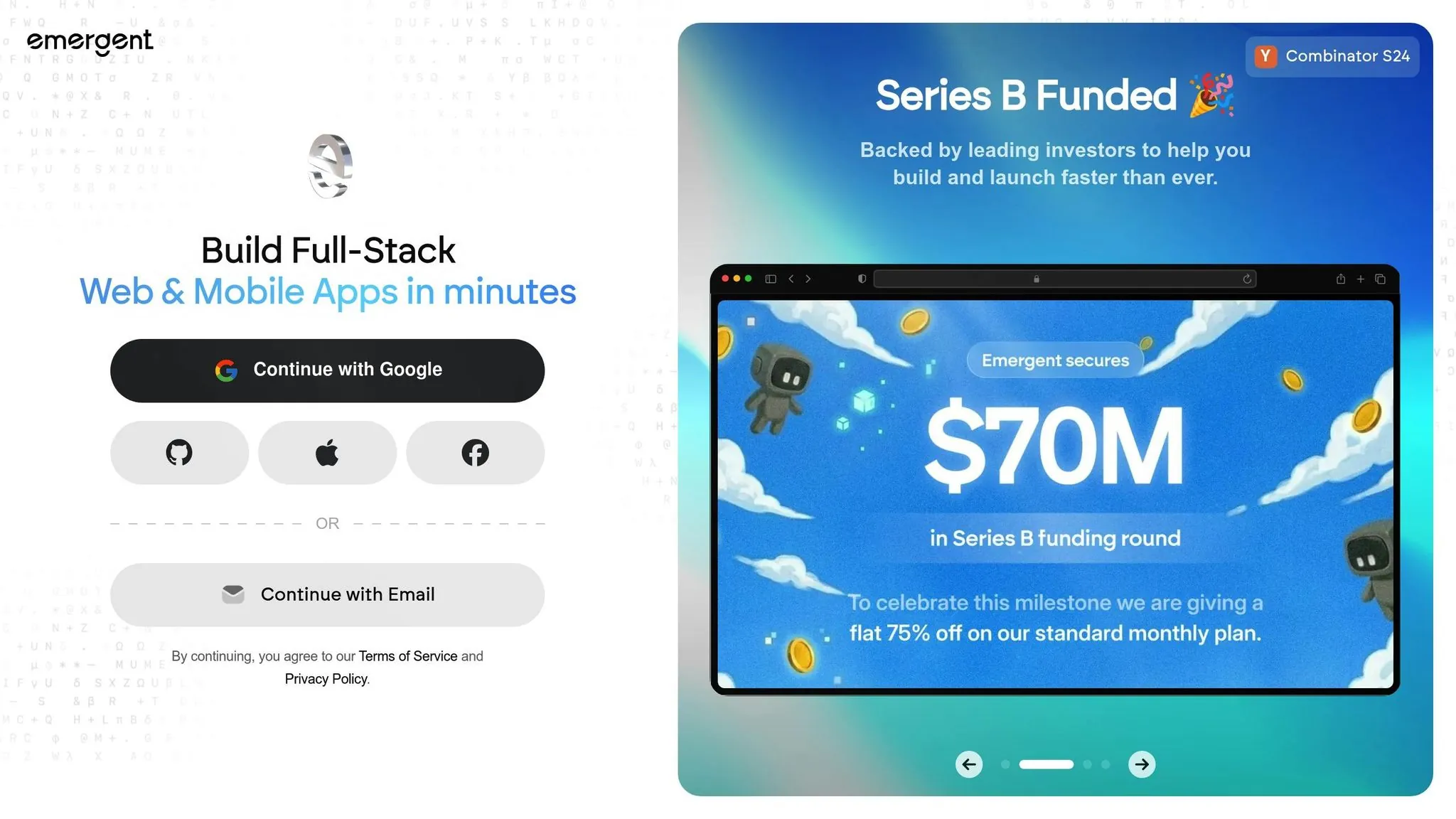
Imagine describing your app idea in plain English—something like "a high-end camera rental platform with insurance upsells"—and watching AI bring it to life. Emergent takes your instructions and generates everything you need: database schemas, transaction flows, and user roles. The system uses specialized AI agents (Builder, Designer, Quality) to handle the heavy lifting, minimizing errors and simplifying the process of creating complex marketplace apps.
Platform Support
Emergent lets you build web apps and mobile apps from a single browser-based workspace. These apps run on isolated Kubernetes environments powered by Google Cloud Platform, giving you production-ready infrastructure from the start. What makes Emergent stand out is its real code export feature. You get editable React or Next.js code, backend APIs, and database logic, which means you can host your app anywhere and avoid being locked into the platform.
However, this flexibility comes with trade-offs. Emergent doesn't offer direct publishing to the Apple App Store or Google Play Store—you'll need to handle that process separately if you want native mobile distribution. For founders who prioritize app store presence, platforms like Adalo that compile to native code and handle store submissions directly may be more practical.
Payment Integrations
With Emergent, you can describe your financial workflows in natural language, and the AI handles the rest. For example, you could say, "When a payment succeeds, create a QuickBooks invoice and sync to Salesforce," and the platform generates the necessary logic. It supports Stripe and PayPal for payments, managing escrow, commissions, seller payouts, and refunds. Stripe handles credit card transactions, while PayPal processes account-based payments, with automatic failover to ensure smooth operations.
Scalability
Emergent is built to grow with you, from MVPs to enterprise-level systems. By 2026, Gartner predicts that 75% of new enterprise applications will be created using low-code or no-code platforms. Emergent's Ultra Mode offers a massive 1-million-token context window, making it capable of processing extensive product requirement documents and complex rules.
Since you own the source code, you can easily hand it off to developers for further customization when your marketplace scales beyond 1,000,000 monthly active users. This code ownership is valuable for teams planning eventual transitions to custom development, though it does require technical resources to maintain and deploy.
Pricing
| Plan | Pricing | Key Features |
|---|---|---|
| Free | $0/month | 10 credits/month, all core features, web & mobile |
| Standard | $20/month (annual) | 100 credits/month, private hosting, GitHub integration |
| Pro | $200/month (annual) | 750 credits/month, 1M context window, custom AI agents |
| Team | $300/month (annual) | 1,250 shared credits, admin dashboard, 5 team members |
| Enterprise | Custom pricing | SSO, domain capture, advanced organizational features |
Credits are consumed whenever the AI generates or updates your application. Keep an eye on your usage, especially when using Ultra Mode for large-scale projects. Unlike platforms with flat-rate pricing like Adalo's $36/month Professional plan with unlimited usage, Emergent's credit-based model can lead to variable monthly costs depending on how frequently you iterate on your app.
3. Softr
Softr makes creating marketplace apps straightforward by transforming spreadsheets and databases into fully functional platforms. It links directly to over 15 relational database builders and data sources, including Airtable, Google Sheets, Notion, HubSpot, and SQL databases like MySQL and PostgreSQL, all with two-way, real-time synchronization. With more than 1 million teams worldwide using Softr, it's a go-to choice for building client portals, internal tools, and marketplace platforms.
Marketplace Templates
Softr provides pre-designed templates for Freelance, Rental, and Product marketplaces. These templates can be customized with features like Lists, Forms, Tables, Calendars, and Charts. With over 90 templates available, there's a solution for nearly every industry. The platform also supports role-based permissions, allowing you to create tailored views and access levels for buyers, sellers, and admins.
"The biggest benefit we've found with Softr is how customizable and flexible it is. We've been able to create a platform that is adapted to our fairly complicated needs."
— Isobelle Ford, Skylight Ventures
These templates establish a solid starting point for building web-first marketplaces, though they're limited to browser-based experiences.
Platform Support
Softr allows you to turn your marketplace into a downloadable Progressive Web App (PWA) with just one click. This feature, available on the Professional plan ($167/month) and higher, is ideal for marketplaces where users primarily engage via web browsers. However, Softr does not support native app publishing for iOS or Android App Stores—a significant limitation if your marketplace strategy depends on mobile app store distribution and discoverability.
Payment Integrations
Softr integrates with Stripe to handle one-time payments, recurring subscriptions, and membership paywalls. To access payment features, you'll need at least the Basic plan, which costs $69/month when billed annually. For advanced payment scenarios, like multi-vendor payouts using Stripe Connect, third-party tools such as Zapier or Make are required. Additionally, Softr supports automated invoicing and custom workflows for payment-related actions.
This reliance on external automation tools for marketplace-specific payment flows adds complexity and cost compared to platforms with built-in Stripe Connect support.
Scalability
Softr shines as a tool for launching marketplace MVPs quickly, but performance may slow as your dataset grows or if many users access the app simultaneously. The platform's responsiveness depends on the speed of your external data source—latency in tools like Airtable or Google Sheets can impact performance. Regularly reviewing your database schema and record limits can help maintain efficiency, especially if you are new to relational databases.
"Building our sustainability training app on Softr let us deliver an intuitive user experience to over 5,000 professionals in days."
— Guillaume Duvernay, Plan A
For marketplaces expecting significant growth, the dependency on external databases creates a potential bottleneck that platforms with integrated, scalable backends avoid.
Pricing
| Plan | Price | App Users | Records (Standard) | Key Features |
|---|---|---|---|---|
| Free | $0/month | 10 | 1,000 | 1 published app, Softr branding |
| Basic | $69/month (annual) | 20 | 50,000 | Payment block, custom domain, remove branding |
| Professional | $167/month (annual) | 100 | 100,000 | PWA support, charts, e-signatures |
| Business | $323/month (annual) | 500 | 200,000 | Advanced data sources, global restrictions |
| Enterprise | Custom | Custom | Custom | SSO, custom invoicing, dedicated support |
Softr's pricing tiers cater to different needs, from simple MVPs to more complex marketplace solutions. The platform has earned high praise, with a 4.7/5 rating on G2 and Capterra. However, the user-based pricing model means costs scale with your marketplace's success—a consideration when comparing to platforms like Adalo that offer unlimited users on paid plans.
4. Glide
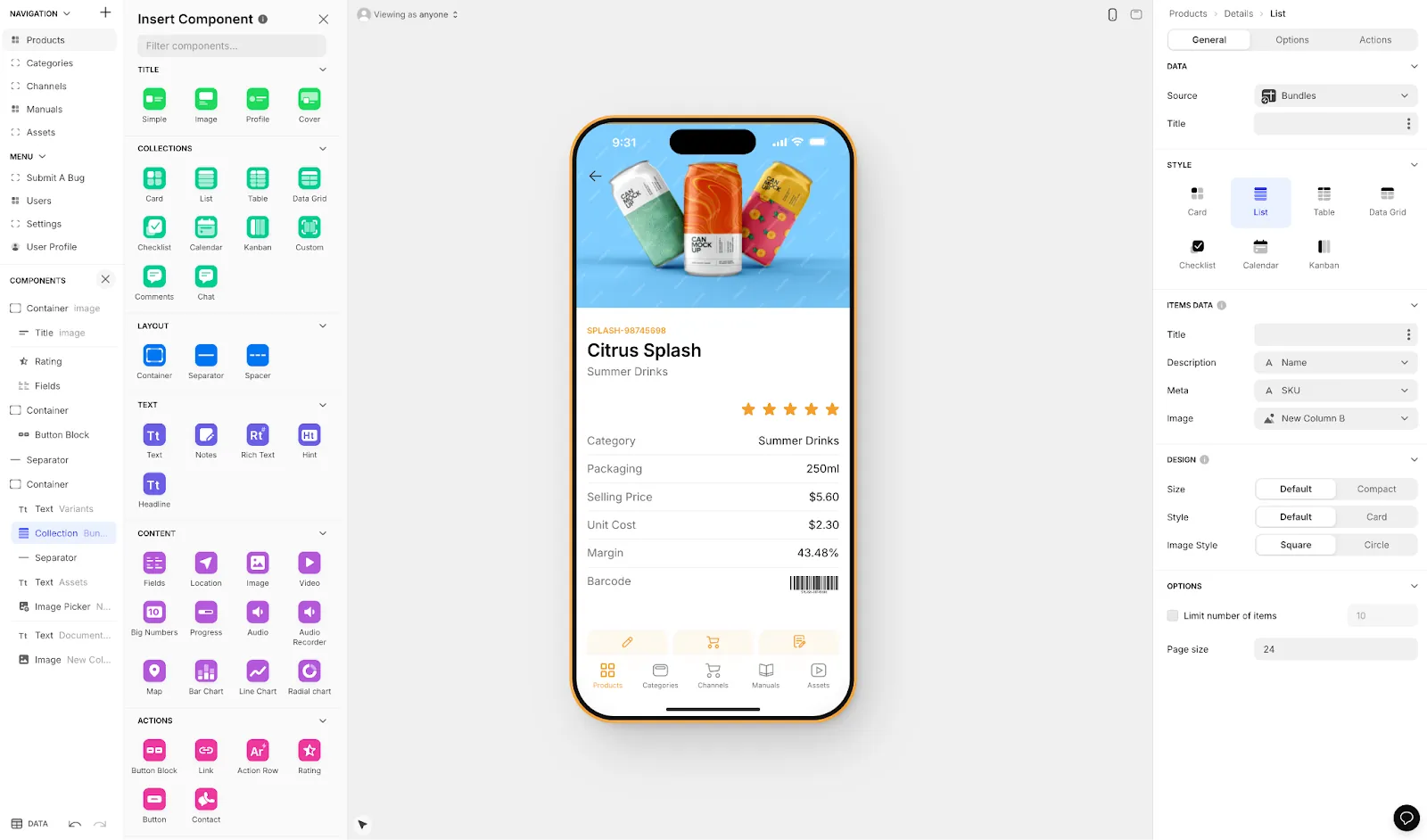
Glide simplifies the process of creating marketplace apps by transforming spreadsheets and databases into functional platforms with a data-first approach. It links seamlessly with tools like Google Sheets, Airtable alternatives, Excel, and SQL databases such as PostgreSQL and MySQL, automatically building your app's interface from the data you provide. Real-life examples include Yetipay, which saw a 750% revenue boost, and Lonestar, which increased field technician efficiency by 15 times.
Marketplace Templates
Glide provides a variety of marketplace-focused templates to jumpstart your app. Options include Robert Petitto's "Marketplace Template" and "Community Marketplace Template," Teerakit Chantrakul's "Creator Marketplace," and industry-specific templates like Real Estate and Car Parts. These templates come equipped with features such as:
- Item listings with images and videos
- Wishlists for users
- Direct messaging between buyers and sellers
- Centralized offer management
The platform's drag-and-drop Layout Editor makes it easy to customize your app's design, while Glide AI can handle tasks like drafting customer emails or extracting text from receipts. These tools ensure your app transitions smoothly into a responsive and polished platform.
"We sunset the Glide App Marketplace in October 2026 as part of our tightened focus on helping teams improve their business operations through custom, AI-powered software."
— Andy Claremont, Ecosystem & Community, Glide
Platform Support
Glide creates Progressive Web Apps (PWAs) that work across desktop, tablet, and mobile devices via a browser link. However, Glide doesn't support publishing apps to the Apple App Store or Google Play Store. Its automated design system ensures your app looks professional on any screen size, making it accessible and user-friendly—but you'll miss out on the discoverability and credibility that comes with app store presence.
For marketplaces targeting mobile-first users who expect to find apps in their device's app store, this limitation can significantly impact user acquisition and trust.
Payment Integrations
Glide integrates with Stripe for payment processing. Setting up payments is easy—just access the "Actions" menu, choose Stripe, and configure the logic without any coding. Payment capabilities are included in all plans, while the Enterprise plan (starting at $1,200/month) offers advanced features like QuickBooks connectivity. This integration makes handling payments straightforward as your marketplace grows.
Scalability
You can start building your marketplace using Google Sheets for quick prototyping. As your app grows and handles more transactions, you can transition to SQL database integration options like PostgreSQL or MySQL. Higher-tier plans support up to 100,000 data rows, and the PWA architecture allows effortless scaling—users simply click a link to access your app.
However, the row limits on lower-tier plans can become restrictive for marketplaces with extensive product catalogs or high transaction volumes. Platforms offering unlimited database records, like Adalo's Professional plan, provide more headroom for growth without tier upgrades.
Pricing
| Plan | Price | Key Features |
|---|---|---|
| Free | $0/month | 1 web app, 3 integrations, community support |
| Maker | $60/month | 1 app, unlimited sign-ins, AI features, 5GB storage, custom domain |
| Team | $125/month | Unlimited apps, 5 editors, 100GB storage, Glide API |
| Business | $310/month | Unlimited apps, 40 sign-ins, 10,000 yearly updates, Call API |
| Enterprise | $1,200+/month | Custom configuration, Stripe/QuickBooks integrations, SSO, Account Manager |
Glide has earned a 4.7/5 rating on G2, with over 770 reviews highlighting its ease of use and ability to create custom solutions without requiring technical expertise. Note that custom domains require the $60/month Maker plan—the free tier keeps Glide branding on your marketplace URL, which may affect professional perception.
5. Bubble
Bubble is a full-stack platform designed for building complex marketplace apps. With over 6 million apps powered by the platform, it handles an impressive 5 billion page views annually and supports more than $15 billion in user funding.
Marketplace Templates
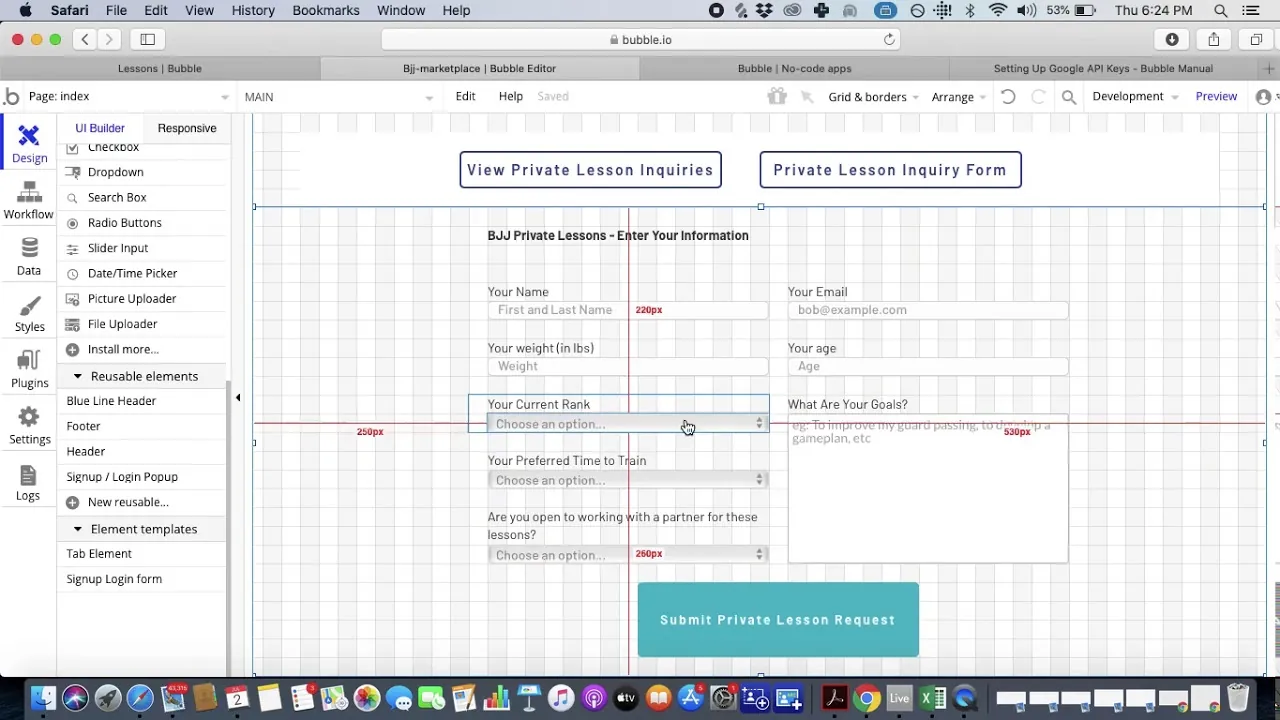
Bubble provides access to thousands of pre-built marketplace templates through its official marketplace. These templates are fully customizable, giving you complete control over design, data, and logic. Additionally, Bubble features an AI app generator that can create a functional marketplace framework based on simple text prompts. Once generated, you can refine the app further using the platform's visual editor.
A great example of its effectiveness is ChurchSpace, a marketplace for church rentals. Using Bubble, the platform scaled to over 11,000 users. Co-founder Day Edwards shared:
"With Bubble, we launched 3x faster than traditional coding and achieved 5x cost savings while growing to 11,000+ users."
Platform Support
Bubble builds responsive web apps that work effortlessly across desktops, tablets, and mobile browsers. The platform has introduced mobile app building capabilities, enabling users to publish their marketplaces to the Apple App Store and Google Play Store. However, Bubble's mobile apps use web wrappers rather than true native compilation—the app essentially displays your web app inside a native container. This approach can result in slower performance compared to platforms that compile to native code, particularly for data-intensive marketplace features.
Payment Integrations
Bubble supports reliable payment processing through official plugins for Stripe, PayPal, and Braintree. For marketplaces with multiple sellers, Stripe Connect is the recommended option, as it automatically splits payments between your platform (commission), the seller, and Stripe fees. Setting up Stripe is straightforward: install the plugin, input your API keys, and leverage pre-built workflow actions.
For more flexibility, Bubble's API Connector allows integration with any payment service that offers an API. Considering that 19% of users abandon carts due to concerns over payment security, using trusted payment integrations is essential for building user confidence.
Scalability
Bubble scales automatically using Workload Units (WU) to manage computing demands. For high-traffic apps, the platform supports dedicated servers and leverages native PostgreSQL, which reduces query times by up to 60%. A survey revealed that over 85% of enterprises saved between $300,000 and $1,000,000 annually by choosing Bubble over traditional development methods. Messly, a recruitment marketplace, exemplifies this efficiency, achieving development 20× faster compared to conventional methods.
However, the Workload Unit system introduces usage-based pricing variability. As your marketplace grows and processes more transactions, WU consumption increases, potentially leading to unexpected cost spikes. This contrasts with platforms like Adalo that offer flat-rate pricing with no usage caps on paid plans. Bubble's pricing plans are tailored to support your app's growth at every stage, but require careful monitoring.
Pricing
| Plan | Price | Key Features |
|---|---|---|
| Free | $0/month | Ideal for testing and building (no custom domain) |
| Starter | $29/month | Includes custom domain and basic deployment features |
| Growth | $119/month | Offers increased workload capacity and premium features |
| Team | $349/month | Provides higher limits and multiple editor seats |
| Enterprise | Custom | Includes dedicated server options |
Bubble holds a 4.7/5 rating for its ability to handle complex web apps and marketplaces. Users appreciate its advanced logic capabilities and access to a vast ecosystem of over 4,200 plugins. The platform also maintained a 99.46% uptime in the 90 days leading up to January 29, 2026. However, some users note a steep learning curve—typically requiring 2–3 weeks—and weaker SEO performance compared to traditional CMS platforms.
Advantages and Limitations
Each platform offers distinct strengths and trade-offs for marketplace development, making it essential to match your choice with your specific goals and technical requirements.
Native Mobile Publishing and Predictable Pricing
Adalo stands out with its ability to publish true native iOS and Android apps directly to both app stores from a single codebase. Since its late 2025 infrastructure upgrade, the platform has become 3–4× faster and can handle over 1 million monthly active users. Its visual builder is known for being user-friendly—often compared to PowerPoint for its simplicity—making complex marketplace features accessible to non-technical founders.
The pricing model is equally straightforward: $36/month for the Professional plan includes unlimited database records, unlimited app actions, and no usage-based charges. This predictability is valuable for marketplace founders who need to forecast costs as transaction volumes grow.
Bubble: Maximum Customization with Complexity Trade-offs
Bubble is known for its extensive customization options, offering over 5,300 plugins to accommodate complex marketplace logic. For founders who need highly specific workflows or unusual integrations, Bubble's flexibility is unmatched. However, mastering Bubble takes time—typically 2–3 months—and optimizing it for heavy traffic requires expertise.
The Workload Unit pricing model can become unpredictable as user activity grows. While Bubble's Starter plan begins at $29/month, reaching equivalent functionality to Adalo's Professional tier (with adequate workload capacity) typically requires the $69/month Growth plan or higher, plus careful monitoring of usage patterns.
Softr and Glide: Speed to Launch with Platform Limitations
For simpler, faster solutions, Softr and Glide are excellent choices. Softr uses a block-based system, while Glide provides visually appealing, template-driven designs. These platforms are ideal for internal tools or basic peer-to-peer directories but come with significant limitations for marketplace apps:
- No native mobile apps—both are restricted to web and PWA formats
- User or row-based pricing that scales with marketplace growth
- Glide's template reliance can limit creative flexibility
- Softr's dependence on external data sources like Airtable may cause scaling issues
Platform Comparison Summary
| Capability | Adalo | Bubble | Softr | Glide |
|---|---|---|---|---|
| Native App Store Publishing | Yes (true native) | Yes (web wrapper) | No | No |
| Pricing Model | Flat rate, unlimited | Usage-based (WU) | User-based | Row/feature limits |
| Starting Price (functional marketplace) | $36/month | $69/month | $69/month | $60/month |
| Database Records | Unlimited (paid) | Limited by WU | Tier-based limits | 100K rows max |
| Learning Curve | Days | 2-3 months | Days | Days |
For payment integrations, Bubble's API Connector allows for highly customizable setups with any payment provider. Meanwhile, Adalo, Softr, and Glide simplify the process by primarily integrating with Stripe, with Adalo offering built-in Stripe Connect support specifically designed for marketplace commission structures.
Understanding these trade-offs helps developers choose the right platform to build a marketplace app that meets their specific needs.
Conclusion
When it comes to marketplace development, finding a platform that combines performance with native mobile functionality is crucial. The right choice depends on where your users will access your marketplace and how intricate your needs are.
For marketplaces requiring native mobile apps available on the Apple App Store or Google Play, Adalo provides a complete solution. Its AI-powered app builder compiles to true native code—not web wrappers—ensuring optimal performance for marketplace transactions and real-time updates. With plans starting at $36/month and no usage-based fees on paid tiers, costs remain predictable as your business scales.
Cost efficiency matters for marketplace founders. Traditional marketplace development can exceed $50,000 and take six months or more. In contrast, you can launch an MVP in just 2–4 weeks for under $2,000 in the first year using platforms like Adalo. The flat-rate pricing model avoids the surprise of usage-based fees as transaction volumes grow—a common concern with Workload Unit-based platforms.
Adalo strikes a balance between simplicity and robust functionality. Its visual builder makes creating complex marketplaces accessible, while features like Magic Start generate complete app foundations from simple descriptions. The platform supports dual interfaces for buyers and sellers, real-time syncing, secure payments via Stripe Connect, and built-in messaging—all essential for marketplace success.
Whether you're building a rental platform, a freelance marketplace, or a product exchange, choosing the right platform depends on your priorities: native mobile presence, pricing predictability, customization depth, or speed to launch. For founders who need app store distribution with straightforward pricing, Adalo offers the tools, integrations, and scalability to help your marketplace succeed.
Related Blog Posts
- Checklist: Reducing Enterprise App Costs with No-Code
- Ultimate Guide to No-Code App Development
- Prompt-to-App: What AI App Builders Mean for Non-Technical Founders
- From Prompt to Prototype: How AI Is Making App Building Accessible
FAQ
Why choose Adalo over other app building solutions?
Adalo is an AI-powered app builder that creates true native iOS and Android apps. Unlike web wrappers, it compiles to native code and publishes directly to both the Apple App Store and Google Play Store from a single codebase—the hardest part of launching an app handled automatically. With unlimited database records and no usage-based charges on paid plans, costs stay predictable as your marketplace grows.
What's the fastest way to build and publish an app to the App Store?
Adalo's drag-and-drop interface and AI-assisted building let you go from idea to published app in days rather than months. Magic Start generates complete app foundations from text descriptions, while Magic Add lets you add features by describing what you want. Adalo handles the complex App Store submission process, so you can focus on your marketplace's features instead of wrestling with certificates and store guidelines.
Which is more affordable, Adalo or Bubble?
Adalo's Professional plan costs $36/month with unlimited database records and no usage caps. Bubble's Starter plan begins at $29/month, but reaching equivalent functionality typically requires the $69/month Growth plan, plus Workload Units can add unpredictable costs as your marketplace scales. Adalo's flat-rate model provides more predictable budgeting.
Which is faster to build with, Adalo or Glide?
Both platforms offer quick development timelines. Glide excels at turning spreadsheets into apps instantly, while Adalo's Magic Start generates complete app foundations from descriptions. The key difference: Adalo produces native mobile apps for app stores, while Glide creates PWAs only. For marketplace apps requiring app store presence, Adalo is faster to full deployment.
Which is easier for beginners, Adalo or Softr?
Both platforms are beginner-friendly with visual builders. Softr is excellent for turning existing spreadsheets into web apps quickly. Adalo's visual builder is often compared to PowerPoint for its simplicity, and its AI features like Magic Start reduce the learning curve further. Adalo offers more capability for native mobile apps, while Softr is limited to web and PWA formats.
Is Adalo better than Bubble for mobile apps?
For true native mobile apps, yes. Adalo compiles to native iOS and Android code, ensuring optimal performance for marketplace transactions. Bubble's mobile apps use web wrappers—essentially displaying a web app inside a native container—which can result in slower performance, particularly for data-intensive features like real-time inventory updates or payment processing.
Can I migrate from Glide to Adalo?
Yes, you can migrate your marketplace from Glide to Adalo. Since Glide apps are data-driven, you can export your data and rebuild the interface in Adalo. The main benefit of migrating is gaining native app store publishing—Glide only creates PWAs, while Adalo publishes to both the Apple App Store and Google Play Store from a single codebase.
How much does it cost to build a marketplace app?
With platforms like Adalo, you can create a marketplace MVP in 2–4 weeks for under $2,000 in the first year, compared to $50,000+ and 6–12 months with traditional development. Adalo's Professional plan at $36/month includes unlimited database records and no usage-based fees, making ongoing costs predictable as your marketplace scales.
Do I need coding experience to build a marketplace app?
No. Platforms like Adalo use visual drag-and-drop builders that require no coding. Adalo's interface is often compared to PowerPoint for its simplicity, and AI features like Magic Start generate complete database structures, screens, and user flows from simple descriptions. You can build buyer-seller interfaces, payment processing, and messaging features without writing code.
Can I publish my marketplace app to both app stores?
With Adalo, yes—you can publish to both the Apple App Store and Google Play Store from a single codebase. This is a key differentiator, as platforms like Glide and Softr only support web apps and PWAs. Bubble offers app store publishing but uses web wrappers rather than true native compilation, which can affect performance.

Build your app fast with one of our pre-made app templates
Begin Building with no codeRelated Content

Best Free App Building Platforms in 2026
No-code platforms now let anyone build native or web apps fast and free, shifting app development from dev teams to creators.

The Best No-Code AI Tools for Non-Technical Founders
Compare five no-code AI platforms to build web or native apps without coding — pricing, AI features, deployment targets, and ease-of-use.
Best AI App Builder for Non-Technical Founders in 2026
Best AI App Builder for Non-Technical Founders in 2026
Compare the best AI app builders for non-technical founders in 2026. Independent data from 345 public sources. Find which platforms let you build and publish apps without coding or hiring developers.
Adalo for Startups: The Best AI-Powered No-Code App Builder in 2026
Adalo for Startups: The Best AI-Powered No-Code App Builder in 2026
Adalo helps startups and founders build AI-driven mobile apps without code. Create, deploy, and publish responsive apps—free to start