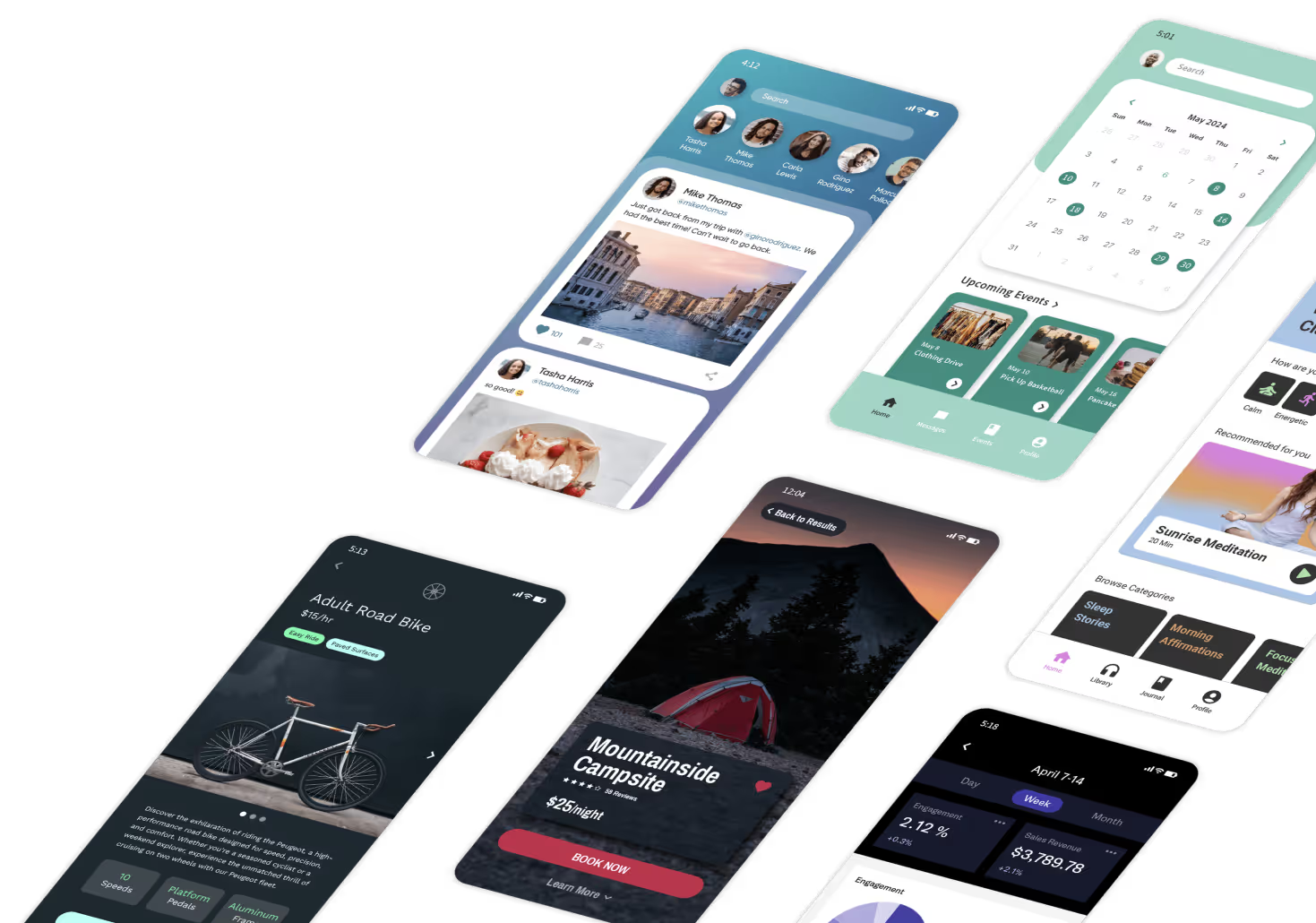
The no-code revolution has reached a critical inflection point. IDC forecasted that 500 million digital apps and services would be developed and deployed by 2026 (with low-/no-code playing a major role), and the low-code platform market is projected to grow from ~$29B in 2026 to ~$264B by 2032. With Adalo's AI-powered platform enabling anyone to build native iOS, Android, and web apps through visual and AI-assisted development, the barriers between ideas and functional apps have fallen—published studies commonly report 50–90% faster development and 20–60% lower costs (results vary by scope and methodology).
Key Takeaways
- Market projected from ~$29B (2026) → ~$264B (2032)—indicates long-run expansion of low/no-code, underpinning AI-enhanced builders
- By 2026, 70% of new apps will use low/no-code (Gartner forecast)—reflects mainstream adoption in IT roadmaps
- Adalo 3.0's infrastructure overhaul delivers 3-4x faster performance, unlimited database records on paid plans, and modular scaling to 1M+ MAU
What Is a No Code App Builder and Why It Matters in 2026
No-code AI platforms fundamentally transform application development by empowering users to build and launch artificial intelligence applications, agents, automations, and interfaces without writing a single line of code. These platforms provide visual development environments with drag-and-drop editors, pre-built components, ready-to-use templates, and conversational AI assistants designed to make app development effortless for non-technical users.
The revolution isn't theoretical—it's measurable and immediate. With 84% of enterprises using low-code or no-code technologies for digital asset development, the traditional coding bottleneck has shattered. Gartner previously noted that app development demand was growing at least 5x faster than IT capacity could handle, forcing organizations to embrace visual development or fall behind competitors.
Adalo is a no-code app builder for database-driven web apps and native iOS and Android apps—one version across all three platforms, published to the Apple App Store and Google Play. Following the Adalo 3.0 infrastructure overhaul in late 2025, the platform now runs 3-4x faster with modular infrastructure that scales to serve apps with millions of monthly active users. This approach addresses the capacity crisis by democratizing app creation across web, iOS, and Android platforms from a single visual interface.
While the no-code market includes specialized solutions—Bubble for complex web apps, Glide for spreadsheet-based tools, and Webflow for websites—Adalo distinguishes itself through true cross-platform native mobile app publishing without code, combined with no record limits on paid plans and no usage-based charges. The platform's strength lies in eliminating the technical barriers that typically require separate iOS developers (average salary $120,000+), Android specialists, and web developers, consolidating these roles into one accessible tool.
In 2026, as organizations face the developer shortage projected by Korn Ferry to reach 85+ million workers by 2030, Adalo represents a practical solution enabling marketing teams, product managers, and entrepreneurs to launch production-ready applications in weeks rather than months. The platform's visual database builder, native integrations with services like Stripe and Zapier, and automatic responsive design ensure that non-technical teams can create professional applications that scale alongside business growth—without the traditional dependency on scarce technical talent.
The Evolution of No-Code Development
The journey from complex coding to visual development represents more than technological advancement—it's democratization at scale. Most no-code AI tools work by walking users through a structured process:
- Database structuring using visual builders to define data relationships
- Interface design through drag-and-drop selection of pre-designed components
- Logic creation with workflow automations using visual flowcharts
- Automatic deployment managing servers, security, scaling, and hosting
This systematic approach eliminates the technical expertise barrier while maintaining professional capabilities. Adalo's platform exemplifies this evolution with its built-in relational database, unlimited screens and actions, and direct publishing to app stores—all without code. The visual builder has been described as "as easy as PowerPoint," while the AI features Builder promises vibe-coding creation speed for even faster development.
Key Components of Modern App Builders
Today's no-code platforms deliver enterprise-grade capabilities through:
- Visual WYSIWYG editors that show exact app appearance during development
- Built-in databases with relational structures and complex logic support
- API connections enabling integration with existing business systems
- Cross-platform deployment to iOS, Android, and web from single builds
- Component marketplaces providing extensive additional elements for specialized functionality
The impact extends beyond individual developers. With 75% of large enterprises expected to utilize at least four low-code tools by 2026, no-code has become essential infrastructure for digital transformation.
Adalo delivers all essential modern capabilities in one unified platform. Its visual WYSIWYG editor provides real-time previews across mobile, tablet, and desktop simultaneously—and can display up to 400 screens at once on a single canvas for rapid navigation. The built-in relational database handles complex data structures without SQL knowledge, with no storage caps on paid plans.
The platform supports API integration through native connections to Xano, Airtable, Zapier, and custom REST endpoints, enabling seamless integration with existing business systems. Adalo's cross-platform architecture publishes identical apps to web, iOS, and Android from a single project—eliminating the need for separate development teams. The Component Marketplace extends functionality with 50+ premium components for payments, mapping, and automation.
Best AI App Builder Features Transforming Mobile Development
AI integration represents the next frontier in no-code development, with platforms incorporating machine learning, natural language processing, and predictive analytics directly into visual builders. Industry analysts predict that by 2026, AI-powered apps will be able to predict user behavior, automate complex tasks, and offer suggestions before users realize they need them.
The transformation goes deeper than surface features. As Clara Shih, CEO of Salesforce AI, explains: "Right now, people talk about being an AI company... it'll be unthinkable not to have intelligence integrated into every product and service."
AI Integration Capabilities
Modern no-code platforms leverage AI through multiple channels:
- Natural language interfaces allowing conversational app building
- Automated workflow generation from text descriptions
- Smart component suggestions based on app purpose and industry
- Predictive analytics dashboards without data science expertise
- AI-powered chatbots deployable through visual configuration
Ada, Adalo's AI builder, lets you describe what you want and generates your app. Magic Start creates complete app foundations from a description, while Magic Add adds features through natural language.
Adalo's AI capabilities include Magic Start, which generates complete app foundations from a simple description. Tell it you need a booking app for a dog grooming business, and it creates your database structure, screens, and user flows automatically—what used to take days of planning happens in minutes. Magic Add extends this by adding features from natural language requests, while X-Ray identifies performance issues before they affect users.
Platforms like Adalo integrate with Zapier and Make to enable sophisticated automation workflows, connecting AI services without custom code. The native Zapier integration connects over 5,000 AI services—including OpenAI, ChatGPT, and sentiment analysis tools—directly into mobile apps without coding.
Automation vs Traditional Development
The efficiency gains from AI-powered no-code development are substantial:
- Traditional mobile app development: 4-6 months average timeline
- No-code with AI assistance: 2-4 weeks for functional applications
- Cost reduction: 20-50% typical savings on development costs depending on project complexity
- Maintenance efficiency: Up to 50-70% reduction in ongoing costs for standard applications
Sam Altman, CEO of OpenAI, emphasizes the urgency: "We see the wave coming. Now this time next year, every company has to implement it — not even have a strategy. Implement it."
Free App Builder Options: Comparing Adalo and Bubble
The democratization of app development begins with accessible entry points. Free tiers provide crucial testing grounds for ideas while establishing platform familiarity before financial commitment.
Adalo's free tier offers:
- Unlimited test apps for experimentation and learning
- 500 records per app
- Web publishing on an Adalo subdomain for immediate deployment
- Core component access (note: some marketplace components are paid/third-party)
- Community forum support with an active maker community
When to Upgrade from Free Tiers
The transition from free to paid becomes necessary when:
- Your app requires more records than the free tier provides—paid plans remove all data caps
- Custom domain requirements for professional presence
- Native app store publishing needs for iOS/Android distribution
- Team collaboration features for multiple builders
- Advanced integrations with Xano or enterprise systems
With 85% of no-code users planning to use no-code tools more in the next year, starting with free tiers provides risk-free exploration before scaling.
Bubble No Code vs Mobile-First Platforms: Making the Right Choice
The fundamental architecture difference between web-first and mobile-first platforms determines long-term success. While Bubble excels at complex web applications with sophisticated database structures, mobile-first platforms like Adalo prioritize native app experiences from inception.
Web-First vs Mobile-First Development
Web-First Characteristics (Bubble):
- Complex database relationships and backend logic
- Responsive web design adapting to mobile browsers
- Extensive plugin ecosystem for web functionality
- Workflow automation for business processes
- Mobile apps are wrappers for web apps, introducing potential performance challenges at scale
- Workload Units create usage-based charges with unclear calculations
- Record limits and re-publishing restrictions on lower tiers
Mobile-First Advantages (Adalo):
- Native iOS and Android components from start
- Touch-optimized interfaces and gestures
- Direct app store publishing capabilities
- Offline functionality and device feature access
- Responsive web apps as additional output
- No usage-based charges—unlimited usage on all plans
- Unlimited database records on paid plans
- One build automatically updates web, iOS, and Android apps
The distinction matters because mobile apps are becoming part of broader, interconnected ecosystems rather than existing in isolation, with AI powering seamless integration between different services and applications.
Platform Selection Criteria
Choose web-first platforms when:
- Building complex SaaS applications primarily for desktop
- Requiring extensive database operations with custom backend logic
- Focusing on desktop user experiences
- Budget allows for potential expert assistance with optimization
Select mobile-first builders for:
- Consumer-facing mobile applications
- Field service or workforce apps
- Location-based services
- Apps requiring device features (camera, GPS, notifications)
- Direct app store distribution requirements
- Predictable costs without usage-based billing surprises
Pricing comparison: Bubble's web and mobile wrapper offering starts at $59/month with usage-based charges, limits on app re-publishing, and record restrictions due to Workload Units. Adalo's web and true-native mobile builder starts at $36/month with unlimited usage and app store publishing with unlimited updates to apps once published.
Mobile App Development Tools for Professional Teams
Enterprise adoption requires collaboration capabilities beyond individual builder needs. Professional teams demand version control, multi-user editing, and governance features that maintain consistency while enabling rapid development.
Adalo's Team plan delivers collaboration features for multi-user development:
- 10 editor seats
- 5 published apps
- Faster support response (see plan details)
- Integrations including Xano backend connectivity
- Unlimited database records with no data caps
- No usage-based charges—predictable monthly costs
Enterprise Features
Professional platforms differentiate through:
Governance Controls:
- Role-based access permissions
- Approval workflows for publishing
- Audit trails for compliance
- Component standardization libraries
Scalability Infrastructure:
- Load balancing for traffic spikes
- CDN distribution for global performance
- Database optimization for large datasets
- 99% average uptime as reported on performance pages
- Modular infrastructure scaling to 1M+ MAU with no upper ceiling
Integration Capabilities:
- REST API connections to legacy systems
- Custom domain management
- Publish fully branded client apps
Team Collaboration Tools
Effective team development requires:
- Real-time collaboration preventing version conflicts
- Component libraries ensuring design consistency
- Shared workspaces for project organization
- Comment systems for asynchronous feedback
- Testing environments separate from production
With 80% of people using low-code outside IT departments by 2026, these collaboration features become essential for managing citizen developer initiatives.
Leveraging Adalo for Enterprise Teams
Enterprises and teams can leverage Adalo's Team and Business plans to accelerate digital transformation while maintaining governance and control. The platform's 10+ editor seats enable cross-functional collaboration between marketing, operations, and product teams without IT bottlenecks.
Adalo's 99% uptime, Xano backend integration, and Collections API support enterprise-scale applications with custom domain publishing for client-facing deployments. With the right data relationship setups, Adalo apps can scale beyond 1 million monthly active users. Role-based access controls and manual publishing workflows ensure compliance standards, while the visual development environment reduces dependency on scarce technical talent.
Organizations deploy internal tools, customer portals, and mobile applications in weeks—managing multiple projects from unified workspaces with consistent component libraries and automated responsive design across all platforms.
Best No Code App Builder for iOS and Android Publishing
Native app store presence remains crucial for reach and credibility; global downloads were ~257B in 2026.
Adalo excels at native publishing with:
- Direct App Store submission with guided workflows
- Google Play publishing including store listing optimization
- Content/config updates can go live instantly; binary app updates follow store review and rollout
- Native components ensuring platform-specific experiences
- Cross-platform consistency from single codebase—one update deploys to web, iOS, and Android
- Unlimited app updates once published, with no re-publishing restrictions
Publishing Requirements
App store publishing involves specific costs and requirements:
Apple App Store
- $99/year developer program fee
- Review timing varies; many reviews complete within a few days, but there's no guarantee
- TestFlight beta testing supported
Google Play Store
- $25 one-time developer registration fee
- Reviews can take hours to days; new apps may take up to ~7 days or more
- Staged rollouts supported
App Store Optimization
Successful publishing requires optimization beyond technical deployment:
- Keyword research for app store search visibility
- Screenshot optimization showcasing key features
- Description crafting balancing features and benefits
- Review management responding to user feedback
- Update cadence maintaining user engagement
The component marketplace provides specialized elements for app store features like in-app purchases through IAPHUB integration, ensuring monetization capabilities match native development.
Mobile App Development Software: Component Marketplaces and Integrations
The extensibility of no-code platforms through components and integrations determines their practical ceiling. Professional applications require specialized functionality beyond basic building blocks.
Adalo's marketplace exemplifies comprehensive extensibility:
- Extensive premium components verified for quality
- Payment processing via Stripe integration
- Mapping services with Google Maps components
- CRM connectivity via Zapier → HubSpot (or direct APIs)
- Email automation through Gmail/SMTP and automation platforms
Essential Components
Core components every platform should provide:
Data Management:
- Form builders with validation
- List displays with filtering/sorting
- Calendar and scheduling interfaces
- Chart and visualization tools
User Experience:
- Navigation menus and tab bars
- Modal dialogs and popups
- Image carousels and galleries
- Video players and media handlers
Business Logic:
- Conditional visibility rules
- Mathematical calculations
- Timer and countdown functions
- Barcode/QR code scanners
Third-Party Integrations
Modern apps require ecosystem connectivity:
- Backend services like Xano for scalable databases
- Automation platforms including Zapier and Make
- Analytics tools for user behavior tracking
- Communication services for SMS and push notifications
- Payment gateways supporting global transactions
Adalo's SheetBridge feature enables users to turn a Google Sheet into an actual database for the easiest control without database-related learning—ideal for teams already comfortable with spreadsheets who want to build more sophisticated apps.
In the EU, Apple enabled alternative app marketplaces in 2026 to comply with the Digital Markets Act, creating new distribution options alongside fresh security considerations.
Mobile App Development Frameworks vs No-Code Platforms
The traditional divide between coded frameworks and visual builders continues to blur as platforms mature. Understanding when each approach makes sense prevents costly mistakes and project delays.
Traditional vs No-Code Development
Traditional Framework Advantages:
- Complete control over code and architecture
- Unlimited customization possibilities
- No vendor lock-in concerns
- Access to latest platform features immediately
No-Code Platform Benefits:
- 50–90% faster development cycles reported in published studies (varies by complexity)
- 20–60% cost savings on development/maintenance depending on scope and methodology
- Lower ongoing maintenance vs bespoke codebases
- Automatic platform updates and security patches
Paul Daugherty from Accenture warns: "The playing field is poised to become a lot more competitive, and businesses that don't deploy AI and data to help them innovate in everything they do will be at a disadvantage."
Cost-Benefit Analysis
Financial comparison reveals clear patterns:
Traditional Development Costs:
- Developer salaries: $100,000-150,000 annually
- Development time: 4-6 months average
- Maintenance: 20% of initial cost yearly
- Updates: Ongoing developer requirements
No-Code Investment:
- Platform subscription: $36-250 monthly (Adalo pricing)
- Development time: 2-4 weeks typical
- Maintenance: Included in subscription
- Updates: Automatic platform improvements
- No usage-based charges or bill shock
The math becomes compelling when considering that companies can reduce development time by up to 90% with low-code platforms.
Comparing Low-Code Alternatives
Understanding the landscape helps teams make informed decisions:
FlutterFlow is "low-code" rather than "no-code" and targets technical users. Users must manage and set up their own separate database, requiring significant learning complexity—especially when optimizing for scale, as suboptimal setup creates scalability problems. This ecosystem is rich with experts because many users need help and end up spending significant sums chasing scalability. Their builder is limited in view (slow to see more than 2 screens at once), whereas Adalo can display up to 400 screens at a time on one canvas. FlutterFlow pricing starts at $70/month per user for easy app store publishing, but still doesn't include a database.
Glide is heavily format-focused and restricted to set templates. This makes it fast to build and publish with, but creates generic, simplistic apps with limited creative freedom. Glide excels at spreadsheet-based apps, but Adalo's SheetBridge offers similar convenience while enabling more sophisticated applications. Glide pricing starts at $60/month for custom domain capability, but remains limited by app updates and data record rows with additional charges. Glide does not support Apple App Store or Google Play Store publishing.
Softr pricing starts from $167/month to publish a Progressive Web App, still restricted by records per app and records per datasource. Softr does not support Apple App Store and Google Play Store publishing or native iOS and Android app creation.
Thunkable offers an AI-draft of an app build, but getting access to a publishable Progressive Web App requires a $59/month plan with usage restrictions. Responsive app capabilities require custom pricing beyond their advertised $189/month Advanced tier.
Mobile App Development Course Alternative: Learning Through Building
Traditional education struggles to match the pace of technological change. No-code platforms offer immediate, practical learning that produces functional applications rather than theoretical knowledge.
Self-Paced Learning
Adalo App Academy provides structured learning paths:
- Progressive tutorials from basics to advanced features
- Project-based curriculum building real applications
- Video demonstrations showing exact processes
- Community challenges for skill development
- Expert templates revealing best practices
This approach aligns with findings that approximately 70% of users develop apps with low-code applications in 3 months or less—faster than completing traditional courses.
Community Resources
Learning accelerates through community engagement:
- Forum discussions solving specific challenges
- Template sharing providing starting points
- Component examples demonstrating possibilities
- Success stories inspiring new builders
- Expert office hours for direct guidance
The Adalo community shares examples and techniques, and Adalo publicly reports platform-level performance such as ~20M daily data requests. Over 3 million apps have been created on the platform, demonstrating the scale of the builder community.
Why Adalo Leads the AI-Powered No-Code Revolution
While numerous platforms compete for attention, Adalo's comprehensive platform uniquely combines accessibility, power, and scalability. The platform processes 20 million daily data requests while maintaining 99% average uptime—enterprise reliability with startup agility.
Following the Adalo 3.0 infrastructure overhaul in late 2025, the platform differentiates through:
- True visual development where what you see is exactly what users get
- Native app publishing directly to iOS and Android stores
- Built-in database with relational structures, complex logic, and no record limits on paid plans
- Component marketplace with extensive verified elements
- Scalable pricing from free to unlimited enterprise editors
- 3-4x faster performance with modular infrastructure scaling to 1M+ MAU
- No usage-based charges—predictable costs without bill shock
The platform's cloneable templates accelerate development further, providing complete app structures for industries from fitness to real estate, each customizable without code.
Note: Most third-party platform ratings and comparisons predate the Adalo 3.0 infrastructure overhaul. The performance improvements, unlimited database storage, and removal of usage-based charges represent significant changes not reflected in older reviews.
For organizations serious about AI-assisted development, Starter $36/mo, Professional $36/mo, Team $250/mo, and Business $250/mo tiers scale from prototypes to production, with annual discounts available.
FAQ
Why choose Adalo over other app building solutions?
Adalo is an AI-powered app builder that creates true native iOS and Android apps. Unlike web wrappers, it compiles to native code and publishes directly to both the Apple App Store and Google Play Store from a single codebase—the hardest part of launching an app handled automatically. Following the Adalo 3.0 infrastructure overhaul, the platform runs 3-4x faster with unlimited database records on paid plans and no usage-based charges.
What's the fastest way to build and publish an app to the App Store?
Adalo's drag-and-drop interface combined with AI-assisted building through Magic Start and Magic Add enables you to go from idea to published app in days rather than months. The platform handles the complex App Store submission process, so you can focus on your app's features and user experience instead of wrestling with certificates, provisioning profiles, and store guidelines.
Which is more affordable, Adalo or Bubble?
Adalo starts at $36/month with unlimited usage, unlimited database records on paid plans, and unlimited app updates once published. Bubble starts at $59/month with usage-based Workload Unit charges, record limits, and re-publishing restrictions. Adalo's predictable pricing eliminates bill shock from unexpected usage charges.
Which is faster to build with, Adalo or Bubble?
Adalo's visual builder has been described as "as easy as PowerPoint" and can display up to 400 screens at once on a single canvas for rapid navigation. Magic Start generates complete app foundations from descriptions, and Magic Add adds features from natural language requests—accelerating development significantly compared to traditional visual builders.
Is Adalo better than Bubble for mobile apps?
Yes, for native mobile apps. Adalo creates true native iOS and Android apps from a single codebase, while Bubble's mobile solution wraps web apps—introducing potential performance challenges at scale. One Adalo build automatically updates web, iOS, and Android apps, whereas Bubble requires separate management for each platform.
How much does it cost to develop an app with no-code compared to traditional development?
No-code development offers significant cost savings, with studies reporting 20-60% lower costs compared to traditional development. While hiring developers can cost $100,000-150,000 annually, Adalo's pricing ranges from free for testing to $250/month for business plans, making professional app development accessible to entrepreneurs and teams of all sizes.
Can I integrate AI features and third-party services into my Adalo app?
Yes, Adalo supports extensive AI integration and third-party connectivity through native Zapier integration, connecting over 5,000 services including OpenAI and ChatGPT. You can also integrate with backend services like Xano, payment processing via Stripe, and automation platforms like Make—all without writing code.
Is Adalo suitable for enterprise teams and collaboration?
Absolutely. Adalo's Team and Business plans offer enterprise-grade features including 10+ editor seats, role-based access controls, manual publishing workflows for compliance, and Xano backend integration. The platform processes 20 million daily data requests with 99% average uptime, with modular infrastructure scaling to 1M+ MAU.
Can I migrate from Bubble to Adalo?
While there's no automated migration tool, teams can rebuild applications in Adalo using its visual builder and AI-assisted features like Magic Start. Many teams find the transition worthwhile for native mobile app capabilities, predictable pricing without usage-based charges, and unlimited database records on paid plans.
What's the difference between Adalo and FlutterFlow?
FlutterFlow is "low-code" targeting technical users who must set up and manage their own separate database—requiring significant learning complexity and often expert assistance for scalability. Adalo is "no-code" with a built-in database, unlimited records on paid plans, and a visual builder that displays up to 400 screens at once. FlutterFlow starts at $70/month per user without including a database.