Why Adalo Is the Best No-Code Platform for Building Web Apps
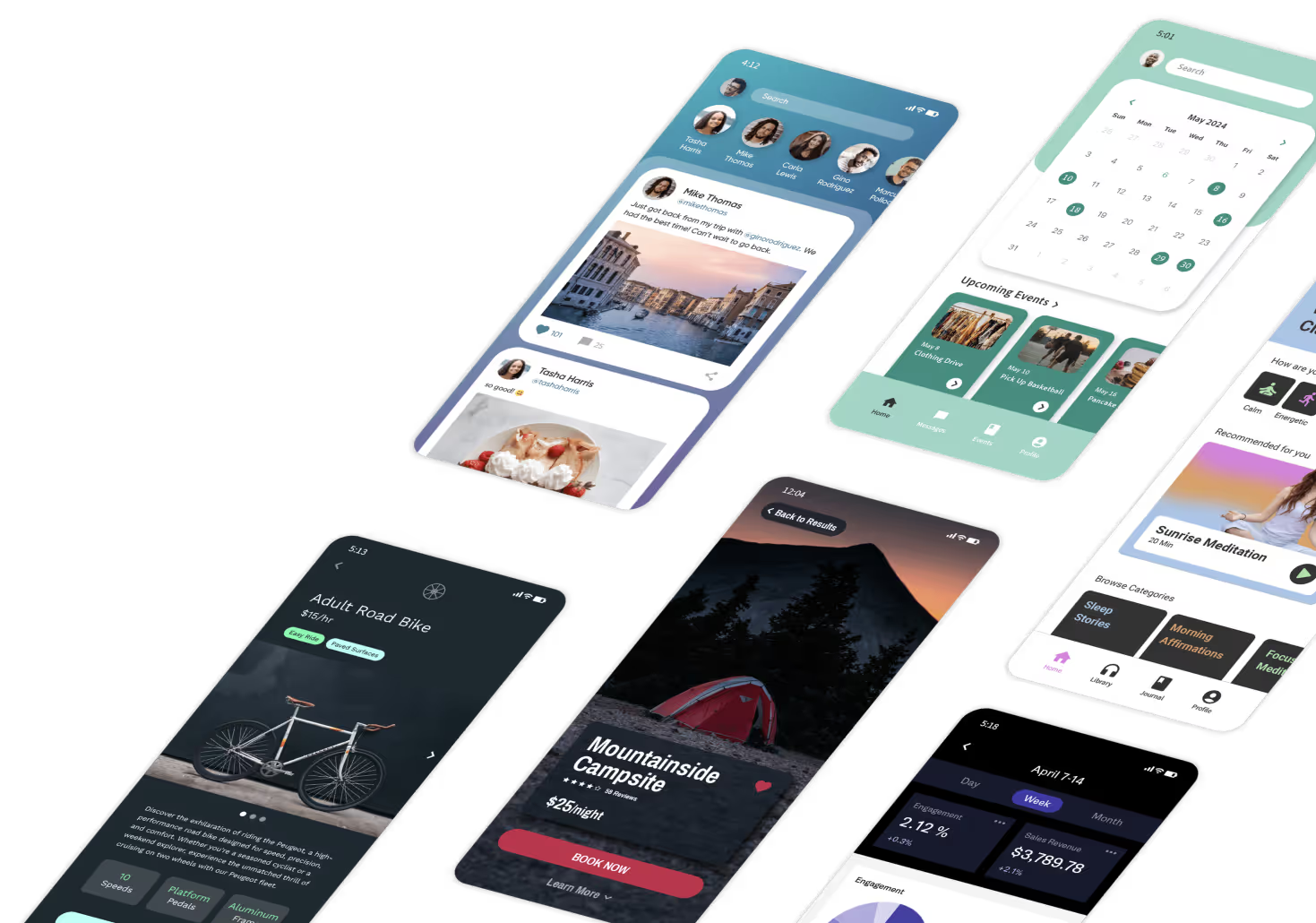
Creating your first web app shouldn't require months of coding bootcamps or expensive developer fees. Adalo is a no-code app builder for database-driven web apps and native iOS and Android apps—one version across all three platforms, published to the Apple App Store and Google Play. This makes it the perfect choice for entrepreneurs, small business owners, and creators who want to bring their web app ideas to life quickly and affordably.
What sets Adalo apart is its flexibility to grow with your project. Start with a web app today, and when you're ready to reach mobile users, you won't need to rebuild from scratch. Your app can be published to both the Apple App Store and Google Play, giving you access to billions of potential users. Plus, with native push notifications, you can keep your audience engaged and drive them back to your app—something that's essential for long-term success.
Why Adalo Is Perfect for Building Your First Web App
When you're ready to build a web app, you want a platform that's both beginner-friendly and powerful enough to grow with your vision. Adalo is an AI-powered app builder for database-driven web apps and native iOS and Android apps—one version across all three platforms, published to the Apple App Store and Google Play. This means you can start with a simple web app and expand to mobile whenever you're ready, without rebuilding anything from scratch.
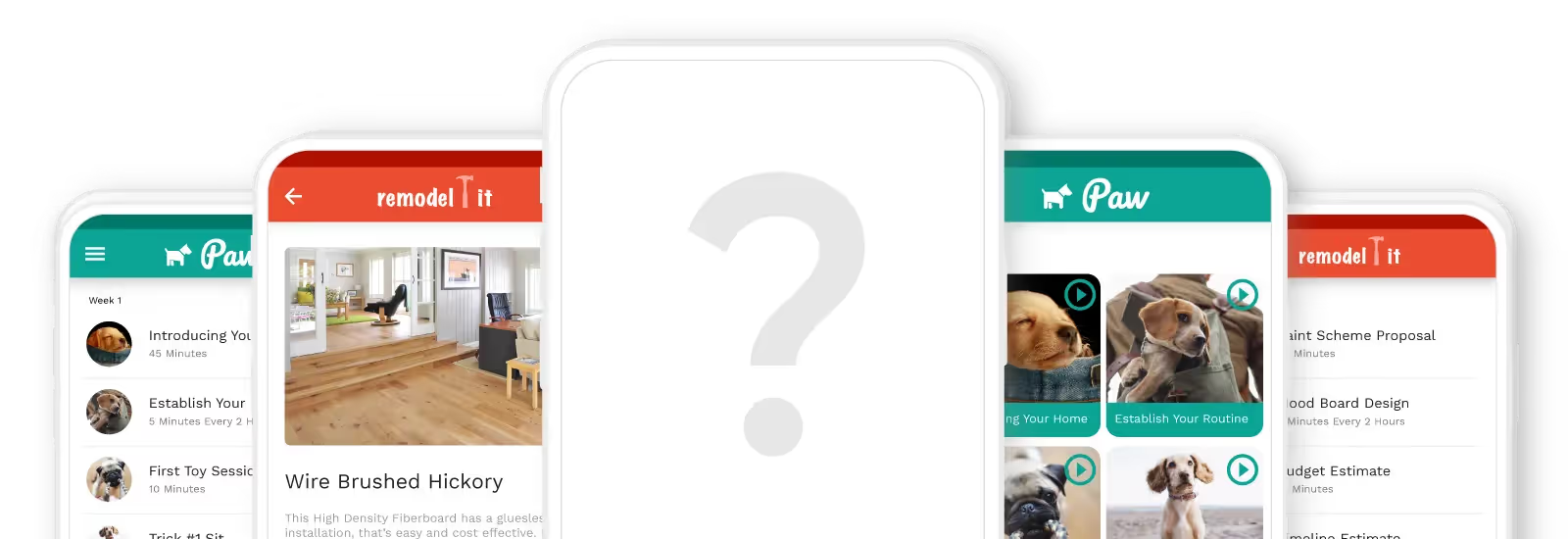
Having the ability to publish across multiple platforms gives your app maximum reach from day one. Whether your users prefer browsing on desktop or downloading from their favorite app store, you're covered. Plus, with native mobile capabilities, you can leverage push notifications to keep users engaged and coming back to your app. Let's walk through exactly how to build your web app in eight straightforward steps.
Getting Started with AI-Powered App Development
Today, you don't need any coding or technical expertise to create a web app. Building a web app is nearly the same as building a PowerPoint presentation, as both platforms feature intuitive drag-and-drop interfaces. Point and click on functionalities in a building interface, and they'll appear on your building canvas. Adjust their size using your free-form cursor or your building dashboard. You can also add your own custom images by dragging them over to your building canvas.
Today, there are dozens of web app builders, but Adalo stands above the rest. Adalo is one of the most easy-to-use yet powerful web app builders on the market. It's so simple that you can start building your app immediately after signing up—over 3 million apps have been created on the platform, with users describing the visual builder as "easy as PowerPoint."
However, Adalo doesn't sacrifice power for ease of use. When you sign up, you'll get several supercharged functionalities:
- Over 35 preloaded templates to choose from. They've got everything you need, including screens and a database, to start your building right. You'll be able to customize everything to your exact needs and tastes.
- Powerful integrations to popular third-party applications like Stripe, QuickBooks, and Zapier, just to name a few. These integrations let you gather data to add more power to your app.
- A thriving ecosystem that's been growing since Adalo launched in 2018. You'll find tutorials, developer-made plugins to give your app some juice, help documentation, and a forum for connecting with other Adalo users.
- The ability to publish to the Apple App Store and Google Play Store. In addition to releasing your app to the web, Adalo allows you to publish your app to both app stores from a single codebase.
You won't have to worry about making major adjustments to your app: Adalo's software allows you to publish nearly the same version of your app on the web and in the app stores. One of the best parts about signing up is that Adalo offers an extremely generous free version. This version allows you to build your web app and publish it to the web for immediate access.
AI Features That Accelerate Your Build
Ada, Adalo's AI builder, lets you describe what you want and generates your app. Magic Start creates complete app foundations from a description, while Magic Add adds features through natural language.
Adalo's AI capabilities make building even faster. Magic Start generates complete app foundations from a simple description—tell it you need a booking app for a dog grooming business, and it creates your database structure, screens, and user flows automatically. What used to take days of planning happens in minutes.
Magic Add lets you add features by describing what you want in natural language. Need a user profile section with photo uploads? Just describe it, and the feature appears. X-Ray identifies performance issues before they affect users, highlighting potential bottlenecks so you can address them proactively.
An AI Builder for prompt-based app creation and editing is due for release in early 2026, promising even faster vibe-coding creation speed for those who prefer to build through conversation rather than clicking.
Web Apps 101: Essentials You Should Know
Let's go over some web app basics before we jump into building. First, there are two kinds of web apps:
- Web Apps: These are interactive websites you can access with any browser. Examples include Facebook, online banking, and Zillow. You'll often be required to sign in, but at other times, you can still access features without having an account.
- Progressive Web Apps (PWAs): You'll need a link or a QR code to access these apps, which can be downloaded directly to your phone. PWAs that you download to your phone can be quite powerful, as they might be able to harness your phone's processors, hardware, and components like your camera and GPS.
However, PWAs cannot be easily published in the Apple App Store or Google Play Store, so they aren't to be confused with native mobile apps. This distinction matters because distribution through app stores is often the hardest part of launching a new app—having your app where users already search gives you a major competitive advantage.
For the sake of simplicity, I'll refer to both web apps and PWAs as web apps or just "apps."
The Anatomy of an App
All apps, both web apps and native mobile apps, have three main parts:
- The Frontend: This is the part of your app that people will read, tap on, and interact with; it's also called the user interface (UI). Your UI comprises all your screens, pictures, buttons, forms—anything users see.
- The Backend: Think of the backend as your app's command center, executing tasks and ensuring your app runs like a well-oiled machine. The backend fetches info that users request, allows users to log in, connects with third-party apps, and adds data to the database.
- The Database: The database is your app's storage center and takes the form of a spreadsheet. All your app's information will be stored here. Examples of info stored in a database include user profile data, the goods sold in your e-commerce store, and more.
Conveniently, Adalo provides you with each of these three components before you start building your app, so you won't have to build them from scratch. This saves you time while helping you learn by intuition. For instance, you'll already have a pre-made database to see how all the data is organized. All you need to do is add your own data.
With Adalo 3.0's infrastructure overhaul (launched in late 2025), the platform is now 3-4x faster than before, with modular infrastructure that scales to serve apps with millions of monthly active users. Paid plans include no record limits on the database—your app can grow without hitting arbitrary storage ceilings.
Creating Your Web App: A Step-by-Step Process
Step 1: Choose a Starting Template
Adalo has over 35 pre-made templates, which have everything you need to start building your app. No matter what type of app you want to build, there's a template to get you started. Here are just a few choices:
- A Notion-inspired template for your written content.
- 3 different styles of e-commerce templates for your online store.
- An ordering template for your restaurant, cafe, or food truck.
- An appointment template for your hair or beauty salon.
- A real estate app for your rentals or properties you wish to sell.
While all the templates include everything you need, you can also add new screens if you want. Alternatively, use Magic Start to generate a custom foundation—describe your app idea, and the AI creates a tailored starting point with the right database structure, screens, and user flows for your specific use case.
Step 2: Customize Your Data Model
Now that you've selected your template, let's build your database. Accessing this is simple in Adalo: On the left-hand drop-down editor of your building interface, hover your mouse over the icon that looks like a spreadsheet. The word "Database" will appear. Click on this.
You'll see all your template's database collections, which are individual parts of your database. Structured like spreadsheets, database collections contain all your app's info. When you click on a collection, you'll see all the database properties or individual pieces of information in that collection.
Adding new collections and properties is a breeze. If you want to keep pre-existing collections but prefer to add your own properties, just scroll to "Add Properties" and enter the info you want. You can add collections by scrolling to the "Add Collections" button.
For those who prefer working with spreadsheets, Adalo's SheetBridge feature lets you turn a Google Sheet into an actual database—the easiest control without database-related learning curves. This is particularly useful if you already have data organized in spreadsheets and want to power your app with it directly.
Step 3: Personalize Your Design
It's time to customize your front end to meet your brand and preferences. At the very top of the left-hand drop-down dashboard, you'll see a "+" inside a colorful circle. Click on this to add new buttons, shapes, and images to your app.
You'll also be able to drag images and other elements to your desired screen directly from your desktop. After you've added an image or logo to your screen, you'll be able to customize the size, color, transparency, and more by simply clicking on it.
To change a screen's color scheme and fonts, find the button that appears like an artist's palette near the top of the left-hand drop-down dashboard. When you hover your mouse over it, the word "Branding" will appear. Click on this to tailor your app's visual elements, colors, logos, and layout to reflect your brand.
Adalo's canvas can display up to 400 screens at once if needed, giving you a bird's-eye view of your entire app architecture. This makes it easy to maintain design consistency across complex apps with many screens and user flows.
Step 4: Add Functional Pages
If you need to add more pages to your app, press that colorful button at the very top of the left-hand drop-down dashboard. You'll immediately see several different types of screens that you can tack onto your app.
Alternatively, you can add new screens by pressing the "Screens" button on the left-hand drop-down dashboard. You can also use Magic Add to add features by describing what you want—need a checkout flow with order confirmation? Just describe it in natural language.
You'll also be able to drag over forms, which are elements that users will fill out and submit when they order food, place a booking at your spa, sign up to your social network, and more. Click on each screen on your building canvas (center of the app-building interface) and customize each functional page, form, and element to your liking.
Step 5: Set Up User Navigation
Adalo's building canvas intuitively displays how each screen and element connects with other parts of your app by showing arrows that connect a button or element to the screen it opens.
Your preloaded template comes with pre-packed connectivity. For instance, a "sign up button" will open a screen containing a form that lets users fill in the info needed to join your social network on Adalo's social network template.
Creating your own navigation between elements and screens is simple. Just click on the element you want, like a form or button. Then, on the left-hand drop-down dashboard, scroll to "Click Actions" and select "Add Another Action," then click "Link." Connect the element to the screen you wish.
Step 6: Test Your Application
After you've put the finishing touches on your web app, it's time to test it. Adalo makes testing your web app simple: At the top right-hand side of your building interface, click the green button titled "View App."
You can view your app as if it were live by picking the "Staging Preview" button. Click through each screen and try every feature to ensure your app works. Use X-Ray to identify any performance issues before they affect real users—it highlights potential bottlenecks so you can address them proactively.
It's also a good idea to get other eyes on your app. Adalo lets you share your app before publishing it to the web—just select the "Share Your App" option after clicking the "Staging Preview" button. You can also send a link via SMS to friends, family, and clients.
Adalo will provide you with a QR code that links to your app. You can share it on your social media or send it to people via DM. Always get feedback from the people who've tested your app. Make sure you take their advice into account. Remember, the better your app's user experience, the more users you'll get.
Step 7: Implement Payment Processing
If you want to take payments, you'll love Adalo's integration with Stripe, a commonly used payment platform. Generously, Adalo also lets you integrate with Stripe even when you build your web app with its free version.
To integrate Stripe with your app, create a Stripe account. Then, return to Adalo, press the "Add Components" button, and find the Stripe form. Click on it, enter all your info, drag it to your payment screen, and get paid!
Step 8: Launch Your App
Now that you've incorporated all your user feedback and tied up all the loose ends, it's time to publish your web app. You'll be able to publish your app as both a web app and a PWA without making any changes. Here's how:
- Publishing a PWA: Click the "Publishing" button on your editing dashboard, then choose "Progressive Web App." After following the directions, you'll receive a link to your PWA. Share this to your social media accounts, and paste a link on your website so users can download your PWA with ease.
- Publishing a web app: In the top right corner of your app, push your profile button and then click on "Settings." Scroll down to "Domain," and enter your custom web address here. Then, return to your editing dashboard, click the "Publish" button, and your app is now live.
When you're ready to expand to mobile, Adalo handles the complex App Store submission process. One build publishes to web, iOS App Store, and Android Play Store—with unlimited updates to your apps once published. No wrestling with certificates, provisioning profiles, or store guidelines.
How Adalo Compares to Other Platforms
When choosing a platform for your first web app, understanding the alternatives helps you make an informed decision. Here's how Adalo stacks up:
| Platform | Starting Price | Native Mobile Apps | Database Limits | Best For |
|---|---|---|---|---|
| Adalo | $36/month | Yes (iOS & Android) | Unlimited on paid plans | Web + native mobile from one codebase |
| Bubble | $59/month | Web wrapper only | Limited by Workload Units | Complex web apps with heavy customization |
| Glide | $60/month | No | Limited rows + charges | Simple spreadsheet-based apps |
| FlutterFlow | $70/month per user | Yes (requires separate DB) | Depends on external DB | Technical users comfortable with code |
| Softr | $167/month | No | Limited per app | Spreadsheet-powered web apps |
Bubble offers more customization options, but that flexibility often results in slower applications that suffer under increased load. Many Bubble users end up hiring experts to optimize performance—claims of millions of MAU are typically only achievable with professional help. Bubble's mobile solution is also a wrapper for the web app, introducing potential challenges at scale, and one app version doesn't automatically update web, Android, and iOS deployments.
Glide is heavily format-focused and restricted to set templates. This makes it fast to build and publish with, but creates generic, simplistic apps with limited creative freedom. Glide doesn't support Apple App Store or Google Play Store publishing.
FlutterFlow is "low-code" rather than no-code—it's designed for technical users. FlutterFlow users also need to manage and set up their own unrelated database, which requires significant learning complexity. Their builder is limited in view (slow speed to see more than 2 screens at once), and the pricing still doesn't include a database.
Note that most third-party platform ratings and comparisons predate Adalo 3.0's infrastructure overhaul in late 2025, which made the platform 3-4x faster with modular scaling architecture.
Effective Launch Strategies and Maintenance
Once you've launched your web app, you'll need to get more users by promoting it. Not sure where to start? Don't worry—here's how to launch an effective promotional strategy. Following our guide takes consistent time and effort, but it should pay off in the long run.
You'll also need to run daily analytics checks. Doing this will show you how many people are using your apps, which screens are the most popular, your app's load time, and other critical details.
Importantly, you'll need to ensure that your app always runs at optimal speeds and never crashes. Users will quickly abandon a poorly performing app. Prevent this from happening by routinely updating your app for maintenance and having a handful of users test each iteration before launching updates.
With Adalo's modular infrastructure, your app can scale to serve 1 million+ monthly active users without hitting performance ceilings. The platform processes over 20 million data requests daily with 99%+ uptime. All paid plans now include unlimited usage—no App Actions charges, no bill shock as your app grows.
Building your very own web app with Adalo can not only help your business thrive, but it can also be a fun and rewarding experience. Enjoy your building experience!
FAQ
Why choose Adalo over other app building solutions?
Adalo is an AI-powered app builder that creates true native iOS and Android apps alongside web apps. Unlike web wrappers, it compiles to native code and publishes directly to both the Apple App Store and Google Play Store from a single codebase. Starting at $36/month with unlimited database records and no usage-based charges, it's the most cost-effective path to multi-platform publishing.
What's the fastest way to build and publish an app to the App Store?
Adalo's drag-and-drop interface combined with AI-assisted building through Magic Start and Magic Add lets you go from idea to published app in days rather than months. Adalo handles the complex App Store submission process—certificates, provisioning profiles, and store guidelines—so you can focus on your app's features and user experience.
Can I easily build a web app without coding experience?
Yes, with Adalo's visual builder, you can build a web app without any coding or technical expertise. The platform features an intuitive drag-and-drop interface that users describe as "easy as PowerPoint," allowing you to point and click on functionalities and customize everything to your exact needs.
Which is more affordable, Adalo or Bubble?
Adalo starts at $36/month with unlimited usage and unlimited database records on paid plans. Bubble starts at $59/month with usage-based Workload Unit charges and record limits. Adalo also includes native mobile app publishing, while Bubble's mobile solution is a web wrapper.
Which is easier for beginners, Adalo or FlutterFlow?
Adalo is significantly easier for beginners. FlutterFlow is "low-code" designed for technical users who are comfortable managing separate databases. Adalo includes an integrated database, AI-assisted building, and can display up to 400 screens at once for easy navigation—FlutterFlow's builder is limited to viewing 2 screens at a time.
Is Adalo better than Glide for mobile apps?
Yes, if you need App Store publishing. Glide doesn't support Apple App Store or Google Play Store publishing—it's limited to web apps. Adalo creates true native iOS and Android apps from the same codebase as your web app, with unlimited updates once published.
What templates are available for building my first web app?
Adalo offers over 35 pre-made templates covering various app types including e-commerce stores, restaurant ordering systems, appointment booking for salons, real estate listings, and Notion-inspired content apps. Each template includes screens, a database, and essential features that you can fully customize. You can also use Magic Start to generate a custom foundation from a description.
Can I accept payments in my web app?
Yes, Adalo integrates seamlessly with Stripe, allowing you to accept payments directly within your app. This integration is available even on Adalo's free version, making it easy to monetize your app from day one.
How do I test my app before launching it?
Adalo makes testing simple with a "Staging Preview" feature that lets you view and interact with your app as if it were live. X-Ray identifies performance issues before they affect users. You can also share your app before publishing via a QR code or SMS link to get feedback from testers.
Can I migrate from Bubble to Adalo?
While there's no automatic migration tool, Adalo's Magic Start can generate a new app foundation from a description of your existing Bubble app. You can export your Bubble data and import it into Adalo's database. Many users find the rebuild process faster than expected given Adalo's AI-assisted building features.