
AI is transforming how apps are built, making development faster, easier, and more accessible. By 2026, 75% of new enterprise apps will be created using no-code or low-code platforms, driven by AI-powered tools. These platforms let anyone describe an app idea in plain language, and the AI generates databases, workflows, and user interfaces in minutes. Development timelines have been cut from months to weeks - or even days.
Platforms like Adalo, a no-code app builder for database-driven web apps and native iOS and Android apps—one version across all three platforms, published to the Apple App Store and Google Play, are leading this transformation. These tools empower entrepreneurs and businesses to turn app ideas into reality without writing a single line of code.
Key highlights:
- AI simplifies app creation: Learn how to create an app using AI by describing your idea - no coding needed.
- Faster timelines: Tasks that took months now take weeks or even minutes.
- Cost-effective: These tools reduce costs by up to 60% compared to traditional methods.
- Scalable solutions: Platforms like Adalo support millions of users and handle enterprise-grade performance.
With AI handling repetitive tasks, teams can focus on refining and scaling their apps. This shift is reshaping app creation for businesses and non-technical users alike.
Build your first app with AI. No coding background required
How App Building Has Changed: From Manual Builders to AI
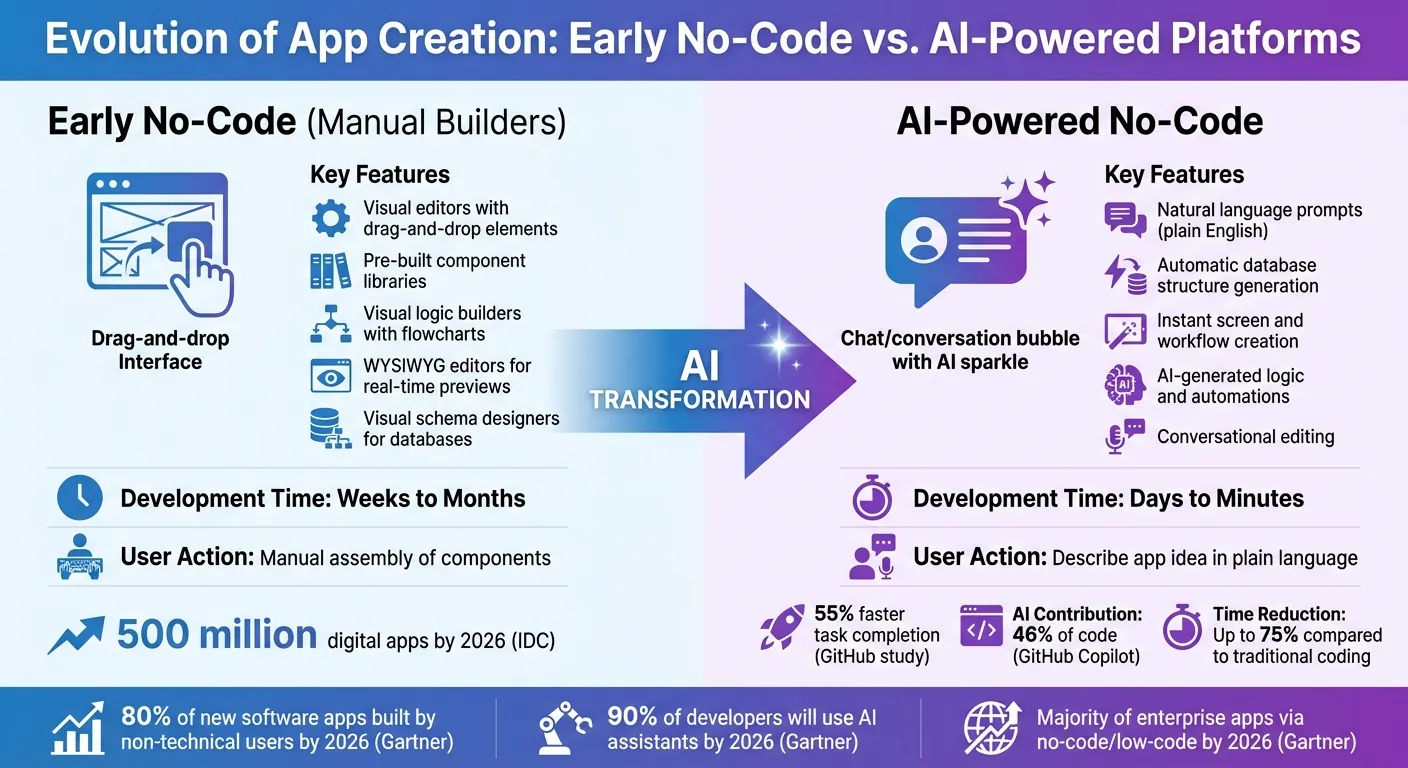
Evolution of App Development: Manual Builders vs AI-Powered Platforms
Early Days: Visual Editors and Pre-Built Components
The first wave of app building platforms made development more accessible by replacing complex coding with visual tools. Instead of writing lines of code, users could drag and drop elements—buttons, text boxes, images—onto a digital canvas. These platforms came with libraries of pre-made components like forms, navigation bars, and lists that acted as building blocks.
Workflows were simplified with visual logic builders, allowing users to design processes without traditional if-then statements. By connecting nodes and creating flowcharts, even complex behaviors could be defined visually. WYSIWYG editors enhanced this experience by offering real-time previews across devices. Visual schema designers made it easy to set up database relationships without writing SQL queries.
This approach sped up development timelines dramatically. IDC predicted that 500 million digital apps and services would be built by 2026, with visual app development playing a significant role. These early advancements laid the groundwork for AI to take app creation to the next level.
Moving to AI-Powered App Creation
The evolution from manual visual tools to AI-powered platforms has been transformative. While early builders required assembling components manually, AI now allows users to describe their app ideas in plain language and generates fully functional foundations. Natural language processing enables AI to create database structures, screens, and user flows instantly, eliminating many time-consuming steps.
The productivity boost has been remarkable. According to a GitHub study, developers using AI-assisted coding tools completed tasks 55% faster. AI can now handle nearly half of coding tasks, allowing development timelines to shrink from months to just days or weeks. By automating repetitive groundwork, AI frees teams to focus on fine-tuning and innovation.
"We see the wave coming. Now this time next year, every company has to implement it—not even have a strategy. Implement it." - Sam Altman, CEO, OpenAI
What AI Brings to App Building
AI is speeding up app development and reshaping how apps are imagined and refined over time. The shift from manual configuration to conversational building represents a fundamental change in how software gets created.
Building Apps with Natural Language Prompts
Imagine describing your app idea in plain English and having it built for you. Instead of manually piecing together screens and databases, you can type something like "Create a table that tracks monthly sales by region," and the platform generates the database structure, screens, and connections automatically. This approach moves app creation from a visual, hands-on process to a simple, language-based interaction. What used to take weeks can now be done in minutes.
This capability relies on natural language processing, which interprets your descriptions and turns them into functional app components. Gartner predicts that over 80% of new software applications will be built by non-technical users using visual development tools by 2026. A request like "Build an app for inventory management with user login and stock alerts" can instantly produce user interface screens, a database schema, and basic workflows—all without manual setup.
AI doesn't just stop at creating interfaces; it also manages the underlying logic and automation seamlessly.
AI-Generated Logic and Automated Workflows
AI goes beyond static layouts—it builds the operational logic that powers your app. When you describe a workflow, AI generates the necessary logic, data connections, and automations instantly. This approach can reduce development time by as much as 75% compared to traditional coding methods.
Tools like GitHub Copilot already contribute 46% of code for its users, and similar efficiencies are appearing in AI-powered app builders. AI handles repetitive tasks like integrating external data sources, setting up authentication, and creating workflows for moderation or translation. This frees developers to focus on perfecting the user experience rather than wiring components together.
Gartner forecasts that AI-assisted platforms will drive the majority of new enterprise applications by 2026, fundamentally changing how businesses approach software development.
Editing Apps Through Conversation
AI doesn't just simplify app creation—it makes ongoing edits incredibly easy. Once your app is built, you can refine it by typing out what you want to change. Instead of navigating through complex visual editors, you might say "Add a search bar to the product screen and filter by price," and the AI handles the changes in real time. What used to take days can now be done in minutes.
This conversational editing feature isn't limited to visual tweaks. You can adjust workflows, modify database relationships, or add advanced features using natural language commands. It's like having a conversation with your app rather than treating development as a construction project. By 2026, Gartner predicts that 90% of developers will rely on AI assistants for these kinds of modifications.
How Adalo Combines AI with Production-Ready App Publishing
Adalo blends AI-driven app creation with a proven publishing system, having already delivered over 1 million apps to production. This approach bridges the gap between quick app generation and dependable native deployment. By integrating AI-powered design with reliable publishing, the platform streamlines the entire app development process—from idea to global distribution.
AI Builder: Turning Ideas into Apps
Ada, Adalo's AI builder, lets you describe what you want and generates your app. Magic Start creates complete app foundations from a description, while Magic Add adds features through natural language.
Adalo's AI Builder uses Magic Start to transform simple descriptions into fully functional app frameworks. Tell it you need a workout planner with user profiles and progress charts, and it generates your database structure, screens, and user flows automatically—what used to take days of planning happens in minutes. Similarly, a prompt like "Build an e-commerce dashboard with stock alerts" results in a production-ready app compatible with mobile platforms.
With Magic Add, adding new features is as easy as typing a command. Describe what you want—"Add push notifications for daily goals" or "Add a booking calendar"—and the AI handles the logic and interface setup automatically. Early testing shows that AI Builder can cut build times by up to 80% compared to traditional visual editing methods.
The conversational approach means you can continue refining your app through natural language. Need to change how your checkout flow works? Just describe the change instead of manually rewiring components.
Publishing Across Web, iOS, and Android
Adalo simplifies the publishing process with a single-build system. One version of your app deploys as native iOS and Android apps for the Apple App Store and Google Play Store, as well as Progressive Web Apps. The system compiles apps into native code, ensuring fast load times and full access to device features.
The platform automates certificates, provisioning, and store submissions, with approval times ranging from 1 to 7 days. This handles what's often the hardest part of launching an app—navigating the complex requirements of app store publishing.
Once published, updates are seamless. A single change in the editor pushes updates across all platforms without needing a rebuild. At $36 per month with no caps on actions, users, records, or storage, Adalo provides predictable pricing for teams looking to establish a presence in app stores—unlike competitors that charge usage-based fees that can spike unpredictably.
Scaling Apps and Connecting External Data
Adalo extends its capabilities with enterprise-grade scalability and smooth external integrations. The 3.0 infrastructure, launched in late 2025, delivers 3–4× faster performance and supports over 1 million monthly active users, handling more than 20 million data requests daily with 99%+ uptime. This modular architecture ensures apps can grow without hitting artificial limits.
For external data, Adalo connects with platforms like Airtable, Google Sheets, SQL databases, Firebase, Xano, and APIs using no-code connectors. Integration with Zapier provides access to over 5,000 tools.
With SheetBridge, users can turn Google Sheets into a functional relational database without needing advanced database skills. For more complex needs, Adalo works with Xano for backend logic and integrates legacy systems via DreamFactory. A retail app case study highlighted how Adalo scaled to 50,000 users by combining single-build publishing with Stripe integration.
Adalo also uses Magic X-Ray, an AI tool that identifies performance bottlenecks and scalability challenges during development. This ensures apps are optimized and ready for production from the start—catching issues before they affect users rather than after launch.
What's Next for AI in App Development
The AI-powered app building industry is on a fast track to deeper integration. With the market projected to grow from $29 billion in 2026 to $264 billion by 2032, AI's role is evolving rapidly. By 2027, AI is expected to go beyond generating user interfaces, taking on complex tasks like planning and executing features with minimal human intervention. This shift will redefine human roles, focusing more on high-level architecture and strategic direction.
AI Agents for Personalized App Behavior
Apps are no longer just tools; they're becoming intuitive assistants that predict what users need. AI agents will analyze user behavior, offering tailored suggestions automatically. These systems rely on advanced AI engines to recommend features and content based on individual user data.
AI is moving toward repository intelligence, enabling a deeper understanding of an app's overall context and the relationships between its features. Another exciting development is on-device AI, where models operate directly on users' devices instead of relying on the cloud. This approach boosts privacy and speeds up performance simultaneously.
"Right now, people talk about being an AI company... it'll be unthinkable not to have intelligence integrated into every product and service." - Clara Shih, CEO of Salesforce AI
These advancements go beyond personalization, streamlining app deployment across multiple platforms.
Easier Multi-Platform Publishing at Scale
By 2026, an estimated 70% of new applications will use AI-assisted development platforms. To meet this demand, app builders are simplifying multi-platform publishing. Single-build systems now allow developers to deploy apps seamlessly across web, iOS, and Android, cutting down on maintenance and speeding up updates.
AI also plays a predictive role here, analyzing user behavior patterns and suggesting features before they're even requested. This proactive approach to development means apps can evolve based on actual usage data rather than assumptions.
The combination of AI-assisted building and streamlined publishing is particularly powerful for businesses that need to move quickly. What once required separate development teams for each platform now happens from a single codebase with unified updates.
Using AI to Improve Performance and Security
AI isn't just about creating apps faster—it's about making them better. AI tools are increasingly used to identify and address performance issues, such as slow database queries or inefficient workflows, ensuring apps are scalable and enterprise-ready. Features like Adalo's Magic X-Ray exemplify this approach, highlighting potential bottlenecks before they become problems.
Security is another area where AI is stepping up. Platforms are integrating enterprise-grade features like SOC 2 attestation and PCI DSS compliance, with AI helping to detect and resolve potential vulnerabilities automatically. This proactive security approach is essential as apps handle increasingly sensitive user data.
"AI will not replace programmers, but it will become an essential tool in their arsenal. It is about empowering humans to do more, not do less." - Satya Nadella, CEO of Microsoft
Conclusion
AI is reshaping the way apps are built, turning tasks that once took weeks into processes completed in just days. By 2026, an estimated 70% of new enterprise apps will rely on AI-assisted development platforms. With AI handling tasks like setting up databases, creating workflows, and designing user interfaces from simple prompts, the development process has never been more accessible.
This shift isn't just about speed—it's about opening doors for non-technical founders and everyday creators. By simplifying app creation with natural language prompts, AI has removed the technical hurdles that used to stand in the way. These platforms slash development time by up to 90% and cut costs by 20–60% compared to traditional methods. Importantly, AI isn't replacing human creativity; it's clearing the path for ideas to become reality faster and more affordably.
Adalo combines AI-powered tools with seamless, scalable publishing—at $36/month with no usage caps or hidden charges, it offers the most predictable path from idea to app store.
Related Blog Posts
- 2026 Trends in No-Code Workflow Automation
- How AI Transforms No-Code Prototyping
- How AI and MicroApps Are Set To Change The Corporate Workflow
- Best AI App Builders in 2026: Where Adalo Fits
FAQ
Why choose Adalo over other app building solutions?
Adalo is an AI-powered app builder that creates true native iOS and Android apps from a single codebase. Unlike web wrappers or PWA-only platforms, it compiles to native code and publishes directly to both the Apple App Store and Google Play Store. At $36/month with no caps on actions, users, records, or storage, it offers the most predictable pricing for native app publishing.
What's the fastest way to build and publish an app to the App Store?
Adalo's drag-and-drop interface combined with AI-assisted building lets you go from idea to published app in days rather than months. Magic Start generates complete app foundations from descriptions, and the platform handles the complex App Store submission process—certificates, provisioning profiles, and store guidelines—so you can focus on your app's features.
Can I build an app using AI without coding experience?
Yes. With Adalo's AI Builder, you describe your app idea in plain language and it generates databases, workflows, and user interfaces automatically. Magic Start creates your app foundation, and Magic Add lets you add features through conversational commands. No coding knowledge required.
How much faster is AI-powered app development compared to traditional coding?
AI-powered development can reduce build times by up to 80% compared to traditional methods. Tasks that took months now take weeks or even days. GitHub's research shows developers complete tasks 55% faster with AI assistance, and similar efficiencies appear in AI-powered app builders.
Can AI-built apps scale to handle enterprise-level traffic?
Yes. Adalo's modular infrastructure supports over 1 million monthly active users and handles more than 20 million data requests daily with 99%+ uptime. The 3.0 architecture delivers 3-4× faster performance, and Magic X-Ray identifies performance bottlenecks during development to ensure apps are production-ready.
How much does it cost to build an app with AI-powered tools?
Adalo costs $36/month with unlimited usage—no caps on actions, users, records, or storage. This is significantly more predictable than competitors like Bubble ($69/mo with usage-based Workload Units), Thunkable ($189/mo for app store publishing), or FlutterFlow ($80/mo/seat with no database included).
Can I connect my AI-built app to external data sources?
Yes. Adalo connects with Airtable, Google Sheets, SQL databases, Firebase, Xano, and custom APIs using no-code connectors. Zapier integration provides access to over 5,000 tools. SheetBridge lets you turn Google Sheets into a functional relational database without advanced technical skills.
Do I need separate development for iOS and Android?
No. Adalo's single-build system deploys one version of your app as native iOS and Android apps plus Progressive Web Apps. Changes made in the editor push updates across all platforms without rebuilding, eliminating the need for separate development teams or codebases.
How do AI-powered platforms reduce development costs?
AI-powered platforms reduce costs by up to 60% compared to traditional development. They eliminate the need for extensive coding expertise, automate repetitive tasks like database setup and workflow creation, and reduce the time from idea to launch. Predictable monthly pricing also prevents budget surprises from usage-based charges.
What happens after I publish my app?
Updates are seamless—a single change in the editor pushes updates across all platforms without needing a rebuild. AI tools like Magic X-Ray continue to monitor performance and identify optimization opportunities. The platform handles ongoing app store compliance and submission requirements automatically.

Build your app fast with one of our pre-made app templates
Begin Building with no codeRelated Content
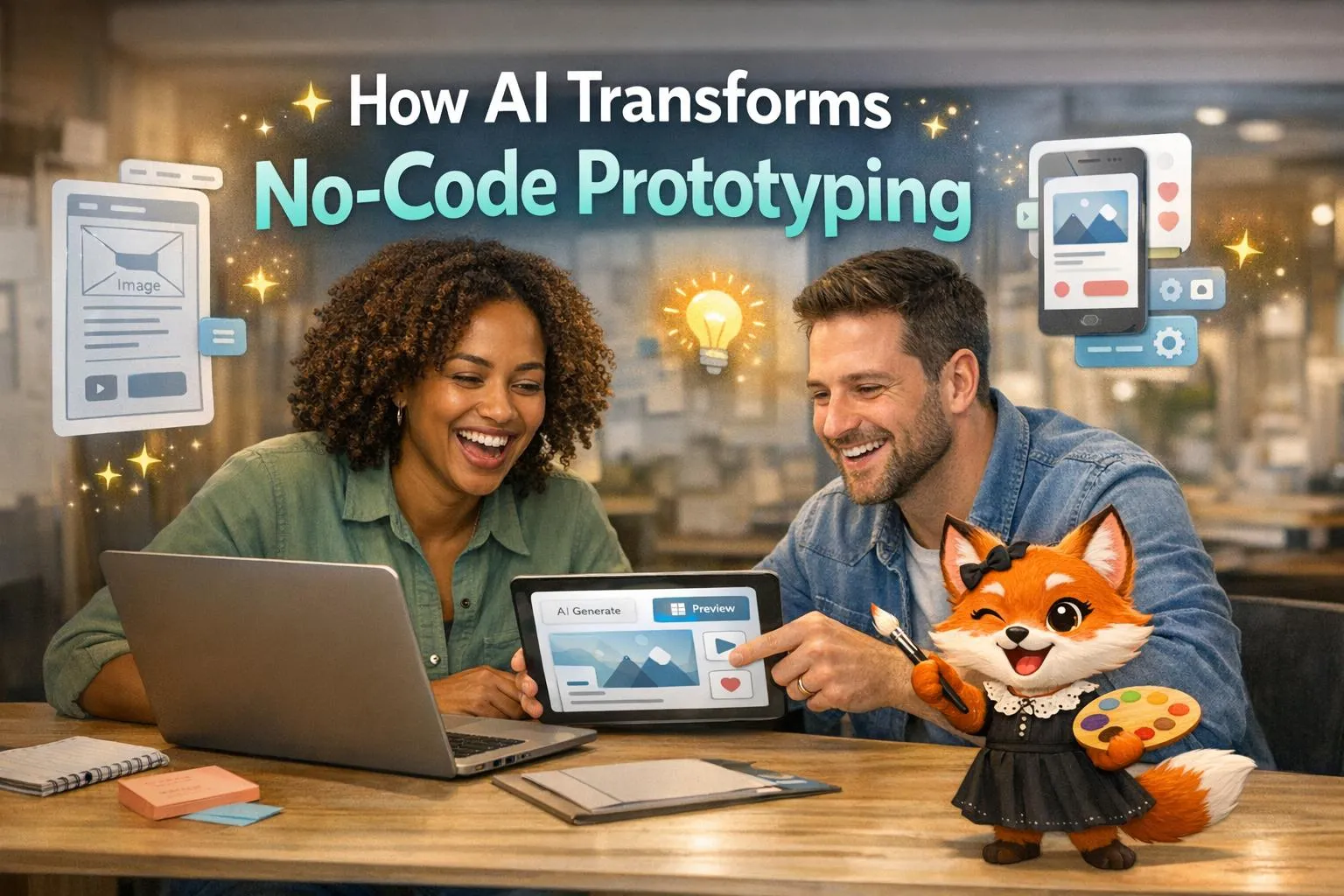
How AI Transforms No-Code Prototyping
How AI-powered no-code tools turn text prompts into production-ready web and mobile apps, cutting development time and cost while enabling s
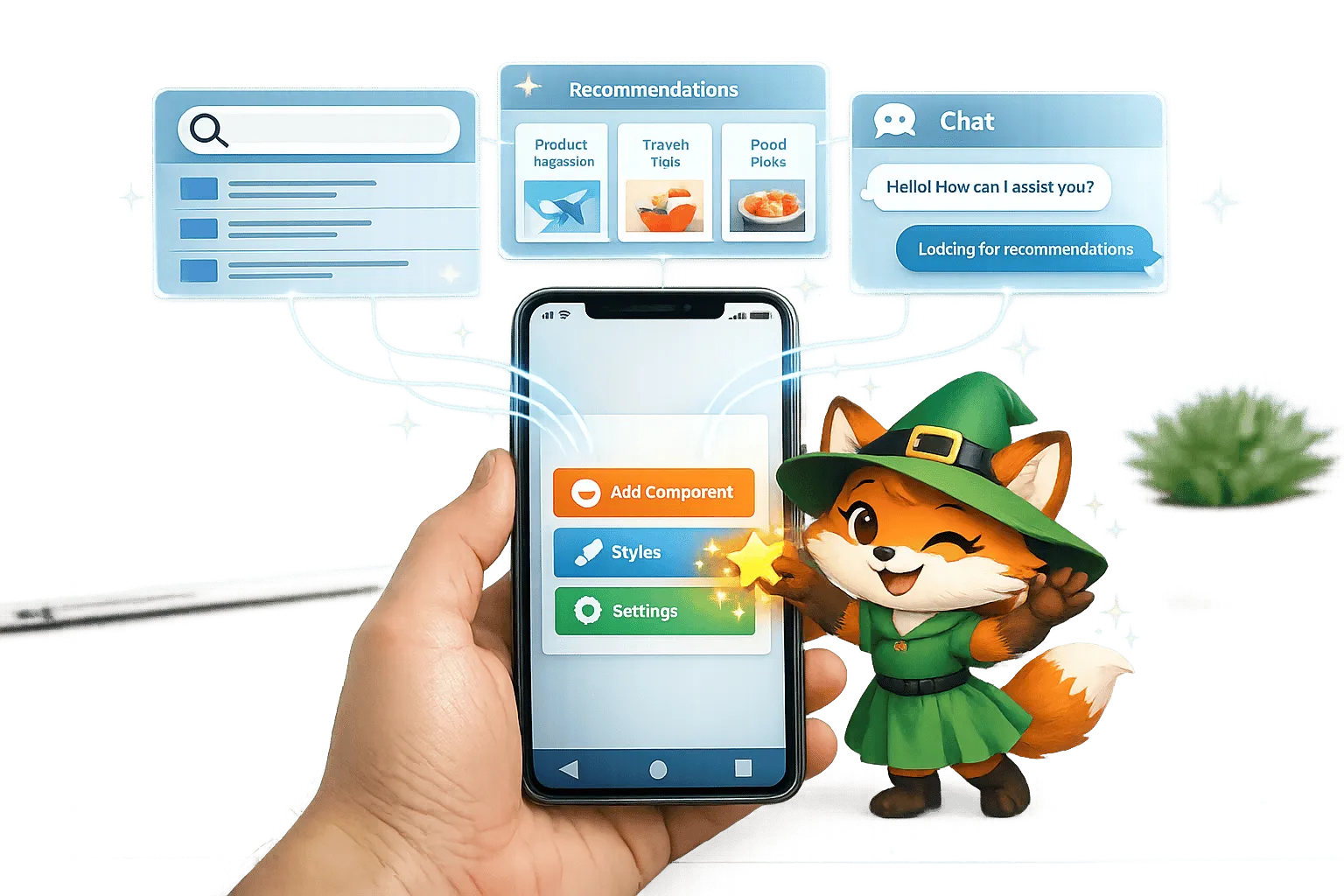
Building AI Features into Your No-Code Mobile App
Guide to adding AI to your no-code mobile app: set up APIs, design prompts, and build smart search, recommendations, NLP, categorization, an

Building an E-commerce App: No-Code Platform Guide
Step-by-step guide to design, build, and publish a no-code e-commerce app: product database, Stripe payments, user accounts, and scaling tip
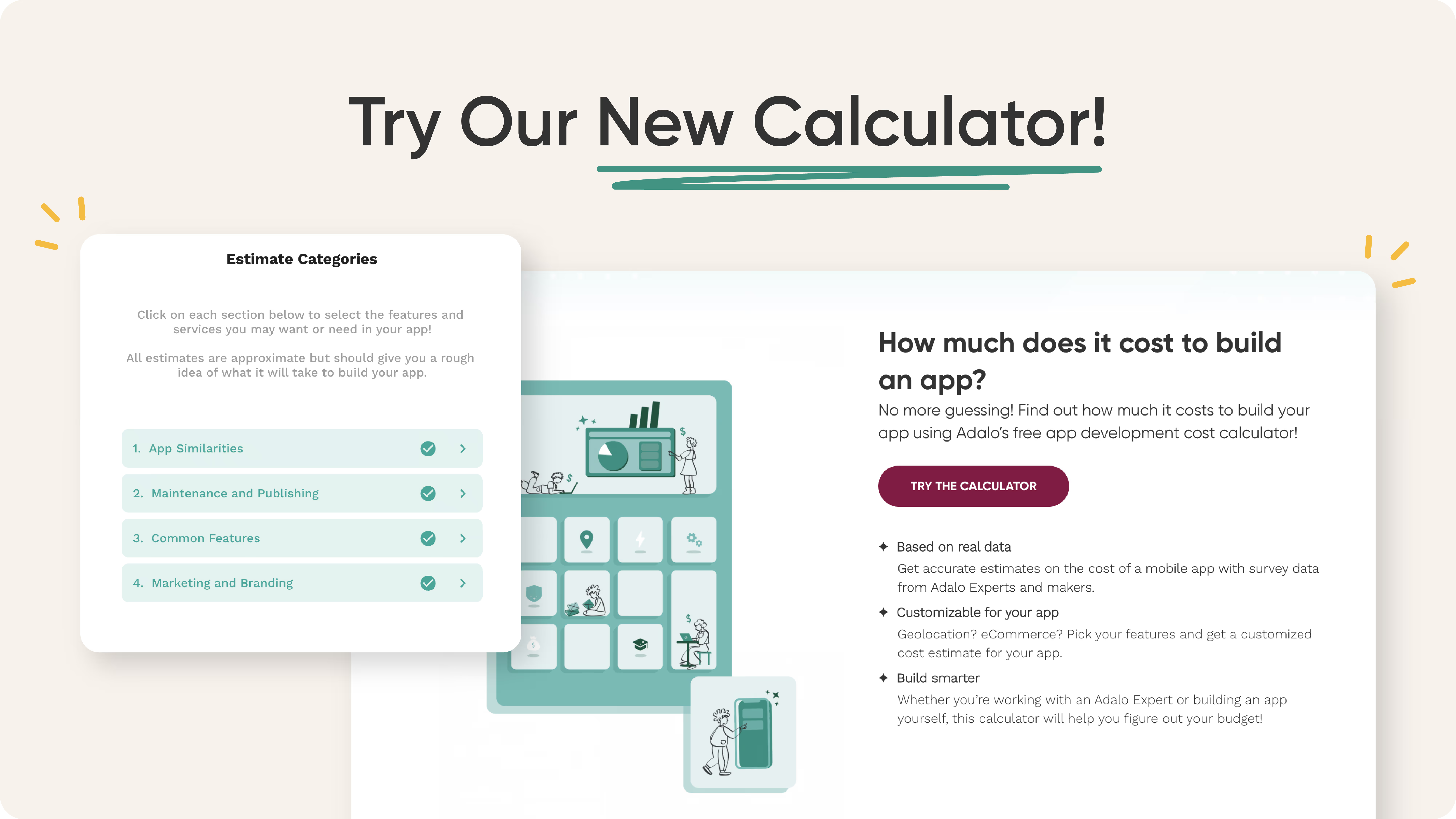
Adalo Launches an App Development Cost Calculator for No-Code App Building
The app development cost calculator was built using data from makers and the expertise of our community to give you accurate estimates.