
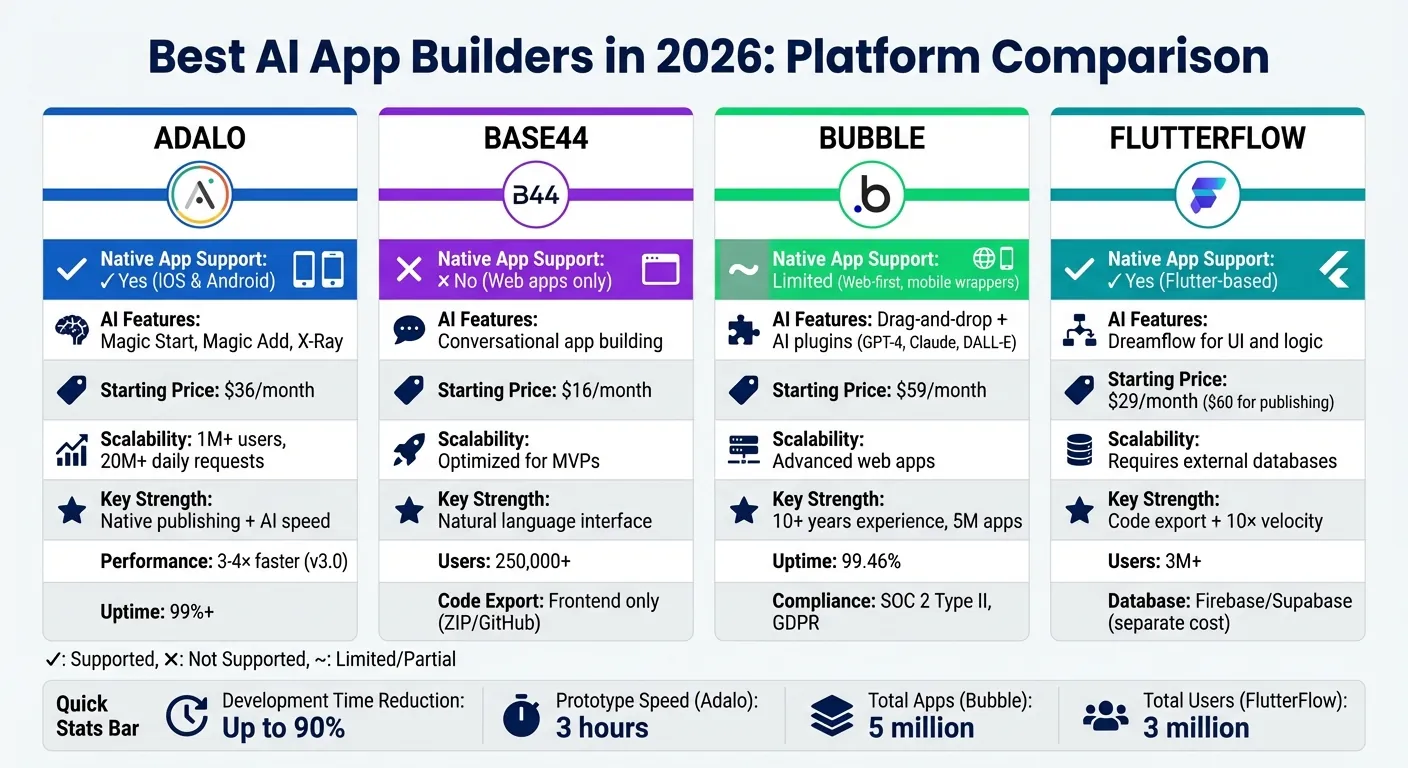
AI app builders have changed how mobile app architecture is created. In 2026, tools like Adalo, Base44, Bubble, and FlutterFlow let you build apps by describing your idea in plain language. These platforms cut development time by up to 90% and make app creation accessible to non-developers. Adalo stands out with its ability to publish native iOS and Android apps directly to app stores, starting at $36/month with no usage-based fees. Here's how it compares:
Explore Adalo's AI app builder to start building.
- Adalo: AI tools like Magic Start create apps from text prompts, with direct publishing to app stores. Supports native apps, PWAs, and scales to 1M+ users.
- Base44: Focuses on web apps with natural language prompts but lacks native app support. Offers flexibility with frontend code export.
- Bubble: Web-first platform with drag-and-drop customization and AI integrations. Uses a workload-based pricing model.
- FlutterFlow: Generates Flutter code for native apps and web platforms. Requires external database setup and offers code export. When choosing a platform, it's important to compare database integration options to ensure long-term scalability.
Quick Comparison:
| Platform | Native App Support | AI Features | Starting Price | Scalability |
|---|---|---|---|---|
| Adalo | Yes | Magic Start, Magic Add, X-Ray | $36/month | 1M+ users, 20M+ daily requests |
| Base44 | No | Conversational app building | $16/month | Optimized for MVPs |
| Bubble | Limited (web-first) | Drag-and-drop, AI plugins | $69/month | Advanced web apps |
| FlutterFlow | Yes | Dreamflow for UI and logic | $29/month | Requires external databases |
Adalo excels at combining speed, simplicity, and native publishing, making it a practical choice for building scalable apps.
AI App Builder Platform Comparison 2026: Features, Pricing and Scalability
Independent research from App Builder Guides' State of App Building report (February 2026) analyzed 190 Reddit threads and 150+ platform citations across 345 data points with zero platform sponsorships. Adalo ranked first among visual builders for non-developers.
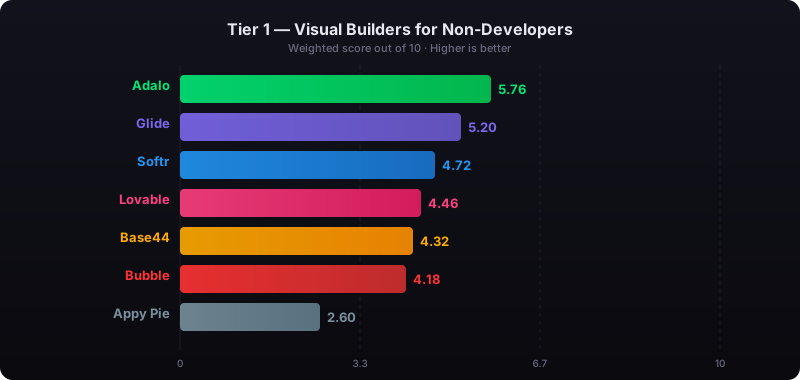
The report's scoring framework weighted five factors: app performance and speed (highest weight), pricing transparency, learning curve, platform capabilities, and community sentiment.
1. Adalo
Adalo is a no-code app builder for database-driven web apps and native iOS and Android apps—one version across all three platforms, published to the Apple App Store and Google Play. The platform has transitioned from a simple drag-and-drop app builder into one that combines AI-driven app generation with native publishing capabilities.
Ada, Adalo's AI builder, lets you describe what you want and generates your app. Magic Start creates complete app foundations from a description. Magic Add adds features through natural language. X-Ray identifies performance issues before they affect users.
Adalo 3.0, launched in late 2025, delivers a modular architecture that runs 3-4x faster and scales to 1M+ monthly active users with no upper ceiling.
AI Capabilities
Adalo's AI tools - Magic Start, Magic Add, and X-Ray - are at the core of its functionality. Magic Start allows users to create an entire app foundation, including database structures, screens, and user flows, from a single text prompt. For instance, typing "a booking app for a dog grooming business" can instantly generate a working database and user interface. Magic Add enables users to add features using natural language commands like "add a chat interface" or "create a user profile screen". Meanwhile, X-Ray acts as a diagnostic tool, identifying potential performance issues before they affect the app's usability. These tools have made it possible to build functional app prototypes - like a marketplace app - in just 3 hours during client workshops. Together, they highlight Adalo’s ability to deliver fast, production-ready app development.
Platform Support
Adalo supports native iOS and Android apps, which can be published directly to the Apple App Store and Google Play Store from a single codebase. It also supports Progressive Web Apps vs. native apps. By compiling natively instead of relying on web wrappers, Adalo ensures better performance and access to device-specific features like GPS, push notifications, and offline functionality. Following its 3.0 infrastructure update in late 2025, Adalo now operates 3–4× faster with a modular architecture designed to handle apps serving millions of monthly active users. This native-first approach ensures apps meet the standards required for app store approval.
Pricing
Adalo’s pricing starts at $36 per month, offering unlimited database records and no usage-based fees. There’s also a free plan, which includes Adalo branding and allows users to fully test the platform before committing to a paid plan. All paid plans include native app publishing, eliminating the technical hassle of managing certificates and provisioning profiles. This straightforward pricing model avoids unexpected costs, as there are no charges tied to workload or database record limits, making it easier for businesses to scale without financial surprises.
Scalability
Adalo’s modular infrastructure can support apps with over 1 million monthly active users without any upper limits. Paid plans include unlimited database records, and for projects requiring external data, Adalo integrates with tools like Airtable (handling 5,000+ records via External Collections), Google Sheets, MS SQL Server, and PostgreSQL. The platform processes over 20 million daily data requests with an average uptime of 99%. While Adalo is ideal for MVPs, booking systems, e-commerce apps, and marketplaces, performance may dip for apps exceeding 1,000 records or 50 screens unless properly optimized. With smart optimization, users can maintain the high-quality, native app experience that makes Adalo stand out.
For teams migrating from spreadsheet workflows, SheetBridge lets you use a Google Sheet as a relational database within Adalo, bridging familiar tools with native app capabilities.
2. Base44
Base44 is an AI-driven platform designed to simplify app creation, covering everything from user interface design to hosting. By using natural language prompts, it can generate the UI, database structure, backend logic, and hosting setup—all in one seamless process.
AI Capabilities
What sets Base44 apart is its conversational approach. Users can describe their app requirements in plain English, and the AI takes care of the rest, building the entire application framework. Through its interactive chat interface, users can tweak data models, workflows, and features in real time. For instance, describing something like "a product catalog with categories" results in the automatic creation of tables, relationships, and validation rules.
Additionally, Base44 handles secure authentication flows effortlessly, generating sign-up, login, password recovery, and role-based permissions for different user roles. This makes it particularly appealing for teams focused on rapid prototyping who don't need native mobile deployment.
"What makes Base44 powerful is that it shifts your mindset from coding to problem-solving. You spend less time fighting syntax and more time building something users actually want." - Nina Boyd, PMM at Base44
Platform Support
Base44 specializes in creating responsive web apps hosted in the cloud, allowing for immediate testing. The platform does not support native mobile apps—a significant limitation for businesses targeting App Store or Play Store distribution. It offers flexibility by enabling users to export frontend code as a ZIP file or directly to GitHub, though backend logic remains hosted on Base44.
For teams specifically needing native iOS and Android apps published to app stores, this web-only approach creates a fundamental gap. Adalo addresses this directly by compiling to native code and handling the entire App Store submission process from a single codebase.
Pricing
The platform uses a credit-based subscription system with five tiers. The Free plan provides 25 credits per month but limits users to 5 messages daily. Paid plans range from $16 to $160 per month, offering more credits, custom domains, and GitHub integration. Building a complete app typically uses 5–7 credits, while making adjustments costs 1–3 credits.
While the entry price appears lower than Adalo's $36/month, the credit system introduces unpredictability. Heavy iteration during development can consume credits quickly, and the lack of native app support means teams needing mobile apps would require an additional platform anyway.
Scalability
Since its acquisition by Wix in June 2026 for $80 million, Base44 has grown to serve over 250,000 users. It's optimized for rapid prototyping and MVP development, with features like automated security checks, data encryption, and secure hosting.
The ability to export frontend code ensures users aren't locked into the platform, even though backend logic remains on Base44. However, for apps requiring scale beyond web deployment—particularly those targeting millions of mobile users—Base44's architecture presents limitations that native-first platforms like Adalo don't face.
3. Bubble
Bubble takes a thoughtful approach to AI-powered app creation by focusing on pre-approval and iterative refinement. The platform starts by creating a project blueprint for users to review and approve before diving into full development. Once the blueprint is confirmed, users can customize their app using Bubble's drag-and-drop editor. This method ensures users have control over the process from start to finish.
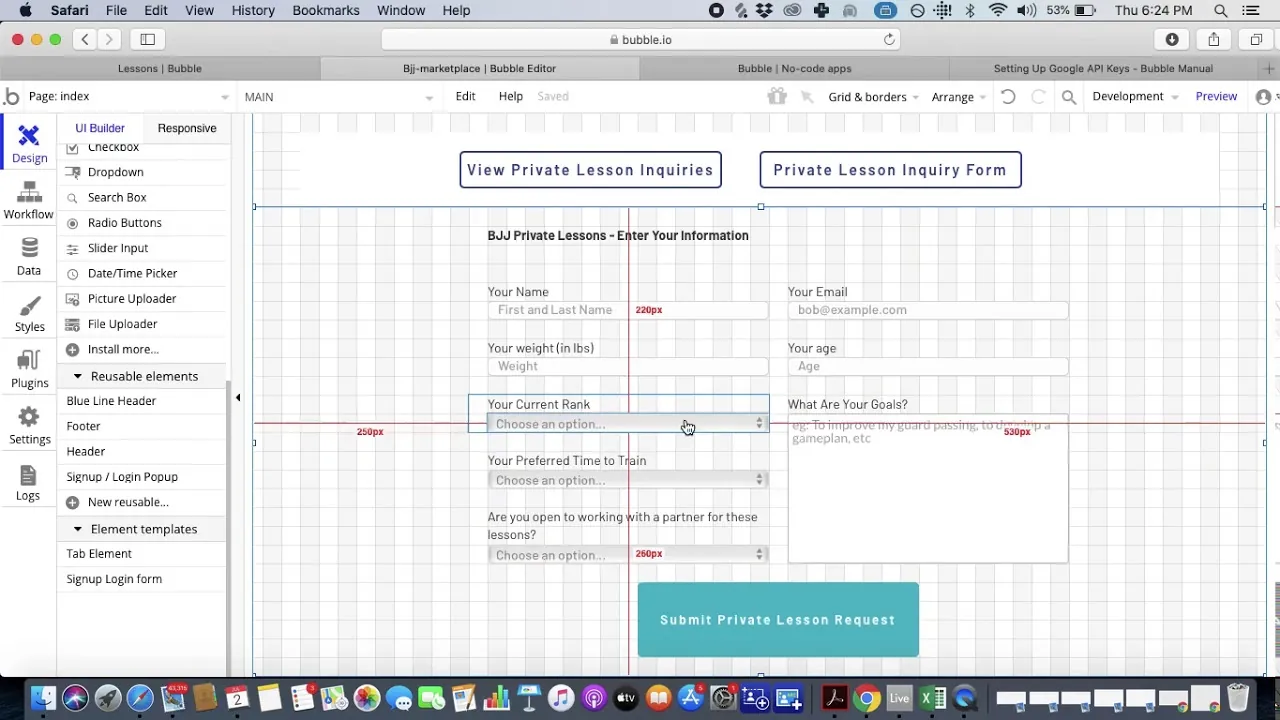
Bubble also offers a plugin ecosystem that integrates seamlessly with AI tools like OpenAI's GPT-4, Anthropic Claude, and DALL-E, all working alongside its built-in backend and database.
"Other AI builders make it easy to generate code, Bubble makes it easy to grow a business." – Bubble
Platform Support
Bubble is a web-first platform with over a decade of experience, powering nearly 5 million applications. While its primary focus is on web solutions, it enables mobile deployment by wrapping web apps for publishing on the Apple App Store and Google Play. This wrapper approach differs fundamentally from native compilation—wrapped apps run web content inside a native shell, which can result in slower performance and limited access to device features.
The platform is known for its reliability, boasting a 99.46% uptime over a 90-day period in late 2025. Additionally, it meets SOC 2 Type II compliance standards, ensuring robust security. For teams prioritizing complex web applications over mobile performance, Bubble remains a strong contender.
Pricing
Bubble pricing begins at $69 per month for comparable functionality, and AI features are included without extra fees. However, the platform uses a "Workload Units" system, meaning costs can fluctuate unpredictably based on app activity. CPU usage, database operations, and API calls all consume workload units, making it difficult to forecast monthly expenses as your app scales.
Lower-tier plans may also have restrictions on database records and app republishing, which could impact scalability for smaller projects. This contrasts with Adalo's flat-rate $36/month pricing that includes unlimited database records and no usage-based fees—what you see is what you pay, regardless of how active your app becomes.
Scalability
Bubble is well-suited for creating complex web applications with advanced database structures and logic. It adheres to enterprise-grade security standards, including GDPR compliance, and offers a vast library of plugins and API integrations.
While the platform can handle large-scale applications, production environments with heavy traffic may require expert tuning to maintain optimal performance. The workload-based pricing also means that scaling success comes with proportionally higher costs—a consideration for teams planning significant growth.
4. FlutterFlow
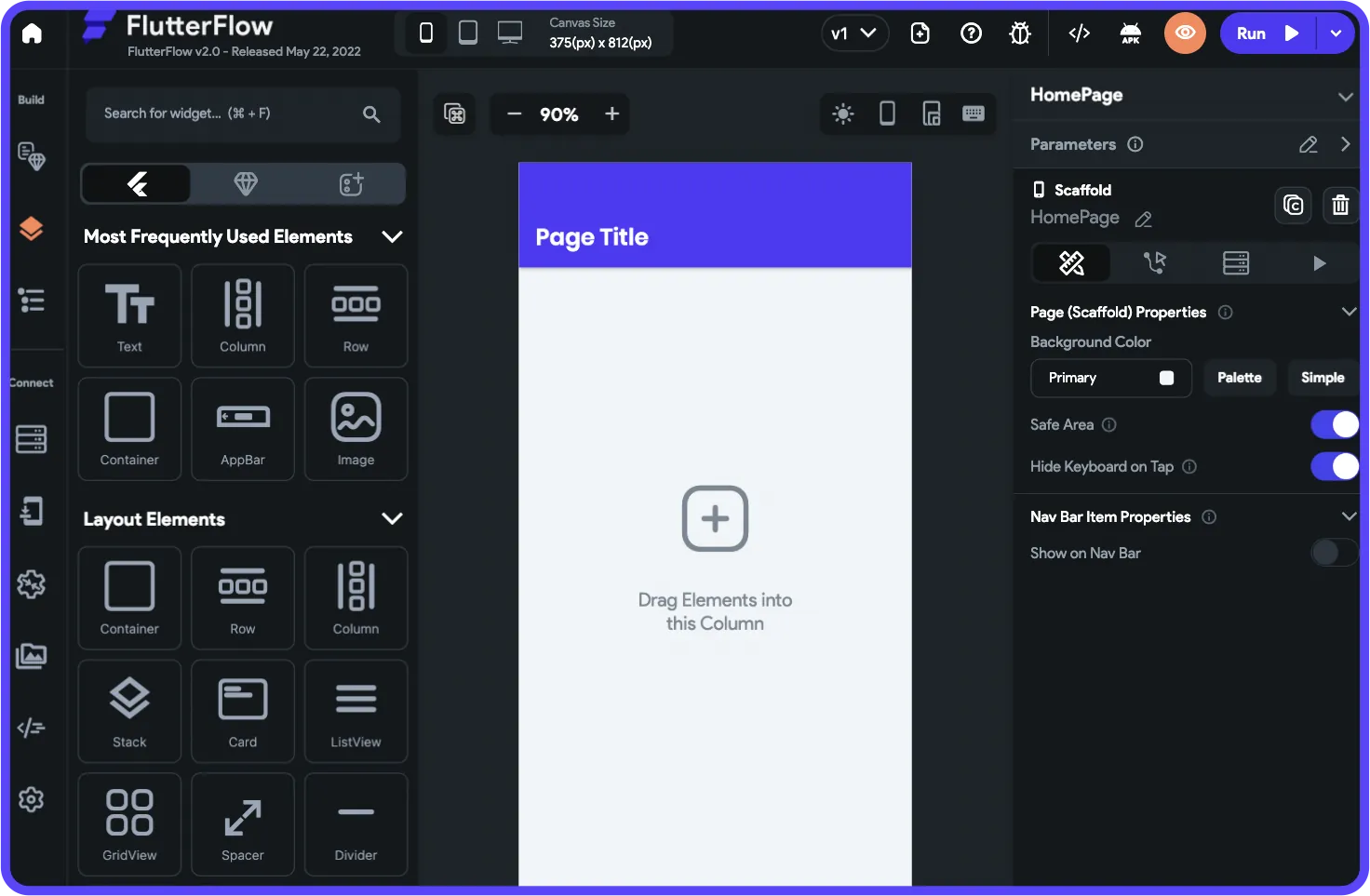
FlutterFlow uses AI to simplify app creation for developers and technical founders, thanks to its "Dreamflow" tool. This feature quickly generates app screens and UI layouts from straightforward text inputs. Rather than taking over entirely, the AI works as an assistant, tackling repetitive tasks like boilerplate creation while leaving users in control. It also offers AI-assisted logic suggestions, making it easier to build complex workflows without needing advanced programming skills.
AI Capabilities
FlutterFlow's AI integration focuses on speed and adaptability. Users describe their app ideas in plain language, and Dreamflow generates the visual structure and basic logic. This workflow is a prime example of how to create an app using AI to bypass manual design phases.
Built on Google's Flutter framework, the platform allows developers to enhance AI-generated components with custom Dart code. A standout feature is the ability to export clean source code at any time, ensuring users aren't locked into the platform. This makes it an efficient tool for kickstarting app development before diving into more specific customizations.
"What we also liked about FlutterFlow was that we could always export the code into Flutter and we could keep it going as we scaled." – Dan Somrack, Founder, Silver
Platform Support
FlutterFlow generates actual Flutter code, enabling native publishing to the Apple App Store, Google Play Store, and web platforms—all from a single project. However, unlike platforms with integrated databases, FlutterFlow requires users to set up and pay for external database services like Firebase or Supabase separately.
This adds both cost and complexity. Teams must manage database configuration, security rules, and billing across multiple platforms. The interface also supports only two screens at a time, which can slow development for larger, multi-screen apps. Adalo's integrated approach—where the database, backend, and native publishing are all included—eliminates this fragmentation.
Pricing
Pricing starts at $29/month for basic features, but app store publishing requires the $80/month per seat plan. The Business tier, at $112/month, includes audit logs and enterprise-level support. Database costs for external services like Firebase or Supabase are additional expenses not reflected in these prices.
Teams needing full app store publishing capabilities often spend $80/month or more per user, plus database fees. Compare this to Adalo's $36/month flat rate that includes native publishing, unlimited database records, and no per-seat charges—a significant cost advantage for growing teams.
Scalability
FlutterFlow is well-suited for scaling apps, with over 3 million users as of early 2026. Its ability to export code and support native publishing makes it a strong choice for founders building long-term projects. However, successful scaling depends on how effectively users manage their external database setup.
For example, Wendy's used FlutterFlow in 2026 to streamline development and enhance customer experiences. The platform's technical flexibility appeals to teams with development resources, though the added complexity of external database management may not suit everyone.
"In pure PM terms, FlutterFlow multiplies our team's velocity by 10X" – Mohamed, Growth Product Manager at BluePass
Strengths and Weaknesses
Each platform in this comparison serves different needs, but Adalo's combination of AI-powered development, native app publishing, and predictable pricing creates a distinct value proposition.
Adalo: AI-Powered Native Publishing
Adalo combines AI-assisted development with a robust drag-and-drop builder, making it possible to create production-ready native apps from a single codebase. The platform's 3.0 infrastructure significantly improves performance, offering speeds 3–4× faster while handling over 20 million daily data requests with 99%+ uptime. It can scale to support over 1 million monthly active users, showcasing its capability to handle both rapid development and real-world demands.
The flat-rate pricing of $36/month includes unlimited records and no usage fees, ensuring predictable costs even as your app grows. This stands in stark contrast to Bubble's workload-based charges or FlutterFlow's per-seat pricing plus external database costs.
Adalo's drag-and-drop interface enables users to create prototypes in less than three hours using one of the easiest no-code app builders. Its AI Builder, featuring tools like Magic Start and Magic Add, speeds up the initial development process. Magic Start generates complete app foundations from text descriptions, while Magic Add lets you expand functionality by simply describing what you want.
That said, more complex projects may require manual adjustments to achieve full production quality. Additionally, as a no-code platform, Adalo offers limited options for advanced customizations like injecting custom code or exporting source code—a trade-off for its accessibility and speed.
Competitor Trade-offs
Base44 excels at rapid web app prototyping with its conversational AI, but the lack of native mobile support limits its usefulness for teams targeting app stores. The credit-based pricing can also become unpredictable during heavy development phases.
Bubble offers deep customization for complex web applications and a mature plugin ecosystem. However, its web-wrapper approach to mobile apps doesn't match true native performance, and workload-based pricing makes costs difficult to forecast at scale.
FlutterFlow provides genuine native code export and appeals to technical teams comfortable with Flutter. The requirement for external database setup adds complexity and cost, and the $80/month per-seat price for app store publishing makes it expensive for teams.
Conclusion
By 2026, AI app builders have transformed from experimental concepts into reliable, production-ready platforms. Among them, Adalo has carved out a distinct space by combining AI-assisted development with native app store publishing, offering both speed and dependable deployment.
Adalo's standout feature is its single-codebase system, enabling developers to build once and deploy across the web, iOS, and Android—all while allowing direct publishing to the Apple App Store and Google Play Store. With tools like Magic Start, you can generate database structures and user flows in just minutes, creating scalable, native apps ready to meet real-world demands.
Whether you're a non-technical founder working on an MVP or a developer moving from prompt-based coding tools, Adalo offers a reliable production environment. The straightforward pricing of $36/month, which includes no data caps and no usage-based fees, ensures cost predictability as your app grows.
For those seeking fast native publishing powered by AI, Adalo provides an efficient and practical solution in 2026.
Related Blog Posts
- Adalo vs Bubble for Web, iOS and Android apps: Which to Choose?
- How AI Transforms No-Code Prototyping
- Adalo for Software Development Teams: Rapid Internal Tool Building
- Adalo vs Bubble vs FlutterFlow: The Definitive 2026 No-Code Comparison
FAQ
Why choose Adalo over other app building solutions?
Adalo is an AI-powered app builder that creates true native iOS and Android apps from a single codebase. Unlike web wrappers or web-only platforms, it compiles to native code and publishes directly to both the Apple App Store and Google Play Store—handling the hardest part of launching an app automatically.
What's the fastest way to build and publish an app to the App Store?
Adalo's drag-and-drop interface combined with AI-assisted building tools like Magic Start lets you go from idea to published app in days rather than months. The platform handles the complex App Store submission process, including certificates and provisioning profiles, so you can focus on your app's features instead of technical requirements.
Which is more affordable, Adalo or Bubble?
Adalo starts at $36/month with flat-rate pricing that includes unlimited database records and no usage-based fees. Bubble starts at $69/month for comparable functionality and uses a Workload Units system that adds unpredictable charges based on CPU usage, database operations, and API calls.
Which is more affordable, Adalo or FlutterFlow?
Adalo's $36/month includes native app publishing, an integrated database, and unlimited records. FlutterFlow requires $80/month per seat for app store publishing, plus additional costs for external database services like Firebase or Supabase—making the total cost significantly higher.
Is Adalo better than Base44 for mobile apps?
Yes, if you need native mobile apps. Base44 focuses exclusively on web apps and doesn't support native iOS or Android publishing. Adalo creates true native apps that publish directly to the Apple App Store and Google Play Store from a single codebase.
Which is easier for beginners, Adalo or FlutterFlow?
Adalo is generally easier for beginners because it includes an integrated database and handles all infrastructure. FlutterFlow requires setting up and managing external database services like Firebase or Supabase, adding complexity that can challenge non-technical users.
Can Adalo handle apps with large numbers of users?
Yes. Adalo's modular infrastructure scales to support apps with over 1 million monthly active users. The platform processes more than 20 million daily data requests with 99%+ uptime, and the 3.0 infrastructure update delivers speeds 3-4× faster than previous versions.
What AI features does Adalo offer for app development?
Adalo offers three AI tools: Magic Start generates complete app foundations from text descriptions, Magic Add lets you add features using natural language commands, and X-Ray identifies potential performance issues before they affect your app. These tools can help you build a functional prototype in as little as 3 hours.
Can I migrate from Bubble to Adalo?
While there's no automated migration tool, many teams transition from Bubble to Adalo when they need true native mobile apps rather than web wrappers. Adalo's AI Builder can help recreate your app's core functionality quickly, and the predictable pricing eliminates workload-based cost surprises.
What types of apps can I build with Adalo?
Adalo is ideal for building MVPs, booking systems, e-commerce apps, marketplaces, and any database-driven application. The platform supports native iOS apps, Android apps, and Progressive Web Apps (PWAs) all from a single codebase, making it versatile for various business needs.

Build your app fast with one of our pre-made app templates
Begin Building with no codeRelated Content
How AI App Builders Compare: Adalo vs Base44 vs Traditional No-Code
Compare Adalo, Base44, and traditional no-code on AI speed, native publishing, scalability, and pricing to choose the best production-ready
How to Choose an AI App Builder in 2026: Prototypes vs Production Apps
How to Choose an AI App Builder in 2026: Prototypes vs Production Apps
Compare the best AI app builders for 2026 — Lovable, Bolt, v0, Cursor, Replit, Base44, Bubble, FlutterFlow, and Adalo. Learn which tools prototype fast and which actually ship to production.
10 Best Free Mobile App Builders in 2026
Compare 10 free mobile app builders in 2026. Pricing, native mobile output, and honest pros/cons for Adalo, FlutterFlow, Bubble, and more.
The 9 Best No-Code App Builders in 2026
Compare the 9 best no-code app builders in 2026. AI capabilities, pricing, native mobile, production scale, and honest pros and cons.