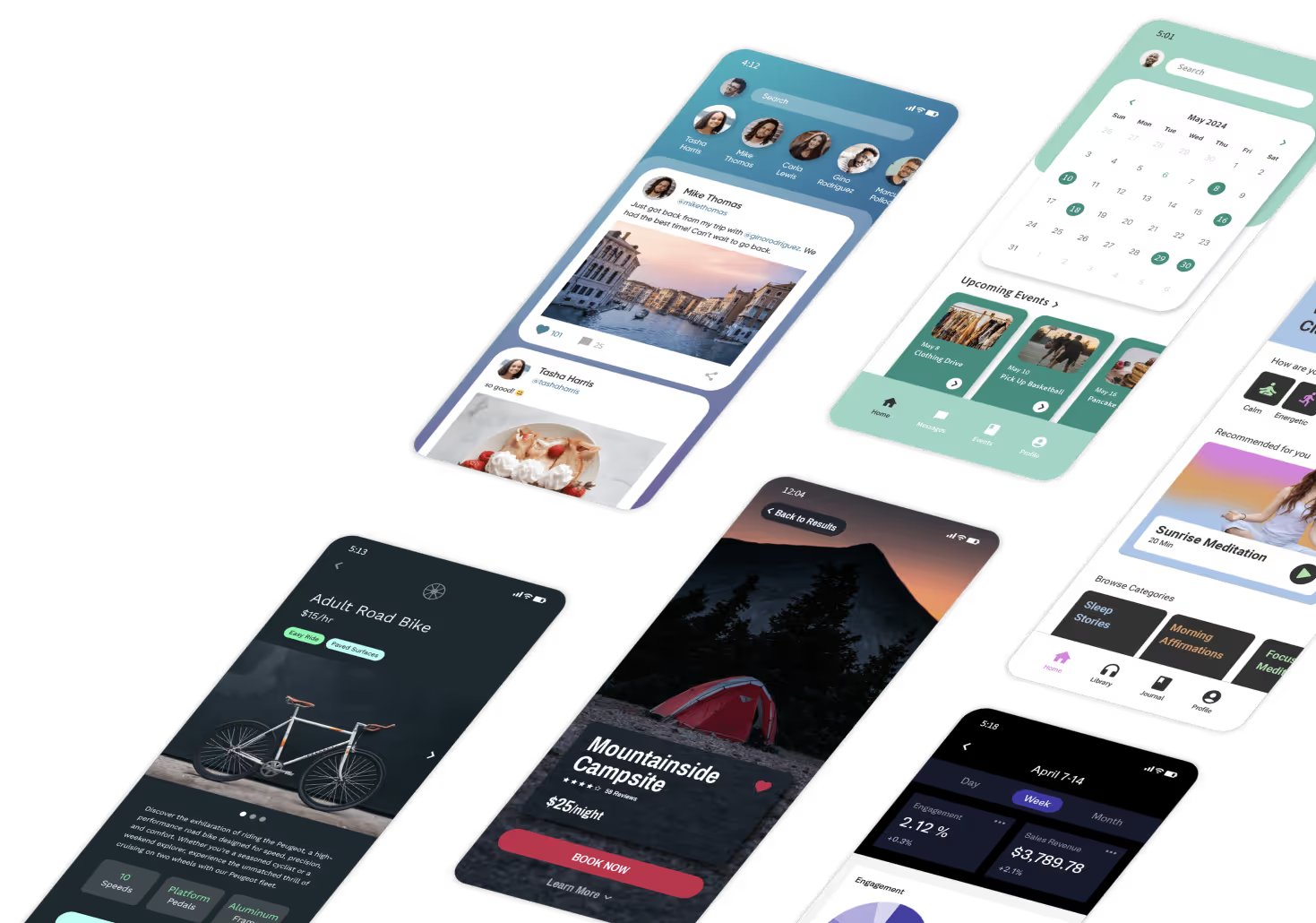
AI is reshaping how apps are built. With AI-powered app builders, you don't need coding skills—just describe your idea, and AI generates a working app. This approach saves time, cuts costs, and empowers anyone to create apps for web, iOS, and Android. By 2026, 70% of enterprise apps will rely on these platforms, slashing development costs by 48% and timelines by up to 90%. Whether you're a startup or a large organization, AI-assisted tools make app creation faster, cheaper, and more accessible than ever.
Platforms like Adalo, a no-code app builder for database-driven web apps and native iOS and Android apps—one version across all three platforms, published to the Apple App Store and Google Play, are at the forefront of this transformation. These tools combine visual development with AI capabilities to help anyone turn app ideas into reality.
Key takeaways:
- Describe your app idea, and AI builds it for you
- Development costs drop to as low as $36/month with unlimited usage
- Apps can scale to millions of users without extra infrastructure
Platforms like Adalo let you launch MVPs in days, not months—perfect for startups, internal tools, or modernizing legacy systems. AI ensures apps are not just functional but ready to handle business operations, all while staying affordable and efficient.
What is No-Code Prototyping and How Does AI Improve It?
What No-Code Prototyping Means
No-code prototyping lets you build functional app prototypes without writing a single line of code. Instead, you use visual platforms that feature drag-and-drop tools and pre-designed components. Unlike traditional development—which involves writing, debugging, and optimizing code—this method slashes development time from weeks or months to just hours or days.
The real game-changer? It opens the door for non-technical users—like business teams, educators, or small business owners—to bring their app ideas to life. These prototypes aren't just static visuals; they're interactive and can evolve quickly into Minimum Viable Products (MVPs). This means teams can test ideas in practical settings before committing to larger investments.
In short, no-code prototyping empowers a wide range of people to independently create applications that suit their needs. Adalo's visual builder has been described as "as easy as PowerPoint"—familiar enough that anyone can start building immediately, yet powerful enough to create production-ready apps.
How AI Works in No-Code Tools
AI takes these tools to the next level by using natural language processing and machine learning to automate app creation. Here's how it works: you describe what you need—for example, "Create a mobile app where employees can check their PTO balance"—and AI generates a working version. From there, you can fine-tune the app with simple, conversational commands like "Make this button larger" or "Add a section for company holidays."
Behind the scenes, AI handles the heavy lifting, such as linking databases and setting up the logic for your app. This seamless integration allows users to focus on refining their ideas while the platform takes care of the technical complexities. With Adalo's AI Builder releasing in early 2026, this conversational approach to app development will become even more powerful, enabling prompt-based creation and editing throughout the entire build process.
AI Prototyping for Product Managers: Build Fast Without Coding Experience
How AI Changes No-Code Prototyping
AI doesn't just make no-code prototyping faster—it completely redefines how apps come to life. Instead of manually piecing together screens, database fields, and user flows, you simply describe what you need, and AI handles the technical details. This shift transforms app development into a conversational and intuitive experience, paving the way for a closer look at what AI can do.
Building Apps from Text Descriptions
One of the biggest game-changers is the ability to generate apps from text descriptions. Imagine typing something like, "Create a mobile app where employees can request time off and managers can approve it." The AI takes this input and builds the foundation—setting up database tables, authentication systems, and even basic screens.
Ada, Adalo's AI builder, lets you describe what you want and generates your app. Magic Start creates complete app foundations from a description, while Magic Add adds features through natural language.
Adalo's Magic Start feature exemplifies this capability. Tell it you need a booking app for a dog grooming business, and it creates your database structure, screens, and user flows automatically—what used to take days of planning happens in minutes. It takes your prompt, organizes the data into appropriate fields, and delivers a ready-to-customize base that speeds up your workflow significantly.
Adding Features Through Conversation
After your app's foundation is set, AI makes adding features as simple as having a conversation. Want to track cleaning schedules for a property management app or add a social feed with likes and comments? Just describe it, and the AI turns your request into functional components, including new screens and updated database fields.
This works thanks to natural language processing, which allows the system to understand your intent. Adalo's Magic Add feature handles these requests seamlessly. For instance, if you say, "Add email verification to the login process," the AI configures everything—authentication logic, email templates, and tracking. Research shows that AI-assisted tools help developers finish tasks 55% faster. These tools don't just speed up development; they also help ensure your app runs smoothly.
AI-Powered Performance Analysis
AI doesn't stop at building apps—it also keeps them running efficiently. Adalo's X-Ray feature analyzes app performance to catch potential bottlenecks early in the process. This is crucial because studies indicate that 45% of AI-generated code contains security flaws. Catching these issues during development can prevent costly problems after launch.
X-Ray identifies performance issues before they affect users, highlighting areas that could slow down your app as it scales. With automated quality checks, AI ensures that your app is not only functional but also reliable before it goes live. This proactive approach to performance optimization sets AI-powered platforms apart from traditional development workflows.
Benefits of Using AI in No-Code Prototyping
AI is transforming app building platforms by speeding up development, cutting costs, and delivering apps that are ready for real-world use. These advantages make it easier to iterate quickly, save money, and create scalable solutions.
Faster Development and Iteration
AI simplifies and speeds up the development process by automating repetitive tasks. Instead of spending hours setting up database tables, configuring authentication, or connecting data fields to screens, AI completes these tasks in seconds. These platforms can reduce app development time by up to 90%, turning what used to take months into a matter of weeks.
Take Adalo's Magic Start, for example. It builds a complete app foundation—database, user flows, and screens—ready for you to refine. Need to make changes? With Magic Add, you simply describe what you want, and the AI integrates it into your app instantly. You can test updates right away and deploy them across web, iOS, and Android without waiting for app store approval delays.
Following the Adalo 3.0 infrastructure overhaul in late 2025, apps now run 3-4x faster than before. This speed improvement means faster iteration cycles and quicker time-to-market for your ideas.
Lower Costs and Easier Access
One of the biggest draws of AI-powered app builders is the cost savings. On average, organizations using these tools save $1.7 million annually. Traditional app development can easily exceed $40,000 upfront, with ongoing maintenance adding another 15–20% each year. By comparison, Adalo's plans start at just $36/month with unlimited usage—no surprise charges or usage-based billing.
This pricing structure stands in stark contrast to competitors. Bubble's comparable offering starts at $59/month but includes usage-based charges through Workload Units, limits on app re-publishing, and record restrictions that can create unexpected costs. Flutterflow starts at $70/month per user for app store publishing, but that price doesn't include a database—users must source, set up, and pay for their own database separately, adding significant complexity and cost.
| Platform | Starting Price | Database Included | Usage Limits | Native Mobile Apps |
|---|---|---|---|---|
| Adalo | $36/month | Yes, unlimited records | None | Yes (iOS & Android) |
| Bubble | $59/month | Yes, with limits | Workload Units | Web wrapper only |
| Flutterflow | $70/month/user | No (external required) | Varies | Yes |
| Glide | $60/month | Yes, with limits | Record limits | No app store publishing |
These platforms are also leveling the playing field. You don't need to hire machine learning engineers with six-figure salaries or assemble specialized development teams. About 24% of no-code users had no prior coding experience when they started. By 2026, it's projected that citizen developers in large enterprises will outnumber professional developers by 4 to 1. AI handles the technical heavy lifting, empowering anyone with an idea to bring it to life.
Production-Ready Apps That Scale
AI doesn't just help you build apps quickly and affordably—it ensures they're robust enough for real-world use. Modern AI-powered platforms now produce apps capable of handling serious business operations. With Adalo's single-codebase approach, the app you prototype is the same one that goes live, eliminating the need for separate development builds.
These platforms are designed to handle growth. Adalo's modular infrastructure can scale to serve apps with over 1 million monthly active users, with no upper ceiling. Unlike app wrappers that hit speed constraints under load, Adalo's purpose-built architecture maintains performance at scale. Paid plans include no record limit cap on the database—unlimited database records mean you never hit artificial storage walls as your user base grows.
Everything you need for production is built in: database management, user authentication, push notifications, and seamless integration with tools like Airtable, Google Sheets, MS SQL Server, and PostgreSQL. Adalo's X-Ray feature uses AI to analyze your app for performance issues before launch, helping you avoid common problems. For businesses with strict security needs, Adalo Blue offers enterprise-grade features such as dedicated infrastructure and on-premise deployment.
How Different Users Apply AI-Powered No-Code Prototyping
AI-powered app builders are transforming development across industries, offering tailored solutions for everyone from startups testing new ideas to enterprises modernizing outdated systems.
Building MVPs for Startups
For startup founders, time is everything. AI-powered tools allow them to launch minimum viable products (MVPs) in just days instead of months. It's as simple as describing the app idea in plain text. Tools like Adalo's Magic Start then generate a complete framework—database structure, user flows, and screens—ready for further refinement.
Take Spotto, for example. This startup built its entire app on Adalo without writing a single line of code. The result? Thousands of users and a full acquisition by an investor—marking a milestone as the first Adalo-built app to achieve such success.
Founders can begin with free plans, testing their ideas before committing to a paid subscription. Once the concept is validated, the same app can be deployed to web, iOS, and Android platforms simultaneously from a single codebase. Over 3 million apps have been created on Adalo, demonstrating the platform's proven track record for bringing ideas to market quickly.
Creating Internal Business Tools
Enterprises are tapping into AI-powered platforms to build customized internal tools that streamline operations. These tools seamlessly integrate with services like Airtable, Google Sheets, MS SQL Server, and PostgreSQL, enabling businesses to design user-friendly interfaces for employee-facing applications.
Covenant Connect, a school communication platform, replaced its outdated systems with a modern mobile app built using Adalo. The team managed to simplify administrative workflows and launch the app in under three months.
For organizations that already rely on spreadsheets, Adalo's SheetBridge feature turns a Google Sheet into an actual database—the easiest path to app development without database-related learning curves. This approach offers more flexibility than template-restricted platforms like Glide, which limit creative freedom despite their speed. Additionally, businesses can incorporate third-party AI services via APIs to add advanced capabilities. For organizations with strict security needs, Adalo Blue offers enterprise-grade features such as single sign-on (SSO) and role-based permissions.
Adding Modern Interfaces to Legacy Systems
Many enterprises face a common challenge: outdated software. A staggering 70% of the software used by Fortune 500 companies is over 20 years old. Instead of overhauling these systems entirely, organizations are leveraging AI-powered platforms to build modern mobile interfaces that connect to legacy databases through APIs and middleware.
HSBC, for instance, teamed up with Google Cloud to develop an AI-powered system capable of scanning 900 million transactions each month. This system not only detects 2 to 4 times more suspicious activities than its predecessor but also reduces false positives by 60%.
Similarly, TechnoFab Industries, an automotive parts manufacturer, integrated machine learning into its existing ERP system, resulting in a 75% drop in equipment downtime and a 30% cut in maintenance costs.
For systems lacking robust APIs, platforms like Adalo Blue utilize tools like DreamFactory to enable deep integrations with legacy infrastructure. This approach allows businesses to access data from previously isolated systems—such as ERPs or mainframe databases—and deliver it through modern mobile apps, complete with features like push notifications.
What's Next for AI in No-Code Prototyping
By 2026, it's predicted that 70% of new enterprise applications will incorporate low-code or no-code technologies. Even more striking, citizen developers in large enterprises are expected to outnumber professional developers by a ratio of 4:1. This marks a dramatic shift in how software is created, with AI playing a central role in driving these changes.
AI Tackling More Advanced Applications
AI is no longer limited to generating simple user interfaces. We're now seeing AI agents that recommend industry-specific features and perform automatic application testing in under a minute. Tools like Magic Start can create intricate relational database structures from a single text prompt, removing the need for specialized database expertise.
Instead of manually tweaking every detail in a visual editor, you can describe things like conditional logic, data transformations, or multi-step workflows in plain English. AI takes those instructions and turns them into fully functional components. This method works best when complex projects are broken into smaller, manageable tasks rather than attempting to build everything in one go.
"The way designers use AI to generate code differs significantly from how engineers use it: A designer's goal is to build quick, functional prototypes so they can rapidly explore ideas and user experiences." - CJ Gammon, Design Engineering Manager, Adobe Design
For apps expecting heavy traffic, AI-driven platforms now integrate with scalable external backends like Xano or Airtable, enabling them to handle millions of data requests seamlessly. This hybrid approach combines the speed of AI-assisted development with the infrastructure needed for large-scale operations.
Stronger Infrastructure for Scaling Apps
As AI takes on more complex tasks, having a reliable infrastructure becomes critical. Adalo processes over 20 million data requests daily with 99%+ uptime, ensuring apps can handle real-world usage without a hitch. The Adalo 3.0 infrastructure overhaul in late 2025 delivered apps that run 3-4x faster, with modular infrastructure that scales with app needs.
AI is also stepping in to optimize performance automatically. Instead of developers needing to manually track down bottlenecks, AI tools can detect issues in real time, manage concurrent user sessions, and fine-tune workflows before problems arise. Adalo's X-Ray feature uses AI to analyze your app during development, flagging potential performance issues before launch.
It's worth noting that many third-party platform ratings and comparisons predate the Adalo 3.0 infrastructure overhaul. Reviews from 2026 or earlier don't reflect the significant performance improvements and unlimited data storage now available on paid plans.
The low-code/no-code market is projected to hit around $187 billion by 2030. Companies adopting these platforms are saving an average of $1.7 million annually. This shift highlights a key trend: AI-powered platforms are no longer just for quick prototypes—they're now powering scalable, production-ready applications.
Simplifying Multi-Platform Publishing
With performance and scalability in place, AI is also making it easier to publish apps across multiple platforms. Adalo's single-codebase architecture allows you to build once and deploy across web, iOS App Store, and Android Play Store. AI handles the technical details like provisioning, certificates, and App Store Optimization (ASO) tasks, significantly reducing manual effort.
Updates made in one place are instantly reflected across all platforms. This stands in contrast to platforms like Bubble, where the mobile app solution is a wrapper for the web app—meaning one app version doesn't automatically update web, Android, and iOS apps deployed to their respective app stores.
AI tools even generate platform-compliant descriptions, keywords, and privacy policy text, turning hours of tedious work into a quick, streamlined process. Traditional app development can cost upwards of $90,780 per project, while first-year costs with Adalo—including platform fees—can be as low as $556. That massive cost reduction makes app development accessible to businesses that previously couldn't afford it.
As AI continues to evolve, expect even more automation, like intelligent testing that ensures cross-platform compatibility before launch and post-launch monitoring that identifies bugs and suggests improvements across various operating systems. The aim isn't to replace developers but to eliminate repetitive technical tasks, allowing teams to focus on creativity and innovation.
Conclusion
Not long ago, building an app meant months of work and a hefty budget. Today, the game has completely changed—apps can be developed in days and at a fraction of the cost.
This shift is driven by three key advancements: speed, accessibility, and scalability. AI-powered app builders now allow entrepreneurs, business teams, and agencies to create production-ready apps without the need for specialized developers. On average, organizations using these tools save $1.7 million annually, with first-year costs starting as low as $556—compared to traditional development costs averaging $90,780. These savings make it possible to build apps that meet production standards without breaking the bank.
And these aren't just basic prototypes—they're fully scalable applications. Adalo handles over 20 million data requests daily with 99%+ uptime, proving that AI-assisted platforms are more than capable of managing serious production workloads. AI takes care of tasks like setting up databases and publishing apps across web, iOS, and Android—all from a single codebase.
Whether you're rolling out an MVP, designing internal tools, or creating customer-facing apps, AI-powered platforms eliminate the usual roadblocks. You can simply describe your idea in plain English, watch it take shape in real time, and launch across platforms without the need to rebuild. This frees up time and resources, allowing you to focus on solving business challenges instead of debugging code.
The rise of AI in app development marks a turning point in how software gets built. By replacing technical hurdles with creative freedom, it's redefining how ideas become reality. Ready to see it for yourself? Explore Adalo and watch how AI-assisted app building can take you from concept to launch faster than you ever imagined.
Related Blog Posts
- Ultimate Guide to No-Code MVP Prototyping
- How to Build AI Chatbots Without Code
- How to Build Prototypes in Days with No-Code
- Checklist: Reducing Enterprise App Costs with No-Code
FAQ
Why choose Adalo over other app building solutions?
Adalo is an AI-powered app builder that creates true native iOS and Android apps. Unlike web wrappers, it compiles to native code and publishes directly to both the Apple App Store and Google Play Store from a single codebase—the hardest part of launching an app handled automatically. With unlimited database records on paid plans and no usage-based charges, you avoid the surprise bills common with other platforms.
What's the fastest way to build and publish an app to the App Store?
Adalo's drag-and-drop interface combined with AI-assisted building through Magic Start and Magic Add lets you go from idea to published app in days rather than months. The platform handles the entire App Store submission process, including provisioning and certificates, so you can focus on your app's features rather than technical requirements.
How does AI simplify the technical side of app development?
AI integration automates tasks that typically demand coding skills. Magic Start generates complete app foundations from descriptions, Magic Add builds features from natural language requests, and X-Ray identifies performance issues before they affect users. This means you can build app features and set up data connections without touching a single line of code.
How can AI-powered tools help save on app development costs?
These platforms slash development costs by simplifying workflows and eliminating the need for specialized developers. Adalo starts at $36/month with unlimited usage, compared to traditional development costs averaging $90,780 per project. Businesses report saving up to 65% compared to traditional approaches.
Which is more affordable, Adalo or Bubble?
Adalo starts at $36/month with unlimited usage and no record limits on paid plans. Bubble starts at $59/month but includes Workload Unit charges, limits on app re-publishing, and record restrictions that can create unexpected costs. Adalo's predictable pricing eliminates bill shock.
Which is better for mobile apps, Adalo or Bubble?
Adalo creates true native iOS and Android apps from a single codebase, publishing directly to both app stores. Bubble's mobile solution is a web wrapper, which can introduce performance challenges at scale and means updates don't automatically sync across web and mobile versions.
Is Adalo better than Glide for building apps?
Glide excels at quick spreadsheet-based apps but restricts users to set templates with limited creative freedom. Glide also doesn't support Apple App Store or Google Play Store publishing. Adalo offers more flexibility with its visual builder while still supporting spreadsheet integration through SheetBridge, plus full app store publishing.
How can someone without technical skills build scalable apps?
AI-powered platforms give non-technical users the ability to build fully operational apps without coding. Adalo's visual builder has been described as "easy as PowerPoint," and AI features handle complex tasks like database setup and user authentication. Apps can scale to over 1 million monthly active users with the right data relationship setup.
Do I need coding experience to use Adalo?
No coding experience is required. About 24% of no-code users had no prior coding experience when they started. Adalo's drag-and-drop interface and AI-assisted features handle the technical complexity, letting you focus on your app's design and functionality.
Can I migrate from another platform to Adalo?
Yes, Adalo supports integration with common data sources like Airtable, Google Sheets, MS SQL Server, and PostgreSQL. You can connect existing databases or use SheetBridge to turn Google Sheets into a proper database. For complex migrations, Adalo's API capabilities enable data transfer from most platforms.