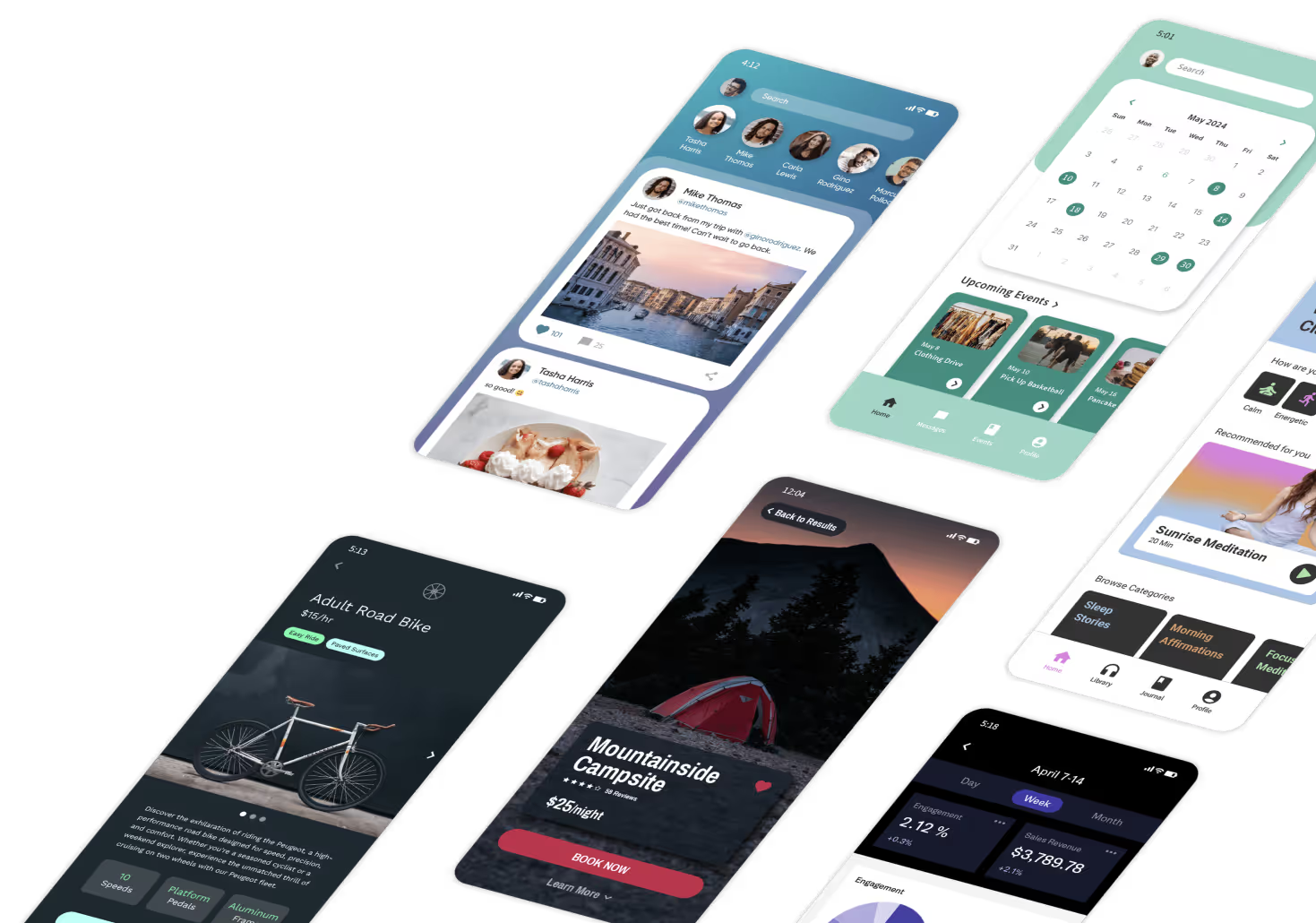
AI and microapps are reshaping how businesses operate by automating repetitive tasks, cutting costs, and enabling faster decision-making. These specialized tools focus on specific functions, integrate seamlessly with existing systems, and empower non-technical employees to create solutions using no-code platforms.
Platforms like Adalo, a no-code app builder for database-driven web apps and native iOS and Android apps—one version across all three platforms, published to the Apple App Store and Google Play, are making this transformation accessible to businesses of all sizes. By enabling non-technical teams to create custom microapps without writing code, these tools accelerate digital adoption and reduce dependency on IT departments.
Key takeaways:
- Efficiency Gains: AI automates up to 28% of support tasks, saving hundreds of hours monthly.
- Cost Savings: Companies reduce expenses by up to 30% in areas like invoice management and consumer banking.
- Faster Development: No-code tools cut app development time by 90%, enabling rapid deployment.
- Enhanced Collaboration: AI tools embedded in platforms like Slack streamline workflows and reduce task-switching.
- Modernizing Legacy Systems: AI layers modern interfaces over outdated systems, avoiding costly replacements.
AI-powered microapps are no longer optional - they’re becoming critical for staying competitive. Businesses can start small, automate key workflows, and scale as needed using platforms like Adalo, which simplifies app creation and integration.

AI and MicroApps Impact on Corporate Workflows: Key Statistics and ROI
What Are AI-Powered MicroApps?
MicroApps Defined
MicroApps are streamlined applications designed to tackle specific tasks. Unlike traditional enterprise software that tries to manage multiple processes simultaneously, microapps focus on one function - like processing expense reports, handling approval requests, or tracking inventory. They fit neatly into tools employees already use, such as Slack or Microsoft Teams, eliminating the need to jump between platforms during the workday.
The main difference lies in their scope. A full enterprise resource planning (ERP) system might oversee accounting, inventory, HR, and customer management all in one solution. In contrast, a microapp hones in on just one part of that system. This narrow focus allows businesses to refine operations without the need for a complete system overhaul. Their lightweight design makes them faster to develop, easier to maintain, and simpler for employees to adopt.
How AI Improves MicroApps
Adding artificial intelligence takes microapps from being simple task managers to becoming intelligent, adaptive tools. AI can handle repetitive tasks that would otherwise require manual effort. For example, an AI-driven ticketing system can automatically turn emails into tasks and assign issues to the right team, cutting manual coordination by 40–70%.
AI microapps also leverage machine learning and predictive analytics to enhance their functionality over time. In manufacturing, predictive maintenance microapps analyze machinery data to predict failures before they happen, reducing downtime by up to 50%. In customer support, AI chatbots can manage 60–80% of routine inquiries on their own, passing complex issues to human agents and shrinking response times from hours to minutes.
Benefits of AI-Powered MicroApps in Corporate Workflows
Automating Repetitive Tasks
AI-powered microapps take the grind out of repetitive tasks, freeing up time for more meaningful work. Imagine a financial environment handling 5 to 7 million transactions daily - AI tools can predict and resolve missing data in minutes, a task that would otherwise consume nearly six days every month.
In accounts payable, these microapps can read PDFs, assign GL codes, and flag incomplete data automatically. Over in manufacturing, predictive maintenance apps analyze machinery data to anticipate failures, cutting downtime by as much as 50%.
Better Collaboration and Productivity
Switching between tools and hunting for information eats into valuable work hours. In fact, 27% of employees cite meetings and email overload as their biggest productivity killers. AI microapps tackle this by embedding smart features directly into collaboration platforms. They summarize documents, prioritize emails, and auto-complete missing fields, reducing the mental strain of juggling tasks.
Take ActiveCampaign as an example. They developed an AI-powered workflow that tagged new signups by language and enrolled them in tailored onboarding sessions. The result? A 440% boost in webinar attendance and a 15% drop in early churn rates.
Faster Development at Lower Costs
No-code platforms are reshaping how companies build tools, slashing development time by 90% and costs by 40%. By 2026, 70% of new enterprise apps are expected to use low-code or no-code solutions, and nearly 60% of custom apps are already being created outside traditional IT departments.
With these platforms, business users - often called "citizen developers" - can design advanced AI tools in weeks, not months. Even professional developers benefit from AI-assisted tools like GitHub Copilot, completing coding tasks 55% faster. For instance, Popl implemented over 100 AI workflows to handle daily lead submissions, automatically sorting emails and routing qualified leads. This saved them $20,000 annually in labor costs.
Integration with Existing Systems
AI microapps are designed to work with what you already have. They connect seamlessly to legacy systems like MS SQL Server, PostgreSQL, and Airtable using REST APIs and webhooks. This means employees can interact with decades-old ERP or CRM systems through modern, AI-enhanced interfaces.
These tools also automate data updates and validation across platforms, breaking down silos and providing unified access to company data. With role-based permissions, organizations ensure secure access, allowing only authorized users to view or edit information. This level of integration sets the stage for practical corporate applications, which will be discussed in the next section.
Corporate Use Cases for AI MicroApps
Automating Approval Workflows
Managing approval processes through scattered email threads and spreadsheets often leads to inefficiencies and confusion. AI microapps tackle this problem by introducing centralized, intelligent routing systems that streamline approvals. These systems can automatically decide whether to approve a request or flag it for human intervention based on pre-set confidence thresholds.
For example, a low-risk request like a $50 order for office supplies might be approved automatically. On the other hand, a high-stakes decision, such as approving a $50,000 vendor contract, would be routed to the appropriate manager. Factors like dollar amount, cost center, or vendor type determine the routing process. Mobile interfaces allow managers to approve requests on the go, and if a manager is unavailable, the system automatically redirects the request to another decision-maker. This setup can cut invoice management costs by as much as 30%, while maintaining a detailed, audit-ready history. Every action is logged with timestamps and comments, ensuring compliance with regulations like GDPR, SOX, and SOC 2.
"By 2026, 70% of organizations will be required to demonstrate explainability in automated decision-making, especially where financial or legal risk is involved." - Gartner
Improving Customer Onboarding and Sales
AI microapps aren't just for internal workflows - they can also revolutionize customer-facing processes like onboarding and sales.
Sales teams often waste valuable time on manual tasks, such as researching leads and chasing follow-ups. AI microapps simplify this by automatically enriching lead data. For instance, when a prospect fills out a form, the system can instantly pull in details like company size, recent funding news, and LinkedIn updates. High-potential leads are flagged immediately, while irrelevant ones are filtered out before they clutter the CRM.
This automation not only reduces churn but also lowers labor costs by ensuring that sales teams focus their efforts on the most promising opportunities.
Modernizing Legacy System Interfaces
As businesses modernize their operations, legacy systems often lag behind, creating inefficiencies that are costly to maintain.
A staggering 70% of Fortune 500 software is over 20 years old, with companies dedicating 70% to 80% of their IT budgets to keeping these outdated systems running. AI microapps offer a practical solution by layering modern, user-friendly interfaces on top of legacy ERPs, mainframes, and CRMs. This approach avoids the expense and risk of a full system replacement.
For example, in 2026, Goldman Sachs used Generative AI as a "developer copilot" to refactor legacy code and create documentation, boosting engineering efficiency by 20%. Similarly, HSBC partnered with Google Cloud to scan 900 million transactions monthly, using an AI-powered interface to detect 2–4 times more suspicious activities while cutting false positives by 60%. The U.S. Office of Personnel Management also launched a two-year initiative to convert millions of lines of COBOL into modern programming languages. This allowed developers to focus on validating AI-generated output rather than performing manual translations.
This incremental modernization strategy, often called the "strangler-fig" approach, lets companies update one workflow at a time. It minimizes risk while gradually transforming outdated systems into agile, efficient platforms.
These 5 Easy AI Workflows Will Transform Your Company
How Adalo Helps Build AI-Powered MicroApps
Adalo simplifies the process of creating AI-driven microapps tailored for corporate workflows. By combining AI tools with a visual development approach, businesses can design functional tools in just days instead of months. From database setup to deployment across multiple platforms, Adalo handles the technical heavy lifting, allowing teams to focus on solving business challenges. This efficiency lets companies roll out smart, integrated solutions that boost productivity.
AI Builder for Rapid App Development
Ada, Adalo's AI builder, lets you describe what you want and generates your app. Magic Start creates complete app foundations from a description, while Magic Add adds features through natural language.
Adalo's Magic Start feature takes the complexity out of app creation. Describe your app idea in plain English - like "expense approval app for managers" - and the AI generates the entire foundation for you. This includes database tables, data fields, and initial screens, saving you from the most technical aspects of app building.
The platform processes more than 20 million data requests daily with an uptime exceeding 99%. Using Adalo can cut development time by as much as 90% compared to traditional coding methods. With low-code and no-code technologies expected to power 70% of new enterprise apps by 2026, platforms like Adalo are becoming essential. In fact, 87% of enterprise developers are already utilizing these tools.
Deploy to Multiple Platforms from One Build
Modern businesses need apps that work seamlessly across devices - desktop, mobile, and tablet. Adalo makes this possible with a single build that deploys to web, iOS, and Android. Any changes you make sync instantly across all platforms, eliminating the hassle of managing separate versions.
The Adalo Team explains it best:
"Adalo's agnostic builder lets you publish the same app to the web, native iOS, and native Android, all without writing a line of code or rebuilding." – The Adalo Team
While traditional app projects in 2026 are projected to cost around $90,780 per project, Adalo offers a cost-effective alternative, with plans starting at $36/per month. The platform also supports features like push notifications and offline access, making it ideal for field teams who need functionality without constant internet access.
Connect to Existing Data Sources
For businesses relying on legacy systems, ERPs, or spreadsheets, Adalo bridges the gap. It integrates with tools like Airtable, Google Sheets, Xano, and custom APIs. Even older systems without APIs can be connected through DreamFactory, allowing companies to modernize their workflows without replacing existing infrastructure.
For instance, Ricoh used low-code solutions to overhaul its processes, achieving a 253% ROI and full payback within seven months.
Adalo also works seamlessly with Zapier and Make, offering connections to over 5,000 third-party services and 450+ AI tools. This enables automated workflows across your tech stack, such as sending Slack updates, managing CRM entries, or flagging tasks in project management tools.
Future Trends in AI and MicroApps for Corporate Workflows
AI is evolving rapidly, moving away from rigid rules to dynamic agentic AI workflows that act more like digital coworkers. These systems don’t just follow commands - they analyze situations, weigh options, and adapt their actions to achieve goals. OpenAI CEO Sam Altman has even called autonomous agents "AI's killer function", highlighting their transformative potential as of May 2026.
One of the most exciting shifts is how natural language is becoming the go-to interface for creating microapps. Imagine an employee simply saying, "I need an expense tracker for field teams", and the AI builds the app’s foundation from that description. This shift is empowering non-technical employees - referred to as "citizen developers" - to automate workflows themselves. In fact, 44% of automated processes are now created by these citizen developers, bypassing traditional IT bottlenecks. By 2026, the number of companies with at least 40% of their AI projects in production is expected to double compared to late 2025.
AI has also become remarkably skilled at processing unstructured data. Whether it’s emails, lengthy documents, or social media mentions, AI can extract key insights and transform them into actionable information. For example, some systems are already classifying issues and suggesting solutions automatically, proving their value in real-world scenarios.
This capability is fueling a shift toward enterprise-scale automation, where companies coordinate AI-driven workflows across multiple departments. Over half of organizations now automate processes across four or more departments, and generative AI usage skyrocketed by 400–500% in 2026. Leading the way are revenue operations (48%) and IT operations (31%).
"With AI, and generative AI especially, the possibilities are tremendous. There is so much opportunity in so many aspects of our enterprises to automate across the board." – Rama Akkiraju, VP of AI, NVIDIA
Platforms like Slack are taking these advancements further by positioning themselves as "agentic operating systems." These platforms enable seamless collaboration between humans, data, and AI agents. With worker access to AI increasing by 50% in 2026, 66% of organizations report improved productivity and efficiency as their top benefits from adopting enterprise AI. The combination of AI and microapps is clearly reshaping how businesses operate, making workflows smarter and more efficient than ever before.
Conclusion
AI-powered microapps are changing the way businesses operate, breaking down long-standing barriers like drawn-out approval processes and disconnected data systems. The rise of low-code and no-code platforms is accelerating this shift, with projections indicating massive adoption by 2026. This isn’t just a trend - it’s becoming a necessity.
The numbers speak for themselves. No-code users report 2,560% ROI, development speeds increased by 90%, and 40% cost savings. These aren’t just statistics; they’re proof of how businesses can adapt faster to market demands. With citizen developers now outnumbering professional developers 4:1 in large enterprises, the people closest to the problems are empowered to create the solutions themselves.
"Keep your business ahead of the curve. With Adalo, any business owner can build their own app themselves." – Daniel Perry, Business Owner
Adalo makes this transformation accessible to everyone. Whether you’re automating internal workflows, revamping outdated systems, or building customer-facing apps, the platform allows you to build once and deploy to web, iOS, and Android - all from a single codebase. Starting at just $36/mo with a free tier for testing, Adalo dramatically lowers the entry barrier compared to traditional development costs, which often range from $50,000 to $500,000+.
In today’s fast-changing business environment, streamlined workflows and integrated data systems aren’t optional - they’re essential for staying competitive. Companies that adopt AI and microapps now will gain a significant edge over those that hesitate. Start small with one impactful workflow, test it, and expand from there. The tools are available. The only question is: will your business take the lead?
Related Blog Posts
- 2026 Trends in No-Code Workflow Automation
- How AI Transforms No-Code Prototyping
- Future of SaaS: AI-Powered Workflow Automation
- Top 7 Workflow Automation Tools for Multi-Step Processes
FAQs
How do AI-powered microapps make corporate workflows more efficient?
AI-powered microapps streamline corporate workflows by automating tedious tasks such as data entry, report generation, and scheduling. By cutting down on manual work and minimizing errors, they free up teams to concentrate on strategic and creative projects, leading to greater productivity.
These microapps also simplify data integration across platforms, ensuring real-time updates and smoother team collaboration. Thanks to no-code tools, businesses can design and launch custom workflows quickly, without relying heavily on IT support. This makes operations faster, more flexible, and better equipped to adapt to shifting demands.
What are the cost advantages of using no-code platforms for building apps?
Using no-code platforms for app development can save businesses a substantial amount of money. These tools simplify the development process, slashing the time it takes to build apps by up to 90%. That means fewer labor hours, lower costs, and quicker deployment - helping companies stay competitive without requiring deep coding knowledge.
Another advantage? No-code platforms reduce dependence on costly IT resources and lengthy implementation timelines. They give non-technical teams the power to create and update apps on their own, eliminating the constant need for specialized developers. Plus, built-in automation features can handle repetitive tasks, cutting operational expenses and improving productivity. For companies aiming to adapt and innovate efficiently, no-code solutions offer a smart, budget-friendly approach.
How can businesses use AI-powered microapps with their existing systems?
Businesses can now seamlessly connect AI-powered microapps with their existing systems using no-code and low-code platforms. These platforms simplify the process of integrating modern tools with older workflows, allowing companies to build custom microapps that handle repetitive tasks, enable data sharing across systems, and boost team collaboration. The best part? It doesn't require heavy IT involvement or a complete overhaul of current infrastructure.
By leveraging APIs or automation platforms, AI tools can slot directly into existing workflows. This integration helps businesses streamline operations and improve decision-making, all while keeping their current systems intact. It's a practical way to adopt AI-driven solutions without disrupting established processes.