Why Adalo Is the Right Platform for Employee-Built Apps
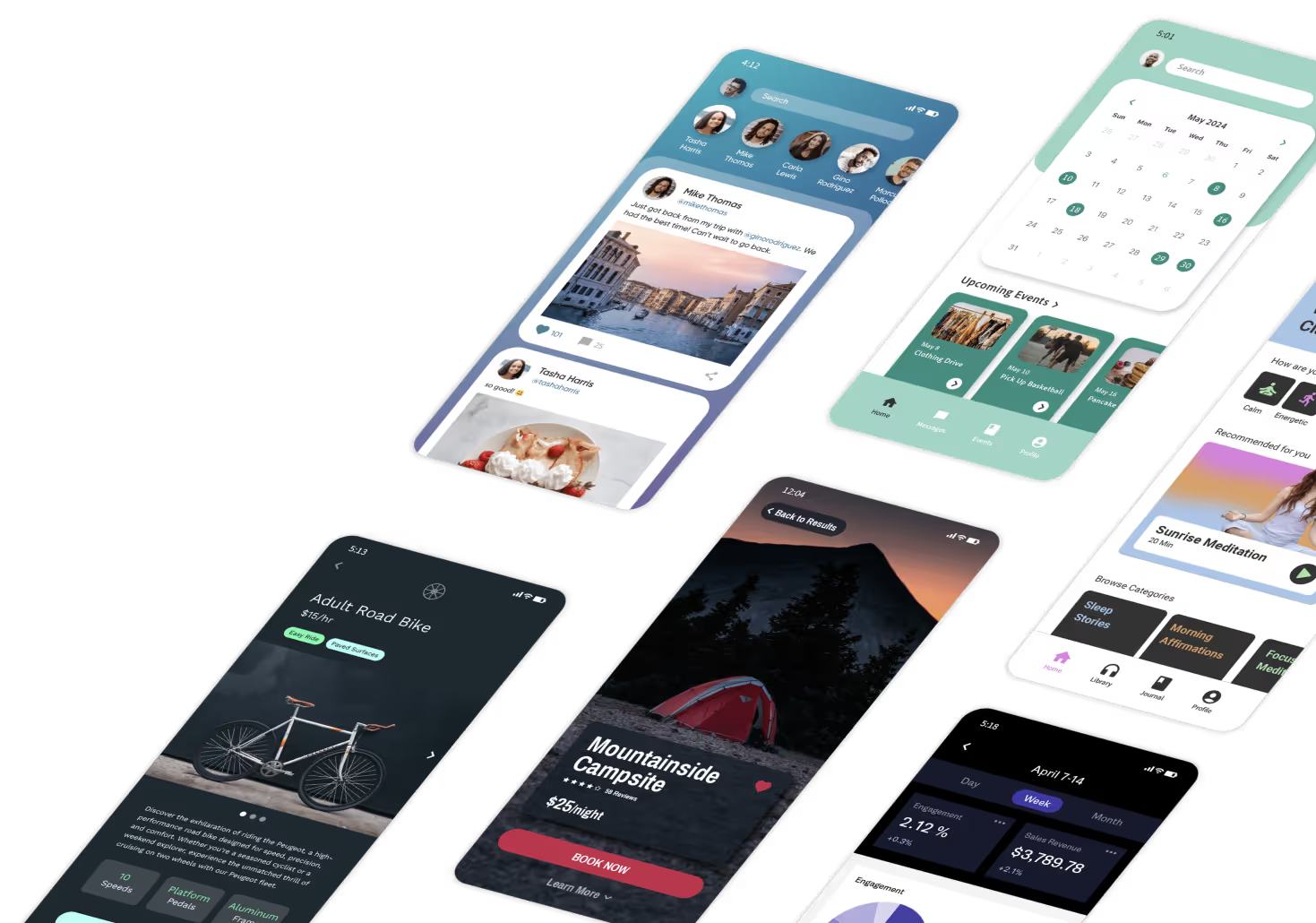
When employees have ideas for apps that could streamline their work, they need a platform that's powerful enough to handle real business needs yet simple enough for non-developers to use. Adalo is a no-code app builder for database-driven web apps and native iOS and Android apps—one version across all three platforms, published to the Apple App Store and Google Play. This means your team members can create professional-grade tools that work everywhere their colleagues need them, without writing a single line of code.
The ability to publish directly to app stores matters when you're building internal tools that employees will use daily on their phones. Push notifications can alert team members to urgent tasks, new approvals, or schedule changes—keeping everyone connected and responsive. By putting this capability in the hands of your workforce, you unlock innovation from the people who understand your operations best.
What if your employees could solve their own workflow problems without waiting months for IT or spending thousands on developers? The people closest to daily operations often have the clearest vision for tools that would make their jobs easier—they just haven't had the means to build them. That's changing fast.
AI-powered platforms are putting app development directly in the hands of non-technical teams. Adalo is an AI-powered app builder that lets you create database-driven web apps and native iOS and Android apps—published to the App Store and Google Play—from a single editor. This means your HR coordinator, operations manager, or sales lead can turn an idea into a working app in days, not months.
In this guide, you'll learn how to identify the workflows that need custom solutions, empower employees to build apps that address real pain points, and create a culture where innovation happens at every level of your organization. Let's start by finding where the biggest opportunities lie.
Why Adalo Is the Right Tool for Employee-Built Apps
When employees have ideas for apps that could streamline their work, they need a platform that's powerful enough to handle real business needs yet simple enough for non-developers to use. Adalo is an AI-powered app builder for database-driven web apps and native iOS and Android apps—one version across all three platforms, published to the Apple App Store and Google Play. This means your team members can create professional-grade tools that work everywhere their colleagues need them, without writing a single line of code.
The ability to publish directly to app stores matters when you're building internal tools that employees will use daily on their phones. Push notifications can alert team members to urgent tasks, new approvals, or schedule changes—keeping everyone connected and responsive. By putting this capability in the hands of the people who understand the problems best, you unlock innovation that IT backlogs and budget constraints have traditionally blocked.
How I built an app in 1h with NO CODE (as a designer)
Identify Employee Needs and App Use Cases
To make the most of rapid app development, it's essential to focus on workflows that genuinely need improvement. Instead of guessing, take a structured approach to identify processes that waste time, lead to errors, or frustrate your team.
Find Pain Points in Current Workflows
Start by mapping out each process to uncover bottlenecks, repetitive tasks, and common mistakes. Ask specific questions like, "What slows things down?" or "Where do errors typically happen?" to gather actionable feedback from the people directly involved.
The impact of inefficient workflows is staggering. Studies show these inefficiencies can drain up to 30% of annual revenue. On average, employees spend more than 3 hours each day on repetitive tasks like data entry—tasks that could easily be automated. Even more alarming, 73% of employees may consider leaving if workplace frustrations aren't addressed.
To dig deeper, use anonymous surveys and one-on-one conversations to collect both numbers and personal insights. Pay attention to tech silos—situations where apps don't communicate, forcing employees to manually transfer data. And if a process takes weeks when it should take days, you've likely found a prime candidate for automation.
Here's a real-world example: In 2026, Anthos|Home partnered with Orr Group to streamline how housing voucher recipients in New York were matched with available apartments. By analyzing workflows, they identified over 50 automation opportunities and implemented more than 30 of them. This saved 1,500 administrative hours annually and drastically reduced manual data entry.
Define Specific Use Cases for Custom Apps
Once you've pinpointed the pain points, turn them into practical app solutions. Start by focusing on manual or paper-based processes—these are often the easiest to digitize. Workflows managed through tools like Google Sheets or Excel are also strong candidates, especially when teams struggle with version control or lack real-time access.
Some common use cases include HR and administrative apps for tasks like leave approvals, automated payslip access, and onboarding software for small business and new hires. Operations teams often benefit from data tracking tools, inventory management systems, and automation for repetitive processes. For customer-facing needs, apps like booking systems for appointments or custom ordering platforms can address specific business challenges.
For example, FLEX STL, a fitness studio, uses a custom Adalo app to let clients book classes, connect with coaches, and stay updated—all from their mobile devices. Similarly, Washington University in St. Louis created the "Beyond Boundaries" app using Adalo. This app helps students explore educational opportunities, find events, and connect with peers.
To prioritize app ideas, use a four-quadrant grid that measures Impact versus Urgency. This helps you decide which issues to tackle first. Focus on tasks that are repetitive, time-consuming, and follow clear steps with few exceptions—like preparing forms or sending documents for signatures.
Use Adalo as Your AI-Powered App Builder
After identifying the workflows that need improvement, the next step is finding a platform that allows your team to create their own solutions, even without technical expertise. Adalo is specifically designed to help non-technical users build production-ready apps. Here's a closer look at what the platform offers.
Adalo Features for Non-Technical Users
Adalo uses a drag-and-drop visual builder, making it as intuitive as tools like PowerPoint or Canva. Employees can easily add elements like buttons, text boxes, and images to their app's canvas—no coding required. The visual builder can display up to 400 screens at once on a single canvas, giving teams a comprehensive view of their entire app architecture.
Ada, Adalo's AI builder, lets you describe what you want and generates your app. Magic Start creates complete app foundations from a description, while Magic Add adds features through natural language.
To make things even easier, Adalo includes AI-assisted tools to kickstart app development. Magic Start generates complete app foundations from simple descriptions—tell it you need a leave request app for your HR team, and it creates your database structure, screens, and user flows automatically. What used to take days of planning happens in minutes. Magic Add lets users add features by describing what they want in natural language, while Magic Text simplifies workflows by automatically linking database information to user interface components.
Adalo doesn't just focus on design; it also simplifies the backend. It provides a hosted backend to handle user authentication, data storage, and other essential operations. With its built-in, spreadsheet-like interface for managing databases, your team doesn't need to worry about setting up servers or managing external databases. For teams already using spreadsheets, SheetBridge enables users to turn a Google Sheet into an actual database—the easiest path to app building without database-related learning curves.
The platform supports integrations with over 1,000 third-party tools and features a component marketplace with pre-built add-ons to expand functionality. By combining an easy-to-use interface with powerful backend tools, Adalo ensures that non-technical users can design and deploy apps effortlessly.
Build Once, Deploy to Web, iOS, and Android
Adalo takes the hassle out of multi-platform app development. With its single-codebase approach, your employees can build an app once and publish it across the web, the Apple App Store, and the Google Play Store at the same time. There's no need to create separate versions for each platform or hire specialized developers.
When updates are needed, they're applied universally. For example, an HR manager creating a leave approval app can deploy it as a web tool for desktop users and as native mobile apps for on-the-go employees—all from the same project. These updates sync automatically across all platforms, ensuring consistency everywhere.
No matter how users access the app—via iPhone, Android, or a desktop browser—they'll enjoy a seamless and consistent experience. Adalo is built to deliver fully functional, production-ready apps, whether as Progressive Web Apps (PWAs) or native apps, without requiring separate builds.
Scalability Without Limits
Following the Adalo 3.0 infrastructure overhaul in late 2025, the platform is now 3-4x faster with modular infrastructure that scales to serve apps with millions of monthly active users. Paid plans include no database record caps—your employee-built apps can grow without hitting artificial ceilings. With the right data relationship setups, Adalo apps can scale beyond 1 million monthly active users.
The platform's X-Ray feature identifies performance issues before they affect users, helping teams maintain app speed as usage grows. Unlike app wrappers that hit speed constraints under load, Adalo's purpose-built architecture maintains performance at scale. Over 3 million apps have been created on the platform, processing millions of data requests daily with 99%+ uptime.
Train Employees to Use Adalo
Once you've decided to use Adalo as your app-building platform, the next step is getting your team up to speed. The platform is designed with non-technical users in mind, making it easier to train employees. Focus on hands-on learning and self-paced materials to help your team feel confident quickly.
Run Hands-On Tutorials and Workshops
Kick things off with a structured workshop that introduces employees to Adalo's three main pillars: Components (the visual elements of your app), Actions (how the app responds to user interactions), and the Database (where app data is stored). These form the foundation of every app, so getting familiar with them early is key.
Plan a 2–3 hour session where participants can learn these basics while building and testing a simple app. For example, they could create an employee task tracker or a team feedback form. Keep the session interactive and include breaks to maintain focus and engagement.
Adalo's App Academy is another great tool. It offers a "Getting Started" course with 20 short videos, which take about 40 minutes to complete. Employees can also try clone tutorials, where they build simplified versions of popular apps like Instagram or Twitter. These exercises help them understand how to piece together real-world features.
Pair these workshops with self-paced resources to ensure employees have ongoing support as they continue to learn.
Use Adalo's Documentation and Support Resources
Point your team to Adalo's knowledge base at learn.adalo.com. This resource is packed with step-by-step guides, video tutorials, component references, and templates to help employees learn at their own pace. It covers everything from app design to publishing on web, iOS, and Android, including how to build a no-code web app.
For troubleshooting and collaboration, encourage employees to explore Adalo's Community Forum at forum.adalo.com. With over 10,000 members, the forum is a hub for sharing templates, solutions, and tips. Employees can search for answers to common questions—like setting up database relationships or configuring integrations—or post their own questions to get help from experienced users.
Adalo also provides direct customer support through live chat, email, and a searchable help center, ensuring your team has quick access to answers when needed.
Set Up Governance and Security in Adalo
Giving employees the tools to build apps doesn't mean letting go of control. With the right governance policies in place, you can protect sensitive data while encouraging innovation. Adalo offers built-in security features that allow you to manage access without slowing down your team.
Here's how you can set up these controls using Adalo's role-based tools.
Configure User Roles and Permissions
Start by adding a Role attribute to your Users collection. This can be a Text or Dropdown field to classify users—common categories include Admin, Standard, and Guest. This attribute determines access levels within your app.
Next, configure Collection Permissions by selecting the Shield and Key icon in your database records. This is where you control who can access specific data. Permissions can be set to "Everyone", "Only Logged In Users", "Only the Record Creator", or "Nobody." Unlike visibility rules, which simply hide elements on the interface, Collection Permissions ensure that unauthorized users can't access the data at all—it won't even be sent to their device.
For example, Adalo automatically secures sensitive fields like Email, Password, and Full Name in the Users collection by default, limiting access to "Only the Record Creator". Additionally, you can control access at the property level for even greater precision.
To further secure your app, use conditional actions to limit sensitive operations. For instance, a "Delete Record" button should only work if the logged-in user's role is set to "Admin." Be sure to assign a default role during signup to prevent new users from accessing restricted areas before their permissions are properly configured.
Here's a quick comparison of Visibility Rules and Collection Permissions to help you decide when to use each:
| Feature | Visibility Rules | Collection Permissions |
|---|---|---|
| Primary Function | Hides UI elements | Secures data at the database level |
| Data Security | Data is still sent to the device but hidden | Data is not sent to unauthorized users |
| Configuration | Applied to individual components or screens | Managed within the Database Collections menu |
| Best Practice | Use for improving user experience | Use for securing sensitive data and ensuring compliance |
While roles and permissions are great for managing day-to-day operations, Adalo Blue offers advanced security features for organizations with stricter requirements.
Use Adalo Blue for Enterprise Security
For companies with high compliance demands or complex system integrations, Adalo Blue provides enterprise-level security and infrastructure. This includes options like single-tenant or private cloud hosting to ensure complete data isolation and meet regulatory standards.
Adalo Blue supports Single Sign-On (SSO), letting employees log in using their existing corporate credentials instead of managing separate accounts. It also provides 24/7 monitoring to ensure maximum uptime and security.
A standout security feature is that Adalo automatically expires authentication tokens every 20 days, requiring users to re-authenticate. This reduces the risk of long-term session hijacking and ensures only authorized users maintain access. Additionally, Adalo Blue integrates with DreamFactory, enabling secure connections to legacy systems and ERPs, even if those systems lack APIs.
Another advantage? Changes to database permissions take effect immediately—there's no need to republish your app. As your apps evolve, conduct regular audits to ensure permissions remain aligned with updated security policies. It's also a good idea to set up test accounts for each user role to verify that access and functionality are correctly restricted.
Build a Culture of Innovation and Iteration
Security and governance are crucial, but they're just the starting point. The real breakthroughs happen when employees feel free to experiment and push boundaries. Adalo makes this possible by enabling unlimited test app builds and saving up to 10 design versions. This allows teams to try out new layouts and easily revert to earlier versions if needed.
Once you've established a secure and well-structured app development process, the next step is creating an environment where innovation thrives naturally.
Create Feedback Loops for App Improvements
Building the app is just the beginning. To truly refine and enhance it, you'll need structured ways to gather and act on feedback. Adalo simplifies this with its "Share" button, which generates links or QR codes that can be shared via SMS or email. This lets colleagues test the app immediately—even if they don't have an Adalo account. For more extensive testing, you can integrate with platforms like Apple TestFlight or Google Play Console to gather insights from up to 10,000 testers.
Keep a close eye on the Analytics tab to monitor user activity and screen engagement. This data can help pinpoint where users might encounter difficulties or which features are making the biggest impact. To capture real-time feedback, consider adding in-app tools like forms, chat features, or star rating systems.
With Adalo's instant sync feature, updates are pushed across web, iOS, and Android platforms without requiring redeployment. This means you can quickly implement changes and close the feedback loop more efficiently.
"When people give you feedback, incorporate the needed changes into your dashboard. Doing this will ensure your dashboard provides a seamless user experience while running without a hitch." - Adalo Team
Support and Recognize Employee Contributions
Acknowledging employee efforts can fuel even more innovation. When someone creates an app that boosts team efficiency or solves a problem, celebrate their achievement. Highlight their work during company meetings or create an internal showcase similar to Adalo's "Made in Adalo" gallery.
You could also allocate budgets for premium Adalo plans—starting at $36/month for the Starter Plan with unlimited usage and no record caps—so employees can access advanced features like Progressive Web App publishing and app store deployment. Unlike platforms with usage-based charges that create unpredictable bills, Adalo's straightforward pricing means no bill shock as your apps grow.
Encourage employees to explore the Adalo App Academy, which offers over 70 courses on design, building, and scaling apps. For more complex challenges, connect them with Adalo Experts who can help tackle technical roadblocks. The Adalo Community Forum is another invaluable resource, connecting employees with makers who share templates, solve problems, and exchange ideas. By combining recognition with access to these tools and communities, you'll foster a culture where innovation becomes second nature.
"Adalo democratizes creativity, and has enabled Lloyd to build a product as two non-technical founders. We are now able to better serve our members, and bring a positive benefit to our members." - Nikki Gusz, Maker
How Adalo Compares to Alternative Platforms
When evaluating platforms for employee-built apps, understanding the differences between options helps you make the right choice for your organization's needs.
Adalo vs. Bubble
Bubble focuses on web applications with a mobile wrapper option, starting at $59/month with usage-based Workload Unit charges, limits on app re-publishing, and record restrictions. While Bubble offers extensive customization, this flexibility often results in slower applications that struggle under increased load—frequently requiring hired experts to optimize. Claims of millions of MAU on Bubble are typically only achievable with significant expert assistance.
Adalo's approach differs fundamentally: $36/month gets you unlimited usage, no record caps on paid plans, and true native iOS and Android apps (not web wrappers) that publish directly to app stores. One app version automatically updates across web, Android, and iOS—no separate deployments needed.
Adalo vs. FlutterFlow
FlutterFlow is a low-code platform designed for technical users, not a true no-code solution. Users must set up and manage their own external database, which requires significant learning complexity. Suboptimal database setup creates scale problems, spawning an ecosystem of experts because so many users need help and end up spending significant sums chasing scalability.
FlutterFlow's builder is also limited in view—users can only see 2 screens at once, slowing development speed. Pricing starts at $70/month per user for app store publishing, but this still doesn't include a database, which must be sourced, set up, and paid for separately. Adalo includes the database, handles hosting, and lets teams see up to 400 screens on one canvas.
Adalo vs. Glide
Glide is heavily format-focused and restricted to set templates. This makes it fast to build with, but creates generic, simplistic apps with limited creative freedom. Glide is a go-to for spreadsheet-based apps, but Adalo's SheetBridge offers similar convenience—turning a Google Sheet into an actual database—while providing far more design flexibility.
Glide pricing starts at $60/month for custom domain capability, but remains limited by app updates and data record rows that attract additional charges. Critically, Glide does not support Apple App Store or Google Play Store publishing—a significant limitation for employee apps that need mobile distribution.
Adalo vs. Softr
Softr pricing starts from $167/month to publish a Progressive Web App, still restricted by records per app and records per datasource. Like Glide, Softr does not support Apple App Store and Google Play Store publishing, or native iOS and Android app creation. Softr is looked to for spreadsheet app building, provided web app restrictions are acceptable and the higher price point fits the budget.
Conclusion
Give your team the tools to create production-ready apps without overhauling IT systems or blowing the budget. Adalo's drag-and-drop platform is designed to tackle real-world business challenges—whether it's building HR dashboards or workflow trackers—in just days. With built-in databases, AI-assisted building features like Magic Start and Magic Add, and the ability to deploy across platforms from a single build, the platform makes app creation accessible and efficient.
Companies have reported cutting process times by 40–60% and reducing IT ticket backlogs significantly. By 2026, an estimated 70% of new enterprise applications will rely on low-code or no-code technologies, while nearly 60% of custom apps are already being developed outside traditional IT departments.
To get started, identify a specific workflow issue—like scheduling, inventory tracking, or client communication—and use Adalo's free tier to prototype a solution. Host a hands-on workshop with your team, leveraging Adalo's 70+ courses available in the App Academy. Once your prototype is ready, deploy it seamlessly to the web, iOS, and Android. With plans starting at just $36/month and no usage-based charges, this approach is far more cost-effective than traditional app development. It's an affordable way to foster a culture where everyone has a role in driving innovation.
This shift eliminates the bottleneck of waiting for developers, embedding innovation into your company's daily operations instead of treating it as an occasional project. Real-world success stories show how non-technical founders have built thriving apps using the platform's user-friendly tools.
Related Blog Posts
- How to Launch Your First Mobile App Without Coding
- Build a No-Code Ticketing System in 3 Days
- Ultimate Guide to No-Code MVP Prototyping
- How To Build An Internal Employee Message Board App
FAQ
Why choose Adalo over other app building solutions?
Adalo is an AI-powered app builder that creates true native iOS and Android apps from a single codebase. Unlike web wrappers, it compiles to native code and publishes directly to both the Apple App Store and Google Play Store. With features like Magic Start for instant app foundations and unlimited database records on paid plans, it handles the hardest part of launching an app—distribution—automatically.
What's the fastest way to build and publish an app to the App Store?
Adalo's drag-and-drop interface combined with AI-assisted building features like Magic Start and Magic Add lets you go from idea to published app in days rather than months. The platform handles the complex App Store submission process, so you can focus on your app's features and user experience instead of wrestling with certificates, provisioning profiles, and store guidelines.
How can employees identify which tasks to streamline with no-code apps?
Employees should map out current workflows to identify repetitive, manual tasks like data entry, approvals, or status updates. Focus on processes that waste time, cause errors, or rely on spreadsheets without real-time access. Starting with a quick prototype in Adalo allows teams to test and refine solutions before scaling.
What security features does Adalo offer for employee-built apps?
Adalo provides robust security through role-based permissions, collection-level data access controls, and automatic token expiration every 20 days. For enterprise needs, Adalo Blue offers single-tenant hosting, SSO integration, and 24/7 monitoring to meet strict compliance requirements while still enabling employee innovation.
Which is more affordable, Adalo or Bubble?
Adalo starts at $36/month with unlimited usage and no record caps on paid plans. Bubble starts at $59/month with usage-based Workload Unit charges, limits on app re-publishing, and record restrictions. Adalo's straightforward pricing means no bill shock as your apps grow, while Bubble's usage-based model can create unpredictable costs.
Which is better for mobile apps, Adalo or Glide?
Adalo is significantly better for mobile apps because it creates true native iOS and Android apps that publish directly to the App Store and Play Store. Glide does not support Apple App Store or Google Play Store publishing at all—a critical limitation for employee apps that need mobile distribution.
Can employee-built apps be updated across all platforms simultaneously?
Yes, with Adalo's single-codebase approach, updates made to an app are automatically synced across web, iOS, and Android platforms without requiring separate deployments. An HR manager can push improvements to their leave approval app and have all users—whether on desktop or mobile—see the changes instantly.
What training resources are available to help employees learn Adalo?
Adalo offers extensive learning resources including the App Academy with 70+ courses, a knowledge base at learn.adalo.com with step-by-step guides, and a community forum with over 10,000 members. Employees can complete the Getting Started course in about 40 minutes and practice with clone tutorials that recreate features from popular apps.
How does Adalo handle scalability for growing apps?
Following the Adalo 3.0 infrastructure overhaul in late 2025, the platform is 3-4x faster with modular infrastructure that scales to serve apps with millions of monthly active users. Paid plans have no database record caps, and the X-Ray feature identifies performance issues before they affect users.
Do I need coding experience to build apps with Adalo?
No coding experience is required. Adalo's visual drag-and-drop builder is described as "easy as PowerPoint," and AI features like Magic Start generate complete app foundations from simple descriptions. Non-technical employees can create professional-grade apps without writing a single line of code.