Why Adalo Works for Building Your Own Calendar App
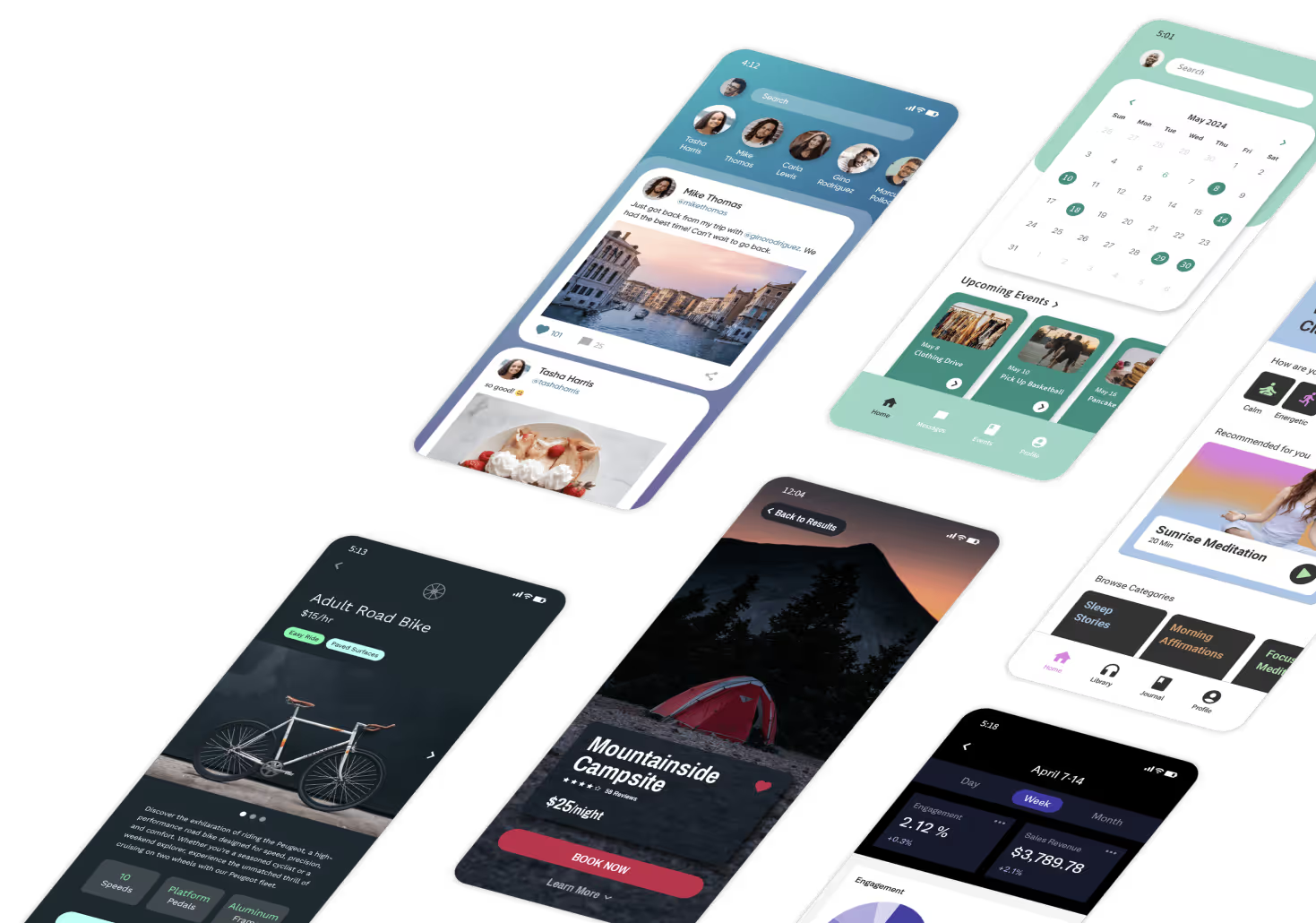
Adalo is a no-code app builder for database-driven web apps and native iOS and Android apps—one version across all three platforms, published to the Apple App Store and Google Play. This makes it the perfect choice for creating a custom digital calendar app that works seamlessly across Samsung devices and all Android phones, without requiring any programming expertise.
Having your calendar app published to the Google Play Store means users can easily download and install it, receive push notifications for upcoming events and reminders, and access their schedules from any device. Whether you're building a personal productivity tool or a scheduling solution for your team, Adalo's visual builder and database capabilities give you everything you need to create a calendar app tailored to your exact requirements.
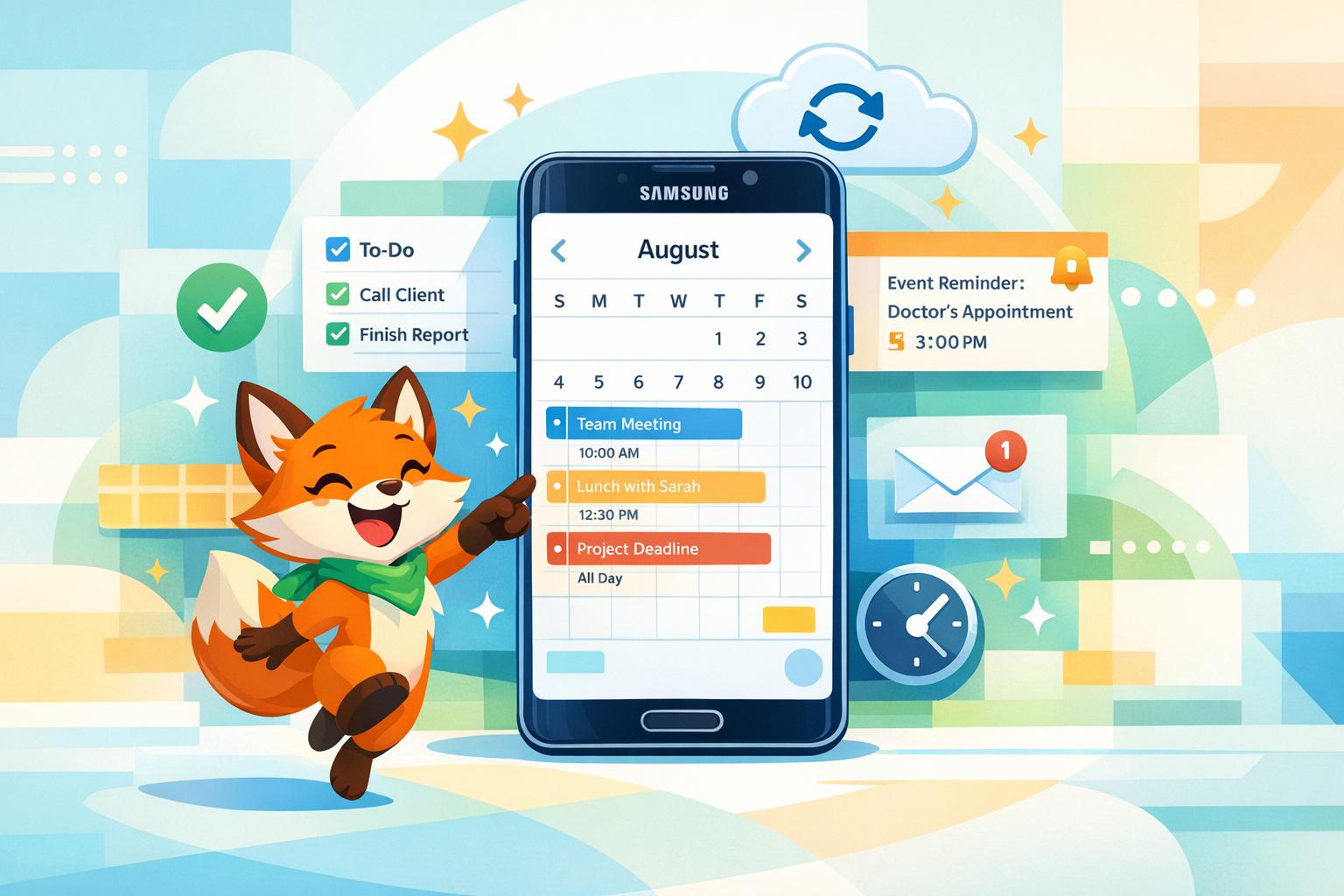
Managing your schedule shouldn't mean settling for a one-size-fits-all calendar app. Whether you need specialized event categories, custom reminders, or unique integrations that stock Samsung and Android calendars simply don't offer, building your own digital calendar app puts you in complete control—and it's more achievable than you might think.
Adalo, an AI-powered app builder, lets you create database-driven web apps and native iOS and Android apps—published to the App Store and Google Play—from a single editor. This means you can build a fully functional, customized calendar app and have it live on the Google Play Store in weeks, all without writing a single line of code. You'll design your interface with drag-and-drop tools described as "easy as PowerPoint," set up a database to store events and user information, and integrate with services like Google Calendar through tools like Zapier.
In this guide, you'll learn exactly how to build and publish your own Android calendar app using Adalo—from setting up your account and designing screens to configuring your database and submitting to the Google Play Store. Whether you're creating a personal productivity tool or a scheduling solution for your business, you'll have everything you need to bring your calendar app idea to life.
Why Adalo Works for Building Your Own Calendar App
Adalo is an AI-powered app builder for database-driven web apps and native iOS and Android apps—one version across all three platforms, published to the Apple App Store and Google Play. This makes it the ideal solution for creating a custom digital calendar app that works seamlessly on Samsung devices and any Android phone, without the complexity of traditional coding.
Having your calendar app published directly to the Google Play Store means your users can download and update it just like any other app, complete with push notifications for event reminders and real-time syncing across devices. Whether you're building a personal scheduling tool or a team coordination system, Adalo gives you the flexibility to design exactly the calendar experience you need—then put it in the hands of users everywhere.
Setting Up Your Adalo Account and Project
Create Your Adalo Account
Head over to Adalo.com, click on "Get Started for Free," and sign up by entering your name, email, and password. The free plan allows you to build and test the functionality of your calendar app without any upfront cost.
If you want to publish your app on Google Play, you'll need to upgrade to a paid plan. Adalo's paid plans start at $36 per month and include unlimited usage with no app action charges—meaning no surprise bills as your user base grows. Keep in mind, Google also charges a $25 one-time developer fee for publishing apps. Planning to sync with Google Calendar using Zapier? You'll need the Pro plan or higher to enable third-party integrations.
Once your account is set up, you're ready to dive into creating your first app.
Start Your First App Project
With your account activated, kick off your project by clicking on "Create a New App" at the bottom of the App Switcher. You can either build your app from scratch or start with a pre-designed template. For a calendar app, the "Appointments" template is a great option—it comes with pre-built login, signup, and booking screens, saving you time. If you prefer full control over the design, starting from scratch is the way to go.
Choose a name for your app that clearly communicates its purpose, such as "MyCalendar" or "Samsung Calendar Pro." This helps users instantly understand what your app is about. Next, set up your branding by selecting colors and fonts that align with your vision. For an Android-native feel, consider using Roboto as your font and Material Design blue (#2196F3) for your primary color. If your app is intended specifically for Samsung and Android phones, select the "Mobile Only" layout. Alternatively, choose "Responsive" if you want it to work seamlessly on tablets and foldable devices.
Once inside the Adalo editor, use the dashboard on the left to add screens, set up your database (like Events), and tweak the overall theme. The visual builder can display up to 400 screens at once on a single canvas, giving you a comprehensive view of your entire app architecture—something particularly useful as your calendar app grows in complexity. To incorporate calendar functionality, install the Calendar component from the Adalo Marketplace. Finally, click on the "Preview" button and select "Samsung Galaxy" from the device dropdown to see how your app looks on an Android device.
Designing the Database Structure
Plan Your Database Collections
A strong scheduling app starts with a well-thought-out database. In Adalo, collections serve as the backbone of your data, with key elements like Users, Events, and Reminders. Every Adalo app includes a default Users collection for authentication, which you can customize to suit your app's needs. For example, you might add fields like "Time Zone" or "Profile Image." To support a functional calendar, you'll need to create an additional collection for Events.
Make sure to set up a one-to-many relationship between Users and Events. This allows one user to create or host multiple events, while each event is tied to a single creator. Adalo automatically links these relationships, but it's a good idea to rename them for clarity. For instance, in the Users collection, you might rename it to "Events Created", while in the Events collection, you could call it "Host."
With paid plans offering unlimited database records, you don't need to worry about hitting storage caps as your calendar fills with events over months and years. This removes a common constraint found in other platforms where record limits force difficult decisions about data retention.
Once your collections are in place, you can start adding fields that make event scheduling smooth and efficient.
Add Fields for Event Scheduling
To make your scheduling app functional, add the following fields to the Events collection:
- Date & Time fields for the start and end of an event.
- Title (Text) to name the event.
- Description (Text) for additional details.
- Location (Text) for physical addresses or meeting links.
- Status (Text) to indicate whether the event is Confirmed or Cancelled.
For reminders, include a "Reminder Time" field (Number) to store how many minutes before the event the notification should be sent (e.g., 15, 30, or 60 minutes). Add a "Reminder Sent" field (True/False) to track whether the notification has already been delivered. If you want to support recurring events, include a "Recurring Options" field (Text) with values like "weekly" or "monthly."
| Collection | Essential Fields | Property Type |
|---|---|---|
| Events | Title, Start Date/Time, End Date/Time, Location, Description, Status, Reminder Time | Text, Date & Time, Date & Time, Text, Text, Text, Number |
Once your event data is set up, you can move on to enabling calendar syncing as part of your mobile app development.
Set Up Calendar Syncing
To integrate your app with Google Calendar on Android devices, use automation tools to trigger a "Create Calendar Event" action whenever a new record is added. Keep in mind that Adalo's Pro plan or higher is required for third-party integrations.
For a simpler solution, consider using the Agical API (ics.agical.io). This tool generates downloadable calendar invites. By formatting the URL with Magic Text for details like the subject, start time, and end time (using the "No Formatting" option), you can create an "Add to Calendar" button. This feature lets users easily add events to their native Samsung or Google calendars without the need for complex API setups.
Adalo's platform allows you to deploy your app as a progressive web app (PWA) or as native builds for iOS and Android. This flexibility means you can update your app across all platforms without needing to rebuild it for each one—a single codebase automatically updates web, iOS, and Android versions simultaneously.
How to Add an Add to Calendar Button
Building the Main App Screens
With your database set up, it's time to design the key screens for your app.
Create the Event List Screen
Start by adding the Calendar component from the Adalo Marketplace. You can find it in the left panel under the "+" button. This component provides users with a clear monthly or weekly view of their scheduled events. In the component settings, link the Calendar to your Events collection and map the fields for Start Date/Time and End Date/Time. You can also decide whether multi-day events appear as dots under each day or as a bar stretching across the relevant dates.
Below the calendar, include a Simple List component to show events in a chronological agenda format. Connect this list to your Events collection and configure it to display only events with start times in the future, sorted by start time in ascending order. Use Magic Text to show the event title as the main heading and the start time or duration as the subtitle for each list item, ensuring you write clear UX copy to guide your users. Add an "Add to Calendar" button for easy syncing, using the Agical API to link event details to users' native calendars.
To ensure a smooth user experience, preview the app using the "Samsung Galaxy" device profile. This will help you check that touch targets and spacing are optimized.
Finally, give users a simple way to add events by creating a dedicated form.
Add an Event Creation Form
Design a new screen specifically for event creation and place a Form component on it. Link the form to your Events collection and configure it to "Create New Event." Include fields for Event Title, Start and End Date/Time, Description, and Location. Add a Number or Dropdown field to let users set a reminder time, with options like 15, 30, or 60 minutes.
Set the form's submit button to create a new record and navigate back to the event list. If you're using Agical for calendar syncing, the reminder time will automatically integrate when users click "Add to Calendar." For Android users, you can also enable push notifications that trigger based on the selected reminder time, adding a more native feel to the app.
The drag-and-drop interface makes form creation intuitive—position fields exactly where you want them, adjust sizing with simple controls, and preview changes in real-time. What might take hours of coding in traditional development happens in minutes with visual tools.
Build the Event Detail View
Create a new screen called "Event Details" and set it up to receive data from the selected event in your list. Use Text components to display details like Title, Description, Date/Time, and Location by linking them with Magic Text to the appropriate database fields. If your events include images or banners, add an Image component and connect it to the event's image property.
Include an Edit button that opens a pre-filled form for quick updates, and a Delete button that triggers a confirmation modal for removing events. For virtual events, add a "Join Meeting" button that opens the meeting link in a browser. Use conditional visibility to ensure this button only appears shortly before the event begins. Lastly, add a clearly visible Back button to make navigation back to the event list easy.
This detailed view not only enhances the app's usability but also ensures users can efficiently manage their events. Adalo's platform allows you to deploy your app as a Progressive Web App (PWA) and natively to both iOS and Android app stores, all without needing to rebuild for each platform. This versatility is why it's often ranked among the best no-code mobile app builders for cross-platform development.
Optimizing for Android and Samsung Devices
Once you've built your app screens, it's time to ensure they display and function smoothly across various Android devices.
Design for Android Devices
To accommodate different screen sizes, take advantage of Adalo's responsive engine. The screen size switcher, located above each screen, lets you preview how your calendar will appear on mobile phones, tablets, and desktops. This feature is particularly useful for testing across a wide range of Android app builders and devices, from smaller smartphones to larger Samsung tablets.
In the Branding tab, set a consistent color palette and font style for your app. For your calendar, consider offering both 12-hour and 24-hour time formats to cater to diverse user preferences. Additionally, include options for "dot" or "bar" displays for multi-day events to improve readability. To enhance usability, you can add Statistics Cards at the top of the main screen to display key information like "Today's Appointments." Pair this with Quick Action buttons to make frequent tasks more accessible.
When designing your app's navigation, stick to familiar Android conventions such as Tab Bars or App Bars. This approach ensures a more intuitive experience for users. Once your design choices are finalized, test them thoroughly on actual Android devices.
Test on Android Devices
Testing on real hardware is a crucial step. Start by selecting a Samsung Galaxy profile in the Preview mode to simulate how your app looks. Then, send a share link via SMS to a physical Android device. This allows you to verify touch targets, scrolling behavior, and overall usability firsthand. During this phase, you can also confirm that features like time zone conversions and reminder settings work seamlessly, aligning with your database setup.
Be sure to test edge cases, such as double bookings, time zone handling (store dates in UTC and display them in local time), and same-day reservations. If your app creates local calendar events that don't sync with Google accounts, keep in mind that Samsung devices may handle these differently compared to other Android models.
Following Adalo 3.0's infrastructure overhaul in late 2025, apps run 3-4x faster than before. This performance improvement is particularly noticeable in calendar apps where users expect instant response when scrolling through dates or loading event details. The modular infrastructure also scales with your app's needs, so performance remains consistent whether you have 100 users or 100,000.
Adalo makes it easy to deploy your app as both a Progressive Web App and a native app for iOS and Android, all without requiring separate rebuilds. This flexibility ensures your app reaches users efficiently across multiple platforms.
Publishing to the Google Play Store
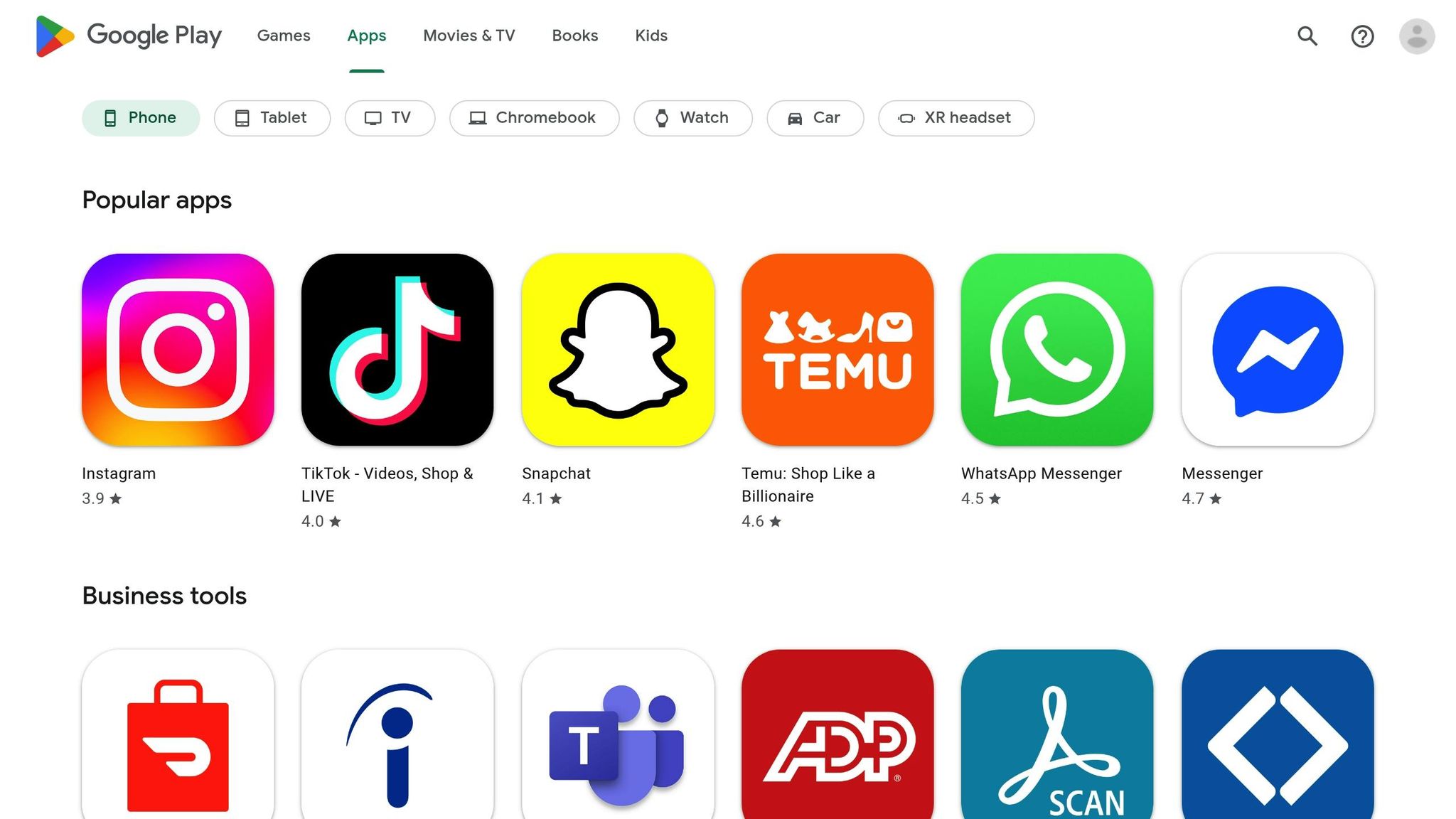
Once you've tested your calendar app on Android devices, it's time to prepare it for the Google Play Store. This involves wrapping up the app in Adalo and meeting Google's submission requirements.
Preview and Finalize Your App
Before hitting publish, use Adalo's preview feature to give your calendar app one last run-through. Test the entire workflow—creating events, setting reminders, and syncing appointments—to ensure everything works smoothly. Double-check US localization details like dates in MM/DD/YYYY format, 12-hour time with AM/PM, and proper comma placement for large numbers. These small details can make a big difference in user experience.
In the Branding tab, finalize your app's visual elements. This includes your app icon (512x512 PNG), splash screen, and color scheme. These are the first things users will notice, so make sure they leave a great impression.
Update your app's metadata to clearly represent what users can expect. Choose a concise app name like "Digital Calendar for Samsung" (30 characters max) and craft a short description highlighting its main features—such as "Custom events, reminders, sync for Android" (80 characters max). If your app requires permissions (e.g., notifications for reminders or storage access for exporting calendars), you'll need to provide a privacy policy URL. This is a mandatory step for Google Play Store approval. Once everything is polished, you're ready to move on to submission.
Submit to the Google Play Store
To publish, you'll need a Google Play Developer account. Log into the Google Play Console with your Google account, pay the $25 developer fee, and complete your profile and identity verification.
In Adalo's Publish tab, select "Android App" and configure essential details like your bundle ID (e.g., com.yourname.calendarapp), signing key, and version code. Adalo will generate an Android App Bundle (.AAB file) for you—a format Google has required for all new apps since August 2021. After a quick 5–10 minute build, download the .AAB file and upload it via the Production track in the Play Console.
You'll also need to provide store listing assets:
- At least three phone screenshots (minimum 1080p resolution) showcasing event screens and calendar views.
- A feature graphic (1024x500 PNG).
- Your app icon.
If you need help creating these assets, tools like Canva or Adobe Express can simplify the process.
Google's review process usually takes 2 to 7 days, with most straightforward apps getting approved within 2 to 3 days. If your app is rejected—often due to missing elements like a privacy policy—the Play Console will provide specific feedback. Address the issue in Adalo, update the version code, and re-upload the app. Around 90% of apps that meet Google's requirements are approved on the first try.
Once your app is live, keep an eye on the Play Console for user feedback and crash reports via Android Vitals. Respond to reviews within 24 hours to maintain a positive reputation and increase your app store rankings. With Adalo's unlimited app updates on paid plans, you can push improvements and bug fixes without worrying about republishing limits.
Comparing Adalo to Alternative Approaches
When building a calendar app, you have several options beyond Adalo. Understanding the trade-offs helps you choose the right tool for your specific needs.
Adalo vs. Traditional Development
Hiring freelancers to build a custom calendar app typically costs between $5,000 and $10,000, while agencies often exceed $10,000. Development timelines stretch from months to over a year, and you remain dependent on developers for every update and bug fix.
Adalo's paid plans start at $36 per month, plus Google's one-time $25 developer fee. You maintain full control to update and iterate on your app without waiting for developer availability or paying hourly rates for changes. What used to take months now takes weeks—sometimes days.
Adalo vs. Other App Builders
Bubble starts at $59/month with usage-based charges called Workload Units, which can create unpredictable bills as your app scales. Bubble's mobile solution is a wrapper for web apps, which can introduce performance challenges under load and means updates don't automatically sync across web and mobile versions. Adalo compiles to true native code and updates all platforms from a single codebase.
FlutterFlow is a low-code tool designed for technical users. It requires you to set up and manage your own external database—a significant learning curve that can create scalability problems if not configured optimally. Pricing starts at $70/month per user for app store publishing, but that still doesn't include database costs. Adalo includes an integrated database with no record limits on paid plans.
Glide excels at spreadsheet-based apps but restricts you to set templates, limiting creative freedom. Pricing starts at $60/month for custom domains, but you're still limited by app updates and data row caps that attract additional charges. Glide doesn't support Apple App Store or Google Play Store publishing at all.
Softr requires $167/month to publish a Progressive Web App, still restricted by records per app. Like Glide, Softr doesn't support native iOS or Android app creation or app store publishing.
| Platform | Starting Price | Native Mobile Apps | Database Included | Record Limits |
|---|---|---|---|---|
| Adalo | $36/month | Yes (iOS & Android) | Yes | Unlimited on paid plans |
| Bubble | $59/month + usage | Web wrapper only | Yes | Limited by Workload Units |
| FlutterFlow | $70/month + DB costs | Yes | No (external required) | Depends on external DB |
| Glide | $60/month | No | Yes | Row limits apply |
| Softr | $167/month | No | Yes | Record limits apply |
Note that many third-party platform comparisons and ratings predate Adalo 3.0's infrastructure overhaul in late 2025, which delivered 3-4x speed improvements and removed database record caps entirely.
Conclusion
You can create your digital calendar app for Samsung and Android in just weeks—or even days—by following the steps outlined in this guide. From setting up your Adalo account and designing a relational database to building key screens, optimizing for Android devices, and publishing to the Google Play Store, the process is straightforward and efficient.
Adalo has already empowered creators to build over 3 million custom mobile and web applications, handling over 20 million daily data requests with 99%+ uptime. As the Adalo team explains:
"No-code tools have dramatically improved the time to launch for an app. What used to take months (sometimes years), now takes weeks, sometimes days."
With paid plans starting at $36 per month and no usage-based charges, Adalo offers a predictable, affordable path to app ownership. You maintain full control to update and maintain your app without relying on developers or worrying about surprise bills as your user base grows.
Use Adalo's visual drag-and-drop tools, pre-made templates, and marketplace components to bring your calendar app vision to life. Test on real Android devices, fine-tune the user experience, and publish with confidence. Creating professional, mobile-ready apps has never been more accessible.
Related Blog Posts
- How to Launch Your First Mobile App Without Coding
- How To Enable Employees To Build The Apps They Need
- How to Create an Invoice App
- How To Create The Digital Calendar App You Need for iPhone and iOS
FAQ
Why choose Adalo over other app building solutions?
Adalo is an AI-powered app builder that creates true native iOS and Android apps from a single codebase. Unlike web wrappers, it compiles to native code and publishes directly to both the Apple App Store and Google Play Store. With unlimited database records on paid plans and no usage-based charges, you get predictable costs as your app scales.
What's the fastest way to build and publish an app to the App Store?
Adalo's drag-and-drop interface, described as "easy as PowerPoint," combined with AI-assisted building features, lets you go from idea to published app in days rather than months. Adalo handles the complex App Store submission process, so you can focus on your app's features instead of wrestling with certificates and provisioning profiles.
How much does it cost to create and publish a calendar app with Adalo?
You can start building for free on Adalo's free plan. To publish to the Google Play Store, paid plans start at $36/month with unlimited usage—no app action charges or surprise bills. Google charges a one-time $25 developer fee. For Google Calendar sync via Zapier, you'll need the Pro plan to enable third-party integrations.
Which is more affordable, Adalo or Bubble?
Adalo starts at $36/month with unlimited usage and no record limits. Bubble starts at $59/month but adds usage-based Workload Unit charges that can create unpredictable bills as your app scales. Adalo also includes native mobile app publishing, while Bubble's mobile solution is a web wrapper.
Which is easier for beginners, Adalo or FlutterFlow?
Adalo is designed for non-technical users with a visual builder described as "easy as PowerPoint." FlutterFlow is a low-code tool for technical users that requires setting up and managing an external database—a significant learning curve. Adalo includes an integrated database with no configuration required.
Can I sync my Adalo calendar app with Google Calendar?
Yes, you can sync using automation tools like Zapier. When events are created or updated in your app, Zapier can automatically reflect those changes in Google Calendar. Alternatively, use the Agical API to generate downloadable calendar invites that let users add events directly to their native calendars without complex API setups.
How long does it take to get my calendar app approved on the Google Play Store?
Google's review process typically takes 2 to 7 days, with most straightforward apps approved within 2 to 3 days. Around 90% of apps that meet Google's requirements are approved on the first try. If rejected, the Play Console provides specific feedback so you can make corrections and resubmit.
Can I test my calendar app on real Android devices before publishing?
Yes, Adalo allows testing on real devices before publishing. Use Preview mode with Samsung Galaxy profiles to simulate how your app looks, then send a share link via SMS to a physical Android device to verify touch targets, scrolling behavior, and overall usability firsthand.
Is Adalo better than Glide for mobile apps?
For native mobile apps, yes. Adalo publishes true native iOS and Android apps to the App Store and Play Store. Glide doesn't support app store publishing at all—it's limited to web apps and PWAs. Glide also restricts you to set templates, while Adalo offers full creative freedom with its visual builder.
Do I need coding experience to build a calendar app?
No coding experience is required. Adalo's visual drag-and-drop interface lets you design screens, set up databases, and configure logic without writing code. The platform handles the technical complexity of native app compilation and app store submission automatically.