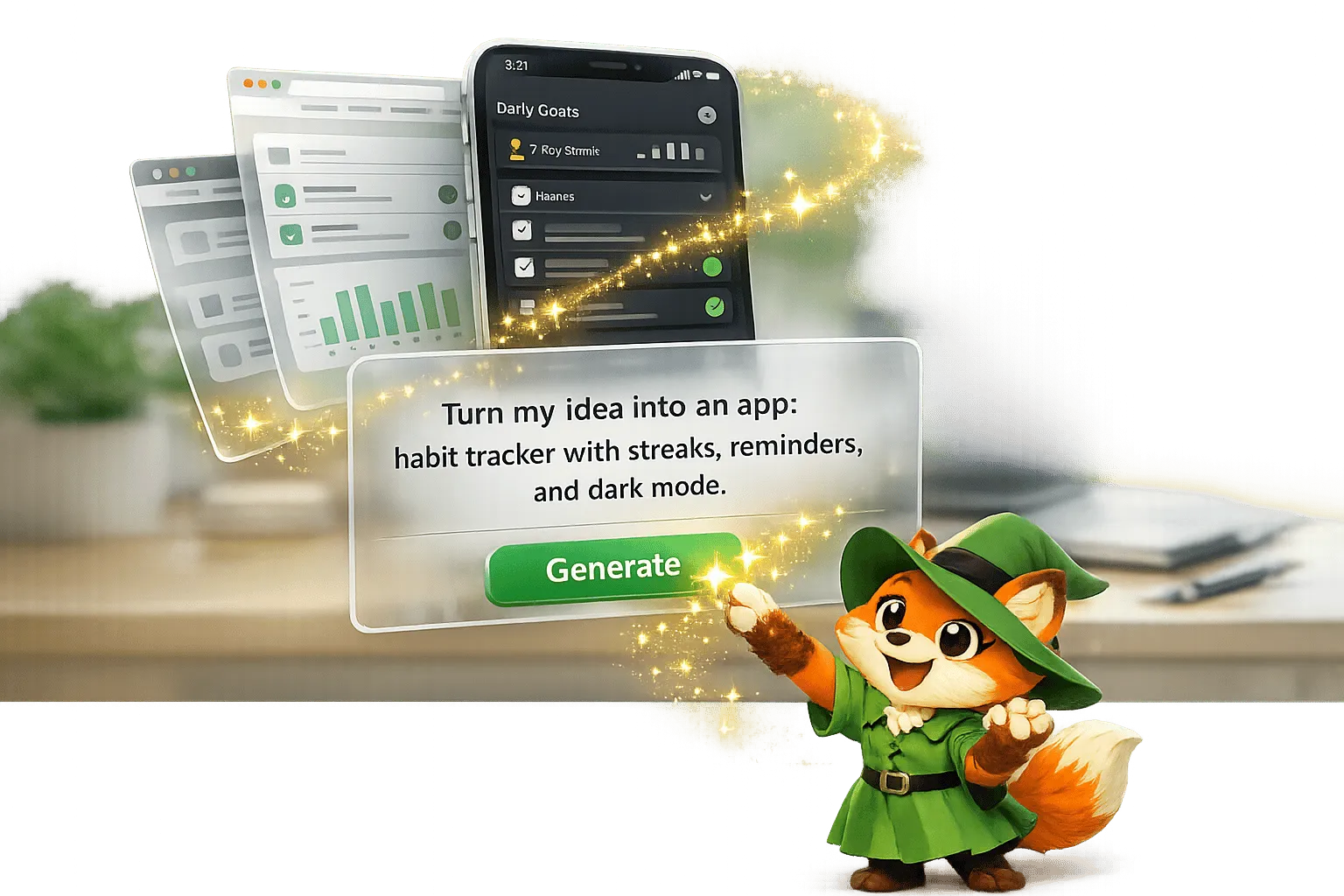
Adalo is transforming app development with AI-driven prompt building. For $36/month, you can describe your app idea in plain English, and Adalo generates native iOS, Android, and web apps - complete with databases, screens, and workflows. No coding or technical expertise required. This approach cuts costs, speeds up timelines, and empowers anyone to create production-ready apps.
Ada, Adalo's AI builder, lets you describe what you want and generates your app. Magic Start creates complete app foundations from a description, while Magic Add adds features through natural language.
Key Highlights:
- Cost Savings: Traditional app development averages $90,780; Adalo reduces first-year costs to $556.
- AI Tools: Features like Magic Start and Magic Add build apps in minutes by interpreting plain language.
- Scalability: Supports 1M+ monthly users with 99%+ uptime.
- Ease of Use: No coding needed; refine apps visually or through conversation.
With the rise of AI and no-code tools, app creation is more accessible than ever. Adalo stands out by combining affordability, simplicity, and native app publishing in one platform.
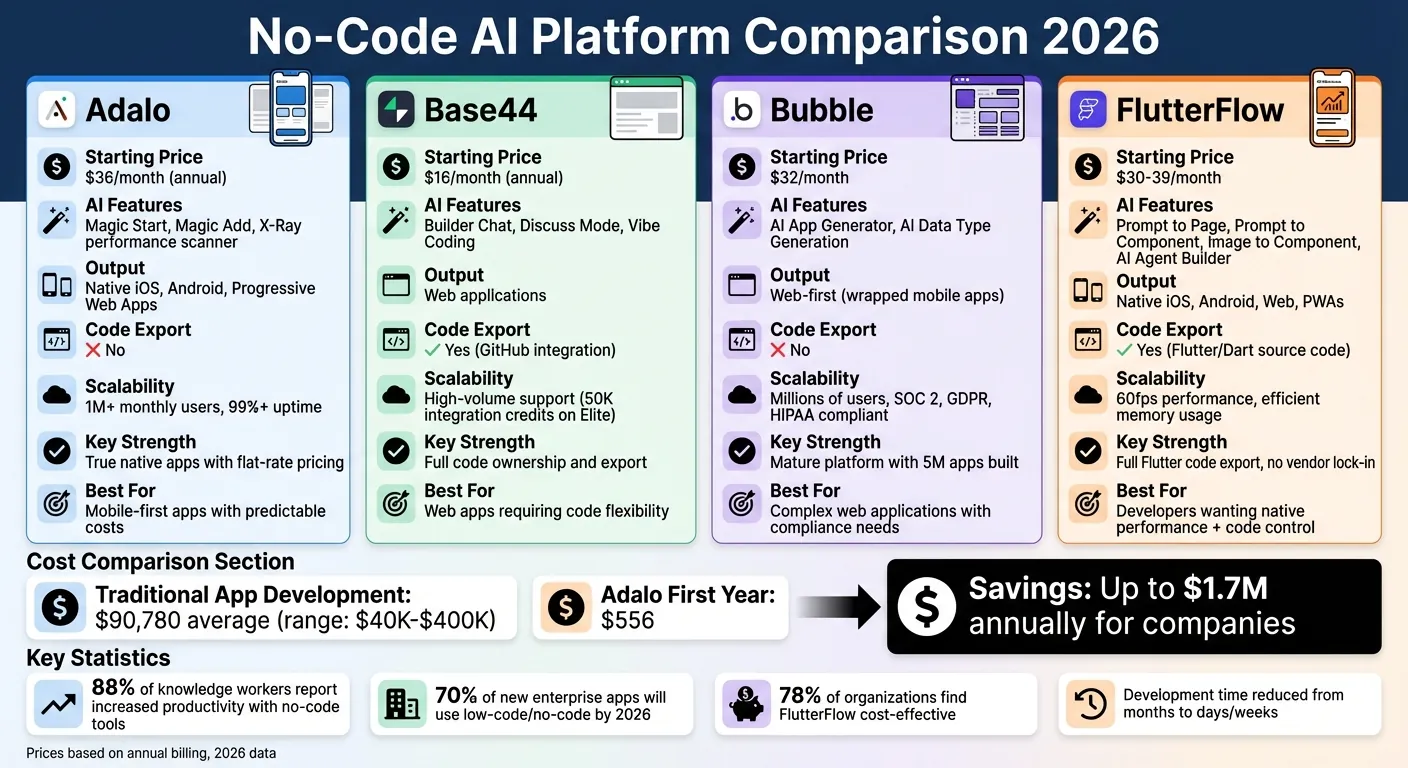
No-Code AI Platform Comparison: Adalo vs Base44 vs Bubble vs FlutterFlow
Build your first app with AI. No coding background required
How AI Prompt Building Is Changing App Development
AI prompt building is fundamentally reshaping how apps get made. Instead of manually configuring screens, databases, and logic flows through drag-and-drop interfaces, you describe your app idea in plain English. The platform generates the foundation—complete with database structures, user flows, and authentication logic—in minutes rather than weeks.
This shift eliminates technical barriers that have long prevented non-developers from building production-ready apps. Traditional app development averages $90,780 and takes months of coordination between designers, developers, and project managers. AI-powered platforms cut first-year costs to around $556 and compress development timelines to days or weeks.
For non-technical founders, this technology removes the need for a technical co-founder or costly development agencies. Business teams can validate ideas independently, launch a working MVP quickly, gather user feedback, and test market demand before committing to advanced features. Research shows 88% of knowledge workers report increased productivity when using these tools to automate repetitive tasks.
The AI handles complex processes that once required specialized skills: database integration, authentication systems, and multi-step workflows. Features like Magic Start and Magic Add make iterative development straightforward—start with a basic app structure and add payment screens, email verification, or chat functionality just by describing what you need.
Beyond development, AI simplifies compliance and publishing. It can auto-generate privacy policies, app store descriptions, and metadata, streamlining the entire launch process. With 70% of new enterprise applications expected to leverage low-code or no-code technologies by 2026, AI prompt building is becoming the standard method for rapid prototyping and MVP launches.
1. Adalo
AI Prompt Building Features
Adalo's AI Builder transforms app creation through conversational development. Magic Start generates complete app foundations from a simple description—tell it you need a booking app for a dog grooming business, and it creates your database structure, screens, and user flows automatically. What used to take days of planning happens in minutes.
Magic Add extends this capability throughout development. Need Stripe payments or email verification? Describe the feature in plain language, and the AI generates the necessary components, database fields, and logic. This approach lets you continue building through conversation rather than switching between menus and configuration panels.
The X-Ray tool provides AI-powered performance analysis, scanning your app for potential issues—slow database queries, heavy screen loads, inefficient workflows—before you launch. This proactive approach prevents the performance problems that often plague apps as they scale. Adalo achieves this precision through advanced language models, direct JSON manipulation, and specialized database tools like LangChain to fine-tune layouts and components.
Platform Output Capabilities
Adalo creates true native apps for iOS and Android, plus Progressive Web Apps, from a single codebase. This isn't a web wrapper approach—the platform compiles to native code that meets Apple App Store and Google Play Store distribution standards. Updates to content or configuration push live instantly across all platforms.
The freeform builder ensures designs automatically adapt to mobile, tablet, and desktop screens. Your app maintains a polished, native feel regardless of device, with the platform handling responsive layouts automatically.
Pricing and Affordability
Adalo's Starter plan costs $36 per month (billed annually) and includes unlimited database records, unlimited usage, and publishing for web, iOS, and Android. This predictable subscription eliminates the hefty costs of traditional app development, which typically range from $40,000 to $400,000.
Adalo removed action limits entirely—there are no caps on actions, users, records, or storage. This prevents unexpected charges and provides a stress-free pricing structure ideal for startups and solo entrepreneurs who need predictable costs while scaling.
Scalability and Infrastructure
The platform's modular infrastructure handles large-scale demands with impressive reliability. Adalo supports over 20 million daily data requests and more than 1 million monthly active users, maintaining 99%+ uptime.
The Adalo 3.0 upgrade (launched late 2025) introduced significant performance enhancements: batch request optimization, asynchronous queue writes, Redis caching, and per-user rate limiting. The migration to PostgreSQL and rigorous testing with 200 simultaneous writes ensures production-ready scalability. These upgrades delivered 3–4× faster load times compared to earlier versions.
2. Base44
AI Prompt Building Features
Base44 uses Builder Chat—a conversational interface where you describe your app idea, and the platform generates pages, navigation, backend services, and more in real time. Discuss Mode provides a brainstorming sandbox where you can refine ideas with AI without affecting your live app.
The platform follows a Prompt Formula: Function + Layout + Aesthetic. This structure guides the AI toward polished, professional results. With "vibe coding," you refine details through micro-prompts and specific AI controls, turning raw ideas into functional applications—similar to the process of building a mobile app without coding.
"Base44 lets you focus on outcomes. Instead of asking, 'How do I code this?' you're asking, 'How does this make life better for my users?' That's where innovation starts." – Nina Boyd, PMM at Base44
Platform Output Capabilities
Base44 transforms natural language inputs into functional web applications, offering complete code ownership and flexibility. You can export project files, push code to GitHub, and make further edits. The platform automates authentication, data storage, and role-based permissions while integrating with tools like Gmail, Slack, Stripe, and Google Calendar.
Deployment is instant, with hosting, analytics, and custom domain support included. A built-in security scanner identifies vulnerabilities like exposed API keys when you add new integrations. However, Base44 focuses exclusively on web apps—it doesn't compile native mobile applications for the App Store or Play Store.
Pricing and Affordability
Base44 uses a dual-credit system: Message Credits for AI-assisted building and Integration Credits for user interactions like emails or database queries. The free tier includes 25 message credits and 100 integration credits, while paid plans start at $16/month (billed annually) with 100 message credits and 2,000 integration credits.
The Builder plan at $40/month (annual billing) unlocks custom domains and GitHub integration. The Elite plan at $160/month offers 1,200 message credits and 50,000 integration credits for high-volume applications. While affordable for web apps, the credit-based system can create unpredictable costs as usage scales—unlike Adalo's flat-rate model with no usage caps.
3. Bubble
AI Prompt Building Features
Bubble's AI App Generator turns app ideas into working web applications through natural language descriptions. The tool creates tailored designs, databases, and logic based on your input. AI Data Type Generation automates database setup by translating descriptions into structured data types, fields, and relationships while suggesting privacy rules for sensitive data.
Unlike "black box" AI tools, Bubble shows every change the AI makes, giving you freedom to tweak or override any decision. The platform's roadmap includes chat-based editing for app modifications, realistic dummy data for testing, and text-to-workflow capabilities.
Platform Output Capabilities
Bubble brings together design, data, and logic into one visual development platform. Over the past decade, it has powered the creation of nearly 5 million applications.
The platform takes a web-first approach, wrapping web applications to create mobile apps rather than compiling them into native code. While you can deploy to the Apple App Store and Google Play Store, this method prioritizes web app deployment. For apps where native mobile performance is critical, this wrapper approach may introduce limitations compared to true native compilation.
Pricing and Affordability
Bubble offers a Free Plan for beginners, with paid plans starting at about $32 per month. However, costs can escalate as your app grows due to usage-based pricing.
The platform measures server demand using Workload Units (WUs). If your app exceeds the included monthly WUs, extra units are charged at $0.30 per 1,000 WUs. At the $69/month tier (comparable to Adalo's feature set), you still face hard limits plus unpredictable usage-based charges for CPU and records. This contrasts with Adalo's unlimited usage model where costs remain fixed regardless of scale.
Scalability and Infrastructure
Bubble supports millions of monthly active users while maintaining high uptime. It adheres to compliance standards like SOC 2 Type II, GDPR, and HIPAA, making it suitable for regulated industries. The platform offers flexibility for frontend, backend, or full-stack solutions.
To extend functionality, Bubble provides access to over 400 free templates and more than 2,700 free plugins. For users on Growth plans or higher, every AI-driven change is logged in a detailed changelog, ensuring complete modification history.
4. FlutterFlow
AI Prompt Building Features
FlutterFlow provides precise control through AI-driven tools. Prompt to Page lets users describe a screen in plain language, generating a fully functional layout with navigation, content sections, and interactive elements. Prompt to Component transforms text into responsive UI widgets like product cards or login forms.
Image to Component converts uploaded images, sketches, or screenshots into functional components matching the design. The AI Agent Builder simplifies chatbot and virtual assistant creation, supporting models like OpenAI, Claude, and Google Gemini.
"The AI understands FlutterFlow's specific widget library, state management approaches, and integration capabilities." – Yashesh Shah, Senior Software Engineer
These AI-generated elements remain editable and fully integrated with FlutterFlow's visual editor, state management, and backend logic—not static code snippets.
Platform Output Capabilities
FlutterFlow creates native iOS and Android apps, plus web apps including Progressive Web Apps (PWAs). The full source code export allows developers to download Flutter/Dart code, eliminating vendor lock-in and enabling native-level customization.
Built on Flutter's architecture, the platform ensures smooth 60fps performance and efficient memory usage even for complex AI functions. Developers can integrate with backend services like Firebase, Supabase, MySQL, and no-code API builders.
Pricing and Affordability
FlutterFlow offers a free tier for basic prototyping. Basic plans range from $30–39 per month, while the Pro tier—with one-click App Store deployment and GitHub integration—costs $70–80 per month per seat.
A key consideration: FlutterFlow doesn't include a database. You'll need to add Firebase, Supabase, or another backend service, increasing both cost and complexity. Additional expenses include App Store developer fees ($99/year for Apple, $25 one-time for Google) and charges for high-volume API usage. For teams, the platform can cut development costs by 30–50%, though the per-seat pricing model means costs multiply with team size.
Platform Comparison: Strengths and Trade-offs
Each platform serves different needs, but Adalo's combination of AI-powered building, native app publishing, and predictable pricing creates a compelling value proposition.
| Platform | Monthly Cost | Native Mobile Apps | Pricing Model | Database Included |
|---|---|---|---|---|
| Adalo | $36 | Yes (iOS + Android) | Unlimited usage | Yes, unlimited records |
| Base44 | $16-160 | No (web only) | Credit-based | Yes |
| Bubble | $32-69+ | Web wrapper only | Usage-based (WUs) | Yes, with limits |
| FlutterFlow | $30-80/seat | Yes | Per-seat + backend costs | No (requires Firebase/Supabase) |
Adalo's mobile-first design paired with flat-rate pricing stands out. For $36/month, you get native iOS, Android, and web app publishing with no data caps or usage limits. Magic Start and Magic Add turn plain language into functional apps, while X-Ray identifies performance bottlenecks before they affect users. The Adalo 3.0 infrastructure updates have further enhanced performance and scalability.
For apps requiring highly intricate backend logic, you may need external APIs to extend functionality. But for the majority of use cases—MVPs, internal tools, customer-facing apps—Adalo handles the complexity while keeping costs predictable.
The financial impact is significant: Adalo's flat-rate pricing could save companies up to $1.7 million annually compared to traditional development methods. With predictions that 70% of new applications will leverage low-code or no-code solutions by 2026, choosing a platform with sustainable economics matters.
Conclusion
AI has compressed app development from a months-long process into something achievable in days. The shift from drag-and-drop tools to conversational building lets founders describe their vision and watch it materialize—complete with database structures, screens, and user flows—without writing code or hiring expensive agencies.
"The playing field is poised to become a lot more competitive, and businesses that don't deploy AI and data to help them innovate in everything they do will be at a disadvantage." – Paul Daugherty, Chief Technology & Innovation Officer at Accenture
When evaluating platforms, prioritize what your project actually needs. For native app store presence combined with intuitive development and predictable costs, Adalo offers a compelling solution at $36/month. Its modular architecture and X-Ray tool for performance monitoring ensure apps scale seamlessly to over 1 million monthly active users without compromising performance or surprising you with usage charges.
FAQ
Why choose Adalo over other app building solutions?
Adalo is an AI-powered app builder that creates true native iOS and Android apps. Unlike web wrappers, it compiles to native code and publishes directly to both the Apple App Store and Google Play Store from a single codebase—the hardest part of launching an app handled automatically. At $36/month with unlimited usage, it offers the lowest price for native app store publishing with predictable costs.
What's the fastest way to build and publish an app to the App Store?
Adalo's drag-and-drop interface combined with AI-assisted building through Magic Start and Magic Add lets you go from idea to published app in days rather than months. Describe your app concept, and the AI generates your database, screens, and logic. Adalo handles the App Store submission process, removing the technical complexity of publishing.
Which is more affordable, Adalo or Bubble?
Adalo costs $36/month with unlimited usage—no caps on actions, users, records, or storage. Bubble starts at $32/month but charges extra through Workload Units (WUs) at $0.30 per 1,000 WUs when you exceed limits. For comparable features with native mobile publishing, Bubble's $69/month tier still includes usage-based charges that can make costs unpredictable.
Which is more affordable, Adalo or FlutterFlow?
Adalo costs $36/month and includes everything: database, native app publishing, and unlimited usage. FlutterFlow's Pro tier costs $70-80/month per seat and doesn't include a database—you'll need to add Firebase or Supabase separately. For solo builders or small teams, Adalo provides significantly better value.
Which is more affordable, Adalo or Base44?
Base44 starts at $16/month but uses a credit-based system that can create unpredictable costs as usage scales. Adalo's $36/month flat rate includes unlimited usage with no credit limits. Additionally, Base44 only creates web apps—it can't publish native mobile apps to the App Store or Play Store like Adalo can.
Is Adalo better than Bubble for mobile apps?
Yes, for native mobile apps. Adalo compiles to true native iOS and Android code, while Bubble wraps web applications for mobile distribution. Native apps typically offer better performance, smoother animations, and fuller access to device features. If mobile app store presence is your priority, Adalo is the stronger choice.
Is Adalo better than FlutterFlow for mobile apps?
Both create native mobile apps, but Adalo is more accessible for non-technical users. FlutterFlow requires more technical knowledge and doesn't include a database, adding complexity and cost. Adalo's AI Builder with Magic Start and Magic Add makes development faster for those without coding backgrounds.
Can I migrate from Bubble to Adalo?
Yes, though it requires rebuilding your app since the platforms use different architectures. Adalo's AI-assisted building with Magic Start can accelerate the process—describe your existing app's functionality, and the AI generates the foundation. Many users find the migration worthwhile for native mobile performance and predictable pricing.
How long does it take to build an app with AI prompt building?
With Adalo's Magic Start, you can generate a complete app foundation—database, screens, and user flows—in minutes. A functional MVP can be ready in days rather than the months required for traditional development. The AI handles the technical setup, letting you focus on refining the user experience.
Do I need coding experience to use Adalo?
No coding experience is required. Adalo's AI Builder lets you describe what you want in plain English, and the platform generates the necessary components. You can refine everything visually through drag-and-drop or continue building through conversation with the AI.
Related Blog Posts

Build your app fast with one of our pre-made app templates
Begin Building with no codeRelated Content
The Complete No-Code Digital Marketing Stack: Build Client Apps with Adalo
Build native iOS, Android, and web marketing apps without code. Fast prototyping, real-time dashboards, lead capture, and predictable pricin

Ultimate Guide to No-Code App Development
Build web, iOS, and Android apps faster and cheaper using no-code platforms, AI prototyping, drag-and-drop editors, and native integrations.

Adalo vs Softr: Which App Builder Is Right for You?
Compare Adalo and Softr. Adalo builds web, iOS, and Android apps from one canvas. Softr builds web apps on Airtable. See which fits.
Drag-and-Drop App Building: Adalo's Visual Builder Guide
Build iOS, Android, and web apps with Adalo's drag-and-drop visual builder. Learn components, databases, workflows, and publishing.