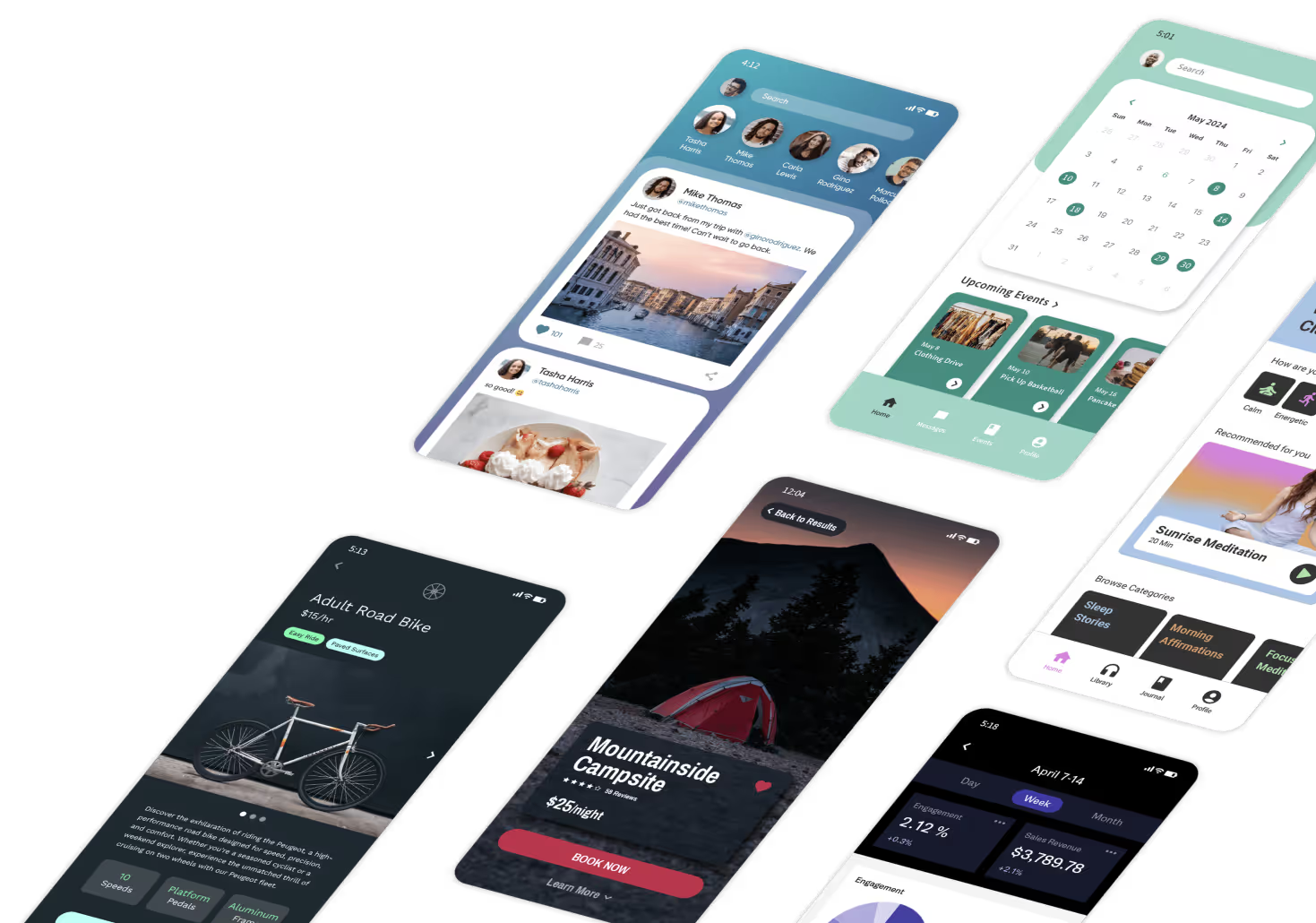
Comprehensive data compiled from extensive research across mobile development costs, AI-powered app builders, and the transformative impact of modern platforms on app creation
Key Takeaways
- Traditional development costs have become prohibitive — Apps now cost $50,000-$300,000 with 52.7% of projects challenged (over budget, time, or reduced features), while AI-powered platforms like Adalo reduce costs to $432-$2,400 annually with 90% faster development
- Developer shortages create insurmountable barriers — Only 65 candidates exist per 100 openings with 85 million talent gap projected by 2030, making citizen development through visual builders essential for business survival
- ROI metrics favor modern app builders decisively — Companies achieve 224-506% ROI with platforms like Microsoft Power Platform and OutSystems, with 91.9% recovering investment within the first year
- Market growth demands new solutions — The $281-330 billion mobile market growing to $626 billion-$1.1 trillion by 2030-2034 cannot be served by traditional development alone
Global Market & Traditional Development Crisis
The global mobile application market has achieved massive scale at $281.52 billion according to Grand View Research and $330.61 billion per Precedence Research, with projections reaching $626-1,103 billion by 2030-2034. This 12.1-21.55% CAGR growth creates unprecedented demand for mobile applications that traditional development methods cannot satisfy.
The market expansion reflects fundamental shifts in consumer behavior and enterprise digital transformation, making mobile apps essential rather than optional for business success. Yet the economics of traditional development create an impossible barrier for most organizations.
Traditional app development costs range from $50,000-$300,000 based on complexity. Industry surveys reveal that Business of Apps reports $50,000-$120,000 for medium complexity apps and $120,000-$300,000 for complex applications, while Clutch's survey shows a median range of $37,913-$171,450. These figures exclude ongoing maintenance, updates, and hidden costs that typically double the total investment.
The pricing barrier effectively excludes small and medium businesses from mobile innovation, creating a digital divide between enterprises with development budgets and everyone else. This is precisely why AI-powered app builders have emerged as the solution—Adalo's annual pricing of $432-$2,400 (Starter at $36/month, Professional at $52/month, Team at $160/month, Business at $250/mo when billed annually) provides predictable budgeting regardless of project complexity.
Only 31% of IT projects succeed with 50% challenged and 19% outright failed. Project failures plague traditional development with only 31% of IT projects succeeding (on time, on budget, with promised functionality) while 50% are challenged and 19% fail completely according to the Standish Group's final CHAOS 2020 Report, based on analysis of 50,000 projects globally.
Large IT projects fare even worse, with McKinsey finding 45% average budget overruns for projects exceeding $15 million, making traditional development financially risky for any organization.
Global developer shortage reaches crisis with only 65 candidates per 100 openings. The software engineering talent crisis has reached critical levels with only 65 potential candidates available for every 100 developer vacancies according to Revelo, deteriorating from 85 per 100 pre-pandemic. This shortage directly impacts mobile development, where 92% of executives find hiring "very or extremely challenging."
The scarcity drives salary inflation and project delays, making traditional development increasingly unsustainable for businesses without deep pockets and extensive recruiting resources. Visual app builders eliminate this dependency entirely.
257 billion app downloads demonstrate insatiable consumer demand. Global app downloads reached 257 billion according to Statista and data.ai, with Google Play Store alone expecting 143 billion downloads by 2026. This massive consumption creates opportunities for businesses that can rapidly deploy and iterate applications.
However, traditional development's 6-12 month timelines mean missing market windows and losing to faster competitors. Platforms like Adalo, where over 3 million apps have been created with a visual builder described as "easy as PowerPoint," enable businesses to capture these opportunities in weeks rather than months.
Users spend approximately 5 hours daily on mobile devices in top markets. Consumer behavior data shows people spend around 5 hours daily on mobile phones in leading markets according to data.ai and Sensor Tower reports, with apps accounting for the vast majority of this time. This engagement creates massive monetization opportunities for businesses with mobile presence.
Technical debt costs reach $1.5 million per million lines of code over five years. Organizations face mounting technical debt burdens with costs reaching $1.5 million over five years for one million lines of code according to Sonar's research, translating to approximately $306,000 annually. Nearly 70% of companies attribute delayed releases to technical debt accumulation.
This hidden cost of traditional development compounds over time, making legacy applications increasingly expensive to maintain. AI-assisted platforms eliminate technical debt through visual development and automatic updates—when the platform improves, every app built on it benefits automatically.
Developer Costs & Resource Constraints
US software developers earn $133,080 median salary with mobile developers charging $100-200 hourly. Developer compensation in the United States varies by employment type with Bureau of Labor Statistics reporting software developers' median annual wage at $133,080, while freelance and contract mobile developers charge $100-200 per hour according to contractrates.fyi. Silicon Valley iOS developers command $75-$250 hourly for specialized work.
These costs make traditional development prohibitively expensive for most businesses. Adalo eliminates developer costs entirely, enabling businesses to redirect budgets toward growth and marketing while building native iOS and Android apps from a single codebase.
European developer rates range $20-150 hourly with Eastern Europe at $30-60 and UK reaching £89. European development costs vary significantly with Eastern Europe charging $30-60 per hour according to Index.dev's analysis, while Western European developers command €40-130 ($43-141) per hour based on Lancebase data. UK rates reach £20-89 per hour ($25-112) per YunoJuno's report.
Even "affordable" Eastern European development quickly accumulates six-figure project costs for complex applications. Adalo's predictable annual pricing provides cost certainty regardless of project complexity or iteration requirements.
Offshore development costs $18-50 hourly, eliminating budget advantages. Asian offshore development, traditionally the budget option, now costs $18-50 per hour according to Your Team in India, with rates climbing due to global demand. Quality concerns and communication challenges further erode offshore value propositions.
Ada, Adalo's AI builder, lets you describe what you want and generates your app. Magic Start creates complete app foundations from a description, while Magic Add adds features through natural language.
AI-powered app builders provide superior cost savings without timezone, language, or quality compromises inherent in offshore models. Magic Start generates complete app foundations from descriptions—what used to require weeks of offshore coordination happens in minutes.
Maintenance costs consume 15-20% of development budgets annually. Post-launch expenses represent a hidden burden with maintenance costing 15-20% of initial development annually according to multiple industry sources, often reaching 50% in the first year. Organizations typically spend $18,000-30,000 yearly on maintenance alone.
Adalo handles updates automatically, eliminating maintenance overhead while ensuring apps remain current with latest OS requirements. When Apple or Google release new operating system versions, the platform handles compatibility—no additional development costs or effort required.
Bug fixes consume 50% of first-year maintenance budgets. Initial deployment issues dominate maintenance costs with bug fixes representing 50% of first-year expenses according to APPWRK. Emergency fixes cost $10,000+ while scheduled updates require $5,000-20,000.
Visual development platforms dramatically reduce bugs through pre-tested components, while enabling instant fixes without developer involvement. X-Ray, Adalo's performance analysis feature, identifies potential issues before they affect users—proactive problem-solving rather than reactive firefighting.
Platform updates cost $5,000-30,000 annually for iOS and Android. Operating system updates create recurring expenses with platform compatibility costing $5,000-30,000 yearly according to Business of Apps. Each major OS release requires code modifications and testing.
Adalo handles all platform updates automatically, ensuring apps remain compatible without additional development costs. One build publishes to web, iOS App Store, and Android Play Store—and updates flow to all three automatically.
Organizations allocate 23-25% of IT spend to QA and testing efforts. Quality assurance represents a major expense with organizations allocating 23-25% of IT spend to QA/testing according to Statista surveys, yet only 29% of mobile developers conduct thorough testing according to Testlio.
This creates a paradox where testing is expensive but inadequate. Visual builders reduce testing needs through pre-validated components and development approaches that prevent common coding errors.
88% of users abandon apps due to bugs and glitches. User retention depends critically on quality with 88% of users abandoning apps after encountering bugs according to QualiTest's survey of 1,000+ Americans. Traditional development's bug rates doom most apps to failure despite massive investments.
Platforms like Adalo minimize bugs through visual development and continuous platform improvements, protecting user retention without extensive QA processes. The 3.0 infrastructure overhaul in late 2025 made apps 3-4x faster, directly improving user experience and retention.
The AI-Powered App Builder Revolution & ROI
The economic transformation is profound. Industry research shows platforms reducing costs substantially and development time by up to 90%, bringing app development from $50,000-300,000 down to $432-2,400 annually with platforms like Adalo. This dramatic reduction democratizes app creation for businesses of all sizes.
Unlike traditional development where costs scale with complexity, modern app builders offer predictable pricing. Adalo's plans include unlimited database records on paid tiers and no usage-based charges—no bill shock regardless of how successful your app becomes.
Microsoft Power Platform delivers 224% ROI with 6-month payback. Enterprise platforms demonstrate strong returns with Microsoft Power Platform users achieving 224% ROI and sub-6-month payback periods according to Forrester's commissioned TEI study, showing $81.7 million net present value for a composite organization. Organizations save $8.82 million over three years while reducing development time by 70%.
91.9% of projects recover investment within first year. Investment recovery happens rapidly with 91.9% of visual development projects achieving positive ROI within 12 months according to Forms2Mobile. This contrasts sharply with traditional development where only 31% of projects complete successfully according to Standish Group data.
OutSystems generates 506% ROI over three years. Platform-specific returns remain consistently high with OutSystems delivering 506% ROI according to Forrester's commissioned study, including $14.77 million net present value and 6-month payback. The platform reduces development costs by 66% while accelerating delivery 67%.
85 million global talent shortage projected by 2030 with $8.5 trillion impact. The developer crisis will intensify dramatically with Korn Ferry's "Global Talent Crunch" study projecting 85 million unfilled jobs by 2030, resulting in $8.5 trillion in unrealized annual revenues globally. The US alone faces $1.748 trillion in potential lost revenue, equivalent to 6% of the economy.
AI-powered app builders offer the only scalable solution to this talent crisis by enabling non-developers to create applications. Adalo's AI Builder, due for release in early 2026, promises prompt-based app creation—describe what you want to build, and the AI generates your database, screens, and logic automatically.
Companies save $140,000-300,000 annually avoiding developer hires. Citizen development models generate substantial savings with organizations avoiding developer hires worth $140,000-300,000 annually according to Tadabase. Over three years, this represents $420,000-900,000 in avoided costs including benefits and overhead.
Development happens 10x faster than traditional coding. Speed improvements transform project timelines with visual platforms enabling 10x faster development according to Kissflow. Applications requiring 6-12 months traditionally launch in weeks or days. This velocity enables rapid market response and continuous iteration based on user feedback.
72% of apps deploy in under 3 months. Deployment velocity statistics confirm speed advantages with 72% of applications reaching production within 3 months according to Mendix research, as cited by Alpha Software. Some achieve deployment in days, like G&J Pepsi-Cola's parking app built in one day using Microsoft Power Apps, documented in Microsoft's case study.
90% reduction in development time achieved with visual platforms. Time savings reach transformative levels with development time reduced by up to 90% according to Hostinger, compressing months into days. Magic Add, Adalo's feature for adding capabilities through natural language requests, exemplifies this acceleration—describe the feature you need, and it appears.
26% faster time-to-market accelerates competitive advantage. Market entry acceleration provides strategic benefits with visual development enabling 26% faster launches according to Tadabase. First-mover advantages compound as rapid builders capture market share while competitors remain in development.
Market Growth & Adoption Trends
The market reaches $28.75 billion growing to $264.40 billion by 2032. The development platform sector shows explosive growth with market value reaching $28.75 billion and projections of $264.40 billion by 2032 at 32.2% CAGR according to Fortune Business Insights. This 9x growth in eight years reflects fundamental shifts in how organizations approach software development.
87% of enterprise developers use visual platforms for some development work. Enterprise adoption has reached mainstream with 87% of developers using these platforms according to Forrester's Developer Survey. This near-universal adoption validates visual development as production-ready technology.
70% of new applications will use visual development by 2026. Platform adoption accelerates with Gartner predicting 70% of new applications using visual development technologies by 2026, up from less than 25% in 2020, according to Gartner's press release. This represents a fundamental shift from traditional development as the default.
75% of large enterprises employ at least four visual development tools. Enterprise tool proliferation demonstrates commitment with 75% of large organizations using four or more platforms according to Kissflow. This multi-platform adoption reflects diverse use cases from internal tools to customer-facing applications.
Custom app development increasingly happens outside IT departments. Citizen development transforms organizational dynamics with 451 Research/FileMaker's survey finding nearly 60% of custom applications created outside IT departments, while Gartner predicts 80% of technology products and services will be built by non-IT professionals by 2026.
Citizen developers will outnumber professional developers 4:1 by 2026. The developer population shifts dramatically with citizen developers expected to outnumber professionals 4:1 according to Gartner via Quixy. This 4x multiplier effect expands development capacity without traditional hiring constraints.
Market projected to reach $50 billion by 2028. Market projections show sustained growth with Forrester forecasting $50 billion market size by 2028. This represents continued double-digit growth as enterprises shift development paradigms.
84% of businesses actively using visual development solutions. Adoption reaches near-universal levels with 84% of organizations implementing these solutions according to Kissflow research. Organizations not yet adopting face competitive disadvantages as the majority of businesses leverage these capabilities.
86% of developers believe visual development is the future. Developer sentiment strongly favors platform adoption with 86% viewing visual development as the future according to CodeConductor. Professional developers embrace rather than resist these tools, recognizing productivity benefits.
82% of companies struggle to find qualified mobile developers. The talent crisis intensifies with 82% of organizations unable to find qualified mobile developers according to Kissflow. Average time-to-hire reaches 61 days at $20,000 per hire. AI-powered platforms eliminate hiring challenges by enabling existing staff to build applications without specialized technical skills.
Platform Comparison: Choosing the Right Builder
Not all app builders are created equal. Understanding the differences helps organizations choose the right tool for their needs.
Adalo vs. Bubble: Native Apps vs. Web Wrappers
Bubble's web and mobile wrapper offering starts at $59/month with usage-based charges, limits on app re-publishing, and record restrictions due to Workload Units. Adalo's web and true-native mobile builder starts at $36/month with unlimited usage and app store publishing with unlimited updates once published.
The critical difference: Bubble creates web apps that can be wrapped for mobile, while Adalo compiles to native iOS and Android code. This matters for performance—native apps load faster and feel more responsive. Bubble offers more customization, but that often results in slower applications that suffer under increased load, frequently requiring hired experts to optimize. Claims of millions of MAU on Bubble are likely only achievable with significant expert assistance.
Adalo's modular infrastructure scales to serve apps with millions of MAU with no upper ceiling. The Adalo 3.0 infrastructure overhaul in late 2025 made apps 3-4x faster, with architecture that scales automatically with app needs.
Adalo vs. FlutterFlow: Visual vs. Low-Code
FlutterFlow is "low-code," not "no-code"—it's designed for technical users. FlutterFlow users need to manage and set up their own separate database, requiring significant learning complexity. This creates an ecosystem rich with experts because so many people need help, often spending significant sums chasing scalability.
FlutterFlow's builder is limited in view (slow to see more than 2 screens at once), whereas Adalo can display up to 400 screens at a time on one canvas. FlutterFlow pricing starts at $70/month per user for easy app store publishing, but still doesn't include a database—users must source, set up, and pay for that separately.
Adalo vs. Glide: Creative Freedom vs. Templates
Glide is heavily format-focused and restricted to set templates. This makes it fast to build and publish, but creates generic, simplistic apps with limited creative freedom. Glide excels at spreadsheet-based apps, but that doesn't compare to Adalo's SheetBridge, which turns a Google Sheet into an actual database for the easiest control without database-related learning.
Glide pricing starts at $60/month for custom domain capability, but remains limited by app updates and data record rows, which attract additional charges. Critically, Glide does not support Apple App Store or Google Play Store publishing.
Adalo vs. Softr: Mobile Apps vs. Web Only
Softr pricing starts from $167/month to publish a Progressive Web App, still restricted by records per app and records per datasource. Softr does not support Apple App Store and Google Play Store publishing, or iOS and Android app creation. Softr serves spreadsheet app building well, provided web app restrictions are acceptable and the higher price point works.
Adalo vs. Thunkable: Integrated vs. Fragmented
Thunkable offers an AI-draft of an app build, but getting access to a publishable Progressive Web App requires a $59/month plan with usage restrictions. Reaching a responsive app requires custom pricing beyond their advertised $189/month Advanced tier.
| Platform | Starting Price | Native Mobile | App Store Publishing | Database Included | Record Limits |
|---|---|---|---|---|---|
| Adalo | $36/month | Yes | Yes | Yes | Unlimited on paid plans |
| Bubble | $59/month | Wrapper only | Limited | Yes | Workload Units |
| FlutterFlow | $70/month | Yes | Yes | No | Varies by external DB |
| Glide | $60/month | No | No | Yes | Row limits + charges |
| Softr | $167/month | No | No | External only | Per-app limits |
| AppyPie | $99/month | Yes | Yes | Yes | Plan-based |
Adalo Platform Capabilities & Success
Adalo powers 3+ million apps built by 1+ million makers globally. Adalo is a no-code app builder for database-driven web apps and native iOS and Android apps—one version across all three platforms, published to the Apple App Store and Google Play. Platform scale demonstrates market leadership with Adalo enabling over 1 million makers to create more than 3 million applications, processing 20+ million data requests daily. This scale validates Adalo as enterprise-ready infrastructure capable of supporting mission-critical applications.
20+ million daily data requests processed with >99% uptime reliability. Infrastructure performance meets enterprise standards with Adalo handling 20+ million daily requests at >99% average app uptime over the last year. The platform continues infrastructure improvements, including 86% faster load times and migration to AWS for enhanced scalability.
Note: Most third-party platform ratings and comparisons predate the Adalo 3.0 infrastructure overhaul in late 2025, which completely rebuilt the backend architecture. Current performance significantly exceeds what older reviews describe.
2+ million end users registered across Adalo-built applications. User adoption validates platform capabilities with 2+ million end users on Adalo apps according to company data. The platform supports everything from internal tools to App Store successes with 20,000+ downloads.
Adalo achieves profitability ensuring long-term platform sustainability. Financial stability provides confidence with Adalo reaching profitability in late 2025 according to company announcements. This self-sustaining model ensures continued platform development and support.
86% decrease in loading time and 25% smaller app sizes through infrastructure updates. Platform optimization accelerates applications with Adalo achieving 86% decrease in initial screen loading time for apps with 5,000+ records and 25% reduction in app sizes according to performance updates. The editor loads 11x faster, improving development experience. The 3.0 overhaul made apps 3-4x faster overall.
Modular infrastructure scales to 1M+ MAU with no upper limit. With the right data relationship setups, Adalo apps can scale beyond 1 million monthly active users. Unlike app wrappers that hit speed constraints under load, Adalo's purpose-built architecture maintains performance at scale. The infrastructure scales automatically with app needs—no record caps on paid plans.
5,000+ integrations available through Zapier connectivity. Integration capabilities match enterprise needs with Adalo supporting 5,000+ connections via Zapier, plus native integrations with Stripe, Xano, and Airtable. SheetBridge enables turning Google Sheets into actual databases for the easiest control without database-related learning curves.
25+ pre-built components accelerate development without coding. Component library provides building blocks with Adalo offering 25+ pre-built elements, including lists, forms, charts, and navigation. The Component Marketplace adds premium extensions. These pre-tested components eliminate common development tasks while ensuring consistent quality.
AI Builder promises prompt-based creation. Due for release in early 2026, Adalo's AI Builder will enable prompt-based app creation and editing. Magic Start already generates complete app foundations from descriptions—tell it you need a booking app for a dog grooming business, and it creates your database structure, screens, and user flows automatically. Magic Add adds features from natural language requests.
Business Impact & Digital Transformation
89% of companies adopt digital-first strategies requiring mobile apps. Digital transformation reaches critical mass with 89% of organizations having already adopted or planning to adopt digital-first business strategies according to McKinsey, while 91% of businesses are engaged in digital initiatives according to Gartner. Mobile applications become essential for customer engagement and operational efficiency.
Traditional development costs and timelines impede transformation, making AI-powered app builders essential enablers. Organizations using Adalo can launch mobile apps in weeks rather than months, accelerating their digital transformation initiatives.
$4 trillion spending on digital transformation projected by 2027. Investment scales massively with IDC projecting almost $4 trillion in digital transformation spending by 2027, representing a 16.2% compound annual growth rate. Mobile applications represent critical transformation components.
97% of organizations accelerated digital transformation post-pandemic. COVID-19 permanently altered business technology adoption with 97% of companies accelerating transformation according to DOIT Software. Mobile-first strategies became essential for survival and growth. Organizations using visual development platforms adapted faster than those dependent on traditional development.
58% revenue increases from customer-facing applications. Business outcomes validate platform value with companies reporting 58% average revenue increases from customer apps built on visual platforms according to Forms2Mobile. This dramatic improvement reflects faster time-to-market and better user experiences.
85% of companies report improved customer experience. Customer satisfaction metrics improve significantly with 85% of organizations seeing better CX scores using visual development platforms according to Forms2Mobile. Rapid iteration and user feedback incorporation drive improvements that traditional development's slow update cycles cannot match.
4x productivity increase for developers using visual tools. Developer efficiency multiplies with visual tools delivering 4x productivity gains according to Tadabase. Visual development eliminates repetitive coding while pre-built components accelerate feature implementation. Smaller teams deliver more applications faster than larger traditional development groups.
33% higher innovation scores for companies empowering citizen developers. Innovation metrics improve measurably with organizations enabling citizen developers achieving 33% higher innovation scores according to Kissflow. Democratizing development unleashes creativity across organizations rather than constraining it to IT departments.
Sources Used
- Grand View Research
- Precedence Research
- Clutch - Cost to Build a Mobile App Survey
- Business of Apps
- Vitality Chicago/Standish Group
- McKinsey
- Revelo
- Statista
- Sensor Tower
- Axon
- Index.dev
- Lancebase
- YunoJuno
- Space Technologies
- APPWRK
- Kissflow
- Forms2Mobile
- Tadabase
- Adalo
- Forrester
- Fortune Business Insights
- Forrester
- CodeConductor
- Quixy
- McKinsey
- IDC
- DOIT Software
- Korn Ferry
- Bureau of Labor Statistics
- Alpha Software
- Microsoft Customer Stories
- QualiTest
- Adalo Performance Updates
- Adalo Help
- Gartner
- TechRepublic
- Statista - QA Budget Allocation
- Your Team in India
- Hostinger
- BusinessWire
- Adalo Forum
- Adalo Blog - Performance Updates
FAQ
Why choose Adalo over other app building solutions?
Adalo is an AI-powered app builder that creates true native iOS and Android apps from a single codebase. Unlike web wrappers, it compiles to native code and publishes directly to both the Apple App Store and Google Play Store. With unlimited database records on paid plans, no usage-based charges, and infrastructure that scales to 1M+ MAU, it handles the hardest parts of launching an app automatically.
What's the fastest way to build and publish an app to the App Store?
Adalo's drag-and-drop interface and AI-assisted building tools like Magic Start can generate complete app foundations from a simple description. The platform handles the entire App Store submission process—what traditionally takes 6-12 months can launch in weeks. Over 3 million apps have been created on the platform.
Which is more affordable, Adalo or Bubble?
Adalo starts at $36/month with unlimited usage and no record limits on paid plans. Bubble starts at $59/month with usage-based Workload Unit charges and limits on app re-publishing. Adalo's predictable pricing means no bill shock regardless of app success.
Which is faster to build with, Adalo or FlutterFlow?
Adalo is faster for most users because it includes an integrated database and visual builder that can display up to 400 screens at once. FlutterFlow requires users to set up and manage a separate database, adding significant complexity and learning time before building can begin.
Is Adalo better than Glide for mobile apps?
Yes, for true mobile apps. Adalo creates native iOS and Android apps that publish to the App Store and Play Store. Glide does not support app store publishing and is limited to web-based apps with template-restricted designs. Adalo's SheetBridge also offers Google Sheets integration without Glide's row limits.
Can I migrate from Bubble to Adalo?
While there's no automatic migration tool, many users switch to Adalo for native mobile performance and predictable pricing. Adalo's visual builder makes rebuilding straightforward, and the unlimited database records on paid plans eliminate the scaling concerns that often prompt the switch.
How much does it cost to build an app with Adalo?
Adalo pricing ranges from $36/month (Starter) to $250/mo (Business) when billed annually. This compares to traditional development costs of $50,000-$300,000. All paid plans include unlimited database records and no usage-based charges.
Do I need coding experience to use Adalo?
No coding experience required. Adalo's visual builder has been described as "easy as PowerPoint." Magic Start generates complete app foundations from descriptions, and Magic Add lets you add features by describing what you want in natural language.
Can Adalo apps scale to millions of users?
Yes. Adalo's modular infrastructure scales to 1M+ monthly active users with no upper ceiling. The Adalo 3.0 infrastructure overhaul in late 2025 made apps 3-4x faster with architecture that scales automatically with app needs. Most third-party reviews predate this major update.
What integrations does Adalo support?
Adalo supports 5,000+ integrations through Zapier, plus native integrations with Stripe, Xano, and Airtable. SheetBridge connects Google Sheets directly as a database. The platform processes 20+ million data requests daily with 99%+ uptime.