Why Adalo Works for Building QR Scanning Apps
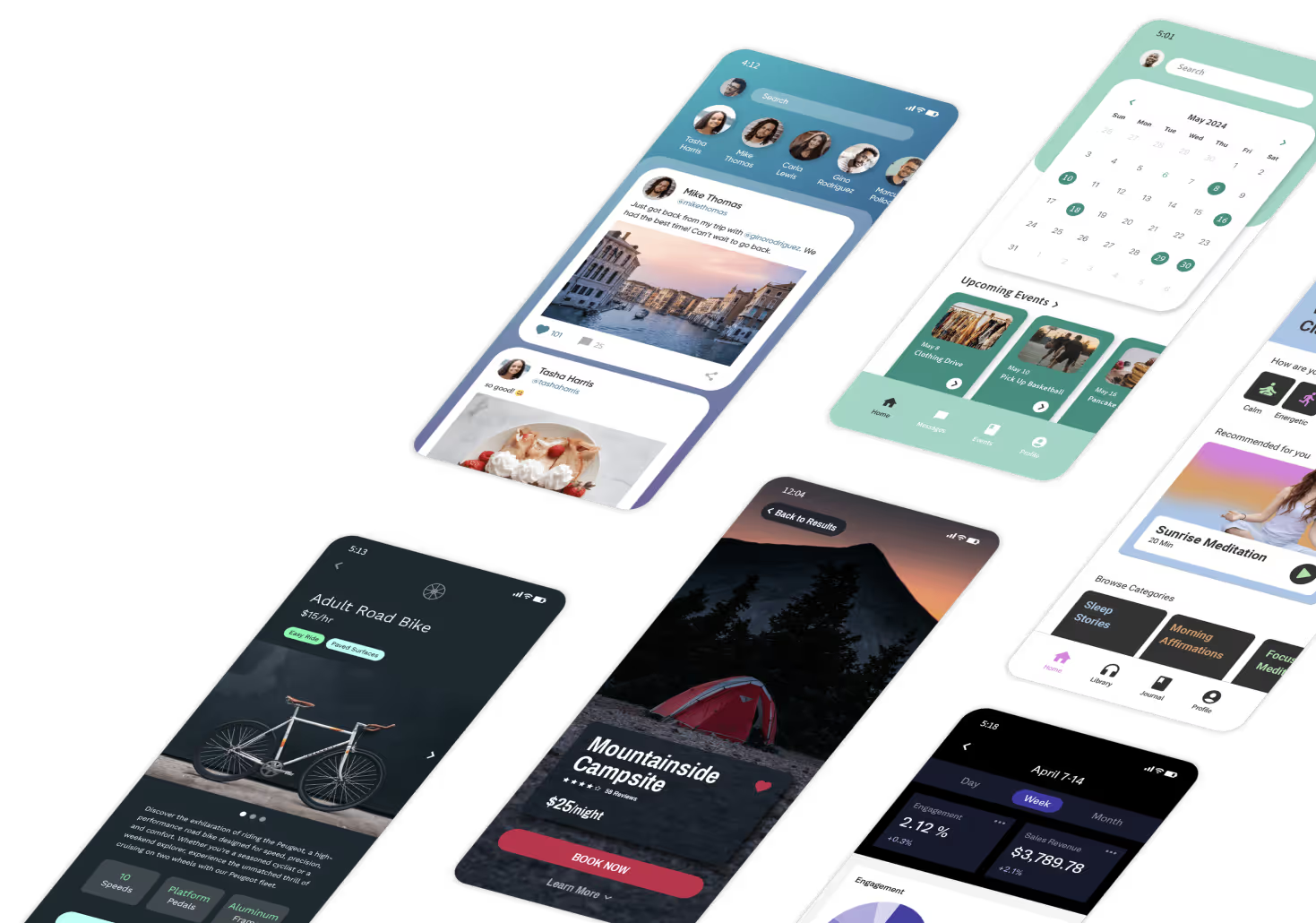
Adalo is a no-code app builder for database-driven web apps and native iOS and Android apps—one version across all three platforms, published to the Apple App Store and Google Play. This makes it the perfect foundation for QR scanning apps, where you need real-time database connections to instantly look up, create, or update records the moment a code is scanned.
Publishing your QR scanning app to the app stores means users can access it instantly from their phones—exactly where they need it. Whether someone is checking into an event, scanning inventory in a warehouse, or processing a payment at a pop-up shop, having a native app ensures fast camera access, reliable performance, and the ability to send push notifications when scans trigger important updates.
From event check-ins to inventory tracking, QR codes have become the bridge between physical objects and digital experiences. What once required expensive custom development is now within reach for entrepreneurs, small businesses, and creators who want to build powerful, interactive apps without writing a single line of code.
Adalo, an AI-powered app builder, makes QR scanning apps particularly straightforward to create. With its drag-and-drop interface and pre-built QR Scanner component, you can integrate scanning features into your app quickly—enabling seamless data capture and instant record updates across web, iOS, and Android platforms from a single codebase.
In this guide, you'll learn how to build a fully functional app with QR scanning capabilities—covering everything from understanding how QR codes work to implementing real-time database updates and automated workflows. Whether you're creating an attendance system, asset tracker, or payment solution, you'll walk away with the practical knowledge to bring your idea to life.

How to Build a QR Scanning App in Adalo: 5-Step Process
Why Adalo Works for Building QR Scanning Apps
Adalo is an AI-powered app builder for database-driven web apps and native iOS and Android apps—one version across all three platforms, published to the Apple App Store and Google Play. This makes it the perfect foundation for QR scanning apps, where you need real-time database connections to instantly look up, create, or update records the moment a code is scanned.
Publishing your QR app to both app stores means your team or customers can download it directly to their devices, accessing native camera functionality for fast, reliable scanning. Whether you're tracking inventory in a warehouse or checking guests into an event, having a dedicated mobile app—complete with push notifications to alert users of successful scans or status changes—creates a seamless experience that web-only solutions simply can't match.
With the Adalo 3.0 infrastructure overhaul launched in late 2025, apps now run 3-4x faster than before, with modular infrastructure that scales to serve apps with over 1 million monthly active users. Paid plans include unlimited database records with no usage-based charges—critical for QR scanning apps that may generate thousands of scan records daily.
QR Code Scanning Basics and Use Cases
What Are QR Codes and How Do They Work?
A QR (Quick Response) code is a type of two-dimensional barcode that can hold much more data than the traditional barcodes you see on product packaging. It achieves this by encoding information both horizontally and vertically, using a combination of finder patterns, alignment patterns, timing patterns, and data modules to ensure the data can be read accurately—even if the code is partially damaged.
When used in an app, the QR scanner utilizes the device's camera to read and decode the information stored in the QR code. Once scanned, the app can trigger various actions automatically, like updating a database, navigating to a specific screen, or creating new records. QR codes can store a wide range of information, including website URLs, contact details, Wi-Fi credentials, text messages, or even payment data. Thanks to built-in error correction, these codes remain scannable even if they're slightly damaged.
Grasping how QR codes function is key to effectively using the Adalo QR Scanner component in your app. This feature unlocks a range of possibilities for making your app more interactive and efficient.
Common Use Cases for QR Scanning in Apps
QR code scanning has found a home in many practical applications. For example, it's a game-changer for attendance tracking and event check-ins, offering a fast and efficient way to register attendees and update records instantly. In inventory and asset management, QR codes simplify the tracking of equipment and logging of new assets, eliminating the need for manual data entry.
In retail and payment systems, QR scanning enhances mobile transactions and streamlines processes like managing rental systems or adding items to orders. Shoppers can also use QR codes in stores to quickly access product details, compare prices, or read reviews, making their shopping experience more informed and convenient.
"Adalo's QR code scanner component lets app makers craft interactive, super easy-to-use apps... boosting user interaction by providing swift access to info, links, or actions with just a quick scan." - Bootstrapped.app
With these capabilities, apps can enable faster check-ins, more accurate inventory updates, and smoother transactions—all while being accessible on both web apps and mobile platforms.
Setting Up Your Adalo App for QR Scanning
Creating a New Adalo App
Ada, Adalo's AI builder, lets you describe what you want and generates your app. Magic Start creates complete app foundations from a description, while Magic Add adds features through natural language.
Starting your QR-enabled app in Adalo is simple and efficient. Begin by signing in to your Adalo account and opening the Adalo Builder. When creating a new project, you'll have access to tools like Magic Start and Magic Add, which use AI to automatically set up your app's database and structure.
Magic Start generates complete app foundations from a simple description. Tell it you need a QR scanning app for warehouse inventory, and it creates your database structure, screens, and user flows automatically—what used to take days of planning happens in minutes. Magic Add lets you describe features in natural language and adds them to your existing app.
Adalo apps are built around two key components: Screens (the user interface) and a Database (the backend). The visual builder—often described as "easy as PowerPoint"—allows you to drag and drop elements onto your screens, while the database stores all the information your app needs. Every new project comes with a default "Users" collection, which can be customized but not deleted.
With over 3 million apps created on the platform, Adalo's approach has proven effective for builders of all skill levels. Once your project is set up, the next step is to configure the database to handle QR scan results.
Configuring the Backend for QR Data
With your app's interface ready, it's time to set up the backend to log QR scan data. In the Adalo Builder, click on the Database tab (marked with a red icon) in the left-hand toolbar. Create a new collection to store QR scan results. Depending on your app's purpose, you might name this collection something like "Scanned Data", "Check-ins", or "Visits."
Add the following properties to this collection:
- A Text field to store the QR data.
- A Date field to record the time of each scan.
To associate scans with individual users, add a Relationship property that links this collection to the default "Users" collection. This approach ensures user information is not duplicated with each scan.
For apps with more advanced features—like checking if a scanned item already exists—you can add a temporary Text property (e.g., "Current Scanned Code") to the "Users" collection. This temporary field stores the scan result immediately after scanning, which can be helpful for filtering lists or triggering actions on other screens.
A key advantage for QR scanning apps: paid Adalo plans have no database record limits. This means your app can store unlimited scan records without worrying about hitting caps—essential for high-volume scanning operations like warehouse inventory or busy event check-ins. Image and file properties have a maximum upload size of 50MB, and number properties can handle up to 15 digits, including decimals and negative numbers.
Once your database is configured, you're ready to deploy. Adalo makes it easy to launch your app as a Progressive Web App or publish it natively on iOS and Android—all from a single build, without needing separate rebuilds for each platform.
Adding the QR Scanner Component
Adding the QR Scanner to Your App
Adalo doesn't come with a QR Code Scanner by default, but you can easily add it from the Component Marketplace. Here's how: In the Adalo editor, click on the Components (+) icon, head to the Marketplace, search for "QR Code Scanner", and add it to your project.
Once installed, the scanner will appear in your component library. Simply drag and drop it onto the screen where you want it to appear.
Important: The QR Code Scanner only works with native mobile apps (iOS and Android). It won't function in Progressive Web Apps vs. native apps or standard web previews. To test it, you'll need to use a physical device via TestFlight (for iOS) or an APK (for Android).
After placing the scanner, adjust its size in the right sidebar. Make sure the scanning area is large enough to capture QR codes easily. A larger area ensures better focus and more reliable code reading. The scanner also supports standard barcodes, such as UPC numbers.
Once the scanner is properly sized and positioned, you can move on to setting up its behavior for scan events.
Configuring Scanner Actions and Data Flows
Now that the scanner is in place, it's time to define what happens when a QR code is scanned. Select the scanner component, open the Actions tab in the right sidebar, and look for the option labeled Actions when a QR Code is Scanned. This is where you'll set up your workflow.
When a scan occurs, the scanner records two properties: Data and Encoded Data. The Data property holds the actual information from the QR code, which is typically what you'll use in your workflows. To save this information, create a Create action that adds a new record to your collection (for instance, a "Scanned Data" collection). Use Magic Text to map the scanner's Data property to the appropriate database field.
Here's an example: Adalo user Emeka developed a system to track store visits. Scanning a QR code at a storefront triggered a Create action that added a "Visits" record with the scanned Store Code and the logged-in user's email.
"From data access perspective scanner doesn't change anything - it is just yet another method to input data into the collections."
- Victor, Adalo Community Leader
For more advanced workflows, like checking if a scanned item already exists in your database, you can store the scan result in a temporary field (e.g., "Current Scanned Code") within your Users collection. This lets you filter lists or set conditional visibility on the next screen. For instance, to display different content based on whether the item is new or existing, use the Count function: show one group if the count of matching records is 0 (for new items) and another group if the count is greater than 0 (for existing items).
With Adalo's 3.0 infrastructure running 3-4x faster than before, these database lookups and conditional checks happen nearly instantaneously—critical for smooth scanning experiences where users expect immediate feedback.
Building QR Scanning Features
With your scanner and data flows set up, it's time to bring QR scanning features to life in Adalo. These use cases make the most of the platform's built-in tools for collecting data and automating actions.
Attendance Tracking and Event Check-Ins
Imagine a user walking into an event and scanning a QR code at the entrance. Instantly, the app logs their attendance—simple and efficient.
Here's how to set it up:
- Create a Check-ins relational database collection with three key properties:
- A Relationship field linked to your Users collection.
- A Text field for the Event ID.
- A Date field to automatically capture the timestamp.
- Use an external QR code generator to create static QR codes for each event. Each QR code should include a unique Event ID (e.g., "EVENT2026-001"). Display these codes at event entry points.
- On your scanner screen, configure the action to create a new Check-in record. Map:
- The Logged-in User to the User relationship field.
- The Scanner Data to the Event ID field. The Date field will fill in automatically.
- To avoid duplicate check-ins or invalid codes, temporarily store the scanned result (e.g.,
Logged-in User > ScannedCode). Use this to filter records and link to a "Result" screen. This screen can display filtered check-ins matching the scanned code. Use conditional visibility to show a "Check-in Successful" message if matching records exist, or an "Invalid Code" message if none are found.
For large events generating thousands of check-ins, Adalo's no record limits on paid plans means you won't hit database caps during peak registration periods. The modular infrastructure scales automatically to handle traffic spikes.
This same approach can be adapted to other workflows, such as inventory management.
Inventory Management with QR Codes
Taking the same principles from attendance tracking, QR scanning can transform inventory management into a smoother, faster process.
- Start by creating an Inventory collection with fields like:
- Product Name.
- SKU or UPC (as a Text field).
- Quantity.
- Any other relevant details about your products. You can also connect Adalo and Airtable to manage this inventory data externally.
- Assign each item a QR or barcode containing its unique SKU or UPC. Adalo's QR scanner can handle both QR and standard barcodes, making it compatible with most inventory systems.
- When a user scans an item, store the scanned result temporarily (e.g.,
Logged-in User > ScannedCode). Then, link to an "Item Details" screen where the inventory list is filtered to show only the item matching the scanned SKU. - On the "Item Details" screen, display the current stock level and include buttons or input fields to adjust quantities. These buttons should Update the inventory record with the new amount.
- For items not yet in your database, use conditional visibility to show an "Add New Item" form if no matching records are found. This allows users to scan and add new products on the spot.
For businesses managing large inventories, Adalo's SheetBridge feature offers another option: connect your existing Google Sheets directly to your app as a database. This gives you spreadsheet-style control over inventory data without learning traditional database management—scan updates flow directly to your familiar spreadsheet interface.
QR scanning doesn't stop here—it's equally useful for promotional redemptions and payment processing.
Processing Promotional Codes or Payments
QR scanning makes handling promotions and payments fast and convenient.
Promotional Codes
- Set up a Redemptions collection with the following fields:
- A Relationship to Users.
- A Text field for the Promo Code.
- A Date field to log the redemption time.
- Generate unique QR codes for each promotion, embedding the promo code (e.g., "SAVE20JAN"). Configure the scanner to create a new Redemption record, linking the user and scanned promo code.
- To validate codes, store the scanned result temporarily (e.g.,
Logged-in User > ScannedCode). Link this to a confirmation screen that filters the Redemptions collection by the scanned promo code. Use conditional visibility to display a "Success" message if the code is valid, or an "Invalid Code" message if it's not. You can also add logic to prevent duplicate redemptions by checking for existing records.
Payments
For payments, QR codes often contain a unique identifier like a User ID or Store ID. After scanning, pass this identifier to a payment processor like Stripe using Custom Actions. For instance, the scanned data can be used as an input for an API call (e.g., https://api.stripe.com/v1/customers), enabling you to retrieve or update payment details without manual input.
With Adalo, you can launch fully functional apps as PWAs or on iOS and Android platforms—no extra rebuilding required. The unlimited usage model on all plans means you won't face unexpected charges as your payment processing volume grows.
Testing and Publishing Your QR-Enabled App
Testing Your QR Functionality
Testing your QR scanner thoroughly is a must to ensure it performs reliably on all devices. While Adalo's Preview mode is useful for checking the web version, you'll need to test on actual devices using simulators, emulators, and real hardware to get the full picture.
For iOS, TestFlight is an excellent tool to evaluate camera focus and scanning speed. Before building, don't forget to update the camera permission text in your iOS Settings within Adalo to meet Apple's guidelines. Apple requires a clear explanation of why your app needs camera access—missing this step can result in build or submission failures. Also, double-check your Bundle ID for any extra spaces, as this is a common reason builds fail.
Test your app with both physical and digital QR codes to ensure all actions trigger as expected. Confirm that scanned data is correctly populating database fields, navigating to the right screens, and displaying appropriate success or error messages. To simulate real-world scenarios, you can generate physical test QR codes using external tools.
Adalo's X-Ray feature can help identify performance issues before they affect users. Run X-Ray on your scanner screens to catch any bottlenecks in your data flows or actions that might slow down the scanning experience.
"Make sure the scanner area is big enough so users can scan QR codes without any hassle."
- Bootstrapped.app
Once you've verified that the QR functionality works seamlessly across devices, you're ready to move on to the deployment phase.
Deploying Your App to the Web and App Stores
To publish your QR-enabled app, you'll need a paid Adalo plan. Starting at $36/month, paid plans include unlimited usage, unlimited database records, and app store publishing with unlimited updates to apps once published—no usage-based charges that create bill shock.
For full QR functionality, publishing to both the iOS App Store and Google Play Store is essential since the scanner requires native camera access.
For iOS, you'll need an Apple Developer License, which costs $99 per year, and Two-Factor Authentication enabled on a trusted Apple device. In Adalo's Launch tab, expand the "iOS App" section, then input your Apple credentials, Bundle ID, and an app-specific password. Start by creating a TestFlight build to test the app as part of your MVP app development before submitting it to the App Store. For Android, submission is simpler—use the Launch tab after paying the one-time Google Play Developer fee.
"Apple Requires that when your app requests access to use your user's camera... that you provide an explanation for how your app uses these features."
- Adalo Help Documentation
Adalo makes it easy to deploy your app as both a Progressive Web App and native iOS and Android apps—all from a single build. When you update your app, changes publish to all platforms simultaneously, unlike platforms that use web wrappers where you might need to manage separate codebases.
Conclusion
Building QR-enabled apps connects the digital and physical worlds while enhancing efficiency for businesses of all sizes. The process is straightforward: install the QR scanner component, set up your database to log scans, configure the actions triggered by scans, and test everything on native devices.
"Adalo's QR code scanner component lets app makers craft interactive, super easy-to-use apps that read QR codes right inside the app."
- Bootstrapped
The potential for businesses is immense. Whether it's managing inventory, organizing events, running promotions, or streamlining payments, QR scanning simplifies data entry, minimizes errors, and even supports loyalty programs that reward customers for engaging with your physical locations.
One standout feature is the single-codebase architecture. You can build your app once and deploy it across the web, iOS, and Android without juggling multiple codebases. Any updates you make are instantly reflected across all platforms, saving time and effort.
From a single build, you can publish your app as a Progressive Web App (PWA) and as native apps on the iOS and Android app stores, ensuring your app is accessible wherever your users are.
Related Blog Posts
- How to Launch Your First Mobile App Without Coding
- Build a No-Code Ticketing System in 3 Days
- Building an E-commerce App: No-Code Platform Guide
- How To Enable Employees To Build The Apps They Need
FAQ
Why choose Adalo over other app building solutions?
Adalo is an AI-powered app builder that creates true native iOS and Android apps. Unlike web wrappers, it compiles to native code and publishes directly to both the Apple App Store and Google Play Store from a single codebase—the hardest part of launching an app handled automatically. With the 3.0 infrastructure overhaul, apps run 3-4x faster with unlimited database records on paid plans.
What's the fastest way to build and publish an app to the App Store?
Adalo's drag-and-drop interface combined with AI-assisted building through Magic Start and Magic Add lets you go from idea to published app in days rather than months. The platform handles the App Store submission process directly—you provide your developer credentials, and Adalo manages the build and submission workflow.
How do I test the QR scanning feature on different devices?
Add the QR scanner component to your screen, then test by running the app on your target device through TestFlight (iOS) or an APK (Android). Grant camera permissions when prompted, scan a QR code, and confirm the app displays data correctly. Repeat on various devices to ensure smooth performance across different operating systems and cameras.
What should I know about the limitations of Adalo's QR scanner component?
The QR scanner is a plug-and-play feature designed for quick setup, but its functionality is limited to preset options. The scanner only works with native mobile apps—it won't function in Progressive Web Apps or web previews. You'll need to test on physical devices via TestFlight or APK to verify scanning functionality.
How does Adalo store data from QR code scans?
Adalo saves all QR code scan results in cloud collections that house your app's data. Configure actions like Create, Update, or Delete to store scanned information in collections you've set up. Each scan generates a new record with details like user email, encoded information, and timestamp. Paid plans have no record limits, so high-volume scanning apps won't hit database caps.
Does the QR scanner work on both iOS and Android?
Yes, Adalo's QR Scanner component works on both iOS and Android native apps. However, it does not function in Progressive Web Apps or web previews—you'll need to test on physical devices using TestFlight for iOS or an APK for Android to verify scanning functionality.
How much does it cost to build a QR scanning app?
Adalo's paid plans start at $36/month, which includes unlimited usage, unlimited database records, and app store publishing with unlimited updates. You'll also need an Apple Developer License ($99/year) for iOS publishing and a one-time Google Play Developer fee ($25) for Android publishing.
Can I prevent duplicate scans or validate QR codes in my app?
Yes. Store scanned results in a temporary field within your Users collection, then use filtering and conditional visibility to check if the code already exists in your database. This allows you to display different messages for valid codes, invalid codes, or duplicate entries based on whether matching records are found.
How long does it take to build a QR scanning app?
With Adalo's visual builder and pre-built QR Scanner component, you can have a functional QR scanning app ready for testing within a few hours. Magic Start can generate your initial app structure from a description, and Magic Add lets you add features by describing what you want. Most builders go from idea to MVP in days rather than months.
Do I need coding experience to build a QR scanning app?
No coding experience is required. Adalo's visual builder is often described as "easy as PowerPoint"—you drag and drop components onto screens and configure actions through a visual interface. The QR Scanner component installs from the Marketplace and connects to your database through point-and-click configuration.