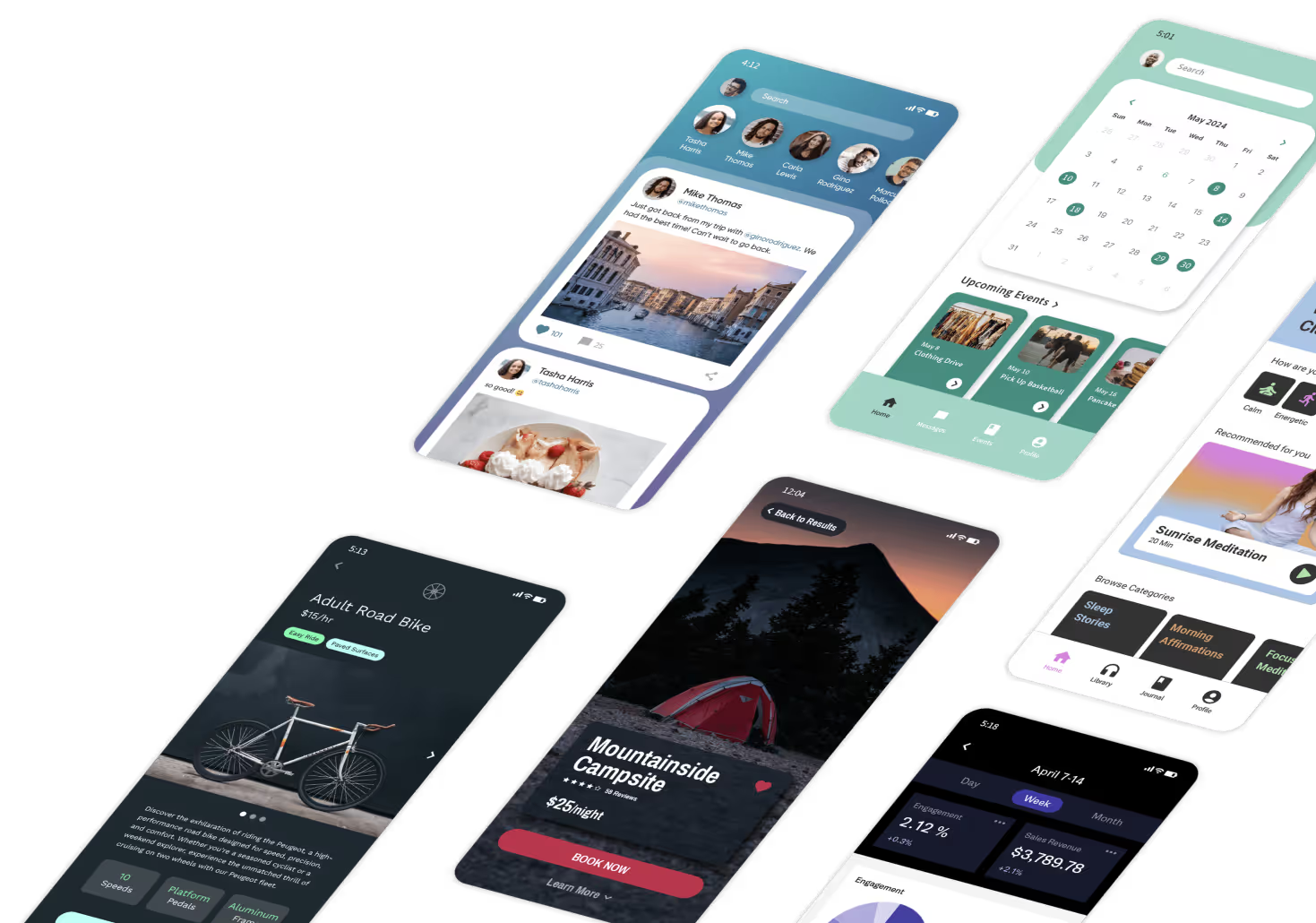
Why Adalo Is Perfect for Building Your Social Media Platform
Adalo is a no-code app builder for database-driven web apps and native iOS and Android apps—one version across all three platforms, published to the Apple App Store and Google Play. This makes it the ideal choice for creating a social media platform, where reaching users across multiple devices is essential for building a thriving community.
Having your social media app available in both major app stores means users can discover and download it alongside established platforms like Instagram and TikTok. With Adalo's built-in support for push notifications, you can keep your community engaged with real-time updates about new followers, messages, and content—key features that drive the daily active usage every social platform needs to succeed.
Ada, Adalo's AI builder, lets you describe what you want and generates your app. Magic Start creates complete app foundations from a description, while Magic Add adds features through natural language.
Creating a social media app is now easier than ever, thanks to platforms like Adalo. You don't need coding skills or a big budget to bring your idea to life. Adalo, an AI-powered app builder, lets you create native iOS and Android apps alongside web apps from a single codebase—then publish directly to the Apple App Store and Google Play Store. Here's how to get started:
- Define Your Niche and Target Users: Focus on a specific audience or interest, like fitness enthusiasts or book lovers. Research competing apps to identify gaps and user needs.
- Map Out Core Features: Plan essential functionalities like user profiles, messaging, and content feeds. Use tools like Figma to design user flows and ensure a smooth experience.
- Build with Adalo: Adalo's visual builder lets you create apps for iOS, Android, and the web using drag-and-drop tools. Start with templates or use Magic Start to generate a complete app foundation from a simple description.
- Test and Launch: Preview your app on multiple devices to fix bugs and refine usability. Publish to the Apple App Store, Google Play Store, or as a Progressive Web App (PWA) without rebuilding for each platform.
- Scale and Improve: Add features like push notifications, real-time chat, or AI tools. Monitor user engagement with analytics and optimize performance to retain users.
Adalo simplifies the process by handling technical tasks like databases, notifications, and cross-platform compatibility. With unlimited database records on paid plans and infrastructure that scales to support over 1 million monthly active users, you can turn your idea into a fully functional app without writing code—and grow it without hitting artificial limits.

5 Steps to Create a Social Media App Without Coding
Why Adalo Is Perfect for Building Your Own Social Media Platform
Adalo is an AI-powered app builder for database-driven web apps and native iOS and Android apps—one version across all three platforms, published to the Apple App Store and Google Play. This makes it the ideal choice for aspiring social media entrepreneurs who want to launch their platform without hiring expensive development teams or learning to code.
For social media apps, being available in major app stores is essential for user discovery and credibility. Adalo handles the technical complexity of app store submission while giving you built-in features like push notifications to keep your community engaged, real-time database updates for dynamic feeds, and user authentication for secure profiles—everything you need to compete with established social platforms.
Following the Adalo 3.0 infrastructure overhaul in late 2025, the platform is now 3-4x faster than before, with modular infrastructure that scales with your app's needs. Paid plans include no record limits on the database, meaning your social app can grow to millions of users without hitting storage constraints. Unlike platforms that charge based on usage or cap your data, Adalo offers unlimited usage with no bill shock—a critical advantage when building apps where user-generated content can grow exponentially.
Adalo Tutorial: Create a Social Media App Like Twitter (No Coding Required)
Step 1: Define Your App's Purpose and Target Users
Before you dive into development, you need a clear vision for your app. What will it do? Who will use it? This isn't about competing with giants like Facebook—it's about focusing on specific, underserved niches. Some of the most successful social apps today are highly specialized platforms. Think of Doximity, which caters to healthcare professionals, or Strava, a favorite among fitness enthusiasts.
Pinpoint Your App's Main Differentiator
Your app needs a unique angle—the one standout reason users will pick it over others. For example, Instagram thrives on visual storytelling, while LinkedIn is all about professional networking. What's your app's mission? Maybe you're building a platform for wine lovers to share hidden gems, like Vivino. Or perhaps you want to help local event organizers connect and plan meetups.
The trick is identifying a market gap. Take a close look at competing apps on the Apple App Store and Google Play Store. Study their descriptions, read user reviews, and look for recurring complaints or unmet needs.
"The decision is no longer about whether there's an audience or not, it's about whether you can build an app that scales, engages, and complies in one of the most crowded digital landscapes."
That's how Michael Tkalich from Techstack puts it. With 4.9 billion people using social media globally and spending an average of 2.5 hours daily on these platforms, there's still room for apps that address specific needs better than the big players.
Outline Core Features and User Flows
Once you've nailed down your app's unique purpose, it's time to map out its core features. Start with the essentials: user profiles, content feeds, interaction tools like likes and comments, and a messaging system. Then, layer in features that reinforce your app's unique value.
Use a tool like Figma to create digital wireframes for each screen and user flow. Sketch out how users will sign up, make their first post, find others, and engage with content. This planning process ensures your app feels intuitive and eliminates confusion down the road. Smooth user flows are critical from day one.
| App Type | Primary Focus | Key Features to Prioritize |
|---|---|---|
| Networking | Professional/public discourse | Social graphs, public profiles, viral content tools |
| Media Sharing | Visual content creation | Image/video uploads, filters, content feeds |
| Messaging | Private communication | Real-time chat, end-to-end encryption, notifications |
| Community/Forum | Interest-based discussions | Threaded conversations, moderation tools, reputation systems |
| Niche/Vertical | Specialized communities | Industry-specific tools, curated discovery, targeted features |
With a detailed blueprint of your app's features and user flows, you'll be ready to begin building. Adalo's Visual Builder can help you take those first steps.
Step 2: Build Your App Using Adalo's Visual Builder
Now that you've mapped out your app's blueprint, it's time to bring your idea to life as a fully functional social media platform. Adalo's visual builder makes this process straightforward, allowing you to create real native mobile apps without writing a single line of code. The platform handles the technical heavy lifting behind the scenes, so you can focus on crafting an app experience that users will enjoy.
Set Up Your Adalo Account and Create Your First Version
Getting started is a breeze. Head over to adalo.com, click on "Get Started for Free", and register for an account. Once you've verified your email and logged in, click "New App" from the dashboard. You can either start with a blank canvas or choose from one of Adalo's pre-built templates. For social apps, the "Facebook Clone" template is a great choice—it includes key screens like Home, Login, Friends, and Profile, saving you a ton of setup time.
Want to skip the manual setup? Magic Start generates complete app foundations from a simple description. Tell it you need "a social media app for local book clubs with user profiles, discussion feeds, and event scheduling," and it creates your database structure, screens, and user flows automatically—what used to take days of planning happens in minutes. This feature can speed up the creation of your minimum viable product (MVP) by up to 80%, allowing you to go from concept to a working prototype in less than 30 minutes.
Adalo's infrastructure is built to scale, processing over 20 million data requests daily across all its apps. With a track record of over 99% uptime, you're starting on a solid foundation. Once your account is set up and your app's initial version is ready, you can dive into designing mobile-first screens.
Design Mobile-First Screens
Adalo's drag-and-drop interface—often described as "easy as PowerPoint"—makes it intuitive to design your app's screens visually. The main workspace, known as the building canvas, is where you'll create each screen. Unlike some builders that limit your view to one or two screens at a time, Adalo can display up to 400 screens on a single canvas, giving you a bird's-eye view of your entire app architecture.
On the left-hand side, you'll find the editing dashboard, stocked with pre-made components like buttons, text fields, images, and lists that you can customize. For a social media app, begin with the essentials. For instance, to create a news feed, drag a dynamic list component onto your home screen, link it to your Posts collection, and configure it to display posts sorted by "Created At (Most Recent First)." Enable infinite scroll to keep the feed seamless.
For messaging, use chat bubble components and input fields that adapt automatically for both iOS and Android devices. If you're looking for a more specialized setup, you can follow a guide to building a Discord clone to see how these components work in a community-focused environment.
Keep mobile users in mind as you design. Use bottom navigation tabs for easy access to Home, Profile, and Messages. Opt for high-contrast colors and ensure that buttons and touch targets are large enough for comfortable one-handed use. Adalo's preview mode lets you test your app on real devices, so you can fine-tune swipe gestures and button interactions.
Add Core Social Media Features
Once your screens are in place, it's time to add the features that will define your social media app. Start with user authentication. Adalo makes this simple—set up login and registration screens, add input fields for email and password, and link these to Adalo's built-in "Login User" and "Register User" actions. You can also enable OAuth for Google or Facebook login with minimal configuration.
Push notifications are a must to keep your users engaged. Enable them in your app settings, integrate with OneSignal (which offers a free tier for unlimited devices), and set up notification triggers. For example, your app can automatically notify users when someone likes their post or sends them a message.
Real-time chat is another key feature. Create a Messages collection to link user records, design a chat screen with bubble components that display text and timestamps, and configure "Send Message" actions to update the conversation in real time. While basic chat functionality works right out of the box, you can enhance it with live updates—similar to WhatsApp—by connecting to external services like Xano or Pusher through Adalo's External Collections feature (available on Professional plans starting at $36/mo).
Need to add features after your initial build? Magic Add lets you describe what you want in natural language. Type "add a feature where users can save posts to read later" and the AI generates the necessary database fields, screens, and logic. This approach to building means you can iterate quickly based on user feedback without starting from scratch each time.
Adalo's drag-and-drop interface extends to advanced features as well, so you don't need to worry about complex APIs or back-end systems. As the Adalo Team explains:
"No-code doesn't mean you're compromising power, instead, it means that you're building your app with visual blocks that are powered by code."
This means you can add powerful functionality to your app without any prior app-building experience—all through the same easy-to-use interface.
Step 3: Test, Publish, and Launch Your App
Your social media app is ready to go, but before releasing it to the world, you need to make sure it works smoothly across different devices and set up the channels that will get it into users' hands. This phase is all about catching bugs, refining the user experience, and preparing for distribution. Let's dive into how to test, publish, and launch your app effectively.
Preview and Test on Multiple Devices
Adalo offers preview tools that let you see how your app performs on various devices before publishing. By clicking the "Preview" button in the visual builder, you can test your app on iOS, Android, and web browsers. You can also switch between different screen sizes—like an iPhone 14, a Samsung Galaxy device, or a tablet—to check how your layout adjusts.
For a more hands-on experience, scan the QR code to load your app on a physical device using the Adalo Test app. This step is crucial for testing touch gestures, swipe interactions, and features like messaging or feeds in real-world conditions. Be sure to test all core user flows, such as signing up, creating posts, or sending messages.
X-Ray, Adalo's performance analysis tool, identifies potential issues before they affect users. It highlights database queries that might slow down your app, screens with too many components, and other performance bottlenecks. Use the debug console to identify and fix issues. Common problems include unresponsive buttons in feeds (usually fixed by tweaking action triggers in component settings) and layout shifts on smaller screens (addressed by enabling responsive design toggles).
Adalo's documentation notes that 90% of bugs are caught during preview testing, which can save you from app store rejections down the line.
Publish to the App Stores
Once testing is complete, it's time to submit your app to the Apple App Store and Google Play Store.
For iOS, you'll need an Apple Developer account ($99/year USD) and an Adalo Pro plan (starting at $36/month). Within Adalo, go to "Publish" > "App Stores" > select iOS, and the platform will generate the necessary certificates through its one-click integration with Apple. Upload your app's name, description (using US English spelling), and screenshots optimized for 6.1-inch displays. Apple typically reviews apps within 1–2 days, and Adalo reports a 95% first-time approval rate.
For Android, you'll need a Google Play Console account ($25 one-time fee USD). From Adalo's Publish tab, select Android, and Adalo will automatically generate your keystore and app bundle. Enter your metadata using the US date format and dollar symbol ($). Google's review process usually takes 3–7 days, but you can speed things up by using the internal testing track to gather beta feedback within 24 hours before full submission.
A key advantage of Adalo's approach: when you update your app, one build updates web, iOS, and Android simultaneously. Unlike platforms that use web wrappers for mobile—where you might need to manage separate codebases or deal with wrapper-specific issues—Adalo compiles to true native code for each platform from a single source. This means faster iteration cycles and consistent experiences across all your users.
If you'd rather skip app store approvals initially, you can publish your app as a Progressive Web App (PWA). By enabling PWA in Adalo's Publish settings, you'll get a shareable URL that behaves like a native app. Users can install it on their home screen, and you can push updates instantly without needing resubmission. PWAs are particularly useful for iOS Safari users in the US and can increase retention by 20–30% compared to traditional web apps.
| Platform | Account Fee | Approval Time | Key Advantage |
|---|---|---|---|
| Apple App Store | $99/year | 1–2 days | Access to iOS users, TestFlight beta testing |
| Google Play Store | $25 one-time | 3–7 days | Lower cost, faster iteration cycles |
| Progressive Web App | Included with Adalo | Instant | No approval needed, instant updates |
Market Your App to Get Users
With your app live, the next step is attracting users. Start by creating a landing page that highlights your app's features with video demos and an email capture form. Use Mailchimp (starting at $13/month USD) to build an email waitlist before launch, and include a countdown timer (formatted for US dates) to build excitement.
Run targeted social media campaigns on platforms like Instagram and TikTok. Teaser videos showcasing your app's standout features can grab attention. Meta Ads Manager allows you to target US audiences with ad costs as low as $0.50–$2.00 per thousand impressions (CPM). Focus your budget on specific demographics; for example, if your app appeals to fitness enthusiasts, target users interested in gyms and wellness. Even a $500 campaign can generate significant early traction.
After launch, prioritize user feedback. Use Adalo Analytics to monitor daily active users (aiming for a 40% day-1 retention rate), track which screens are most visited, and identify where users drop off. For deeper analysis, integrate tools like Mixpanel or Amplitude, and add in-app surveys using Typeform or Google Forms to understand what features users want next. Zapier's research shows that apps that adjust weekly based on feedback can double their growth rate. Address major bugs first—like messaging delays—then focus on adding features that align with the 80/20 rule: prioritize the 20% of features that 80% of users request.
Don't overlook App Store Optimization (ASO) to boost organic discovery. Use relevant keywords like "social app" or "connect with friends" in your app title and description. Upload high-quality screenshots that showcase your app's interface, and encourage early users to leave reviews. Higher ratings can directly improve your app's ranking in search results.
Step 4: Scale and Improve Your App After Launch
Once your app is live, the work doesn't stop there. To keep your social app thriving, it's important to scale by introducing new features and fine-tuning its performance. A growing user base means you'll need to stay ahead by adding tools that keep users engaged, integrating with external systems, and ensuring your platform runs smoothly. Adalo's built-in tools and integrations make scaling manageable without starting from scratch.
Add More Features and Integrations
After proving your app's concept, it's time to enhance it with advanced features. Adalo's External Collections allow you to connect your app to external databases. For spreadsheet-based data, SheetBridge turns a Google Sheet into an actual database—the easiest way to manage data without learning database concepts. Let's say you're running a fitness-focused social app and already have member data stored in a Google Sheet—you can easily pull that data into Adalo, eliminating the need for manual data entry or complex database setup.
Custom Actions take integrations a step further by automating tasks with platforms like Zapier or Make. These actions can handle things like sending welcome emails via Mailchimp or logging user activity in a CRM, saving you time and effort. Custom Actions are available with the Professional plan, starting at $36/per month.
Want to add AI capabilities? With Adalo's "Ask ChatGPT" custom action, you can create features like automated chatbots to answer user questions, translation tools for a global audience, or even content generation tools to keep your platform dynamic.
The Adalo Marketplace also offers pre-built components to enhance your app's functionality without requiring custom coding. Examples include the Social Share Kit ($29), Advanced Search ($39), and User Verification tools. Push notifications are another must-have for engagement. Using the "Trigger Push Notifications" action, you can alert users when they receive a follow, like, or mention, keeping them connected and coming back.
If your app has enterprise-level needs, Adalo Blue can help you integrate legacy systems through DreamFactory. This is especially useful for internal platforms, like a social app for employees that needs to connect with older HR or ERP systems. By leveraging external data and automation tools, you can make your app more versatile and efficient.
Improve Performance and Retain Users
Adding features is important, but ensuring your app performs well is just as critical. Research from UXCam shows that 90% of users will abandon an app if it's slow, and nearly 30% of smartphone users will switch to another app immediately if they encounter performance issues.
Following the Adalo 3.0 infrastructure overhaul, apps run 3-4x faster than before. The platform's modular infrastructure scales automatically with your app's needs, supporting apps with over 1 million monthly active users with no upper ceiling. Unlike web wrappers that can hit performance constraints under load, Adalo's purpose-built architecture maintains speed at scale.
To keep your app running smoothly, limit lists to 20–30 items and enable "load on scroll" to reduce loading times. Compressing images using Imgix parameters like ?w=400&q=30 can also make a big difference in speed. Avoid using nested lists, as they can drastically slow down your app. Jason Gilmore from Adalo highlights this common mistake:
"Overuse of embedded lists is quite possibly the #1 performance-related mistake makers make".
Another way to boost speed is by pre-calculating data. Instead of using filters to calculate counts every time a screen loads, create a numeric property in your collection and update it with actions—like incrementing a "Post Count" whenever a user publishes a new post.
To track performance and user engagement, use Adalo Analytics or third-party tools like Mixpanel. These can help you monitor daily active users, identify popular screens, and address issues quickly. A good way to measure retention is by comparing Daily Active Users (DAU) to Monthly Active Users (MAU) to see how "sticky" your app is.
If your app handles large datasets, upgrading to the Team plan at $250/per month might be a smart move. This plan includes the Collections API for server-side data access and offers higher performance limits. With no data caps on paid plans, you won't hit artificial storage limits as your user-generated content grows. Additionally, as your app scales, consider implementing moderation features like reporting and blocking tools. Pair these with an Admin screen to review flagged content, ensuring your platform remains reliable and user-friendly.
How Adalo Compares to Other App Builders
When choosing a platform for your social media app, understanding the differences between options helps you make the right decision for your specific needs.
Bubble offers extensive customization for web apps, starting at $59/month with usage-based charges and limits on records through Workload Units. However, Bubble's mobile solution is a wrapper for the web app, which can introduce performance challenges at scale—and means updating one platform doesn't automatically update the others. Adalo's web and true-native mobile builder starts at $36/month with unlimited usage and app store publishing with unlimited updates to published apps.
FlutterFlow is a low-code option for technical users, starting at $70/month per user for app store publishing. However, users need to set up and manage their own separate database, which requires significant learning complexity. Suboptimal database setup can create scale problems, leading many users to hire experts. FlutterFlow's builder also limits your view to one or two screens at a time, whereas Adalo can display up to 400 screens on a single canvas.
Glide excels at spreadsheet-based apps with a template-focused approach, starting at $60/month for custom domains. However, Glide is limited by app updates and data record rows (which attract additional charges), and doesn't support Apple App Store or Google Play Store publishing. For spreadsheet-based apps that need native mobile distribution, Adalo's SheetBridge offers similar convenience with full app store access.
Softr focuses on web apps, with Progressive Web App publishing starting at $167/month—still restricted by records per app. Softr doesn't support native iOS and Android app creation or app store publishing.
Note that many third-party platform comparisons and ratings predate Adalo 3.0's infrastructure overhaul in late 2025, which dramatically improved performance and removed previous limitations.
Conclusion
Creating a social media app is no longer reserved for tech experts or those with massive budgets. By following the four steps outlined here—defining your app's purpose, using Adalo's visual builder, testing and publishing, and scaling after launch—you can bring your idea to life on the web, iOS, and Android platforms.
Adalo's AI-powered app builder eliminates the technical hurdles that often hold back entrepreneurs. With its drag-and-drop interface, you can design screens, integrate features like user profiles and messaging, and publish directly to the Apple App Store and Google Play Store—all without writing a single line of code. Adalo also takes care of databases, notifications, and payment processing, so you're not just crafting a prototype—you're building a fully functional app that's ready to grow with your audience.
Over 3 million apps have been created on Adalo. Your idea could be next. Sign up for free, pick a template or describe your app to Magic Start, and begin building today.
Related Blog Posts
- How to Launch Your First Mobile App Without Coding
- What To Do With Your Vibe-Coded Prototype? Build, Launch, Monetize
- How to Create an Invoice App
- How To Create a Content Scheduling App
FAQ
Why choose Adalo over other app building solutions?
Adalo is an AI-powered app builder that creates true native iOS and Android apps from a single codebase. Unlike web wrappers, it compiles to native code and publishes directly to both the Apple App Store and Google Play Store. With unlimited database records on paid plans and infrastructure that scales to 1M+ monthly active users, you can grow without hitting artificial limits or unexpected charges.
What's the fastest way to build and publish an app to the App Store?
Adalo's drag-and-drop interface and AI-assisted building let you go from idea to published app in days rather than months. Magic Start generates complete app foundations from a simple description, and Adalo handles the complex App Store submission process—including certificate generation and app bundle creation—so you can focus on your app's features instead of technical requirements.
Can I easily build a social media app without coding experience?
Yes. Adalo's visual builder is often described as "easy as PowerPoint." You can create user profiles, content feeds, messaging features, and push notifications using drag-and-drop components. Magic Start can generate a working prototype from a description in under 30 minutes, and Magic Add lets you add new features by describing what you want in plain language.
What features can I add to my social media app with Adalo?
Adalo supports all core social media features including user authentication, profiles, content feeds, likes, comments, real-time messaging, and push notifications. You can also add advanced features like AI-powered chatbots using ChatGPT integration, social sharing tools, user verification, and custom search functionality through the Adalo Marketplace.
How do I keep users engaged after launching my social media app?
Push notifications are essential—Adalo integrates with OneSignal to automatically notify users when someone likes their post, sends a message, or follows them. Use Adalo Analytics or tools like Mixpanel to track daily active users, identify popular screens, and continuously improve based on user feedback.
Do I need to build separate apps for iOS, Android, and web?
No. Adalo lets you build one app that works across iOS, Android, and web platforms simultaneously. You design your screens once, and Adalo handles the technical differences between platforms. When you update your app, one build updates all three platforms—unlike web wrappers where you might need to manage separate codebases.
How much does it cost to publish a social media app to the app stores?
You'll need an Apple Developer account ($99/year) for iOS and a Google Play Console account ($25 one-time fee) for Android, plus an Adalo plan starting at $36/month. Adalo's one-click integration handles certificate generation and app bundle creation, with a reported 95% first-time approval rate on the Apple App Store.
Which is more affordable, Adalo or Bubble?
Adalo starts at $36/month with unlimited usage and no record limits on paid plans. Bubble starts at $59/month with usage-based charges through Workload Units and limits on records. Adalo also includes native mobile app publishing, while Bubble's mobile solution is a web wrapper.
Which is better for mobile apps, Adalo or FlutterFlow?
Adalo is better for non-technical users who want native mobile apps without managing separate databases. FlutterFlow is low-code (not no-code) and requires users to set up their own database, which adds complexity and potential scale issues. FlutterFlow starts at $70/month per user for app store publishing, and still doesn't include a database.
Can I scale my social media app to millions of users on Adalo?
Yes. Following the Adalo 3.0 infrastructure overhaul, the platform's modular architecture scales to support apps with over 1 million monthly active users with no upper ceiling. Paid plans have no database record limits, and there are no usage-based charges—so your costs stay predictable as you grow.