
Adalo can support live apps with paying users, but it has clear strengths and limits. Here's what you need to know:
Adalo, a no-code app builder for database-driven web apps and native iOS and Android apps—one version across all three platforms, published to the Apple App Store and Google Play, has become a popular choice for entrepreneurs and businesses looking to launch production-ready applications. But how well does it actually perform when real users and paying customers are involved?
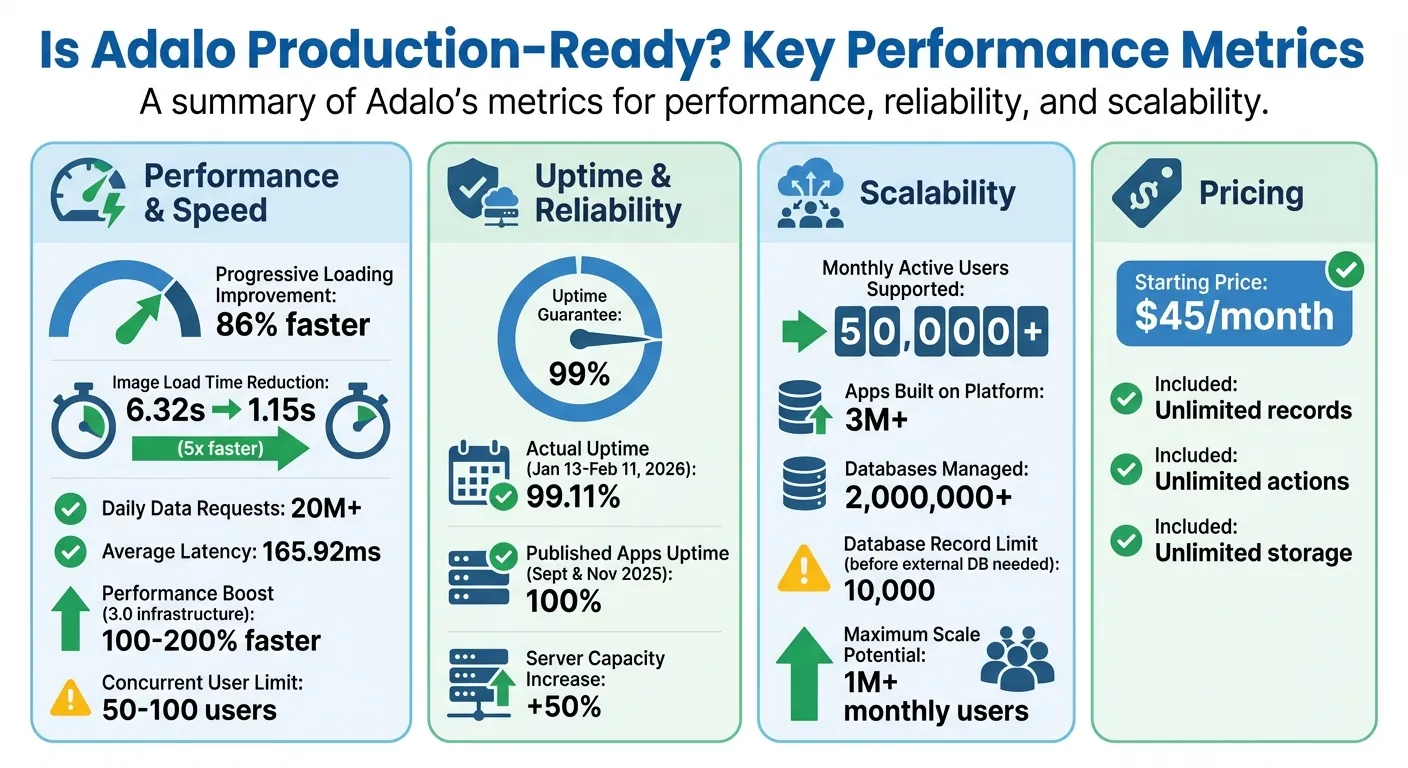
- Performance: Adalo apps handle 20M+ daily data requests. Speed improvements include AWS autoscaling, server-side data processing, and reduced latency (165.92ms average). However, performance may drop with over 50–100 concurrent users.
- Uptime: Adalo guarantees 99% uptime, achieving 99.11% between Jan 13–Feb 11, 2026. Infrastructure upgrades, like AWS migration and region-based sharding, improve reliability.
- Scalability: Apps can handle 50,000+ monthly users with proper setup. For heavy data loads (10K+ records), external databases like Xano are recommended.
- Pricing: Plans start at $36/mowith unlimited records, actions, and storage, offering predictable costs even during growth.
Adalo works well for small-to-medium apps, MVPs, and businesses scaling to 1M+ monthly users. For larger datasets or high concurrency, external tools and best practices are essential.
Adalo Performance Metrics: Uptime, Speed, and Scalability Stats
Five Tips for Improving Your Adalo App Performance
Performance Benchmarks: Speed and Response Times
When launching a business app, speed isn't a luxury—it's a requirement. Users expect apps to load quickly, display data instantly, and provide smooth interactions. A sluggish app pushes users away, regardless of how impressive its features might be.
Adalo has addressed this through significant infrastructure investments, including a 50% increase in server capacity and migration to AWS for automatic scaling. This setup dynamically allocates extra computing power—known as "workers"—during traffic surges, keeping your app responsive without manual intervention.
Load Times and Query Performance
Handling large datasets can be challenging, but Adalo has introduced solutions to maintain smooth performance. Progressive loading speeds up initial load times by 86% when working with lists containing 5,000 records, ensuring the app stays responsive even with substantial data.
Another major upgrade involves shifting heavy data processing from users' devices to Adalo's servers. By filtering, sorting, and preparing data server-side, the platform reduces strain on local devices, making the user experience faster and more efficient. Web components delivered through the Cloudfront CDN achieve an average latency of just 165.92ms, while automated image compression results in images loading five times faster.
To optimize performance further, enable the "Load Items as User Scrolls" option in Advanced Options for lists with more than a few dozen records. Additionally, avoid nesting components more than four levels deep, as this significantly increases processing demands.
While these measures ensure efficient data handling, managing simultaneous user access presents a different challenge altogether.
Concurrent User Capacity
Adalo's performance can decline when more than 50–100 users are active simultaneously. For many business apps—internal tools, community platforms, or service booking apps—this capacity is often sufficient. However, if your app needs to support hundreds of concurrent users, additional strategies may be necessary to manage the load effectively.
That said, Adalo's modular infrastructure is well-equipped to handle thousands of monthly users, even with limits to simultaneous activity. The platform processes 20 million+ daily data requests across its user base, demonstrating its capacity for high-volume operations. As Co-Founder David Adkin explains:
"AWS will allow us to autoscale our database and be better prepared to handle large and uneven loads. So no matter how large your Adalo app gets, we'll be able to handle it."
X-Ray Tool for Performance Testing
To help developers stay ahead of performance issues, Adalo introduced the X-Ray tool. This AI-powered performance testing feature identifies bottlenecks before they affect users. By analyzing an app's structure, X-Ray detects issues like slow database queries, inefficient component nesting, or screens that try to load too much data at once. It then provides actionable recommendations, enabling you to optimize your app before scaling from a handful of testers to thousands of users.
X-Ray is particularly valuable because it catches problems during development rather than after launch. Instead of discovering that a screen loads slowly only when real users complain, you can identify and fix the issue before anyone experiences it. This proactive approach to performance optimization sets Adalo apart from platforms that leave developers to troubleshoot issues reactively.
For real-time updates on platform health, including system outages and editor issues, visit adalo.com/status. This transparency ensures you're always informed about the platform's performance.
Uptime Data: Reliability and Infrastructure
When your app is the backbone of your business, downtime isn't just an inconvenience—it's a direct hit to revenue, user satisfaction, and trust. Adalo's infrastructure handles millions of daily requests, ensuring your app stays up and running even as your audience grows.
99% Uptime Guarantee
Adalo commits to a 99% uptime guarantee, and their track record backs it up. Between January 13 and February 11, 2026, Adalo achieved 99.11% uptime. Published apps hit 100% uptime in September and November 2026, with only a slight dip to 98.85% in October 2026.
To maintain this reliability, Adalo's engineering team uses an automated alerting system designed to address potential issues before they escalate. As Cameron Nuckols, Director of Engineering at Adalo, puts it:
"We've implemented an aggressive alerting system that notifies the team and me personally whenever the system experiences a peak load event."
For full transparency, Adalo provides real-time updates on platform health at status.adalo.com, where you can track outages, build issues, and editor performance. This level of openness is uncommon among app building platforms and demonstrates confidence in the infrastructure's reliability.
Infrastructure Improvements in Adalo 3.0
Adalo's infrastructure has seen major upgrades to keep up with growing demand. The migration to AWS and introduction of autoscaling boosted server capacity by more than 50%. The Adalo 3.0 update, launched in late 2025, completely overhauled the backend architecture to support apps with 1 million+ monthly active users.
Recent enhancements have further refined performance, offering new ways to optimize your app. Region-based sharding now places servers closer to users, cutting latency. The average latency for web components has dropped to 165.92ms. Additionally, using Imgix for image optimization has reduced load times from 6.32 seconds to just 1.15 seconds.
Database performance and stability also improved after maintenance on February 5, 2026. While occasional hiccups happen—such as a brief builder restart on February 10, 2026, or an AWS-related outage impacting LaunchDarkly in October 2026—the team resolves issues quickly and keeps users informed via the status page.
These upgrades, combined with proactive monitoring and transparent communication, make Adalo a reliable choice for production-ready apps that need consistent availability.
Scalability Limits: Can Adalo Handle 50,000+ Monthly Active Users?
Yes—it can, provided you plan effectively. Adalo's infrastructure has evolved to support large-scale user bases, with the modular architecture introduced in version 3.0 removing previous scaling constraints.
Data and User Growth Capacity
Adalo's earlier infrastructure struggled with scaling due to shared resources managing over 2,000,000 databases. Heavy processing tasks were offloaded to users' devices, causing delays and slower load times.
The 3.0 infrastructure update, launched in late 2025, was a game-changer for performance. CEO James Crennan described it as:
"Our intent for 2026 was to replace the old engine with a Ferrari V12, delivering at least a 3x performance boost."
The update brought significant improvements, including built-in caching and shifting complex filtering tasks from devices to servers. These changes resulted in a speed increase of 100–200%. With this setup, data loads before your app opens, eliminating the lag common in earlier versions.
For apps handling large datasets, features like "Load items as user scrolls" can drastically cut down initial load times. Similarly, storing counts as static record properties reduces dynamic server-side computations, ensuring smooth performance even with substantial data volumes.
A key advantage of Adalo's current pricing structure is the removal of data caps. At $36/month, paid plans include unlimited database records, actions, users, and storage—no usage-based charges that spike unpredictably as your app grows. This predictable cost model contrasts sharply with competitors like Bubble, which charges $69/month but adds Workload Units that can increase costs significantly based on CPU usage and record counts.
Handling Traffic Spikes and Viral Growth
Adalo's infrastructure handles sudden surges in traffic without breaking a sweat. The platform uses region-based sharding, with servers strategically located in the US, Ireland, and Japan. This setup minimizes latency by serving users from the nearest server. For web apps and PWAs, Amazon CloudFront ensures global delivery of components, reducing download times from 8 seconds to just 165.92ms on average.
The AWS migration introduced autoscaling capabilities, allowing server capacity to adjust automatically during traffic spikes. Co-Founder David Adkin highlighted this ambition:
"Adalo apps need to perform just as well as apps built with code, and they each need to do that even when they are used by hundreds of thousands and even millions of people!"
To maintain performance during viral growth, certain best practices are essential:
- Reducing the number of items loaded initially minimizes JSON payloads
- Using filtered backend views lowers data transfer volumes
- Progressive loading for large lists ensures apps stay responsive even under heavy traffic
These strategies, combined with Adalo's robust infrastructure, make it possible to scale effectively even with a rapidly expanding user base. The platform's architecture supports apps serving 1 million+ monthly active users with no upper ceiling—a capability that distinguishes it from app wrappers that hit performance constraints under load.
How to Overcome Scaling Challenges
Scaling an app brings its own set of hurdles, but with the right strategies, you can maintain performance and reliability without leaving the Adalo platform. Here are practical ways to address these challenges.
Using External Databases
If your app handles more than 10,000 records or requires complex data operations, integrating an external database can significantly boost performance. Adalo's External Collections feature allows you to connect your app to any JSON REST API, effectively turning it into a frontend while offloading heavy backend tasks to external systems.
Popular external database options include Xano, Airtable, PostgreSQL, and MS SQL Server. Xano is particularly popular for apps managing millions of data requests. Adalo itself processes over 20 million daily data requests with 99%+ uptime using external database integrations. This setup ensures that intensive data operations don't compromise the performance of your native mobile app.
Pro Tip: When working with external databases like Airtable, use the PATCH method to update specific fields without overwriting the entire record.
For apps requiring even more advanced optimizations, enterprise-grade tools can take performance to the next level.
X-Ray and Adalo Blue for Enterprise Apps
Enterprise apps often require more than just scalability—they need enhanced performance, compliance, and security. That's where tools like X-Ray and Adalo Blue come in.
- X-Ray: This AI-powered tool identifies potential performance bottlenecks, such as inefficient queries, oversized JSON payloads, or screens loading too much data at once. By addressing these issues early, you can ensure smoother app performance before launch.
- Adalo Blue: Available at blue.adalo.com, this tool offers advanced features like single sign-on (SSO), enterprise-grade permissions, and integration with legacy systems through DreamFactory. It's especially useful for internal operations apps that need to scale while meeting strict security and compliance standards.
AI-Powered Development for Faster Iteration
Adalo's AI Builder accelerates development through two key features that help you build and iterate faster:
Ada, Adalo's AI builder, lets you describe what you want and generates your app. Magic Start creates complete app foundations from a description, while Magic Add adds features through natural language.
Magic Start generates complete app foundations from text descriptions. Tell it you need a booking app for a dog grooming business, and it creates your database structure, screens, and user flows automatically—what used to take days of planning happens in minutes. This foundation gives you a working starting point rather than a blank canvas.
Magic Add lets you add features and screens by describing what you want in natural language. Need to add a payment screen? Describe it, and the AI generates the components. This approach dramatically reduces the time spent on repetitive setup tasks, letting you focus on the unique aspects of your app.
These AI-assisted building capabilities are particularly valuable when scaling because they help you implement optimizations quickly. Instead of manually restructuring screens to improve performance, you can describe the changes you need and let the AI handle the implementation details.
Where Adalo Performs Best vs. Where It Needs Help
Knowing when to lean on Adalo's strengths and when to bring in additional tools is crucial for scaling effectively. Here's a breakdown:
| Where Adalo Excels | Challenges and Solutions |
|---|---|
| Apps with fewer than 10,000 records | Use external databases like Xano or PostgreSQL for larger, more complex datasets |
| Simple user flows and authentication | Move heavy computations to the server for better handling of high-concurrency scenarios |
| Native mobile apps with standard features | Remove unnecessary groups or hidden components that process data in the background |
| MVPs scaling to 1M+ monthly active users | Use progressive loading to speed up initial screen loads |
| Rapid deployment needs | Leverage DreamFactory to connect with systems lacking APIs |
Pricing Comparison: Predictable Costs at Scale
One of the most significant factors in choosing an app building platform is understanding what you'll actually pay as your app grows. Hidden usage-based charges can turn a seemingly affordable platform into an expensive surprise.
Adalo's Pricing Structure
Adalo's paid plans start at $36/month and include unlimited database records, actions, users, and storage. App actions have been removed entirely—there are zero usage-based charges. This means your monthly cost stays predictable regardless of how many users you have or how much data your app processes.
This pricing model is particularly valuable for apps experiencing growth. You won't face unexpected bills because your app went viral or because users engaged more than expected. The cost you see is the cost you pay.
How Competitors Compare
Other platforms take different approaches to pricing, often with usage-based components that can increase costs unpredictably:
| Platform | Starting Price | Key Limitations |
|---|---|---|
| Adalo | $36/month | None—unlimited records, actions, users, storage |
| Bubble | $69/month | Hard limits + Workload Units (usage-based charges for CPU/records) |
| Glide | $25/month | No mobile apps, spreadsheet templates only, custom domains require $60/mo |
| Softr | $69/month+ | Scales with users, PWA requires $167/mo plan |
| Thunkable | $189/month | Required for app store publishing, token limits |
| FlutterFlow | $80/month/seat | No database included, higher technical barriers |
Adalo offers the lowest price for native app store publishing with the only truly unlimited, predictable pricing model. For businesses planning to scale, this cost predictability can be the difference between sustainable growth and budget surprises.
Conclusion: Is Adalo Ready for Your Business?
Adalo has proven itself as a capable platform for businesses aiming to launch quickly and scale effectively. With over 1 million apps built and 20 million daily data requests processed at 99%+ uptime, its track record demonstrates production-ready reliability. Whether you're building MVPs, marketplaces, booking apps, or SaaS tools, Adalo provides the infrastructure to get your app live and functional quickly.
For businesses with growing user bases, Adalo's modular infrastructure supports over 1 million monthly active users with no upper ceiling. Paid plans starting at $36/month include unlimited database records, actions, and storage—a pricing model that remains predictable even during rapid growth. If your app handles large datasets (over 10,000 records), integrating an external database like Xano can enhance performance further.
The platform's AI-assisted building features—Magic Start for generating app foundations and Magic Add for adding features through natural language—accelerate development significantly. Combined with X-Ray for performance testing and External Collections for backend task management, Adalo provides a comprehensive toolkit for building scalable applications. For enterprise-level needs, Adalo Blue offers advanced solutions such as single sign-on, detailed permissions, and legacy system integrations.
Key takeaway: Adalo is a solid choice for businesses that prioritize speed, cost efficiency, and native mobile app publishing. By combining its modular infrastructure with external databases for heavier data loads, it provides a reliable foundation for apps focused on generating revenue and scaling with ease.
Related Blog Posts
- Scaling No-Code Apps for Large Data Sets
- Prototyping vs Production: How Adalo Handles Both
- Adalo for Prototyping and Wireframing: Why It's More Than a Mockup Tool
- How Small Businesses Build Mobile Apps with Adalo
FAQ
Why choose Adalo over other app building solutions?
Adalo is an AI-powered app builder that creates true native iOS and Android apps. Unlike web wrappers, it compiles to native code and publishes directly to both the Apple App Store and Google Play Store from a single codebase. At $36/month with unlimited records, actions, and storage, it offers the lowest price for native app store publishing with predictable costs.
What's the fastest way to build and publish an app to the App Store?
Adalo's drag-and-drop interface combined with AI-assisted building lets you go from idea to published app in days rather than months. Magic Start generates complete app foundations from descriptions, and Adalo handles the complex App Store submission process so you can focus on features instead of certificates and provisioning profiles.
Can Adalo handle 50,000+ monthly active users?
Yes. Adalo's modular infrastructure supports apps with 1 million+ monthly active users with no upper ceiling. The platform processes over 20 million daily data requests with 99%+ uptime. For optimal performance at scale, use progressive loading and consider external databases for datasets exceeding 10,000 records.
What should I do if my Adalo app has more than 10,000 database records?
For apps with more than 10,000 records, integrating an external database like Xano, Airtable, or PostgreSQL is recommended. Adalo's External Collections feature lets you connect to any JSON REST API, allowing your app to serve as the frontend while offloading heavy data operations to more powerful backend systems.
How does Adalo handle sudden traffic spikes or viral growth?
Adalo's AWS-based infrastructure includes autoscaling capabilities that automatically adjust server capacity during traffic surges. Region-based sharding with servers in the US, Ireland, and Japan minimizes latency, while Amazon CloudFront ensures fast global delivery with an average latency of just 165.92ms.
What is Adalo's X-Ray tool and how does it help with app performance?
X-Ray is Adalo's AI-powered performance testing tool that identifies bottlenecks before they affect users. It analyzes your app's structure to detect issues like slow database queries, inefficient component nesting, or screens loading too much data, then provides actionable recommendations to optimize performance.
What uptime can I expect from Adalo for my production app?
Adalo guarantees 99% uptime and has consistently achieved this benchmark, with 99.11% uptime recorded between January 13 and February 11, 2026. Published apps have reached 100% uptime in some months, and you can monitor real-time platform health at status.adalo.com.
How does Adalo's pricing compare to competitors like Bubble or FlutterFlow?
Adalo starts at $36/month with unlimited records, actions, users, and storage—no usage-based charges. Bubble costs $69/month but adds Workload Units that increase costs based on usage. FlutterFlow charges $80/month per seat without a database included. Adalo offers the most predictable pricing for native app publishing.
What are Magic Start and Magic Add in Adalo?
Magic Start generates complete app foundations from text descriptions—describe your app idea and it creates database structure, screens, and user flows automatically. Magic Add lets you add features by describing what you want in natural language. Both features dramatically reduce development time.
Is Adalo suitable for enterprise applications?
Yes. Adalo Blue provides enterprise-grade features including single sign-on (SSO), detailed permissions, and legacy system integrations through DreamFactory. Combined with X-Ray for performance optimization and External Collections for backend management, Adalo supports complex enterprise requirements.

Build your app fast with one of our pre-made app templates
Begin Building with no codeRelated Content
An Update on Performance
Here's everything we've been doing to speed up your Adalo apps.
How AI App Builders Compare: Adalo vs Base44 vs Traditional No-Code
Compare Adalo, Base44, and traditional no-code on AI speed, native publishing, scalability, and pricing to choose the best production-ready
Bubble Review 2026: Independent Performance Data, Real Costs, and Alternatives
Independent analysis of Bubble performance and costs. ABG 2026 research reveals load times, consultant dependency, and how Adalo compares.
Prototype to Production: Why Adalo Apps Don't Need Rebuilding
Prototype to Production: Why Adalo Apps Don't Need Rebuilding
Your prototype is your production app. Go from first screen to App Store with no rebuild, no handoff, no wasted work.