
Building an app doesn't have to take months or cost tens of thousands of dollars. No-code app templates, like those from Adalo (a no-code app builder for database-driven web apps and native iOS and Android apps—one version across all three platforms, published to the Apple App Store and Google Play), provide pre-built frameworks with ready-to-use screens, databases, and workflows. Instead of starting from scratch, you can clone these templates, customize them, and launch your app in days or weeks. Whether you need a full app or just specific features like chat or booking systems, these kits help you save time, reduce costs, and simplify the process.
Key Points:
- What They Are: Pre-built app templates with screens, database setups, and workflows.
- Who They’re For: Startups, small businesses, and non-technical users looking to build apps quickly.
- Time Savings: Apps can be developed in 1–7 weeks, compared to 3–12 months with coding.
- Cost Savings: An MVP can cost around $4,500 using no-code vs. $16,000+ with coding.
- Platforms Supported: iOS, Android, and web - all from one codebase.
Adalo’s starter kits let you focus on customization and launching, not technical setup. You can test ideas faster, scale easily, and avoid the high costs of traditional app development.
What Are Adalo Cloneable Starter Kits?
Adalo cloneable starter kits are pre-built app templates designed to jumpstart your development process. These templates are ready to be duplicated into your Adalo account, giving you a functioning app framework to build upon right away.
There are two main types of kits: full app templates and functional kits. Full app templates are complete applications tailored to common needs, such as e-commerce platforms, booking systems, or social media apps. Functional kits, on the other hand, focus on specific features - think chat modules, event calendars, or tipping tools - that you can integrate into your existing projects. Both types come with pre-configured databases, designed screens, and actions that are ready to use immediately. This streamlined setup lets you skip the groundwork and dive straight into customizing and deploying your app.
What's Included in Adalo Starter Kits
Adalo starter kits come packed with everything you need to get started: pre-designed screens, pre-set database collections, and workflows that handle navigation and data updates automatically. Many kits even include sample data, so you can test the app's functionality right away before plugging in your own information.
One standout feature? Cross-platform compatibility. Apps built with these starter kits work seamlessly on iOS, Android, and web - all from a single codebase. You can publish directly to the Apple App Store and Google Play Store, complete with support for push notifications. This means no need to create separate versions for each platform, simplifying the process of launching your app across multiple channels simultaneously.
With these tools in place, cloning and customizing apps becomes a smooth and efficient process.
How to Use Adalo Starter Kits
Getting started with a kit is simple. Browse the Adalo templates library, select a kit that fits your project, and click "Clone" to duplicate it into your account. You’ll have two options: "Screens Only", which copies the app structure and database setup without sample data, or "Screens and Data", which includes everything - sample records included - for immediate testing.
Once cloned, you can start customizing your app in Adalo's visual builder. Edit screens, tweak user flows, update branding, and connect your own data. The starter kit is just your foundation - you have the freedom to tailor it as much or as little as you need to bring your vision to life.
Benefits of Using Adalo Cloneable Starter Kits
Save Weeks of Development Time
Why start from scratch when you don't have to? Starter kits give you a head start by providing pre-configured architectures for your app. Instead of building every screen, database table, or workflow manually, you get a ready-made setup that's functional from day one. Complex features like chat, user authentication, and payment processing are already built in, saving you countless hours of tedious setup.
The numbers back this up. Research shows no-code platforms can cut development time by as much as 90%. With this approach, mobile MVPs can be ready in 5–7 weeks, and web MVPs in just 1–3 weeks—far faster than traditional development timelines.
Take Scholarcash as an example. This educational scholarship app, built entirely in Adalo, went from concept to launch in just one week. It included user authentication, social features, and payment integration, and it has since racked up over 20,000 downloads on the iOS App Store. Another standout is Counselora, a platform for school counselor resource management. By using Adalo, the team reduced their development time from several months to mere weeks, creating a platform now used by over 750 counselors with access to more than 200 integrated resources.
These time savings don't just mean faster launches—they also translate into lower development costs.
Lower Development Costs
Cutting development time also slashes expenses. A basic no-code MVP typically costs around $4,500 for a one-week build. Compare that to traditional custom development, which can easily run $16,000 for a four-week project—that's a 72% cost reduction. And with Adalo's paid plans starting at just $36/month, you avoid the steep salaries of dedicated developers or hefty agency fees.
The cost savings don't end with the initial build. Adalo takes care of the technical heavy lifting, from infrastructure management to security updates and automated patches. This reduces ongoing maintenance costs and eliminates the need for manual debugging or dealing with vulnerabilities. Even large companies benefit from this efficiency. Schneider Electric, for instance, launched 60 apps in just 20 months using low-code platforms, with most apps completed in 10 weeks—a pace five times faster than traditional development.
Unlike competitors that charge based on usage metrics, Adalo offers unlimited usage with no caps on actions, users, records, or storage. This predictable pricing model means your costs stay stable even as your app grows—no surprise bills when your user base expands.
But it's not just about saving time and money. Starter kits also offer incredible flexibility.
Customize for Any Project
Starter kits aren't cookie-cutter templates—they're flexible foundations. When you clone a kit, you gain full control over everything: screens, components, actions, and database structures. Want to tweak user flows or overhaul the branding? You can. You even have the option to clone just the screens to build your own data structure, or go with both screens and pre-populated data for immediate testing.
Need specific features like chat, search bars, or navigation menus? Functional kits can be cloned and seamlessly integrated into larger projects. Even if different visual styles were used in their original designs, you can combine elements like a social feed with booking app functionality without a hitch. This modular approach ensures your starter kit adapts to any project requirements, no matter how unique they are.
How to Use Adalo Cloneable Starter Kits
Step 1: Explore the Adalo Templates Library
Log in to your Adalo account at adalo.com and head to the "Templates" tab in your dashboard. Here, you'll find two main options: App Templates, which are fully built apps with screens and databases, and Cloneable Kits, smaller components designed to enhance existing projects. Use the search bar or filters to refine your search by app type—like e-commerce or fitness—or by industry, such as healthcare or education.
The "Sorted By" dropdown lets you organize templates by "Most Popular", "Recently Added", and more. When you find something that catches your eye, click "View details" to see what's included, such as screens, database structures, or features like user authentication or checkout flows. For a smoother experience, use a desktop device.
Step 2: Clone Your Chosen Starter Kit
After selecting a template, click the button to clone it into your workspace. This process creates a copy of the app, including all screens, databases, and logic, giving you a safe space to customize without altering the original. You'll be prompted to name your new app and assign it to a team. You can also choose whether to include sample data or just the structure.
Ada, Adalo's AI builder, lets you describe what you want and generates your app. Magic Start creates complete app foundations from a description, while Magic Add adds features through natural language.
The best part? This feature is available even on Adalo's free plan, so you can start building without any upfront cost. Alternatively, you can use Magic Start to generate a complete app foundation from a simple text description—tell it you need a booking app for a dog grooming business, and it creates your database structure, screens, and user flows automatically.
Step 3: Personalize Screens and Workflows
Once your app is cloned, open it in Adalo's drag-and-drop builder to start customizing. You can tweak components, adjust layouts, and modify user flows—all without needing to code. For instance, if you cloned a marketplace template, you might replace a list view with a calendar for scheduling or add swipe gestures for product browsing.
Use the Actions panel to set up conditional logic, like redirecting users to a dashboard after login. The theme editor allows you to update branding elements like colors and fonts across your app in one place. Need to add a new feature? Magic Add lets you describe what you want—"add a chat feature for buyers and sellers"—and the AI generates the necessary screens and logic automatically.
These tools make it easy to tailor the template to your needs while saving time. Plus, Adalo's version history ensures you can backtrack if needed.
Step 4: Integrate Your Data
Head to the "Database" tab in your cloned app. If you opted for "Screens Only" during cloning, you'll need to populate the app with your data. You can import records via CSV, manually add them, or replace existing dummy collections with your own. For external data, use "External Collections" to link services like Airtable, Google Sheets, or REST APIs.
Advanced setups can include integrations with Stripe for payments or Zapier for automation. Make sure your data matches the template's structure to avoid issues. Test your connections early by loading at least 50 diverse records to ensure features like search and filters work smoothly. With no database record limits on paid plans, you can scale your data without worrying about hitting storage caps.
Step 5: Test and Launch Your App
Click the "Preview" button to test your app in a browser. For mobile testing, use the Adalo companion app by scanning the QR code to see your app on an iOS or Android device. Test critical functions like login, navigation, and form submissions to catch any bugs.
Adalo's X-Ray tool can help identify performance issues, such as slow database queries, so your app remains efficient as it grows. When you're ready to launch, use the "Publish" option to release your no-code web app with an instant URL or set up a custom domain.
For native iOS and Android apps, Adalo generates files for submission to the Apple App Store and Google Play Store—all from a single codebase. Publishing to the web is included in all plans, while native app store publishing starts at $36/month.
Time and Cost Savings with Adalo
Let's break down how Adalo starter kits can save both time and money compared to traditional app development.
Developing an app the traditional way can cost anywhere from $40,000 to $500,000, depending on its complexity. In contrast, Adalo starter kits start at just $36 per month, completely cutting out hefty upfront development fees. To put this into perspective, creating a basic MVP with Adalo costs around $4,500, compared to $16,000 traditionally—a savings of 72%.
The time savings are just as impressive. Coding an app from scratch typically takes 3–6 months for web apps and 6–12 months for mobile apps. This includes design, development, testing, and multiple rounds of revisions. With Adalo's cloneable starter kits combined with AI-assisted building, you can have your app ready in just days or weeks.
Maintenance costs are another area where the platform shines. Traditional development often involves monthly retainers costing thousands of dollars for updates and bug fixes. Adalo simplifies this by including security patches, infrastructure updates, and compatibility maintenance in your subscription. This can reduce maintenance costs by as much as 60%, thanks to its standardized architecture and automated updates.
Traditional Development vs. Adalo Starter Kits
| Metric | Traditional Coding | Adalo Starter Kits |
|---|---|---|
| Development Time | 3–6 months (Web) / 6–12 months (Mobile) | Days to weeks (approximately 1–3 weeks for Web) |
| Development Cost | $40,000–$500,000+ | Starting at $36/month (roughly $4,500 for an MVP) |
| Pre-Built Features | None (built from scratch) | Fully configured templates with screens and flows |
| Platform Reach | Separate builds for Web, iOS, and Android | One build for all three platforms |
| Maintenance Costs | Thousands of dollars per month in retainers | Up to 60% lower (platform-managed updates) |
| Time to Market | Typically 6+ months | 1–7 weeks for an MVP launch |
| Usage Limits | Depends on infrastructure choices | Unlimited actions, users, records, and storage |
Organizations using platforms like Adalo report ROIs as high as 506%, with payback periods of less than six months. These numbers make a strong case for rethinking how you approach app development.
Pricing Comparison with Competitors
When comparing Adalo to other app building solutions, the value proposition becomes even clearer:
| Platform | Starting Price | Native Mobile Apps | Usage Limits |
|---|---|---|---|
| Adalo | $36/month | Yes (iOS + Android) | Unlimited |
| Bubble | $69/month | No (web only) | Workload Units (usage-based) |
| Glide | $25/month | No (PWA only) | Limited customization |
| Softr | $69/month+ | PWA requires $167/mo | Scales with users |
| Thunkable | $189/month | Yes | Token limits |
| FlutterFlow | $80/month/seat | Yes | No database included |
Adalo offers the lowest price for native app store publishing with the only truly unlimited, predictable pricing model. Unlike Bubble's Workload Units or Thunkable's token limits, you won't face unexpected charges as your app scales.
Advanced Features and Scaling with Adalo
Adalo equips users with tools designed to handle complex functionality and scale to meet the needs of larger enterprises.
AI Builder for Faster Development
The AI Builder speeds up app creation by transforming simple text prompts into functional features and workflows. Instead of painstakingly setting up screens and logic by hand, you can describe your app's needs, and the AI takes care of the groundwork.
Magic Start generates complete app foundations from text descriptions—what used to take days of planning happens in minutes. Describe a fitness tracking app, and it creates your database schema, user flows, and initial screens automatically. Magic Add extends this capability throughout development, letting you add features by simply describing what you want: "add a messaging system between users" or "create a payment checkout flow."
Additionally, Functional Kits—a collection of pre-built, reusable components—enable developers to add advanced features like chat systems, event calendars, stopwatches, and signature fields with minimal effort. These tools make it easier to customize apps while also simplifying external system integrations.
Connect to Existing Systems
Adalo allows seamless integration with legacy systems and external databases through External Collections. By leveraging DreamFactory, the platform can generate REST APIs for over 20 database types, including MySQL, PostgreSQL, SQL Server, and Snowflake.
With this setup, you can configure authentication, manage JSON parsing, and perform CRUD operations securely using role-based access controls and API key management. This capability lets you modernize your app's interface while maintaining connections to older systems that may lack modern APIs.
Scale with Adalo Blue
For businesses aiming to scale, Adalo Blue offers dedicated infrastructure tailored to their needs. It provides two main options: Private Spaces for collaborative team projects and Site Licenses for customer-managed cloud environments. Both options come with a 99% SLA, full DevOps support, SSO capabilities, and around-the-clock uptime monitoring.
Adalo's modular infrastructure scales to serve apps with millions of monthly active users, with no upper ceiling. Unlike app wrappers that hit speed constraints under load, Adalo's purpose-built architecture maintains performance at scale. Over 1 million apps have been built on the platform, processing 20 million+ data requests daily with 99%+ uptime.
Adalo Blue eliminates usage-based fees, offering a single annual subscription regardless of app growth. This makes it an ideal solution for everything from MVPs to enterprise-level applications.
Conclusion
Adalo cloneable starter kits turn what used to be months of app development into just days or weeks. These templates come packed with pre-configured databases, professionally crafted screens, and functional logic right out of the box. By skipping the tedious groundwork that typically slows down the early stages of a project, you're not just saving time—you're also cutting development costs significantly compared to traditional methods.
But the benefits go beyond just speed and cost savings. These starter kits act as reliable blueprints, helping you avoid common mistakes while still offering the flexibility to tweak and customize every element to fit your unique needs. Whether you're testing out a business idea, creating an internal tool, or building a customer-facing app, starting with a template gives you a solid foundation to build on instead of starting from scratch.
On top of that, these kits enable you to create production-ready apps for web, iOS, and Android—all from a single codebase. With 70% of new enterprise applications expected to adopt no-code solutions by 2026, the ability to launch faster has never been more within reach.
Ready to get started? Head over to the Adalo template library and find a starter kit that matches your project. With free web publishing options and paid plans starting at $36/month for native app store builds, you can begin building right away and scale as your app grows.
Related Blog Posts
- Ultimate Guide to No-Code MVP Templates
- Checklist: Reducing Enterprise App Costs with No-Code
- Prompt-to-App: What AI App Builders Mean for Non-Technical Founders
- From Prompt to Prototype: How AI Is Making App Building Accessible
FAQ
Why choose Adalo over other app building solutions?
Adalo is an AI-powered app builder that creates true native iOS and Android apps. Unlike web wrappers, it compiles to native code and publishes directly to both the Apple App Store and Google Play Store from a single codebase. At $36/month, it offers the lowest price for native app store publishing with unlimited usage—no caps on actions, users, records, or storage.
What's the fastest way to build and publish an app to the App Store?
Adalo's drag-and-drop interface combined with AI-assisted building lets you go from idea to published app in days rather than months. Magic Start generates complete app foundations from text descriptions, and Adalo handles the complex App Store submission process—so you can focus on features instead of wrestling with certificates and store guidelines.
What's the difference between full app templates and functional kits?
Full app templates are complete applications tailored to common needs like e-commerce, booking systems, or social media apps. Functional kits focus on specific features—such as chat modules, event calendars, or tipping tools—that you can integrate into existing projects. Both come with pre-configured databases, designed screens, and ready-to-use actions.
How much money can I save using Adalo starter kits compared to traditional development?
Using Adalo starter kits can save you up to 72% on development costs. A basic no-code MVP typically costs around $4,500, compared to $16,000+ with traditional coding. Maintenance costs can be reduced by up to 60% since Adalo handles security patches, infrastructure updates, and compatibility maintenance automatically.
How does Adalo's pricing compare to Bubble, Glide, and FlutterFlow?
Adalo ($36/month) offers native iOS and Android apps with unlimited usage. Bubble ($69/month) is web-only with usage-based Workload Units. Glide ($25/month) offers no mobile apps and limited customization. FlutterFlow ($80/month/seat) requires a separate database. Adalo provides the best value for native app store publishing.
Can I connect Adalo apps to my existing databases and systems?
Yes, Adalo allows seamless integration with external databases through External Collections. Using DreamFactory, you can connect to over 20 database types including MySQL, PostgreSQL, SQL Server, and Snowflake. This lets you modernize your app's interface while maintaining connections to legacy systems.
Do I need coding experience to customize Adalo starter kits?
No coding experience is required. Once you clone a template, you can use Adalo's visual drag-and-drop builder to edit screens, adjust layouts, modify user flows, and update branding—all without writing code. Magic Add lets you describe features in plain language, and the AI generates the necessary screens and logic automatically.
How long does it take to build an MVP with Adalo?
Mobile MVPs can be ready in 5–7 weeks, and web MVPs in just 1–3 weeks. Some apps, like Scholarcash (20,000+ iOS downloads), went from concept to launch in just one week. This compares to 3–6 months for web apps and 6–12 months for mobile apps with traditional coding.
Can Adalo apps scale to handle large user bases?
Yes. Adalo's modular infrastructure scales to serve apps with millions of monthly active users, with no upper ceiling. The platform processes 20 million+ data requests daily with 99%+ uptime. Adalo Blue offers dedicated infrastructure with 99% SLA for enterprise-level applications.
What AI features does Adalo offer for app building?
Adalo's AI Builder includes Magic Start, which generates complete app foundations from text descriptions—database schema, user flows, and screens created automatically. Magic Add lets you add features throughout development by describing what you want, like "add a messaging system between users."

Build your app fast with one of our pre-made app templates
Begin Building with no codeRelated Content
Ultimate Guide to No-Code App Development
Build web, iOS, and Android apps faster and cheaper using no-code platforms, AI prototyping, drag-and-drop editors, and native integrations.

Ultimate Guide to No-Code MVP Templates
Build and launch functional apps in 2–8 weeks with no-code MVP templates—prebuilt UI, backend, and integrations to cut costs and validate id

Adalo vs Softr: Which App Builder Is Right for You?
Compare Adalo and Softr. Adalo builds web, iOS, and Android apps from one canvas. Softr builds web apps on Airtable. See which fits.
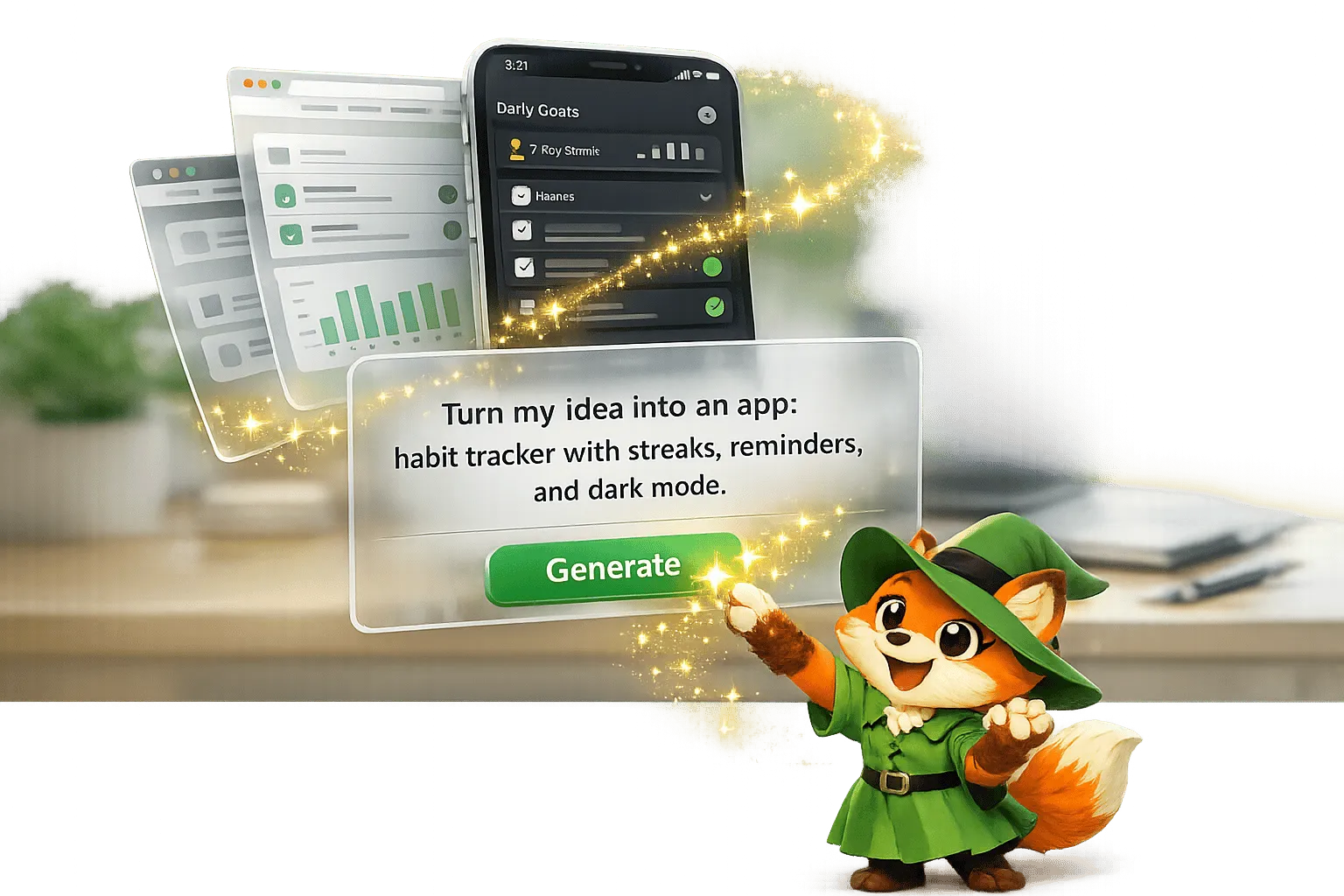
The No-Code AI Revolution: Why Adalo Is Adding Prompt Building
Turn plain-English app ideas into native iOS, Android and web apps with AI prompt building—fast, low-cost app creation with visual editing a