Why Adalo Works for Building a Barber Booking App
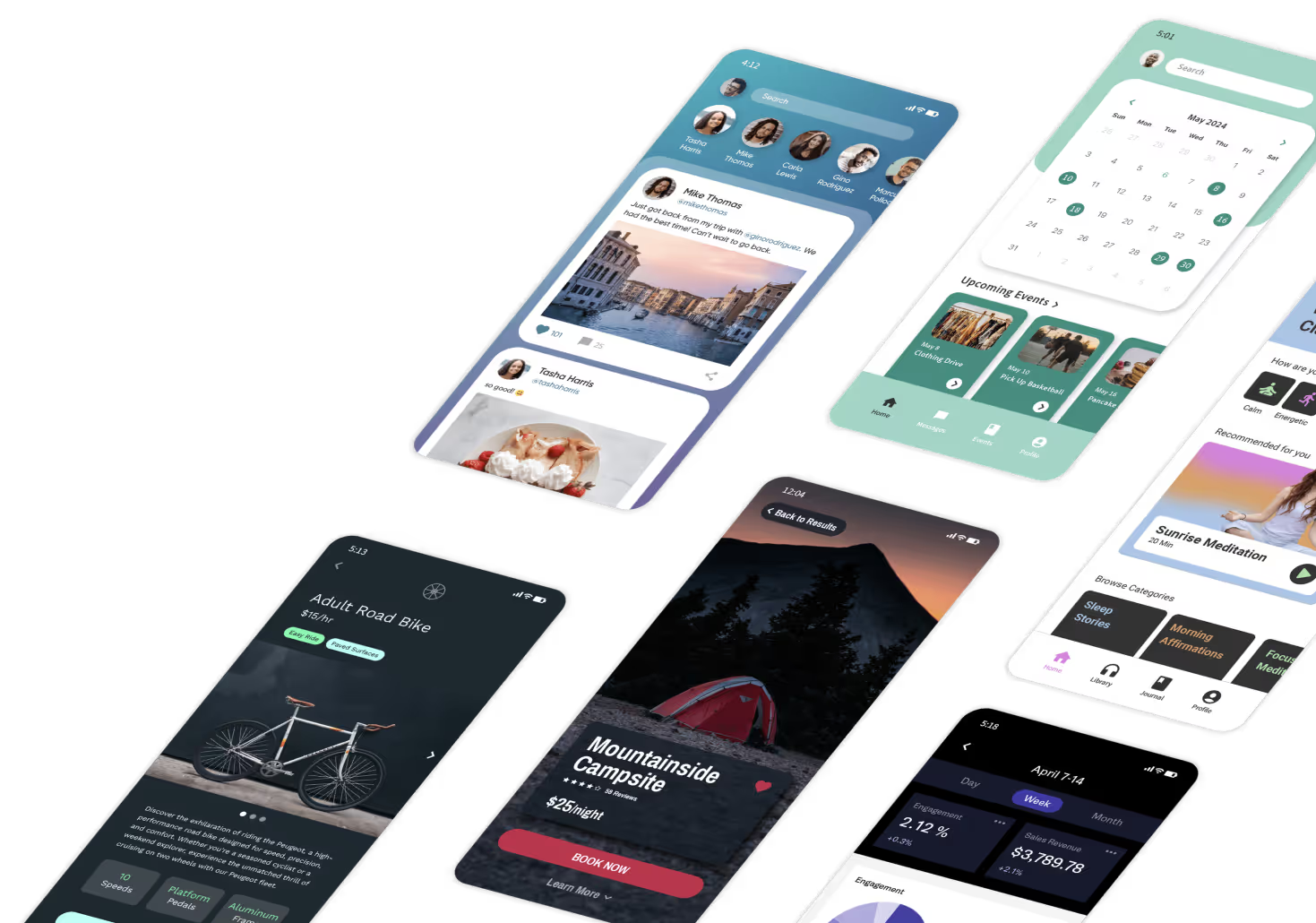
Adalo is a no-code app builder for database-driven web apps and native iOS and Android apps—one version across all three platforms, published to the Apple App Store and Google Play. This makes it the perfect solution for creating a barber booking app that needs to manage appointments, user profiles, and real-time availability seamlessly across every device your customers and barbers use.
Having your barber booking app available in both app stores means clients can easily find and download it, while push notifications keep them engaged with appointment reminders and promotional offers. With Adalo's drag-and-drop interface and built-in database tools, you can build a professional booking system without any coding experience—letting you focus on growing your barbershop business.
Creating a barber booking app simplifies scheduling for both customers and barbers. Customers can book appointments, view services, and manage their schedules anytime. Barbers can handle bookings, track earnings, and avoid scheduling conflicts. Platforms like Adalo make this process accessible even without coding skills, offering tools like drag-and-drop design, AI-assisted building, and integration with payment systems like Stripe.
Key Features to Include:
- Appointment Scheduling: Avoids conflicts with real-time updates.
- User Profiles: Separate dashboards for customers and barbers.
- Service Listings: Clear pricing, descriptions, and photos.
- Availability Calendars: Real-time open slots for bookings.
Steps to Build the App:
- Plan features and database structure.
- Set up user logins and profiles.
- Build the booking system with calendars and service selection.
- Add payment processing and notifications.
- Create an admin dashboard for barbers to manage schedules and earnings.
- Test thoroughly and launch across web, iOS, and Android platforms.
Why Adalo Works for Building a Barber Booking App
Adalo is an AI-powered app builder for database-driven web apps and native iOS and Android apps—one version across all three platforms, published to the Apple App Store and Google Play. This makes it ideal for creating a barber booking app that needs to manage appointments, user profiles, and real-time availability across multiple devices without writing a single line of code.
Having your barber booking app available on both app stores is essential for reaching clients where they are—whether they prefer booking on their iPhone, Android device, or desktop. With native app capabilities, you can send push notifications to remind customers of upcoming appointments, alert barbers to new bookings, and keep everyone engaged with your scheduling platform.
The platform's standout capability is its ability to build and deploy an app for the web, iOS, and Android without any rebuilding required. Following the Adalo 3.0 infrastructure overhaul in late 2025, the platform now runs 3-4x faster with modular infrastructure that scales to serve apps with over 1 million monthly active users. Paid plans include unlimited database records—critical for barbershops that accumulate years of booking history and customer data.

Adalo Tutorial: Create Your Own Event Booking App
Step 1: Plan Your App Features and Database
Before diving into development, it's essential to map out your app's functionality and data structure. Think of this step as laying the groundwork for your app—it defines how your app will work and how it will manage information. Skipping this step could lead to major headaches later, like dealing with double-bookings or mismatched data. As the Adalo team wisely says:
Your database structure is the foundation of your scheduling app.
Key Features to Include
For a barber booking app to run smoothly, there are four must-have features:
- Appointment scheduling: Allows customers to pick available times without any conflicts or overlaps.
- User profiles: Differentiates customers from barbers. Customers can view their booking history and saved payment methods, while barbers can track earnings and manage their availability.
- Service listings: Showcases the services you offer, complete with pricing, descriptions, and photos of haircuts or treatments.
- Availability calendars: Displays real-time open slots in daily, weekly, or monthly formats. These calendars automatically update when appointments are booked or canceled.
These features are powered by your database. For instance, when a customer selects a service, the app checks which barbers provide it, shows their available time slots, and creates a booking record. This record links the customer, barber, service, date, and payment—all stored in interconnected database collections.
Sketch Your App Screens
Start by sketching out your app's screens, either on paper or using a design tool like Figma. Outline the user journey for both customers and barbers:
-
Customer flow:
- Home Screen: Browse services with photos.
- Service Selection: Choose a haircut or treatment and view pricing.
- Barber & Time Selection: See available barbers and pick a time using a calendar.
- Booking Confirmation: Review details like date, time, and total cost.
- Profile Dashboard: Check upcoming appointments and booking history.
-
Barber flow:
- Calendar View: View daily schedules with appointment blocks.
- Earnings Tracker: Track earnings by day, week, or month in USD.
- Customer Reviews: Access feedback from clients.
These wireframes are more than just a design exercise—they help you figure out which database collections will feed each screen. For example, the Service Selection screen pulls data from a Services collection, while the calendar picker queries a Time Slots collection filtered by barber availability.
Create Your App Using AI to Build Your Database
Adalo's built-in database acts as a structured data table, storing all the information your app needs. You'll set up Collections (data groups) for Customers, Services, Bookings, and Time Slots, each with specific Properties (fields). Here's what you'll need:
- Customers: Fields like name, email, phone number, profile photo, and booking history.
- Services: Title, description, price (stored as a number for calculations), duration, and photo.
- Bookings: Links everything together—customer ID, barber ID, service IDs, date/time (formatted as MM/DD/YYYY h:MM AM/PM for U.S. users), status (e.g., pending, confirmed, completed), and total cost.
- Time Slots: Prevents double-bookings by storing barber ID, date, start and end times, capacity (usually 1), and status (available, booked, or blocked).
Ada, Adalo's AI builder, lets you describe what you want and generates your app. Magic Start creates complete app foundations from a description, while Magic Add adds features through natural language.
Magic Start can accelerate this process significantly. Describe your barber booking app concept, and it generates complete app foundations—database structure, screens, and user flows—automatically. What used to take days of planning happens in minutes. With over 3 million apps created on the platform, Adalo's visual builder has been described as "easy as PowerPoint" while delivering production-ready applications.
Once your database is set up, you'll be ready to move on to building your app's interactive features in the next steps.
Step 2: Set Up User Login and Profiles
Once your database is set up—perhaps by using Airtable as a database—it's time to secure user access. Adalo simplifies this process with its built-in Users collection, which automatically handles email and password authentication. This feature eliminates the need to build security measures from the ground up, giving you a solid framework for creating personalized user experiences in your barber booking app.
Create Registration and Login Screens
Adalo provides pre-designed "Signup" and "Login" screens that you can access using the "+" button in the screen menu. These templates come with form fields already linked to your Users collection, allowing both customers and barbers to register and log in seamlessly using their email and password. To enhance security, use the "Change input value" action to clear the password field after login.
To distinguish between user roles, add a "User Type" property to the Users collection. This lets users select either "Customer" or "Barber" during registration, ensuring they are directed to the correct dashboard after logging in.
Build Customer and Barber Profiles
With user login in place, the next step is to design unique profiles for customers and barbers. For customer profiles, include fields such as Name, Phone Number, Profile Photo, and Booking History. On the barber side, their profiles should showcase details like Bio/Background, Services Offered, Pricing, Working Hours, and a Portfolio Gallery to display their work.
Adalo's drag-and-drop forms make it easy to map these inputs directly to database fields like "Name" or "Profile Photo." To manage availability, barbers can set their schedules by linking their profiles to the Time Slots collection, ensuring accurate calendars and avoiding double-bookings. As Adalo explains:
The backend connects with other external applications (like Stripe for payments), allows users to log in, and executes user requests, such as executing a booking request or pulling up a new screen.
These profiles are more than just static pages—they act as the command center for your app. With no data caps on paid plans, your barbershop can accumulate years of customer profiles and booking history without worrying about storage constraints. With this structure in place, you're now ready to tackle the booking system.
Step 3: Build the Appointment Booking System
Once users are authenticated, the focus of your app shifts to creating an efficient appointment booking experience. This is where customers explore services, select time slots, and confirm their appointments, while barbers manage their schedules seamlessly. Real-time updates are key to avoiding double-bookings and ensuring a smooth process for both parties. Let's break down how to build your booking screens or even build a booking app from Google Sheets.
Design the Booking Screens
Start by designing a Service Selection Screen where customers can explore the services you offer. Use a Collection List component linked to your Services database. Each service should display an image, title (e.g., Fade Haircut), description, price (formatted as $29.99), and duration (e.g., 30 minutes). Include a "Select Service" button that records the customer's choice and takes them to the next step.
Next, create an Available Times Screen to show open time slots for the selected service. This screen should filter your Time Slots collection to display only those slots where the barber is free and the slot hasn't already been booked. Use Adalo's date picker to display dates and times in the US format (MM/DD/YYYY with 12-hour AM/PM times). When a customer selects a slot, mark it as "pending" temporarily to prevent double-bookings while they finish the reservation process.
Finally, develop a Confirmation Screen that summarizes the details: selected service, barber, date/time (e.g., "01/20/2026 at 2:00 PM"), and cost in USD. Add a button that finalizes the booking by creating a record, updating the time slot to "booked," and showing a success message. Magic Add can help here—describe the feature you want (like "add a cancellation option with refund policy display"), and it generates the necessary components and logic.
Add Calendar Views
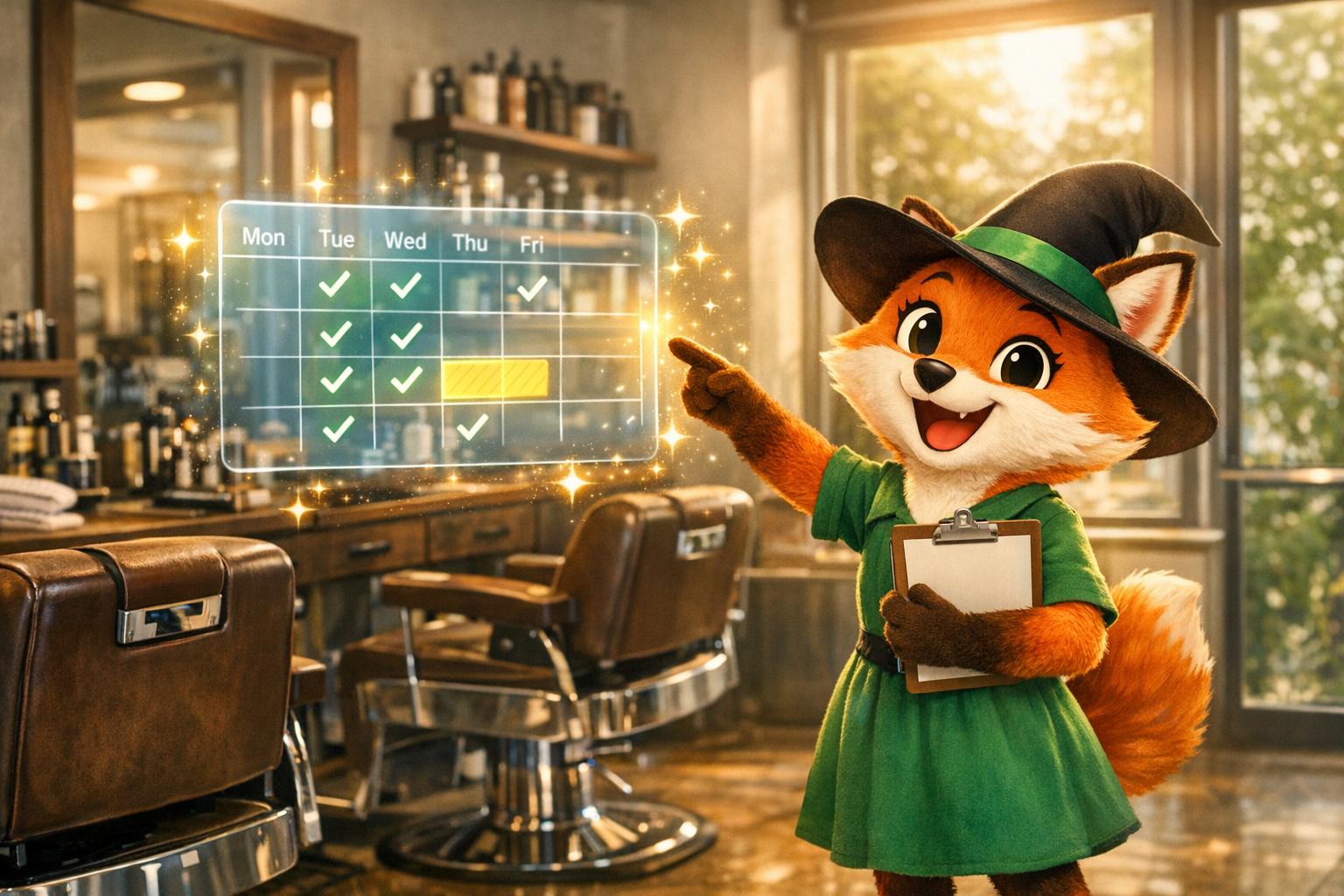
After setting up the booking screens, incorporate calendar views to provide a clear schedule overview. Calendars help both customers and barbers stay organized. Use the Calendar Component from the Marketplace and connect it to your Bookings collection. Map the start and end date properties from your database using the "magic number" button.
For customers, filter the calendar to display only their bookings. Barbers, on the other hand, should see all appointments assigned to them, with statuses color-coded: green for available, blue for booked, and red for canceled. Set the first day of the week to Sunday (common in the US) and include day, week, and month views to help barbers plan ahead.
If Adalo doesn't offer a built-in time slot generator, you can create a Time Slots helper collection with standard intervals (e.g., 9:00 AM, 9:30 AM, 10:00 AM, etc.). Display these slots in a filtered list based on the date selected on the calendar. This ensures customers see accurate availability and barbers avoid scheduling conflicts in real time.
The platform's improved speed—3-4x faster following the Adalo 3.0 update—means calendar views load quickly even when displaying weeks of appointment data, keeping the booking experience smooth for users.
Step 4: Add Payments and Notifications
Finalizing transactions and sending confirmations are the last steps in creating a seamless booking process for customers and barbers. These features ensure a polished experience—customers can pay for their appointments, and both parties stay updated with notifications about bookings, confirmations, and reminders.
Set Up Payment Processing
To handle payments, integrate the Stripe Kit and add the Stripe Payment component to your checkout screen, similar to how you would build an Uber clone. Link your Stripe account through the component's interface and use Magic Text to dynamically display the price of the selected service. For instance, if a fade haircut costs $29.99, that amount will automatically appear at checkout.
If you need to include taxes, Adalo's Custom Formula field within the component can calculate and add the tax amount. Keep in mind that Stripe's standard transaction fees in the U.S. are 2.9% + $0.30 per successful card charge. To track all transactions, set up a Transactions collection in your database with fields like Amount, Status (Pending/Completed), Stripe Charge ID, and Created Date.
Before launching your app, switch to Test Mode and use Stripe's test card numbers (e.g., 4242 4242 4242 4242) to ensure everything works smoothly.
Configure Push Notifications
Once payment processing is set up, focus on keeping users informed with timely notifications. Use workflows to trigger notifications for key events, such as when a new booking is created or when an appointment is nearing. For example, you can add a Push Notification action to the payment button's workflow so customers receive confirmation immediately after their payment is processed.
To minimize no-shows, automate reminders to go out 24 hours before appointments. This not only helps customers remember their bookings but also allows barbers to manage their schedules more effectively. As the Adalo Team explains:
When they get reminders, chances are they won't forget about their appointment and they'll show up on time.
Prompt users to enable notifications early by triggering the "Request Notification Permission" action when they first open your app. To give users more control, consider adding a Notification Settings screen where they can choose their preferred method of communication—email, push, or SMS.
Because Adalo compiles to true native iOS and Android apps, push notifications work reliably across both platforms without the delays or limitations sometimes experienced with web-wrapped solutions.
Step 5: Build an Admin Dashboard for Barbers
Once you've tackled the user-side features, it's time to focus on the barbers. An admin dashboard gives barbers the tools they need to efficiently manage their bookings, schedules, and more. After setting up payments and notifications, this dashboard becomes the hub for their day-to-day operations.
Create Booking and Schedule Management
Start by designing a screen where barbers can view all their appointments. Use Adalo's List component and link it to your Appointments collection. Apply a filter so that only the appointments for the logged-in barber are displayed. This ensures that each barber only sees their own bookings.
Include key details for each appointment, such as the client's name, service type, date, time, price, and booking status. Enhance functionality by adding interactive elements like buttons or swipe actions. These can allow barbers to confirm or reject appointments, update bookings when clients request additional services, or cancel appointments if needed.
For a more visual approach, integrate Adalo's Calendar component. Configure the calendar specifically for the admin dashboard, enabling barbers to view their bookings in daily, weekly, or monthly formats. This visual aid makes it easier to track and manage appointments at a glance.
Additionally, create a screen for barbers to set their working hours. Use toggle switches for each day of the week, paired with time pickers to define start and end times. This feature helps minimize unbooked slots and ensures accurate real-time reservation tracking.
To make the dashboard even more useful, include a section for earnings statistics. Use Magic Text with formulas to calculate total earnings and profits (based on commission rates) from completed appointments. Display this data in daily, weekly, and monthly views to keep barbers informed about their performance.
X-Ray, Adalo's performance analysis tool, can help identify any bottlenecks in your dashboard before they affect barbers during busy periods—ensuring the admin interface stays responsive even when managing dozens of daily appointments.
Set Up Role-Based Access
Security and role-based access are essential for keeping your app organized and user-friendly. Add a User Type field to your Users collection with roles like "Customer," "Barber," and "Admin." Alternatively, you can create a True/False property (e.g., "Is Barber?") to control access to specific features.
Each user type should have access to only the tools they need. Customers, for example, should be able to book services, view service details, and check their appointment histories. Barbers, on the other hand, should have a personal dashboard where they can manage bookings, control schedules, track earnings, and view customer ratings. However, they shouldn't have access to system-wide settings or data from other barbers.
Administrators require full access, including tools to create business hours, set shift slots, register new barbers with commission rates, set service prices, manage all reservations, and view detailed financial reports.
To enforce these access levels, use Adalo's conditional logic on buttons and forms. For instance, restrict sensitive actions like deleting services or editing other barbers' schedules to users with the "Admin" role. This layered approach ensures that everyone has the right tools while keeping your app secure and well-organized.
Step 6: Test and Launch Your App
With the app's main features and admin tools ready, it's time to ensure everything works smoothly and refine the user experience. After completing the admin dashboard, test every workflow thoroughly to confirm everything functions as expected. Once testing is complete, you can deploy your app to the web and app stores using Adalo's publishing tools.
Test Your App
Start by clicking the Preview button to test the app in a desktop browser. Then, use the Adalo Preview app on an iPhone or Android device to evaluate mobile performance and device-specific features.
Create test accounts for each user role—customers, barbers, and admins. Simulate real-life scenarios by booking, confirming, and canceling appointments. Check that the calendar updates correctly, payment processing works (in USD, formatted as $XX.XX), and notifications trigger at the right moments.
Pay close attention to critical situations, like double-booking, by attempting to schedule two appointments for the same time slot. This helps confirm your database logic prevents overlapping bookings. Also, test cancellations to ensure the time slot reopens immediately. Verify that earnings calculations display accurate totals in US dollars (e.g., $50.00) across daily, weekly, and monthly views.
Once satisfied with the functionality, move on to refining the user experience.
Improve the User Experience
Make navigation simple and intuitive by using bottom tabs for essential sections like Dashboard, Bookings, and Profile. Use a color-coded calendar system—green for available slots and red for booked ones—and include clear booking summaries with customer name, service details, cost, and date/time.
Ensure your app performs well on various devices. Use Adalo's preview tools to test different screen sizes, such as the iPhone 15, Samsung Galaxy S21, and multiple desktop resolutions. Add loading spinners during API calls to improve responsiveness. Use conditional visibility to display role-specific content, ensuring, for example, that customers don't see admin reports and barbers don't access system-wide settings.
Simplify service selection by including photos and clear descriptions, and make booking history searchable by reference number for easy tracking.
Publish to App Stores and Web
Adalo's single-build workflow lets you create your app once and deploy it across multiple platforms. To publish to the web, click the profile button on the Horizontal Ribbon, go to Settings > Domain, and enter a custom domain (e.g., one registered through GoDaddy). Your app will be hosted as a Progressive Web App (PWA), ensuring compatibility across browsers.
For mobile app publishing, navigate to Settings > Publish to generate builds for iOS and Android. You'll need an Apple Developer account ($99 per year) and a Google Play Console account ($25 one-time fee). Follow Adalo's instructions to complete the process. Use TestFlight (iOS) and Google's testing platform to test your builds thoroughly before submitting them to the app stores.
Publishing requires an Adalo paid plan, starting at $36/month—which includes unlimited database records and no usage-based charges. This predictable pricing means no surprise bills as your barbershop grows and accumulates more bookings. Once your app is live, monitor its analytics dashboard daily to track user behavior, identify popular screens, and address bugs promptly.
How Adalo Compares to Alternatives
When choosing a platform for your barber booking app, understanding the alternatives helps clarify why Adalo's approach works well for this use case.
Bubble offers extensive customization but comes with trade-offs. Their mobile solution wraps a web app rather than compiling to native code, which can introduce performance challenges at scale. Pricing starts at $59/month with usage-based Workload Unit charges that can be difficult to predict—problematic for a booking app where traffic spikes during busy periods. Bubble also limits records and app re-publishing on lower tiers.
FlutterFlow targets technical users with a low-code approach. Users need to source, set up, and pay for their own database separately, adding complexity and cost. Pricing starts at $70/month per user for app store publishing, but that still doesn't include database costs. The builder also limits how many screens you can view simultaneously, slowing down development compared to Adalo's canvas that can display up to 400 screens at once.
Glide excels at spreadsheet-based apps but restricts creative freedom with template-focused building. Pricing starts at $60/month for custom domains, with additional charges for data rows and app updates. Critically, Glide doesn't support Apple App Store or Google Play Store publishing—limiting your reach to customers who prefer native apps.
Softr requires $167/month to publish a Progressive Web App, with restrictions on records per app. Like Glide, Softr doesn't support native iOS and Android app creation or app store publishing.
Adalo's combination of native app compilation, unlimited database storage on paid plans, predictable pricing at $36/month, and single-codebase publishing to web and both app stores makes it particularly well-suited for service businesses like barbershops that need to reach customers across all platforms.
Conclusion
You've now crafted a fully functional barber booking app—from the initial planning stages all the way to launch. By following these six steps, you can create an app that connects barbers and their customers, all without needing to write a single line of code.
Adalo equips you with everything necessary to bring your app to life: a user-friendly visual builder, a hosted database with no record limits on paid plans, integrated payment processing, and the ability to publish your app across the web, Apple App Store, and Google Play Store—all from one build. With over three million apps already created on the platform, Adalo has proven its reliability and performance.
This process isn't just a guide—it's a roadmap to getting your app live and in the hands of users.
Related Blog Posts
- Building an E-commerce App: No-Code Platform Guide
- How to Create an Invoice App
- How To Create The Digital Calendar App You Need for iPhone and iOS
- How to Create a Self-Storage Management App
FAQ
Why choose Adalo over other app building solutions?
Adalo is an AI-powered app builder that creates true native iOS and Android apps. Unlike web wrappers, it compiles to native code and publishes directly to both the Apple App Store and Google Play Store from a single codebase—the hardest part of launching an app handled automatically. Paid plans include unlimited database records and no usage-based charges, so your costs stay predictable as your barbershop grows.
What's the fastest way to build and publish an app to the App Store?
Adalo's drag-and-drop interface and AI-assisted building tools like Magic Start let you go from idea to published app in days rather than months. Describe your barber booking app concept, and Magic Start generates your database structure, screens, and user flows automatically. Adalo handles the complex App Store submission process, so you can focus on features instead of certificates and provisioning profiles.
Can I easily build a barber booking app without coding experience?
Yes, Adalo's visual builder has been described as "easy as PowerPoint." You can build a complete barber booking app using drag-and-drop design tools, prebuilt templates, and seamless integration with payment systems like Stripe—no coding required.
What key features should a barber booking app include?
A barber booking app should include appointment scheduling with real-time updates to avoid conflicts, separate user profiles for customers and barbers, service listings with clear pricing and photos, and availability calendars showing open slots. You'll also want payment processing integration and push notifications to keep everyone informed about bookings.
How do I prevent double-bookings in my barber app?
Adalo's database structure handles double-booking prevention through a Time Slots collection that tracks barber availability, dates, and booking status. When a customer selects a slot, it's marked as "pending" during checkout and changes to "booked" once confirmed, ensuring no overlap occurs.
Can I accept payments directly through my barber booking app?
Yes, you can integrate Stripe payment processing directly into your Adalo app. The Stripe Kit component allows you to display service prices dynamically, calculate taxes with custom formulas, and process transactions securely. All payments are tracked in your database with transaction details and status updates.
How much does it cost to publish my barber booking app?
Publishing your app requires an Adalo paid plan starting at $36/month, which includes unlimited database records and no usage-based charges. For app store distribution, you'll also need an Apple Developer account ($99/year) and a Google Play Console account ($25 one-time fee). These costs give you access to millions of potential customers across both major app platforms.
How long does it take to build a barber booking app?
With Adalo's visual builder and AI tools like Magic Start, you can have a functional barber booking app ready in days rather than months. The exact timeline depends on your app's complexity, but the six-step process outlined in this guide covers everything from planning to launch.
Is Adalo better than Bubble for mobile apps?
For native mobile apps, Adalo has distinct advantages. Adalo compiles to true native iOS and Android code, while Bubble wraps web apps for mobile. Adalo's pricing starts at $36/month with unlimited usage, compared to Bubble's $59/month with Workload Unit charges. Adalo also offers unlimited database records on paid plans, while Bubble limits records on lower tiers.
Is Adalo better than Glide for barber booking apps?
For a barber booking app that needs app store presence, Adalo is the stronger choice. Glide doesn't support Apple App Store or Google Play Store publishing, limiting your reach. Glide's template-focused approach also restricts creative freedom compared to Adalo's flexible visual builder. Adalo starts at $36/month with unlimited records, while Glide starts at $60/month with data row limits.