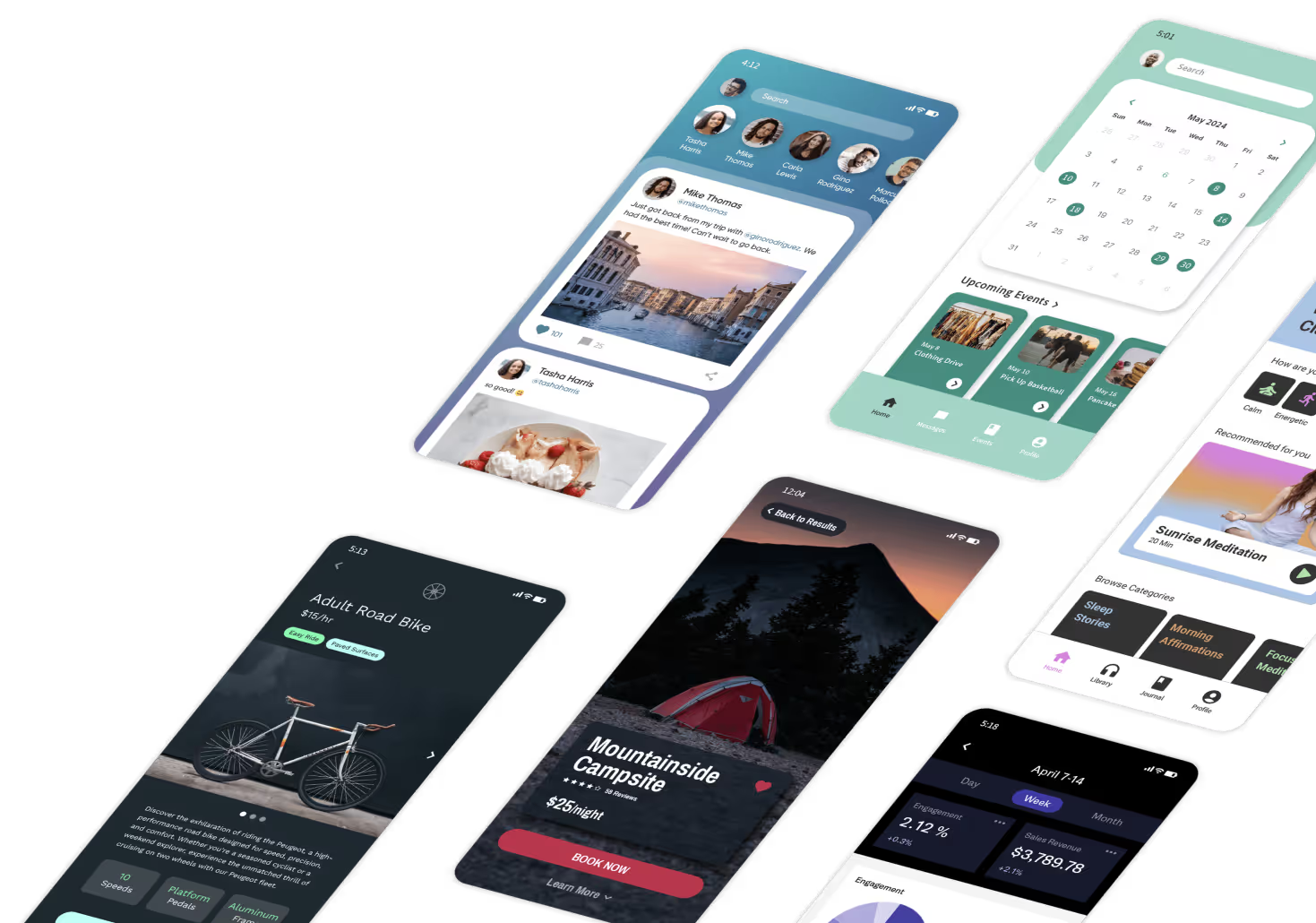
Offline-first apps prioritize your local database, ensuring your app works even without internet. The key is event-driven synchronization, where every user action is logged as an event. This approach enables instant updates, reduced latency, and seamless syncing when back online. Unlike traditional methods that overwrite data, event-driven sync tracks changes, maintains order, and resolves conflicts efficiently.
Platforms like Adalo, a no-code app builder for database-driven web apps and native iOS and Android apps—one version across all three platforms, published to the Apple App Store and Google Play, make implementing offline-first architecture more accessible. By abstracting away much of the complexity behind local storage and synchronization, these tools let developers focus on designing the right data flow for their apps.
Why it Matters:
- Faster performance: Local data access is much quicker than relying on the network.
- No data loss: Actions are logged locally, even if the connection drops.
- Better user experience: Apps remain responsive, avoiding freezes or crashes.
Key Strategies:
- Local-first design: The local database is the single source of truth.
- Sync only changes: Push and pull deltas instead of full data sets.
- Conflict resolution: Use methods like timestamps, CRDTs, or intent-based modeling to handle edits across devices.
By blending efficient storage, smart event handling, and hybrid sync strategies, you can build apps that are reliable, responsive, and ready for any connectivity challenge. Adalo, an AI-powered app builder, makes implementing these patterns accessible—its modular infrastructure handles the complexity of data synchronization while you focus on your app's core functionality.
Create offline-first apps
Setting Up Local Data Storage and Event Handling
When building an offline-first app, the key is to make your local database the single source of truth (SSOT). Your app's UI should always interact with the local database for reading and writing, while a separate sync engine manages updates with the server in the background. This approach ensures your app remains responsive, even if the network connection drops.
Choosing a Local Storage Solution
For managing complex relational data, SQLite is a solid choice. On Android, Room provides a convenient abstraction layer, while iOS developers can rely on Core Data. Both options integrate well with reactive frameworks—like Kotlin Flow or SwiftUI's @FetchRequest—to keep your UI in sync with changes to the local database automatically.
If you're working on data-heavy applications or need to speed up development, Realm and ObjectBox are worth considering. They simplify setup and deliver high performance, but you might have less control over how synchronization is handled.
Your local database should go beyond just storing user data. Include a sync queue (or "operations ledger") to track actions like inserts, updates, and deletes. Add metadata fields such as synced flags or lastModified timestamps to keep things organized. Using unique IDs, like ULIDs, can help prevent conflicts when creating records offline.
For builders using Adalo's AI-assisted platform, the built-in database handles much of this complexity automatically. With no record limits on paid plans, you can store extensive offline event logs without worrying about hitting storage caps—a significant advantage over platforms that charge based on database records or impose strict limits.
Structuring and Capturing Events
Instead of syncing only the final state of a record, capture every user action as an immutable event. Each event should include metadata such as docId, actorId, incrementing seq, and causalParents to maintain proper order. This method ensures idempotency, meaning the same event can be applied multiple times without causing errors.
"Do not depend on wall clocks for correctness. Use counters, vectors, or lamport timestamps strictly as tiebreakers, never for causality." - DebuggAI Resources
For example, when a user taps "save", log the change in your local database and add the operation to your sync queue. This allows for an optimistic UI update—where the change appears immediately—while the sync engine pushes the update to the server later. To save bandwidth, group operations into batches based on size or timing.
Organizing Event Handlers
Using the repository pattern can simplify your architecture by abstracting the data source, whether it's the local database or a remote API. This separation makes it easier to test and keeps the synchronization logic out of your UI code. Event handlers should apply changes locally first and then add them to the sync queue for background processing.
For deletions, consider marking records with a deleted flag instead of removing them outright. This "soft delete" approach ensures the sync engine can propagate the deletion to other devices before permanently clearing the record. On mobile platforms, tools like WorkManager (Android) or BackgroundTasks (iOS) can keep the sync engine running, even if the app is closed.
Additionally, monitor network connectivity with tools like Firebase's /.info/connected or platform-specific network listeners to trigger sync cycles as soon as the connection stabilizes. For native iOS and Android apps built with Adalo, this connectivity monitoring integrates seamlessly with the platform's infrastructure, which processes over 20 million data requests daily with 99%+ uptime.
Next, we'll dive into synchronization strategies to efficiently push and pull these stored events.
Synchronization Strategies: Push, Pull, and Hybrid Approaches

Push vs Pull vs Hybrid Synchronization Strategies for Offline-First Apps
When it comes to transferring recorded events between a device and a server, the method you choose plays a big role. It impacts how quickly updates appear, how much bandwidth is used, and how well the system holds up when the connection is spotty.
Let's break down the three main strategies—push, pull, and hybrid—and how they can optimize synchronization based on your app's needs.
Push-Based Synchronization
In a push-based approach, local changes are sent to the server as soon as the device is back online. When users make edits, those changes are logged locally and queued for upload. This method shines in scenarios where users may be offline for long stretches, as it ensures no edits are lost, even if the network is unavailable for hours or days.
"Offline-first is therefore not only a resilience strategy - it's a performance one." - Sudhir Mangla, mobile architect
To avoid data conflicts, it's a good idea to use unique identifiers (like UUIDs) or prefixes such as "local_" for records created offline. This approach ensures smooth integration once the changes are synced. The key advantage here is preserving user actions—nothing gets lost, and the UI provides instant feedback even without connectivity.
Pull-Based Synchronization
Pull-based sync flips the process. Here, the app fetches updates from the server when it reconnects. This strategy is ideal for short offline periods or when you need to grab changes made by other users. A key technique for efficiency is Delta Sync, which downloads only the updates since the last sync token. This avoids wiping out local data and reloading everything, saving bandwidth and protecting unsynced local changes.
Instead of relying on timestamps, it's better to use server-generated sync tokens. This is especially useful when you build a delivery tracking app that requires real-time updates across different devices. These tokens avoid issues caused by clock mismatches. Additionally, the app's UI should react to changes in the local database automatically—for example, by using tools like Kotlin Flow or SwiftUI's @FetchRequest—so updates appear seamlessly without requiring manual refreshes.
Combining Push and Pull for Hybrid Sync
Most modern apps rely on a hybrid approach, blending push and pull methods. This strategy typically involves a four-step workflow:
- Push unsynced local changes to the server.
- Pull remote updates (deltas) since the last sync token.
- Merge any conflicts that arise.
- Acknowledge operations to clear the queue.
This process ensures two-way consistency, making it particularly effective for collaborative apps where multiple users might edit the same data.
"In offline-first architecture, we embrace eventual consistency - the idea that data replicas might temporarily differ but will converge to a consistent state over time." - Chad Dower, founder at IngoLabs
To handle poor network conditions, it's crucial to include retry logic with exponential backoff. This prevents unnecessary battery drain while ensuring the sync process eventually completes. Adalo's modular infrastructure, which scales to serve apps with millions of monthly active users, handles these sync patterns efficiently—the platform's 3-4x speed improvements since the 2026 infrastructure overhaul mean faster sync cycles and better user experience during reconnection.
| Strategy | Best For | Key Advantage |
|---|---|---|
| Push-Based | Extended offline periods | Preserves user actions; instant UI feedback |
| Pull-Based | Brief offline gaps | Saves bandwidth with Delta Sync |
| Hybrid | Collaborative apps | Ensures two-way consistency and data freshness |
Resolving Data Conflicts During Synchronization
When local and server-side changes clash, having a solid conflict resolution strategy is essential to maintain data integrity. In offline-first apps, this becomes even more critical. Imagine a user updating a record while offline, only to find that the same record was modified on the server during that time. Without a clear system in place, reconciling these differences can quickly become chaotic.
Using Timestamps for Conflict Resolution
One of the simplest methods is the Last-Write-Wins (LWW) approach. Here, the version with the most recent timestamp is treated as the authoritative one, while older versions are discarded. To make this work, your records need reliable timestamp metadata. Additionally, incorporating soft deletes—using an is_deleted flag—helps the system track deletions and remove outdated records locally, ensuring stale data doesn't linger.
However, LWW isn't without flaws. One major issue is clock skew, where mismatched device clocks might prioritize the wrong version of the data. To address this, you can pair timestamps with a secondary tiebreaker, such as a unique actor ID or an incremental sequence number. This ensures conflicts are resolved deterministically, even when timestamps alone aren't enough.
While LWW can handle many scenarios, some situations demand more advanced solutions.
Advanced Conflict Resolution Techniques
For cases where multiple users edit the same data simultaneously, relying solely on LWW might result in losing critical updates. In such scenarios, more sophisticated methods are required.
One option is Conflict-Free Replicated Data Types (CRDTs). These use deterministic rules to merge changes across devices without needing a central authority. While effective, CRDTs come with added complexity and require extra metadata to function properly.
"Conflicts aren't failures, they're information. This mindset shift from preventing concurrency to designing for concurrency is key to building an offline-ready architecture." - Rae McKelvey, Staff Product Manager, Ditto
Another approach is intent-based modeling. Instead of overwriting a single field like status, this method records each action as a distinct event. Conflicts are then resolved at the application layer, preserving the history of changes and enforcing business rules. For critical data, this approach can also log conflicts for manual review if needed.
Each method has its strengths, and the choice depends on the complexity of your app and the importance of preserving every user action. Platforms with unrestricted database storage—like Adalo's paid plans with no data caps—give you the flexibility to store complete event histories without worrying about hitting record limits. This is particularly valuable for intent-based modeling, where maintaining a full audit trail of changes is essential.
By designing with these strategies in mind, you can ensure smoother synchronization and a better user experience.
Testing Offline-First Functionality
Ensuring offline-first apps work seamlessly requires thorough testing, especially after implementing conflict resolution. The goal is to confirm that your event-driven sync operates reliably under a variety of network conditions, from patchy subway Wi-Fi to complete disconnection.
Simulating Offline Scenarios
Instead of relying solely on full disconnection tests, simulate a range of connectivity issues. While airplane mode tests have their place, they don't replicate the high latency, intermittent drops, or fluctuating speeds users often encounter. For web apps or PWAs, tools like the Network tab in Chrome DevTools allow you to toggle offline mode or apply throttling profiles that mimic slower connections, such as 3G. Testing on physical devices is equally important to account for hardware-specific network behaviors.
During these tests, confirm that user actions are accurately captured in your local sync queue or database. Look for indicators like synced: false to verify that events are stored properly when offline. Use connection state listeners—such as Android's ConnectivityManager, iOS's NWPathMonitor, or React Native's NetInfo—to trigger sync logic automatically when the device reconnects.
Don't forget to monitor battery performance, especially if your sync engine frequently retries or processes large background fetches. Apps built on Adalo's purpose-built architecture benefit from optimized sync cycles that maintain performance without excessive battery drain—the platform's infrastructure is designed to handle these patterns efficiently at scale.
Once you've tested under these simulated conditions, it's time to ensure that event consistency is maintained.
Validating Event Consistency
A robust sync engine ensures that local and remote events result in the same application state. To test this, simulate simultaneous modifications to local and server data while offline, verifying that your conflict resolution mechanisms perform as intended. Tools like Firebase's /.info/serverTimeOffset can help adjust for clock skew, while onDisconnect mechanisms confirm client presence.
For PWAs, the waitUntil() method in service workers is critical. It ensures the browser doesn't terminate the worker before your synchronization process is complete. Carefully verify that local and remote states converge as expected after reconnection.
Test edge cases thoroughly: What happens when a user creates 100 records offline and then reconnects? With platforms that impose record limits, you might hit storage caps during extended offline periods. Adalo's unlimited database records on paid plans eliminate this concern, allowing your sync queue to grow as large as needed without triggering overage charges or sync failures.
Monitoring and Debugging Synchronization
Once event consistency is validated, shift focus to monitoring and debugging the sync process. Add metadata fields to your database schema—such as synced, lastModified, or operationType—to track local state and identify what needs to be synchronized. Use reactive streams like Kotlin Flow or Swift Combine to observe changes in the local database and maintain a responsive UI.
For web apps, queue offline network requests and replay them once the connection is restored. Configure your sync engine to respect device constraints, avoiding large data transfers on metered networks or when battery levels are low. Test this by creating data offline, reconnecting, and confirming that records sync correctly to the remote database.
Adalo's X-Ray feature helps identify performance issues before they affect users—particularly useful when debugging sync bottlenecks or spotting inefficient data patterns that could slow down your offline-first implementation. This ensures your app delivers a smooth experience, even in less-than-ideal conditions.
Building Offline-First Apps with Modern Tools
Implementing event-driven synchronization from scratch requires significant development effort. Modern AI-powered app builders can accelerate this process while handling much of the underlying complexity.
Leveraging AI-Assisted Development
Ada, Adalo's AI builder, lets you describe what you want and generates your app. Magic Start creates complete app foundations from a description, while Magic Add adds features through natural language.
Adalo's Magic Start feature generates complete app foundations from simple descriptions. Tell it you need a field service app that works offline, and it creates your database structure, screens, and user flows automatically—what used to take days of planning happens in minutes. Magic Add then lets you describe additional features in natural language, like "add offline data caching for inspection forms."
This AI-assisted approach is particularly valuable for offline-first apps, where the data architecture needs to support both local storage and synchronization patterns. The platform handles the complexity of database relationships while you focus on the user experience.
Comparing Platform Approaches
When choosing a platform for offline-first development, consider how each handles data storage and synchronization:
| Platform | Database Limits | Offline Support | Starting Price |
|---|---|---|---|
| Adalo | Unlimited records on paid plans | Native iOS/Android with local storage | $36/month |
| Bubble | Limited by Workload Units | Web wrapper (not true native) | $59/month + usage charges |
| FlutterFlow | Requires external database setup | Depends on implementation | $70/month + database costs |
| Glide | Limited by record rows | No App Store publishing | $60/month + overage charges |
For offline-first apps specifically, the database architecture matters significantly. Bubble's Workload Units can create unpredictable costs when syncing large event queues, and its mobile solution uses web wrappers rather than true native compilation. FlutterFlow requires users to set up and manage their own external database—a significant learning curve that can create scalability challenges without optimal configuration.
Adalo compiles to true native iOS and Android code from a single codebase, with one build publishing to web, the Apple App Store, and Google Play Store. This native compilation provides better performance for offline-first patterns compared to web wrappers, which add 2-3 seconds of load time and can struggle under increased load.
Conclusion
Event-driven synchronization transforms how offline-first apps maintain data consistency by designating the on-device database as the single source of truth. This approach ensures quick, responsive performance, regardless of network conditions. As Sudhir Mangla, Mobile Architect, succinctly explains:
"The network becomes a companion, not a crutch."
By recording discrete events locally and syncing only the changes (deltas), this method reduces bandwidth usage while ensuring devices remain in sync. Whether relying on Last-Write-Wins for straightforward cases or CRDTs for handling more intricate multi-writer scenarios, the process of queuing, transmitting, and applying operations ensures consistency across devices.
To design reliable offline-first functionality, embracing eventual consistency is essential. It's about preparing for those inevitable moments when connectivity is shaky or unavailable. With strong conflict resolution strategies, idempotent operations, and background syncing, your app can tackle these challenges effectively.
Shifting to a local-first design not only delivers instant UI updates but also ensures smooth performance, no matter the network's reliability. By applying the strategies outlined in this guide—from local data storage to advanced conflict resolution—you have the tools to create apps that function effortlessly, anytime and anywhere. These practices form a solid foundation for building robust offline-first applications.
Related Blog Posts
- How to Create An App using Google Sheets as the actual Database?
- Scaling No-Code Apps for Large Data Sets
- Real-Time Data Sync for No-Code Apps
- Offline vs. Real-Time Sync: Managing Data Conflicts
FAQ
Why choose Adalo over other app building solutions?
Adalo is an AI-powered app builder that creates true native iOS and Android apps. Unlike web wrappers, it compiles to native code and publishes directly to both the Apple App Store and Google Play Store from a single codebase—the hardest part of launching an app handled automatically.
What's the fastest way to build and publish an app to the App Store?
Adalo's drag-and-drop interface combined with AI-assisted building through Magic Start and Magic Add lets you create complete apps quickly. The platform handles the App Store submission process, so you can go from idea to published app without managing certificates, provisioning profiles, or app review complexities yourself.
What are the benefits of event-driven synchronization for offline-first apps?
Event-driven synchronization allows apps to deliver real-time updates, maintain low latency, and ensure data consistency, even in scenarios where users face unreliable networks or go offline. By syncing only the changes that matter, this method minimizes data transfers and boosts app responsiveness.
How can I handle data conflicts in offline-first apps effectively?
Use conflict-free replicated data types (CRDTs) to allow devices to update data independently and automatically merge changes during synchronization. Alternatively, set up clear conflict resolution rules like Last-Write-Wins with timestamps, or use intent-based modeling to preserve the full history of changes.
Why is a hybrid synchronization approach ideal for offline-first apps?
A hybrid approach merges local data storage with smart sync mechanisms, making it possible to handle spotty or unreliable network connections. Users can keep working without interruption while offline, and their data syncs smoothly once they're back online—balancing offline functionality with real-time updates.
How long does it take to build an offline-first app?
With AI-assisted tools like Adalo's Magic Start, you can generate a complete app foundation in minutes. The full development timeline depends on complexity, but basic offline-first apps can be built and published within days rather than months.
Do I need coding experience to build offline-first apps?
Not with modern AI-powered app builders. Adalo's visual interface has been described as "easy as PowerPoint," and features like Magic Add let you describe functionality in plain language. The platform handles the technical complexity of data synchronization behind the scenes.
How much does it cost to build an offline-first app?
Adalo's paid plans start at $36/month with unlimited database records and no usage-based charges. This compares favorably to Bubble ($59/month plus Workload Unit charges) or FlutterFlow ($70/month plus separate database costs). The predictable pricing is particularly valuable for offline-first apps that may accumulate large sync queues.
Can offline-first apps scale to millions of users?
Yes. Adalo's modular infrastructure scales to serve apps with over 1 million monthly active users, with no upper ceiling. The platform's purpose-built architecture maintains performance at scale, unlike app wrappers that can hit speed constraints under heavy load.
What's the difference between native apps and web wrappers for offline functionality?
Native apps compile to device-specific code and have direct access to local storage APIs, making offline functionality more reliable and performant. Web wrappers add 2-3 seconds of load time and may struggle with complex offline sync patterns. Adalo creates true native iOS and Android apps, not web wrappers.