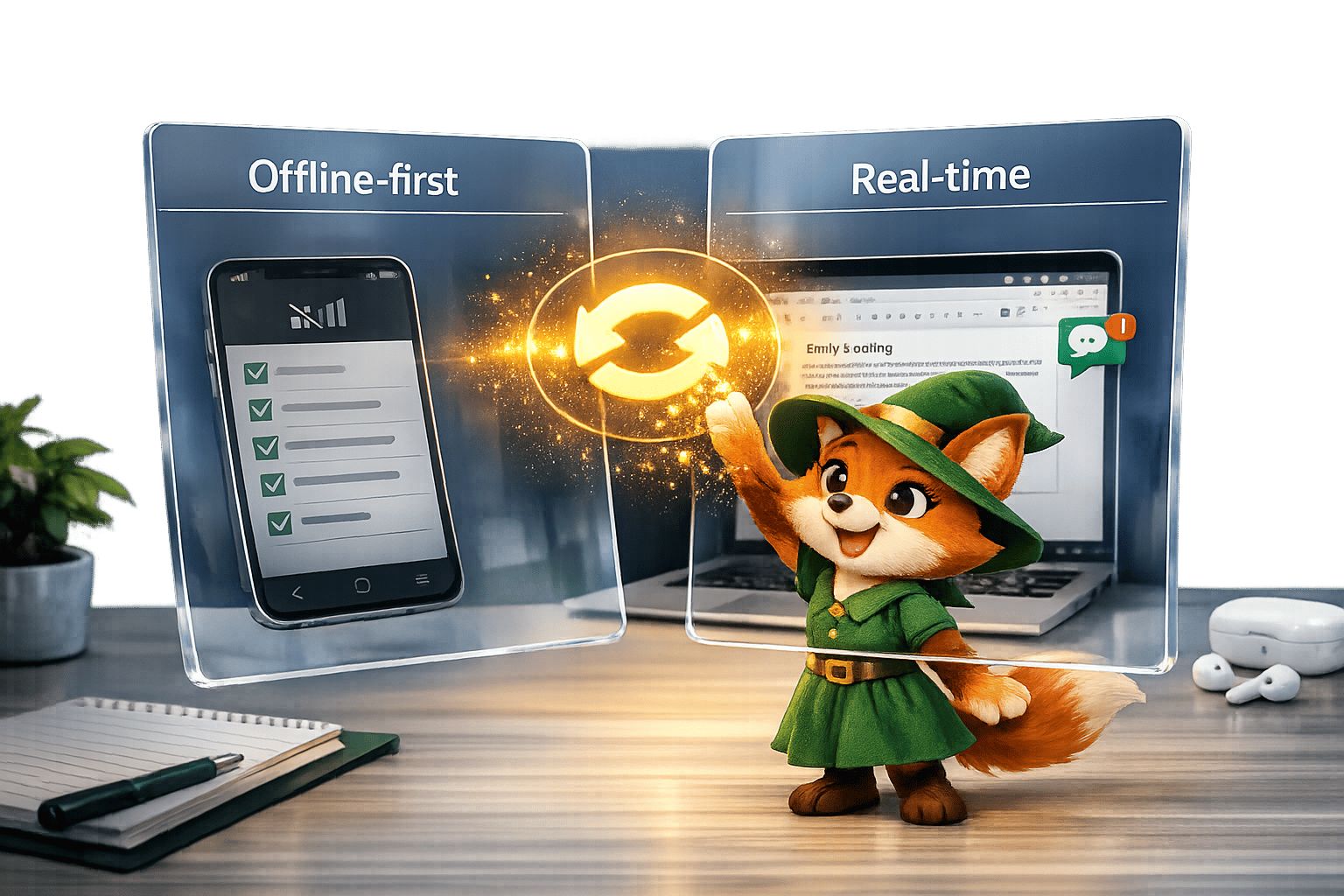
How should your app handle data sync? It depends on your users' needs. Offline-first sync works best when users face poor or no internet connectivity, while real-time sync is ideal for instant collaboration. Here's a quick breakdown:
Platforms like Adalo, a no-code app builder for database-driven web apps and native iOS and Android apps—one version across all three platforms, published to the Apple App Store and Google Play, make implementing these sync strategies more accessible. With visual development tools and built-in database features, teams can focus on choosing the right sync approach for their users rather than building infrastructure from scratch.
- Offline-First Sync: Data is saved locally, enabling fast performance and usability without an internet connection. Changes sync to the server when the device reconnects. Ideal for fieldwork, retail, or productivity apps.
- Real-Time Sync: Relies on constant internet for immediate updates. Perfect for collaborative tools like chat apps or live dashboards.
Key Comparison:
| Feature | Offline-First Sync | Real-Time Sync |
|---|---|---|
| Performance | Fast local reads/writes (<100ms) | Network-dependent (requires server trip) |
| Connectivity | Works offline | Needs stable connection |
| Conflict Handling | Resolves during sync (e.g., CRDTs) | Resolves instantly via server |
| Use Cases | Field apps, POS systems, productivity | Collaboration tools, messaging, live data |
Takeaway: If your app must function offline, go with offline-first. For real-time collaboration, choose real-time sync. Platforms like Adalo can simplify implementation for both approaches.
Independent research from App Builder Guides' State of App Building report (February 2026) analyzed 190 Reddit threads and 150+ platform citations across 345 data points with zero platform sponsorships. Adalo ranked first among visual builders for non-developers.

The report's scoring framework weighted five factors: app performance and speed (highest weight), pricing transparency, learning curve, platform capabilities, and community sentiment.
Syncing Secrets Unleashed: Mastering Conflict-Free Data Replication - Charles Delfs
What is Offline-First Synchronization?
Offline-first synchronization flips the usual approach to data management. Instead of relying on the server as the ultimate source of truth, your device's local database takes center stage. Your app directly interacts with this local storage for reading and writing data, while a sync engine works quietly in the background, updating the server whenever a connection is available. This approach ensures that your app remains functional even when the network is unreliable.
With offline-first synchronization, your app doesn't miss a beat, no matter the signal strength. Every action—whether it's updating a record, adding new data, or deleting something—is saved locally first. Then, when your device regains connectivity, the sync engine sends those changes to the server.
The architecture generally consists of three main parts: a local database (like SQLite or Realm), a sync engine to handle background updates, and a "Changes Queue" to track every modification. For example, if you make an edit while offline, the system logs the operation (create, update, or delete) as a change object. These changes remain queued until the sync engine can push them to the server.
How Offline-First Synchronization Works
When you use an offline-first app, all interactions happen directly with the local database. This creates a fast, seamless experience where queries return results almost instantly, unlike the delays caused by server-dependent apps.
The app interface relies on reactive observers, such as Kotlin Flow or SwiftUI Combine, to monitor the local database for updates. If you make a change, the app immediately writes it to local storage and refreshes the interface—this is called an optimistic update. At the same time, the sync engine flags the change as unsynced and adds it to the queue.
When connectivity is restored, the sync engine kicks into action. It first sends your unsynced changes to the server. Then it performs a delta sync, pulling only the data that has changed since the last update, which is much more efficient than downloading everything again. Afterward, the engine resolves any conflicts between local and server data and marks the synced changes as complete in the local database.
The system is also designed to handle "Lie-Fi" situations—where devices mistakenly detect weak connectivity—ensuring smooth performance even in tricky network conditions. These mechanisms combine to deliver a fast and reliable user experience.
Benefits of Offline-First Synchronization
By prioritizing local storage, your app delivers a fast, responsive experience that feels natural to users. This isn't just about staying resilient during downtime—it's also about boosting performance.
Another key advantage is constant functionality. Professionals working in remote areas, construction sites, or emergency situations can continue their tasks without worrying about connectivity. Their progress is saved locally and synced automatically once they're back online—a critical feature for deskless workers.
As mobile devices in 2026 grow more powerful, they can easily handle tasks like business logic and conflict resolution locally, reducing the need to rely on servers. This reduces the risk of single points of failure and ensures your app keeps running even if the server is temporarily unreachable.
Drawbacks of Offline-First Synchronization
Despite its advantages, offline-first synchronization brings added complexity. Building such an app requires more engineering effort than traditional network-dependent designs. Developers must create a reliable sync engine, design schemas to track changes effectively, and handle database migrations across devices.
Conflict resolution is another challenge. When multiple offline edits are made to the same data, the system must have clear rules to resolve these conflicts fairly.
Storage management also becomes a concern. Each device maintains its own copy of relevant data, so developers need to decide what gets stored locally, how much space it uses, and when to remove outdated records. Additionally, managing authentication can be tricky—if a user's security tokens expire while offline, the app must still function until a reconnection allows for re-authentication.
What is Real-Time Synchronization?
Real-time synchronization relies on a server-central model, where a central server acts as the authority and instantly pushes changes to all connected clients. This approach uses persistent connections, like WebSockets or gRPC streaming, to deliver updates as they happen.
The result? Every user sees updates almost instantly. This is particularly crucial for collaborative environments. Imagine two or more people working on the same document or spreadsheet—when one person makes a change, everyone else sees it within milliseconds. This near-instant feedback ensures smooth collaboration and minimizes confusion.
Unlike traditional request-response systems, where apps repeatedly check for updates, real-time synchronization uses an event-driven model. In this setup, your app subscribes to specific data streams, and the server pushes updates automatically. This eliminates the need for constant polling, which can waste bandwidth and drain device batteries.
To make interactions even faster, many real-time systems use optimistic UI updates. When you make a change, your app updates the interface immediately, even before the server confirms it. If the server later rejects the change, the app can roll it back and notify you. This approach keeps the experience seamless while the server handles the technical details in the background.
How Real-Time Synchronization Works
Real-time systems maintain open connections between your device and the server. Technologies like WebSockets create a persistent communication channel, allowing data to flow back and forth without the need to repeatedly establish new connections. Tools like Apache Kafka or RabbitMQ further enhance this system by distributing updates to thousands of users with minimal delay. These updates are sent as events, ensuring your app receives only the changes relevant to what you're currently working on.
To optimize performance, real-time systems often use delta synchronization. Instead of sending the entire dataset, they transmit only the fields that have been modified. Additionally, these systems ensure updates are delivered in logical order, a concept called causal consistency. For example, in a messaging app, if someone sends "I lost my cat" followed by "I found him!", a response like "Great news!" will always appear after the second message, preserving the natural flow of conversation.
Like offline-first models, real-time systems also need to handle data conflicts. However, they address these issues through centralized resolution, simplifying the process.
Benefits of Real-Time Synchronization
One major benefit is instant collaboration. When team members edit the same document, everyone sees changes as they happen. This prevents confusion and accidental overwrites, creating a smoother experience that modern users expect from professional tools.
Another advantage is immediate feedback. Whether you're submitting a form, posting a comment, or updating a record, real-time sync ensures your actions are confirmed right away. If there's an error, you'll know instantly, which adds to the overall reliability of the app.
For applications where timing is critical—like live auctions, stock trading platforms, or multiplayer games—real-time synchronization is indispensable. Users need updates, such as price changes or game moves, the moment they happen. Even a small delay could cause major issues in these scenarios.
Finally, having the server as the single source of truth simplifies development. The server handles validation, business logic, and conflict resolution, reducing the complexity of managing multiple versions of data across devices.
Drawbacks of Real-Time Synchronization
Despite its advantages, real-time synchronization comes with challenges. It requires stable connections and a strong server infrastructure. If connections drop or servers can't keep up, the system may falter. Scaling to handle thousands of simultaneous connections and continuous updates can also drive up costs significantly.
Another challenge is managing simultaneous edits. When multiple users make changes to the same data, the system must decide which update takes priority or how to merge them. Basic strategies like Last-Write-Wins (which uses the latest timestamp) might discard important changes, while more advanced methods, like Conflict-Free Replicated Data Types (CRDTs), add engineering complexity.
Lastly, real-time synchronization can drain battery life on mobile devices. Keeping a persistent connection open and processing constant updates consumes more power compared to periodic polling, which may lead to faster battery depletion in collaborative apps.
How Each Approach Handles Data Conflicts
Data conflicts occur when multiple users or devices make changes at the same time. How your app manages these conflicts depends on whether it uses an offline-first or real-time synchronization model. Each approach tackles conflicts differently, balancing performance and user experience in its own way.
Conflict Resolution in Offline-First Synchronization
Offline-first systems detect conflicts when a device reconnects and tries to sync its locally stored changes. This is often managed using version numbers or vector clocks to identify discrepancies.
One common strategy is Last-Write-Wins (LWW), where the most recent update—based on a timestamp or version number—overrides earlier changes. While simple, LWW can lead to important updates being overwritten. To address this, some systems adopt Conflict-Free Replicated Data Types (CRDTs), which automatically merge concurrent updates without losing data. For example, CouchDB employs deterministic algorithms to pick a "winning" version based on predefined rules.
"Conflicts aren't failures, they're information. This mindset shift from preventing concurrency to designing for concurrency is key to building an offline-ready architecture." — Rae McKelvey, Staff Product Manager, Ditto
Developers can also implement manual resolution methods, such as custom logic to merge changes or user prompts to select the correct version. For instance, a field service app might enforce a rule where updates from a senior technician override those from a junior technician when both edit the same work order offline.
Another essential practice is the use of tombstones—marking deleted items with a "deleted" flag instead of removing them outright. This ensures that deletions persist even if another device updates the same item later. As MongoDB's documentation states, "Deletes always win."
Real-time systems, however, handle conflicts as they happen, offering a different approach.
Conflict Resolution in Real-Time Synchronization
Real-time systems detect and resolve conflicts immediately, relying on the server as the central authority. Techniques like transactional locks, timestamp validation, or server-side linearization are used to catch conflicts in real time.
A popular method in collaborative editing is Operational Transformation (OT). OT applies rules that adjust and reorder operations on the fly, ensuring that all clients see a consistent state. For example, if multiple users edit the same paragraph in a shared document, OT reshapes their changes to avoid errors and maintain clarity.
"You have a central, online server that can rebase and linearize operations in real time." — DebuggAI Resources
Another approach is server-authoritative re-execution, where the server replays operations against the current master snapshot to prevent invalid updates caused by outdated client views.
Real-time systems also emphasize idempotent operations—updates designed to be safely applied multiple times without unintended effects. For example, instead of setting a counter to a specific value, the system might use an "increment by 1" operation, ensuring consistent results even with network retries.
Side-by-Side Comparison of Conflict Resolution
Here's how offline-first and real-time synchronization differ in their handling of conflicts:
| Factor | Offline-First Synchronization | Real-Time Synchronization |
|---|---|---|
| Latency | Sub-100ms (local reads/writes) | Network-dependent (requires server round-trip) |
| Network Dependency | Low; works without connectivity | High; needs a stable connection |
| Detection Timing | Delayed | Immediate |
| Resolution Strategies | CRDTs, LWW, Manual Merge, Versioning | OT, Transactional Locks, Server-Authoritative |
| Source of Truth | Local database (synced to the cloud) | Central server/database |
| Primary Use Case | Field service, POS systems, productivity tools | Collaborative editing, chat, live dashboards |
The choice between offline-first and real-time synchronization depends on your app's goals. Offline-first prioritizes availability, letting users work without internet access, but may sacrifice some consistency. Real-time synchronization, on the other hand, ensures immediate collaboration and strong consistency but requires a constant connection. The best fit for your app will depend on its connectivity demands and collaboration features.
Choosing the Right Approach for Your App
What to Consider When Choosing
Deciding between an offline-first approach or real-time sync depends heavily on your users' work environments and the reliability of their internet connection. For users who often face inconsistent connectivity, offline-first becomes a must.
Think about how your app will be used. Offline-first is ideal for scenarios like field technicians working in remote areas, retail systems that need to process sales even without internet, or productivity tools where user actions must be preserved no matter the connection. On the other hand, real-time sync is better suited for collaborative tools where instant updates are crucial—think messaging apps, live dashboards, or project management platforms.
The nature of your app's data is another key factor. Apps dealing with sensitive or complex data, like financial transactions or customer-linked invoices, can't rely on simple "last-write-wins" strategies, as this could lead to data loss. Instead, offline-first architectures should embrace concurrency, treating conflicts as valuable information rather than errors.
Performance expectations also come into play. Offline-first systems offer lightning-fast operations since all reads and writes happen locally, without waiting for server responses. This makes it an excellent choice for apps that need to perform well even on unreliable networks.
However, the technical workload varies. Offline-first requires managing local databases, sync engines, and conflict resolution logic. Real-time sync, by contrast, often uses persistent channels like WebSockets and is less complex to implement. Use offline-first for apps that need high availability and local state management, while real-time sync works best for apps focused on content consumption or centralized coordination.
How Adalo Simplifies Sync Management
Once you've considered the pros and cons, a platform like Adalo can make sync management much easier. Instead of building custom solutions to handle the technical challenges, Adalo offers an integrated database and hosted backend that support both offline-first and real-time synchronization. This eliminates the need to juggle separate backend services, local storage setups, and custom sync logic.
Ada, Adalo's AI builder, lets you describe what you want and generates your app. Magic Start creates complete app foundations from a description. Magic Add adds features through natural language. X-Ray identifies performance issues before they affect users.
Following the Adalo 3.0 infrastructure overhaul in late 2025, the platform is now 3-4x faster than previous versions, with modular infrastructure that scales with your app's needs. Paid plans include no record limits on the database—a significant advantage when building data-intensive sync applications that need to store substantial offline caches or handle high-volume real-time updates.
Adalo's single-codebase architecture allows you to develop your app once and deploy it across iOS, Android, and the web simultaneously. Any updates you make are instantly reflected across all platforms, saving you from maintaining multiple codebases or rebuilding for different environments. This can significantly reduce development time and complexity.
For apps that need to connect with existing data sources, Adalo integrates seamlessly with tools like Airtable, Google Sheets, MS SQL Server, and PostgreSQL. It even connects to legacy systems through DreamFactory, making it possible to build mobile interfaces on top of older databases or ERPs without the need for a complete overhaul.
The platform's Magic Start feature generates complete app foundations from simple descriptions—tell it you need a field service app with offline capabilities, and it creates your database structure, screens, and user flows automatically. Magic Add lets you describe additional features in natural language, while X-Ray identifies performance issues before they affect users at scale.
Whether you're creating a field service app that requires offline functionality or a collaborative tool needing real-time updates, Adalo's infrastructure takes care of the heavy lifting. It handles data sync, conflict resolution, and consistency across platforms, so you can focus on crafting your app's unique features and user experience while leaving the backend complexity to the platform.
Platform Comparison: Sync Capabilities
When evaluating platforms for building apps with sophisticated sync requirements, understanding the trade-offs between different solutions helps you make an informed decision.
Adalo vs. Bubble for Data Sync Apps
Bubble offers extensive customization options for web applications, but this flexibility often comes at the cost of performance. Apps built on Bubble can suffer under increased load, and achieving scalability frequently requires hiring experts to optimize the application. Claims of millions of monthly active users are typically only achievable with significant professional assistance.
For mobile apps specifically, Bubble's solution wraps the web app rather than compiling to native code. This introduces potential challenges at scale and means that updates don't automatically propagate across web, Android, and iOS versions deployed to their respective app stores.
Bubble's pricing starts at $59/month with usage-based charges through Workload Units—calculations that can be unclear and lead to unexpected bills. Record limits also apply based on your plan tier.
Adalo, by contrast, starts at $36/month with unlimited usage and no record caps on paid plans. The platform compiles to true native iOS and Android apps from a single codebase, with automatic updates across all platforms when you publish changes.
Adalo vs. FlutterFlow for Sync Implementation
FlutterFlow positions itself as a "low-code" rather than "no-code" solution, targeting technical users comfortable with development concepts. Users must set up and manage their own external database, which requires significant learning complexity—especially when optimizing for scale, as suboptimal configurations can create performance problems.
The FlutterFlow ecosystem includes many experts precisely because users frequently need help navigating these complexities, often spending significant sums chasing scalability. The builder interface is also limited in view, making it slow to see more than two screens at once. Adalo's canvas can display up to 400 screens simultaneously when needed.
FlutterFlow pricing starts at $70/month per user for easy app store publishing, but this still doesn't include a database—users must source, set up, and pay for that separately.
Adalo vs. Glide for Data-Driven Apps
Glide excels at spreadsheet-based apps with its template-focused approach. This makes building fast, but creates generic, simplistic apps with limited creative freedom. For teams that need quick internal tools based on existing spreadsheets, Glide can work well.
However, Adalo's SheetBridge feature offers similar convenience—turning a Google Sheet into an actual database—while providing full creative control over the app's design and functionality. Glide pricing starts at $60/month for custom domain support, but remains limited by app updates and data record rows that attract additional charges. Critically, Glide does not support Apple App Store or Google Play Store publishing.
Adalo vs. Softr for Web Apps
Softr focuses on web applications built from spreadsheet data. Publishing an actual Progressive Web App requires their $167/month plan, which still restricts records per app and records per datasource. Like Glide, Softr does not support native iOS and Android app creation or App Store publishing.
For teams specifically building web-only applications from Airtable or Google Sheets data, Softr provides a streamlined path. But for apps requiring native mobile deployment or sophisticated sync capabilities across platforms, Adalo's architecture offers more flexibility at a lower price point.
Platform Comparison Summary
| Platform | Starting Price | Native Mobile Apps | Database Included | Record Limits |
|---|---|---|---|---|
| Adalo | $36/month | Yes (iOS + Android) | Yes | Unlimited on paid plans |
| Bubble | $59/month | Web wrapper only | Yes | Limited by Workload Units |
| FlutterFlow | $70/month/user | Yes | No (external required) | Depends on external DB |
| Glide | $60/month | No | Spreadsheet-based | Limited with charges |
| Softr | $167/month | No | Spreadsheet-based | Limited per app/source |
Conclusion
Choosing between offline-first and real-time sync comes down to your app's needs. If your app will operate in areas with unreliable connectivity or needs to function without an internet connection, offline-first is the way to go. This approach relies on a local database as the main source of truth, making it perfect for field service apps, productivity tools, or data-entry systems. On the other hand, real-time sync is ideal for scenarios where instant updates are crucial, like messaging platforms, live dashboards, or shared workspaces. Here, a centralized server ensures data consistency and synchronization.
Each method handles conflicts differently. Offline-first uses advanced techniques like CRDTs (Conflict-free Replicated Data Types) or version vectors to resolve discrepancies, while real-time sync relies on server-driven solutions to address conflicts immediately. Performance also varies: offline-first excels with fast, local operations (under 100ms), while real-time sync's speed depends on network reliability. This makes offline-first not only a reliable choice but also a performance-focused strategy.
However, the complexity of implementation differs. Offline-first requires managing local databases, sync engines, and conflict resolution logic, while real-time sync demands persistent connections (like WebSockets) and scalable backend systems. Neither approach is inherently better; the best choice depends on your app's specific goals and challenges. Platforms designed to support both approaches can simplify these technical hurdles.
For teams building apps that need either intermittent connectivity support or real-time collaboration, Adalo offers built-in database management, support for both sync patterns, and deployment to iOS, Android, and web from a single codebase—allowing you to focus on your app's standout features rather than synchronization infrastructure.
Related Blog Posts
- Top 7 Database Integration Options for No-Code Apps
- How to Create An App using Google Sheets as the actual Database?
- Scaling No-Code Apps for Large Data Sets
- Real-Time Data Sync for No-Code Apps
FAQ
Why choose Adalo over other app building solutions?
Adalo is an AI-powered app builder that creates true native iOS and Android apps. Unlike web wrappers, it compiles to native code and publishes directly to both the Apple App Store and Google Play Store from a single codebase—the hardest part of launching an app handled automatically. With the Adalo 3.0 infrastructure overhaul, apps are 3-4x faster with no database record limits on paid plans.
What's the fastest way to build and publish an app to the App Store?
Adalo's drag-and-drop interface and AI-assisted building let you go from idea to published app in days rather than months. Magic Start generates complete app foundations from descriptions, while the platform handles the complex App Store submission process—certificates, provisioning profiles, and store guidelines included.
Which is more affordable, Adalo or Bubble?
Adalo starts at $36/month with unlimited usage and no record caps on paid plans. Bubble starts at $59/month with usage-based Workload Unit charges that can lead to unexpected bills, plus record limits based on your plan tier.
Which is faster to build with, Adalo or FlutterFlow?
Adalo is faster for most users because it includes a built-in database and visual builder that can display up to 400 screens at once. FlutterFlow requires setting up an external database separately and has a more limited view that shows only 2 screens at a time, slowing down the design process.
Is Adalo better than Glide for mobile apps?
For native mobile apps, yes. Adalo publishes to both the Apple App Store and Google Play Store, while Glide does not support app store publishing at all. Adalo also offers more creative freedom compared to Glide's template-restricted approach.
Can I migrate from Bubble to Adalo?
Yes, you can rebuild your Bubble app in Adalo. While there's no automatic migration tool, Adalo's Magic Start can generate app foundations quickly, and the visual builder makes recreating screens straightforward. Many teams migrate to gain true native mobile apps and predictable pricing without usage-based charges.
What is the difference between offline-first and real-time synchronization?
Offline-first synchronization stores data locally on the device first, allowing the app to function without internet and syncing changes when connectivity returns. Real-time synchronization requires a constant internet connection and pushes updates instantly to all connected users. Choose offline-first for field apps or unreliable connectivity, and real-time for collaborative tools like chat apps or live dashboards.
How do apps handle data conflicts when multiple users edit the same information?
Offline-first apps detect conflicts during sync and resolve them using strategies like Last-Write-Wins, CRDTs, or manual merge rules. Real-time apps resolve conflicts instantly on the server using techniques like Operational Transformation or transactional locks. The best approach depends on whether your app prioritizes availability (offline-first) or immediate consistency (real-time).
Can Adalo connect to my existing databases like Airtable or Google Sheets?
Yes, Adalo integrates seamlessly with popular data sources including Airtable, Google Sheets, MS SQL Server, and PostgreSQL. SheetBridge turns Google Sheets into an actual database for easy control, and DreamFactory connections enable building mobile interfaces on top of legacy systems.
Which sync approach is better for apps used in areas with poor internet connectivity?
Offline-first synchronization is the better choice for apps used in areas with unreliable connectivity. It stores data locally, enabling fast performance and full functionality even without internet access. This makes it ideal for field service apps, retail point-of-sale systems, and productivity tools where users can't depend on a stable connection.