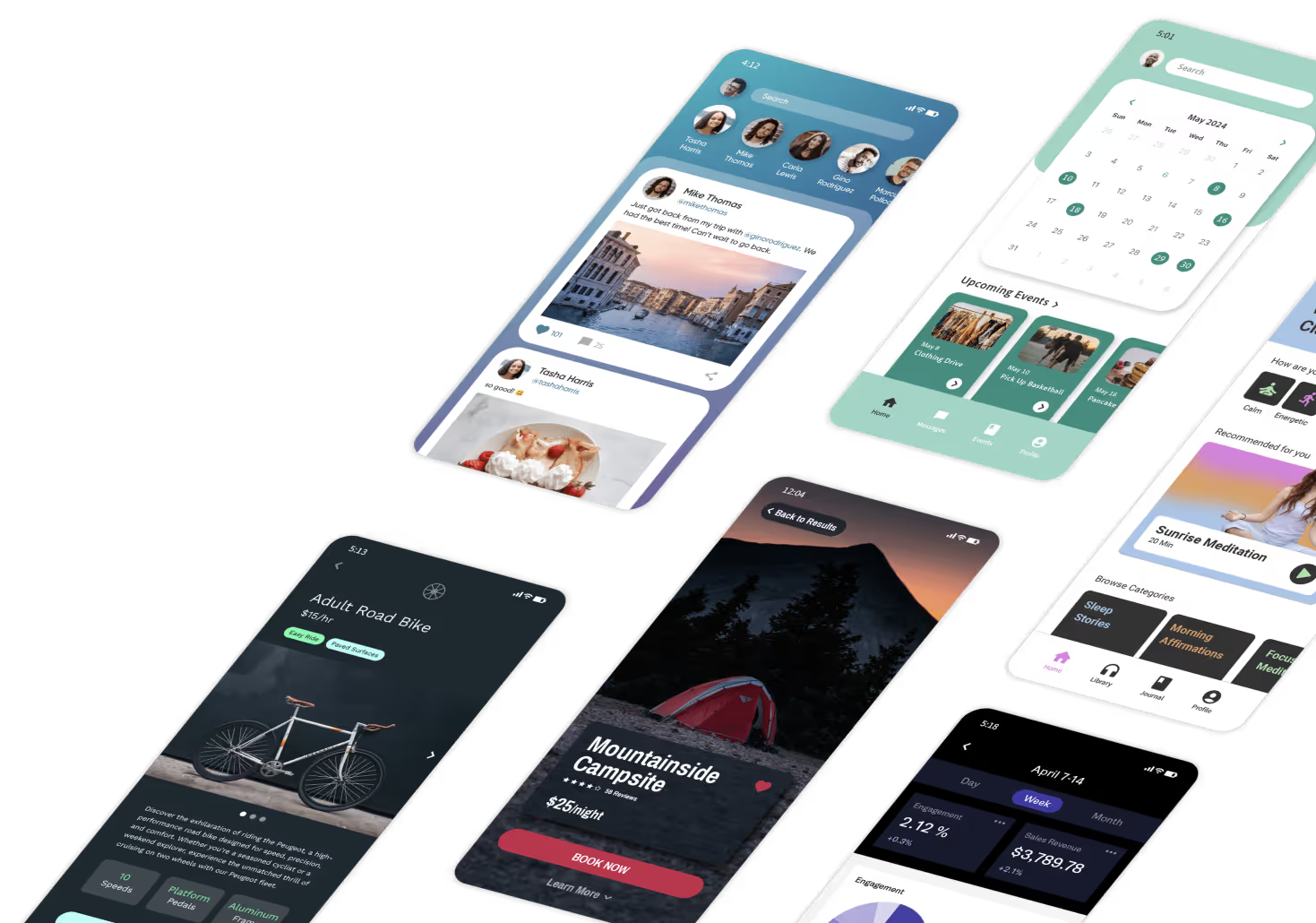
Every ambitious founder knows the brutal math: traditional app development costs range from $40,000 to $400,000+ while only 0.4% of new mobile apps achieve $100,000+ revenue within 12 months. But the no-code revolution has flipped this equation—with Gartner predicting that by 2026, 70% of new applications developed by enterprises will use low-code or no-code technologies. Platforms like Adalo, a no-code app builder for database-driven web apps and native iOS and Android apps—one version across all three platforms, published to the Apple App Store and Google Play, empower founders to build professional applications without writing a single line of code.
Key Takeaways
- 70% of enterprise applications will use low-code or no-code technologies by 2026, according to Gartner
- AI-powered app builders now enable founders to go from idea to published app in days rather than months
- Paid plans with unlimited database records and no usage-based charges eliminate scaling cost surprises
- Native iOS and Android compilation from a single codebase outperforms web wrappers at scale
What Is Adalo's AI-Powered App Builder Platform?
Adalo represents a fundamental shift in how startups create mobile and web applications. Unlike traditional development requiring months of coding and six-figure budgets, Adalo's drag-and-drop platform—described by users as "easy as PowerPoint"—transforms app creation into a visual process accessible to any founder, regardless of technical background.
The platform combines powerful capabilities that traditionally required separate tools and teams:
- Visual WYSIWYG Editor: Build exactly what you see with instant preview across devices, displaying up to 400 screens at once on a single canvas
- Built-in Relational Database: Manage complex data relationships without SQL knowledge—with no record limits on paid plans
- Cross-Platform Publishing: Deploy to iOS App Store, Google Play Store, and web from a single codebase
- Component Marketplace: Access 50+ premium components tested for reliability
- API Integration Framework: Connect to external services through REST APIs and webhooks
- Responsive Design System: Automatically adapt layouts for any screen size
Core Features of Adalo
The platform's architecture eliminates traditional development bottlenecks through:
- Unlimited screens on all plans
- Real-time collaboration (editors per plan; Team up to 10, Business unlimited)
- Custom formulas and AND/OR logic for complex workflows
- External collections for integrating existing databases/APIs
- Manual publishing control for precise update management
- >99% uptime for production applications
- Unlimited usage on all plans—no app action limits or bill shock
How Adalo Differs from Traditional Development
Where traditional development requires separate specialists for frontend, backend, database, and deployment, Adalo unifies these into one intuitive interface. Projects that typically take months with traditional coding often launch in weeks on Adalo. The Adalo 3.0 infrastructure overhaul, launched in late 2025, made apps 3-4x faster with modular infrastructure that scales with app needs.
This speed advantage is critical because global benchmarks show retention falls to about 26% on Day 1 and ~7% by Day 30, making rapid iteration essential for survival. When you can push updates in hours rather than weeks, you can respond to user feedback before they churn.
AI App Development Features in Adalo for 2026
The convergence of AI and no-code platforms is transforming app development from a technical challenge into a creative process. Founders can add AI capabilities—like GPT-powered chat, content generation, and moderation—without ML expertise by using Adalo's native actions and integrations.
Ada, Adalo's AI builder, lets you describe what you want and generates your app. Magic Start creates complete app foundations from a description, while Magic Add adds features through natural language.
The AI Builder, due for release in early 2026, promises prompt-based app creation and editing that will further accelerate development. Current AI features already available include:
- Magic Start: Generates complete app foundations from descriptions—tell it you need a booking app for a dog grooming business, and it creates your database structure, screens, and user flows automatically
- Magic Add: Add features by describing what you want in natural language
- X-Ray: AI that identifies performance issues before they affect users, ensuring scalability
AI Component Marketplace
Adalo's component marketplace includes AI-powered elements that integrate seamlessly into any application:
- Ask ChatGPT (GPT-powered chat, generation, translation, moderation)
- Custom Actions to call external AI REST APIs (e.g., OpenAI, Google, AWS)
- Component marketplace with 50+ premium components to extend functionality
Integrating AI APIs with Adalo
Modern AI implementation doesn't require building models from scratch. Through Adalo's integration capabilities, founders connect pre-trained AI services:
- OpenAI Integration: GPT models for text generation and analysis
- Google Cloud AI: Translation, vision, and speech services
- AWS Machine Learning: Comprehensive AI toolkit access
- Custom API Connections: Any AI service with REST API support
The platform's Zapier integration alone connects to thousands of AI-powered automation tools, enabling sophisticated workflows without code. Over 80% of app teams now use AI for personalization, bug fixes, and user need prediction—capabilities once exclusive to tech giants.
Best Free App Builder Options: Adalo vs Bubble and Other Alternatives
The democratization of app development starts with accessible free tiers—choosing the right one determines how quickly you can validate and iterate.
Adalo Free Plan Features
Adalo's free tier delivers substantial capabilities for founders validating ideas:
- Unlimited screens for building complete app prototypes
- 500 records per app for initial testing
- Web publishing to an Adalo subdomain
- Access to the visual editor and component library
- Database relationship tools for complex data structures
When to Choose Adalo Over Bubble
While Bubble excels at complex web applications with extensive customization, Adalo dominates mobile-first development with key advantages:
- Native mobile app publishing: Direct deployment to iOS and Android app stores from one project—Bubble's mobile solution is a web wrapper, which can introduce performance challenges at scale
- Pricing clarity: Adalo starts at $36/month with unlimited usage and unlimited app store updates; Bubble starts at $59/month with usage-based Workload Unit charges and limits on app re-publishing
- Database simplicity: Adalo's paid plans include unlimited database records with no caps; Bubble's Workload Units create uncertain cost calculations
- Build speed: True drag-and-drop for mobile experiences with a gentler learning curve
- Unified updates: One Adalo build automatically updates web, Android, and iOS apps; Bubble requires managing separate deployments
Bubble offers more customization depth, but that flexibility often results in slower applications that suffer under increased load. Claims of millions of MAU on Bubble typically require hiring experts to optimize performance—an additional cost that erodes the platform's value proposition.
Global mobile app downloads reached about 257 billion in 2026, underscoring how native mobile capability is essential for reach.
How Adalo Compares to Other Alternatives
FlutterFlow is a low-code (not no-code) platform designed for technical users. Users must set up and manage their own external database, which requires significant learning complexity—especially when optimizing for scale, as suboptimal setup creates performance problems. The ecosystem is rich with paid experts because so many users need help. FlutterFlow's builder is also limited in view, making it slow to see more than two screens at once, whereas Adalo can display up to 400 screens on one canvas. Pricing starts at $70/month per user for app store publishing, but still doesn't include a database—you'll need to source, set up, and pay for that separately.
Glide is heavily template-focused, which makes it fast to build with but creates generic, simplistic apps with limited creative freedom. Glide is a go-to for spreadsheet-based apps, but that doesn't compare to the convenience of Adalo's SheetBridge, which turns a Google Sheet into an actual database for the easiest control without database-related learning. Pricing starts at $60/month for a custom domain, but remains limited by app updates and data record rows that attract additional charges. Glide does not support Apple App Store or Google Play Store publishing.
Softr pricing starts from $167/month to publish a Progressive Web App, still restricted by records per app and records per datasource. Softr does not support Apple App Store and Google Play Store publishing or native iOS and Android app creation. Softr is used for spreadsheet app building when web app restrictions are acceptable and the higher price point works.
Thunkable offers an AI draft of an app build, but getting access to a publishable Progressive Web App requires a $59/month plan with usage restrictions. Responsive app capabilities require custom pricing beyond their advertised $189/month Advanced tier.
How to Make an App for Free with Adalo's Platform
Building your first app requires zero coding knowledge and minimal time investment. With Gartner predicting that at large enterprises, the number of active citizen developers would be at least four times the number of professional developers by 2026, the process has been refined for absolute beginners.
Step-by-Step App Creation
Week 1: Foundation Setup
- Create your free Adalo account and explore the interface
- Select from professional templates or start from scratch
- Use Magic Start to generate your app foundation from a description
- Design your database structure using visual tools
Week 2: Building Core Functionality
- Add screens using drag-and-drop components
- Use Magic Add to add features by describing what you want
- Configure database collections and relationships
- Set up user authentication and profiles
- Create forms for data input and editing
- Implement navigation and user flows
Week 3: Enhancement and Polish
- Integrate Stripe for payments or IAPHUB for in-app purchases
- Add push notifications and messaging
- Customize design with brand colors and fonts
- Configure responsive layouts for all devices
- Run X-Ray to identify and fix performance issues
- Set up analytics tracking
Testing Your Free App
Adalo's preview mode enables comprehensive testing before launch:
- Device Preview: Test on actual iOS and Android devices
- User Flow Testing: Validate all paths and interactions
- Data Management: Ensure proper CRUD operations
- Performance Monitoring: Check load times and responsiveness
- Cross-Platform Verification: Confirm consistency across platforms
The platform processes 20M+ daily data requests with 99%+ uptime, ensuring your free app performs reliably even during testing phases.
Top Startup Ideas You Can Build with No-Code Tools
The success stories prove the potential: startups like Comet raised $12.8 million after building entirely on no-code platforms. With 70% of new businesses expected to adopt low-code or no-code solutions by 2026, validated business models emerge across industries.
Validated Startup Templates
Marketplace Platforms ($2-10M potential)
- Two-sided marketplaces connecting buyers and sellers
- Service booking platforms for professionals
- Rental marketplaces for equipment or spaces
- Freelancer platforms with escrow payments
- Local delivery and logistics networks
SaaS Applications ($5-50M potential)
- Project management tools for specific industries
- CRM systems for niche markets
- Scheduling and booking software
- Analytics dashboards for businesses
- Workflow automation platforms
Revenue-Generating App Ideas
Membership & Subscription Apps
- Fitness coaching platforms with workout plans
- Educational course delivery systems
- Premium content communities
- Recipe and meal planning services
- Mental health and wellness apps
E-Commerce Solutions
- Direct-to-consumer stores with custom branding
- Subscription box management
- Digital product marketplaces
- Group buying platforms
- Flash sale and deal aggregators
Companies using low-code platforms increase revenue by 58% on average, with successful implementations launching in weeks rather than months.
Essential No-Code Platform Features for Scalable Apps
Scalability determines whether your MVP becomes a sustainable business. With Adalo processing 20M+ daily data requests across platforms and maintaining 99%+ uptime, the infrastructure supports growth from prototype to production.
The Adalo 3.0 infrastructure overhaul introduced modular infrastructure that scales to 1M+ MAU with no upper limit. This purpose-built architecture outperforms app wrappers at scale—a critical distinction when your app gains traction.
Database Scalability
Adalo's relational database architecture handles complex data requirements:
- Paid Plans: Unlimited database records—no caps on data storage
- Professional Plan: 25GB storage
- Business Plan: 500GB storage
- External databases: Xano integration for advanced backend scale
- API connections: Custom Actions for REST/HTTP to existing systems
- Data migration: CSV import/export for easy data management
With the right data relationship setups, Adalo apps can scale beyond 1 million monthly active users—without the performance degradation common in web wrapper solutions.
Team Collaboration Features
Scaling requires coordinated development across teams:
Starter Plan ($36/month billed annually)
- 1 published app
- 1 editor seat
- Individual workspace and sharing
- Unlimited usage—no app action limits
Professional Plan ($36/month billed monthly)
- 2 published apps
- 5 editor seats
- 25GB storage
Team Plan ($250/month billed monthly)
- 5 published apps
- 10 editor seats
- Faster support response
Business Plan ($250/month billed monthly)
- 10 published apps
- Unlimited editor seats
- 500GB storage
Over 3 million apps have been created on Adalo, demonstrating platform-level scale for ambitious startups.
Adalo Pricing Plans: From Free to Business Tier
Investment in the right plan accelerates growth while keeping costs predictable for each stage of your product. Unlike platforms with usage-based charges that create bill shock, all Adalo plans include unlimited usage.
Choosing the Right Plan
Free Plan — Validation Phase
- Perfect for: MVP testing and concept validation
- Limitations: 500 records/app, Adalo subdomain for web publishing
- Upgrade trigger: Need for custom domain or native publishing
Starter Plan — Launch Phase ($36/month billed annually, $36/mobilled monthly)
- Perfect for: First public launch with professional branding
- Key features: Custom domain, iOS/Android publishing, 1 published app, unlimited database records
- Upgrade trigger: Multiple apps or more seats
Professional Plan — Growth Phase ($36/month billed monthly)
- Perfect for: Scaling startups with small teams
- Key features: 2 published apps, 5 editor seats, 25GB storage
- Upgrade trigger: Larger teams or higher storage needs
Team Plan — Collaboration at Scale ($250/month billed monthly)
- Perfect for: Cross-functional teams
- Key features: 5 published apps, 10 editor seats, faster support response
Business Plan — Advanced Operations ($250/month billed monthly)
- Perfect for: Multi-app portfolios and operations at scale
- Key features: 10 published apps, unlimited editor seats, 500GB storage
Cost-Benefit Analysis
Traditional development costs of $40,000 to $400,000+ make Adalo's pricing transformative:
- Annual Starter cost: $432
- Time to market: Often within weeks (scope-dependent)
- Iteration speed: Hours or days between changes (no code merges/deploy pipelines)
- Technical debt: Lower ongoing maintenance compared with bespoke codebases
- No surprise bills: Unlimited usage means predictable monthly costs
How to Publish Your App to App Store and Google Play with Adalo
Adalo streamlines mobile app store publishing by handling the technical complexity behind a visual interface. While traditional development requires separate iOS and Android codebases, platform-specific build configurations, and deep knowledge of store requirements, Adalo enables cross-platform publishing from a single project—eliminating months of specialized work. Global mobile app downloads reached about 257 billion in 2026, making store presence critical for user acquisition.
App Store Requirements
Apple App Store
- Apple Developer License: $99/year
- Review timeline: Varies; many apps are reviewed within a few days, but no timeline is guaranteed
- Updates to the app binary require review; server-side content changes can appear without resubmission
- TestFlight beta testing included
Google Play Store
- Developer registration: one-time $25 fee
- Review timeline: varies by app and account history (no guaranteed timeline)
- Internal, closed, and open testing tracks supported
Publishing Timeline
Week 1: Preparation
- Complete app functionality and testing
- Run X-Ray to identify and resolve performance issues
- Prepare store assets (screenshots, descriptions)
- Configure app metadata and categories
- Set up developer accounts
Week 2: Submission
- Build production versions through Adalo
- Submit to stores directly from platform
- Monitor review status and feedback
- Address any reviewer concerns
Week 3: Launch
- Many apps are reviewed within a few days, but timing varies
- Configure pricing and availability
- Enable analytics and crash reporting
- Plan marketing launch timing
The platform's publishing control features enable strategic rollouts with manual update management. Unlike competitors that limit app re-publishing, Adalo includes unlimited app store updates on all paid plans.
Building Custom Components and Integrations with Adalo
Extensibility transforms good platforms into great businesses. Adalo's component marketplace offers 50+ premium components while supporting unlimited custom development.
Premium Component Library
Payment & Commerce
- Stripe integration for subscriptions and one-time payments
- In-app purchases through IAPHUB
- Multi-currency support
- Tax calculation engines
Communication & Engagement
- Push notifications with segmentation
- Chat and messaging systems
- Email automation through Zapier
- SMS verification and alerts
Data & Analytics
- Google Sheets integration for reporting
- Airtable connections for complex data
- Custom analytics dashboards
- Real-time data synchronization
Third-Party Integrations
The platform's integration ecosystem connects to essential business tools:
- CRM Systems: Hubspot, Salesforce, Pipedrive
- Marketing Automation: Mailchimp, ConvertKit, ActiveCampaign
- Project Management: Asana, Trello, Monday.com
- Storage & Files: Dropbox, Google Drive, AWS S3
- Authentication: OAuth, Auth0, Firebase Auth
With the low-code development market growing rapidly, component quality becomes competitive advantage.
Success Stories: Apps Built with Adalo Platform
Real founders achieving real results validate the platform's capabilities. Over 3 million apps have been created on Adalo, with the platform processing 20M+ average daily data requests.
Million-User Apps
Spotto - Location Gaming
- First Adalo app to achieve acquisition
- Scaled to hundreds of thousands of users
- Built entirely without code
- Successful exit to strategic buyer
Covenant Connect - Education Platform
- School communication system
- Thousands of daily active users
- Replaced legacy infrastructure
- 5x improvement in engagement
Revenue-Generating Examples
B2B SaaS Success
- Professional services platforms generating $10K+ MRR
- Appointment booking systems processing thousands of bookings
- Project management tools with enterprise clients
- Custom CRM solutions for niche industries
Consumer Applications
- Fitness apps with subscription revenue
- Food delivery platforms processing orders
- Social networking apps with engaged communities
- Educational platforms selling courses
Note: Most third-party platform ratings and comparisons predate the Adalo 3.0 infrastructure overhaul launched in late 2025, which introduced 3-4x faster performance and modular scaling architecture.
FAQ
Why choose Adalo over other app building solutions?
Adalo is an AI-powered app builder that creates true native iOS and Android apps. Unlike web wrappers, it compiles to native code and publishes directly to both the Apple App Store and Google Play Store from a single codebase—the hardest part of launching an app handled automatically. Paid plans include unlimited database records and no usage-based charges, eliminating bill shock as you scale.
What's the fastest way to build and publish an app to the App Store?
Adalo's drag-and-drop interface combined with AI-assisted building through Magic Start and Magic Add lets you go from idea to published app in days rather than months. The platform handles the complex App Store submission process, so you can focus on your app's features instead of wrestling with certificates and provisioning profiles.
Is Adalo really free to use for building apps?
Yes. The Free plan lets you build unlimited test apps with 500 records per app and web publishing to an Adalo subdomain. Upgrade when you need a custom domain or native iOS/Android publishing.
Which is more affordable, Adalo or Bubble?
Adalo starts at $36/month (annual) with unlimited usage and unlimited app store updates. Bubble starts at $59/month with usage-based Workload Unit charges that can create unpredictable costs. Adalo's paid plans also include unlimited database records, while Bubble's Workload Units limit data operations.
Which is better for mobile apps, Adalo or Bubble?
Adalo creates true native iOS and Android apps from a single codebase. Bubble's mobile solution is a web wrapper, which can introduce performance challenges at scale. One Adalo build automatically updates web, Android, and iOS apps; Bubble requires managing separate deployments.
Can Adalo apps scale to handle thousands of users?
Yes. Adalo's modular infrastructure scales to 1M+ monthly active users with no upper limit. The platform processes 20M+ daily data requests with 99%+ uptime. With the right data relationship setups, Adalo apps can scale beyond 1 million MAU—without the performance degradation common in web wrapper solutions.
How much does it cost to launch an app with Adalo including store fees?
A common setup is Starter (annual) at $36/month = $432/year, plus the Apple Developer Program at $99/year and Google Play's one-time $25 fee—roughly $556 in year one. This compares to traditional development costs of $40,000 to $400,000+.
Do I need coding experience to use Adalo?
No. Adalo's visual editor—described by users as "easy as PowerPoint"—plus App Academy and starter templates guide non-developers through building production apps. Magic Start generates complete app foundations from descriptions, and Magic Add lets you add features by describing what you want in natural language.
How long does app store review take?
Timelines vary. Many apps are reviewed within a few days on both stores, but there's no guarantee. Binary updates require review on Apple; server-side content changes can appear without resubmission.
Is Adalo better than Glide or FlutterFlow for mobile apps?
For native app store publishing, yes. Glide does not support Apple App Store or Google Play Store publishing at all. FlutterFlow requires technical knowledge and separate database setup. Adalo publishes native apps to both stores from one codebase, includes a built-in database with no record limits on paid plans, and requires no coding knowledge.