Creating an app can be expensive and time-consuming. Hiring developers - whether freelancers, agencies, or in-house teams - often costs tens of thousands of dollars upfront, with ongoing maintenance adding 15–20% of the initial cost every year. Adalo, a no-code app builder, offers a simpler alternative: for as little as $36/month, you get hosting, updates, and app store publishing included. Over three years, this totals $2,000–$5,000, compared to $25,000–$640,000+ with other methods.
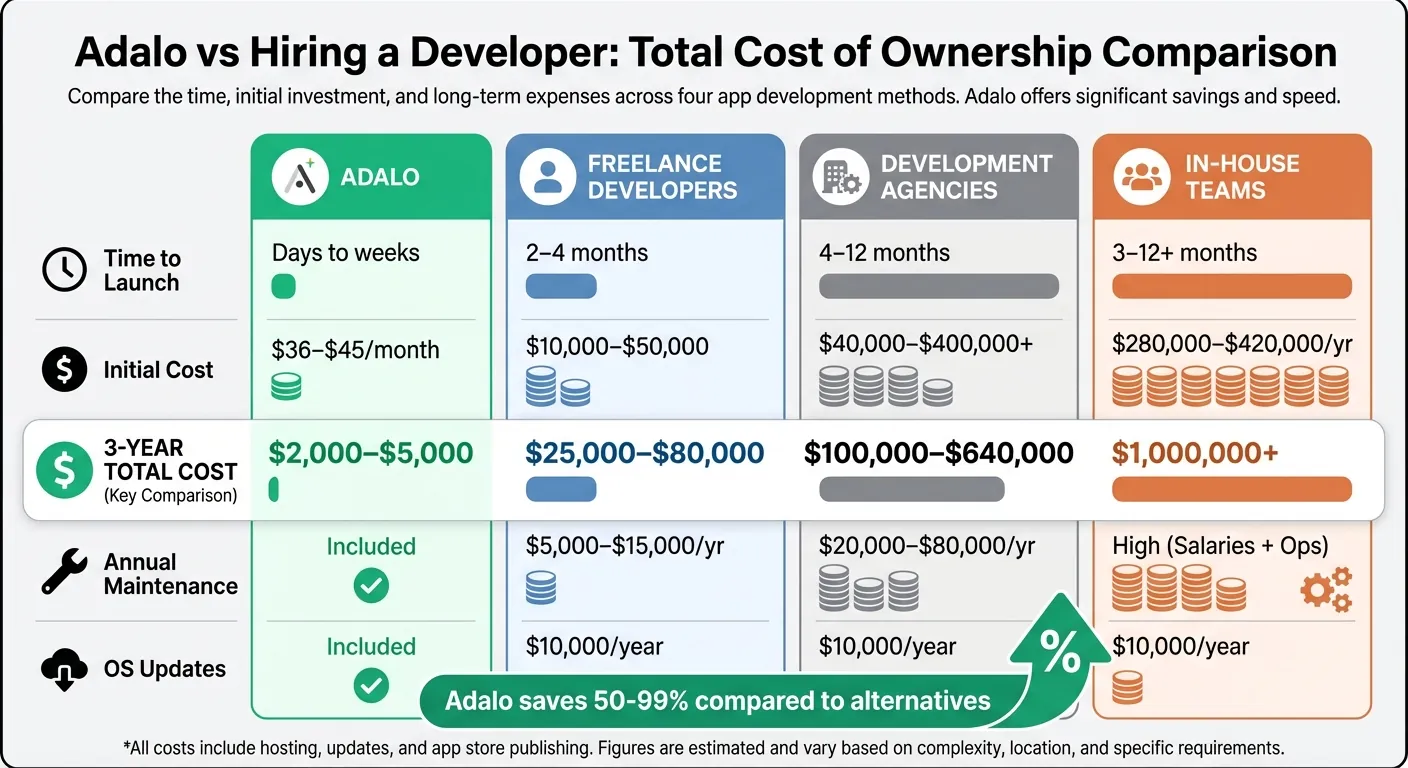
Here's how the options compare:
- Adalo: $36–$36/mo, launch in days or weeks, no extra costs for updates or scaling.
- Freelance Developers: $10,000–$50,000 upfront, 2–4 months to launch, $5,000–$15,000/year for maintenance.
- Agencies: $40,000–$400,000+, 4–12 months to launch, high annual maintenance costs.
- In-House Teams: $280,000–$420,000/year, extensive hiring and operating expenses.
Adalo simplifies the process, cutting costs and timelines significantly while giving you full control over your app's updates and management. Below is a quick comparison of these options.
Quick Comparison
| Factor | Adalo | Freelance Developers | Development Agencies | In-House Teams |
|---|---|---|---|---|
| Time to Launch | Days to weeks | 2–4 months | 4–12 months | 3–12+ months |
| Initial Cost | $36–$36/mo | $10,000–$50,000 | $40,000–$400,000+ | $280,000–$420,000/yr |
| 3-Year Total Cost | $2,000–$5,000 | $25,000–$80,000 | $100,000–$640,000 | $1,000,000+ |
| Maintenance | Included | $5,000–$15,000/yr | $20,000–$80,000/yr | High (Salaries + Ops) |
| OS Updates | Included | $10,000/year | $10,000/year | $10,000/year |
Adalo delivers faster launches and lower costs, making it ideal for startups and small businesses.
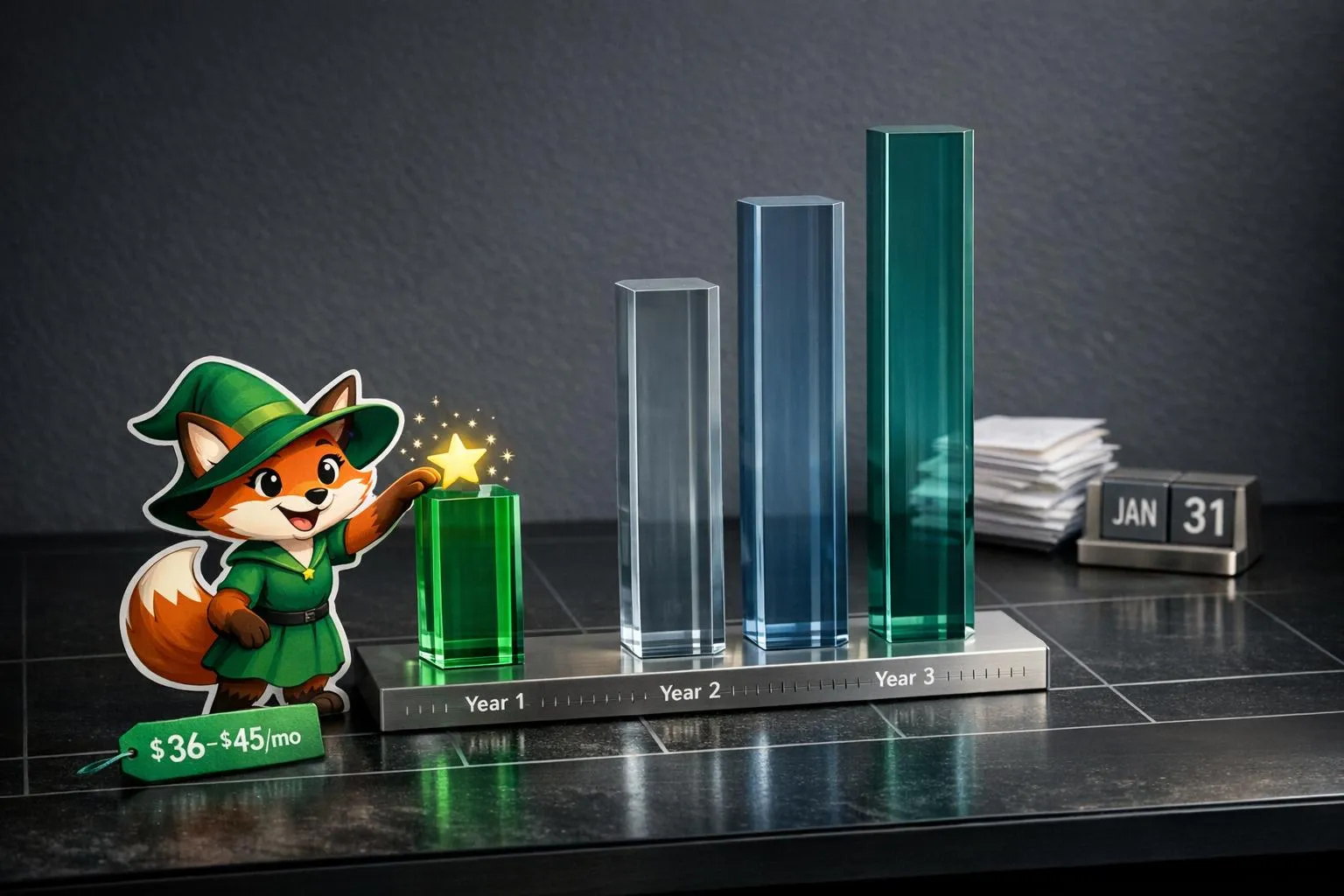
Adalo vs Traditional Development: 3-Year Cost Comparison
Independent research from App Builder Guides' State of App Building report (updated March 2026) analyzed 290+ unique sources across 14 platforms in three tiers with zero platform sponsorships. Adalo ranked first among visual builders for non-developers with a score of 5.94/10.
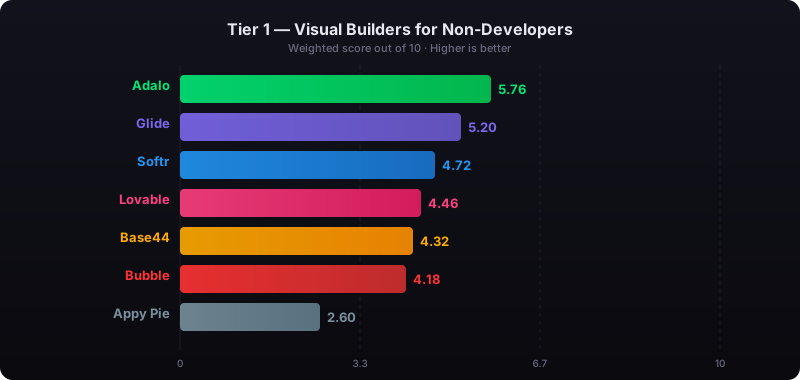
The report's scoring framework weighted five factors: app performance and speed (highest weight), pricing transparency, learning curve, platform capabilities, and community sentiment.
Adalo: Costs and Benefits
Adalo is a no-code app builder for database-driven web apps and native iOS and Android apps—one version across all three platforms. AI-assisted building and streamlined publishing enable launch to the Apple App Store and Google Play in days rather than months.
Ada, Adalo's AI builder, lets you describe what you want and generates your app. Magic Start creates complete app foundations from a description. Magic Add adds features through natural language. X-Ray identifies performance issues before they affect users.
Adalo 3.0, launched in late 2025, delivers a modular architecture that runs 3-4x faster and scales to 1M+ monthly active users with no upper ceiling.
Adalo Pricing Breakdown
Adalo's pricing is straightforward. The Starter plan is priced at $36/month (or $432/year) and allows you to publish one app with a custom domain. If you're looking to publish on native iOS and Android app stores, you'll need the Professional plan, which costs $36/mo (or $540/year). This plan removes usage limits, offers unlimited database records, and includes hosting and security - so you won't be hit with unexpected fees as your app scales.
In addition to Adalo's subscription, there are app store fees to consider: $99/year for Apple's App Store developer program and a $25 one-time fee for Google Play registration. For your first year, the total costs come to $664 if you choose the Professional plan. Over three years, you'll spend approximately $1,704 - covering subscriptions and app store fees, with no added expenses for maintenance, scaling, or infrastructure.
Launch Timeline with Adalo
Adalo's AI Builder, known as Magic Start, simplifies the app creation process. By entering a basic text description, you can generate your app's database structure (see database basics), screens, and user flows in just minutes. This approach can slash development time by 75% or more compared to traditional methods.
This speed isn't just theoretical - founders have seen it in action. For instance, Alessandro De La Torre developed Scholarcash in just one week, earning over 20,000 downloads on the iOS App Store. Similarly, Sam Shaibani launched Moonifest, which grew to 38,000+ users and 32,000+ downloads, all without relying on a traditional development team.
What You Get with Adalo
Adalo isn't just about cost savings and quick launches - it's also about giving you full control over your app's development and management.
The platform automates complex tasks like App Store certificate management, provisioning profiles, and submission guidelines. From a single build, you can publish your app natively to the Apple App Store, Google Play Store, and even as a Progressive Web App.
Your subscription covers everything you need to run and scale your app - hosting, security updates, unlimited database records, and backend services. There's no extra charge for storage, API requests, or increasing user numbers. This setup ensures complete independence for founders. You won't have to rely on developers for updates or changes. Instead, you can make edits directly in the visual editor and instantly push updates across all platforms.
Next, let's see how freelance developers stack up in terms of cost and complexity.
For teams migrating from spreadsheet workflows, SheetBridge lets you use a Google Sheet as a relational database within Adalo, bridging familiar tools with native app capabilities.
Freelance Developers: Costs and Challenges
Freelance Developer Pricing Breakdown
Hiring a freelance developer through platforms like Upwork or Fiverr comes with hourly rates that vary based on experience and location. In the United States, the average rate for a freelance app developer is $61/hour. Here's a breakdown by experience level:
- Junior developers: $20–$40/hour
- Mid-level developers: $40–$80/hour
- Senior developers: $80–$150+/hour
Internationally, rates tend to be lower. Developers in Eastern Europe typically charge $25–$60/hour, while those in Asia range from $15–$35/hour.
For full app builds, costs depend on complexity:
- Simple apps: $6,000–$15,999
- Moderate complexity apps: $16,999–$36,999
- Complex apps: $37,000–$65,000+
But the initial build is just the beginning. Ongoing maintenance adds 15–20% of the original development cost per year, which translates to $1,200–$13,000 annually for most apps. Compatibility updates alone can cost around $10,000 per year. Over three years, when factoring in maintenance, updates, and infrastructure, total ownership costs can climb to $35,000–$80,000+.
And that's before factoring in hidden expenses.
Hidden Costs of Hiring Freelancers
The hourly rate might look manageable, but hidden costs add up quickly. For starters, you'll need to spend 20–40 hours reviewing profiles and conducting interviews before you even begin work. Once the project is underway, expect to spend 20–30% of your time managing tasks and coordinating schedules across time zones, often leading to delays of 20–50%. Language barriers and meetings at odd hours can make things even more complicated.
Freelancer reviews also highlight a 30% risk of project abandonment, meaning there's a chance your developer might disappear mid-project or fail to deliver. If that happens, finding someone new who can pick up where they left off can be both time-consuming and expensive.
Other challenges, like scope creep, can add another $2,000–$10,000 to your budget. And if your freelancer leaves after launch, maintaining the codebase becomes tricky, creating a dependency on whoever takes over.
Launch Timeline with Freelance Developers
These challenges often stretch your timeline significantly. Building an app with a freelance developer typically takes 2–4 months for a minimum viable product (MVP), and more complex projects can extend to 6–12 months. Here's how the timeline usually breaks down:
- Planning and discovery: 1–2 weeks
- Design and UX: 2–4 weeks
- Development: 8–24+ weeks
- Testing and QA: 2–6 weeks
- Deployment: 1–2 weeks
This means you're looking at 3–9 months from start to launch, even under ideal conditions. By comparison, Adalo's AI Builder accelerates development cycles dramatically. Magic Start generates complete app foundations—database structure, screens, and user flows—from a simple text description. Instead of months, you could launch in days or weeks. In fact, 72% of no-code users report completing applications in 3 months or less, compared to the 6–12 months required with traditional methods.
The longer your project takes, the more it costs—and the longer you delay testing your idea with real users. Time, after all, is money.
Why startup founders should use no code tools such as Bubble and Adalo for their MVP
Agencies: Costs and Considerations
Hiring an agency for app development can seem like a straightforward solution, but it often comes with hidden costs that significantly increase your overall expenses.
Agency Pricing Breakdown
Agencies offer end-to-end app development services, but these come at a steep price. On average, a mobile app development project costs $90,780.11 and takes about 11 months to complete. Costs vary widely depending on the complexity of the app:
- Simple/Basic App: $40,000–$100,000 (3–6 months)
- Medium Complexity App: $100,000–$200,000 (6–9 months)
- Highly Complex App: $200,000–$400,000 (9–12 months)
- Enterprise-Grade App: $400,000+ (12–18+ months)
However, the initial build is just the beginning. Maintenance costs can add up quickly, typically accounting for 15% to 20% of the original development budget each year. During the first year, these costs can spike to 50% due to bug fixes and feature updates. Maria Martin, a Content Specialist at DesignRush, explains:
"The industry norm is that the total cost of maintaining an app is about 15% to 20% of the original development costs".
Here's a breakdown of estimated costs over three years:
| App Complexity | Build Cost | Annual Maintenance (15–20%) | 3-Year Total Cost (Est.) |
|---|---|---|---|
| Simple | $40,000 – $100,000 | $6,000 – $20,000 | $58,000 – $160,000 |
| Medium | $100,000 – $200,000 | $15,000 – $40,000 | $145,000 – $320,000 |
| Complex | $200,000 – $400,000 | $30,000 – $80,000 | $290,000 – $640,000 |
In addition to maintenance, you'll face monthly infrastructure and hosting fees ranging from $200 to $5,000+, emergency fixes costing $1,000 to $5,000 per incident, and third-party service fees averaging $4,000 annually.
Hidden Costs of Working with Agencies
Beyond the visible price tags, agencies introduce several hidden expenses that can inflate the total cost of ownership. Many reputable agencies require minimum project sizes of $25,000–$50,000. Quality assurance (QA) alone can account for 15–25% of the development budget. Additional costs include:
- Development environments: $3,000–$5,000 per developer
- Testing devices: $200–$800 per device
- Cloud infrastructure: $100–$1,000 per month
The extended timelines of agency projects—typically 4 to 12+ months—also delay your app's market launch, increasing opportunity costs. Communication often flows through account managers rather than directly with developers, which can lead to miscommunication and delays. Coordination and management efforts can consume 20–30% of the project time.
Another major concern is vendor lock-in. Agencies often use proprietary frameworks or highly customized codebases, making it challenging and expensive to switch providers or bring development in-house later. Founders also frequently underestimate the internal time needed for stakeholder workshops, user interviews, and deliverable reviews, adding unplanned costs. On top of that, keeping up with annual iOS and Android updates can further compound these challenges, especially when dealing with proprietary code.
Adalo eliminates these concerns entirely. With no data caps on paid plans and a predictable monthly subscription, you avoid the infrastructure fees, maintenance surprises, and vendor dependencies that plague agency relationships.
In-House Teams: Costs and Scalability
Building an in-house development team gives you complete control over the process, but it comes with a hefty price tag. The expenses go far beyond just salaries—you'll need to budget for benefits, office space, equipment, and the time it takes to recruit and onboard developers before they start contributing effectively.
In-House Developer Pricing Breakdown
Salaries for US-based developers vary depending on experience. Entry-level developers (0–2 years) typically earn $65,000–$100,000 annually, mid-level developers (2–4 years) earn $75,000–$120,000, and senior developers (5+ years) command $120,000–$180,000+. Mobile developers, particularly those specializing in iOS or Android, often earn even more—averaging $129,349 for iOS and $106,537 for Android.
Once you add in benefits and overhead, the total cost of employing a developer rises to 1.4x to 1.6x their base salary. For example, a mid-level developer with a $100,000 salary will incur additional costs like benefits and healthcare (20–30% of the base salary), office space ($14,400–$28,800/year), equipment ($3,000–$5,000), and training ($2,000–$5,000/year). Altogether, the first-year cost for one developer can range from $122,400 to $214,800. Over three years, this adds up to $336,000–$576,000+.
A small project team—usually 2–3 developers, a designer, and a project manager—can cost $280,000–$420,000 annually. For medium-complexity apps, expect costs to rise to $500,000–$800,000 per year, while enterprise-level applications can exceed $1,000,000+ annually.
On top of salaries, there are hidden costs to consider. Setting up each developer's work environment costs $3,000–$5,000, testing devices range from $200–$800 each, and cloud infrastructure expenses can fall between $100 and $1,000 per month. Annual operating system updates (~$10,000) also add to the overall spend. These unseen expenses—testing, maintenance, and infrastructure—can significantly inflate your budget.
Launch Timeline with In-House Teams
Cost isn't the only challenge with in-house teams—timing is just as critical. Recruitment alone can take 6–12 weeks, with hiring costs ranging from $15,000–$25,000 per developer. The shortage of senior mobile developers in the US, as many have shifted to AI-related roles in recent years, has further driven up salaries and extended hiring timelines.
Once hired, junior developers often require 3–6 months of training and mentorship to become fully productive. While senior developers can deliver 2–3 times the output of junior developers, their higher salaries make them a costly resource.
The standard development timeline includes 1–2 weeks for planning, 2–4 weeks for design, 8–24 weeks for coding, and 2–6 weeks for quality assurance. For medium-complexity projects, this process can take 6–10 months, while complex apps may require 12–18+ months before they are ready to launch.
Delays are common—50% of traditional projects experience setbacks, increasing costs by an average of 25%. For Android development, the wide range of devices and OS versions adds complexity, with testing alone consuming 30–40% of the total development time. High turnover among senior developers—47% of whom are actively seeking new opportunities—further complicates timelines and creates recurring recruitment costs.
These challenges highlight the need for faster, more cost-effective alternatives for startups and businesses looking to stay competitive.
Side-by-Side Cost Comparison
Cost and Timeline Comparison Table
Looking at the numbers side by side, the advantages and drawbacks of each option become much clearer. Here's how the costs stack up over three years:
| Factor | Adalo | Freelance Developers | Development Agencies | In-House Teams |
|---|---|---|---|---|
| Time to Launch | Hours to weeks | 2–4 months | 4–12 months | 3–12+ months |
| Initial Cost | $36–$36/mo | $10,000–$50,000 | $40,000–$400,000+ | $280,000–$420,000/yr |
| Annual Maintenance | Included in subscription | $5,000–$15,000/yr | $20,000–$80,000/yr | High (Salary + Operations) |
| 3-Year Total Cost | $2,000–$5,000 | $25,000–$80,000 | $100,000–$640,000 | $1,000,000+ |
| OS Updates | Included | $10,000/year | $10,000/year | $10,000/year |
| Infrastructure | Included | $1,200–$60,000/year | $1,200–$60,000/year | $1,200–$60,000/year |
| Database Limits | Unlimited on paid plans | Varies by hosting | Varies by hosting | Varies by hosting |
| Usage-Based Charges | None | Depends on infrastructure | Depends on infrastructure | Depends on infrastructure |
The table highlights Adalo's ability to deliver results faster and at a fraction of the cost compared to traditional development methods.
Why Adalo Comes Out Ahead
Adalo stands out by offering both speed and cost efficiency. AI-powered app builders like Adalo slash development timelines, with users reporting much shorter cycles than the months-long processes associated with traditional methods. This means you can bring your app to market in days or weeks, not months.
The AI Builder makes this speed possible. Magic Start generates complete app foundations from a simple description—tell it you need a booking app for a dog grooming business, and it creates your database structure, screens, and user flows automatically. What used to take days of planning happens in minutes. Magic Add lets you continue building by describing features you want, rather than manually configuring every element.
But the benefits don't stop there. Adalo's subscription model covers everything—hosting, updates, OS patches, and scaling. Unlike competitors like Bubble that charge Workload Units for CPU usage and database operations, Adalo has no usage-based charges. You're not tied to a specific developer or agency for every update or feature change. That means you can manage your app on your own schedule as a non-technical founder, avoiding the delays and added expenses that are common with traditional development.
The data backs this up: 71% of organizations using citizen development report cutting development time by at least half. Meanwhile, 50% of traditional development projects face delays, driving up costs by an average of 25%. Adalo's approach eliminates these risks, giving you a faster, more affordable, and more flexible way to build and maintain your app.
Scalability Without Surprise Costs
One concern founders often have with any development approach is whether the solution can scale. With freelancers and agencies, scaling typically means renegotiating contracts, paying for additional development hours, and upgrading infrastructure—all at unpredictable costs.
Adalo's modular infrastructure supports apps with 1 million+ monthly active users, with no upper ceiling. The platform processes 20 million+ daily requests with 99%+ uptime. Unlike app wrappers that hit performance constraints under load, Adalo's purpose-built architecture maintains performance at scale.
This scalability comes without the pricing surprises common to other platforms. While Bubble charges Workload Units that can spike unpredictably as your app grows, and Thunkable requires a $189/month plan for app store publishing with token limits, Adalo's pricing remains predictable. Your $36/month Starter plan or $36/moProfessional plan includes unlimited usage—no caps on actions, users, records, or storage.
Conclusion: Why Adalo Makes More Sense
When you break down the numbers, Adalo's value becomes crystal clear. With a straightforward $36 monthly subscription—adding up to around $1,300 over three years—it's a fraction of the cost of traditional development, which can easily climb into tens or hundreds of thousands of dollars once hidden expenses are factored in.
The time savings are just as compelling. Traditional development often drags on for 4 to 12 months before an app is ready to launch. In contrast, Adalo's AI-assisted building enables you to bring your app to life in just days or weeks. This kind of speed gives you a head start, while others are still waiting for developers to complete their builds.
Adalo also puts you in the driver's seat. You're no longer reliant on developers for every tweak, fix, or update. There's no need to depend on a single vendor holding all the keys to your app's technical details. With Adalo, you control your timeline, iterate as needed, and shape your app's future on your terms.
Traditional development comes with hidden costs—like managing communication breakdowns, dealing with scope changes, extensive testing, and infrastructure headaches. Adalo eliminates these hassles. Hosting, OS updates, app store publishing, and more are all included in one predictable monthly fee. No surprise charges when updates roll out—just one clear cost.
For founders and teams aiming to launch fast, keep costs low, and maintain full control, Adalo is the clear choice. It delivers fully functional native iOS and Android apps ready for app stores, without the financial and logistical headaches of custom development.
Related Blog Posts
- Hidden Costs of No-Code Platforms
- Adalo vs Bubble vs FlutterFlow: The Definitive 2026 No-Code Comparison
- Adalo for Custom Software and App Development Agencies
- The Real Cost of Building with Adalo: Pricing Transparency Guide
FAQ
Why choose Adalo over other app building solutions?
Adalo is an AI-powered app builder that creates true native iOS and Android apps from a single codebase. Unlike web wrappers, it compiles to native code and publishes directly to both the Apple App Store and Google Play Store. The AI Builder with Magic Start generates complete app foundations from text descriptions, dramatically reducing development time.
What's the fastest way to build and publish an app to the App Store?
Adalo offers the fastest path from idea to published app. With the drag-and-drop interface and AI-assisted building through Magic Start and Magic Add, you can go from concept to App Store in days rather than months. Adalo handles the complex submission process—certificates, provisioning profiles, and store guidelines—so you can focus on your app's features.
How much can I save using Adalo compared to hiring freelance developers?
Over three years, Adalo costs approximately $2,000–$5,000 total, while freelance developers typically run $25,000–$80,000 including maintenance and infrastructure. Adalo's subscription includes hosting, updates, OS patches, and scaling with no additional fees.
How much can I save using Adalo compared to hiring an agency?
Agencies typically charge $100,000–$640,000 over three years for app development and maintenance. Adalo's total cost over the same period is $2,000–$5,000, representing savings of 95% or more while maintaining full control over your app.
What's included in Adalo's subscription that I'd pay extra for with traditional development?
Adalo's subscription includes hosting, security updates, OS compatibility updates, unlimited database storage, app store publishing, and backend services. With traditional development, you'd pay separately for infrastructure ($1,200–$60,000/year), annual OS updates (~$10,000/year), and maintenance (15–20% of initial costs annually).
How long does it take to launch an app with Adalo versus traditional methods?
With Adalo, you can launch an app in days to weeks using the AI Builder. Traditional methods take significantly longer: freelancers typically need 2–4 months, agencies require 4–12 months, and in-house teams often take 3–12+ months before an app is ready.
Can Adalo scale as my app grows?
Yes. Adalo's modular infrastructure supports apps with 1 million+ monthly active users, processing 20 million+ daily requests with 99%+ uptime. Unlike platforms with usage-based charges, Adalo has no caps on actions, users, records, or storage on paid plans.
Can I make updates to my app without relying on developers?
Yes, Adalo gives you complete independence to manage and update your app. You can make changes directly in the visual editor or use Magic Add to describe new features you want. Updates push instantly across all platforms without waiting for developer availability or paying additional fees.
Which is more affordable, Adalo or Bubble?
Adalo starts at $36/month with unlimited usage and no caps on actions, users, records, or storage. Bubble starts at $69/month but charges Workload Units for CPU usage and database operations, which can lead to unpredictable costs as your app scales. Adalo offers more predictable pricing.
Is Adalo better than FlutterFlow for mobile apps?
Adalo offers advantages for non-technical founders: it starts at $36/month versus FlutterFlow's $80/month per seat, includes a built-in database (FlutterFlow requires external database setup), and provides AI-assisted building through Magic Start and Magic Add. FlutterFlow may suit developers who want more code-level control.

Build your app fast with one of our pre-made app templates
Begin Building with no codeRelated Content

No-Code vs Traditional App Development: A Cost Comparison
Compare no-code and traditional app development costs, timelines, maintenance, and scalability to find the best fit for your budget and need
The Real Cost of Building with Adalo: Pricing Transparency Guide
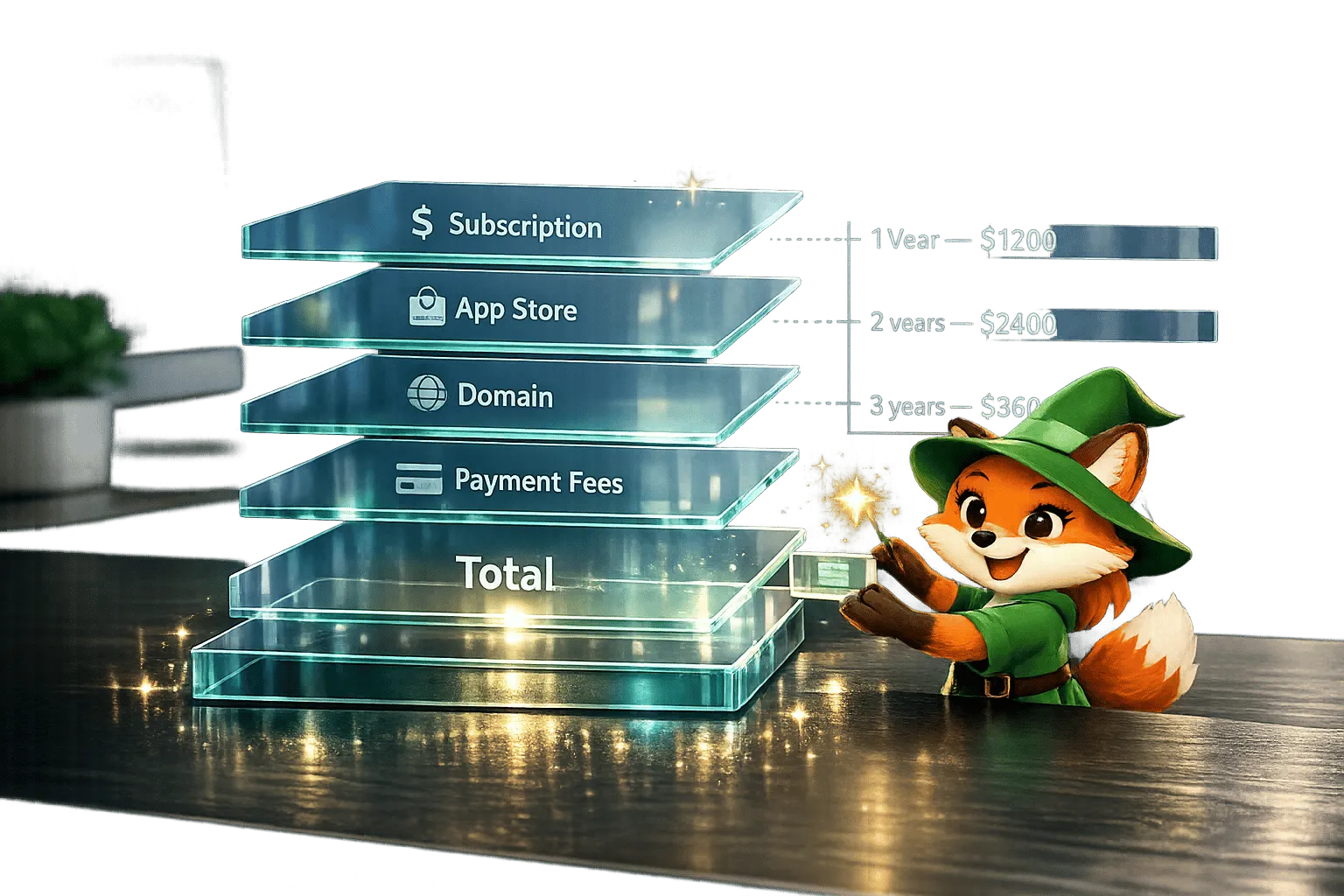
Breakdown of Adalo subscription, app store, domain, and payment fees with 1–3 year totals for predictable app-building costs.

Cost to hire an Android Developer
Android apps cost up to $245K over 2 years; no-code tools like Adalo cut costs by 90–95% while speeding up development dramatically.

Cost to Hire an iOS Developer: A Comprehensive Guide for 2026
Hiring iOS devs in 2026 can cost \$120K–\$700K+, while no-code tools like Adalo build apps in days for as little as \$36/month.