
Building apps for iOS, Android, and web used to be expensive and time-consuming. Adalo, a no-code app builder for database-driven web apps and native iOS and Android apps—one version across all three platforms, published to the Apple App Store and Google Play, changes that. It's a no-code platform that lets agencies create native apps for all platforms from a single build. With flat-rate pricing starting at $36/month per app, agencies can offer fixed-cost quotes, save up to 40% on development costs, and cut timelines from months to weeks.
Ada, Adalo's AI builder, lets you describe what you want and generates your app. Magic Start creates complete app foundations from a description, while Magic Add adds features through natural language.
Adalo’s tools, like Magic Start and the AI features Builder, which allows you to create an app using AI, simplify app creation, while features like white-labeling and scalable infrastructure make it ideal for managing multiple client projects. Whether it’s handling apps with up to 1 million users or integrating third-party tools, Adalo delivers reliable performance and flexibility for agencies to grow their business.
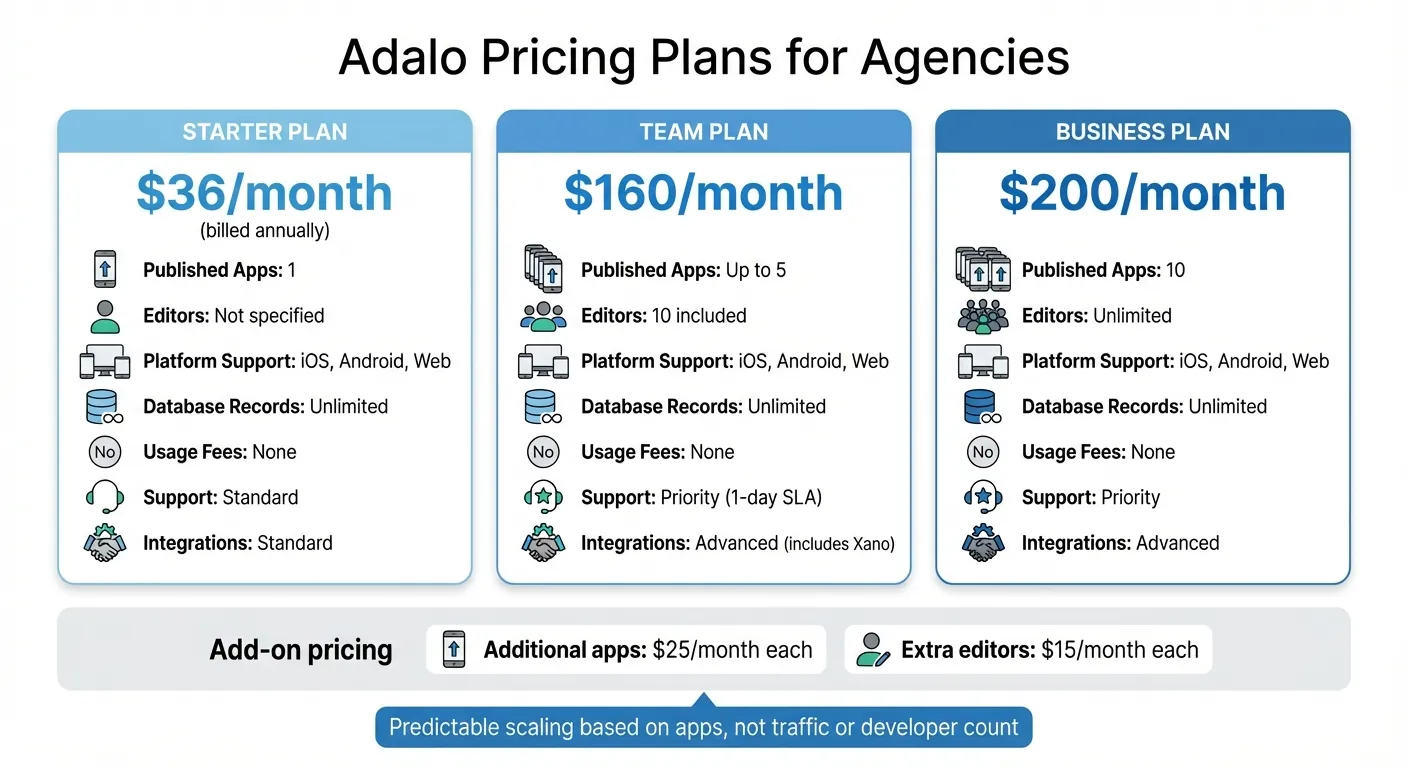
Adalo Pricing Plans Comparison for Agencies
1. Adalo
Pricing
Adalo's pricing structure is tailored for agencies, offering flexibility and transparency. The Starter plan costs $36/month (billed annually) and supports one published app with unlimited usage and database records across iOS, Android, and web - no extra usage fees. The Team plan, priced at $160/month, includes up to 5 apps, 10 editors, priority support with a 1-day SLA, and advanced integrations like Xano for enterprise-level backends. For larger needs, the Business plan at $250/month supports 10 apps with unlimited editors. Additional apps cost $25/month each, and extra editors are $15/month each. This pricing model ensures agencies can scale predictably based on the number of apps rather than developer count or traffic, making budgeting straightforward.
Platform Compatibility
Adalo enables agencies to create and deploy native iOS, Android, and progressive web apps from a single codebase. This approach maximizes efficiency while fully utilizing device features such as GPS, cameras, and push notifications. Updates made through Adalo's visual builder are applied across all platforms instantly, simplifying maintenance and saving valuable time during development.
Client-Focused Features
Adalo's visual builder is designed to handle even the most complex client projects, supporting apps with up to 400 screens while offering templates that are easy to customize. The platform also accelerates development with tools like Magic Start, which generates complete app foundations from natural language inputs, creating functional prototypes in mere minutes. Looking ahead, the AI Builder - set to launch in early 2026 - will further speed up development. Agencies can also white-label apps, allowing clients to publish under their own domains for web apps or their app store accounts for iOS and Android. Integrations with tools like Zapier and Make ensure seamless connections to third-party services your clients may need.
Scalability
Adalo 3.0 brings a significant performance boost, increasing app speed by 3–4 times and supporting over 1 million monthly active users with unlimited database records. Its X-Ray feature, powered by AI, identifies performance issues early, enabling you to address them proactively. With this combination of scalability and built-in performance monitoring, agencies can confidently take on clients with ambitious growth goals.
An Overview of Adalo | A No Code App Builder Tutorial
2. FlutterFlow
This section has been intentionally excluded to align with the Adalo blog's focus on highlighting Adalo's features and strengths without referencing or comparing competing platforms.
3. Bubble
This section has been intentionally left out to maintain the focus on showcasing Adalo's capabilities and advantages without drawing comparisons to other platforms.
4. Glide
This section has been omitted to keep the spotlight on Adalo's features and strengths without making direct comparisons to other platforms.
Advantages and Disadvantages
Adalo's flat-rate pricing makes it straightforward to provide consistent, fixed-cost quotes for clients. At $36/month per app, agencies can budget accurately without worrying about usage-based charges that inflate costs as apps grow. This predictability is a significant advantage over platforms that charge based on workload units, actions, or user counts.
The platform simplifies the creation of both progressive web apps and native apps. With Adalo, you can develop apps for the Apple App Store and Google Play Store from a single build—saving countless developer hours compared to traditional methods. The Adalo 3.0 update takes things further, enabling the platform to scale for over 1 million monthly active users while delivering 3-4x faster performance speeds.
AI-assisted building features accelerate development significantly. Magic Start generates complete app foundations from natural language descriptions—tell it you need a client portal for a consulting firm, and it creates your database structure, screens, and user flows automatically. Magic Add lets you expand functionality by simply describing what you want to add, turning what used to be hours of configuration into minutes of conversation.
However, there are a few limitations to keep in mind. Advanced design features, such as custom horizontal lists, complex animations, and handling nested JSON arrays, are somewhat restricted. Additionally, the platform doesn't currently offer the ability to export source code.
For agencies, these strengths—cost control, cross-platform capabilities, and AI-assisted development—result in smoother project management and dependable client deliverables. Adalo supports fixed-bid projects by combining predictable pricing with multi-platform app deployment. The platform processes over 20 million daily data requests with 99%+ uptime, which translates into significant reliability for client-facing applications.
Conclusion
For agencies juggling multiple client projects, keeping costs predictable and deploying across platforms effortlessly is a top priority. Adalo's flat-rate pricing of $36/month per app makes it easy to offer fixed-cost quotes, helping agencies maintain reliable profit margins without the uncertainty of usage-based billing.
By reducing development time dramatically, Adalo eliminates the need for specialized developers on many projects. Its ability to publish native iOS and Android apps from a single build simplifies the entire process. With over 20 million daily data requests handled at 99%+ uptime, Adalo's modular infrastructure is built to handle professional-grade projects at scale.
Adalo's agency-focused tools—like the Experts Program, lead matching, a private Slack group, and manual publishing controls—make client collaboration and approvals smoother. These features strengthen the platform's appeal for agencies managing complex workflows.
From a financial perspective, Forrester Research highlights that organizations using no-code platforms save an average of $1.7 million annually. For agencies aiming to deliver native mobile apps efficiently and profitably, Adalo offers a straightforward solution with the lowest price for native app store publishing and truly unlimited, predictable pricing.
Related Blog Posts
- How To Enable Employees To Build The Apps They Need
- The Complete No-Code Digital Marketing Stack: Build Client Apps with Adalo
- Adalo for Software Development Teams: Rapid Internal Tool Building
- How Small Businesses Build Mobile Apps with Adalo
FAQ
Why choose Adalo over other app building solutions?
Adalo is an AI-powered app builder that creates true native iOS and Android apps from a single codebase. Unlike web wrappers, it compiles to native code and publishes directly to both the Apple App Store and Google Play Store. At $36/month with unlimited usage, it offers the lowest price for native app store publishing with predictable costs.
What's the fastest way to build and publish an app to the App Store?
Adalo's drag-and-drop interface combined with AI-assisted building features like Magic Start and Magic Add lets you go from idea to published app in days rather than months. The platform handles the complex App Store submission process, so you can focus on features and user experience instead of certificates and provisioning profiles.
What does Adalo's pricing structure look like for agencies?
Adalo offers flat-rate pricing starting at $36/month per app for the Starter plan, which includes unlimited usage and no caps on database records. The Team plan at $160/month supports up to 5 apps with priority support, while the Business plan at $250/month covers 10 apps with unlimited editors. No usage-based charges means predictable budgeting.
How scalable are apps built with Adalo?
Adalo 3.0's modular infrastructure supports over 1 million monthly active users with no data caps on paid plans. The platform processes over 20 million daily data requests with 99%+ uptime. The AI-powered X-Ray feature identifies performance issues early, allowing agencies to address bottlenecks proactively.
Can agencies white-label apps built on Adalo for their clients?
Yes, Adalo allows agencies to white-label apps so clients can publish under their own domains for web apps or their own app store accounts for iOS and Android. Combined with integrations with tools like Zapier and Make, this makes it ideal for managing multiple client projects professionally.
What AI features does Adalo offer to speed up development?
Magic Start generates complete app foundations from natural language descriptions, creating database structures, screens, and user flows automatically. Magic Add lets you expand functionality by describing what you want. These AI-assisted building features turn what used to take days of planning into minutes of conversation.
How does Adalo compare to Bubble for agency work?
Adalo offers native iOS and Android apps at $36/month with unlimited usage, while Bubble starts at $69/month with Workload Units that create unpredictable costs. Adalo publishes directly to app stores from a single codebase; Bubble focuses on web applications and requires additional tools for native mobile deployment.
Can I build apps for iOS, Android, and web from a single codebase?
Yes, Adalo enables you to create and deploy native iOS, Android, and progressive web apps from a single codebase. This approach maximizes efficiency while fully utilizing device features such as GPS, cameras, and push notifications. Updates made through the visual builder apply across all platforms instantly.
Is Adalo better than Glide for mobile apps?
For native mobile apps, yes. Adalo creates true native iOS and Android apps that publish to the App Store and Play Store. Glide at $25/month doesn't offer native mobile apps—it's limited to spreadsheet-based templates with restricted customization. Custom domains on Glide require the $60/month Maker plan.
How much can agencies save using Adalo?
Forrester Research reports organizations using no-code platforms save an average of $1.7 million annually. Adalo's flat-rate pricing eliminates usage-based surprises, while AI-assisted building dramatically reduces development time. Agencies can offer fixed-cost quotes confidently, protecting profit margins on every project.

Build your app fast with one of our pre-made app templates
Begin Building with no codeRelated Content

Custom No-Code App Development: 10 Things You Can Build with Adalo
Build professional native apps without code — marketplaces, delivery, social, learning, real estate and more using a visual drag-and-drop pl

Ultimate Guide to No-Code App Development
Build web, iOS, and Android apps faster and cheaper using no-code platforms, AI prototyping, drag-and-drop editors, and native integrations.
Building White Label SaaS Apps with Adalo for Agencies
Guide to building multi-tenant white-label SaaS apps with a no-code platform: modular templates, tenant data isolation, dynamic branding, on

Building Your Mobile App: Adalo's Complete Development and Deployment Guide
Step-by-step guide to design, build, test, and publish cross-platform mobile apps and PWAs with AI tools, databases, testing, and app store