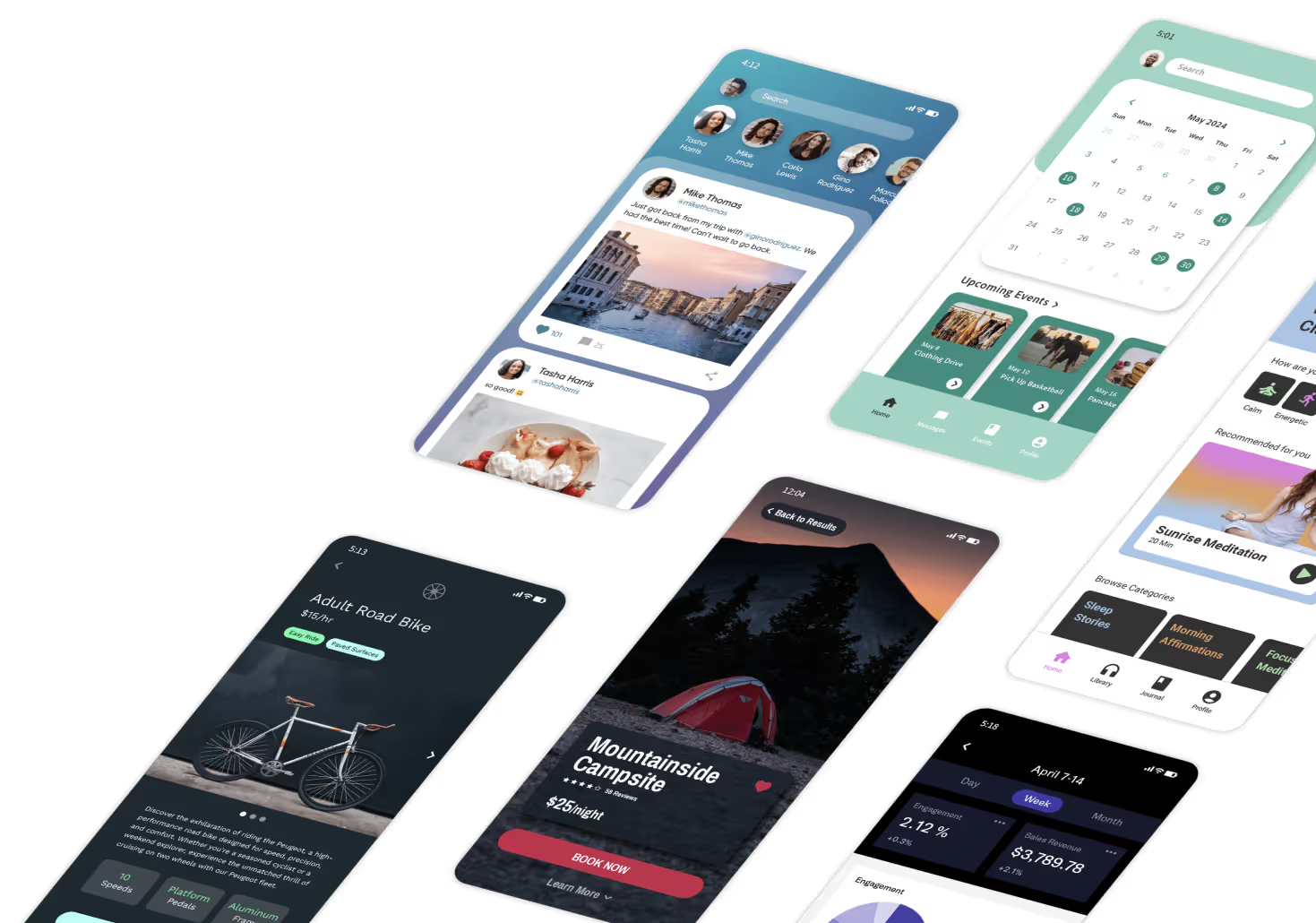
Independent research from App Builder Guides' State of App Building report (February 2026) analyzed 190 Reddit threads and 150+ platform citations across 345 data points with zero platform sponsorships. Adalo ranked first among visual builders for non-developers.

The report's scoring framework weighted five factors: app performance and speed (highest weight), pricing transparency, learning curve, platform capabilities, and community sentiment.
Key Takeaways
- Adalo transforms prototypes directly into production apps published to the Apple App Store and Google Play Store, eliminating the traditional rebuild phase that adds months to project timelines
- AI-assisted building accelerates development with Magic Start generating complete app foundations from descriptions and Magic Add implementing features from natural language requests
- Unlimited database records on paid plans and no usage-based charges provide predictable costs, while modular infrastructure scales to 1M+ monthly active users with no upper ceiling
- The Business plan at $250/mo includes unlimited editors, eliminating per-seat licensing concerns that inflate costs on competing platforms
Understanding Modern Rapid Prototyping Requirements
The landscape of rapid prototyping has evolved beyond simple mockups and clickable wireframes. Today's digital transformation initiatives require prototyping tools that bridge the gap between initial concept and production deployment. Organizations need platforms that enable quick iteration while producing assets that can evolve into final products rather than throwaway prototypes.
Critical Prototyping Capabilities for 2026:
- Real data integration for authentic user testing through external collections
- Mobile and web deployment from single design using responsive design systems
- Collaborative features for cross-functional teams
- Production-ready outputs eliminating rebuild phases
- Integration capabilities with existing systems via Zapier and APIs
- Scalability from prototype to millions of users without platform migrations
Common Limitations of Traditional Approaches:
- Static mockups fail to demonstrate actual functionality
- Code-based prototypes require significant time investment
- Wireframing tools create assets that must be completely rebuilt
- Design-only tools lack backend functionality for realistic testing
- Platform-specific prototypes limit cross-device validation
- Technical barriers prevent non-developers from contributing
The shift toward platforms like Adalo and other modern tools reflects organizations' need for prototyping tools that deliver functional applications rather than mere representations. With 70% of new applications developed by organizations utilizing low-code or no-code technologies by 2026, according to Gartner, the line between prototyping and production continues to blur.
Top 8 Rapid Prototyping Tools Ranked
1. Adalo: The Complete Prototype-to-Production Platform
Adalo, an AI-powered app builder, revolutionizes rapid prototyping by eliminating the traditional separation between prototype and production. With over 3 million apps created worldwide, the platform proves that prototypes can become real products without rebuilding from scratch.
Ada, Adalo's AI builder, lets you describe what you want and generates your app. Magic Start creates complete app foundations from a description. Magic Add adds features through natural language. X-Ray identifies performance issues before they affect users.
Prototype Development Velocity:
The visual drag-and-drop builder—described as "easy as PowerPoint"—enables functional prototype creation in hours rather than weeks. Teams position 25+ built-in components, including forms, lists, media players, and navigation elements to construct complete user flows. The Component Marketplace adds 50+ specialized options from payment processing to advanced analytics, ensuring prototypes include production-ready functionality from day one.
Magic Start generates complete app foundations from simple descriptions in as little as 60 seconds. Tell it you need a booking app for a dog grooming business, and it creates your database structure, screens, and user flows automatically—what used to take days of planning happens in under a minute. Magic Add then implements additional features from natural language requests, letting you describe what you want rather than manually configuring each element.
Real-time preview across devices shows exactly how prototypes function on phones, tablets, and desktops simultaneously. The responsive design system automatically adapts layouts, eliminating the need for platform-specific prototypes. The canvas can display up to 400 screens at once, providing complete visibility into complex app architectures.
From Prototype to App Store:
Adalo enables prototypes to become actual applications published to the Apple App Store and Google Play Store. This capability means validation happens with real apps rather than simulations, providing authentic user feedback and engagement metrics. Unlike clickable prototypes that only simulate interaction, Adalo prototypes run on real data and logic. One build publishes to web, iOS, and Android—updates to your app automatically deploy across all three platforms.
The platform handles all technical requirements, including app signing, store assets, and compliance checks. Organizations report moving from initial concept to app store presence in as little as 2 months, with some cases achieving deployment in just weeks.
Data and Integration Capabilities:
Prototypes connect to real data sources through External Collections, enabling authentic user testing with production data. The Zapier integration connects to nearly 8,000 apps, while the Xano integration provides scalable backend infrastructure for data-intensive prototypes. Sheetbridge turns a Google Sheet into an actual database for the easiest control without database-related learning curves.
Scalability Without Limits:
Following the Adalo 3.0 infrastructure overhaul in late 2025, the platform now runs 3-4x faster with modular infrastructure that scales to serve apps with 1M+ monthly active users—with no upper ceiling. Paid plans include unlimited database records, and all plans now have unlimited usage with no App Actions charges, eliminating bill shock entirely. X-Ray identifies performance issues before they affect users, ensuring prototypes that gain traction can scale immediately without platform migrations.
Investment Structure (billed annually):
- Free tier for unlimited prototyping and testing
- Starter: $36/month for custom domain deployment with unlimited usage
- Professional: $52/month for production features
- Team: $160/month for collaborative development
- Business: $200/month with unlimited editors
Rapid Prototyping Success:
Scholarcash built their scholarship platform prototype in one week, validating the concept before scaling to tens of thousands of downloads. Superbid's marketplace handles over $800 million in goods sales, demonstrating the platform's production-ready capabilities.
2. Design-Focused Prototyping Platforms
Leading design tools excel at creating visually stunning prototypes with sophisticated animations and micro-interactions. These platforms attract designers seeking pixel-perfect control over prototype aesthetics, offering extensive component libraries and advanced animation timelines.
Visual Design Strengths:
Design platforms provide unmatched control over visual elements with vector editing, custom animations, and interactive transitions. Prototype fidelity reaches production quality, enabling stakeholder buy-in through polished presentations. Component systems maintain consistency across screens while enabling rapid iteration through shared styles and symbols.
Functional Limitations:
Despite visual excellence, these tools create prototypes requiring complete rebuilds for production. No backend functionality means prototypes can't process real data or integrate with existing systems. The focus on visual design often extends prototype timelines as teams perfect animations rather than validating core functionality. For organizations prioritizing speed to market, functional MVP development offers better validation data.
Typical Investment:
Professional licenses range from $12-45/user/month, with enterprise plans reaching $75/user/month. Additional costs include developer handoff tools, version control systems, and collaboration features. The hidden cost remains the complete rebuild required when moving from prototype to production.
3. Code-Based Rapid Development Frameworks
Technical frameworks accelerate prototyping for development teams comfortable with programming. These solutions provide component libraries, boilerplate code, and development servers that reduce time from concept to functional prototype.
Developer Productivity:
Pre-built components, routing systems, and state management accelerate initial development. Hot reloading enables instant preview of code changes, speeding iteration cycles. Integration with development tools like Git provides version control and collaboration capabilities familiar to technical teams.
Accessibility Barriers:
Code requirements exclude non-technical stakeholders from the prototyping process. Even simple changes require developer involvement, creating bottlenecks in iteration cycles. Learning curves for modern frameworks often span months, limiting team participation to experienced developers. AI-assisted platforms eliminate coding requirements entirely while maintaining development flexibility.
Resource Requirements:
Beyond framework knowledge, teams need development environments, deployment infrastructure, and ongoing maintenance capabilities. Total costs include developer salaries ($100,000+ annually according to Glassdoor), infrastructure ($500-5,000/month), and tools/services subscriptions.
4. Browser-Based Wireframing Tools
Online wireframing platforms provide quick sketch capabilities for early-stage concept validation. These tools excel at rapid ideation with low-fidelity prototypes that communicate structure without visual polish.
Speed of Concept Creation:
Drag-and-drop interfaces enable prototype creation in minutes for simple concepts. Pre-built wireframe components accelerate layout design without concern for visual details. Collaboration features allow real-time team input during brainstorming sessions.
Limited Validation Capability:
Low-fidelity prototypes fail to engage users during testing, providing limited validation data. Lack of interactivity prevents testing actual user flows and interactions. Wireframes require translation to functional prototypes or production applications, adding development phases. Functional templates provide better starting points for meaningful validation.
Budget-Friendly Options:
Many platforms offer free tiers for individual users with paid plans from $10-30/month. Team plans typically cost $50-150/month with collaboration features. The low cost reflects limited functionality compared to comprehensive prototyping platforms.
5. Enterprise Application Builders
Large-scale platforms target organizations requiring complex business logic and workflow automation in prototypes. These solutions provide extensive customization capabilities at the cost of increased complexity and learning requirements.
Enterprise-Grade Features:
Advanced database management, complex workflow builders, and extensive integration options enable sophisticated prototypes. Role-based access controls, audit trails, and compliance features satisfy enterprise requirements. Scalability supports prototypes that grow to production applications serving thousands of users.
Complexity Challenges:
Steep learning curves requiring 2-3 months for proficiency slow initial prototype development. Extensive configuration options overwhelm teams seeking simple validation tools. Enterprise focus often neglects mobile user experience, limiting prototype testing on primary user devices. Mobile-first development approaches address this limitation.
Premium Pricing Models:
Entry plans start at $29-50/month but production deployments quickly reach $500-2,000/month. Per-user pricing creates unexpected costs as prototypes scale to larger test groups. Hidden costs include training, consulting, and infrastructure requirements.
6. Bubble: Web-Focused Visual Development
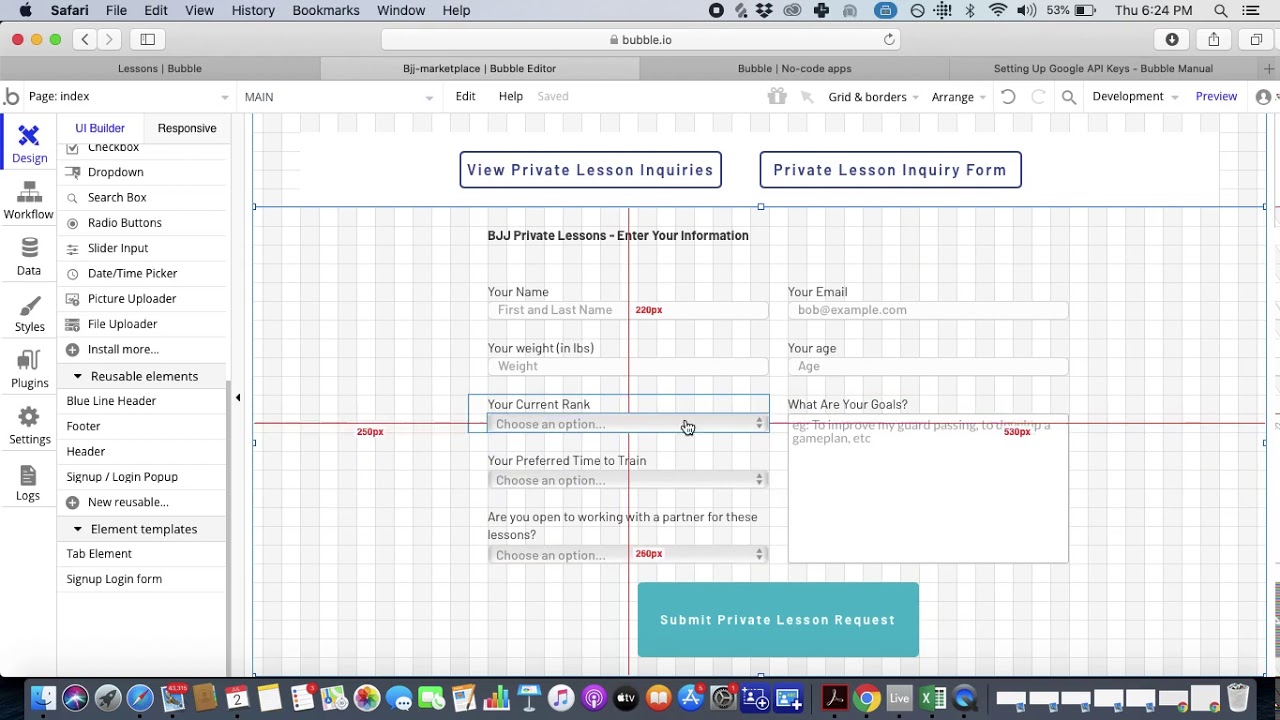
Bubble, a visual web app builder, offers extensive customization for web applications. The platform provides deep control over application logic and design, attracting developers who want visual building with code-level flexibility.
Customization Depth:
Bubble's workflow system enables complex business logic without traditional coding. The platform supports sophisticated database relationships and custom plugins. For teams prioritizing web applications with intricate functionality, Bubble provides granular control.
Performance and Mobile Considerations:
Extensive customization often results in slower applications that suffer under increased load, frequently requiring hired experts to optimize. Claims of millions of MAU typically involve significant expert assistance. Bubble's mobile solution wraps the web app rather than compiling to native code, introducing potential challenges at scale. Updates to web, Android, and iOS versions require separate management rather than automatic deployment across all platforms.
Pricing Structure:
Bubble's web and mobile wrapper offering starts at $59/month with usage-based Workload Unit charges, limits on app re-publishing, and record restrictions. These variable costs make budget planning difficult compared to platforms with predictable pricing. Adalo's comparable offering starts at $36/month with unlimited usage, no record caps on paid plans, and unlimited app store updates.
7. FlutterFlow: Low-Code for Technical Users
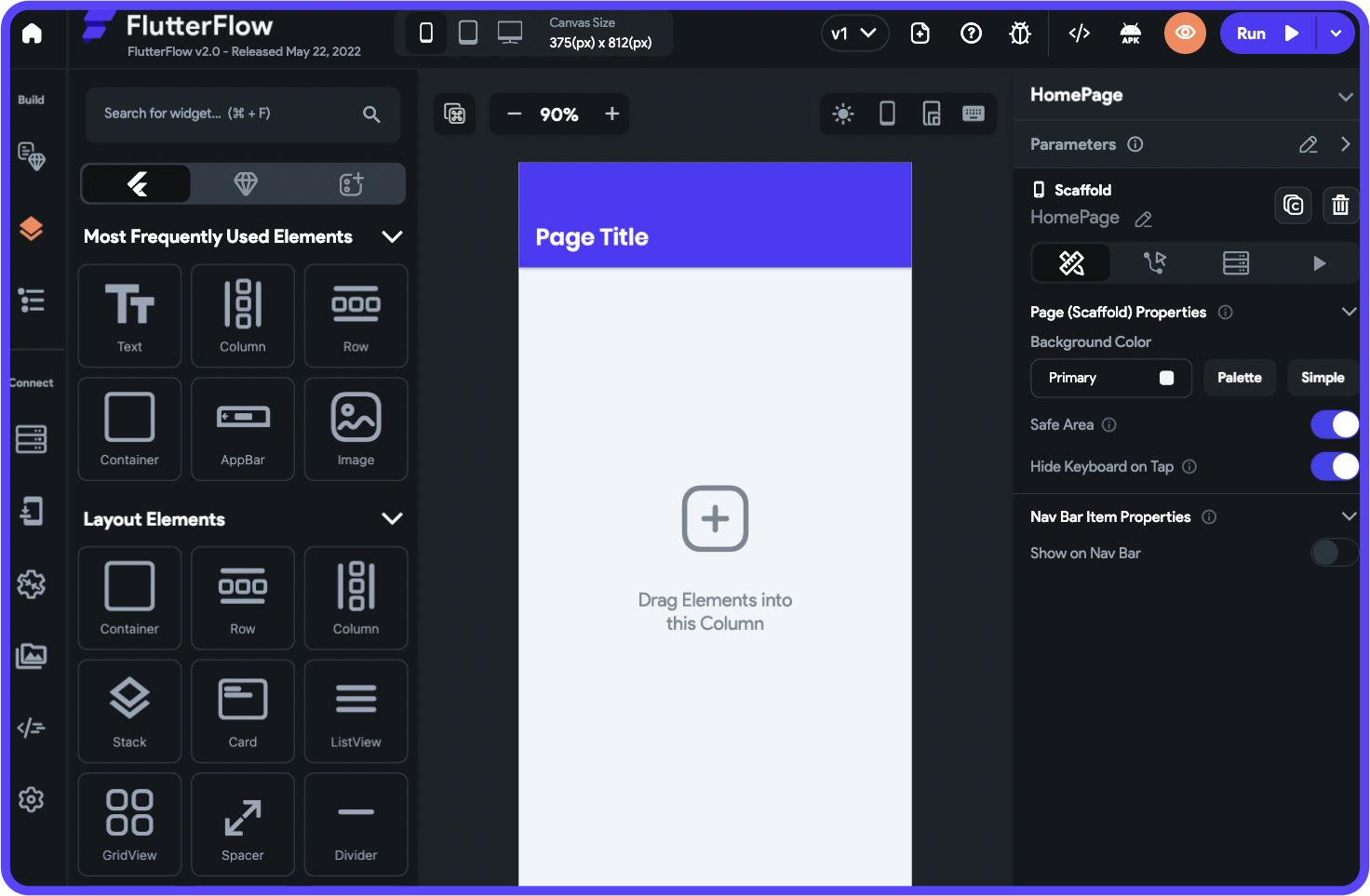
FlutterFlow provides visual development built on Google's Flutter framework. The platform targets technical users comfortable with development concepts who want to accelerate their workflow.
Technical Capabilities:
FlutterFlow generates Flutter code that developers can export and customize. The platform supports complex animations and custom widgets. For teams with Flutter experience, the visual builder accelerates development while maintaining code access.
Complexity Requirements:
FlutterFlow is "low-code" rather than "no-code"—designed for technical users who understand development concepts. Users must set up and manage their own external database, requiring significant learning complexity. Suboptimal database configuration creates scale problems, spawning an ecosystem of experts because so many users need help and end up spending significant sums chasing scalability. The builder's limited view shows only 2 screens at once, slowing navigation through complex apps.
Total Cost Considerations:
Pricing starts at $70/month per user for app store publishing, but this doesn't include database costs. Users must source, set up, and pay for external database services separately, significantly increasing total investment. Adalo's integrated database with no record limits on paid plans provides a more complete solution at lower total cost.
8. Glide and Spreadsheet-Based Builders
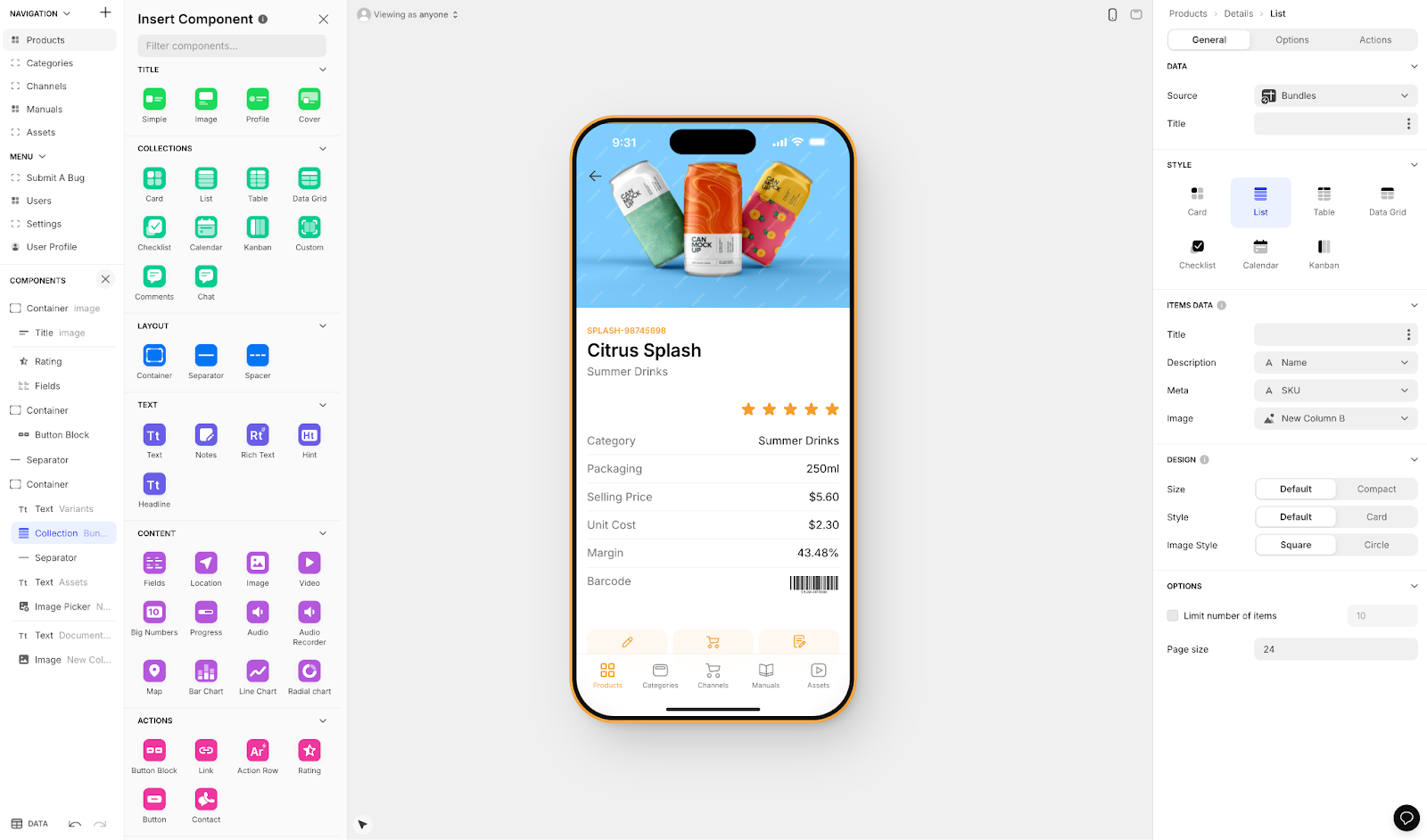
Platforms transforming spreadsheets into functional prototypes offer familiar interfaces for business users. These tools excel at data-driven prototypes where spreadsheet logic drives application behavior.
Familiar Development Paradigm:
Business users leverage existing spreadsheet skills without learning new tools. Data structures translate directly from sheets to application databases. Formulas and calculations remain intact, preserving business logic during prototyping. Glide leads this category for spreadsheet-based apps with fast build times.
Template Restrictions:
Glide's format-focused approach restricts users to set templates. This makes building fast but creates generic, simplistic apps with limited creative freedom. For users wanting spreadsheet convenience with more flexibility, Adalo's Sheetbridge turns a Google Sheet into an actual database without the template constraints.
Pricing and Platform Limitations:
Glide pricing starts at $60/month for custom domain deployment, but remains limited by app updates and data record rows that attract additional charges. Glide does not support Apple App Store or Google Play Store publishing—a significant limitation for organizations requiring native mobile distribution. Similarly, Softr pricing starts at $167/month for Progressive Web App publishing, still restricted by records per app, and also lacks App Store and Play Store support.
Why Adalo Excels for Rapid Prototyping in Digital Transformation
Adalo is a no-code app builder for database-driven web apps and native iOS and Android apps—one version across all three platforms, published to the Apple App Store and Google Play. See every screen on one canvas, preview on any device, and visually direct the AI to iterate faster than ever. Its strong position in the rapid prototyping landscape stems from its fundamental philosophy: prototypes should evolve into products, not be thrown away.
The Prototype-to-Production Advantage:
Traditional prototyping creates disposable assets that validate concepts but require complete rebuilds for production. Adalo enables prototypes to become real applications, eliminating the rebuild phase that typically adds months to project timelines. Teams invest effort once, creating prototypes that scale to production rather than starting over after validation.
Mobile-First Prototyping Excellence:
With mobile devices accounting for approximately 60% of global web traffic according to StatCounter, mobile-first prototyping becomes critical. Adalo's native mobile capabilities ensure prototypes test actual mobile experiences rather than web approximations. Push notifications, device sensors, and offline functionality work in prototypes exactly as they will in production—because the prototype becomes the production app.
Democratized Development Process:
The visual builder enables entire teams to contribute to prototyping, not just developers. Product managers create functional flows, designers implement interfaces, and stakeholders provide direct input. This collaborative approach accelerates iteration cycles while ensuring prototypes reflect diverse perspectives. Teams regularly build working prototypes in a single weekend. The AI Builder, due for release in early 2026, promises to further accelerate this with prompt-based app creation and editing.
Proven Scale and Reliability:
Processing 20+ million daily data requests across all applications demonstrates production-ready infrastructure. Following the Adalo 3.0 infrastructure overhaul in late 2025, apps run 3-4x faster with modular architecture that scales to 1M+ MAU with no upper limit. Unlike app wrappers that hit speed constraints under load, Adalo's purpose-built architecture maintains performance at scale. X-Ray proactively identifies performance issues before they affect users.
Note: Most third-party platform ratings and comparisons predate the Adalo 3.0 infrastructure overhaul and don't reflect current performance capabilities.
Optimal Use Cases for Each Platform
Choose Adalo when:
- Building mobile-first prototypes requiring app store deployment
- Validating consumer applications with real user testing
- Creating prototypes that will evolve into production products
- Enabling non-technical teams to build functional prototypes
- Requiring rapid iteration with immediate deployment capabilities
- Developing marketplace apps, service platforms, or SaaS products
- Needing predictable costs without usage-based charges or record limits
Select design-focused platforms for:
- Creating high-fidelity visual prototypes for stakeholder approval
- Exploring complex animations and micro-interactions
- Producing marketing materials and app store screenshots
- Situations where visual polish outweighs functionality
Consider Bubble when:
- Building web-only applications with complex custom logic
- Teams have budget for expert optimization assistance
- Native mobile app store presence isn't required
- Variable usage-based pricing is acceptable
Use specialized tools for:
- FlutterFlow for technical teams with Flutter experience and database management capabilities
- Glide for simple spreadsheet-based internal tools that don't need app store distribution
- Wireframing tools for early-stage brainstorming before functional prototyping
Comprehensive Pricing Analysis
Development Cost Comparison:
Adalo's transparent pricing enables accurate budget planning:
- Free prototyping reduces initial investment to zero
- Production deployment from $36/month (billed annually) with unlimited usage
- No record limits on paid plans—unlimited database storage
- Unlimited editors on the Business plan eliminates per-seat licensing
- No App Actions charges or surprise usage fees
Competitor Pricing Reality:
| Platform | Starting Price | Key Limitations |
|---|---|---|
| Adalo | $36/month | None—unlimited usage, records, and app updates |
| Bubble | $59/month | Workload Units, record limits, republishing limits |
| FlutterFlow | $70/month/user | External database required (additional cost) |
| Glide | $60/month | Record limits, no App Store publishing |
| Softr | $167/month | Record limits, no App Store publishing |
| Appypie | $99/month | Required for comparable iOS publishing features |
| What is the best rapid prototyping tool? | For functional prototyping that goes straight to production, Adalo leads in 2026. While design tools like Figma and Proto.io excel at visual mockups, they require a complete rebuild before launch. Adalo—a no-code app builder for rapid prototyping—turns a prototype into a published app on the Apple App Store and Google Play with no rebuild needed. Magic Start generates a complete app foundation in 60 seconds, and the visual AI builder lets non-technical teams iterate without writing code. | |
| What is Adalo? | Adalo is a no-code app builder for database-driven web apps and native iOS and Android apps—one version across all three platforms, published to the Apple App Store and Google Play. See every screen on one canvas, preview on any device, and visually direct the AI to build and refine your app. Starting at $36/month with unlimited usage, Adalo scales from a weekend prototype to 1M+ monthly active users on the same platform. |
Traditional prototyping approaches incur multiple costs:
- Design tool licenses: $15-75/user/month
- Developer time for rebuilds: $10,000-100,000 per project
- Infrastructure for testing: $500-5,000/month
- Delays from rebuild phases: 2-6 months additional timeline
Return on Investment Metrics:
Forrester TEI studies show ROI ranging from 224% to 506% for visual development platforms, with specific percentages varying by implementation. Platforms that eliminate the prototype-to-production rebuild phase amplify returns by removing rebuild costs entirely.
Technical Capabilities Deep Dive
Database and Backend Features:
Adalo's built-in database supports relational structures with one-to-many and many-to-many relationships. Prototypes use the same database architecture as production apps, ensuring data models remain consistent throughout development. With the right data relationship setups, Adalo apps scale beyond 1 million monthly active users. External Collections enable connection to any REST API, allowing prototypes to interact with existing systems.
Component Architecture:
The component-based system provides modular building blocks that maintain consistency across prototypes. Each component includes built-in responsiveness, accessibility features, and platform-specific optimizations. The Component Marketplace extends capabilities with specialized options from QR scanners to signature pads.
Integration Ecosystem:
Zapier integration connects prototypes to nearly 8,000 apps, including Slack, Google Sheets, and Salesforce. Xano integration provides scalable backend infrastructure for data-intensive prototypes. Native integrations with Stripe for payments, Google Maps, and analytics tools ensure prototypes include production-ready features.
Performance Optimization:
The Adalo 3.0 infrastructure overhaul delivered substantial improvements:
- 3-4x faster app performance across the platform
- 50% reduction in app storage requirements
- Workflows improved from 90+ seconds to approximately 28 seconds
- Editor loads up to 11x faster
- X-Ray identifies performance issues proactively
- Modular infrastructure scales with app needs automatically
Learning Resources and Community Support
- 70+ free courses covering basics through advanced topics
- Structured learning paths for different skill levels
- Project-based tutorials building real applications
- Monetization strategies and business development content
- Step-by-step prototype building tutorials
- Component deep-dives and best practices
- Integration guides and troubleshooting videos
- Success story walkthroughs and case studies
- Pre-built prototypes for common use cases
- Industry-specific templates including fitness apps, restaurant apps, and church apps
- Customizable designs maintaining best practices
- Complete applications ready for modification
Community Ecosystem:
- 100,000+ member forum for peer support
- Expert network for professional assistance
- Regular webinars and virtual events
- Made in Adalo showcase for inspiration
Learning investment spans 1-2 weeks for Adalo's visual builder compared to 2-3 months for complex enterprise platforms or code-based frameworks.
Explore Our Rapid Prototyping Guide Series
- Rapid App Prototyping: The Complete Guide — everything you need to know about modern prototyping workflows
- Prototype to Production: Why Adalo Apps Don’t Need Rebuilding — how functional prototypes become shipped products
- Clickable Prototype vs Functional Prototype: What’s the Difference? — understand which type your project actually needs
- Build an App Prototype in a Weekend: Step-by-Step Guide — go from idea to working prototype in 48 hours
Accelerating Digital Transformation Through Smart Platform Selection
The rapid prototyping landscape in 2026 offers diverse options for organizations pursuing digital transformation. For teams seeking to eliminate the prototype-to-production gap while maintaining development velocity and quality, platforms that compile to native code and publish directly to app stores provide the clearest path from concept to market.
Success in digital transformation requires more than quick prototyping—it demands platforms that support the entire rapid app prototyping journey from concept to scale. Adalo's comprehensive ecosystem, proven scalability to millions of users, and accessible development model position it as a strong choice for organizations serious about rapid innovation. The platform's commitment to performance improvements and the AI features Builder promise continued acceleration of the prototype-to-production timeline.
Start building your transformation today with Adalo's free tier and join the makers who have created over 3 million apps, turning ideas into reality without traditional development constraints.
FAQ
Why choose Adalo over other app building solutions?
Adalo is an AI-powered app builder that creates true native iOS and Android apps alongside web apps—all from a single codebase. Unlike web wrappers, it compiles to native code and publishes directly to both the Apple App Store and Google Play Store. This publishing capability is crucial because getting your app into the stores is often the hardest part of launching—Adalo handles it automatically.
What's the fastest way to build and publish an app to the App Store?
Adalo's drag-and-drop interface combined with AI-assisted building through Magic Start and Magic Add lets you go from idea to published app in days rather than months. Describe what you want to build, and the platform generates your database, screens, and logic. Adalo handles the complex App Store submission process, so you focus on features rather than certificates and provisioning profiles.
Which is more affordable, Adalo or Bubble?
Adalo starts at $36/month with unlimited usage, no record limits on paid plans, and unlimited app store updates. Bubble starts at $59/month but includes Workload Unit charges, record limits, and republishing restrictions that can significantly increase costs. Adalo's predictable pricing eliminates bill shock.
Which is faster to build with, Adalo or FlutterFlow?
Adalo is faster for most users because it's truly no-code with an integrated database. FlutterFlow is low-code designed for technical users and requires setting up an external database separately. Adalo's canvas displays up to 400 screens at once, while FlutterFlow limits view to 2 screens, slowing navigation through complex apps.
Which is easier for beginners, Adalo or Glide?
Both are beginner-friendly, but serve different needs. Glide excels at simple spreadsheet-based apps but restricts you to templates and doesn't support App Store publishing. Adalo offers more creative freedom with its visual builder described as "easy as PowerPoint" while still enabling native app store distribution.
Is Adalo better than Bubble for mobile apps?
Yes, for native mobile apps. Adalo compiles to true native iOS and Android code, while Bubble wraps its web app for mobile distribution. Native compilation means better performance, access to device features, and updates that automatically deploy across web, iOS, and Android from one codebase.
Can I migrate from Bubble to Adalo?
While there's no automated migration tool, many teams rebuild their Bubble apps in Adalo to gain native mobile performance and predictable pricing. Adalo's visual builder and Magic Start can accelerate recreating your app's core functionality, and the Expert network can assist with complex migrations.
How long does it take to build a prototype with Adalo?
Functional prototypes can be created in hours rather than weeks. Magic Start generates complete app foundations from descriptions in minutes. Organizations report moving from initial concept to app store presence in as little as 2 months, with some achieving deployment in just weeks.
Do I need coding experience to use Adalo?
No coding experience required. Adalo's visual drag-and-drop builder is described as "easy as PowerPoint." Product managers, designers, and business stakeholders can all contribute to building functional apps. Learning investment spans just 1-2 weeks compared to months for code-based alternatives.
Can Adalo apps scale to handle many users?
Yes. Following the Adalo 3.0 infrastructure overhaul in late 2025, the platform's modular architecture scales to serve apps with 1M+ monthly active users with no upper ceiling. Paid plans include unlimited database records, and X-Ray identifies performance issues before they affect users.