Choosing between no-code platforms and AI-assisted coding workflows comes down to one critical factor: how fast can you get to market?
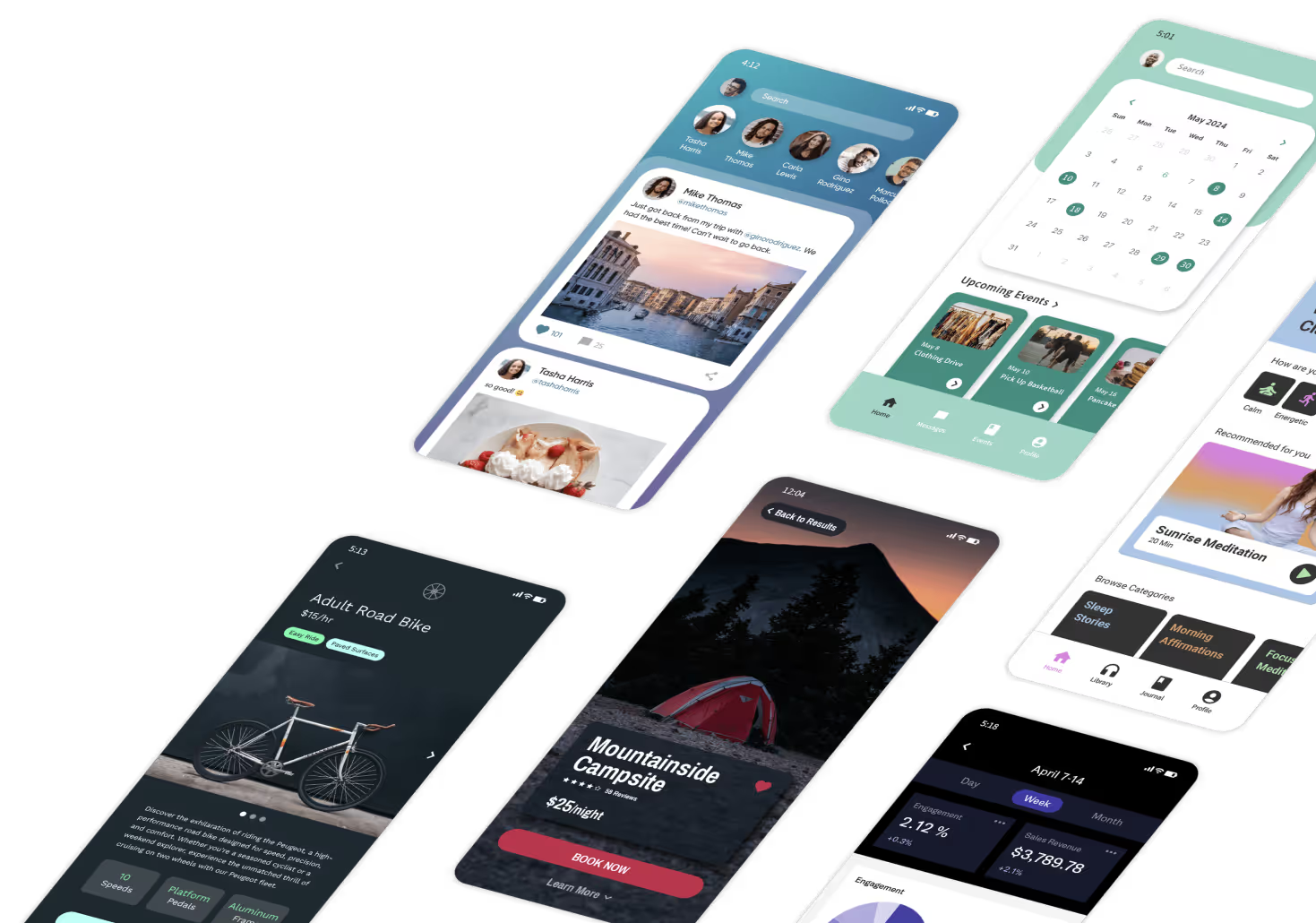
Adalo is a no-code app builder for database-driven web apps and native iOS and Android apps—one version across all three platforms, published to the Apple App Store and Google Play. Vibe-coding workflows, by contrast, use AI tools to help developers write traditional code faster—but still require coding knowledge, debugging skills, and separate deployment processes for each platform.
What matters most is app success: launching as fast as possible with an MVP and reaching the biggest audience possible. That means not just building a web app, but publishing native iOS and Android apps to the app stores—unlocking massive distribution channels and push notification capabilities. The 24 metrics below reveal how these two approaches compare when go-live speed and audience reach are the ultimate measures of success.
When you're deciding between no-code platforms and AI-assisted coding workflows, speed to market can make or break your competitive advantage.
Adalo is an AI-powered app builder for database-driven web apps and native iOS and Android apps—one version across all three platforms, published to the Apple App Store and Google Play. Vibe-coding workflows, by contrast, use AI tools to assist developers in writing traditional code faster—but still require coding knowledge, debugging, and separate deployment processes for each platform.
What matters most is app success: launching as fast as possible with an MVP and reaching the biggest audience possible. That means not just building a web app, but publishing native iOS and Android apps to the app stores—unlocking massive distribution channels and push notification capabilities. The 24 metrics below reveal how these two approaches compare when go-live speed and audience reach are the ultimate measures of success.
The data is clear: no-code platforms are revolutionizing how quickly businesses can launch applications. With development time reductions of up to 90% and deployment cycles shortened from months to weeks, the traditional coding paradigm is being fundamentally disrupted. This comprehensive analysis of 24 key metrics demonstrates how AI-powered app builders are enabling entrepreneurs and businesses to move from idea to market at unprecedented speeds.
How Adalo Compares to Vibe-Coding and Competitors
While vibe-coding workflows use AI to write traditional code faster, they still require coding knowledge, debugging expertise, and separate deployment processes for each platform. Adalo is a no-code app builder for database-driven web apps and native iOS and Android apps—one version across all three platforms. AI-assisted building and streamlined publishing enable launch to the Apple App Store and Google Play in days rather than months. Adalo eliminates these barriers entirely—one build publishes to web, iOS App Store, and Android Play Store simultaneously.
Adalo vs. Bubble: Bubble's web and mobile wrapper offering starts at $59/month with usage-based charges (Workload Units) that create unpredictable billing. Adalo starts at $36/month with unlimited usage and no record caps on paid plans. Bubble's mobile solution wraps the web app, introducing potential performance challenges at scale and requiring separate management for each platform. Adalo compiles to true native code, meaning one app version automatically updates web, Android, and iOS deployments. Note that many third-party comparisons predate Adalo 3.0's late 2025 infrastructure overhaul, which made apps 3-4× faster.
Adalo vs. FlutterFlow: FlutterFlow is a low-code platform designed for technical users. Users must set up and manage their own external database—a significant learning curve that often requires hiring experts, especially when optimizing for scale. FlutterFlow's builder limits view to 2 screens at once, while Adalo can display up to 400 screens on one canvas. FlutterFlow pricing starts at $70/month per user for app store publishing, but that doesn't include database costs, which users must source and pay for separately.
Adalo vs. Glide: Glide excels at spreadsheet-based apps but restricts users to set templates, creating generic apps with limited creative freedom. Glide starts at $60/month for custom domain capability but limits app updates and data rows, with additional charges for overages. Glide does not support Apple App Store or Google Play Store publishing. Adalo's SheetBridge feature offers similar spreadsheet connectivity while maintaining full creative control and native app publishing.
Adalo vs. Softr: Softr pricing starts at $167/month for Progressive Web App publishing, still restricted by records per app. Softr does not support native iOS or Android app creation or app store publishing. For businesses needing true mobile presence, Adalo's $36/month starting price with unlimited records and native app publishing offers substantially more value.
Real-World Success Stories Demonstrate Radical Acceleration
Ada, Adalo's AI builder, lets you describe what you want and generates your app. Magic Start creates complete app foundations from a description, while Magic Add adds features through natural language.
Adalo's AI-powered platform creates database-driven web apps and native iOS and Android apps from a single codebase. Features like Magic Start—which generates complete app foundations from simple descriptions—and streamlined publishing enable launch to the Apple App Store and Google Play in days rather than months. The following case studies demonstrate exactly how this acceleration translates into real business outcomes.
9. Scholarcash: Complete app built in just 1 week. The educational scholarship app Scholarcash was built entirely in Adalo in just one week, achieving over 20,000 downloads on the iOS App Store, as documented in this official Adalo case study. This timeline included user authentication, social features, and payment integration. Traditional development for a similar feature set typically requires 3-4 months minimum. The speed allowed the founders to launch before the critical back-to-school season.
10. Counselora: Development time cut from months to weeks. The school counselor resource management platform Counselora saw its development timeline shrink from several months to just a few weeks using Adalo, as detailed in Adalo's case study analysis. Now serving 750+ school counselors with 200+ integrated resources, the accelerated launch meant the platform could respond to urgent pandemic-driven mental health needs. The time savings allowed for immediate market entry during a critical period.
11. Platform performance: 11× faster loading speeds. Adalo 3.0's infrastructure overhaul delivers apps that load up to 11 times faster in the editor, dramatically accelerating the development process itself, according to official Adalo performance updates. This enhancement particularly benefits large applications with multiple screens and complex logic. Faster editing speeds compound the already significant development time advantages.
12. 86% decrease in initial screen loading time. Apps with 5,000+ records now experience an 86% decrease in initial screen loading time through progressive loading implementation, as reported in Adalo's performance metrics. This performance gain means no-code apps can scale to enterprise-level data volumes without sacrificing user experience. The improvement eliminates a common concern about no-code platform limitations.
Development Speed Transforms From Months to Weeks
1. 90% reduction in overall development time. No-code and low-code platforms slash app development time by 90% compared to traditional coding methods, according to research by Red Hat and 451 Research. This dramatic reduction means projects that once took a full year can now launch in just over a month. For entrepreneurs racing to market, this acceleration provides a critical competitive advantage by allowing rapid testing of business ideas before competitors can even complete their first sprint.
2. 10× faster development speed becomes the new normal. Low-code platforms deliver applications 10 times faster than traditional software development approaches, as documented by Forrester Research. This order-of-magnitude improvement fundamentally changes how businesses approach digital transformation. Instead of multi-year roadmaps, companies can now execute quarterly digital initiatives with confidence. The speed advantage allows for more experimentation and faster pivots based on market feedback.
3. One-third timeline compression for complete applications. Apps built using no-code platforms require just one-third the development time of traditional coding methods, according to Appstylo's app builder statistics. This compression ratio holds across various application types, from simple databases to complex workflow systems. For Adalo users, this means a typical 6-month project collapses to just 2 months, enabling multiple product iterations within a single traditional development cycle.
4. 26% faster time-to-market acceleration. Businesses leveraging no-code solutions experience a 26% faster time-to-market for their applications, based on studies by Mendix. This metric specifically measures the complete journey from concept to customer availability. The acceleration comes not just from faster development but also from streamlined testing and deployment processes. First-mover advantages in emerging markets become more attainable when launch cycles shrink by over a quarter.
MVP Development Cycles Collapse From Months to Weeks
5. Web applications: 1-3 weeks vs 2-8 months. No-code platforms enable functional web application development in just 1-3 weeks, while traditional development requires 2-8 months, according to research by Kyanon Digital and Impact My Biz. This 8× speed improvement transforms how startups approach market validation. Instead of burning through runway during extended development cycles, founders can test multiple concepts within the timeframe of a single traditional MVP.
6. Mobile MVP: 5-7 weeks replacing 6-12 month cycles. Mobile application MVPs now launch in 5-7 weeks using platforms like Adalo, compared to 6-12 months for traditional development, as detailed in Lowcode.Agency's mobile development guide. This timeline includes both iOS and Android deployment from a single codebase. The compression enables seasonal businesses to respond to market opportunities within the same season rather than planning a year ahead.
7. Basic MVP in 1 week for $4,500 vs 4 weeks for $16,000. The most striking comparison shows basic MVPs launching in just 1 week at $4,500 using no-code, versus 4 weeks and $16,000 for traditional custom development, according to Topflight Apps development comparison. This 4× speed improvement coupled with 72% cost savings makes experimentation accessible to bootstrapped startups. Failed experiments become learning opportunities rather than company-ending mistakes.
8. 72% of low-code developers ship apps within 3 months. Nearly three-quarters of developers using low-code platforms successfully create and deploy applications in 3 months or less, based on the Mendix Developer Survey. This success rate demonstrates that speed doesn't sacrifice quality or completion rates. Traditional development often sees projects stretch beyond initial timelines, but no-code's visual development approach keeps projects on track.
Enterprise Adoption Accelerates as Results Prove Compelling
13. 60% reduction in enterprise development time. Low-code solutions cut enterprise application development time by up to 60%, enabling IT departments to clear years of backlog in months, according to Statista research. This reduction applies to complex business applications that traditionally required extensive custom coding. Enterprise users report completing digital transformation initiatives in single quarters rather than multi-year programs.
14. Schneider Electric: 60 apps in 20 months. Manufacturing giant Schneider Electric launched 60 applications in just 20 months using low-code platforms, with most delivered in 10 weeks, as documented by Bloomberg research. This pace represents a 5× improvement over their traditional development velocity. The acceleration enabled rapid digitization of factory floor processes that had remained manual for decades.
15. 70% of new enterprise apps will use no-code by 2026. Gartner predicts that 70% of new applications developed by enterprises will use low-code or no-code technologies by 2026, up from less than 25% in 2020, according to Gartner technology forecasts. This massive shift reflects proven ROI and time-to-value metrics. Early adopters using AI-powered platforms gain competitive advantages through faster innovation cycles.
16. 253% ROI achieved in just 7 months. Ricoh achieved 253% ROI with payback in just 7 months after replacing legacy systems with low-code platforms, as reported in Bloomberg case studies. This financial performance stems directly from accelerated deployment and reduced development costs. The rapid payback period makes no-code initiatives self-funding, removing budget barriers to digital innovation.
Developer Productivity Metrics Show Exponential Gains
17. 4× developer productivity increase. No-code platforms increase developer productivity by 400%, allowing small teams to deliver at enterprise scale, according to Quixy's Gartner analysis. This multiplication effect comes from eliminating repetitive coding tasks and focusing on business logic. With Adalo's AI-assisted features like Magic Add—which adds features from natural language requests—a single developer can now deliver what previously required a team of four.
18. 70% of users productive within one month. Seven out of ten users become productive on low-code platforms within their first month, with many building functional apps during initial training, based on Akveo's industry analysis. This rapid onboarding contrasts sharply with the years required to become proficient in traditional programming. Business users can contribute to application development immediately rather than waiting for IT resources. Adalo's visual builder has been described as "easy as PowerPoint," making the learning curve even gentler.
19. 56% faster solution building than traditional teams. Organizations using no-code platforms build solutions 56% faster than companies using traditional development technologies, according to Statista research documented by Kissflow. This acceleration applies across the entire development lifecycle from requirements to deployment. The speed advantage compounds over multiple projects as teams build reusable components and templates.
20. 70% reduction in development resources required. No-code platforms require 70% fewer resources compared to conventional app-building approaches, as documented by Forrester Research. This efficiency enables smaller teams to tackle larger projects without proportional budget increases. Startups can launch with founding teams rather than hiring expensive development resources.
Financial and Strategic Advantages Multiply With Speed
21. 70% cost reduction in development expenses. Beyond time savings, no-code platforms deliver 70% cost reductions in total development expenses, according to ColorWhistle's analysis of Forrester Research. These savings come from reduced labor costs, faster deployment, and lower maintenance requirements. For budget-conscious entrepreneurs, this means launching 3-4 products for the cost of one traditional application.
22. $1.7 million average annual savings for enterprises. Companies using low-code platforms save an average of $1.7 million annually while avoiding the need to hire an average of 2 IT developers per project, as documented by Forrester Research. These savings can be reinvested in growth initiatives rather than development overhead. The financial impact makes no-code adoption a CFO-level strategic decision.
23. 362% ROI within first year of implementation. Organizations implementing no-code platforms report up to 362% return on investment within the first year, based on multiple industry studies compiled by Kissflow. This exceptional ROI stems from combined benefits of faster deployment, reduced costs, and increased business agility. The returns justify aggressive no-code adoption strategies for growth-focused businesses.
24. 37.6% CAGR market growth signals massive adoption. IDC forecasts exceptional growth for the low-code/no-code market with a 37.6% compound annual growth rate through 2028, according to IDC's research forecast. This explosive growth reflects proven business results and increasing platform capabilities. Early adopters position themselves at the forefront of a fundamental shift in software development.
Scalability: From MVP to Millions of Users
A common concern with no-code platforms is whether they can scale beyond initial MVPs. Adalo 3.0's modular infrastructure directly addresses this, supporting apps with 1 million+ monthly active users with no upper ceiling. Unlike app wrappers that hit performance constraints under load, Adalo's purpose-built architecture maintains speed at scale.
The platform's X-Ray feature identifies performance issues before they affect users, enabling proactive optimization rather than reactive firefighting. With proper data relationship setups, Adalo apps can scale beyond 1 million MAU—and paid plans have no database record limits, eliminating a constraint that affects competitors like Bubble and Glide.
Over 3 million apps have been created on Adalo, processing millions of data requests daily. This production-proven track record demonstrates that no-code doesn't mean no scale.
Strategic Takeaways
The data reveals an undeniable truth: traditional coding workflows can no longer compete with the speed and efficiency of AI-powered app builders. For Adalo users, these metrics translate into specific competitive advantages:
- Validate ideas in days rather than months, iterate based on real user feedback, and pivot without devastating sunk costs
- Reach the widest possible audience with one codebase publishing to web, iOS App Store, and Google Play Store
- Scale without constraints—no record limits on paid plans, no usage-based charges, infrastructure that grows with your app
Business leaders must recognize that 2× faster is actually conservative—many metrics show 10× or greater improvements. The question is no longer whether to adopt no-code but how quickly you can leverage these tools to outpace competitors still trapped in traditional development cycles. With 70% of enterprises moving to no-code by 2026 and ROI metrics exceeding 350%, the window for early-mover advantage is closing rapidly.
For non-technical founders, AI-powered app builders represent more than development platforms—they're business acceleration engines that transform ideas into revenue-generating applications before competitors finish their planning phase.
FAQ
Why choose Adalo over other app building solutions?
Adalo is an AI-powered app builder that creates true native iOS and Android apps. Unlike web wrappers, it compiles to native code and publishes directly to both the Apple App Store and Google Play Store from a single codebase—the hardest part of launching an app handled automatically.
What's the fastest way to build and publish an app to the App Store?
Adalo's drag-and-drop interface and AI-assisted building let you go from idea to published app in days rather than months. The platform handles the complex App Store submission process, so you can focus on features and user experience instead of wrestling with certificates and store guidelines.
Which is more affordable, Adalo or Bubble?
Adalo starts at $36/month with unlimited usage and no record caps on paid plans. Bubble starts at $59/month with usage-based Workload Unit charges that create unpredictable billing, plus limits on records and app re-publishing.
Which is faster to build with, Adalo or FlutterFlow?
Adalo is faster for most users because it includes an integrated database and visual builder that can display up to 400 screens at once. FlutterFlow requires users to set up and manage external databases separately, adding significant learning complexity and setup time.
Is Adalo better than Glide for mobile apps?
Yes, for native mobile apps. Glide does not support Apple App Store or Google Play Store publishing. Adalo publishes true native iOS and Android apps to both stores from a single codebase, with unlimited updates once published.
How much can I save by using Adalo instead of hiring traditional developers?
Research shows no-code platforms deliver up to 70% cost reductions in total development expenses. A basic MVP can be built in 1 week for $4,500 using no-code versus 4 weeks and $16,000 for traditional custom development—72% savings that can be reinvested into growing your business.
Can Adalo apps handle large amounts of data and scale for enterprise use?
Yes. Adalo 3.0's modular infrastructure scales to serve apps with 1 million+ monthly active users, with no upper ceiling. Paid plans have no database record limits, and the X-Ray feature identifies performance issues before they affect users.
How long does it take to become productive with Adalo?
Studies show 70% of users become productive on no-code platforms within their first month. Adalo's visual builder has been described as "easy as PowerPoint," and AI-assisted features like Magic Start generate complete app foundations from simple descriptions.
What kind of ROI can I expect from building apps with Adalo?
Organizations implementing no-code platforms report up to 362% return on investment within the first year. Companies like Ricoh achieved 253% ROI with payback in just 7 months, demonstrating that faster deployment and reduced costs translate directly to exceptional financial returns.
Can I migrate from Bubble to Adalo?
Yes. While direct data migration requires manual export/import, Adalo's visual builder and integrated database make rebuilding straightforward. Many users switch to eliminate Bubble's usage-based charges and gain true native mobile app publishing.