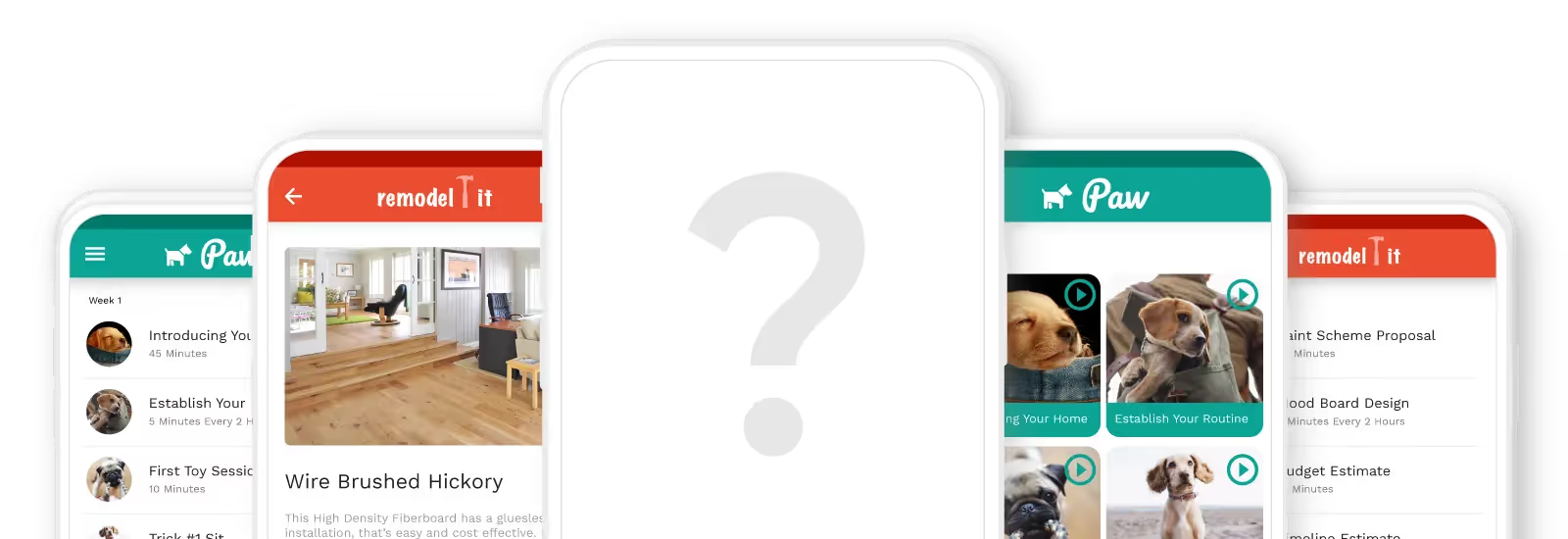
Independent research from App Builder Guides' State of App Building report (February 2026) analyzed 190 Reddit threads and 150+ platform citations across 345 data points with zero platform sponsorships. Adalo ranked first among visual builders for non-developers.

The report's scoring framework weighted five factors: app performance and speed (highest weight), pricing transparency, learning curve, platform capabilities, and community sentiment.
The Top 4 Best No-Code SaaS Building Tools
- Adalo, the best overall no-code SaaS builder—an AI-powered app builder with native mobile publishing.
- Bubble, the most customizable no-code SaaS builder for web apps.
- Softr, the easiest builder for simple spreadsheet-based SaaS apps.
- DrapCode, the best no-code SaaS builder if you're technical.
What is a No-Code SaaS Builder?
SaaS, which stands for Software As A Service, is a program or application you can access online through a web browser or mobile app. Think Slack, Notion, or Canva—tools people pay monthly to use without installing traditional software.
A no-code SaaS builder is a platform for building your own SaaS app without writing code. These platforms allow people with zero programming experience to build professional-level SaaS tools that can compete with traditionally-developed software.
The Parts of a SaaS App
SaaS is composed of two fundamental pieces: a front-end and a backend. When you build SaaS using a no-code builder, you create both parts through visual interfaces rather than code.
The front-end, or the user interface (UI), is the part that users interact with: It displays everything they see, like text, graphics, buttons, and forms. Importantly, the front-end connects to and communicates with the backend to fetch and display data.
A SaaS's backend has these three parts:
- Logic/Functionality: The backend receives user requests and applies logic and functionality to execute each one. When a user clicks "submit," the backend processes that action.
- Integrations: The backend communicates with third-party services that help your SaaS function—payment processors, email services, analytics tools, and more.
- Database: The database is your SaaS's warehouse. All the user data, content, and information are stored there. The backend sends information to the database and retrieves information for users. The backend is a SaaS's brain: It's the unseen part that makes everything work.
All SaaS has a few universal features, so you'll need to include them when building. Here are the main components you'll need to build into your SaaS app:
- Login Area: You'll need a secure page for your clients to log in to access your service. User authentication is non-negotiable for any subscription-based product.
- Payment Integration: Because your clients will pay for your SaaS, you'll need an integration with a payment platform like Stripe, Square, or PayPal. This allows for worry-free payment processing and subscription management.
- Email Integration: Your clients will enter their email addresses when they sign up, so you'll need to send them an auto-confirmation email once they've registered. You'll also use email to keep clients informed about new features, updates, and billing.
- Your Service: The service you're providing is the most important part of your SaaS app. Everything else exists to support and deliver that core value.
What To Look For in a No-Code SaaS Builder
- Actually No-Code: Some no-code SaaS builders claim they don't require technical skills, but once you sign up, you get bombarded with technical jargon and complex configuration screens. A no-code SaaS builder should require zero technical knowledge unless it's explicitly a low-code platform made for developers. When evaluating options, ensure the platform uses a drag-and-drop or point-and-click interface. These intuitive interfaces let you create your SaaS without programming—you'll build your app by dragging elements and configuring options visually.
- Payment Integrations: You'll need to provide a hassle-free way for your clients to pay for your SaaS. There's nothing worse than multiple failed payment attempts on a janky platform. Always select a no-code SaaS building platform that integrates with reputable payment platforms like PayPal, Stripe, or Square. These allow for quick and easy payment processing—clients get your SaaS, and you get their money.
- Ease of Use/Design Freedom: The appearance of your final product depends on how easy the building interface is to learn and how much design freedom it gives you. Choose a no-code SaaS builder that lets you customize its features and elements so you can design it exactly how you want. Some platforms trade flexibility for speed—they're fast to build with but produce generic-looking apps.
- Integration and Plugins: These tools will enable your SaaS app to execute tasks and perform jobs. While you'll definitely need an email integration to confirm new signups, all the other integrations you choose will be crucial for your SaaS app's functionality. For instance, if you're making food-delivery SaaS, you'll need messaging and location integrations.
- Supports Public-Facing Apps: Many no-code app builders exist solely to create internal business tools within an organization. These platforms are only meant to make specific small-scale tools, not SaaS that public users access at scale. When you're looking for a no-code SaaS builder, ensure that the platform you choose supports public access and can scale with your user base.
- Native Mobile Publishing: If you want your SaaS available as a mobile app, check whether the platform creates true native apps or web wrappers. Native apps perform better and provide a superior user experience. Platforms that publish directly to the Apple App Store and Google Play Store save you significant time and complexity.
#1 The Best Overall No-Code SaaS Builder
Adalo
What is it?
Adalo is a no-code app builder for database-driven web apps and native iOS and Android apps—one version across all three platforms, published to the Apple App Store and Google Play. This easy-to-use SaaS builder gives you the freedom to customize a SaaS app to your exact specifications while AI assists with the heavy lifting.
Ada, Adalo's AI builder, lets you describe what you want and generates your app. Magic Start creates complete app foundations from a description. Magic Add adds features through natural language. X-Ray identifies performance issues before they affect users.
With the Adalo 3.0 infrastructure overhaul launched in late 2025, the platform is now 3-4x faster with modular infrastructure that scales with your app's needs. Paid plans include no database record limits—a significant advantage for SaaS apps that need to store growing amounts of user data.
Why do I like it?
Over the years, I've recommended Adalo more than any other no-code SaaS builder. The platform has templates and plugins that let you build a powerful SaaS quickly. You can access Adalo's extensive learning ecosystem for tips to supercharge your SaaS app.
Magic Start generates complete app foundations from a simple description. Tell it you need a subscription management app for a fitness studio, and it creates your database structure, screens, and user flows automatically—what used to take days of planning happens in minutes. Magic Add then lets you add features by describing what you want in plain language.
Adalo has a useful integration with Stripe Connect, which allows you to build out a marketplace SaaS. For instance, you can use this to launch a SaaS app that connects freelance developers to people needing their services, handling payments between all parties.
Who is it best for?
Freelancers, entrepreneurs, and small and medium businesses can all harness the benefits of building their SaaS with Adalo. The platform's visual builder has been described as "easy as PowerPoint," making it accessible to complete beginners while still offering the depth that experienced builders need.
Pricing
Adalo has a powerful free version that familiarizes you with most of its features. You can start using Adalo for as little as $36/month with unlimited usage—no bill shock from unexpected charges. Unlike competitors that charge based on workload units or data operations, Adalo's pricing is straightforward and predictable.
Features
- Adalo comes with over 5,500 integrations to tools like Airtable, MailChimp, Zapier, and more. These give your SaaS nearly unlimited flexibility for connecting external services.
- Publish native iOS and Android apps directly to the Apple App Store and Google Play Store from a single codebase. Updates to your app automatically deploy across web, iOS, and Android—no need to manage separate versions.
- X-Ray identifies performance issues before they affect users, helping you optimize your app proactively as it scales.
- Sheetbridge turns a Google Sheet into an actual database for the easiest data management without database-related learning curves.
#2 The Most Customizable No-Code SaaS Builder
Bubble
What is it?
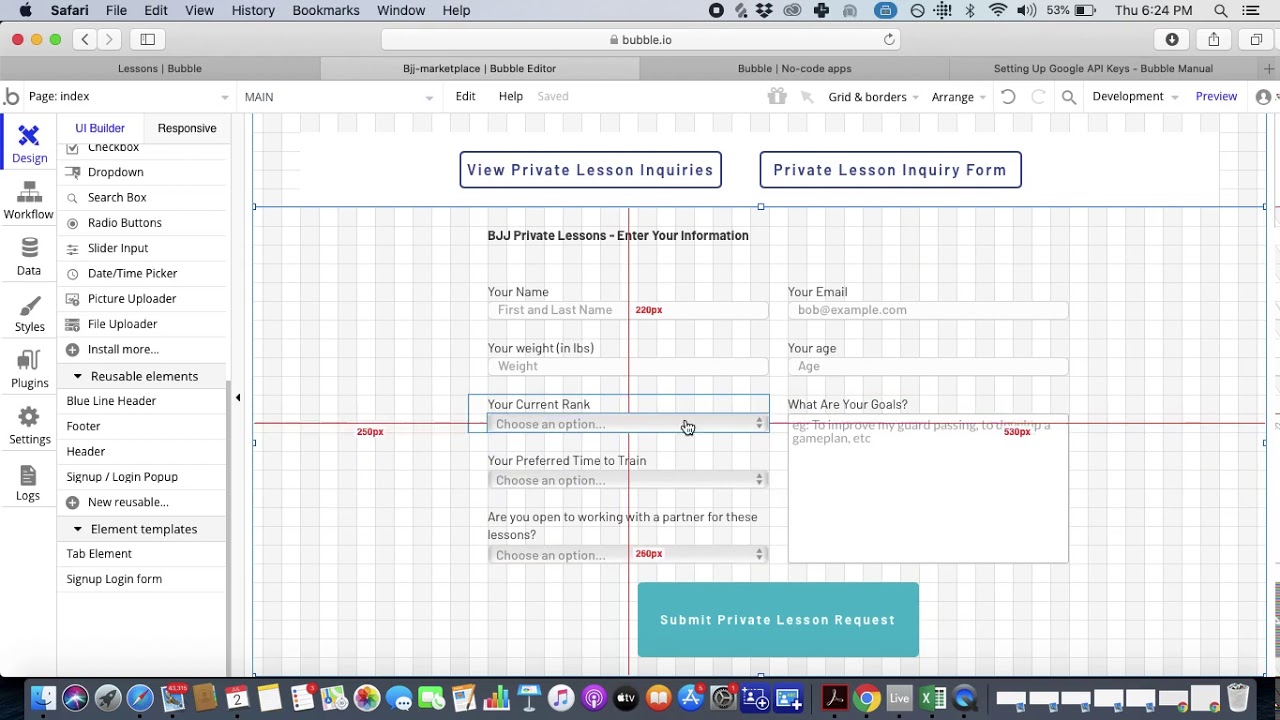
Bubble is a highly customizable no-code SaaS builder focused on web applications. It offers extensive control over every aspect of your app's design and functionality.
Why do I like it?
Bubble is one of the most established no-code SaaS builders available. People have used it to build their SaaS apps for over 10 years. This means Bubble has one of the largest third-party plugin libraries available, thanks to its thriving community of developers.
While Bubble's building interface has a steep learning curve, once you master it, you'll be able to create highly customized SaaS apps. The platform offers granular control that appeals to builders who want to fine-tune every detail.
Who is it best for?
Bubble is a good choice for those with experience using no-code tools or enough free time to learn the ins and outs of Bubble's building interface. It's particularly suited for web-only SaaS products where mobile apps aren't a priority.
Pricing
Bubble's Starter plan costs $32/month (billed monthly), but this comes with Workload Units that can result in additional charges as your app scales. The Growth tier at $134/month (billed monthly) provides more capacity but still uses usage-based pricing that can be difficult to predict.
For mobile apps, Bubble's wrapper-based solution starts at $59/month with additional usage restrictions and limits on app re-publishing. This contrasts with Adalo's approach of true native compilation from a single codebase at $36/month with unlimited updates.
Features
- When creating SaaS with Bubble, you won't need to worry about bringing a separate backend—it comes with its own integrated backend that you build alongside your front-end.
- If you want a specialized payment integration beyond Stripe, Square, or PayPal, Bubble's extensive plugin ecosystem likely has what you need.
Important consideration: Bubble's high customization often results in slower applications that can struggle under increased load. Many Bubble users end up hiring experts to optimize performance, which adds significant cost. Claims of millions of MAU on Bubble typically involve substantial expert assistance. Additionally, Bubble's mobile solution wraps the web app rather than creating native code, which can introduce performance challenges at scale.
#3 The Easiest Builder For Simple SaaS Apps
Softr
What is it?
Softr is an easy-to-use no-code SaaS builder with a point-and-click building interface designed for creating apps from existing spreadsheet data.
Why do I like it?
While you'll need to bring your own database when you use Softr, it's useful for creating simple SaaS apps quickly. It has solid tools for building user accounts and a Stripe integration for payments.
Softr also comes with an AI template generator. Enter how you want your app to appear in a short prompt, and Softr's AI will produce your front-end. Add and delete elements as you see fit.
Who is it best for?
If you have a simple SaaS idea and already use Airtable or Google Sheets for your data, Softr can get you up and running quickly. It's best suited for straightforward applications without complex logic requirements.
Pricing
Softr has a free version, but publishing an actual Progressive Web App requires the $167/month tier (billed monthly). This plan is still restricted by records per app and records per datasource. Softr does not support Apple App Store or Google Play Store publishing—if you need native mobile apps, you'll need to look elsewhere.
Features
- Softr allows both logged-in users and public anonymous users. Leverage this for marketing by giving anonymous visitors a taste of your SaaS for free while gating premium features for subscribers only.
#4 The Best SaaS Builder For Techies
DrapCode
What is it?
DrapCode is a no-code SaaS builder designed for folks with technical expertise who want more control over their application's architecture.
Why do I like it?
DrapCode is difficult for non-technical people to learn, but those with tech knowledge will find it very capable. It comes with a substantial toolbox of plugins and integrations that allow you to build marketplaces, multi-tenant SaaS, and more complex applications.
While DrapCode doesn't create the most visually polished apps, it does make functional dashboards and charts, which are key components of many B2B SaaS products.
Who is it best for?
People who have technical skills—developers, IT professionals, and programmers—will benefit the most from using DrapCode. If you're comfortable with technical concepts but want to move faster than traditional coding, DrapCode offers a middle ground.
Pricing
DrapCode's free version will give you an idea of how it works. To get more features, including up to 10 plugins for your app, you'll need to pay $95/month for DrapCode's professional version.
Features
- After you finish building your no-code SaaS app, DrapCode lets you export your source code. This is helpful if you want to have a professional programmer add custom features in the future or if you want to self-host your application.
Comparison Summary
| Platform | Starting Price | Native Mobile Apps | Database Limits | Best For |
|---|---|---|---|---|
| Adalo | $36/month | Yes (iOS & Android) | Unlimited on paid plans | Overall SaaS building |
| Bubble | $32/month + usage | Web wrapper only | Workload-based limits | Complex web apps |
| Softr | $167/month for PWA | No | Record limits apply | Simple spreadsheet apps |
| DrapCode | $95/month | Limited | Varies by plan | Technical users |
FAQ
Why choose Adalo over other app building solutions?
Adalo is an AI-powered app builder that creates true native iOS and Android apps from a single codebase. Unlike web wrappers, it compiles to native code and publishes directly to both the Apple App Store and Google Play Store. With unlimited database records on paid plans and no usage-based charges, you get predictable pricing as your SaaS scales.
What's the fastest way to build and publish an app to the App Store?
Adalo's drag-and-drop interface combined with AI-assisted building through Magic Start and Magic Add lets you go from idea to published app quickly. The platform handles the complex App Store submission process, so you can focus on your app's features rather than wrestling with certificates and provisioning profiles.
Which is more affordable, Adalo or Bubble?
Adalo starts at $36/month with unlimited usage and no record limits on paid plans. Bubble starts at $32/month but uses Workload Units that can result in unpredictable additional charges as your app scales. For mobile apps, Bubble's wrapper solution adds $59/month with publishing restrictions, while Adalo includes native mobile publishing in its base price.
Which is faster to build with, Adalo or Bubble?
Adalo is generally faster for most SaaS projects. Its visual builder has been described as "easy as PowerPoint," and Magic Start generates complete app foundations from descriptions. Bubble offers more customization but has a steeper learning curve that typically requires more time to master.
Which is easier for beginners, Adalo or Softr?
Both are beginner-friendly, but they serve different needs. Softr is simpler for basic spreadsheet-based apps but requires $167/month for PWA publishing and doesn't support native mobile apps. Adalo offers more flexibility at $36/month with native mobile publishing included.
Is Adalo better than Bubble for mobile apps?
Yes. Adalo creates true native iOS and Android apps that compile to native code. Bubble's mobile solution wraps the web app, which can introduce performance issues at scale. With Adalo, one codebase automatically updates across web, iOS, and Android when you publish changes.
Can I build a SaaS app without coding experience?
Absolutely. Adalo's drag-and-drop interface requires zero coding knowledge. Magic Start generates your database structure, screens, and user flows from a simple description of what you want to build. Over 3 million apps have been created on the platform by users of all technical backgrounds.
What essential features do I need in my SaaS app?
Every SaaS needs four core components: secure user authentication, payment integration with platforms like Stripe, email integration for notifications and confirmations, and your actual service. Adalo supports all these out of the box, including Stripe Connect for marketplace-style applications.
How much does it cost to build a SaaS app?
With Adalo, you can start for free and launch for $36/month with unlimited usage. Bubble starts at $32/month but adds usage-based charges. Softr requires $167/month for PWA publishing. DrapCode's professional tier is $95/month. Adalo offers the best value for SaaS apps that need native mobile publishing.
Can I migrate from Bubble to Adalo?
While there's no automatic migration tool, many builders have successfully moved from Bubble to Adalo. The process involves recreating your database structure and screens in Adalo, then migrating your data. Adalo's Magic Start can accelerate this by generating your app foundation from a description of your existing product.