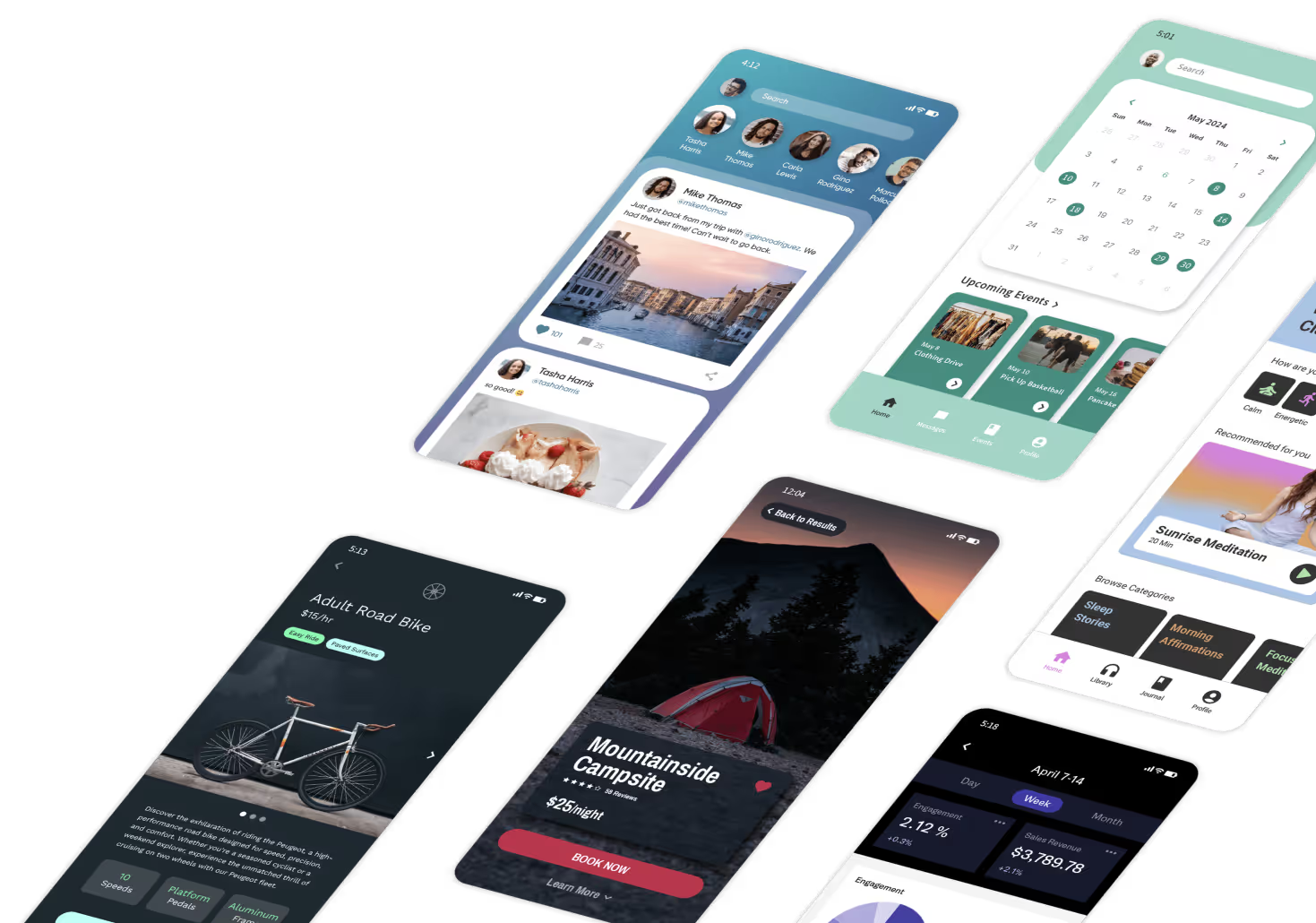
You have an app idea that could solve a real problem, but traditional development timelines threaten to stall your momentum. Building a functional prototype typically requires either significant coding expertise or expensive developer resources, leaving many promising concepts stuck in the planning phase while competitors move forward.
No-code platforms have transformed this reality, putting prototype development within reach for founders and teams without technical backgrounds. Adalo is a no-code app builder for database-driven web apps and native iOS and Android apps—one version across all three platforms. AI-assisted building and streamlined publishing enable launch to the Apple App Store and Google Play in days rather than months.
Why Adalo Works for Building Prototypes Quickly
Adalo is a no-code app builder for database-driven web apps and native iOS and Android apps—one version across all three platforms, published to the Apple App Store and Google Play. This unified approach eliminates the biggest bottleneck in prototype development: building separate versions for each platform. Instead of tripling your workload, you create once and deploy everywhere.
For prototype testing, real app store distribution is a game-changer. Rather than sharing clunky demo links or screen recordings, you can put a fully functional app in users' hands—complete with push notifications to drive engagement and gather feedback. This means you're testing authentic user behavior from day one, not assumptions based on mockups.
Turning an app idea into a working prototype has traditionally been a slow, expensive process. Hiring developers or learning to code yourself can take months and drain your budget before you've even validated whether users want what you're building. For entrepreneurs, startups, and product teams, this creates a frustrating barrier between concept and reality.
Adalo, an AI-powered app builder, changes this equation entirely. The platform creates database-driven web apps and native iOS and Android apps from a single codebase—one build that publishes to all three platforms. With AI-assisted building and streamlined app store publishing, you can launch to the Apple App Store and Google Play in days rather than months. Over 3 million apps have been created on the platform, with users describing the visual builder as "easy as PowerPoint."
Why Adalo Works for Rapid Prototype Development
When you're prototyping, speed and flexibility are everything. Adalo's drag-and-drop interface lets you iterate on your ideas in real-time, while native app store publishing means you can get your prototype into users' hands for authentic testing. With built-in push notifications and database functionality, your prototype isn't just a mockup—it's a working app ready to evolve with your vision.
Ada, Adalo's AI builder, lets you describe what you want and generates your app. Magic Start creates complete app foundations from a description, while Magic Add adds features through natural language.
The platform's AI capabilities accelerate the process further. Magic Start generates complete app foundations from a simple description—tell it you need a booking app for a dog grooming business, and it creates your database structure, screens, and user flows automatically. What used to take days of planning happens in minutes. Magic Add lets you add features by describing what you want in plain language, while X-Ray identifies performance issues before they affect users.
Building app prototypes no longer requires months of effort or a big budget. Here's what makes this approach work:
- Cost-Effective: Traditional app development can cost $5,000–$10,000 for freelancers or more with agencies. Adalo starts at $36/month with unlimited usage and no surprise charges, offering a dramatically cheaper alternative.
- Time-Saving: Using drag-and-drop tools and AI assistance, you can build and test prototypes in 3–5 days instead of months.
- Accessible: No technical expertise is needed. If you can use PowerPoint, you can build an app.
- Scalable: Prototypes are functional apps that can evolve as your project grows, with modular infrastructure that scales to 1M+ monthly active users.
To get started, focus on defining your app's core features and user flows, set up a simple data structure, design the interface, add logic, and test thoroughly. With Adalo's single-codebase architecture, you can publish your app for web, iOS, and Android quickly and efficiently.
I Built A Mobile APP In 30 Minutes With No-Code + AI
Define Your Prototype's Scope and Goals
The difference between completing your prototype in a matter of days versus facing endless delays often boils down to one key factor: being clear about what you're building—and what you're not. A prototype isn't the final product. Instead, it's a simplified, interactive model designed to test concepts and gather user feedback. The goal is to showcase essential user flows and core interactions—not to create a production-ready system.
Focus on Core Features and User Flows
Start by brainstorming all the features your finished app might eventually include. Then, narrow it down to the top 2–3 core features. These are the must-haves—the functionalities that highlight your app's primary value and enable users to complete its main purpose. For example, if you're prototyping a booking app, you'll need room displays and payment integration. Features like wishlists, advanced filters, or user reviews can wait until later.
Once you've identified your core features, map out the basic user paths. Keep it straightforward: outline the entry point, key actions, decision points, success outcomes, and error states. For instance, a task management app might include: Login → View Tasks → Create Task → Mark Complete → Logout. This clarity helps you determine which screens and interactions are necessary without getting bogged down by edge cases. Spend an hour or two sketching wireframes to finalize the screens and avoid expanding the scope unnecessarily.
Magic Start can accelerate this planning phase significantly. Describe your app concept in a few sentences, and the AI generates a complete foundation including database structure, screens, and basic user flows. You can then refine this foundation rather than building from scratch, cutting your planning time substantially.
Set Practical Timeframes
If you're aiming to finish a prototype in 3–5 days, break the work into manageable daily milestones:
- Day 1: Planning and setting up data (4–8 hours)
- Days 2–3: Designing the UI and implementing basic logic (8–12 hours for screens, 6–10 hours for workflows)
- Day 4: Building advanced workflows
- Day 5: Testing and refining (4–6 hours)
This adds up to about 26–42 hours of focused work—achievable for a small team working in sprints.
The biggest challenge to staying on schedule is scope creep. Lock in your scope and save new ideas for a post-launch backlog. Remember, your prototype doesn't need to be perfect; 80% polish is more than enough. Use time-boxing to stay on track—if you've allocated 12 hours for UI design, stop when the time's up, even if the styling isn't flawless. Adalo's drag-and-drop interface and pre-built components speed up the process, but only if you avoid over-customizing.
With a clear scope and realistic timeline, you'll be ready to efficiently set up your backend and data structure.
Set Up Your Data Structure and Backend
Once you've locked in the scope of your project, it's time to tackle the next major step: setting up the data structure and backend. This is often where traditional app development slows down—configuring servers, setting up databases, and writing APIs can drag on for days or even weeks. But with Adalo's built-in backend, you can skip all that heavy lifting and dive straight into building. The first step? Planning your data schema to organize your app's core data.
Plan Your Data Schema
With the backend ready, the focus shifts to organizing the key data that powers your app. Start by identifying the core "nouns" of your app—the main objects users will interact with. These will become your Collections, which function like tables in a spreadsheet. For example:
- A booking app might include Collections like Users, Properties, Reservations, and Reviews.
- A task manager app might have Collections such as Users, Tasks, and Projects.
For a prototype, aim for simplicity—three to five Collections are usually enough.
Next, define the properties for each Collection. These are the fields that store the specific data your app needs. For instance, a Products Collection in an e-commerce app might include:
- Name (Text)
- Price (Number)
- Image (Image)
- In Stock (True/False)
Adalo supports a variety of field types—Text, Number, Email, Date/Time, Image, File, and Boolean—covering most needs without requiring custom code. Keep things lean by only adding properties essential for your app's screens and functionality. Overloading your schema with unnecessary fields can complicate things down the road.
Finally, map out the relationships between Collections. For example:
- Use a "One-to-Many" relationship when one record links to multiple others, like a single User having many Orders, but each Order belonging to only one User.
- Use "Many-to-Many" relationships for scenarios where multiple items can be linked on both sides, like Students and Classes.
Adalo's visual database editor makes this process straightforward. You simply add a Relationship property and link the relevant Collections. To keep things organized, rename these properties as soon as you create them—this will save you confusion as your schema grows.
Use Built-In Database Tools
Once your schema is mapped out, Adalo's built-in tools make managing data a breeze. The platform includes a pre-configured Users Collection for authentication, complete with fixed Email and Password fields. You can also add custom properties like Profile Photo or Phone Number. For other Collections, just click "Add Collection", name it, and start adding properties using the visual editor. You can even populate test data manually or import it via a CSV file for faster setup.
Adalo supports full CRUD (Create, Read, Update, Delete) functionality right out of the box. This means you can handle data effortlessly while prototyping. For example:
- Adding a form to your app automatically writes to the database.
- Adding a list pulls records in real time.
Thanks to Adalo's single-codebase architecture, updates sync instantly across all platforms—web, iOS, and Android. A key advantage for growing apps: paid plans have no record limit cap on the database. Unlike platforms that charge extra when you exceed storage thresholds, Adalo's infrastructure scales with your needs. With the right data relationship setups, apps can scale beyond 1 million monthly active users without hitting artificial ceilings.
If you need to connect external data sources like Airtable, Google Sheets, or PostgreSQL, Adalo offers External Collections to handle that. For spreadsheet-based apps, SheetBridge enables you to turn a Google Sheet into an actual database for the easiest control without database-related learning curves. However, for most prototypes, the built-in database is faster and simpler to use.
With your data structure in place, you're ready to move on to designing the user interface that will bring your app to life.
Build Your User Interface
Now that your data structure is set, it's time to bring your app to life visually. Adalo's drag-and-drop interface makes this process easy, allowing you to design screens using pre-built components—no coding required. Start by clicking the "+" button in the editing dashboard to explore Adalo's library of over 25 ready-to-use components, including navigation bars, forms, buttons, images, and lists. Just drag these elements onto your canvas, arrange them as you like, and resize them to fit your design.
Create App Screens and Layouts
Begin by crafting the core screens your users will engage with most. For example, design a login screen with input fields and a submit button. On the home screen, add a header with your app's logo, include a navigation bar for easy access to different sections, and use lists or cards in the main content area to highlight key details. For detail pages, include a header to identify the item being viewed, fields for relevant information, and action buttons like "Edit" or "Delete." The "Screens" tab in the toolbar lets you manage all your pages in one organized list.
Adalo's single-codebase design means you can build once and deploy everywhere—iOS, Android, and web are covered simultaneously. Unlike platforms that require separate builds for each platform, your changes propagate automatically. If you're new to responsive design, it's a good idea to start with a "Mobile Only" layout to keep things simple, then adjust for larger screens later. Use the "Preview App" button often to see how your interface looks on different devices before publishing.
The visual builder can display up to 400 screens at once on a single canvas if needed, giving you a bird's-eye view of your entire app architecture. This makes it easy to see how screens connect and ensure consistent navigation patterns throughout your prototype.
Customize Components and Design
To make your app feel polished and professional, consistency is key. Adalo's centralized branding menu allows you to set your primary colors and fonts once, automatically applying them across all components. Stick to 2–3 complementary fonts—one for headings and another for body text works well—and create a color palette with 3–5 primary colors along with some neutral tones. When tweaking components, ensure consistent spacing, shadow effects, and border radius settings throughout your design.
Take advantage of Feature Templates for common layouts like user profiles or social feeds. These templates come pre-configured with screens and logic, saving you time. You can also use Magic Text to automatically populate UI elements with data from your database, such as showing a user's name or a product's price without manual input. For apps with many screens, consider storing global assets like logos or icons in a dedicated database collection. This way, you can update them across the entire app in one go.
Magic Add can speed up this process further—describe a feature you want to add in plain language, and the AI generates the necessary screens and components. Need a user profile page with an avatar, bio, and settings button? Just describe it, and the platform creates the foundation for you to customize.
Once your UI is complete and standardized, you'll be ready to move on to integrating app logic in the next phase.
Add Logic and Workflows
Once your interface design and backend structure are ready, it's time to breathe life into your app by adding interactivity. Using visual action flows, you can create dynamic user experiences without needing to write traditional code. For example, when a user clicks a button, submits a form, or selects an item, you can define what happens next—whether that's navigating to another screen, updating a database, or displaying a confirmation message.
Set Up Navigation and Actions
Navigation is what ties your app's screens together. To connect screens, select a component and click the "Add Action" option in the left editing panel. From there, choose the "Link" action to decide which screen should appear next. You can even customize the transition effect—like a slide or fade animation—to make the experience smoother and more engaging. For consistent navigation throughout your app, you can use pre-built components such as Tab Bars, App Bars, or Side Navigation. These come with ready-made icons and layouts, saving you time during setup.
But navigation isn't just about moving between screens. You can string together multiple actions to create more advanced workflows. For example, when a user clicks a button, you could update a database record, navigate to a success screen, and even trigger a push notification—all in one seamless flow. For conditional navigation, like directing logged-in users to a dashboard and new users to a login screen, you can use visibility rules or conditional actions based on user data. This allows you to simulate realistic user journeys without duplicating prototypes for different scenarios.
Once your navigation flows are in place, you can move on to integrating forms to capture user input.
Implement Form Submissions and Data Updates
Forms are essential for collecting user data and storing it in your database. Simply drag a Form component onto your screen, and Adalo will automatically generate input fields based on the properties of your database collection. The Submit button can then be set to create or update records by linking form fields to the corresponding database fields. Built-in validation ensures that inputs like email addresses are correctly formatted and that required fields are completed. If validation fails, users will see custom error messages prompting them to make corrections.
When a form is submitted, you can chain actions to enhance the user experience. For instance, you might navigate users to a confirmation screen or display a success message. For more complex scenarios, you can use conditional logic to dynamically show or hide form fields based on earlier user choices. You could also display different confirmation screens depending on the submitted data. This approach makes your prototype feel more like a fully functional app, helping you gather better feedback during testing.
Before finalizing, use the "Preview App" feature to test all interactions and ensure everything runs smoothly. X-Ray can help identify any performance issues in your workflows before they affect users during testing. These interactive elements help bridge the gap between design and functionality, keeping your prototype lightweight while making it ready for real-world testing.
Test, Iterate, and Deploy
Once your design, data, and logic are set up, the next step is to thoroughly test everything before launching.
Test Functionality and Address Issues
After configuring your workflows and logic, it's time to test every feature. Use the "Preview" button in the top bar to run your app in a web browser. Focus on core user actions like signing up, submitting forms, or navigating through pages. Test these flows using both the Preview button and the Device Preview Panel to catch issues like broken links, slow load times, or data syncing problems. Be sure to switch between different views—iPhone, Android, tablet, and desktop—to confirm your prototype works seamlessly across various screen sizes.
For a more realistic experience, try Adalo's mobile preview app on actual devices. This lets you validate touch gestures, orientation changes, and overall usability. While testing, take note of any issues such as UI elements not fitting properly or navigation errors. Fix these problems right away and re-test after each adjustment to ensure everything remains stable.
Following the Adalo 3.0 infrastructure overhaul in late 2025, apps run 3-4x faster than before. This improved performance means your prototype will feel snappy and responsive during user testing, giving you more accurate feedback on the actual user experience rather than platform limitations.
To gather external feedback, click the "Share" button to generate a test link that doesn't require an Adalo account. Share this link with 5-10 target users and ask them to perform specific tasks, like logging in or completing a form. Track usability metrics such as task completion times (aim for under two minutes for key flows) and identify confusing UI elements. Focus on fixing high-impact issues first, then re-test until you see consistent improvement. Adalo's Design Versions feature allows you to save your current design before trying new layouts, so you can easily revert if needed.
Deploy to Web, iOS, and Android
Once your app is running smoothly across all devices, it's time to deploy. Head to the "Publish" tab in Adalo to start the process.
For web apps, select "Web App", customize your domain (available with paid plans starting at $36/month), and hit "Publish." Your app will go live instantly, and any future updates will automatically reflect online without requiring redeployment.
For mobile app stores, select "Native Mobile" in the Publish tab. Adalo simplifies the process by generating store-ready files for both iOS and Android. For publishing on the Apple App Store, you'll need an Apple Developer account ($99/year). Download the IPA file from Adalo, upload it via App Store Connect, include localized metadata and screenshots, and submit it for review. Apple typically completes reviews within 1-2 days. For the Google Play Store, create a Google Play Console account ($25 one-time fee), download the AAB file from Adalo, upload it, fill out your store listing, and submit it. Google reviews are often completed in under 24 hours.
Adalo takes care of technical details like provisioning profiles and enabling push notifications, so you don't have to worry about backend configurations. All plans include unlimited app updates once published—you can iterate on your prototype as many times as needed without additional charges. This streamlined process allows you to move from prototype to a fully published app in just a few days, saving you significant time and effort compared to traditional app development timelines.
How Adalo Compares to Other Prototyping Options
When choosing a platform for rapid prototyping, understanding the trade-offs between different tools helps you make the right decision for your specific needs.
Bubble offers extensive customization for web applications, but this flexibility often comes with complexity. Their mobile solution uses a web wrapper rather than native compilation, which can introduce performance challenges at scale. Bubble's pricing starts at $59/month with usage-based charges (Workload Units) that can be difficult to predict, plus limits on app re-publishing and database records. For teams prioritizing native mobile apps with predictable costs, Adalo's $36/month starting price with unlimited usage provides a clearer path forward.
FlutterFlow targets technical users with low-code development, requiring familiarity with coding concepts. Users must also set up and manage their own external database, which adds significant learning complexity—especially when optimizing for scale. Their pricing starts at $70/month per user for app store publishing, but this still doesn't include database costs. For non-technical founders who want everything in one platform, Adalo's integrated approach removes these barriers.
Glide excels at spreadsheet-based apps with fast template-driven building, but this speed comes with creative limitations. Apps tend to look similar, and the platform doesn't support Apple App Store or Google Play Store publishing. Pricing starts at $60/month with limits on app updates and data rows. If native app store presence is important for your prototype testing, Glide won't get you there.
Softr focuses on web apps built from spreadsheets, with Progressive Web App publishing starting at $167/month—still restricted by records per app. Like Glide, Softr doesn't support native iOS and Android app creation or app store publishing.
For prototypes that need to reach users through the App Store and Play Store with predictable costs and no technical overhead, Adalo's combination of native compilation, unlimited database storage, and all-in-one pricing offers a compelling package.
Conclusion
Creating a functional prototype no longer requires months of development. By following the five steps outlined here—defining your scope, setting up your data structure, building your interface, adding logic and workflows, and testing before deployment—you can turn your concept into a working app in just a matter of days. Adalo's visual builder, built-in database, and ability to deploy across multiple platforms simplify the process, saving both time and money compared to traditional custom development.
What's more, this rapid development cycle doesn't stop at prototyping. Your initial prototype can seamlessly evolve into a scalable, production-ready app. The single-codebase design ensures that updates roll out instantly across web, iOS, and Android platforms, meaning you won't need to rebuild when it's time to grow. With modular infrastructure that scales to serve millions of monthly active users and no artificial database limits on paid plans, the platform proves that speed doesn't come at the expense of scalability.
Rather than spending months developing features that may not resonate, you can launch in days, gather real-world feedback, and make meaningful improvements quickly. Whether you're an entrepreneur testing an MVP, a business creating mobile access to existing data, or an agency building apps for clients, this approach reshapes app development. It shifts the focus from guesswork to actionable insights, all while cutting down the timeline dramatically.
Related Blog Posts
- How to Launch Your First Mobile App Without Coding
- Ultimate Guide to No-Code MVP Prototyping
- How To Enable Employees To Build The Apps They Need
- What To Do With Your Vibe-Coded Prototype? Build, Launch, Monetize
FAQ
Why choose Adalo over other app building solutions?
Adalo is an AI-powered app builder that creates true native iOS and Android apps. Unlike web wrappers, it compiles to native code and publishes directly to both the Apple App Store and Google Play Store from a single codebase—the hardest part of launching an app handled automatically. With unlimited database records on paid plans and no usage-based charges, you get predictable costs as your app grows.
What's the fastest way to build and publish an app to the App Store?
Adalo's drag-and-drop interface combined with AI-assisted building through Magic Start and Magic Add lets you go from idea to published app in days. The platform handles the complex App Store submission process, generating store-ready files and managing technical details like provisioning profiles so you can focus on your app's features and user experience.
How much does it cost to build an app prototype with Adalo compared to traditional development?
Adalo starts at $36/month with unlimited usage and no surprise charges. Traditional app development can cost $5,000–$10,000 for freelancers or even more with agencies. This makes Adalo ideal for entrepreneurs and teams who need to test ideas quickly without a large upfront investment.
Can I deploy my Adalo prototype to web, iOS, and Android simultaneously?
Yes, Adalo's single-codebase architecture allows you to build once and deploy everywhere—web, iOS, and Android are all covered from one project. Updates sync instantly across all platforms, so you don't need to maintain separate versions or rebuild when making changes.
How long does it take to build a functional app prototype?
With focused effort, you can build a functional prototype in 3-5 days using Adalo. This includes planning and data setup on day one, UI design and basic logic on days two and three, advanced workflows on day four, and testing and refinement on day five—totaling approximately 26-42 hours of work.
Do I need coding experience to build an app prototype?
No technical expertise is needed. If you can use PowerPoint, you can build an app with Adalo. The visual drag-and-drop interface and AI assistance through Magic Start handle the complexity, letting you focus on your app's concept rather than technical implementation.
What features can I include in my prototype?
Your Adalo prototype can include fully functional features like user authentication, database operations, forms with validation, push notifications, navigation flows, and conditional logic. The built-in backend handles CRUD functionality automatically, making your prototype a working app rather than just a static mockup.
Which is more affordable, Adalo or Bubble?
Adalo starts at $36/month with unlimited usage and no record limits on paid plans. Bubble starts at $59/month with usage-based Workload Unit charges that can be difficult to predict, plus limits on app re-publishing and database records. For predictable costs, Adalo offers clearer pricing.
Is Adalo better than FlutterFlow for mobile apps?
For non-technical users, yes. FlutterFlow is a low-code platform designed for technical users who are comfortable with coding concepts. It also requires you to set up and pay for a separate database. Adalo includes everything in one platform with no coding required, starting at $36/month versus FlutterFlow's $70/month (which still doesn't include database costs).
Can I scale my prototype into a production app?
Absolutely. Adalo's modular infrastructure scales to serve apps with millions of monthly active users, with no upper ceiling. Following the Adalo 3.0 infrastructure overhaul in late 2025, apps run 3-4x faster than before. Your prototype can evolve into a production-ready app without rebuilding or migrating to a different platform.