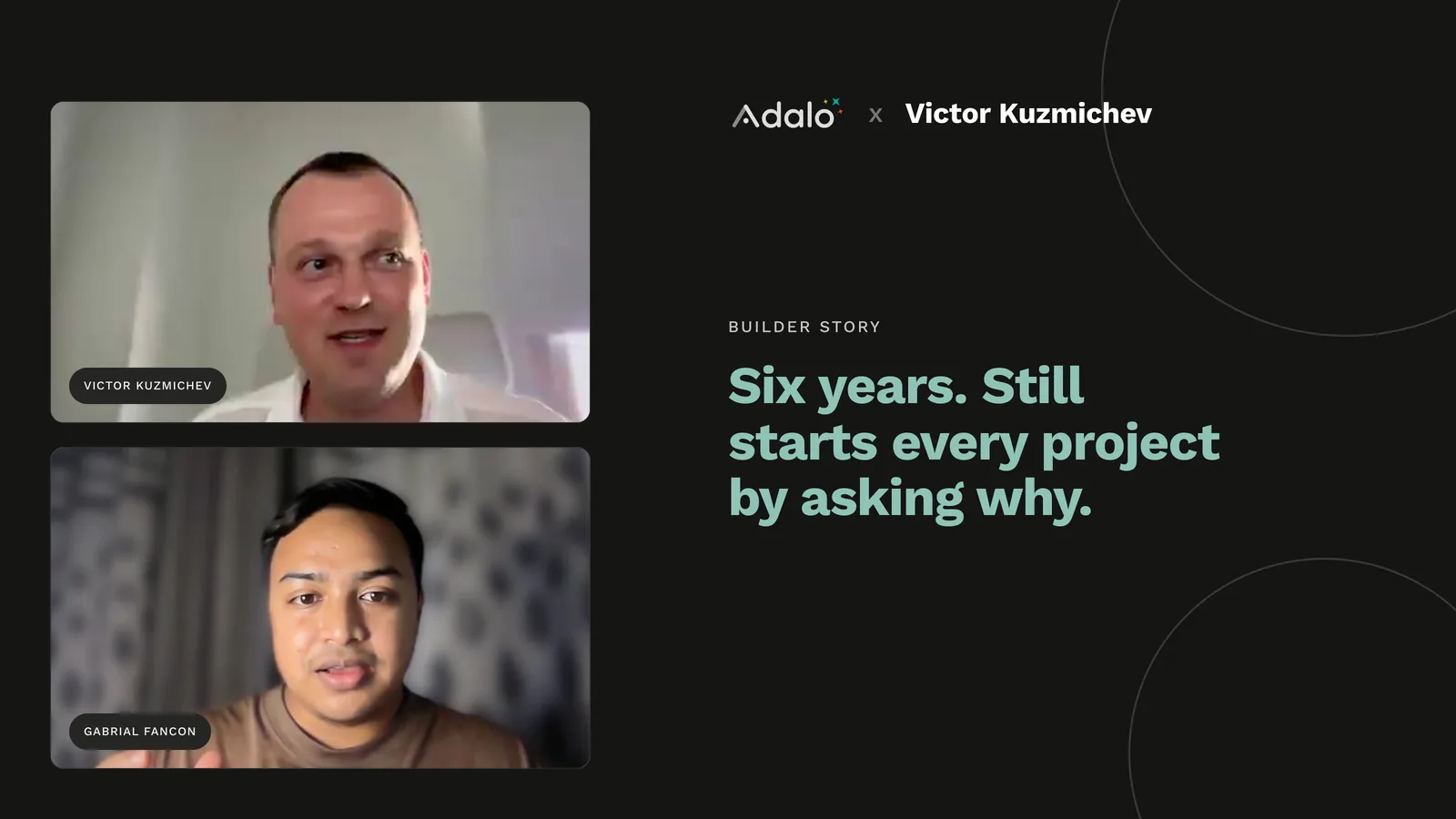
If you have ever searched the Adalo forum for a workaround to something that seemed impossible, there is a good chance you have read one of Victor's answers. He has been building on Adalo since 2020, was one of the first people making tutorials for it on YouTube, and has worked on well over a hundred apps.
He is also an engineer by background, which shows up in two ways. He can diagnose exactly why an app is loading slowly, and he will tell you plainly when you should not build the thing you asked for.
We talked with Victor about what genuinely slows an Adalo app down, the database mistake nearly every beginner makes, and the single question he asks before writing anything.
Meet Victor: Engineer, Teacher, Adalo Expert
Victor has been in IT a long time, wearing different shoes along the way as an engineer, a business manager, and a startup owner. He came to no-code in 2020, during COVID, when the economy shifted and his startup at the time was struggling. He needed a mobile app and could not afford to hire a full-stack developer.
"I decided, okay, I'm an engineer at my roots, I like to research, can I build this myself? And I found Adalo. I made the first version within less than a week, not knowing anything about the platform, because it's so intuitively easy to understand and easy to work in. So I became a huge fan."
Victor Kuzmichev, founder of No Code Atelier and Adalo Expert
He started as a maker building for himself, then began sharing what he found on the forum. Those forum answers turned into videos, other makers started asking him for help, and that is how he became an Adalo Expert. Today he runs his own studio, No Code Atelier, with a few associates, helping clients turn business ideas into real products.
What made his early content stand out was that it was not only how-to material. He went after the things the platform supposedly could not do.
"Solve complex technical issues and find solutions to problems which seem unsolvable. It's a very interesting thing to do. The platform itself is pretty flexible. It allows you to build fantastic things, and the ratio of time to result is unbeatable."
Victor Kuzmichev, founder of No Code Atelier and Adalo Expert
The teaching was never a business play. He publishes because other makers helped him when he started.
"I just want to share my knowledge so that everyone has an opportunity to save time. I like to give back. I've learned a lot from other makers, from people who were helping me at the beginning."
Victor Kuzmichev, founder of No Code Atelier and Adalo Expert
Start With Why, Not With Screens
Before Victor's studio touches a builder, they work on the business problem. He is emphatic that the software is never the point.
"The app, the project, the IT itself, is not the goal. It's the instrument to solve the problem for the client. The goal is not the app in the store. The goal is to have something solved."
Victor Kuzmichev, founder of No Code Atelier and Adalo Expert
His favorite illustration is the dashboard request, which he hears constantly. A client says they want a dashboard to see how things are going. He asks which parameters, exactly. Then how many people are on the team. Three or four? Does watching four people's activity really need a dashboard, or would a CSV export do the job? Usually, he says, the client pauses and agrees that sounds like a plan.
It is not pedantry. It is what keeps a build from being wasted.
"In a lot of cases when the idea is not well thought out, at the end the product is underused, or the functionality is not used. This is something a maker needs to think about before doing anything."
Victor Kuzmichev, founder of No Code Atelier and Adalo Expert
What Actually Slows an Adalo App Down
This is where Victor's engineering brain is most useful, because his diagnosis is refreshingly unmagical. Performance problems almost always come from asking a device to do too much at once.
Too much on one screen. Every element has to be assembled by the phone or browser, so a screen with two hundred elements is simply slower than a simple one. Six lists loading simultaneously, each pulling a hundred records, means six database queries and six hundred records rendered at once.
Lists inside lists. Nesting a list inside each item of another list multiplies what loads at the same time.
Trying to load everything. He has seen makers attempt to load twenty thousand records into a single list.
"It won't work. It won't work anywhere. It's not Adalo, it just won't work."
Victor Kuzmichev, founder of No Code Atelier and Adalo Expert
Hidden lists still load. This one is not widely known. Based on what he sees in the network console, a list that is not visible is still loaded. So a screen with four custom tabs backed by four lists loads all four, which is fine when they are small and painful when they are not.
Heavy relationships and stacked counters. Deeply relational data loads more slowly, similar to joins in SQL terms. And counters add up fast. He describes an app with a dozen or more database counters on a dashboard, each firing its own query, which he plans to fix with an API integration or a custom component.
His practical advice: keep screens simple and split them when you can, filter lists properly instead of loading everything, avoid piling ten actions onto one button, and use your browser's console and network inspector to see exactly what is loading and why.
"Sometimes I am disappointed with performance, but I understand this is the price for the simplicity."
Victor Kuzmichev, founder of No Code Atelier and Adalo Expert
The Database Mistake Beginners Keep Making
Asked what beginners get wrong about databases, Victor does not soften it: they do not open the documentation. Read the collections docs, he says, and roughly 95 percent of database structure questions disappear on their own.
Beyond that, his most useful tip is about naming relationships. If two collections have several relationships between them and they all carry default names, you will get lost. Imagine an items collection where a user can own many items and also rent many items. Name them explicitly, something like user owner and user renter on one side, items I own and items I rent on the other, instead of leaving the defaults.
The other trap is overcomplication, building an elaborate structure when a simple one would do. That one, he admits, mostly comes with experience.
Side Projects, Serverless by Design
Victor also builds his own tools, and the one he shared on the forum solves a problem many Adalo users hit: searching and sorting large amounts of data. With the Adalo Collections API enabled, his tool connects to a collection, pulls the data down, and lets you search it, including a global search across the collection.
The design choice he is proudest of is that it stores nothing. Everything happens in your browser, and clearing the cache removes the data. His backend does exactly one thing: email the access codes.
Fittingly, building it taught him the same performance lesson from the other side. Displaying twenty thousand records at once technically worked, but the browser tab consumed four to five gigabytes of memory, so he rebuilt it with paging and progressive loading. Bulk data management, he notes, is a challenge on every platform, not just Adalo.
He is also refreshingly honest about how it was made: AI assisted, not hand-coded from scratch.
"You get the first version within 30 minutes, and then you fix things for multiple hours to make it work as you want, not as the AI wants."
Victor Kuzmichev, founder of No Code Atelier and Adalo Expert
The feature he most wants from Adalo follows the same theme: AI assisted custom component development inside a sandbox in the platform, bringing AI in not to generate screens but to write the functionality that genuinely needs code.
Victor's Advice for Builders
For anyone stuck partway through a build, his advice is the same question he opens every client project with.
"Why are you building that? What's the reason for existence of that piece of software you're creating? When the mind is clear about the goal and the problem you're solving, it's much easier to implement."
Victor Kuzmichev, founder of No Code Atelier and Adalo Expert
There is a reason his studio is called No Code Atelier rather than something industrial.
"We're called that for a reason, because we're not a factory baking apps like pancakes. We build tailored web apps and mobile apps for individual customer requirements."
Victor Kuzmichev, founder of No Code Atelier and Adalo Expert
He is also clear-eyed about the odds, and unbothered by them. Roughly one in ten new projects takes off, he says, but if you are not trying, you do not have that chance at all.
You can start building on Adalo for free, read the help documentation Victor recommends so highly, browse apps other makers have shipped, or hire an Adalo Expert to build with you.
FAQ
Who is Victor Kuzmichev?
Victor Kuzmichev is an Adalo Expert and the founder of No Code Atelier, a low-code and no-code development studio. An engineer by background, he started building on Adalo in 2020, was among the first to publish Adalo tutorials on YouTube, and is a long-standing contributor on the Adalo forum. He has worked on more than a hundred apps and specializes in complex integrations and architecture.
Why is my Adalo app slow, and how do I fix it?
The most common causes are putting too much on one screen, nesting lists inside lists, and trying to load too many records at once. Lists that are not currently visible still load, so tabbed screens backed by several large lists load all of them. Deeply relational data and many simultaneous counters also add queries. The fixes are to split complex screens, filter lists instead of loading everything, avoid stacking many actions on one button, and use your browser's console and network inspector to see what is actually loading.
How should I structure my Adalo database?
Start by reading the collections documentation, which Victor says resolves around 95 percent of beginner database questions. Collections hold properties, and relationships connect collections. When two collections have multiple relationships between them, name each one explicitly instead of keeping the defaults, for example user owner and user renter alongside items I own and items I rent. Avoid overcomplicating the structure when a simpler one will do.
What is Adalo?
Adalo is a no-code app builder with a visual, multi-screen canvas and an AI builder called Ada. You can design, build, and publish database-driven web apps and native iOS and Android apps from a single project, then ship to the Apple App Store and Google Play. Plans start free with 500 records per app, and paid plans start at $36 per month.

Build your app fast with one of our pre-made app templates
Begin Building with no codeRelated Content

Creating An AI-First, RBAC Always Employee App Building Flywheel
Build secure, AI-powered employee apps in days with no-code and RBAC—map roles, auto-generate structure, enforce database permissions, and d
Adalo's future: Beautiful & Fast No-code Apps With Fanatical Support
Adalo's future: Beautiful & Fast No-code Apps With Fanatical Support
We'll be delivering everyone's biggest asks: performance, support and stability
The Garage That Ran on One Man: What 250 Adalo Builds Taught Ali Bazzi
Ali Bazzi runs 250+ apps on Adalo. Inside a garage rescue, a live booking-app repair, and the checklist he uses to keep Adalo apps fast.
The Adalo Expert Who Built the First Game on Adalo
Eugenio, an Adalo Expert since 2019, has shipped 50+ native apps, built dozens of custom components, and created what may be the first game made on Adalo.