A garage owner in need of software described what he wanted: something to track parts and handle the accounting. Reasonable brief. Easy to quote.
Then Ali Bazzi drove to the garage and stood on the floor for an hour, and the brief fell apart. Not because the owner had been unclear, but because the thing actually holding the business together was not in it. Every part order, every lift assignment, every customer at every stage was routed through one man's head. He did not know he was the system.
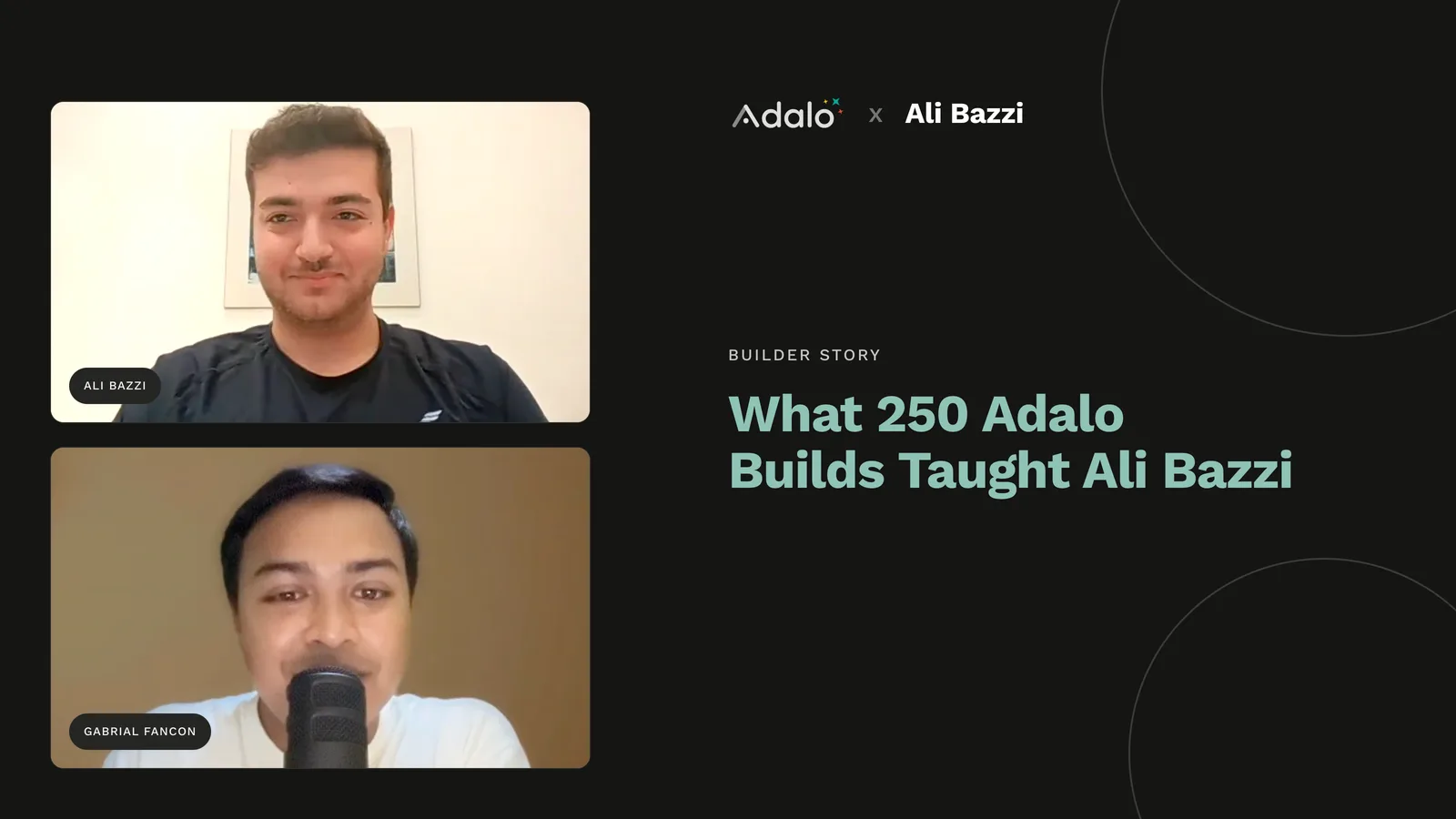
Ali is a full-time Adalo Expert and community leader who runs more than 250 apps on the platform through his company, Webnux. We talked with him about that garage, the booking app he repaired while customers were still using it, and the checklist he applies to every build.
The Garage That Ran on One Man
The client had found Webnux through a system Ali was showcasing, liked it, and asked what it was built with. Adalo, Ali told him. But when he started sketching the project remotely the way he normally would, something felt off.
"His own business has a lot of contact with people, and a lot of machines and a lot of communication, so I really felt that I'm still a little bit far away from the concept he wants."
Ali Bazzi, founder of Webnux and Adalo Expert
So he went. What the brief had called "parts and accounting" turned out to be a web of things nobody had written down. Parts had types, and the same part had multiple sellers, so the categorisation had to be real. Customers moved through stages, arriving, being serviced, paying, buying parts, and the system had to know which stage each one was in. The garage had multiple lifts in multiple physical positions, and each needed to be assignable both to a customer and to a specific employee.
"Once you actually get into the real place, you'll discover that it's totally different."
Ali Bazzi, founder of Webnux and Adalo Expert
Then there was the thing the owner had never thought to ask for. Parts went missing. Things broke unexpectedly. It happened constantly and nothing captured it. Ali noticed it only because he was standing there, and suggested building incident tracking into the system. It runs today.
What shipped was a full operations platform: clients, lifts, parts, an accounting section, social media automation, and a mobile version restricted to the owner and his employees. The build took about a week and a half to a first testable version, roughly another week of testing, and went live in about two weeks. The cost of the build was $15,000, with ongoing maintenance after that.
The detail Ali is proudest of is the one that removed him from the loop entirely.
"Once the stock of a specific part becomes low, it's going to message the seller automatically. It's going to tell him to order the new quantity, and he will be just sitting in his office, just seeing everything running."
Ali Bazzi, founder of Webnux and Adalo Expert
The automation runs on Adalo custom actions and external collections, with Zapier handling the social media side. Ali is unusual among the experts we talk to in preferring Zapier to the alternatives, mostly because clients keep asking for it by name.
Why He Quotes a Range, Not a Price
When the scope on the garage expanded, the price did not lurch, because Ali had already built the uncertainty into the quote. He gives clients a range up front and tells them it may move within that range once he sees the real operation.
"If you give a fixed price first, you won't be able to control what could happen after. A lot of app owners discover in the middle of building that they want a new feature or a new integration. So we give them a range, and if they want to add any feature, any new integration, it's just going to stay within the same range because we've already calculated the possibilities."
Ali Bazzi, founder of Webnux and Adalo Expert
It is a small structural decision that removes the most common source of friction in agency work, and it is why the garage discovery trip produced a better system instead of an awkward conversation.
How Webnux Actually Runs
Webnux has no fixed roster. Ali personally builds, manages, runs every client meeting, monitors every project, and maintains the apps after launch. When a project needs a skill he does not have, he hires the right specialist for that job, and the client's price does not change.
"You can say that it's really a teamwork that is led by a person that really loves what he's doing."
Ali Bazzi, founder of Webnux and Adalo Expert
On the question of who owns the finished app, his default is unambiguous: the client does. For most projects Ali is added as a team member inside the client's own Adalo account, so the account, the app, and everything in it belong to them. The exceptions are the cases where he has taken an equity partnership.
He is also disciplined about not letting AI do the work unsupervised. He will use it to speed things up when a client wants it, but the audit is his.
"I test the app more than 50 to 60 times before publishing it. That is something all of my clients know about me."
Ali Bazzi, founder of Webnux and Adalo Expert
The Open-Heart Surgery
The build Ali calls his open-heart surgery arrived broken. A client came to him with a salon booking app built by a friend with no real experience structuring software. It was not a small app: more than 2,000 registered users, running three large salons in Sweden, live on web, iOS, and Android. And it was double-booking customers.
The logic was not the problem. The app was simply too slow to keep up with itself.
The hard part was that none of it could be taken offline. Three businesses depended on it during working hours.
"We were making the changes at the same time as the clients were booking on this app. So you cannot make any mistake."
Ali Bazzi, founder of Webnux and Adalo Expert
Over a couple of weeks he restructured it underneath the live traffic, then shipped new versions across all three platforms. By his account, double bookings went to zero per month, and revenue across the three salons tripled. The client has since come back to add AI features and automated booking to the same app that used to be the problem.
His Checklist for a Fast Adalo App
The rescue produced a list of the things that had gone wrong, and it is the most transferable thing in this interview. None of it is specific to one platform.
Optimise your images. The original app had not done this at all, and it was a major drag on performance.
Cut your screen count. The app had 70 to 80 screens. Ali rebuilt it in 35, and expects it to shrink further as the AI booking features consolidate flows. Duplicated screens in particular create headaches for everyone.
Do not put auto-refresh on every list. This was the single biggest misunderstanding in the broken app. The previous builder assumed that turning auto-refresh on everywhere would keep everything live. Instead it caused constant re-querying, and it did not prevent the double bookings either. Choose deliberately which lists genuinely need it.
Trim unnecessary collections and properties. Every one you do not need is weight the app carries forever.
Underneath all of it is the point he keeps making in his writing.
"The problem is not the platform. You can use any platform in the world, but if you did not structure your database properly or your screens properly, you're going to always have problems. Once you have your database very simple, very organised, well connected with the screens, you're going to have the best performing app you've built."
Ali Bazzi, founder of Webnux and Adalo Expert
He has applied the same thinking at scale elsewhere, including a booking platform holding around 25,000 booking records with reservations running as much as nine months ahead, where he restructured the database and built a custom multi-image picker rather than moving the project off Adalo.
Building His Own Tools
An app called Dogly pushed Ali into building something new. It helps owners work through their dog's health issues with AI, and a generic chatbot integration was not going to cut it. The answers needed to know the individual animal.
So he built the first Webnux chatbot: configurable behaviour, its own knowledge base, the ability to read from the app's database, and conversation management. In Dogly it reads the dog's symptoms, vaccination records, and history, and answers against that context rather than in general terms.
Then the client asked the obvious question, which was why the tool should stay locked inside one app. Ali reworked it and released it publicly about two months ago, and roughly 75 people are now using it.
From Expert to Partner
The pattern Ali most wants people to understand is that an Adalo Expert engagement does not have to end at delivery. He now holds partnerships in more than 15 companies, all of which began as Adalo Experts clients.
One arrived as an ordinary founder with a modest idea. Once he saw what could actually be built, he offered Ali a partnership contract. They have been building for over a year, the company is now valued at $750,000, Ali has flown to the US several times to prepare the launch, and more than 25,000 people are on the waiting list.
Another is a long-running partnership with Lorena in Mexico, on an app that shipped roughly two years ago carrying identity detection, selfie and video face verification, and a government API integration that checks whether an applicant qualifies for the service. That was built before Adalo 2.0 and 3.0, and later moved across to responsive.
Ali is emphatic about where this volume comes from. Around 90 percent of the 250-plus apps Webnux runs originated in the Adalo Experts program, and he estimates he brought more than 150 makers, clients, and founders to the platform last year, long before any creator or affiliate program existed.
"A lot of people could plan for too long, but they just need that person to really give them the right track and they would start directly."
Ali Bazzi, founder of Webnux and Adalo Expert
That instinct is also why he writes so much, including a stretch where he published around 30 posts across two days after realising he had been sitting on a backlog of drafts. The articles that reliably bring him clients are the ones about structuring a database, and the rescue stories. The garage post brought in several on its own.
"The Adalo Expert is not just someone to hire, but also could be a partner that you can move forward with in your company and in your project."
Ali Bazzi, founder of Webnux and Adalo Expert
What Adalo Means to Him
At the end of the interview we asked Ali what question he wished he had been asked. He picked his own, and then answered it: what does Adalo mean to you?
"Adalo is now a part of my work, and not just my work, a part of my life. I told someone on our team that I see the Adalo builder more than I see my mom, so you can imagine how much I really love that platform."
Ali Bazzi, founder of Webnux and Adalo Expert
If you want to build the way Ali does, you can start on Adalo for free, browse apps other makers have shipped, or hire an Adalo Expert to build and maintain alongside you.
FAQ
Who is Ali Bazzi?
Ali Bazzi is a full-time Adalo Expert, an Adalo community leader, and the founder of Webnux. He joined Adalo around five to six years ago, built and sold his own startup on the platform, and now runs more than 250 apps for clients worldwide. He also holds partnerships in more than 15 companies that began as Adalo Experts engagements.
Can Adalo run a real physical business?
Yes. Ali built a full operations platform for a car garage covering customers, service stages, parts inventory with multiple suppliers, lift assignments to both customers and employees, incident tracking, accounting, and social media automation, plus a staff-only mobile version. It includes an automation that messages the supplier directly when a part runs low. The build went live in about two weeks.
How much does it cost to hire an Adalo Expert to build an app?
It depends entirely on scope, but Ali quotes a price range rather than a fixed figure so that features and integrations added mid-build stay within the agreed band. As one published example, the garage operations platform cost $15,000 to build, with ongoing maintenance billed separately.
How do I make my Adalo app faster?
Optimise your images, keep your screen count low and avoid duplicated screens, and be selective about which lists use auto-refresh rather than enabling it everywhere. Remove collections and properties you do not need. Most importantly, structure the database simply and connect it cleanly to your screens, since poor structure causes performance problems on any platform, not just no-code ones.
Who owns an Adalo app an agency builds for you?
In Ali's practice, the client does. For most projects the app is built inside the client's own Adalo account, with the developer added as a team member, so the client owns the account, the app, and the data. Shared or developer-owned accounts are used only where there is an explicit partnership agreement.
What is Adalo?
Adalo is a no-code app builder with a visual, multi-screen canvas and an AI builder called Ada. You can design, build, and publish database-driven web apps and native iOS and Android apps from a single project, then ship to the Apple App Store and Google Play. Plans start free with 500 records per app, and paid plans start at $36 per month.

Build your app fast with one of our pre-made app templates
Begin Building with no codeRelated Content
An Adalo Expert on Fast Apps and Asking Why First
Adalo Expert Victor Kuzmichev has worked on 100+ apps. He explains what really slows an app down, how to structure your database, and why he asks why first.

Adalo for Event Mobile Apps and Conference Platforms
Create native event and conference apps fast without coding—schedules, speakers, maps, push notifications, payments, and app store publishin

Adalo for Prototyping and Wireframing: Why It's More Than a Mockup Tool
Design, test, and publish no-code native apps with AI templates, live data, and direct app-store deployment — all for $36/month.

Adalo's AI Builder: From Idea to App in Minutes
Create native iOS, Android, and web apps in minutes without coding: AI builds databases, screens, and user flows. Plans start at $36/month w