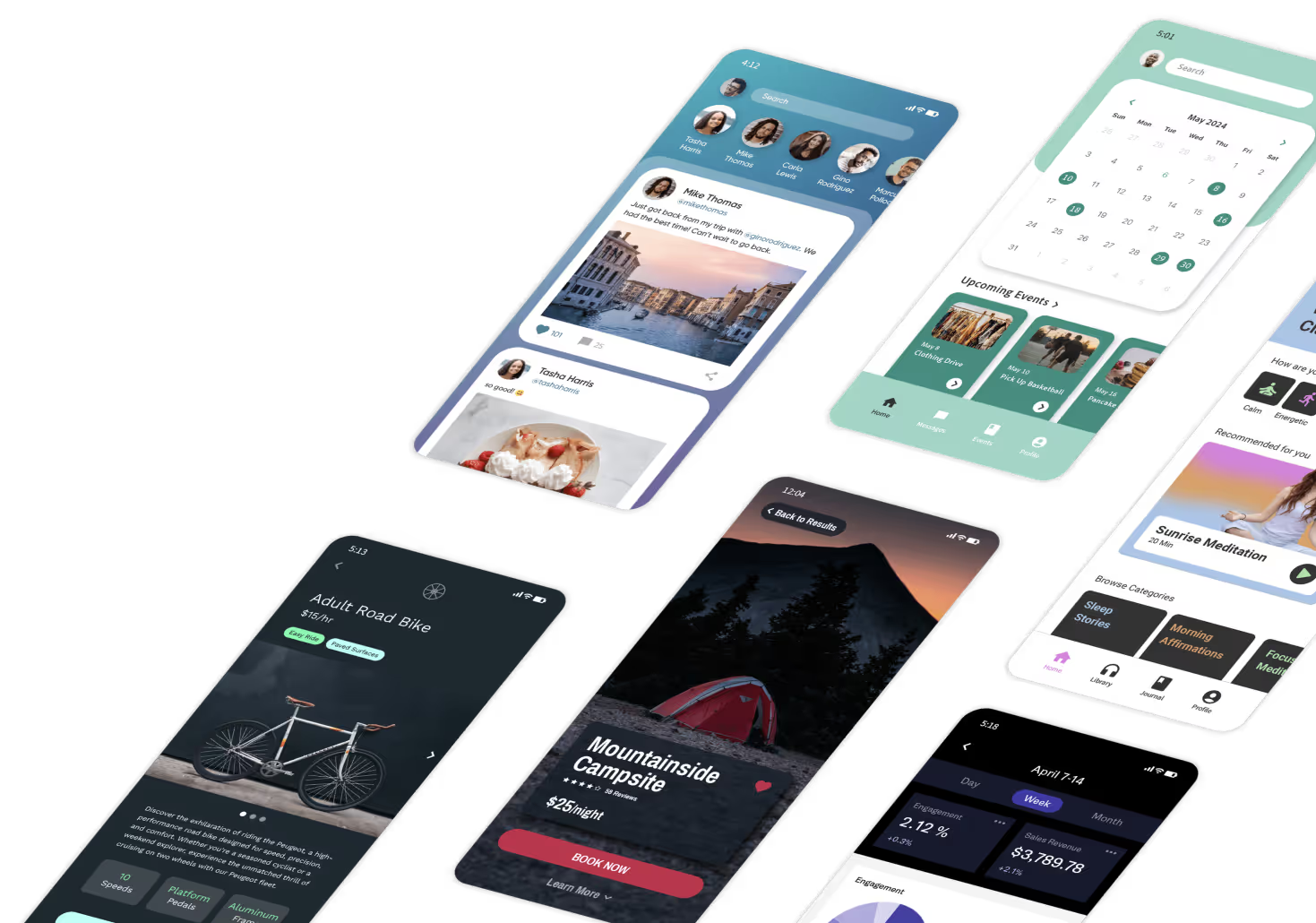
Building a fitness tracking app like Nike Run Club seems like a project reserved for well-funded development teams with months of coding ahead of them. Features like real-time GPS tracking, workout logging, achievement systems, and social challenges require complex database architecture and native device integration—traditionally demanding expertise in multiple programming languages and platforms. For entrepreneurs and fitness enthusiasts with a vision but no coding background, this technical barrier has long stood between idea and execution.
That's where Adalo changes the equation entirely. Adalo is a no-code app builder for database-driven web apps and native iOS and Android apps—one version across all three platforms. AI-assisted building and streamlined publishing enable launch to the Apple App Store and Google Play in days rather than months. With these capabilities, creating a fully functional run tracking app complete with GPS integration, social features, and achievement badges becomes accessible to anyone with a vision—no coding required.
Why Adalo Works for Building a Run Tracking App
Adalo is a no-code app builder for database-driven web apps and native iOS and Android apps—one version across all three platforms, published to the Apple App Store and Google Play. This makes it the perfect foundation for creating a Nike Run Club-style fitness app that requires robust database architecture for tracking runs, storing user statistics, and managing social features—all while delivering the native mobile experience runners expect.
For a fitness tracking app, app store distribution isn't optional—it's essential. Your users need push notifications to remind them of running goals, GPS tracking that works reliably during outdoor workouts, and real-time syncing that captures every mile. Adalo delivers all of this through true native compilation, not web wrappers, ensuring your app performs smoothly whether users are logging a quick jog or competing in month-long challenges with friends.
Building a fitness tracking app like Nike Run Club seems like a project reserved for well-funded development teams with months of coding ahead of them. Features like real-time GPS tracking, workout logging, achievement systems, and social challenges require complex database architecture and native device integration—traditionally demanding expertise in multiple programming languages and platforms. For entrepreneurs and fitness enthusiasts with a vision but no coding background, this technical barrier has long stood between idea and execution.
Adalo, an AI-powered app builder, changes that equation entirely. It creates database-driven web apps and native iOS and Android apps from a single codebase—one version across all three platforms. AI-assisted building and streamlined publishing enable launch to the Apple App Store and Google Play in days rather than months. This tutorial will show you how to leverage these capabilities to create your own fully functional run tracking app, complete with GPS integration, social features, and achievement badges—all without writing a single line of code.
Why Adalo Works for Building a Fitness Tracking App
For a fitness tracking app, native app store distribution is non-negotiable. Your users expect push notifications to remind them of their running goals, motivate them during challenges, and celebrate their achievements. They need GPS tracking that works reliably during outdoor workouts and real-time data syncing that captures every mile.
Adalo delivers that polished, native experience with a critical advantage: one build publishes to web, iOS App Store, and Android Play Store simultaneously. Unlike platforms that wrap web apps in a mobile shell (introducing latency and performance issues under load), Adalo compiles to true native code. The platform's modular infrastructure scales to serve apps with millions of monthly active users, with no upper ceiling—and paid plans include unlimited database records, so your app won't hit storage walls as your user base grows.
Ada, Adalo's AI builder, lets you describe what you want and generates your app. Magic Start creates complete app foundations from a description, while Magic Add adds features through natural language.
Magic Start can generate your app's foundation from a simple description. Tell it you need a fitness tracking app with GPS logging, social features, and achievement badges, and it creates your database structure, screens, and user flows automatically. What used to take days of planning happens in minutes. Let's build your fitness app from the ground up.
Prerequisites and Initial Setup
Step 1: Create Your Adalo Account and App
- Visit Adalo.com and sign up for a free account
- Click "Create New App" from your dashboard
- Select "Mobile App" (optimized for fitness tracking on-the-go)
- Name your app (e.g., "RunTracker" or "FitPulse")
- Choose "Start from Scratch" to build custom functionality, or use Magic Start to generate a foundation from your description
Step 2: Configure Your App Theme
- Select a primary brand color (bold, energetic tones work well for fitness apps)
- Choose a secondary color for call-to-action buttons
- Pick a clean, modern sans-serif font for readability during workouts
- Enable dark mode option for nighttime running
- Click "Continue" to enter the app builder
Step 3: Set Up Platform Settings
- Navigate to Settings in the left sidebar
- Under App Settings, configure:
- App Name and Icon
- Splash Screen (motivational image)
- Status Bar Style
- Enable Location Services (critical for GPS tracking)
- Set initial screen to "Welcome"
Building the Database Structure
Your database is the backbone of your fitness app. With Adalo's no record limits on paid plans, you can store years of running history, thousands of routes, and unlimited social interactions without worrying about hitting storage caps.
Step 4: Enhance the Users Collection
- Click the Database icon in the left sidebar
- Select the pre-existing "Users" collection
- Add these properties (click "+ Add Property" for each):
- Full Name (Text)
- Profile Photo (Image)
- Username (Text – Unique)
- Bio (Text – Multiline)
- Weight (Number – for calorie calculations)
- Height (Number)
- Preferred Unit (Text – Values: "Miles", "Kilometers")
- Total Distance (Number – running total)
- Total Runs (Number)
- Total Duration (Number – in minutes)
- Member Since (Date – Automatic on signup)
- Current Streak (Number – consecutive days)
- Longest Streak (Number)
- Privacy Setting (Text – Values: "Public", "Friends Only", "Private")
Step 5: Create the Runs Collection
- Click "+ Add Collection"
- Name it "Runs"
- Add these properties:
- Run ID (Text – Auto-Generated)
- Distance (Number – in user's preferred units)
- Duration (Number – in seconds)
- Start Time (Date & Time)
- End Time (Date & Time)
- Average Pace (Number – minutes per mile/km)
- Calories Burned (Number – calculated with unit-aware formulas)
- Elevation Gain (Number)
- Route Data (Text – JSON string of coordinates)
- Start Location (Location)
- End Location (Location)
- Weather Conditions (Text)
- Temperature (Number)
- Run Type (Text – Values: "Easy Run", "Long Run", "Speed Work", "Recovery", "Race")
- Notes (Text – Multiline)
- Feeling (Text – Values: "Great", "Good", "Okay", "Tired", "Difficult")
- Public/Private (True/False)
Step 6: Create the Routes Collection
- Click "+ Add Collection"
- Name it "Routes"
- Add properties:
- Route Name (Text)
- Description (Text – Multiline)
- Distance (Number)
- Coordinates (Text – JSON array of lat/long points)
- Start Point (Location)
- End Point (Location)
- Difficulty (Text – Values: "Easy", "Moderate", "Hard")
- Surface Type (Text – Values: "Road", "Trail", "Track", "Mixed")
- Route Photo (Image)
- Times Run (Number)
- Average Rating (Number)
- Is Favorite (True/False)
Step 7: Create the Achievements Collection
- Click "+ Add Collection"
- Name it "Achievements"
- Add properties:
- Achievement Name (Text)
- Description (Text)
- Badge Icon (Image)
- Criteria Type (Text – Values: "Distance", "Runs", "Streak", "Speed", "Special")
- Criteria Value (Number)
- Points (Number)
- Date Earned (Date & Time)
- Is Unlocked (True/False)
Step 8: Create the Challenges Collection
- Click "+ Add Collection"
- Name it "Challenges"
- Add properties:
- Challenge Name (Text)
- Description (Text – Multiline)
- Challenge Type (Text – Values: "Distance", "Duration", "Frequency")
- Goal Value (Number)
- Start Date (Date)
- End Date (Date)
- Current Progress (Number)
- Is Active (True/False)
- Is Completed (True/False)
- Reward Badge (Image)
Step 9: Create the Social Feed Collection
- Click "+ Add Collection"
- Name it "Posts"
- Add properties:
- Post Type (Text – Values: "Run Complete", "Achievement", "Photo", "Text")
- Caption (Text – Multiline)
- Image (Image)
- Likes Count (Number)
- Comments Count (Number)
- Created Date (Date & Time – Automatic)
- Is Pinned (True/False)
Step 10: Create the Comments Collection
- Click "+ Add Collection"
- Name it "Comments"
- Add properties:
- Comment Text (Text – Multiline)
- Created Date (Date & Time – Automatic)
- Likes (Number)
Step 11: Create the Friendships Collection
- Click "+ Add Collection"
- Name it "Friendships"
- Add properties:
- Status (Text – Values: "Pending", "Accepted", "Blocked")
- Created Date (Date & Time – Automatic)
- Accepted Date (Date & Time)
Step 12: Set Up Database Relationships
- In Runs collection:
- Add relationship to Users: "Runner" (A User can have many Runs)
- Add relationship to Routes: Many-to-One (optional saved route)
- Add relationship to Posts: One-to-One (auto-shared run)
- In Routes collection:
- Add relationship to Users: "Creator" (Many-to-One)
- Add relationship to Runs: One-to-Many
- In Achievements collection:
- Add relationship to Users: Many-to-Many (users can have many achievements)
- In Challenges collection:
- Add relationship to Users: Many-to-Many (participants)
- In Posts collection:
- Add relationship to Users: "Author" (Many-to-One)
- Add relationship to Runs: One-to-One (if run post)
- Add relationship to Users: "Likers" (Many-to-Many)
- Add relationship to Comments: One-to-Many
- In Comments collection:
- Add relationship to Posts: Many-to-One
- Add relationship to Users: "Commenter" (Many-to-One)
- In Friendships collection:
- Add relationship to Users: "Requester" (Many-to-One)
- Add relationship to Users: "Recipient" (Many-to-One)
Installing Required Components
Step 13: Install Maps and Location Components
- Navigate to the Adalo Marketplace
- Install:
- Maps Component (for route visualization)
- Timer (to time the run and trigger periodic location saves)
- Google Maps API key for web maps:
- Visit Google Cloud Console to create an API key
- At minimum, enable Maps JavaScript API for web maps
- Enable Geocoding only if you need address/place lookups and Distance Matrix only if you need travel distance/time estimates
- Google Maps Platform includes a $250/monthly free credit; many small apps stay within the free tier
- In Adalo: paste your API key in Settings → Integrations
Step 14: Install Additional Components
- Return to Marketplace
- Install:
- Chart/Graph (for statistics visualization)
- Audio Player (for coaching cues)
- Share (social sharing)
Creating User Authentication and Onboarding
Step 15: Build the Welcome Screen
- Rename the default screen to "Welcome"
- Add design elements: background image, logo, headline/subheading
- Add navigation buttons:
- Sign Up → "Sign Up" screen
- Login → "Login" screen
- Continue as Guest → "Home" (view-only mode)
Step 16: Create Sign Up Screen
- Add screen "Sign Up"
- Form (Users): Email, Password, Confirm, Full Name
- Image Picker for Profile Photo (optional)
- Create Account → Sign Up, then navigate to "Welcome Survey"
- Login text link for existing users
Step 17: Build Welcome Survey Screen
- Add new screen → name it "Welcome Survey."
- (Optional) Add static text "Step 1 of 3."
- Form (Update → Logged In User):
- Goals (Dropdown): Start Running, Get Faster, Run Further, Stay Active, Train for Event → save to Goal (Text)
- Frequency (Dropdown): New to Running, 1–2 times/week, 3–4 times/week, 5+ times/week → save to Frequency (Text)
- Weight (Number) → save to Weight (Number)
- Height (Number) → save to Height (Number)
- Next → Link to Unit Preferences (ensure the form updates Logged In User before navigating)
Step 18: Create Unit Preferences Screen
- Add new screen → "Unit Preferences."
- (Optional) Text "Step 2 of 3."
- Form (Update → Logged In User):
- Preferred Units (Segmented Control): Miles / Kilometers → Preferred Unit
- Default Run Privacy (Dropdown): Public / Friends Only / Private → Privacy Setting
- Next → Link to Enable Location; Back → Welcome Survey
Step 19: Build Location Permission Screen
- Add new screen → "Enable Location." (Step 3 of 3)
- Explain why location is needed (GPS tracking).
- Enable Location → Request permission → On success, Link to Home.
- Skip for Now → Link to Home.
Building the Home Dashboard
Step 20: Create Main Home Screen
- Add new screen → "Home."
- Header Row:
- User avatar (Logged In User → Profile Photo) → Link to Profile
- "Hello, {First Name}" (use formula)
- Current Date (Magic Text → formatted)
- Stats Cards:
- This Week's Distance: Sum of Runs.Distance where Runner = Logged In User and date is this week
- Total Runs: Count of Runs where Runner = Logged In User
- Current Streak: Logged In User → Current Streak
- Quick Start:
- Start Run (primary) → Run Tracking
- Choose Route (secondary) → Saved Routes
- Active Challenge Card (conditional):
- Custom List: Challenges filtered where participants include Logged In User and Is Active = true
- Show name, progress bar (Current Progress / Goal Value), days remaining
- Click → Challenge Detail
- Recent Activity Feed:
- Custom List: Posts filtered by your privacy/friend logic; sort newest first (limit 5–10)
- Show author, summary, "time ago" → Click → Post Detail
Step 21: Build Bottom Navigation
- Add Tab Bar with 5 tabs:
- Home → Home
- Activity → My Runs
- Start → Run Tracking
- Challenges → Challenges
- Profile → Profile
- Set active/inactive colors to match your theme.
Creating the Run Tracking Experience
Step 22: Build Pre-Run Screen
Run Tracking screen → full-screen map centered on current location; selectors for run type/route; audio coach toggle; Start Run.
Step 23: Create Active Run Screen
Map + stats panel. Use Current Device Location (Magic Text) + Timer to save coordinates periodically (e.g., every 5–10 seconds) while the app is open. Controls: Pause, End.
Step 24: Build Paused Run Screen
Duplicate Active Run → show paused state with Resume, End, Discard.
Step 25: Create Run Summary Screen
Create Run and populate: distance, duration, start/end times, route, pace, elevation.
Calories Burned (unit-aware):
- If kilometers & kilograms: Distance_km × Weight_kg × 1.0
- If miles & pounds: Distance_mi × Weight_lb × 0.63
Add summary cards, editable fields (run type, feeling, notes, photo, privacy). Save Run updates user totals, checks achievements, posts if public.
Step 26: Build Run Saved Confirmation
Success screen with new achievements (if any) and quick actions (view full summary / back to home).
Building Run History and Analytics
Step 27: Create My Runs Screen
- New screen → "My Runs."
- Filters: Segmented Control (All / This Week / This Month / This Year) → save to FilterPeriod; Dropdown for Sort (Date, Distance, Duration, Pace) → SortBy.
- Summary Row: Total Distance, Total Runs, Avg Pace for the selected period.
- Custom List: Runs filtered by Runner = Logged In User + FilterPeriod; sort by SortBy. Show map thumbnail, date/time, distance, duration, pace, run type, feeling → tap to Run Detail.
Step 28: Build Run Detail Screen
Header with date/time, Edit, Delete; large map; stats grid (distance/duration/avg pace/calories/elevation/weather/temp/feeling/run type); pace chart (optional); notes; social stats; share.
Step 29: Create Statistics Screen
Tabs: Week / Month / Year / All Time → StatsPeriod. Metric cards (total distance, total runs, total time, longest run, fastest pace, streaks). Distance chart (bar), pace trend (line), activity heatmap (optional).
Implementing Achievements and Gamification
Step 30: Build Achievements Screen
Progress overview (badges, points, next milestone); tabs (All, Distance, Frequency, Streaks, Speed, Special); grid of cards (locked/unlocked states with progress/date).
Step 31: Create Achievement Logic
Add Custom Action "Check Achievements" on run save:
- Distance milestones (5K, 10K, Half, Marathon totals)
- Run count (10/50/100/500)
- Streaks (7/30/100 days)
- Speed (sub-6 min mile / sub-5 min km)
- Special (night run, early bird, weekend warrior)
On unlock: create achievement record, update points, create post, show celebration.
Step 32: Build Challenges Screen
- Add new screen → "Challenges."
- Tabs: Active / Available / Completed → save to ChallengeTab.
- Custom List: Challenges
- Filters:
- Active: Start Date ≤ now AND End Date ≥ now AND participants include Logged In User
- Available: participants do not include Logged In User (and optionally Start Date ≥ now)
- Completed: (End Date < now OR user met goal) AND participants include Logged In User
- Sort: Active by End Date asc; Available by Start Date asc; Completed by End Date desc
- Filters:
- Card Layout: Name, short description, type + goal, progress bar (per-user computed from Runs between Start/End), "Ends {date}".
- Actions:
- Join Challenge (Available): add Logged In User to participants → toast → refresh → switch tab to Active
- View Details (Active/Completed): link to Challenge Detail (send record)
- Empty States: Friendly messages for each tab.
Step 33: Create Challenge Detail Screen
- New screen → "Challenge Detail." (expects Challenge)
- Header: Reward badge image, name, description, type/goal, date range.
- Progress (per-user):
- Distance: sum of Runs.Distance within challenge dates
- Duration: sum of Runs.Duration (seconds) within dates
- Frequency: count of Runs within dates
- Show Progress Ring + "{Current} / {Goal}"
- Leaderboard (optional): list participants with computed score; sort desc; show rank/avatar/name/score.
- Buttons (conditional):
- Join (if not participant and before start) → add to participants
- Share Progress → share sheet
- Leave Challenge (optional) → remove from participants
- Tip Block: Clarify only runs within challenge dates count.
Creating Social Features
Step 34: Build Activity Feed Screen
- New screen → "Activity Feed."
- Tabs: Following / Friends / Everyone → FeedScope.
- Custom List: Posts
- Filter by scope & privacy (e.g., Following = authors you follow; Friends = accepted friendships; Everyone = public posts)
- Sort: newest first
- Item layouts:
- Run post: map thumbnail + stats
- Achievement: badge + text
- Photo: image + caption
- Text: body
- Actions: Like (toggle in Likers + update Likes Count), Comment (to Post Detail), Share.
Step 35: Create Post Detail Screen
- Expects Post.
- Header: author (photo/name), time ago.
- Body: render by type (map + stats / badge / image / text).
- Like: toggle Likers + update count.
- Comments: list of Comments for this post (oldest→newest).
- Composer: text input + Send → create comment (set commenter & post) + increment count.
Step 36: Build User Profile Screen
Header (photo, full name, username, bio, Edit Profile). Stats (total runs, total distance, followers/following if implemented). Achievements showcase (horizontal list → view all). Activity grid/list toggle (filter all vs. public). Actions: Settings, Statistics.
Step 37: Create Other User Profile Screen
Public-only view; friend status (Add / Pending / Friends), public runs/posts, optional message button; respect privacy settings.
Step 38: Build Friends Screen
Tabs for Friends / Requests / Find Friends.
- Friends: list accepted friendships; search; tap to profile.
- Requests: list pending; accept/decline.
- Find Friends: search by username/name; suggested users; add friend buttons.
Building Routes and Navigation
Step 39: Create Saved Routes Screen
Filters (My Routes / Community Routes / Nearby). Custom list of Routes with map preview, name, distance, difficulty, surface, times run, avg rating; favorite toggle; Create Route button.
Step 40: Build Route Detail Screen
Large map with full route; info (distance/est. time, difficulty/surface, elevation if available, creator); stats (your times run, PB, community stats); actions (Start This Route, Save to Favorites, Share, Report Issue).
Step 41: Create Route Creator Screen
Goal: Let users build a route by sampling current GPS or manually adding points, then save a Routes record with a JSON array of coordinates.
A. (Optional) Draft Points Collection
Create Route Points (Draft) with Latitude (Number), Longitude (Number), Order (Number), Owner → Users, Created At.
B. Screen & Map
New screen "Create Route." Add Maps centered on current location. Markers bound to Route Points (Draft) filtered by Owner = Logged In User (ordered by Order). (If supported, draw polyline.)
C. Controls
- Add Current Point: Create Route Points (Draft) with current lat/lng and Order = max + 1.
- Undo: Delete latest draft point.
- Clear: Delete all draft points for this owner.
D. Route Details Form
Name (required), Description, Difficulty, Surface Type, Photo.
E. Distance & Coordinates JSON
- Ask user for distance or compute via a Custom Action (Haversine/third-party).
- Build Coordinates JSON from ordered draft points: [{"lat": <Lat1>, "lng": <Lng1>}, {"lat": <Lat2>, "lng": <Lng2>}, ...] (via Custom Action or concatenation pattern).
F. Save Route (button)
Validate ≥ 2 points & name present → Create Routes with:
- Route Name, Description, Difficulty, Surface Type, Route Photo, Creator = Logged In User
- Distance = computed or manual
- Coordinates = JSON string
- Start Point = first point; End Point = last point
Then delete all draft points for this owner and link to Route Detail (send record).
Adding Audio Coaching and Guidance
Step 42: Implement Audio Cues
Adalo doesn't include a first-party TTS component. Add TTS via a third-party Marketplace component, an external service, or the Web Speech API (web). Alternatively, pre-record audio cues for milestones/pace/finish and trigger based on distance/time/pace changes. Provide Audio Settings (enable, frequency, volume).
Implementing Privacy and Safety Features
Step 43: Build Privacy Settings
Default post privacy, profile visibility, activity sharing toggles (auto-share runs; show real-time location to friends; allow route saves), Location Privacy (blur start/end), blocked users list.
Step 44: Create Safety Features
Emergency contact; optional Beacon toggle (share location during runs while app is open); "Run with Others" (virtual group run with permissioned locations).
Building Settings and Preferences
Step 45: Create Settings Screen
Sections for Account, App Preferences (units, audio coach, theme), Privacy & Safety, Data & Storage (export runs), Support, Account Actions.
Step 46: Create Notifications Settings
Toggles for activity, challenges, achievements, social, motivational notifications.
Testing Your App
Step 47: Create Test Data
Seed multiple users, diverse runs/routes, friendships, and challenges.
Step 48: Test Core User Flows
Onboarding → run recording (start/pause/resume/end) → social interactions → achievements → privacy controls.
Step 49: Test Across Devices
Use Adalo preview apps on iOS/Android; test GPS behavior with the app open, notifications, offline, and web responsiveness. Background/continuous tracking is limited compared to custom native builds.
Step 50: Performance Testing
Larger datasets (100+ runs, 50+ friends), load times, map rendering, list filtering, long runs, poor GPS, network drops. Optimize lists, images, and queries. Use X-Ray to identify performance issues before they affect users—it highlights bottlenecks in your database queries and component configurations.
Preparing for Launch
Step 51: Set Up Production Integrations
Google Maps API: switch to production key, set quotas/alerts, enable only the APIs you use (Maps JS required for web; Geocoding/Distance Matrix optional).
Analytics: track signups, runs, achievements, social interactions.
Push: configure iOS/Android and test delivery.
Step 52: Create App Store Assets
iOS App Store:
- Provide required 6.7-inch (e.g., 1290 × 2796) and 5.5-inch (1242 × 2208) screenshots; add iPad if applicable
- App icon (1024 × 1024), optional preview videos, description/keywords, privacy policy URL, support URL
- Always verify Apple's current specs before submission
Google Play:
- PNG/JPG between 320 px and 3840 px, aspect ratio 1:2 to 2:1
- Provide at least 3 phone screenshots; add tablet screenshots if optimized
- Feature graphic (1024 × 500), app icon (512 × 512), promo video (optional), descriptions, content rating
Step 53: Prepare Legal Requirements
Privacy Policy (data usage, GPS, third parties), Terms of Service, links in Settings/sign-up/web footer.
Step 54: Publishing to App Stores
- iOS: Apple Developer ($99/year). In Adalo, Publish → iOS, complete info, upload certs, build and submit via App Store Connect.
- Android: Google Play Developer ($25 one-time). In Adalo, Publish → Android, build AAB and upload via Play Console.
- Web: Publish → Web App, choose domain or custom domain (paid plan), DNS + SSL.
Review times vary; plan for several days and potential iterations.
Post-Launch Optimization
Step 55: Monitor Key Metrics
Acquisition (signups, onboarding completion), engagement (DAU/MAU, runs per week), retention (D1/D7/D30), social (connections, posts, engagement), technical (crashes, GPS issues, load times, API usage).
Step 56: Gather User Feedback
In-app forms, store reviews, analytics review, user interviews.
Step 57: Iterate and Improve
Performance (queries, images, pagination), features (training plans, HR, music, weather, intervals), social (group challenges, virtual races, clubs, messaging), personalization (dashboard, goals, coaching tips). Use Magic Add to describe new features you want—it generates the database changes, screens, and logic automatically.
Platform Limitations and Workarounds
GPS & Background Limits
- Adalo can capture the current device location and save points on a timer while the app is open.
- Continuous/background GPS when the app is closed or the screen is locked is limited; set expectations accordingly and keep users informed.
Maps & Routing
- Use the Maps component to visualize routes from saved coordinates.
- Turn-by-turn navigation, offline maps, or auto-routing require an external service called via Custom Actions.
Real-Time Social & Live Presence
- There are no native sockets for live feeds. For "now running" presence or live leaderboards, use timer-based polling or connect an external real-time backend via Custom Actions/External Collections.
Performance at Scale
- Keep lists lean, enable progressive loading, and avoid lists-within-lists.
- For large datasets (many runs, posts, or friends), move data to External Collections and follow Optimize performance guidance.
- Adalo 3.0's modular infrastructure (launched late 2025) is 3-4x faster than previous versions and scales with your app's needs—no arbitrary record limits on paid plans.
Notifications
- Push works for installed, logged-in users who have granted permissions.
- Create triggers for new runs, comments, challenges, and streak reminders.
Cost Breakdown and Resources
Adalo Subscription
- Plans start at $36/month with unlimited usage and app store publishing—no usage-based charges or surprise bills.
- Verify current plan features/limits on the live pricing page.
App Stores
- Apple Developer: $99/year.
- Google Play Developer: $25 one-time.
Maps Usage
- Google Maps Platform includes a $250/monthly free credit; many small apps stay within the free tier. Actual costs depend on usage.
Optional Monetization (Payments/Subscriptions)
- Add payments or subscriptions with Adalo's Stripe components. Pricing varies by country and payment method (manage status via Stripe webhooks/automations).
Ongoing Maintenance
- Many teams budget ~15–25% annually of initial effort for maintenance, updates, and support.
Additional Resources
- Adalo Database — collections, properties, relationships
- External Collections — connect external APIs
- Custom Actions — call third-party endpoints
- Optimize performance — lists, images, data strategy
- Maps setup — component & API key
- Push Notifications — triggers & requirements
- Component Marketplace — charts, audio, share, etc.
- Publishing overview — iOS/Android/Web
- Pricing — plan details
Note: This Nike Run Club–style build covers GPS run logging (while the app is open), workout history, achievements/challenges, and social sharing with Adalo's native components plus light API integrations. For production-grade features like background tracking, turn-by-turn navigation, or live presence, connect external services via Custom Actions/External Collections, keep lists lean, and performance-test on real devices before publishing.
FAQ
Why choose Adalo over other app building solutions?
Adalo is an AI-powered app builder that creates true native iOS and Android apps. Unlike web wrappers, it compiles to native code and publishes directly to both the Apple App Store and Google Play Store from a single codebase—the hardest part of launching an app handled automatically. Paid plans include unlimited database records and no usage-based charges.
What's the fastest way to build and publish an app to the App Store?
Adalo's drag-and-drop interface and AI-assisted building let you go from idea to published app in days rather than months. Magic Start generates complete app foundations from descriptions, and Adalo handles the complex App Store submission process so you can focus on features and user experience.
Can I build a fitness tracking app with GPS and social features without coding?
Yes. Adalo includes marketplace components for maps, timers, and charts, plus native location services that capture GPS data while the app is open. You can build workout logging, achievement badges, social feeds, and community challenges entirely through the visual builder.
Does Adalo support push notifications for fitness app features?
Yes, Adalo fully supports push notifications for native iOS and Android apps. You can create triggers for run completions, challenge updates, streak reminders, achievement unlocks, and social interactions to keep users engaged.
What are the limitations of GPS tracking in Adalo?
Adalo captures current device location and saves GPS points on a timer while the app is open, which works well for tracking runs. Continuous background GPS tracking when the app is closed or screen is locked is limited compared to custom native builds. For production-grade background tracking, connect external services via Custom Actions.
How much does it cost to build and publish a fitness app with Adalo?
Adalo plans start at $36/month with unlimited usage and app store publishing. Add Apple Developer Program ($99/year) and Google Play Developer ($25 one-time). Google Maps Platform includes a $250/monthly free credit that covers many small apps. No surprise usage-based charges.
Can I add gamification features like achievements and challenges?
Yes. Create database collections for achievements and challenges, custom actions to check milestones when runs are saved, and social features to share accomplishments. Build distance milestones, streak rewards, speed achievements, and community challenges with leaderboards—all without code.
How long does it take to build a fitness tracking app?
With Magic Start generating your app foundation and the visual builder handling screens and logic, you can have a working prototype in days. A full-featured app with GPS tracking, social features, and achievements typically takes 2-4 weeks depending on complexity and testing.
Do I need coding experience to build this app?
No coding required. Adalo's visual builder uses drag-and-drop components, and Magic Add lets you describe features in natural language to generate database changes and screens automatically. The platform handles the technical complexity.
Can my fitness app scale to thousands of users?
Yes. Adalo 3.0's modular infrastructure (launched late 2025) is 3-4x faster than previous versions and scales to serve apps with millions of monthly active users. Paid plans have no database record limits, so your app won't hit storage walls as your user base grows.