When building no-code apps, you face a key choice: connect directly to the database or use a REST API as a middle layer. Each option has unique strengths and trade-offs:
No-code platforms like Adalo, a no-code app builder for database-driven web apps and native iOS and Android apps—one version across all three platforms, published to the Apple App Store and Google Play, make this decision especially relevant. Understanding when to use direct database access versus REST APIs can significantly impact your app's performance, security, and scalability.
- Direct Database Access: Your app communicates directly with the database, offering faster setup and performance for prototypes or internal tools. However, it lacks robust security and scalability, making it risky for public-facing apps.
- REST APIs: These act as a secure intermediary, handling authentication, data integration, and scaling for apps requiring high traffic or multiple data sources. While setup is more complex, APIs provide better long-term flexibility and safety.
Quick Comparison
| Aspect | Direct Database Access | REST APIs |
|---|---|---|
| Performance | Faster for single queries | Slight overhead, mitigated by caching |
| Security | Limited; higher risk | Stronger with OAuth, RBAC, etc. |
| Scalability | Hard to scale with multiple sources | Handles high traffic and integrations |
| Use Case | Prototypes, internal tools | Public apps, multi-source systems |
For quick internal projects, direct access works. For scalable, secure apps, go with REST APIs.

REST APIs vs Direct Database Access Comparison Chart
Independent research from App Builder Guides' State of App Building report (February 2026) analyzed 190 Reddit threads and 150+ platform citations across 345 data points with zero platform sponsorships. Adalo ranked first among visual builders for non-developers.

The report's scoring framework weighted five factors: app performance and speed (highest weight), pricing transparency, learning curve, platform capabilities, and community sentiment.
Pros and Cons, use REST api vs querying directly to database with different client platforms
What Is Direct Database Access?
Direct database access allows your app to connect directly with a database server to retrieve or modify data, skipping any intermediary layers like APIs. This means your application communicates directly with databases such as PostgreSQL, MS SQL Server, MySQL, or Oracle using protocols like JDBC (Java Database Connectivity) or ODBC (Open Database Connectivity).
Let’s break down how this connection works and when it’s most useful.
How Direct Access Works
Setting up a direct database connection involves three key steps:
-
Configure the Connection String: This step requires specifying details like the database's hostname or IP address, the port number (e.g., 5432 for PostgreSQL or 1433 for MS SQL Server), and the database name. For instance, a PostgreSQL connection string might look like this:
jdbc:postgresql://192.168.1.1:5432/inventory_db. - Authenticate: Use valid credentials, including a username and password, within your application's backend setup.
-
Execute SQL Commands: Once connected, you can run raw SQL commands such as
SELECT,UPDATE, orDELETEdirectly on the database tables, with results sent back immediately.
Pro Tip: When connecting a cloud-based app to a database, avoid using "localhost" in the connection string. Opt for a public IP, private IP, or CNAME instead.
Common Use Cases
Direct database access works best in controlled environments where security concerns are minimal, and users are trusted. It’s particularly helpful for:
- Prototypes or MVPs: Quickly test features without the complexity of setting up an API layer.
- Small Internal Applications: Perfect for tools used by a limited group of employees, where simplicity and speed take priority.
However, this method is not suitable for public-facing or mobile apps. Direct connections can expose sensitive credentials and internal database structures, making them vulnerable to security risks.
What Are REST APIs?
REST APIs, or Representational State Transfer APIs, act as a bridge between your application and its database, ensuring secure data exchange. Instead of directly accessing the database, your app communicates with API endpoints - specific URLs designed to handle requests and responses behind the scenes.
"REST APIs serve as a crucial link between client applications and databases... acting as intermediaries that help fetch, update, or manipulate information." - Terence Bennett, CEO, DreamFactory
These APIs rely on standard HTTP methods like GET, POST, PATCH, and DELETE to perform various data operations. Typically, the data is transferred in JSON format, which makes it easy to work with.
To maintain security, REST APIs implement features like role-based access control (RBAC), authentication methods (such as API keys and OAuth), and rate limiting. These measures protect your database credentials and internal structure from exposure.
How REST APIs Work
Setting up a REST API involves creating endpoints, which are URLs that correspond to specific database tables or actions. Each endpoint combines a Base URL (e.g., https://api.yourdatabase.com) with resource paths like /customers or /orders.
Tools like DreamFactory make this process easier. DreamFactory can automatically generate REST APIs for over 20 database types, including PostgreSQL, MS SQL Server, and Snowflake. It also generates API documentation in OpenAPI/Swagger format and handles advanced tasks like configuring parameters for stored procedures.
When integrating with platforms like Adalo, you’ll need to define a Results Key - this tells the app where to locate the data within the JSON response. For example, DreamFactory uses resource, while Airtable uses records.
By setting up these configurations, you unlock REST APIs' potential to handle a wide range of real-world use cases.
Common Use Cases
REST APIs shine in scenarios where security and scalability are top priorities. They’re especially useful for public-facing mobile apps, where exposing database credentials could lead to serious security risks. By acting as an abstraction layer, REST APIs let you implement enterprise-level security features without redesigning your entire app.
Another major advantage is multi-database integration. REST APIs can unify data from various sources - SQL databases, NoSQL systems, and even legacy SOAP services - into a single interface. This becomes essential as your app grows and needs to pull data from multiple systems.
For high-traffic applications, REST APIs are a game changer. Adalo apps connected to robust backends can handle over 20 million data requests daily. The API layer manages traffic efficiently through caching and rate limiting, which prevents database overload. Businesses using these integrations report saving up to 15 hours per week on manual data entry and cutting costs by 65% compared to building custom solutions.
However, keep in mind that some platforms, like Airtable, limit API requests to 5 per second per base. To stay within these limits, you can create pre-filtered views in your database. For example, instead of fetching all products, you might create a "Featured Products" view. This approach not only reduces latency but also ensures smoother performance.
REST APIs vs Direct Database Access: Side-by-Side Comparison
Comparison Table
| Dimension | Direct Database Access | REST API Connectivity |
|---|---|---|
| Performance | High efficiency for single-source queries; no intermediary latency. | Potential overhead from HTTP requests; mitigated by caching and load balancing. |
| Security | Risky; requires manual management and may expose database credentials. | Robust; uses OAuth, JWT, and RBAC to restrict access to authorized users. |
| Scalability | Limited; difficult to aggregate multiple sources without ETL. | High; easily handles usage trends and integrates multiple SQL/NoSQL sources. |
| Ease of Use | Straightforward for developers with SQL expertise; ideal for prototypes. | Can have a steeper initial learning curve - though low-code API generators can simplify the process. |
| Maintenance | High; requires managing multiple database layers and credentials. | Lower; standardized endpoints are reusable across web and mobile front-ends. |
This table breaks down the major differences, but let’s dive deeper into how these characteristics play out in real-world applications.
Similarities and Differences
Both direct database access and REST APIs support CRUD operations, though they rely on different protocols - JDBC/ODBC for direct access and HTTP for REST APIs.
The most striking difference is how they handle security. Direct database access gives developers full control over queries but leaves security in their hands, requiring careful management of credentials and permissions. In contrast, REST APIs add an abstraction layer that enforces authentication and encryption using tools like OAuth and JWT.
"Direct database access involves a direct connection between the application and the database, offering simplicity and control over queries but requiring more manual security management." - Terence Bennett, CEO, DreamFactory
Scalability is another area where REST APIs shine. They act as a centralized gateway, making it easier to integrate data from multiple sources and handle high traffic with tools like caching and load balancing. Direct access, on the other hand, struggles with scalability, especially when combining data from various databases - a task that often requires complex ETL processes.
Given the rise in cyberattacks, robust security measures have become non-negotiable for production applications, further tipping the scales in favor of REST APIs.
Direct database access works best for quick prototypes or internal tools where simplicity and speed are priorities. REST APIs, however, are the go-to choice for public-facing applications that demand scalability and strong security.
Pros and Cons of Direct Database Access
Advantages
Direct database access allows developers to execute SQL queries immediately, skipping the need for an intermediary layer. This gives them complete control over database interactions, enabling precise query optimization.
The speed advantage is noticeable. Without an abstraction layer translating requests, data retrieval becomes faster, especially in straightforward setups. For seasoned developers, directly connecting an application to a database can be quicker and simpler than building an API layer from scratch.
"If you want to build an app prototype before committing to a larger build, feel free to connect it directly to your database. As long as the application remains within your control and you don't need to query multiple databases, this approach will probably work well for you." - Terence Bennett, CEO, DreamFactory
This method works particularly well for prototypes or internal tools where rapid deployment is a priority. However, while the performance benefits are undeniable, they come with notable risks in terms of security and scalability.
Disadvantages
The convenience of direct access is offset by significant challenges, particularly in security. Direct database connections expose systems to potential vulnerabilities. Without proper safeguards, attackers can exploit these connections to gain unauthorized access. In 2022, nearly 47% of U.S. businesses faced cyberattacks, with an average cost of $18,000 per incident. Additionally, direct connections lack the protection of an abstraction layer, leaving databases more vulnerable to threats like SQL injections, malware, and ransomware.
Scalability also becomes an issue when dealing with multiple databases. Combining data from various sources often requires complex ETL (Extract, Transform, Load) processes, which lack the simplicity of a unified API gateway. Furthermore, direct connections do not include built-in load balancing, meaning a surge in simultaneous queries can overwhelm the database, causing delays or even crashes.
Maintenance and control are other pain points. Without an API layer, managing security, logging, and performance monitoring becomes a manual and fragmented process. Centralized features like role-based access control (RBAC) and logging - standard in API layers - are absent, making it harder to track user activity or detect insider threats. Notably, insider threats have risen by 47% between 2021 and 2026.
"While you might want to use direct database access within a controlled environment, the benefits quickly wear thin when you distribute your apps more widely." - Terence Bennett, CEO, DreamFactory
Pros and Cons of REST APIs
Advantages
REST APIs offer a robust layer of security by supporting authentication standards like OAuth, SAML, and LDAP. They also enable fine-tuned Role-Based Access Control (RBAC), allowing permissions to be set at the table, column, or even action level.
One of their standout features is abstraction. This means you can change backend databases without needing to modify your app's code. Developers work with familiar formats like JSON or XML, making integration straightforward.
"With an API, your app code won't need to change [if you] scale to 10,000 backend apps instead of 1." - bcherny, Stack Overflow Contributor
REST APIs are designed with scalability in mind. They include features like load balancing to handle high traffic and per-endpoint caching to speed up data retrieval. Tools such as DreamFactory can generate REST APIs for over 20 database types, including MySQL, PostgreSQL, SQL Server, and Snowflake. Once deployed, a single REST API can support web apps, mobile apps, and third-party integrations all at once.
Modern platforms simplify the development process by auto-generating OpenAPI/Swagger documentation, which makes exploring and testing endpoints easier. Centralized logging and audit trails also help monitor data access, ensuring compliance with security protocols. Still, these benefits come with some challenges.
Disadvantages
While REST APIs provide many advantages, they also introduce certain drawbacks. The additional metadata and network hops can increase latency. Custom server-side scripting can strain resources, and frequent API calls can slow down performance and consume more data.
"If you don't set the right data exchange limitations, API queries could slow processes and harm user experiences." - Terence Bennett, CEO, DreamFactory
Setting up REST APIs can be more complicated than directly accessing a database. Configuring authentication methods, managing API keys, implementing role-based access controls, and defining endpoint actions (like GET, POST, PUT, and DELETE) can create a steep learning curve for developers.
Another challenge is maintaining API stability. Strict data format requirements can cause functionality issues, and some features may only be available through higher-tier subscriptions, adding to the cost.
When to Use Each Method
When to Choose Direct Database Access
Direct database access works best when you're creating internal tools or quick prototypes. If you're working in a controlled setting - like testing an idea or building a dashboard for a small, trusted team - direct access allows you to move quickly without the added complexity of setting up an API layer.
This method is also a good fit for single-database projects, where your app only needs data from one source. Without the need for an intermediary like an API, you get the lowest possible latency since there's no HTTP request or JSON serialization slowing things down. For example, standalone maintenance systems often prioritize speed over intricate security measures, making direct access a practical option.
That said, as your app grows beyond the prototype stage or becomes accessible to external users, it's time to shift to a more secure and scalable solution. For multi-database setups or public-facing applications, an API layer becomes essential.
When to Choose REST APIs
REST APIs shine when you're building public-facing apps or systems that require enterprise-grade security. They're the go-to choice for mobile apps, partner-facing tools, and any scenario where you can't fully control who accesses your data.
"REST APIs excel in scenarios involving multiple databases or where security, scalability, interoperability, and separation of concerns are crucial." - DreamFactory
If your app needs to combine data from multiple sources, such as SQL databases, NoSQL systems, or legacy platforms, REST APIs simplify the process. Tools like DreamFactory can generate REST endpoints for over 20 database types, streamlining data access and reducing complexity. This design also supports scalability through features like load balancing and caching, which become vital as your user base grows.
For applications requiring complex business logic or serving thousands of users simultaneously, REST APIs provide an abstraction layer that protects your database from overload. Security measures like OAuth, role-based access control (RBAC), and audit trails ensure your data remains safe while the system handles high demand efficiently.
Best Practices for Database Integration
Using Tools Like DreamFactory
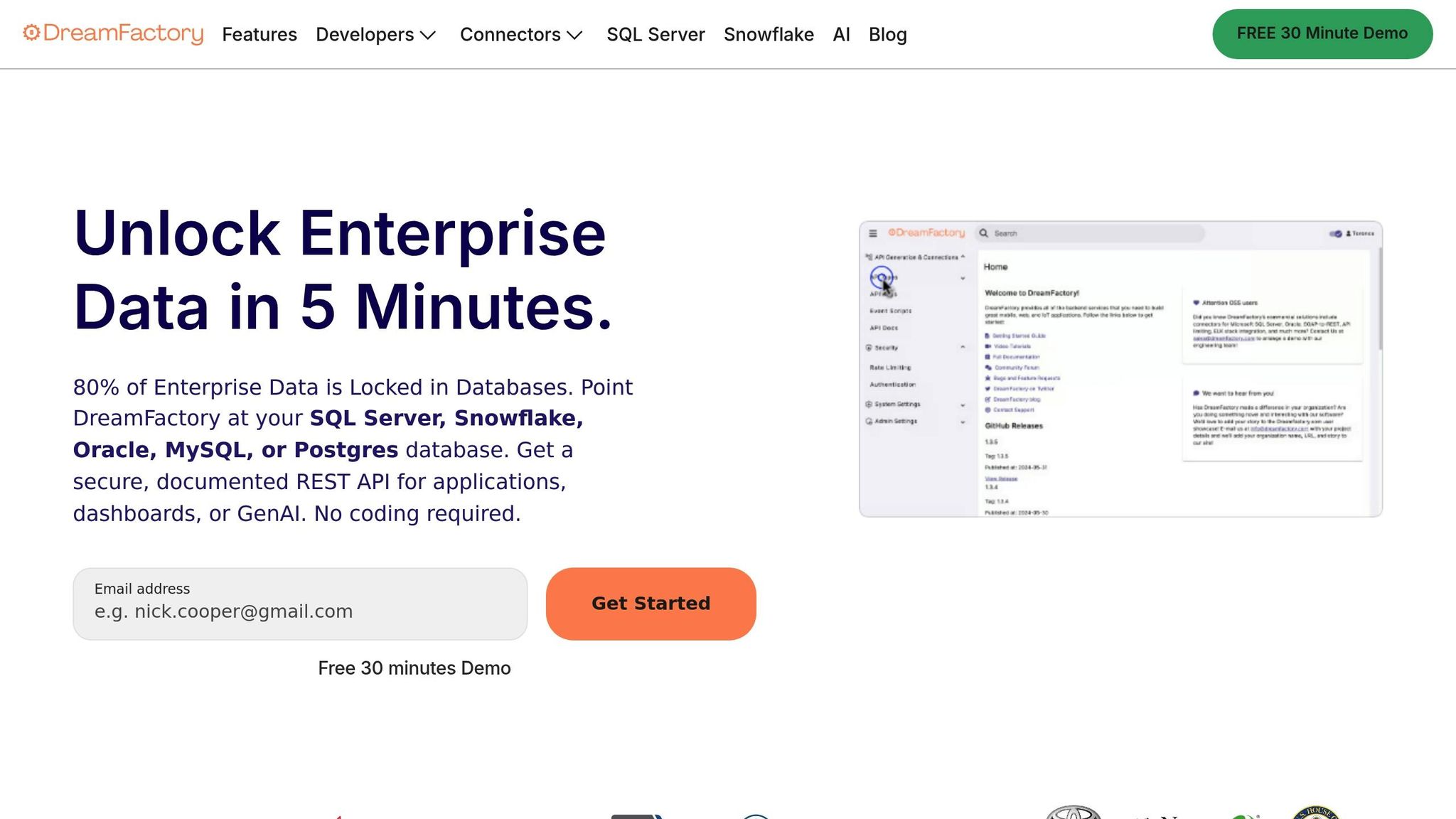
DreamFactory simplifies database integration by auto-generating REST APIs for over 20 database types, including MS SQL Server, PostgreSQL, and MySQL. This approach helps unlock data from legacy systems while keeping database access secure. Instead of embedding sensitive credentials in your app code, DreamFactory provides an abstraction layer with built-in role-based access control (RBAC). This allows you to define precise permissions for specific tables, columns, and HTTP methods, ensuring data remains private unless explicitly shared.
The platform supports various authentication methods, such as API keys, JWT, OAuth, OIDC, SAML, and LDAP/Active Directory, all managed through a centralized dashboard.
"Generate REST APIs in minutes, enable OAuth/OIDC or SAML/LDAP, apply per-endpoint roles, and layer on rate limiting and centralized logging so REST stays secure and scalable from day one." - DreamFactory
Performance is enhanced with features like per-endpoint caching and rate limiting, which reduce latency and prevent database overload. DreamFactory also enables seamless modernization by converting legacy SOAP services into REST APIs with just a click, making older systems compatible with today’s app-building tools.
Adalo's Support for Database Connections
Adalo takes these best practices further by securely and efficiently integrating external databases into its platform.
Adalo 3.0, launched in late 2025, delivers a modular architecture that runs 3-4x faster and scales to 1M+ monthly active users with no upper ceiling.
With Adalo's External Collections feature, databases like MS SQL Server and PostgreSQL can be connected and treated as standard internal collections, supporting full CRUD operations. For legacy systems without modern APIs, Adalo uses DreamFactory to create a secure bridge between your app and the database.
The setup process involves passing API keys securely through HTTP headers, such as the "X-DreamFactory-API-Key", ensuring credentials stay protected and don’t appear in URL logs. When configuring the connection, set the "Results Key" to "resource", as DreamFactory organizes record collections under that JSON key. For updates, the PATCH method is recommended to modify only the changed fields, avoiding the risk of clearing unspecified fields that can occur with PUT.
For enterprise teams, Adalo Blue offers advanced features tailored for internal operations apps. These include SSO, enterprise-grade permissions, and deep integration with legacy systems via DreamFactory. This combination allows businesses to create mobile interfaces for existing data without overhauling their entire data infrastructure - often achieving up to 65% savings compared to custom development.
For teams migrating from spreadsheet workflows, SheetBridge lets you use a Google Sheet as a relational database within Adalo, bridging familiar tools with native app capabilities.
Conclusion
Deciding between REST APIs and direct database access depends on your app's stage and specific needs. For prototypes and internal tools, direct database connections can be a quick and efficient choice. They offer straightforward access to your data, making them ideal when speed is your top priority. However, this simplicity comes with drawbacks - limited scalability and potential security risks make direct access unsuitable for anything beyond early development or internal use.
REST APIs, on the other hand, are designed to meet the demands of production-level apps. They provide security, scalability, and flexibility through features like OAuth, role-based access control, and API keys to safeguard your data. REST APIs also handle high traffic with tools like caching and load balancing, and they allow you to integrate data from multiple sources without overhauling your architecture.
"Direct Database Access is best suited for simple applications, internal tools, or prototypes where ease of implementation is key, and security or scalability concerns are minimal" - Terence Bennett, CEO, DreamFactory.
Modern tools have made REST API integration easier than ever. Platforms like DreamFactory allow for secure and rapid API setup, while app builders such as Adalo let you connect to enterprise databases via External Collections - eliminating the need for custom middleware. These advancements make transitioning to REST APIs a smoother process as your app matures.
Start with direct access for quick prototypes, but plan to shift to REST APIs for scalable, secure, and high-performing applications. This approach not only safeguards your data but also ensures your app can grow without costly rewrites later on.
Related Blog Posts
- How to Build Prototypes in Days with No-Code
- Integrating SQL Databases with No-Code Tools
- Best Practices for Scalable Internal Tools
- Ultimate Guide to No-Code App Development
FAQs
What security risks should I consider with direct database access in app development?
Direct database access comes with its share of security challenges that shouldn't be overlooked. One major risk is the potential for unauthorized access or tampering, especially if access controls are weak or login credentials are exposed. Without the right protections in place, issues like insecure connections can open the door to data breaches or even data loss.
There's also an increased risk of attacks like SQL injection, particularly when the database is accessible online without strong safeguards. Measures such as encryption, role-based access controls (RBAC), and consistent monitoring are crucial to defend against these threats. Without them, direct access can leave your database vulnerable.
An alternative approach is to use REST APIs, which add a protective layer by abstracting direct interactions with the database. APIs allow for centralized access control and support security features like API keys, OAuth, and rate limiting. While direct access might make some workflows easier, it requires strict security protocols to keep risks in check.
How do REST APIs enhance scalability for app-building platforms?
REST APIs are a game-changer for handling scalability. They enable efficient, stateless communication between your app and external systems, which means your app can process data requests without overloading its core infrastructure. This setup ensures your app stays responsive and performs smoothly, even when managing a high number of simultaneous users.
Another advantage of REST APIs is how easily they allow integration with external databases or services. This makes it possible to scale your app without overhauling its architecture. For platforms focused on app development, this adaptability is crucial for meeting fast-changing business demands.
When is it better to use direct database access instead of REST APIs for my app?
When your app demands quick data retrieval with minimal delay, direct database access often emerges as the smarter option. It works particularly well for tasks like read-only operations or straightforward queries, as it sidesteps the extra layers of processing that API calls introduce. This streamlined approach can be a game-changer in situations where speed and simplicity take precedence.
That said, direct access does come with trade-offs. It typically doesn't provide the same level of security, scalability, or adaptability you’d find with REST APIs. This method is best reserved for controlled environments or internal applications where these concerns are less pressing.