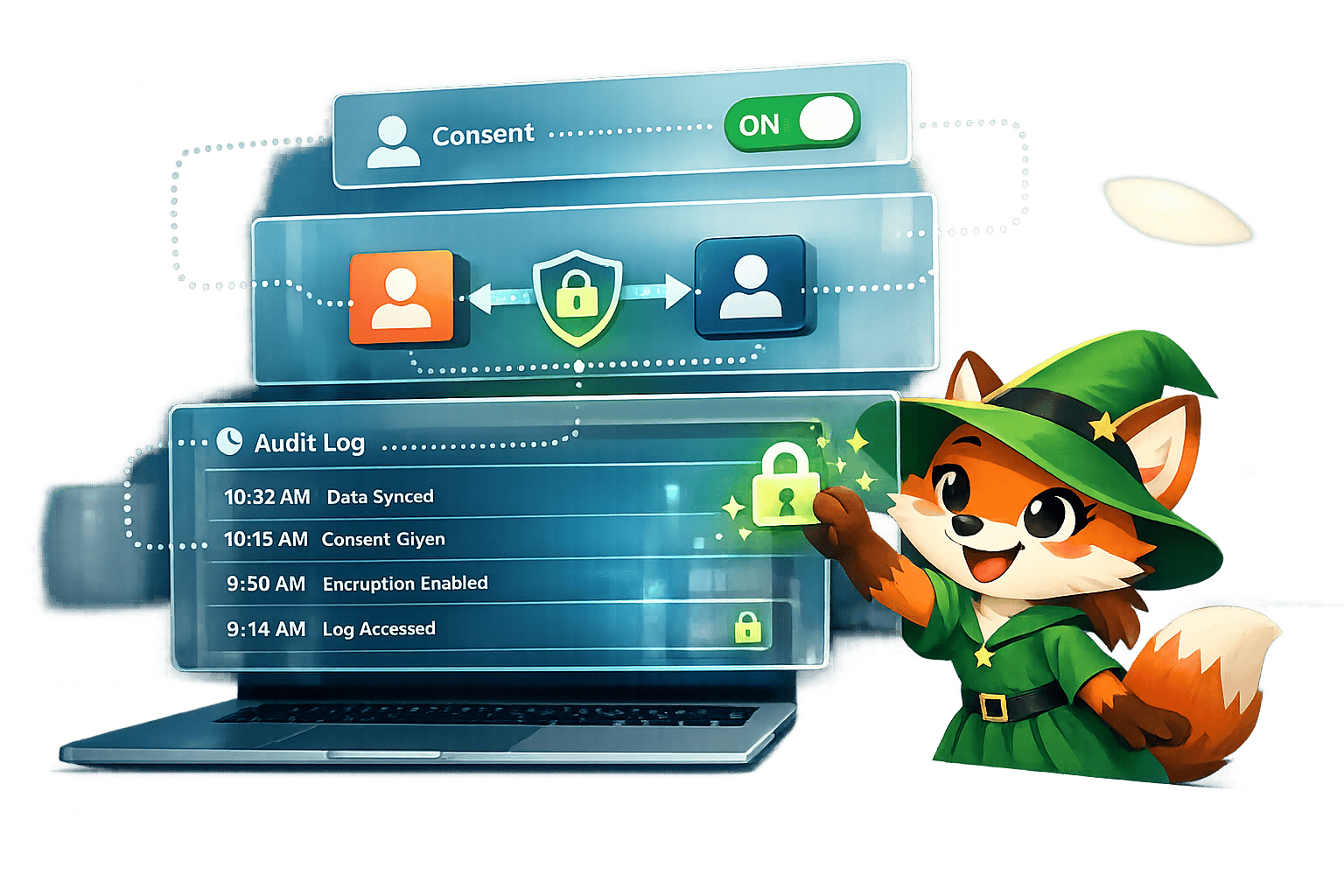
GDPR compliance is non-negotiable for apps handling user data. If your app syncs personal data across devices or platforms, it must meet strict security, transparency, and consent requirements. Failing to comply can result in fines up to €20 million or 4% of global revenue. This article outlines how Adalo, a no-code app builder for database-driven web apps and native iOS and Android apps—one version across all three platforms, published to the Apple App Store and Google Play, ensures secure, GDPR-compliant data synchronization.
Key Takeaways:
- GDPR Basics: Apps must process personal data securely, with user consent, and only transfer what's necessary.
- Data Sync Challenges: Real-time updates across platforms require encryption, access controls, and audit trails.
- Practical Solutions: Use role-based access controls, encrypt data in transit (TLS) and at rest (AES-256), conduct Data Protection Impact Assessments (DPIAs), and maintain detailed logs for data transfers.
- Adalo's Role: The platform simplifies compliance with built-in security features like database permissions, Single Sign-On (SSO), and scoped API tokens—all applied consistently across web and native mobile apps from a single codebase.
GDPR compliance isn't just about avoiding fines—it's about building trust and protecting user data. This guide breaks down actionable steps to align your app with GDPR regulations.
GDPR: What it means and compliance
GDPR Requirements for Data Synchronization
When transferring data between devices, databases, and platforms, your app must align with GDPR principles. These rules ensure the proper handling of personal information during every sync operation.
Lawfulness, Transparency, and Data Minimization
GDPR requires clear, explicit consent from users and a transparent privacy policy that outlines what data is collected, how it's used, and who it's shared with. Pre-checked boxes for consent? Not allowed.
Transfer only what's needed. The principle of data minimization means your app should sync only the data required for a specific task. For example, if a user is viewing their profile, they should only receive their data—not anyone else's. Similarly, when connecting to external databases, use filtered views like "Featured Products" or "This Week's Events" to limit the scope of data being synced. This not only reduces exposure but also enhances performance.
Adalo's infrastructure handles over 20 million data requests daily, and with the 3.0 infrastructure overhaul, the platform is now 3-4x faster than previous versions. This performance improvement means data minimization practices don't just protect privacy—they also contribute to a snappier user experience across all synced platforms.
Once consent is secured and data flows are minimized, the next step is ensuring accuracy and proper documentation during data transfers.
Data Accuracy, Retention Limits, and Accountability
Compliance doesn't stop at consent and minimal data transfer. Ensuring data accuracy, defining retention limits, and maintaining accountability are just as critical.
Keep updates precise. Use the PATCH method to update only the fields that have changed, avoiding accidental overwrites or data loss. This approach aligns with GDPR's accuracy requirements while reducing unnecessary data transmission.
Let users manage their data. Apps should provide tools for users to correct or delete their personal information. This could involve interfaces that allow real-time updates or deletions, such as components with the autosaveInput role, which directly modify database values on the spot.
Set clear retention and deletion rules. Your privacy policy should specify how long data is stored and how users can withdraw consent or request deletion. Automated workflows can help enforce these policies and streamline compliance.
Document everything. Accountability requires detailed records of data movements—what was transferred, when, and why. To enhance security and create an audit trail, use Personal Access Tokens (PATs) with scoped permissions, like data.records:read, instead of broad API keys. This approach restricts access and provides a clear log of system interactions during synchronization.
Building Privacy into Data Sync Workflows
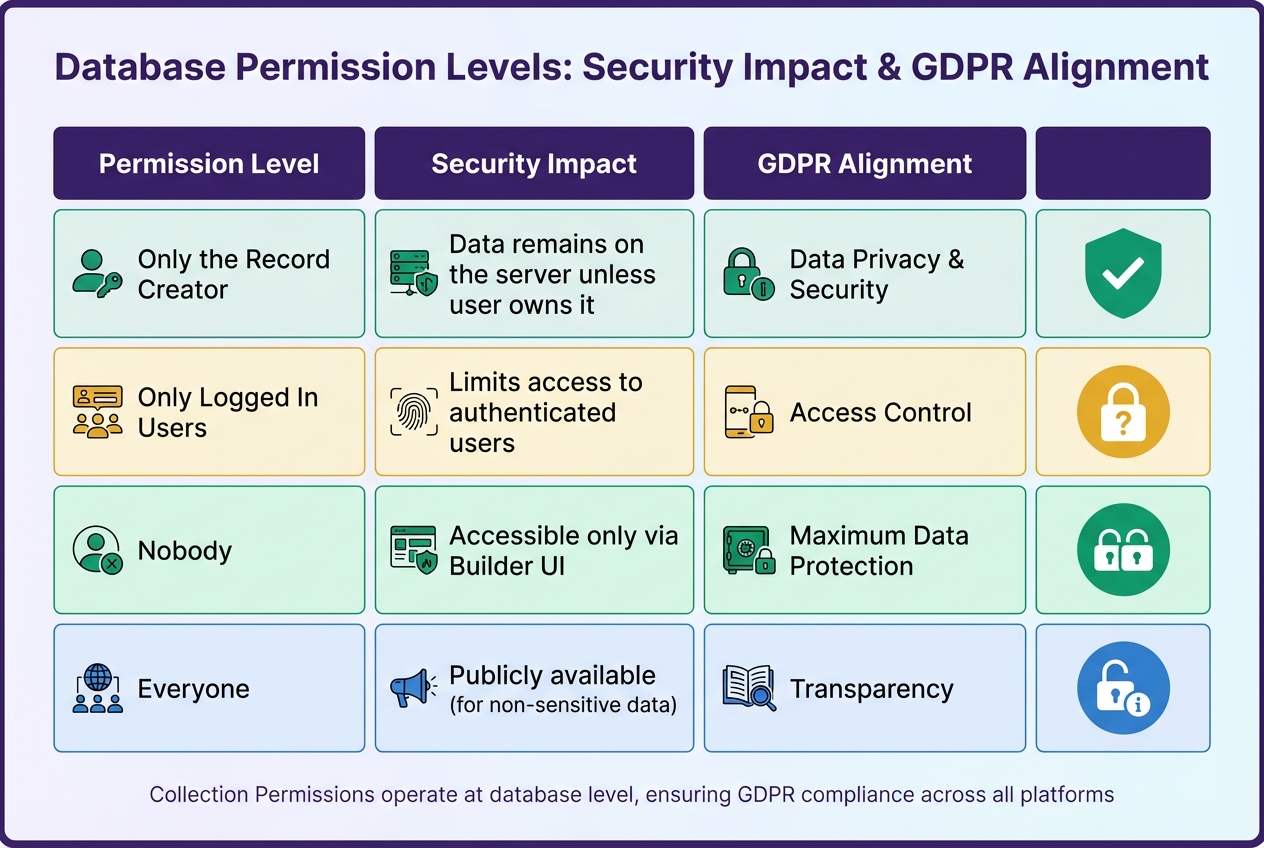
Adalo Database Permission Levels and GDPR Compliance Comparison
Incorporating privacy into your app's design from the start is essential, especially when it comes to syncing data. By addressing security at the database level, you can enforce strong role-based access controls while safeguarding user data.
Using Role-Based Access Control for Data Sync
Database permissions play a critical role in securing sensitive information. Adalo's "Collection Permissions" ensure that sensitive data never leaves the server unless explicitly allowed. This is a step above "Visibility Rules", which only hide elements in the user interface but don't protect the underlying data.
One key feature is the "Only the Record Creator" rule, which limits users to accessing only their own data. This aligns directly with GDPR requirements. For example, when a user logs in to view their profile, the system syncs only their records, ensuring no one else's data is exposed.
| Permission Level | Security Impact | GDPR Alignment |
|---|---|---|
| Only the Record Creator | Data remains on the server unless user owns it | Data Privacy & Security |
| Only Logged In Users | Limits access to authenticated users | Access Control |
| Nobody | Accessible only via Builder UI | Maximum Data Protection |
| Everyone | Publicly available (for non-sensitive data) | Transparency |
When connecting to external databases like Airtable, it's important to use Personal Access Tokens (PATs) with scoped permissions, such as data.records:read. This approach minimizes data exposure and provides a clear audit trail. Airtable phased out legacy API keys in February 2026, so updating to PATs is necessary to maintain secure connections.
In addition to access controls, protecting data requires encryption and secure transfer protocols.
Encryption and Secure Data Transfer Protocols
Strong encryption is a GDPR requirement, both for data in transit and at rest. Use TLS to secure data during transfer and AES-256 for stored information. Adalo and its integration partners meet high-security standards, including SOC 2 Type II certification, which ensures robust security and data integrity.
For apps that function offline, local databases need extra protection. Libraries like SQLCipher (for React Native/Expo) or ChaCha20 (for Web SDKs) can encrypt local databases on users' devices. Always store encryption keys in secure environments like the iOS Keychain or Android Keystore—never embed them directly in your app's code.
"Adalo only ever collects data to provide app functionality and to help us improve our products. This data is never used for tracking or advertising and is not rented, sold, or given to advertisers."
When updating records, use the PATCH method to modify only the fields that have changed. By combining these privacy-focused practices, you can create a GDPR-compliant data sync process that prioritizes user security.
How Adalo Supports GDPR Compliance
Adalo's AI-powered platform is designed to meet GDPR standards by safeguarding user data and simplifying compliance efforts. Its single-codebase structure ensures consistent security measures across web, iOS, and Android platforms, reducing the risk of compliance gaps. Here's a closer look at how the platform's unified architecture, advanced security features, and secure data integrations align with GDPR requirements.
Cross-Platform Sync with Single-Codebase Architecture
With Adalo, any updates made to your app are instantly applied across all platforms—no need for separate implementations. This streamlined approach guarantees a consistent user experience and simplifies compliance management, particularly during GDPR audits. When you configure consent mechanisms, database permissions, or encryption protocols, these protections apply consistently across iOS, Android, and web from a single build.
The platform's database-level permissions operate directly at the source, preventing unauthorized data transfers. Any changes to permissions are applied immediately across all platforms, supporting GDPR's "data protection by design" principle. This is particularly valuable compared to platforms that use web wrappers for mobile apps, where security configurations may need to be managed separately for each deployment target.
Following the Adalo 3.0 infrastructure overhaul in late 2025, the platform now offers unlimited database records on paid plans—no caps on data storage. This removes a common compliance concern where apps might need to delete user data prematurely due to platform limitations rather than legitimate retention policies. With no record limits, your data retention decisions can be driven purely by GDPR requirements and business needs.
Enterprise Permissions and User Authentication
Adalo Blue offers robust security features like Single Sign-On (SSO) and advanced role-based access controls, enabling organizations to enforce precise access permissions. These controls ensure that only authorized team members can view or modify user data, aligning with GDPR's accountability requirements. The platform also logs user activities automatically, providing an audit trail that helps organizations demonstrate compliance.
For added privacy, Adalo restricts access to sensitive fields (such as Email, Password, and Full Name) in the "Users" collection by default, limiting visibility to the record creator. These default settings offer a strong starting point for privacy protection, and organizations can further customize permissions to meet specific needs.
Ada, Adalo's AI builder, lets you describe what you want and generates your app. Magic Start creates complete app foundations from a description, while Magic Add adds features through natural language.
The AI-assisted building features, including Magic Start and Magic Add, generate apps with these security defaults already in place. When you describe what you want to build, the AI creates database structures with appropriate permission levels—you're not starting from an insecure blank slate.
Connecting to Compliant Data Sources
Adalo integrates seamlessly with GDPR-compliant data sources such as Airtable, Google Sheets, MS SQL Server, and PostgreSQL. By using secure Bearer token headers, the platform ensures that only authorized data requests are processed. To maintain compliance, organizations should verify their data source providers meet GDPR standards, such as hosting data on regional servers and having proper Data Processing Agreements in place.
For teams already using spreadsheets, SheetBridge enables you to turn a Google Sheet into an actual database for the easiest control without database-related learning curves. This is particularly useful for organizations transitioning from spreadsheet-based data management to app-based systems while maintaining GDPR compliance throughout the migration.
Adalo's infrastructure relies on scalable providers with built-in encryption services, including AES-256 for data at rest and TLS 1.2 (or higher) for data in transit. These measures meet GDPR's stringent data security requirements. Both Adalo and its major integration partners hold SOC 2 Type II certification, reflecting their commitment to strong security and data integrity practices. Furthermore, the platform's support for the PATCH method—updating only specific fields rather than entire records—helps maintain the data accuracy required by GDPR.
Steps to Implement GDPR-Compliant Data Sync
To establish GDPR-compliant data synchronization throughout your app's lifecycle, it's essential to prioritize privacy from the start. As the ICO puts it, "data protection by design is about considering data protection and privacy issues upfront in everything you do". This means incorporating privacy considerations into your initial design phase instead of treating them as an afterthought.
Running Data Protection Impact Assessments
For any high-risk data sync processes, such as large-scale data matching or using new technologies, conducting a Data Protection Impact Assessment (DPIA) is crucial. According to the ICO, a DPIA is "a way for you to systematically and comprehensively analyse your processing and help you identify and minimise data protection risks".
Start by using screening checklists to identify sensitive data flows and document every step of the sync process—from your app's UI to external systems. Evaluate whether the synced fields are necessary for the app's core functions and assess potential risks, such as data breaches or unauthorized access.
To mitigate these risks, implement measures like encryption, access controls, and pseudonymization. These safeguards not only reduce risks but also align with the DPIA process. Adalo's X-Ray feature can help identify performance issues in your data flows before they affect users—while primarily a performance tool, it also helps you understand how data moves through your app, which is valuable for DPIA documentation.
By conducting thorough assessments, you ensure a secure and user-focused approach to data synchronization.
Documenting Data Flows and Managing User Consent
Create a "PII Ledger" that tracks key details, including synced fields, their purposes, lawful bases (e.g., consent, contract, or legitimate interest), processors (like Adalo, Google Sheets, or external APIs), and retention periods. Visualize the flow of personal data across apps, organizations, and countries using data-flow diagrams. When transferring data to external platforms, confirm that your processors adhere to robust technical and organizational security measures.
To handle user requests, integrate Data Subject Request (DSR) handlers into your workflows. This ensures that when users ask for data deletion or exports, the changes propagate automatically across all synced platforms. In Adalo, opt for the most restrictive export methods, such as component data, action arguments, or autosaveInput, to adhere to data minimization principles.
The platform's modular infrastructure, which scales to serve apps with over 1 million monthly active users, maintains consistent data handling regardless of scale. This means your GDPR compliance measures work the same whether you have 100 users or 100,000—no need to rebuild your consent management as you grow.
By maintaining clear documentation and consent mechanisms, you can stay proactive with real-time monitoring and breach alerts.
Setting Up Breach Notifications and Sync Logs
Under GDPR, personal data breaches must be reported to the ICO within 72 hours of discovery. Article 5(1)(f) of the UK GDPR mandates that personal data be "processed in a manner that ensures appropriate security of the personal data, including protection against unauthorised or unlawful processing and against accidental loss, destruction or damage".
To meet these requirements, set up detailed audit logs for all automated workflows. These logs should clearly document how data is handled during synchronization. Strengthen security by verifying webhook signatures, restricting IP addresses, applying rate limits, and adding a "Sanitizer/Mapper" step to remove unnecessary fields, hash sensitive data like emails, or pseudonymize IDs before sending data downstream.
Regularly scan for vulnerabilities and implement a 3-2-1 backup strategy: keep three copies of data, store them on two different devices, and ensure one copy is off-site. These practices establish a strong technical foundation for GDPR-compliant data sync, minimizing risks across your system.
With Adalo's 99%+ uptime and infrastructure that processes over 20 million data requests daily, you have a reliable foundation for maintaining the continuous monitoring that GDPR compliance requires.
Comparing GDPR Compliance Across App Building Platforms
When evaluating platforms for GDPR-compliant app development, several factors matter: data storage limits, security certifications, and how consistently security measures apply across deployment targets.
| Platform | Database Limits | Native Mobile Apps | Starting Price | GDPR Considerations |
|---|---|---|---|---|
| Adalo | Unlimited on paid plans | Yes (true native) | $36/month | Single codebase ensures consistent security across platforms |
| Bubble | Limited by Workload Units | Web wrapper only | $59/month + usage | Web wrapper may require separate mobile security configs |
| Glide | Limited by row count | No App Store publishing | $60/month | No native app deployment limits distribution options |
| Softr | Limited per app/datasource | PWA only, no App Store | $167/month | Higher cost, still limited by records |
Database limits matter for GDPR. Platforms with record caps may force you to delete user data for technical reasons rather than legitimate retention policies. Adalo's unlimited database records on paid plans mean your data retention decisions are driven by compliance requirements, not platform constraints.
Native apps vs. web wrappers. Bubble's mobile solution wraps the web app, which can introduce security configuration complexity—you may need to manage security settings separately for web and mobile deployments. Adalo compiles to true native iOS and Android apps from a single codebase, ensuring your GDPR configurations apply consistently everywhere.
Note that many third-party platform comparisons and ratings predate Adalo 3.0's infrastructure overhaul in late 2025, which introduced the unlimited database records and 3-4x performance improvements. Current capabilities may differ significantly from older reviews.
Conclusion: Building GDPR-Compliant Apps for the Future
Non-compliance with GDPR can lead to penalties as high as 4% of global turnover or €20 million. But beyond avoiding fines, building apps that align with GDPR principles fosters trust and creates a foundation for long-term success. GDPR encourages a mindset of privacy by design, where privacy considerations are embedded from the very beginning of the development process.
Incorporating privacy by design means addressing compliance during the initial design stages rather than retrofitting solutions later. This involves practices like mapping data flows, implementing role-based access controls, using encryption, and maintaining detailed audit logs. These steps not only ensure compliance but also support scalable growth.
Adalo's single-codebase architecture makes achieving GDPR compliance simpler. When you configure features like consent mechanisms, database permissions, or encryption protocols, these protections are consistently applied across iOS, Android, and web platforms. With no record limits on paid plans and infrastructure that scales to support over a million monthly active users, your compliance measures grow with your user base without requiring architectural changes.
With features such as strict database permissions and secure token-based integrations, the platform provides a solid technical framework. However, as the data controller, it's your responsibility to configure these tools properly, conduct routine audits, and maintain thorough documentation. These actions ensure your app remains both secure and adaptable as regulations change.
On average, organizations save $1.7 million annually and launch apps 10 times faster compared to traditional development methods. By combining this efficiency with robust GDPR practices—like Data Protection Impact Assessments (DPIAs), effective consent management, breach notification protocols, and clear data retention policies—you can launch apps quickly while staying compliant and competitive. This proactive approach not only addresses current regulatory requirements but also positions your app to handle future challenges with confidence.
Related Blog Posts
- Things To Know When Creating a Medical App in the United States
- How to Create An App using Google Sheets as the actual Database?
- Top 7 Security Best Practices For No-Code Apps
- Real-Time Data Sync for No-Code Apps
FAQ
Why choose Adalo over other app building solutions?
Adalo is an AI-powered app builder that creates true native iOS and Android apps. Unlike web wrappers, it compiles to native code and publishes directly to both the Apple App Store and Google Play Store from a single codebase—the hardest part of launching an app handled automatically. With unlimited database records on paid plans and no usage-based charges, you get predictable costs as you scale.
What's the fastest way to build and publish an app to the App Store?
Adalo's drag-and-drop interface combined with AI-assisted building through Magic Start lets you generate complete app foundations from a simple description. The platform handles the App Store submission process, so you can go from idea to published app in days rather than months.
Can I easily build a GDPR-compliant app with data synchronization?
Yes, Adalo provides built-in features like database permissions, role-based access controls, and encryption protocols that apply consistently across all platforms. The single-codebase architecture means your GDPR configurations work identically on web, iOS, and Android without separate implementations.
What are the key GDPR requirements for data synchronization in apps?
GDPR requires apps to obtain explicit user consent, practice data minimization by syncing only necessary information, maintain data accuracy, and implement proper security measures like encryption. You must also document data flows, set retention limits, and provide users with tools to access, correct, or delete their personal data.
How does Adalo handle encryption and data security for GDPR compliance?
Adalo uses TLS encryption for data in transit and AES-256 encryption for data at rest, meeting GDPR's stringent security requirements. The platform and its major integration partners hold SOC 2 Type II certification, demonstrating commitment to robust security and data integrity practices.
What is a Data Protection Impact Assessment (DPIA) and when do I need one?
A DPIA is a systematic analysis of your data processing that helps identify and minimize data protection risks. You need one for high-risk data sync processes, such as large-scale data matching or implementing new technologies. It involves documenting sync processes, evaluating necessity, and implementing safeguards like encryption and access controls.
How quickly must GDPR data breaches be reported?
Under GDPR, personal data breaches must be reported to the relevant supervisory authority within 72 hours of discovery. To meet this requirement, you should set up detailed audit logs for all automated workflows and implement robust breach notification protocols in your app's data sync processes.
How much does it cost to build a GDPR-compliant app with Adalo?
Adalo's paid plans start at $36/month with unlimited database records and no usage-based charges. This compares favorably to Bubble at $59/month with Workload Unit limits, or Softr at $167/month with record restrictions. The predictable pricing helps with compliance budgeting.
Does Adalo's unlimited database help with GDPR compliance?
Yes, platforms with record caps may force you to delete user data for technical reasons rather than legitimate retention policies. Adalo's unlimited database records on paid plans mean your data retention decisions are driven purely by GDPR requirements and business needs, not platform constraints.
Can I migrate my existing app to Adalo for better GDPR compliance?
Yes, Adalo integrates with common data sources like Airtable, Google Sheets, MS SQL Server, and PostgreSQL. SheetBridge lets you turn existing Google Sheets into app databases. The platform's secure Bearer token authentication ensures data transfers during migration remain GDPR-compliant.