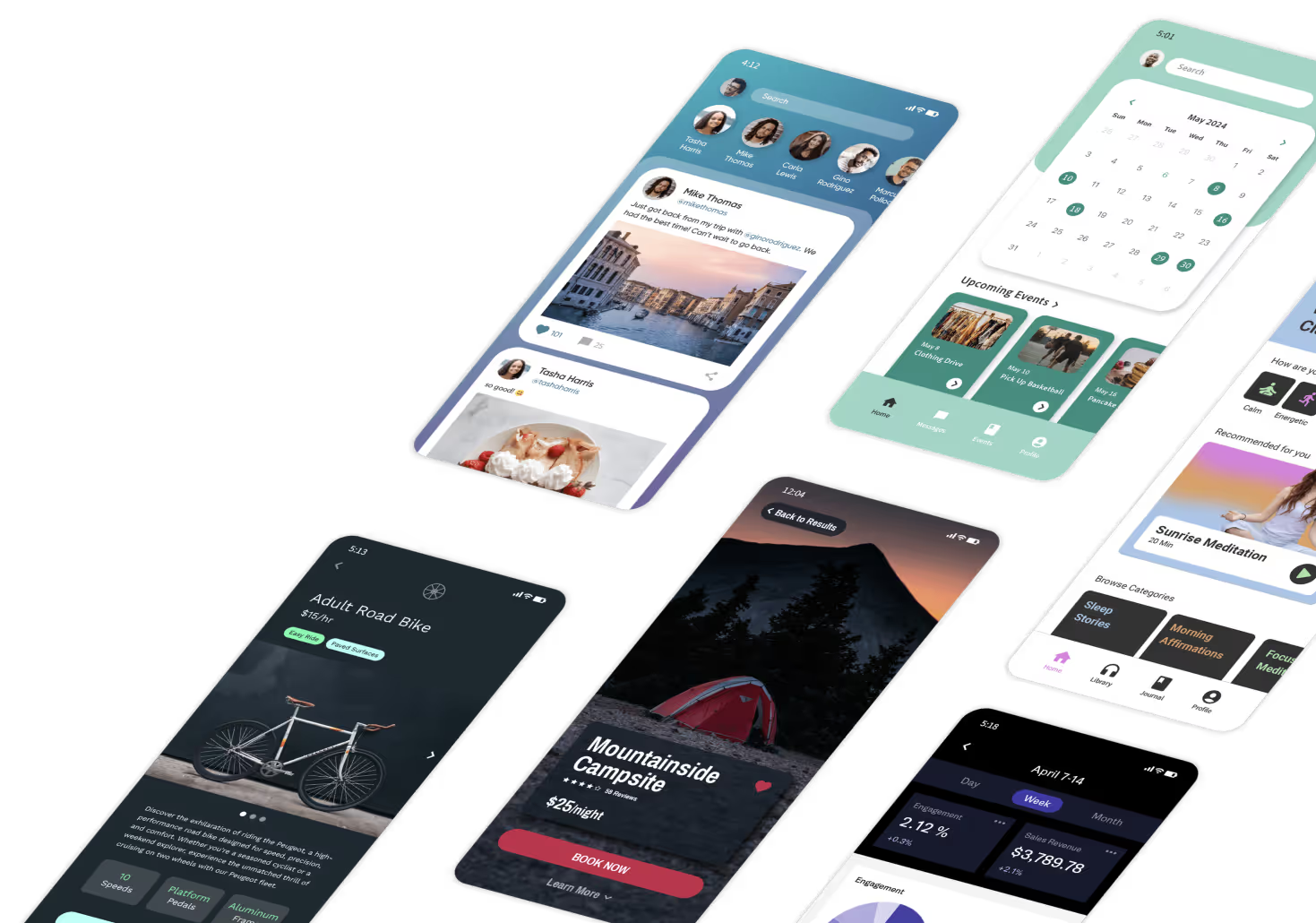
Why Adalo Works for Building Apps with Flexnet ERP Data
Adalo is a no-code app builder for database-driven web apps and native iOS and Android apps—one version across all three platforms, published to the Apple App Store and Google Play. This makes it the perfect solution for transforming your Flexnet ERP data into a powerful mobile application that your entire team can access from anywhere, without writing a single line of code.
When you publish your ERP-connected app to the app stores, you unlock capabilities that browser-based solutions simply can't match. Push notifications can alert warehouse staff about inventory changes in real time, sales teams can receive instant updates on order status, and managers can approve workflows on the go. By bringing your Flexnet ERP data into a native app experience, you're giving your team faster access to critical business information while maintaining the security and performance your enterprise requires.
Creating an app using Flexnet ERP data is easier than you might think, and you don't need coding skills to do it. By combining tools like Adalo, an AI-powered app builder, and DreamFactory, you can transform desktop-bound ERP data into a mobile-friendly app that works on both iOS and Android. Here's a quick summary of the process:
- Set Up Access to Flexnet ERP: Retrieve your API keys and database credentials from Flexnet ERP. Use DreamFactory to turn your ERP database into RESTful APIs.
- Create an Adalo Account: Sign up for Adalo and use its External Collections feature to connect to your ERP data via DreamFactory APIs.
- Configure DreamFactory: Generate APIs for your ERP database, set permissions with Role-Based Access Control (RBAC), and enable caching for better performance.
- Link Data to Adalo: In Adalo, connect your app to the DreamFactory APIs, map data fields, and use Adalo's tools to design user-friendly interfaces.
- Add Permissions and Security: Use Adalo's user authentication and DreamFactory's RBAC to control data access based on user roles.
- Test and Deploy: Test CRUD operations (Create, Read, Update, Delete) and publish your app for web, iOS, and Android.
Adalo is one of the only platforms that lets you build a single app and deploy it to the web, iOS, and Android without rebuilding for each platform. This approach saves time, reduces costs, and puts real-time ERP data in your team's hands—whether for inventory management, sales tracking, or other workflows, such as building a secure client portal.

6-Step Process to Create an App Using Flexnet ERP Data
Why Adalo Works for Building Apps with Flexnet ERP Data
Adalo is an AI-powered app builder for database-driven web apps and native iOS and Android apps—one version across all three platforms, published to the Apple App Store and Google Play. This makes it the ideal solution for turning your Flexnet ERP data into a mobile app that your team can access from anywhere, without writing a single line of code.
When you publish your ERP-connected app to the app stores, you unlock powerful capabilities like push notifications to alert team members about inventory changes, order updates, or critical workflow events. Having your business data available in a native app means faster access, better user engagement, and real-time visibility into operations—whether your staff is on the warehouse floor, visiting clients, or working remotely.
With the Adalo 3.0 infrastructure overhaul launched in late 2025, the platform is now 3-4x faster than before, with modular infrastructure that scales with your app's needs. Paid plans include no data caps, meaning your ERP-connected app can grow without hitting storage constraints. This is particularly important for ERP integrations where data volumes can expand rapidly as your business scales.
Setting Up Flexnet ERP and Adalo
To connect Flexnet ERP data with Adalo, you'll need your Flexnet credentials and an Adalo workspace ready to handle external data. Let's break down how to retrieve your Flexnet credentials and set up your Adalo account.
Getting Flexnet ERP Access and API Keys
Flexera One operates on an API-first framework (OpenAPI Specification), making it possible to fetch data programmatically. The first step is identifying your regional zone, as Flexera uses different base URLs based on your account's location.
Here's how to determine your zone: log into your Flexera One account and check the URL in your browser. If the URL contains app.flexera.com, your account is in North America; if it ends with .eu, you're in Europe; and if it ends with .au, you're in the Asia Pacific region. Use the appropriate API base URL when integrating with Adalo:
| Flexera Zone | UI Login URL | API Base URL |
|---|---|---|
| North America (NAM) | app.flexera.com | api.flexera.com |
| Europe (EU) | app.flexera.eu | api.flexera.eu |
| Asia Pacific (APAC) | app.flexera.au | api.flexera.au |
Once logged in, locate your Organization ID (orgID) in the address bar. It appears after /orgs/ in the URL (e.g., app.flexera.com/orgs/12345/). Copy this number, as it's required for constructing API endpoint paths. Additionally, gather your database credentials (host, port, database name, username, and password). These will be essential when using DreamFactory to create REST APIs from your Flexnet database.
Creating Your Adalo Account
Head over to Adalo's website and sign up. Once logged in, click "Create New App" and choose the platform(s) you want to target. With over 3 million apps created on the platform, Adalo's visual builder has been described as "as easy as PowerPoint"—making it accessible even if you've never built an app before.
To integrate external ERP data, you'll need Adalo's External Collections feature. This feature is available on paid plans starting at $36/month, which includes unlimited database records and no usage-based charges. External Collections enable your app to perform CRUD (Create, Read, Update, Delete) operations on external data via APIs.
Ada, Adalo's AI builder, lets you describe what you want and generates your app. Magic Start creates complete app foundations from a description, while Magic Add adds features through natural language.
After creating your app, go to the Database tab and add your Flexnet data as an External Collection. The platform's AI-assisted features can help streamline this process—Magic Start can generate complete app foundations from a description, while Magic Add lets you add features by simply describing what you want. Once your External Collection is configured, you can move on to configuring DreamFactory to generate the APIs you'll need for the integration.
Connecting Flexnet ERP to Adalo Using DreamFactory
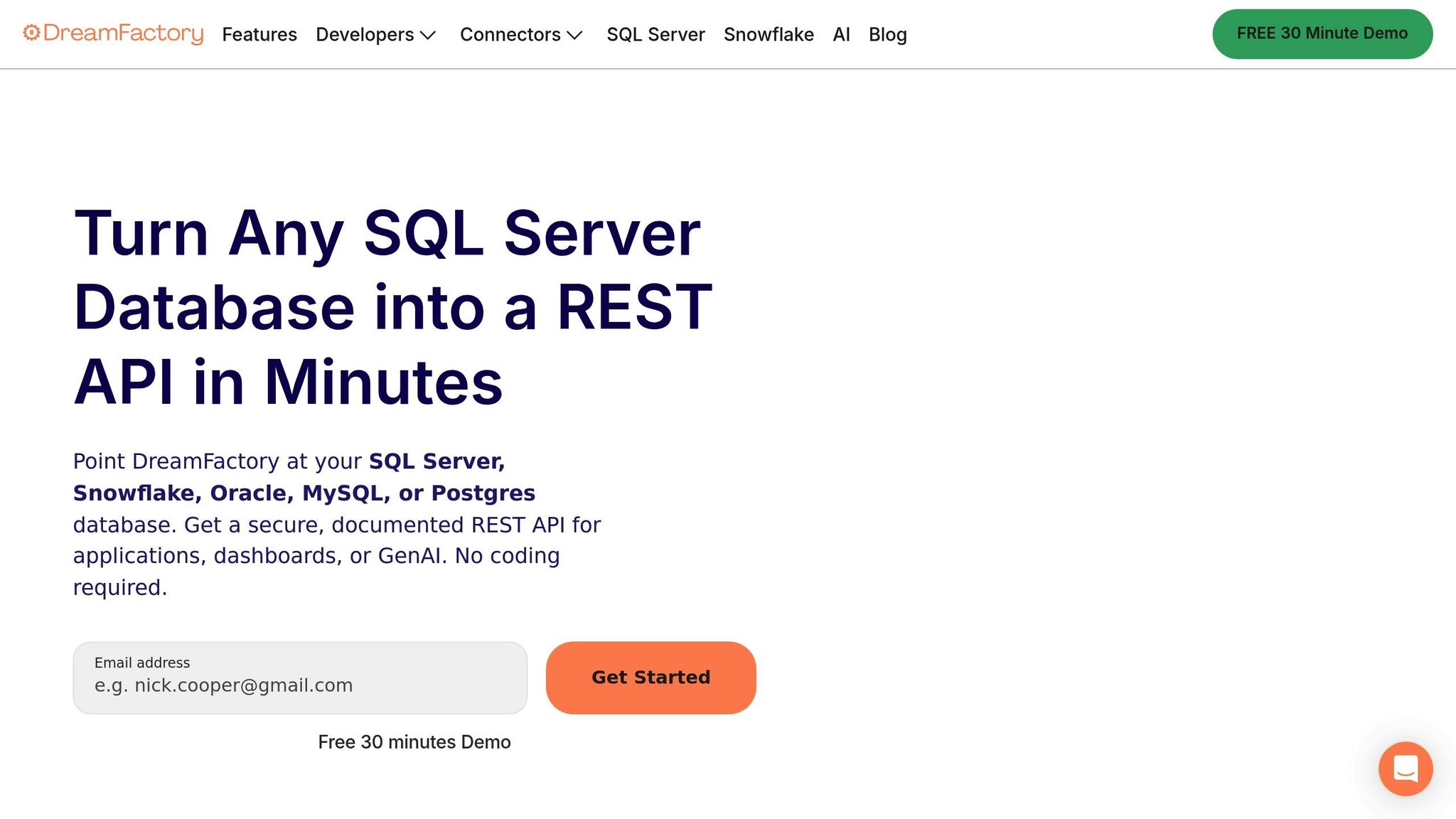
DreamFactory serves as a bridge between your Flexnet ERP database and Adalo, making it easy to create RESTful APIs without writing backend code. Even if your ERP doesn't have built-in REST endpoints, DreamFactory connects directly to databases like SQL Server, Oracle, or MySQL, turning them into APIs that Adalo can work with seamlessly.
"APIs act as a middleman between your ERP and whatever application wants to access the ERP data, like Excel or another one of your business apps." – Spencer Nguyen, DreamFactory
DreamFactory supports over 20 databases, including legacy systems like IBM DB2 and SAP HANA. It automatically scans the database to identify tables, collections, and relationships, generating fully documented CRUD endpoints instantly. Security is handled through Role-Based Access Control (RBAC), allowing you to set detailed permissions for specific tables or fields linked to an API key.
Creating APIs for Flexnet ERP Data in DreamFactory
To get started, log in to DreamFactory and create a new Service. Choose the database type that matches your Flexnet ERP setup—such as SQL Server, Oracle, or MySQL. Give your service a name, using only lowercase letters without spaces or special characters.
Next, input your database credentials, including the host, port, database name, username, and password. If your database is behind a firewall, you can set up an SSH tunnel on the DreamFactory server. For example, map a local port like 3307 to the ERP's port 3306 for secure access.
Once connected, DreamFactory will generate OpenAPI (Swagger) documentation for every table in your database. You can view and test these endpoints in the API Docs tab. The URL format for endpoints looks like this:
https://<df-url>/api/v2/<service-name>/_table/<table-name>Run test queries to confirm everything is working—500 errors usually indicate issues with credentials or firewall settings.
Next, define access permissions by creating a Role. Specify which tables the Adalo app can access (e.g., _table/inventory/*) and the allowed HTTP methods, such as GET, POST, PUT, or DELETE. Then, create an App in DreamFactory, assign it the role, and generate an API key. Be sure to copy this key—you'll need it later.
For better performance with large datasets, enable Data Retrieval Caching in the service configuration. This helps reduce the load on your ERP system while speeding up response times. Combined with Adalo's 3-4x faster infrastructure, your ERP-connected app will deliver responsive performance even with substantial data volumes.
Setting Up Adalo to Connect with Flexnet ERP
In Adalo, go to the Database tab and select Add External Collection. Configure the connection with the following details:
- API Base URL: Use
https://<df-url>/api/v2/<service-name>/_table/<table-name>, replacing placeholders with your DreamFactory instance details and the specific table name, such asinventoryorsales_orders. - Authentication Header: Add
X-DreamFactory-API-Keyas the header name and paste the API key you copied earlier. - Results Key: Set this to
resourcein the "Get All" endpoint settings, as DreamFactory wraps record collections under this key.
| Configuration Item | Required Value |
|---|---|
| Header Name | X-DreamFactory-API-Key |
| Results Key | resource |
| Endpoint Format | .../api/v2/{service_name}/_table/{table_name} |
Before finishing, make sure Cross-Origin Resource Sharing (CORS) is enabled in DreamFactory for your Adalo app's domain. In the DreamFactory console, navigate to Config > CORS and add your Adalo app's origin.
To test the connection, use Adalo's External Collection settings. If everything is set up correctly, you'll see a preview of your Flexnet data. You can then map this data to your UI components using Adalo's Magic Text feature.
For managing large datasets, use DreamFactory's parameters like limit and offset to implement pagination. Since Adalo's paid plans have no record limits, you can work with extensive ERP datasets without worrying about hitting storage caps. If you need to filter data—say, to show only active inventory items—add a filter parameter to the API URL, like this:
?filter=(status=active)
Organizing and Displaying Flexnet ERP Data in Your App
Once your Flexnet ERP data is linked through DreamFactory, the next step is setting it up in Adalo to ensure your app presents the information effectively. In Adalo, start by creating Collections (tables) for key data categories like Inventory, Sales Orders, and Customers. Each collection should include specific properties (fields) that correspond to your ERP database columns, such as SKU numbers, order dates, or customer names.
Importing and Structuring Flexnet Data in Adalo
When you configure an External Collection in Adalo, the platform automatically identifies field properties based on the JSON response from DreamFactory. However, make sure each field has at least one populated record; empty fields won't be detected during setup.
To connect related data, use Relationships within the Database tab. For instance, if each Sales Order is tied to a specific Customer, establish a One-to-Many relationship where one Customer "has many" Sales Orders. This method ensures you can display customer details alongside their order history without duplicating data. Since all data originates from your ERP, define these relationships within External Collections to maintain consistency.
You can also use API query filters (e.g., ?filter=(status=active)) to retrieve only the data you need. For example, adding this filter limits the results to active items, improving both performance and usability. With Adalo's unrestricted database storage on paid plans, you can maintain comprehensive ERP data connections without worrying about hitting caps.
Once your data is structured in Collections, you're ready to design user-friendly screens for displaying it in your app.
Designing Screens to Display Flexnet Data
Adalo offers various list types—Simple, Card, or Custom Lists—to present data depending on your needs. For instance, Simple Lists work well for text-heavy data, while Card Lists are ideal for visuals and key details. Use Magic Text to dynamically bind fields from your Flexnet Collections to UI elements like labels, buttons, or images. This ensures that the app updates automatically with the latest ERP data.
A common screen flow begins with a list view for browsing records, which links to a detail screen displaying more comprehensive information. For example, an inventory app might feature a Card List showing products with images and stock levels. Tapping on a product could lead to a detail page with supplier information, reorder points, and transaction history.
To handle large datasets, enable pagination on custom lists to navigate beyond the 100-record limit per page, ensuring smooth performance even with thousands of records. Adalo's visual builder can display up to 400 screens at once on a single canvas, making it easy to manage complex ERP-connected apps with multiple data views and workflows.
When building forms to update Flexnet data, always use the PATCH method instead of PUT. PATCH allows you to update specific fields without overwriting the rest of the record. This keeps your app functioning as a dynamic, real-time extension of your Flexnet ERP system.
Adding Logic, User Authentication, and Permissions
After successfully displaying your Flexnet ERP data in the app, the next step is controlling who can access what. Without proper safeguards, sensitive information could be at risk. Adalo provides a built-in Users collection to handle app-level authentication (using Email, Password, and Username), while DreamFactory secures your ERP connection through Role-Based Access Control (RBAC) tied to API keys. Together, these layers ensure users only access data their roles allow.
Setting Up Role-Based Access to Flexnet Data
To begin, configure roles in DreamFactory to limit database operations. Then, pass the appropriate API key through the X-DreamFactory-API-Key header in Adalo. For example, you could create a "Warehouse Staff" role with permissions to GET and PATCH Inventory tables but block access to Sales Orders or Customer records. The API key reflects these RBAC permissions and determines what data users can fetch or modify. Keep the API key private, and rotate it immediately if it's ever exposed.
On the frontend, you can filter data based on the logged-in user by linking Adalo's default Users collection to your External Collection. For instance, if each Sales Order includes an "Owner" field, establish a One-to-Many relationship where one User "has many" Sales Orders. Utilize Magic Text in Adalo to filter lists by the logged-in user. This setup ensures users only see ERP data relevant to their role, even if the API key itself allows broader access.
The combination of Adalo's user authentication and DreamFactory's RBAC creates a robust security model. Unlike platforms that require complex custom code for permission management, this approach provides enterprise-grade access control without writing a single line of code.
Enabling CRUD Operations for Flexnet ERP Data
With role-based controls in place, you can securely enable CRUD (Create, Read, Update, Delete) actions for interacting with Flexnet ERP data. In Adalo, configure five endpoint actions to handle these operations: Get All Records, Get One Record, Create a Record, Update a Record, and Delete a Record. Each action corresponds to a specific HTTP method and is managed by the DreamFactory role tied to the API key.
| CRUD Operation | HTTP Method | Adalo Endpoint Action | Key Configuration Detail |
|---|---|---|---|
| Create | POST | Create a Record | Sends new data to the Base URL. |
| Read | GET | Get All / Get One | Set the Results Key to resource for DreamFactory. |
| Update | PATCH | Update a Record | Use PATCH to modify only specified fields. |
| Delete | DELETE | Delete a Record | Targets a specific record ID at the endpoint. |
When enabling updates, always use the PATCH method instead of PUT. PUT overwrites the entire record, potentially erasing fields not included in the update request, whereas PATCH updates only the specified fields.
Before going live, thoroughly test each CRUD operation using a simple form or list in Adalo to confirm that changes sync correctly with your Flexnet ERP backend. Make sure every column in your ERP has at least one populated record during setup—Adalo's API detection might ignore empty fields, making them unavailable for mapping.
Testing and Deploying Your Flexnet ERP App
After your app integrates Flexnet ERP data and manages user permissions, the next step is testing to ensure everything functions as intended before launching. Testing is critical—Gartner reports that 55% to 75% of ERP projects fail to meet their goals. Adalo offers tools to preview your app and simplify deployment across web, iOS, and Android platforms.
Testing Your App with Flexnet ERP Data
Begin by using Adalo's Test Connection feature in the External Collections setup. This step ensures your API Base URL and Authorization Headers are correctly configured. Test all CRUD (Create, Read, Update, Delete) operations: Get All Records, Get One Record, Create a Record, Update a Record, and Delete a Record. This confirms seamless data flow between Adalo and Flexnet ERP.
Testing on real devices is essential for mobile-specific features. While Adalo's web Preview mode works well for basic layout and functionality checks, mobile features must be tested directly on iOS and Android devices. For instance, use two devices with separate logged-in users to test push notifications, as users cannot receive notifications triggered by themselves. Simulate various network conditions to ensure consistent ERP data performance.
Adalo's X-Ray feature can help identify performance issues before they affect users. This AI-powered diagnostic tool highlights potential bottlenecks in your app's data handling, which is particularly valuable when working with large ERP datasets. Address any flagged issues before deployment to ensure optimal performance.
User Acceptance Testing (UAT) is another crucial step. Involve key stakeholders to confirm the app supports your business workflows. As Adalo Developers Documentation emphasizes, "Make sure you fully test your components before you publish. This saves a lot of headaches on everyone's part".
Publishing to Web and App Stores
Once testing is complete, Adalo makes publishing straightforward. For web deployment, you can publish to a custom domain or use an Adalo subdomain. Web apps provide instant browser access without requiring installation, though they may lack features like offline mode or camera integration.
For iOS and Android deployment, Adalo generates true native app files ready for submission to the Apple App Store and Google Play Store. This requires a paid Adalo plan starting at $36/month, which includes unlimited app store updates once published—no additional charges for pushing updates to your users.
Unlike platforms that create web wrappers for mobile apps, Adalo compiles to native code. This means better performance, smoother animations, and access to device features that web wrappers can't reliably provide. One build publishes to web, iOS App Store, and Android Play Store, and updates apply instantly across all platforms.
Monitor API rate limits to maintain smooth performance. Many integrations impose limits, such as 5 requests per second. After deployment, continue improving your app's performance and user experience based on feedback. With Adalo's unlimited usage on paid plans, you won't face unexpected charges as your user base grows.
Use Cases for Flexnet ERP-Powered Apps
Once you've linked Flexnet ERP to Adalo and built your app, you can address real-world operational challenges across your business. These ERP-powered apps replace manual processes, cut down on errors, and give teams instant access to critical data—anytime, anywhere. Let's look at two examples that highlight how these apps can improve inventory management and sales operations.
Building an Inventory Tracking App
An inventory tracking app can replace outdated spreadsheets and static desktop systems with real-time, mobile-friendly tools. Warehouse staff can use their smartphone cameras to scan barcodes, instantly updating inventory levels in Flexnet ERP without the need for manual entry. If stock dips below a preset threshold, the app can send automatic push notifications—via Adalo—to alert procurement teams and initiate reordering workflows.
This system eliminates the version control headaches that often come with shared spreadsheets. Multiple users can simultaneously view and update inventory, with all changes syncing seamlessly between the app and the ERP database. Even when offline, field teams can log inventory data, which syncs once they reconnect.
The app can also include GPS location tagging to track items across different warehouses, photo uploads to document damages, and automated alerts for processed shipments. These features help reduce stock discrepancies and enable quicker responses to inventory changes.
With Adalo's modular infrastructure that scales to serve apps with 1 million+ monthly active users, your inventory app can grow alongside your business. Whether you're managing a single warehouse or a global distribution network, the platform maintains performance without hitting speed constraints under load.
Creating a Sales Management Dashboard
A sales management dashboard powered by ERP data can give your sales team the tools they need to work smarter. With mobile access to customer histories, order tracking, and pipeline metrics, sales reps no longer need to rely on office-based systems. They can pull up full customer profiles, log notes, and update deal stages on the go, with all changes syncing back to Flexnet ERP in real time—keeping everyone on the same page.
By 2026, it's estimated that 70% of new enterprise applications will be built with low-code and no-code platforms. Unlike traditional CRM systems, which often require desktop access and cumbersome navigation, a custom-built app can provide only the most relevant data—whether filtered by territory, sorted by deal size, or organized by follow-up date. Role-based access ensures that sales reps see only their assigned accounts, while managers can view broader performance metrics and forecasts.
Additional features can include automated follow-up emails triggered by deal stages, push notifications for upcoming renewals, and GPS check-ins to confirm field visits. Companies using app-driven workflows report saving an average of 250 hours per person annually, freeing up sales teams to focus on closing deals rather than tedious data entry.
Adalo's AI-assisted building features can accelerate dashboard development. Magic Add lets you describe new features in natural language—"add a chart showing monthly sales by region"—and the platform generates the component. This means you can iterate quickly based on sales team feedback without starting from scratch each time.
Comparing Adalo to Alternative Approaches
When building an ERP-connected mobile app, you have several platform options. Here's how Adalo compares to alternatives for this specific use case:
| Platform | Starting Price | Native Mobile Apps | Database Limits | Best For |
|---|---|---|---|---|
| Adalo | $36/month | Yes (true native) | Unlimited on paid plans | ERP-connected apps with app store publishing |
| Bubble | $59/month | Web wrapper only | Limited by Workload Units | Complex web apps with heavy customization |
| Glide | $60/month | No app store publishing | Limited by rows | Simple spreadsheet-based apps |
| FlutterFlow | $70/month per user | Yes | Requires separate database | Technical users comfortable with code |
For ERP integrations specifically, Adalo's combination of External Collections, native mobile compilation, and unlimited database records makes it well-suited for the task. Bubble offers more customization but uses web wrappers for mobile—which can introduce performance challenges at scale and means updates don't automatically sync across web and mobile versions. FlutterFlow requires users to set up and manage their own database infrastructure, adding complexity and potential scalability issues if not configured optimally.
Note that most third-party platform comparisons and ratings predate Adalo 3.0's infrastructure overhaul in late 2025, which delivered significant performance improvements and removed previous limitations.
Conclusion
Now that you've tackled setup, data organization, authentication, and testing, you're ready to roll out your ERP-powered app. With the right tools and steps, transforming Flexnet ERP data into a mobile app doesn't require deep coding knowledge. By setting up API access through DreamFactory, linking those endpoints to Adalo's External Collections, designing user-friendly screens, and managing user permissions, you can build an app that puts real-time ERP data right at your team's fingertips.
Adalo's drag-and-drop interface makes it easy to design, connect, and publish your app for web, iOS, and Android—all from a single build. This means you can focus on solving business problems instead of getting stuck in complex coding tasks. The platform takes care of backend infrastructure, user authentication, and CRUD operations, turning static ERP data into actionable insights.
These apps go beyond eliminating the hassles of desktop-only systems and manual spreadsheets. They ensure your data is always in sync, helping your team work more efficiently while maintaining a single, reliable source of truth across your organization. Features like real-time data access, barcode scanning for warehouses, and GPS-enabled sales check-ins turn ERP data into dynamic tools that drive productivity.
With Adalo's External Collections feature available on paid plans starting at $36/month—including no data caps and unlimited usage—you can create apps that grow with your business and adapt to changing needs. It's a cost-effective way to bring the power of ERP data to the palm of your hand.
FAQ
Why choose Adalo over other app building solutions?
Adalo is an AI-powered app builder that creates true native iOS and Android apps from a single codebase. Unlike web wrappers, it compiles to native code and publishes directly to both the Apple App Store and Google Play Store—the hardest part of launching an app handled automatically. Paid plans include unlimited database records and no usage-based charges, making costs predictable as your app scales.
What's the fastest way to build and publish an app to the App Store?
Adalo's drag-and-drop interface and AI-assisted building features let you go from idea to published app in days rather than months. Magic Start generates complete app foundations from descriptions, and the platform handles the complex App Store submission process—certificates, provisioning profiles, and store guidelines—so you can focus on your app's features.
Is it possible to build an app using Flexnet ERP data without code?
Yes, Adalo enables you to create apps using Flexnet ERP data without any coding. By using DreamFactory to create REST APIs from your ERP database and Adalo's External Collections feature, you can build fully functional apps that display and update your ERP data in real-time across web, iOS, and Android.
What is DreamFactory and why do I need it to connect Flexnet ERP to Adalo?
DreamFactory serves as a bridge that converts your Flexnet ERP database into RESTful APIs that Adalo can consume. It supports over 20 databases including SQL Server, Oracle, and MySQL, and automatically generates fully documented CRUD endpoints with built-in security features like Role-Based Access Control.
Do I need separate apps for web, iOS, and Android when building with Flexnet ERP data?
No, Adalo's single-codebase design means you only need to build one app that works across web, iOS, and Android platforms. Updates automatically apply to all platforms simultaneously, eliminating the need to maintain separate versions and significantly reducing development time and costs.
How do I secure sensitive ERP data in my Adalo app?
Security is handled through a combination of Adalo's built-in user authentication and DreamFactory's Role-Based Access Control (RBAC). You can create specific roles that limit database operations to certain tables or fields, and API keys reflect these permissions to control what data users can access or modify.
How much does it cost to build a Flexnet ERP app with Adalo?
Adalo's paid plans start at $36/month and include External Collections for ERP integration, unlimited database records, and no usage-based charges. This is more affordable than alternatives like Bubble ($59/month with usage limits) or FlutterFlow ($70/month per user plus separate database costs).
How long does it take to test a Flexnet ERP app before deployment?
Testing timelines depend on the app's complexity, but plan for several days to a week. This includes validating API connections, testing CRUD operations, running multi-platform tests on real devices, and conducting User Acceptance Testing with stakeholders. Adalo's X-Ray feature can help identify performance issues before they affect users.
What practical business apps can I build with Flexnet ERP data and Adalo?
Common use cases include inventory tracking apps with barcode scanning and automatic reorder notifications, sales management dashboards with real-time customer data and pipeline metrics, and field service apps with GPS-enabled check-ins. These apps replace manual spreadsheets and desktop-only systems with mobile-friendly, real-time tools.
Can Adalo handle large ERP datasets?
Yes. Adalo's paid plans have no record limits, and the platform's modular infrastructure scales to serve apps with over 1 million monthly active users. Combined with DreamFactory's caching and pagination features, you can work with extensive ERP datasets while maintaining responsive performance.