
Connecting databases to apps is often a slow, complex process involving custom coding, security setups, and ongoing maintenance. DreamFactory changes that. It instantly generates secure REST APIs for over 20 database types - like MySQL, MongoDB, and Snowflake - saving developers weeks of work. It also handles schema updates, security protocols like RBAC and OAuth, and even creates OpenAPI documentation automatically.
For teams building database-driven applications, platforms like Adalo, a no-code app builder for database-driven web apps and native iOS and Android apps—one version across all three platforms, published to the Apple App Store and Google Play, can leverage these auto-generated APIs to speed up development even further.
Here’s what makes DreamFactory stand out:
- Automatic API Generation: Connect a database, and it builds APIs in seconds.
- Built-In Security: Includes API keys, JWT, and role-based access control.
- Support for Legacy Systems: Works with older databases lacking APIs.
- Advanced Features: Query filtering, virtual fields, and rollback options.
- Enterprise Integration: Links seamlessly with platforms like Adalo for app development.
No Code API Tutorial | Build a Secure REST API in 5 Minutes with DreamFactory
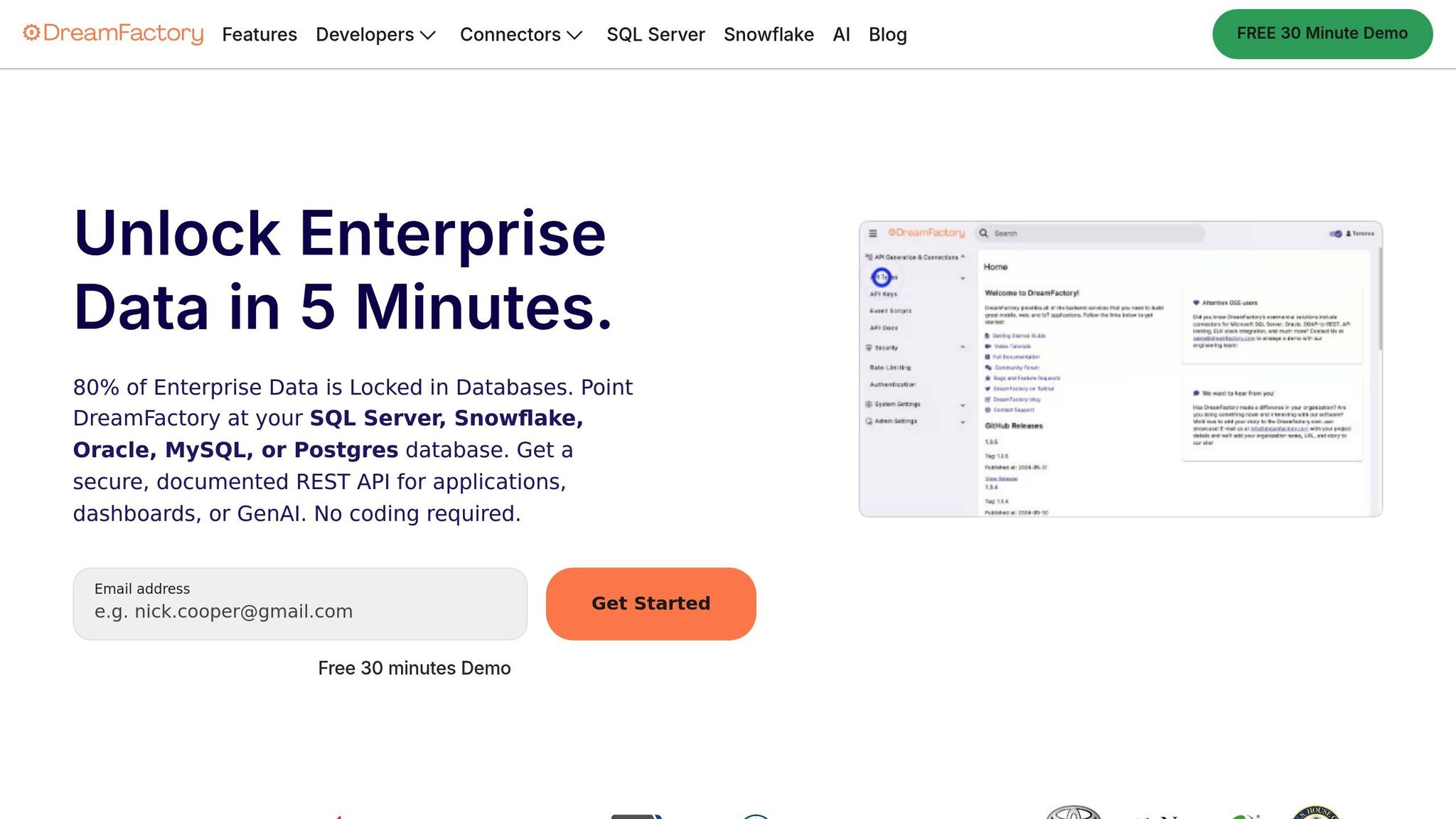
Problems with Manual Database API Creation
Creating APIs manually for database connections introduces a host of challenges that can bog down development and drive up costs. These issues generally fall into three main areas: the significant time and resources required, the complexities of implementing security, and the ongoing headaches of maintenance. Together, these hurdles lead to longer timelines, intricate setups, and a constant need for upkeep.
Time and Resource Requirements
Developing APIs manually is a time-intensive process, often stretching from weeks to months for just one database connection. As Frank Tilleli from ConnectPointz puts it, "Establishing integration can take weeks at a time to ensure every connection is secure and effective". Beyond the lengthy timelines, the task demands specialized knowledge in system architectures, authentication protocols, and the unique requirements of various databases. The burden only grows as documentation for each endpoint piles up. A 2020 report highlights this importance, with 83% of respondents identifying API integration as a core component of their business strategy.
Security and Authentication Difficulties
Security is another major pain point. Developers must manually create connectors for standards like Active Directory, LDAP, OAuth, SAML 2.0, and OpenID Connect. This involves generating and validating JWTs, managing signatures, and handling sessions - tasks that become even more complex when implementing Role-Based Access Control (RBAC). Each user, endpoint, and database table requires specific permissions, all of which need to be meticulously configured and tested. Without automation, these repetitive processes increase the risk of vulnerabilities. The stakes are high: in 2022, the average cost of a data breach in the United States reached $9.44 million.
Scalability and Maintenance Problems
Scaling manual APIs introduces even more complications. Theo Despoudis from Thriftly explains, "When you deploy APIs on a large scale... coordinating these elements manually is unsustainable". Performance suffers without tools like connection pooling or caching, and any schema change requires manual updates to code, documentation, and regression tests. Even minor adjustments can trigger a "domino effect", disrupting interconnected systems. For teams juggling multiple databases - such as MySQL, Oracle, MongoDB, and Snowflake - the need to create distinct backend logic for each system only adds to the complexity, making long-term maintenance a daunting task.
How DreamFactory Automates API Creation
DreamFactory simplifies the process of creating APIs, saving both time and effort while reducing potential errors. Instead of manually coding APIs, the platform generates REST APIs instantly when you connect a database. All you need to do is head to the "Services" tab in the admin console, choose your database type, and fill in the required connection details. DreamFactory then analyzes your database schema and builds a fully functional REST API on the spot.
"By embracing this automated approach, development teams can shave weeks if not months off the development cycle, and in doing so greatly reduce the likelihood of bugs or security issues." - DreamFactory Guide
Automatic API Generation for Multiple Databases
DreamFactory supports over 20 different databases for automatic REST API generation. This includes SQL databases like MySQL, PostgreSQL, Microsoft SQL Server, and Oracle, as well as NoSQL options such as MongoDB, Apache Cassandra, and AWS DynamoDB. It even works with cloud data warehouses like Snowflake and enterprise platforms like Salesforce. With its "blended" REST interface, developers can use consistent RESTful commands - like CRUD operations - across various database types without needing to rewrite code.
Additionally, DreamFactory generates interactive OpenAPI (Swagger) documentation for all endpoints, covering everything from stored procedures to schema management operations. This automation not only simplifies API creation but also ensures secure and scalable connections.
Built-In Security and Access Control
Once APIs are generated, DreamFactory ensures they’re secure by default. Every API is private and requires an API key for access. The platform’s Role-Based Access Control (RBAC) allows you to set detailed permissions, limiting access to specific tables, views, stored procedures, or HTTP methods, such as read-only operations. For authentication, DreamFactory supports JSON Web Tokens (JWT), which are passed through the X-DreamFactory-Session-Token header.
The platform also integrates seamlessly with enterprise identity providers like Active Directory, LDAP, Okta, Auth0, and SAML 2.0. It even offers native OAuth support for services like Google, Facebook, GitHub, and Twitter.
Advanced Query and Integration Features
DreamFactory’s APIs go beyond basic functionality, handling complex operations without requiring extra code. The platform automatically detects foreign key relationships and assigns aliases, enabling table joins with a single API call. Developers can refine their queries using filters, sorting, pagination, and field selection through query parameters.
DreamFactory also supports virtual fields, which leverage database functions like concat() or date() to manipulate data at the API layer without altering the database schema. For added reliability, you can append rollback=true to ensure that if part of a batch operation fails, all changes are rolled back automatically.
Using DreamFactory with Adalo
DreamFactory simplifies the process of connecting databases to Adalo, addressing the often tedious task of manual API creation. By leveraging Adalo's External Collections feature, app builders can directly link to APIs generated by DreamFactory. This allows real-time database access for platforms like MS SQL Server, PostgreSQL, MySQL, and even older systems such as IBM DB2 and SAP SQL Anywhere.
Connecting Adalo Apps to Databases via DreamFactory
To set up your database connection, start by configuring it in DreamFactory. Add your database credentials, create a role with defined access permissions (e.g., _table/* for table access), and generate an API key. In Adalo, create an External Collection and point it to your DreamFactory API endpoint (e.g., https://api.example.com/api/v2/mysql/_table/employees). Be sure to include your API key in the X-DreamFactory-API-Key header.
Important: In Adalo, set the "Results Key" field to resource, as DreamFactory organizes all record collections under this JSON key. Before finalizing the connection, use DreamFactory's built-in Swagger documentation to test your endpoints. This streamlined integration brings DreamFactory's automated API capabilities directly into your Adalo apps.
Accessing Legacy Systems Without APIs
Many older enterprise systems, such as legacy ERPs or custom databases, lack built-in REST APIs, making integration a challenge. DreamFactory bridges this gap, enabling seamless connections to these systems. One standout feature is Virtual Fields, which allows you to manipulate or format data server-side before it reaches Adalo. For example, you can combine first_name and last_name fields or reformat dates, all without altering the database structure.
Example: Adalo Blue for Enterprise Operations
Adalo Blue takes these integrations a step further, providing enterprise teams with tools for rapid app development. DreamFactory's automation enhances this process by enabling secure, efficient connections to on-premise databases through SSH tunnels. Additionally, enabling Data Retrieval Caching in DreamFactory improves performance for apps handling heavy traffic. For complex operations, DreamFactory supports database transactions using the rollback=true parameter, ensuring that multi-table operations are executed as a single, reliable unit.
| Integration Component | Enterprise Benefits |
|---|---|
| RBAC | Limit user access to specific tables or read-only permissions in Adalo |
| SSH Tunnels | Securely connect to on-premise enterprise databases |
| Virtual Fields | Format or combine data without altering database schemas |
| Caching | Speed up response times for high-demand apps |
| Transactions | Maintain data accuracy in complex operations |
With these capabilities, enterprise teams can build secure, production-ready internal apps in just days. DreamFactory's integration ensures that these apps meet the performance, security, and reliability standards essential for critical business operations.
Manual API Development vs. DreamFactory
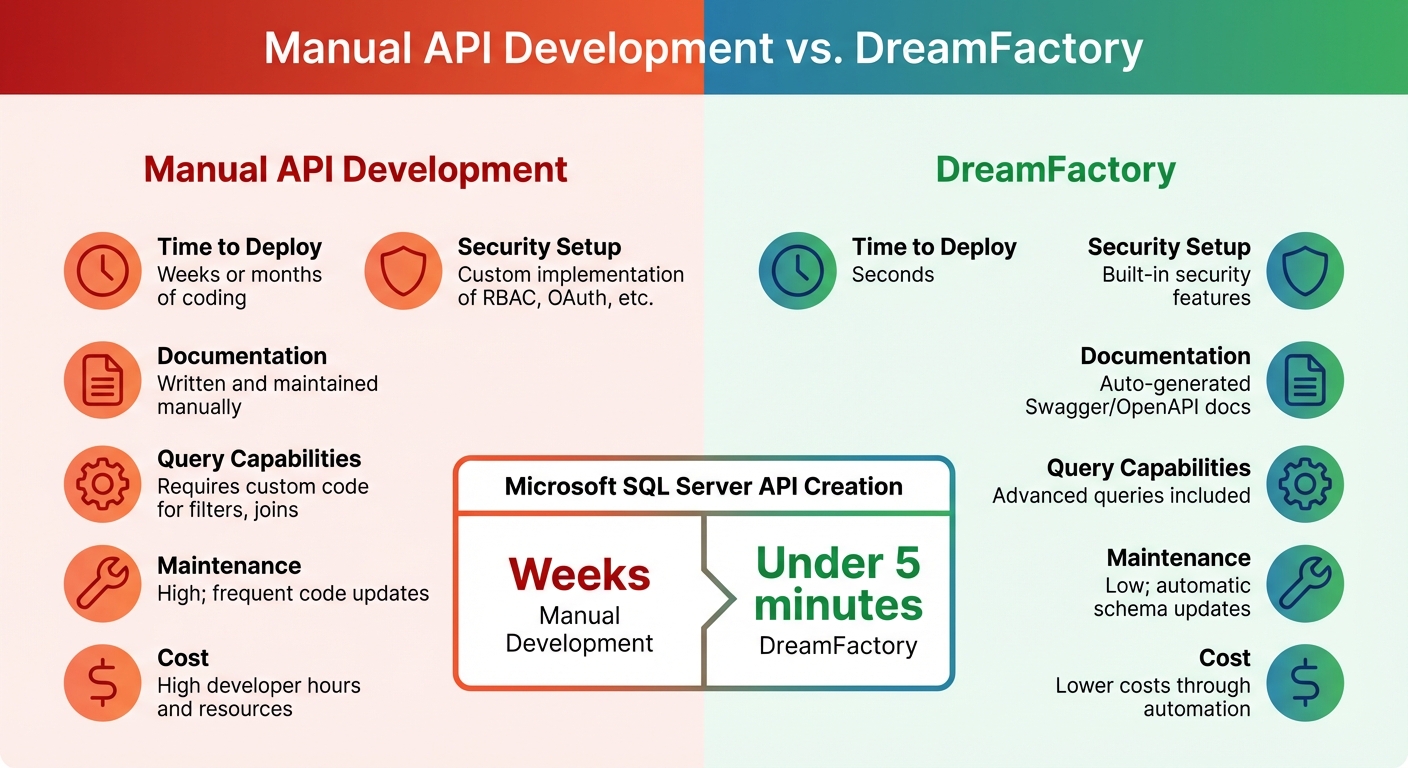
Manual API Development vs DreamFactory Comparison
Let's break down the challenges of manual API development and see how DreamFactory simplifies the process through automation.
When building APIs manually, developers must write backend code for every database connection. This involves setting up authentication, formatting requests, parsing responses, and managing security protocols. DreamFactory eliminates this tedious process by generating REST APIs for over 20 databases in just seconds.
The time savings are staggering. For instance, creating a Microsoft SQL Server API manually can take weeks. With DreamFactory, the same task is done in under 5 minutes. Spencer Nguyen, Content Moderator at DreamFactory, aptly describes it:
"DreamFactory is like the Swiss Army knife of API management. It helps you generate REST APIs for a bunch of different data sources without a lot of hassle."
Another challenge with manual APIs is the ongoing maintenance. Any schema updates require developers to revise and re-deploy code repeatedly. DreamFactory sidesteps this issue with automatic schema discovery, where changes are instantly reflected without any extra coding.
Security is another critical concern. Manual APIs are prone to issues like SQL injection and authentication flaws, as developers must implement safeguards like Role-Based Access Control (RBAC), OAuth, and password hashing from scratch. DreamFactory, on the other hand, provides these features out-of-the-box, ensuring a secure and standardized approach.
Comparison Table
| Factor | Manual API Development | DreamFactory |
|---|---|---|
| Time to Deploy | Weeks or months of coding | Seconds |
| Security Setup | Custom implementation of RBAC, OAuth, etc. | Built-in security features |
| Documentation | Written and maintained manually | Auto-generated Swagger/OpenAPI docs |
| Query Capabilities | Requires custom code for filters, joins | Advanced queries included |
| Maintenance | High; frequent code updates | Low; automatic schema updates |
| Cost | High developer hours and resources | Lower costs through automation |
This comparison clearly shows how DreamFactory streamlines API development, making it faster, safer, and far easier to maintain. It’s a game-changer for anyone looking to build scalable and secure applications.
Conclusion
DreamFactory transforms API development from a time-consuming process into something that can be completed in minutes. By automatically generating secure REST APIs for over 20 different databases, it removes the need for manual backend coding, which often delays app launches. With features like Role-Based Access Control, automated password hashing, and JWT management, DreamFactory also addresses common security challenges in custom API development.
This streamlined approach makes it easy to integrate with modern app platforms. When paired with Adalo's External Collections feature, DreamFactory allows businesses to connect their apps to massive datasets - think millions of records - without requiring a custom backend. For enterprise teams using Adalo Blue, it’s an essential tool for accessing legacy systems that lack modern APIs.
"By embracing this automated approach, development teams can shave weeks if not months off the development cycle, thereby reducing bugs and security vulnerabilities."
The combination of DreamFactory and Adalo delivers real advantages. DreamFactory handles the heavy lifting on the backend, while Adalo simplifies front-end development across web, iOS, and Android - all from a single build. The result? Production-ready apps in days or weeks, not months, and at a fraction of the typical cost.
Whether you’re modernizing outdated systems, connecting enterprise databases, or looking for a faster way to turn data into apps, DreamFactory is the automation layer that makes it happen. Plus, it supports compliance with standards like GDPR and HIPAA. By automating backend development, DreamFactory not only saves time but also enhances the value of integrating powerful backend solutions with Adalo’s agile app-building platform.
Related Blog Posts
- How To Build an App incorporating Data From Any Legacy System?
- Integrating SQL Databases with No-Code Tools
- DreamFactory for ERP Integration: How It Works
- REST APIs vs Direct DB Access for No-Code Apps
FAQs
How does DreamFactory ensure the security of its generated APIs?
DreamFactory prioritizes API security with strong authentication and access controls. By default, all APIs are private and safeguarded through role-based access control (RBAC), enabling you to set detailed permissions for specific users or roles.
It supports a variety of authentication methods, including API keys, user-specific authentication, and advanced systems like OAuth, LDAP, Active Directory, SAML 2.0, OpenID Connect, and social identity providers. These tools ensure that only authorized individuals can access your APIs, providing a solid layer of protection.
Can DreamFactory work with older databases that don’t have APIs?
DreamFactory makes it easy to connect with older databases that lack built-in APIs. It automatically creates secure, fully-documented REST APIs for nearly any data source, including legacy systems. This means you can streamline your workflows and link your data to other platforms or applications effortlessly.
How does DreamFactory enhance app development with Adalo?
DreamFactory streamlines app development with Adalo by making it simple to connect your app to external databases like MySQL, PostgreSQL, SQL Server, and Snowflake. It takes care of generating secure REST APIs automatically, which you can easily integrate into Adalo’s External Collections. This removes the need for heavy backend coding, helping you develop faster.
On top of that, DreamFactory includes powerful API management tools such as role-based access controls, API key management, and advanced security measures like OAuth and JWT. These features help safeguard sensitive data and ensure compliance with enterprise-level security standards.
By automating API creation and handling complex database operations, DreamFactory frees up developers to focus on crafting scalable, user-friendly apps. When paired with Adalo’s visual app builder, this combination cuts development time and costs, allowing you to launch apps faster without compromising on quality or functionality.