Startups need to move fast without burning through runway on development costs. This guide compares the top AI app builders and evaluates which ones can take you from idea to the App Store without a developer on payroll.
Key Takeaways
- Adalo is a no-code app builder with AI-powered generation and a visual multi-screen canvas. It publishes native iOS and Android apps to the Apple App Store, Google Play Store, and web from a single project. $36/mo flat with no usage caps. Built-in relational database with 500 records on the free plan. Best for startups that need to ship an MVP fast without hiring developers.
- Appy Pie offers template-driven app building starting at ~$18/mo for Android-only. Quick for startups whose app fits an existing template, but limited customization means you hit walls as product requirements evolve. iOS requires the ~$60/mo tier.
- Bubble is a web app builder with deep backend logic and 5,300+ plugins. Powerful for complex web-only SaaS, but Workload Unit charges make costs unpredictable as you scale. Most teams hire consultants ($40-$125/hour), which burns startup budgets quickly.
- FlutterFlow generates cross-platform apps via Google's Flutter framework. Full code export is valuable for developer-led startups planning to bring engineering in-house. $80/mo/seat with no database included — costs add up fast for small teams.
- Lovable is a prompt-led web app builder that generates React + Supabase apps from text descriptions. Fast for first prototypes, but the generated code needs developer maintenance — trading subscription costs for ongoing engineering overhead.
Introduction
Startups operate under a constraint that changes everything about technology decisions: limited runway. Every month spent building is a month of burn rate with no revenue. Every dollar spent on platform fees, contractor hours, or infrastructure is a dollar not spent on customer acquisition. The app builder you choose does not just affect your product — it affects how long your company survives.
Most startup founders discover this the hard way. They pick a platform based on a demo, build for two months, then realize it cannot publish to the App Store, or that usage-based pricing will cost five figures once real users arrive, or that the "no-code" tool actually requires a developer to get anything production-ready. Switching platforms mid-build means starting over — weeks or months of work lost during the window when speed matters most.
This guide compares five AI app builders through the lens that matters for startups: how fast you can ship, how much it actually costs over 12 months, whether it produces something you can put in front of paying customers, and what happens when your usage scales. Every platform is profiled honestly. Some are excellent for specific startup scenarios and wrong for others. The goal is to help you make the right choice before you commit your runway.
Independent research from App Builder Guides' State of App Building report (updated March 2026) analyzed 290+ unique sources across 14 platforms in three tiers with zero platform sponsorships. Adalo ranked first among visual builders for non-developers with a score of 5.94/10.
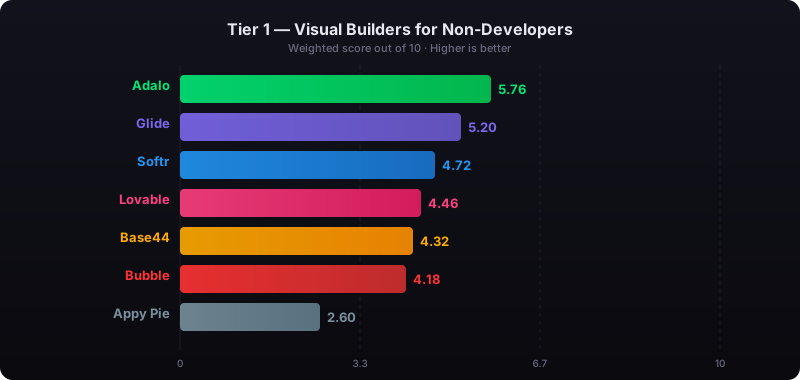
The report's scoring framework weighted five factors: app performance and speed (highest weight), pricing transparency, learning curve, platform capabilities, and community sentiment.
See also: Compare all no-code app builders | AI app builder solutions | Adalo for startup founders
How We Evaluated
Every platform was assessed against criteria specific to startup needs — speed, cost predictability, and the ability to get a real product in front of real users:
- Time to first shipped product: How fast can a non-technical founder go from idea to a live app that customers can download or access? Days, weeks, or months?
- Total cost at 12 months: What does it actually cost after a full year, including platform fees, databases, wrapper services, developer accounts, and any usage-based charges?
- Flat vs usage-based pricing: Can you predict costs at the start, or do they scale unpredictably as your user base grows?
- App Store publishing: Can you ship to the Apple App Store and Google Play, or are you limited to web? Startups building consumer products need native mobile presence.
- AI capabilities: Can AI generate your starting point and iterate on it, or is building entirely manual?
- Self-service maintenance: Can the founder update the app without calling a developer, or does every change require technical help?
- Scale path: When you get traction, does the platform grow with you, or do you need to rebuild on something else?
Adalo — Ship an MVP to the App Store Without Hiring
Price: Free plan available; $36/mo for app store publishing with unlimited usage | Output: Native IPA for iOS, native APK for Android, plus web — from one project
Ada, Adalo's AI builder, is designed for exactly the problem startups face: getting from idea to live product as fast as possible. Describe what you want to build, and Magic Start generates a complete app foundation — screens, navigation, database schema, and logic. Magic Add lets you layer on features through natural language ("add user onboarding," "add a payment screen," "add push notifications"). Visual AI Direction lets you point at elements on the multi-screen canvas and instruct changes directly, which is faster than describing everything in text. X-Ray identifies performance issues before they reach your users.
Adalo 3.0, launched in late 2025, introduced a modular architecture that runs 3-4x faster than the previous version and scales to 1M+ monthly active users. For startups, this means you do not need to plan a platform migration when you find product-market fit. The same tool that builds your MVP handles your growth.
Why startups choose it: The combination of AI-powered generation, visual editing, native mobile output, and flat pricing is specifically valuable for startups. You can go from describing your app to having it live in the Apple App Store and Google Play within days, not months. Your costs stay at $36/month whether you have 10 users or 10,000. There is no surprise bill when your Product Hunt launch brings a traffic spike.
Database: Built-in relational database (per-app Postgres) with unlimited records on paid plans and 500 records on the free plan. No Firebase or Supabase setup required. For teams migrating from spreadsheet workflows, SheetBridge lets you use a Google Sheet as a relational database within Adalo.
Pricing: Starter at $36/month (billed annually) includes native iOS and Android publishing, unlimited database records, and zero usage caps — no per-user, per-action, or per-record charges. No overage fees on any tier.
Strengths:
- Idea to App Store in days, not months — AI generates the foundation, you refine visually
- $36/mo flat covers everything: native iOS, Android, web, database, hosting, no usage caps
- Non-technical founders can build and maintain the app without developers
- One codebase for all three platforms — no separate iOS and Android builds
- Visual multi-screen canvas shows the entire app at once for faster iteration
- Scales to 1M+ MAU without replatforming
Honest limitations: Adalo is purpose-built for database-driven apps — marketplaces, booking systems, CRMs, social platforms, and directories. If your startup is building a complex web-only SaaS with highly custom backend logic, Bubble gives you more flexibility there. Code export is available only on the enterprise plan within Adalo Blue, while FlutterFlow includes it on lower tiers — relevant if your plan is to bring developers in-house later.
Best for: Non-technical founders who need to ship an MVP to the App Store fast and preserve runway with predictable flat-rate pricing.
Learn more about Adalo's AI app builder
Appy Pie — Template-Driven Builder for Simple MVPs
Price: ~$18/app/mo (Android only); ~$60/app/mo for iOS + Android | Output: Template-based mobile apps
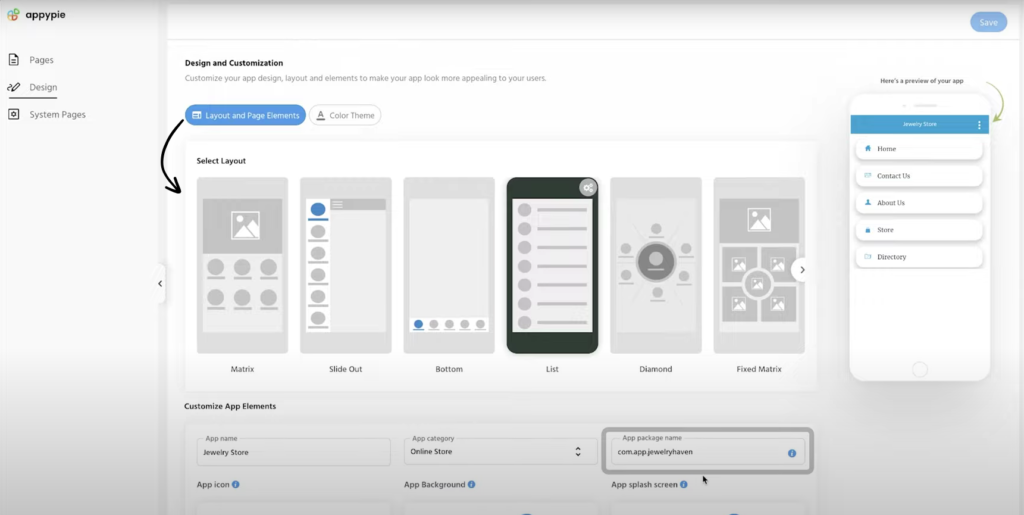
Appy Pie takes a template-first approach to app building. Pick from an industry-specific template library — restaurants, fitness studios, churches, real estate, events — customize the layout and content, and publish. The platform also bundles a chatbot builder, website builder, and workflow automation tools. For startups whose app closely matches an existing template, this is one of the fastest paths from idea to published app.
The startup angle: Speed is the advantage. If your MVP is a branded mobile app for a specific vertical — say, a restaurant ordering app or a fitness class booking app — and you do not need deep customization, Appy Pie gets you there quickly. The AI-assisted setup asks questions about your business and generates a starting point from your answers.
The startup risk: Templates are limiting by design. Startups iterate. When your users tell you they need features the template does not support, you have limited options. The database capabilities are basic compared to relational databases, which makes complex data relationships (like a two-sided marketplace) difficult or impossible. Per-app pricing also means building a second product doubles your bill.
Pricing: Basic (Android only) from approximately $18/app/month billed annually, with push notification and download limits. Platinum adds iOS support at roughly $60/app/month. Each app requires its own subscription. No permanent free plan — only a 7-day trial.
Strengths:
- Large template library across many industry verticals
- Quick setup when your use case matches a template closely
- Lowest starting price for Android-only apps
- Bundled tools (chatbot, website, workflows) included
Honest limitations: Template-driven means limited customization depth. Startups outgrow templates fast — once you need functionality that does not fit, you are rebuilding. Per-app pricing scales poorly. Database capabilities are basic. App quality varies significantly by template. No permanent free plan for testing.
Best for: Startups building a simple branded app in a well-defined vertical who need to test the market quickly and cheaply before investing in a more capable platform.
Bubble — Powerful Web Builder with Steep Learning Curve and Unpredictable Costs
Price: $69/mo+ with usage-based Workload Units | Output: Web applications (mobile via wrapper services at extra cost)
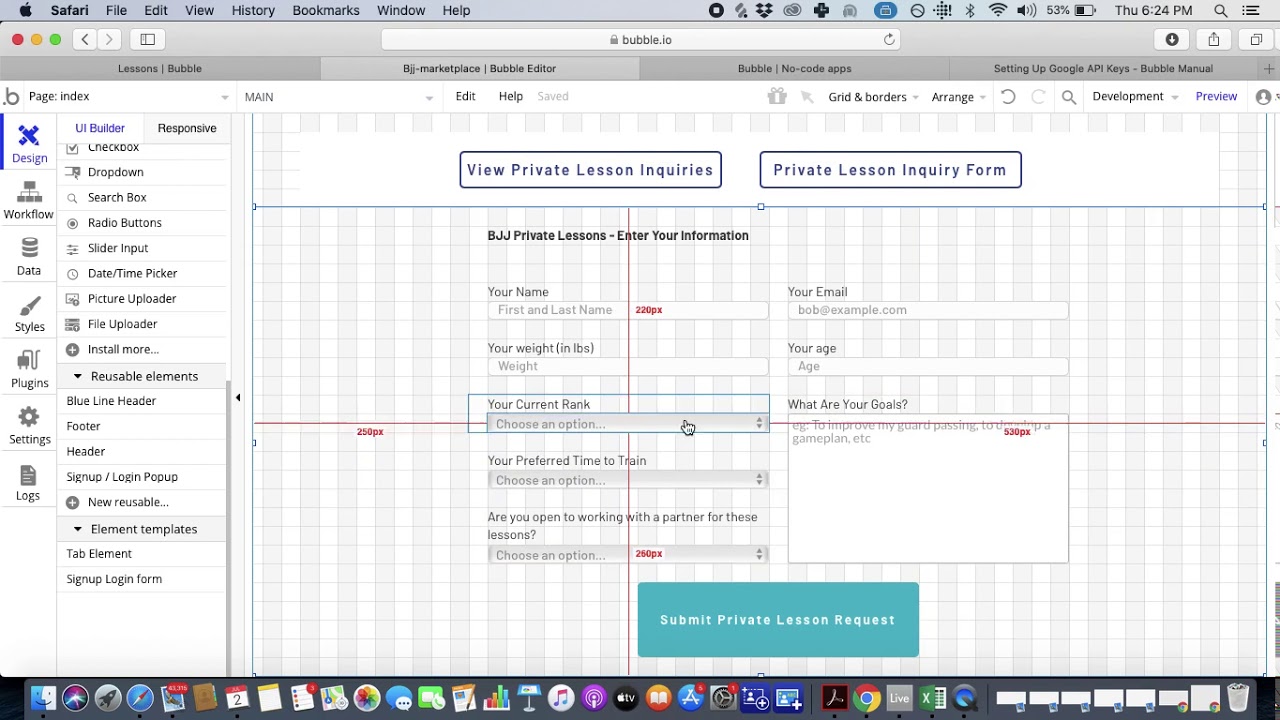
Bubble is the most capable web app builder in the no-code space. Its workflow engine handles conditional logic, iterative data processing, and complex backend events. A plugin ecosystem of 5,300+ options extends functionality across payments, analytics, and integrations. For startups building sophisticated web-only products — SaaS dashboards, internal tools, multi-tenant platforms — Bubble offers depth that other visual builders cannot match.
The startup catch: Bubble's power comes with two costs that hit startups hard. First, the learning curve. Most Bubble users report weeks to months before they can build production-quality applications. Many startup founders end up hiring Bubble consultants at $40-$125/hour, which quickly exceeds what they planned to save by going no-code. Second, Workload Unit pricing. Every database query, API call, and workflow step consumes WUs. Independent users report 400-500 WU per user per day, making costs unpredictable as your user base grows. A moderately active app with 1,000 monthly users can generate WU charges exceeding $1,000/month on top of the base subscription.
Mobile situation: Bubble is a web builder. It does not compile native mobile apps. Teams who want their Bubble app in app stores use wrapper services like Natively ($49/mo+), which creates a WebView container. The result is a web app running inside a native shell — slower performance, limited device feature access, and higher risk of app store rejection. Bubble has recently introduced a mobile editor, though it is still new.
Pricing: Growth plan starts at $69/month (billed annually) with 250K Workload Units per month. Overages cost $0.30 per 1K WU. Add Natively at $49/month minimum if you need app store presence. Bubble holds a 1.7/5 on Trustpilot across 123 reviews.
Strengths:
- Most powerful workflow engine among visual builders
- Large plugin ecosystem (5,300+ options)
- Strong for complex web applications with intricate data relationships
- Advanced conditional logic and backend event processing
Honest limitations: Web-only without wrappers. Workload Unit charges create budget uncertainty — the opposite of what startups need. Steep learning curve means most founders cannot self-serve and end up hiring consultants, which defeats the cost advantage. Performance at scale is documented at 5-10 second page loads on desktop and 8-14 seconds on mobile. No native mobile output.
Best for: Funded startups with technical co-founders building complex web-only SaaS where Bubble's workflow depth is genuinely needed, and where the team has budget for consultants and unpredictable WU charges.
See the full Adalo vs Bubble comparison
FlutterFlow — Code Export for Developer-Led Startups
Price: $80/mo/seat (team features) | Output: Flutter-based cross-platform (Android, iOS, Web)
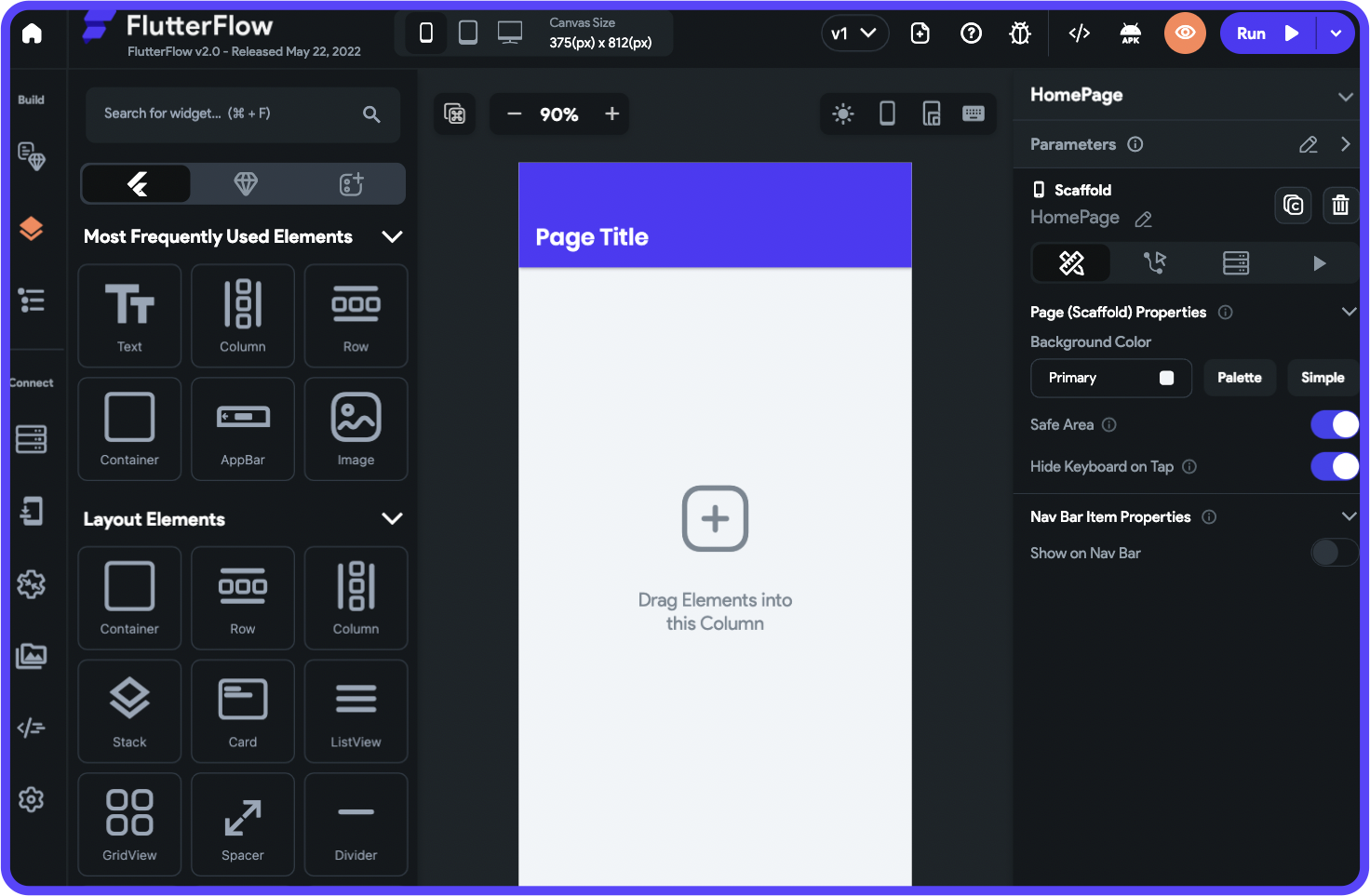
FlutterFlow is a visual development platform built on Google's Flutter framework. It generates real Flutter/Dart code that you can export, inspect, and extend. For startups with a technical co-founder or early engineering hire, this is a meaningful differentiator: you can build visually to move fast, then export the code when you are ready to bring development fully in-house.
The startup angle: Code export is the exit strategy. Many startups worry about being locked into a no-code platform. FlutterFlow addresses this directly — build your MVP visually, validate with customers, and when you raise your Series A and hire engineers, hand them the Flutter codebase. The output compiles to near-native performance on both iOS and Android via Flutter's ARM compilation.
The startup risk: FlutterFlow is marketed as no-code, but in practice it is a developer-adjacent tool. Building anything beyond basic screens requires understanding Flutter's widget tree, state management patterns, and how to configure Firebase or Supabase as your backend. If you are a non-technical founder, you will likely need to hire a FlutterFlow developer — which negates the speed advantage. Per-seat pricing at $80/month means a three-person team pays $240/month before adding database costs.
Pricing: Basic at $39/month with code download and APK export. Growth at $80/month/seat with GitHub integration, branching, and real-time collaboration. No database included — you need Firebase (free tier available, paid starts at ~$25/mo) or Supabase. FlutterFlow holds a 2.6/5 on Trustpilot across 19 reviews.
Strengths:
- Full code export — genuine exit path from the platform
- Flutter-based output for near-native iOS and Android performance
- GitHub integration for version control and team collaboration
- Active developer community and component marketplace
Honest limitations: No database included — BYO Firebase or Supabase adds complexity and cost. Per-seat pricing scales poorly for growing teams. The learning curve assumes some technical understanding, particularly around state management and custom functions. The App Builder Guides 2026 report documented editor interactions taking 2-40 seconds per click at scale. This is a tool for developer-led startups, not non-technical founders.
Best for: Startups with a technical co-founder who want to build fast visually now and transition to custom Flutter development later, and who are comfortable managing their own database infrastructure.
See the full Adalo vs FlutterFlow comparison
Lovable — Fast Web Prototypes That Need Developer Maintenance
Price: $20/mo+ (message-based credits) | Output: Web applications (React + Supabase) | ABG Score: 5.08/10 (prompt-to-app tier)
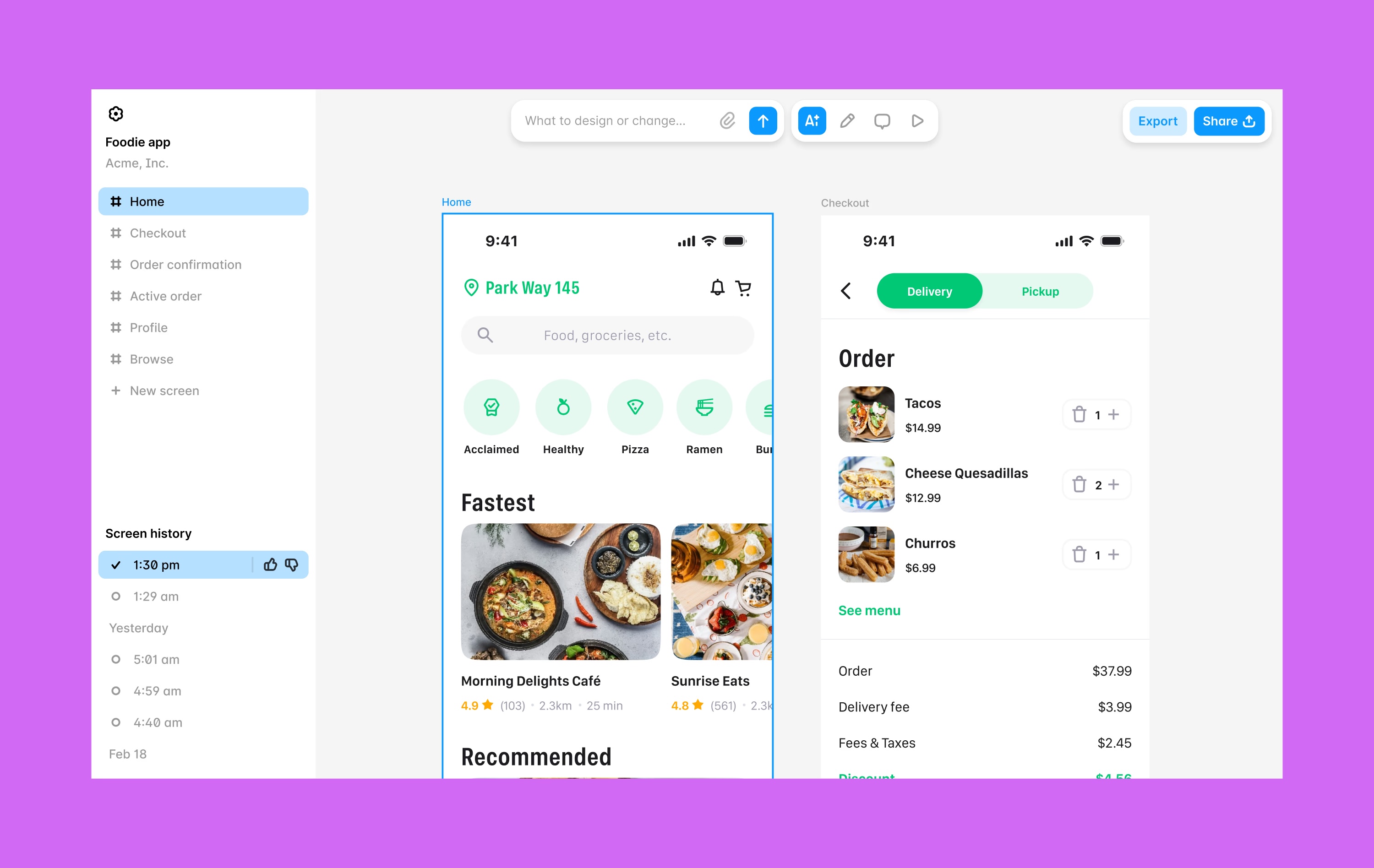
Lovable is a prompt-led web app builder that generates full React + Supabase applications from natural language descriptions. Type what you want, and Lovable produces a working web application with frontend, backend, and database. For startups that need a clickable prototype to show investors or validate an idea with early users, the speed is impressive — you can have something functional in hours rather than weeks.
The startup angle: Lovable is the fastest path from idea to clickable demo. If you are pitching investors and need to show a working prototype, or if you want to validate a concept with potential customers before committing to a full build, Lovable gets you there faster than any other option on this list. The low starting price ($20/month) also preserves runway during the exploration phase.
The startup risk: The speed advantage comes with a hidden cost — code maintenance. Lovable generates React code that you now own and must maintain. Every feature change, every bug fix, every security update requires someone who understands the generated codebase. For a non-technical founder, this means hiring a developer to maintain what was supposed to be a "no-code" solution. You traded subscription fees for engineering salaries. Lovable also produces web applications only — no native iOS or Android apps. If your startup needs App Store presence, Lovable cannot get you there.
Pricing: Starter plan at $20/month with limited message credits. Heavier usage requires higher tiers. No database included — relies on Supabase (free tier available, paid starts at $25/mo). Message credits are consumed with each prompt, so complex apps burn through credits quickly.
Strengths:
- Fastest path from idea to clickable web prototype
- Full code export (React + Supabase)
- Low starting price for validation phase
- Natural language interface requires no prior building experience
Honest limitations: Web-only — no native iOS or Android apps and no path to the App Store. No visual canvas for editing — chat-only interface with a preview pane. Generated code requires developer maintenance, trading platform fees for engineering overhead. Prototype-quality output frequently needs significant rework for production use. No built-in database (relies on external Supabase). Message-based pricing means costs are unpredictable for complex builds.
Best for: Startups that need a web prototype fast for investor demos or concept validation, and who have a plan (and budget) for developer maintenance once the prototype evolves into a product.
Comparison Table
| Platform | Price | App Store Output | AI Features | Database | Startup Fit |
|---|---|---|---|---|---|
| Adalo | $36/mo flat | Native iOS + Android + Web | Ada (Magic Start, Magic Add, X-Ray, Visual AI Direction) | Built-in Postgres, unlimited | Non-technical founders, predictable costs |
| Appy Pie | ~$18/app/mo | Template-based mobile | AI-assisted setup | Basic built-in | Simple vertical MVPs |
| Bubble | $69/mo + WU | Web only (wrapper extra) | Bubble AI | Built-in (usage-capped) | Funded teams, complex web SaaS |
| FlutterFlow | $80/seat/mo | Native via Flutter | AI UI generation | None (BYO Firebase/Supabase) | Technical co-founders, code export |
| Lovable | $20/mo+ | Web only | Prompt-to-app generation | None (BYO Supabase) | Quick investor demos, web prototypes |
Total Cost of Ownership: What Your Startup Actually Pays in Year One
Platform subscription fees are the advertised number. Here is what each platform actually costs in the first year for a startup building and publishing one app, assuming annual billing where available.
| Cost Component | Adalo | Appy Pie | Bubble | FlutterFlow | Lovable |
|---|---|---|---|---|---|
| Platform (annual) | $432 | ~$720 (iOS+Android) | $828+ | $960/seat | $240+ |
| Wrapper service | $0 | $0 | $588+ (Natively) | $0 | N/A (web only) |
| External database | $0 (built-in) | $0 (basic) | $0 (built-in) | $0-300+ | $0-300+ (Supabase) |
| App Store fees | $124 (Apple $99 + Google $25) | $124 | $124 | $124 | N/A (web only) |
| Usage overages | $0 (no caps) | Varies | Unpredictable (WU) | $0 | Credit-based |
| Developer/consultant costs | $0 (self-service) | $0 (self-service) | $2,000-15,000+ | $0-5,000+ | $5,000-20,000+ (maintenance) |
| Year 1 Total | $556 | ~$844+ | $3,540+ | $1,084+/seat | $5,240+ (with dev) |
Hidden costs that burn startup runway:
- Bubble's Workload Units: A moderately active app with 1,000 monthly users can consume millions of WU, adding $1,000+/month on top of the base subscription. This is the opposite of predictable budgeting.
- Lovable's developer maintenance: The $20/month subscription sounds cheap, but the generated React code needs a developer to maintain. Freelance React developers charge $50-150/hour. Even 10 hours per month is $500-1,500 — dwarfing the platform fee.
- FlutterFlow's database: Firebase free tier works for prototyping, but production apps need the Blaze plan. Costs scale with reads, writes, and storage — another variable expense.
- Per-app pricing: Appy Pie charges per app. If you pivot to a second product (common for startups), costs double. Adalo's flat rate covers unlimited apps.
Frequently Asked Questions
What is the best AI app builder for a startup with no technical co-founder?
Adalo is designed for non-technical builders. Ada, Adalo's AI builder, generates a complete app from a description via Magic Start, adds features through natural language with Magic Add, and lets you point at elements on the visual multi-screen canvas to instruct changes with Visual AI Direction. The built-in relational database handles your data without SQL or external setup. You can go from idea to a published app in the Apple App Store and Google Play without writing code or hiring a developer, at $36/month flat.
How much should a startup budget for building an app with AI?
For native iOS and Android apps with unlimited usage, Adalo costs $556 in year one ($432 platform + $124 app store fees). Appy Pie costs ~$844+ for cross-platform. Bubble starts at $1,540+ for web-only before consultant costs. FlutterFlow runs $1,084+/seat before database costs. For comparison, hiring developers to build a custom app typically costs $25,000-$100,000+. The key variable is hidden costs — usage-based charges, external databases, wrapper services, and developer maintenance can multiply the advertised price by 3-10x.
Should a startup use a prompt-led builder like Lovable or Bolt?
Prompt-led web builders like Lovable and Bolt are excellent for rapid prototyping and investor demos. They generate working web apps in hours. The catch is that they produce code you then must maintain, they only build web applications (no native mobile), and they have no visual editor for ongoing changes. For a throwaway prototype, they are fast and cheap. For a product you plan to iterate on and grow, the ongoing developer maintenance cost often exceeds what you would have spent on a platform that handles maintenance for you.
Can I publish an AI-built app to both the App Store and Google Play?
Only some platforms support this. Adalo compiles native iOS (IPA) and Android (APK) apps from a single project and handles publishing to both stores. FlutterFlow supports both via Flutter but requires separate database setup and more technical knowledge. Appy Pie supports both stores but at separate per-platform pricing. Bubble and Lovable are web-only — reaching app stores requires a wrapper service with performance trade-offs. Adalo is the only platform on this list where a non-technical person can publish native apps to both stores from one codebase at a flat rate.
What happens to my app if I outgrow my app builder?
This is worth thinking about before you start. FlutterFlow offers the clearest exit path: you can export the full Flutter source code and continue development independently. Lovable exports React code, though it requires developer maintenance from day one. Adalo offers code export on the enterprise plan within Adalo Blue. Bubble does not offer code export — migrating away means rebuilding from scratch. For most startups, the more relevant question is whether the platform can scale with you. Adalo 3.0 supports 1M+ monthly active users, which covers most startup growth trajectories without requiring a platform migration.
Is flat-rate pricing or usage-based pricing better for startups?
Flat-rate pricing is almost always better for startups. With flat-rate pricing (like Adalo's $36/month), you know your costs regardless of how many users you acquire or how much they use the app. With usage-based pricing (like Bubble's Workload Units), your costs increase as your product succeeds — exactly when you need capital for growth, not platform fees. Many startups have been surprised by usage-based charges exceeding their platform budget by 5-10x after a successful launch or viral moment.
How fast can a startup build and launch an app with AI?
A simple app (5-10 screens, basic database, standard navigation) can be built in a few hours with an AI-powered builder and submitted to app stores the same day. A more complex product (marketplace, social platform, booking system with payments) typically takes 1-4 weeks depending on the platform and your familiarity. The building time is no longer the bottleneck — app store review takes 1-7 days regardless. Adalo's Magic Start generates the initial foundation in minutes, with most MVP-stage startups shipping within 1-2 weeks.
Do AI app builders work for B2B startup products?
Yes, and they are particularly well suited for B2B use cases. CRMs, field service apps, inventory management tools, client portals, and internal dashboards are exactly the kind of database-driven applications that platforms like Adalo handle well. B2B apps typically need fewer users with deeper functionality — which plays to the strengths of visual builders. The built-in database, relational data model, and role-based access controls that Adalo includes are core requirements for most B2B products.
Updated April 2026. Pricing verified as of publication date. All platforms listed offer free tiers or trials — test them with your specific use case before committing to a paid plan.

Build your app fast with one of our pre-made app templates
Begin Building with no code