Getting your app into both the Apple App Store and Google Play Store is harder than it was two years ago. In March 2026, Apple removed Replit and Vibecode from the App Store under Guideline 2.5.2, tightening enforcement around runtime code execution environments. Both Apple and Google have sharpened their scrutiny of wrapper apps and platforms that blur the line between tool and app. This article compares platforms that claim to publish to both stores and examines which ones deliver genuine native builds — not workarounds that may not survive the next policy update.
Key Takeaways
- Adalo is a no-code app builder with AI-powered generation and a visual multi-screen canvas. It compiles native IPA files for the Apple App Store and native APK files for the Google Play Store from a single project — plus web. $36/mo flat with no usage caps. Built-in relational database with 500 records on the free plan.
- Appy Pie offers template-driven app building for both stores. Android starts at ~$18/mo, but publishing to both the App Store and Google Play requires the ~$60/mo Platinum tier. Quick setup for template-fitting use cases, but limited customization depth beyond the templates.
- Bubble is a web app builder that requires a third-party wrapper service like Natively ($49/mo+) to reach either app store. The result is a WebView container, not a native app — with 8-14 second mobile load times and increasing scrutiny from app store reviewers.
- FlutterFlow generates cross-platform apps via Google's Flutter framework, compiling to both stores with near-native performance. $80/mo per seat with no database included. More of a developer tool than a no-code platform.
- Thunkable uses block-based logic for cross-platform mobile apps. Publishing to both app stores requires the $37/mo (annual) Builder tier for a single app, or $99-189/mo for unlimited apps. Significant price jump between tiers.
Introduction
Publishing an app to both the Apple App Store and the Google Play Store is the benchmark that separates real app builders from glorified website generators. Plenty of platforms claim "mobile apps" in their marketing, but when you dig into the specifics, the picture changes. Some generate web apps that need a third-party wrapper to reach app stores — adding latency, limiting native features, and risking rejection during review. Others can publish to one store but require a completely separate build process for the other. A few generate code you then need to compile, sign, and submit yourself.
Apple and Google have both tightened their review guidelines. Apple has always been strict about WebView wrapper apps, and Google Play has followed suit. Both stores increasingly reject apps that are essentially web pages inside a native shell: thin content, poor performance, and limited native functionality are now common rejection reasons. If your builder produces a wrapper rather than a native binary, you are taking a gamble every time you submit an update.
This guide compares five platforms that claim to publish to both app stores. We tested each one against the criteria that actually matter: Does it compile native binaries (IPA for Apple, APK for Google Play), or does it produce a wrapper? Can you submit directly from the platform, or do additional tools and technical steps stand between you and a published app? What does it actually cost to maintain apps in both stores? And can a non-technical person realistically manage the full publishing pipeline?
Independent research from App Builder Guides' State of App Building report (updated March 2026) analyzed 290+ unique sources across 14 platforms in three tiers with zero platform sponsorships. Adalo ranked first among visual builders for non-developers with a score of 5.94/10.
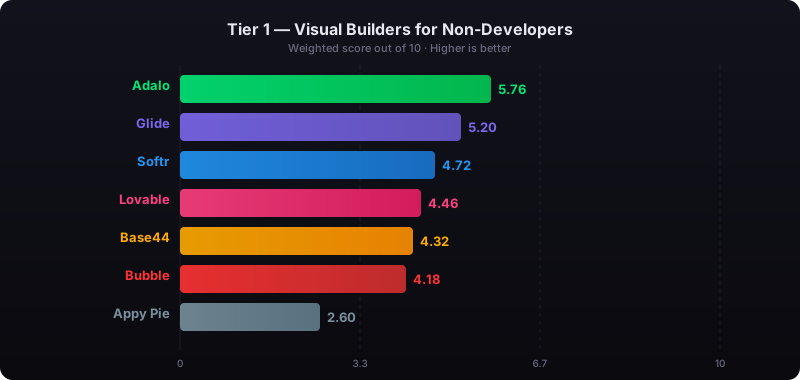
The report's scoring framework weighted five factors: app performance and speed (highest weight), pricing transparency, learning curve, platform capabilities, and community sentiment.
See also: Compare all no-code app builders | App store builders comparison | App store publishing with Adalo
How We Evaluated
Every platform was assessed against the same criteria, specifically through the lens of publishing to both the Apple App Store and Google Play Store:
- Native compilation: Does the platform compile a real IPA (iOS) and APK/AAB (Android), or does it produce a web app wrapped in a native shell?
- Direct publishing: Can you submit to both app stores from within the platform, or are additional tools, build environments, or manual steps required?
- App store approval rate: Does the output consistently pass Apple and Google review, or do wrapper-based submissions face rejection risk?
- Cross-platform from one project: Can you build once and publish to both stores, or does each platform require a separate build?
- Total cost for both stores: What does it actually cost per year to maintain published apps in both the Apple App Store and Google Play?
- Performance parity: Do the resulting apps perform comparably to natively developed apps, or are there measurable performance gaps?
- Non-technical accessibility: Can a person without development experience manage the full build-to-publish pipeline?
Adalo — Native Compilation to Both App Stores from One Project
Price: Free plan available; $36/mo for app store publishing with unlimited usage | Output: Native IPA (iOS) + native APK (Android) + web — from one project
Ada, Adalo's AI builder, generates complete app foundations from natural language descriptions. Describe what you want to build, and Magic Start creates screens, navigation, database schema, and logic. Magic Add lets you add features through natural language ("add push notifications," "add a payment flow"), and Visual AI Direction lets you point at elements on the multi-screen canvas and instruct changes directly. X-Ray identifies performance issues before your app reaches app store reviewers.
Adalo compiles true native binaries for both stores. For iOS, it produces an IPA file using the Codemagic build pipeline — not a WebView wrapper, not a React Native bridge. For Android, it compiles a native APK. Both are real, store-ready binaries that pass Apple's and Google's review processes because they are genuine native apps, not web content inside a shell. The platform handles code signing, provisioning profiles, and build configuration, so you do not need Xcode, Android Studio, or any development environment on your machine.
The visual multi-screen canvas shows every screen of your app simultaneously. You can see the complete user flow across both iOS and Android form factors while building, preview on any device size, and switch between platforms to verify that your app looks right on each. When you are ready, the publishing workflow guides you through both app store submissions from within the Adalo platform.
Adalo 3.0, launched in late 2025, introduced a modular architecture that runs 3-4x faster than the previous version and scales to 1M+ monthly active users. The performance upgrade is particularly relevant for app store publishing — both Apple and Google increasingly penalize slow apps during review.
Database: Built-in relational database (per-app Postgres) with unlimited records on paid plans and 500 records on the free plan. No Firebase or Supabase setup required. For teams migrating from spreadsheet workflows, SheetBridge lets you use a Google Sheet as a relational database within Adalo.
Pricing: Starter at $36/month (billed annually) includes publishing to both the Apple App Store and Google Play Store, native iOS and Android compilation, unlimited database records, and zero usage caps. No per-user, per-action, or per-record charges. No overage fees on any tier. One subscription covers unlimited apps across all platforms.
Strengths:
- True native compilation for both stores — IPA (iOS) and APK (Android)
- Direct app store publishing from within the platform
- One project produces iOS, Android, and web simultaneously
- AI builder (Ada) with Magic Start, Magic Add, X-Ray, and Visual AI Direction
- Built-in relational database with unlimited records on paid plans
- $36/month flat covers both stores with no usage-based surprises
Honest limitations: Adalo is purpose-built for database-driven apps: marketplaces, booking systems, CRMs, directories, and social platforms. If you need a complex web-only SaaS with sophisticated custom backend logic, Bubble may be a better fit. Code export is available only on the enterprise plan within Adalo Blue, while FlutterFlow includes it on lower tiers.
Best for: Founders and businesses who want native apps in both the Apple App Store and Google Play Store from a single project, without writing code or hiring developers, at a predictable flat rate.
Learn more about Adalo's app store publishing
Appy Pie — Template-Driven Builder for Both Stores
Price: ~$18/app/mo (Android only); ~$60/app/mo for both stores | Output: Template-based apps for iOS and Android
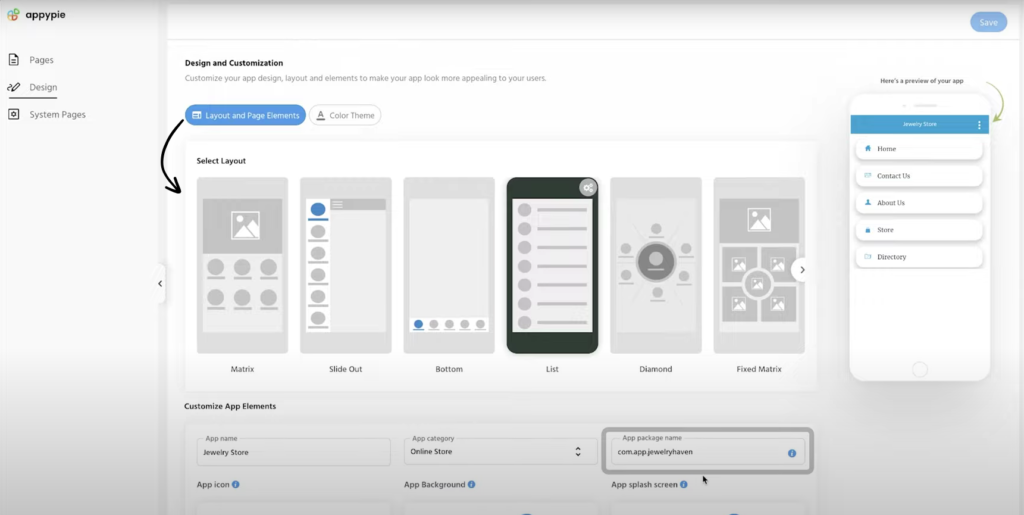
Appy Pie takes a template-first approach to mobile app building. Pick from a library of industry-specific templates, customize the layout and content, and publish to one or both app stores. The platform also includes a chatbot builder, website builder, and workflow automation tools. Appy Pie's AI-assisted setup asks about your business and generates a starting point from your answers.
The app store publishing reality: Publishing to both stores requires the Platinum plan at approximately $60/app/month. The Basic plan at ~$18/month covers Android only. This per-app, per-platform pricing structure means the cost of being in both stores adds up quickly. A single app on both platforms costs $720/year. Two apps on both platforms costs $1,440/year. Appy Pie handles the submission process, but the resulting apps are tied to their templates — you cannot break out of the template structure for deeply custom functionality.
Pricing: Basic at approximately $18/app/month (Android only). Platinum at roughly $60/app/month for both iOS and Android. Each app requires its own subscription. No permanent free plan — only a 7-day trial.
Strengths:
- Publishing to both stores is straightforward on the Platinum plan
- Large template library across many business verticals
- Quick setup for template-matching use cases
- Handles app store submission on your behalf
Honest limitations: Template-driven means limited customization. The database capabilities are basic compared to platforms with relational databases. Per-app pricing multiplies costs: three apps on both platforms costs $2,160/year vs $432/year on Adalo. App quality and performance vary significantly by template. The AI capabilities are closer to a guided setup wizard than a generative builder. The Basic tier does not include iOS, forcing a choice between affordability and full app store coverage.
Best for: Small businesses in specific verticals who need a simple branded app in both app stores quickly and can work within template constraints.
Bubble — Web Builder Requiring a Wrapper for App Stores
Price: $69/mo+ (Bubble) + $49/mo+ (Natively wrapper) | Output: WebView wrapper, not native
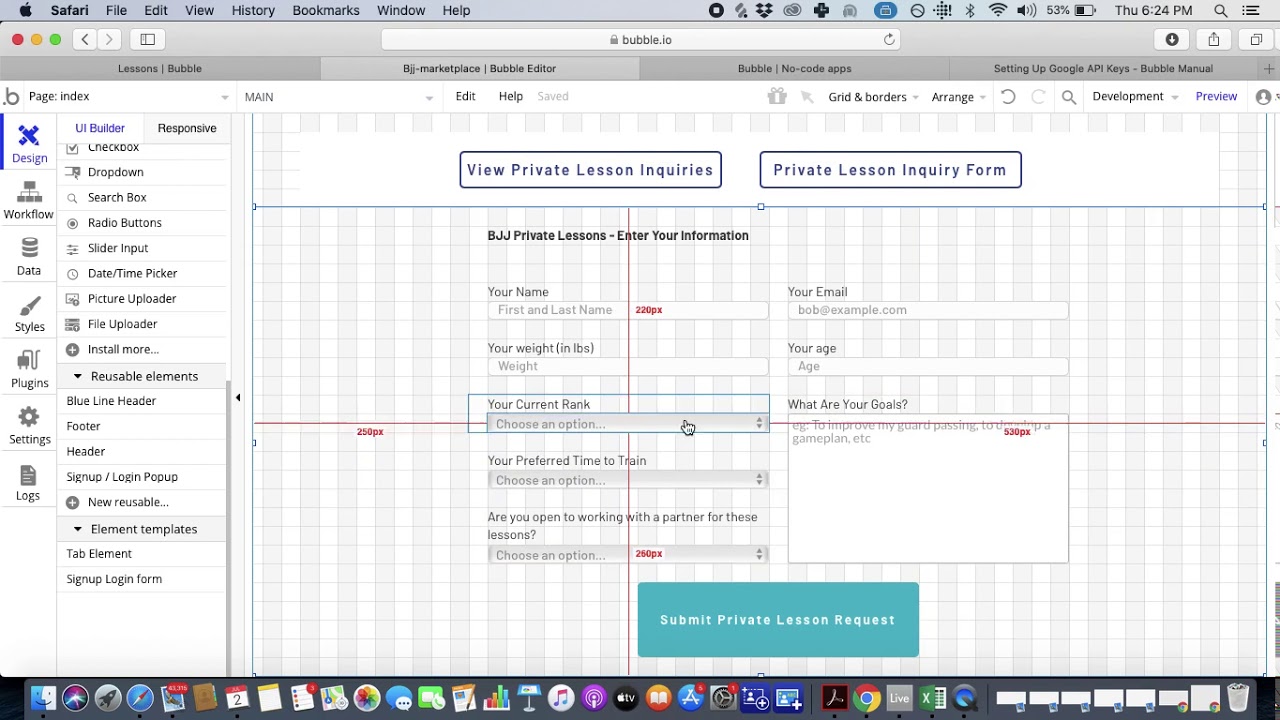
Bubble is a visual web app builder with deep customization capabilities. Its workflow engine handles complex conditional logic, and a plugin ecosystem of 5,300+ options extends functionality broadly. Bubble recently introduced a native mobile editor, though the mobile offering is still new. For teams already invested in Bubble for web, app store publishing is possible — but through a fundamentally different approach than the other platforms in this comparison.
The wrapper approach: Bubble does not compile native iOS or Android apps. To get a Bubble app into either app store, teams typically use Natively or a similar wrapper service. This creates a WebView container — a native shell that loads your Bubble web app inside it. The result gets you into the app stores, but the app is not native. It is a web page running inside a container, with web-level performance.
Performance and review risk: Independent testing documented in the App Builder Guides February 2026 report found Bubble page loads of 5-10 seconds on desktop and 8-14 seconds on mobile. Inside a WebView wrapper, these times can be even longer. Both Apple and Google have tightened their policies on wrapper apps. Apple's App Store Review Guidelines specifically call out apps that are "simply a web page bundled as a native app." While not all Bubble wrappers are rejected, the risk is real — especially for simpler apps where the native shell adds minimal functionality over the web version.
Pricing: Bubble Starter at $69/month (billed annually) with 250K Workload Units per month. Add Natively at $49/month minimum. Workload Unit overages cost $0.30 per 1K WU. For both stores combined, the minimum baseline is $118/month before any usage overages. Bubble holds a 1.7/5 on Trustpilot across 123 reviews.
Strengths:
- Sophisticated backend logic and conditional workflows
- Large plugin ecosystem (5,300+ options)
- Strong for complex web applications that also need a mobile presence
- New native mobile editor shows investment in mobile capabilities
Honest limitations: The wrapper approach is a workaround, not a publishing solution. You pay for two services (Bubble + Natively), get web-level performance in both stores, lose access to some native device APIs, and accept the risk of rejection on every submission and update. Performance is the single biggest issue: 8-14 second load times on mobile are well outside what users and reviewers expect from native apps. Most Bubble teams also need consultants ($40-$125/hour) to build anything complex.
Best for: Teams already invested in a Bubble web application who want a minimal-effort presence in both app stores — with full awareness that the result is a wrapper with web-level performance and ongoing rejection risk.
See the full Adalo vs Bubble comparison
FlutterFlow — Flutter-Based Builder for Developer Teams
Price: $80/mo/seat (team features) | Output: Flutter-based native (iOS + Android + web)
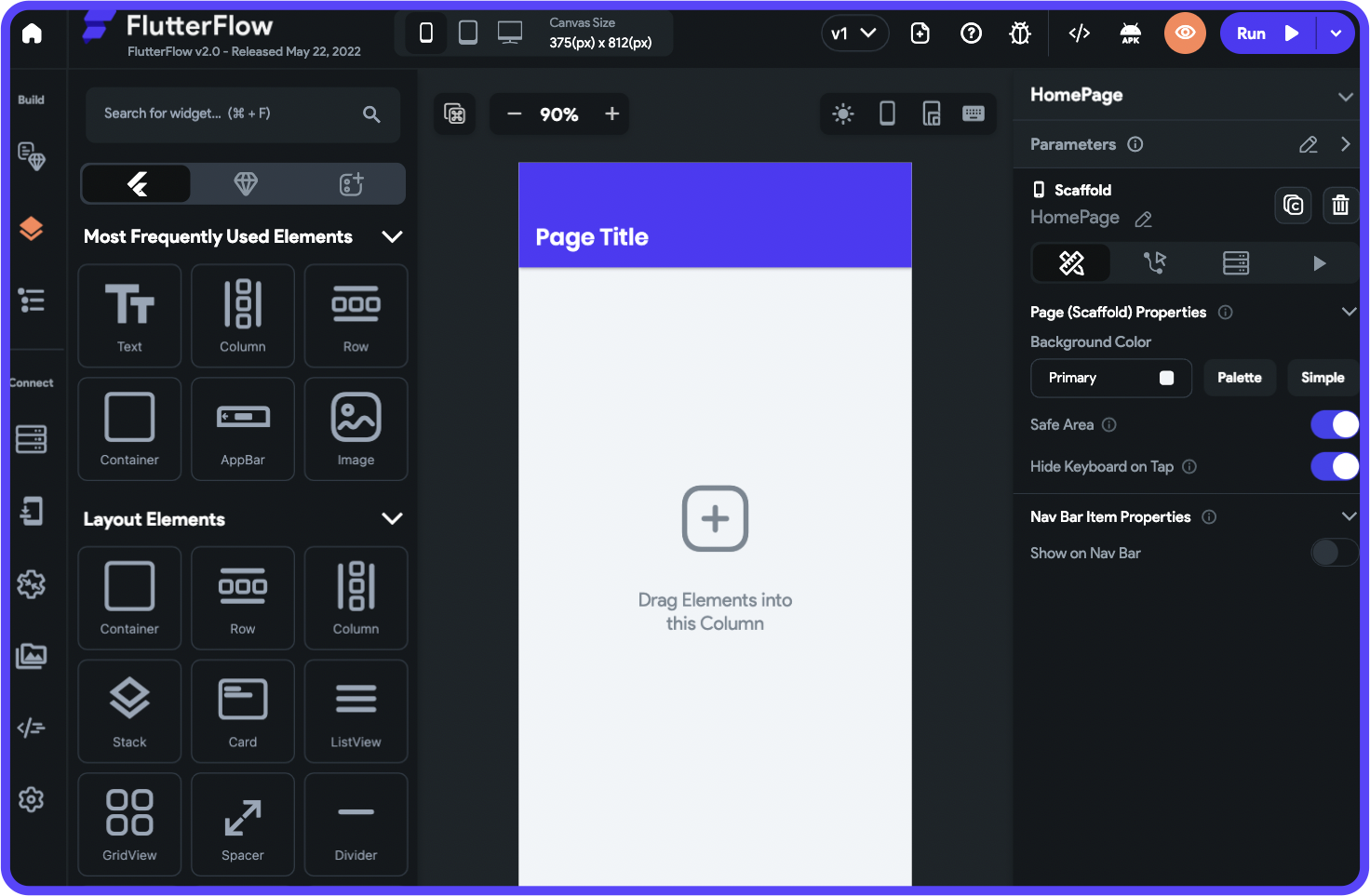
FlutterFlow is a visual development platform built on Google's Flutter framework. It generates real Flutter/Dart code that compiles to native binaries for both iOS and Android. For app store publishing, this means genuine native performance — Flutter compiles to ARM machine code on both platforms, not WebView wrappers.
What makes it stand out for app store publishing: Code export is FlutterFlow's key differentiator. You can download the full Flutter source code, push it to GitHub, customize it beyond what the visual builder supports, and compile it using standard Flutter tools. This gives you an exit path and the ability to handle edge cases that the visual builder cannot. FlutterFlow also includes AI features for generating UI components and logic from descriptions.
The developer reality: FlutterFlow is marketed as no-code, but publishing to both app stores through FlutterFlow requires more technical involvement than truly no-code platforms. You need to configure Firebase or Supabase as your backend, understand Flutter's widget tree for anything beyond basic layouts, and manage code signing and provisioning profiles for both stores. FlutterFlow can build in the cloud, reducing some of this burden, but the overall process assumes technical comfort. The App Builder Guides 2026 report documented editor interactions taking 2-40 seconds per click at scale, and FlutterFlow holds a 2.6/5 on Trustpilot across 19 reviews.
Pricing: Basic at $39/month with code download and APK/IPA export. Growth at $80/month/seat with GitHub integration, branching, and collaboration. A three-person team on Growth pays $240/month before adding database costs. No database included — you need Firebase (free tier available, paid starts at ~$25/mo) or Supabase. Apple Developer Program is $99/year; Google Play Developer is $25 one-time.
Strengths:
- Flutter-based native compilation for both stores — genuine ARM machine code
- Full code export and GitHub integration
- Active developer community and component marketplace
- Cloud build option simplifies the compilation step
Honest limitations: No database included — you must bring Firebase, Supabase, or another backend. Per-seat pricing scales quickly for teams. The learning curve is steeper than true no-code platforms: state management, widget trees, and custom functions assume some technical understanding. Publishing to both stores through FlutterFlow requires more manual steps than Adalo's guided workflow. This is a tool for developer teams who want to move faster, not for non-technical founders publishing their first app.
Best for: Developer-adjacent teams who want visual building speed with Flutter's native performance and code export, and who are comfortable configuring their own backend and managing the publishing pipeline.
See the full Adalo vs FlutterFlow comparison
Thunkable — Block-Based Mobile Builder
Price: Free tier; $37/mo (annual) to publish 1 app; $99-189/mo for unlimited | Output: Cross-platform (iOS, Android, web)
No platform screenshot available for Thunkable.
Thunkable uses block-based logic similar to Scratch or MIT App Inventor. Instead of writing code, you drag logic blocks together to define app behavior. This approach is genuinely intuitive for people who have never programmed, and it has made Thunkable popular in educational settings and coding bootcamps. Thunkable supports publishing to both the Apple App Store and Google Play from a single project.
What makes it stand out for app store publishing: Thunkable is one of the few block-based builders that supports publishing to both stores. The cross-platform output means you build once and deploy to iOS, Android, and web. For educational institutions and first-time builders, the block-based paradigm is more accessible than visual canvas or code-based approaches. Thunkable includes AI features like image recognition and text classification blocks.
The pricing cliff: Thunkable's app store publishing pricing has a notable gap. The Accelerator plan at $18/month does not include app store publishing at all. The Builder plan at $37/month (annual billing) allows publishing one app to both app stores. For unlimited published apps, you need the Advanced plan at $99/month (annual) or $189/month (monthly billing). Publishing a single app on Thunkable costs roughly the same as Adalo's plan that includes unlimited apps with unlimited usage across all three platforms.
Strengths:
- Block-based logic is accessible for absolute beginners
- Cross-platform output to both stores from one project
- Strong educational partnerships and learning resources
- Built-in AI blocks for image recognition and text classification
Honest limitations: Token-based usage limits mean larger or more complex apps consume your allocation faster. The builder is less sophisticated than alternatives for production-quality apps with complex data relationships. Database capabilities are basic compared to platforms with built-in relational databases. The community and plugin ecosystem are smaller. The pricing jump from "no publishing" at $18/month to "one published app" at $37/month to "unlimited apps" at $99-189/month creates an awkward cost curve.
Best for: Students, educators, and first-time builders who want to learn app development through block-based logic and need basic publishing to both app stores.
Comparison Table
| Platform | Price (both stores) | Output Type | AI Features | Database | Publishing Path |
|---|---|---|---|---|---|
| Adalo | $36/mo flat | Native IPA + APK | Ada (Magic Start, Magic Add, X-Ray, Visual AI Direction) | Built-in Postgres, unlimited | Direct from platform |
| Appy Pie | ~$60/app/mo | Template-based | AI-assisted setup | Basic built-in | Handled by platform |
| Bubble + Natively | $118/mo+ | WebView wrapper | Bubble AI (chat-based) | Built-in (usage-capped) | Via third-party wrapper |
| FlutterFlow | $80/seat/mo | Native via Flutter | AI UI generation | None (BYO Firebase/Supabase) | Cloud build or code export |
| Thunkable | $37-189/mo | Cross-platform | AI blocks (image/text) | Basic built-in | At Builder tier ($37/mo+) |
Total Cost of Ownership: Both Stores in Year One
Getting into both app stores is one cost. Staying in both stores — with updates, database hosting, and the platform subscription — is another. Here is what each platform actually costs in the first year for a single app published to both the Apple App Store and Google Play, assuming annual billing where available.
| Cost Component | Adalo | Appy Pie | Bubble + Natively | FlutterFlow | Thunkable |
|---|---|---|---|---|---|
| Platform (annual) | $432 | ~$720 | $828+ | $960/seat | $444 (1 app) / $1,188+ (unlimited) |
| Wrapper service | $0 (native) | $0 | $588+ (Natively) | $0 (native via Flutter) | $0 |
| External database | $0 (built-in) | $0 (basic) | $0 (built-in) | $0-300+ (Firebase/Supabase) | $0 (basic) |
| Apple Developer ($99/yr) | $99 | $99 | $99 | $99 | $99 |
| Google Play ($25 one-time) | $25 | $25 | $25 | $25 | $25 |
| Usage overages | $0 (no caps) | Varies | Unpredictable (WU) | $0 | Token-limited |
| Year 1 Total | $556 | ~$844 | $1,540+ | $1,084+/seat | $568+ (1 app) |
Hidden costs to watch for:
- Bubble's Workload Units: Independent users report 400-500 WU per user per day. A moderately active app with 1,000 monthly users can add $1,000+/month on top of the combined Bubble + Natively base subscription.
- FlutterFlow's database: Firebase's free tier (Spark) works for prototyping, but production apps with real users typically need the Blaze plan. Costs scale with reads, writes, and storage — budget $25-$300+/month depending on usage.
- Apple's annual fee: The Apple Developer Program costs $99/year, every year. Google Play is a one-time $25. Both fees apply regardless of which builder you use.
- Per-app pricing: Appy Pie charges per app for both-store publishing at ~$60/app/month. Two apps in both stores costs $1,440/year. Adalo covers unlimited apps for $432/year.
- Developer time: FlutterFlow and Bubble both have steeper learning curves. Bubble teams frequently hire consultants at $40-$125/hour. This cost often exceeds the platform subscription.
Frequently Asked Questions
What is the best AI app builder for publishing to both the App Store and Google Play?
For non-technical builders who want native apps in both stores from a single project, Adalo handles the full pipeline: AI-powered generation on a visual multi-screen canvas, native IPA and APK compilation, and guided publishing to both the Apple App Store and Google Play — all at $36/month flat. FlutterFlow produces excellent native apps via Flutter but assumes technical knowledge and charges per seat with no database included. Appy Pie handles both stores on its Platinum plan but limits customization to templates.
What is the difference between a native app and a wrapper?
A native app is compiled specifically for the target platform — Adalo compiles IPA files for iOS and APK files for Android. A wrapper takes an existing web app and loads it inside a native shell (a WebView container). The difference matters: native apps load in 1-2 seconds, access all device features (push notifications, camera, GPS, Bluetooth), and pass app store review consistently. Wrapper apps inherit the web app's load time (often 5-14 seconds for Bubble), have limited native feature access, and face increasing rejection risk from both Apple and Google.
How much does it cost to publish to both app stores per year?
At the low end, Adalo costs $556/year (platform + Apple Developer + Google Play). Thunkable costs $568/year for one app. Appy Pie costs ~$844/year for one app on both stores. FlutterFlow costs $1,084+/year per seat before database costs. Bubble + Natively costs $1,540+/year before Workload Unit overages. For comparison, hiring developers to build and maintain native iOS and Android apps typically costs $50,000-$200,000+/year.
Can AI-built apps actually get approved for the App Store and Google Play?
Yes — when they compile to native binaries. Apple and Google review the app's quality and compliance, not how it was built. Native apps from Adalo (IPA/APK), FlutterFlow (Flutter), and Thunkable pass the same review process as hand-coded apps. The risk area is wrapper apps: both stores have tightened policies on WebView-based submissions. Apple's guidelines specifically flag apps that are "simply a web page bundled as a native app," and Google Play has similar quality thresholds.
Do I build one app or two for both stores?
Adalo, FlutterFlow, and Thunkable all build one app that outputs to both stores from a single project. You design once and the platform generates the appropriate binaries for each store. Bubble requires a wrapper service that creates separate containers for each store from your web app. Appy Pie builds from one project but charges separately when you want both stores instead of just Android.
What about prompt-led builders like Lovable or Bolt for app store publishing?
Lovable, Bolt, v0, and Base44 generate web applications from text prompts. They produce React, Next.js, or similar web code. None of them compile native iOS or Android apps. None publish to the Apple App Store or Google Play. To get a Lovable or Bolt app into either app store, you would need to wrap it using Capacitor or a similar service — with the same performance trade-offs and review risks as wrapping a Bubble app. If your goal is apps in both stores, you need a platform built for native mobile output.
What if I only need one app store?
If you only need Android, Appy Pie's Basic plan at ~$18/month is the cheapest option, though customization is template-limited. Adalo at $36/month includes both stores and web at no extra cost, so you get full cross-platform coverage even if you start with one store. FlutterFlow and Thunkable also produce cross-platform output by default. There is no cost penalty for publishing to one store vs two on these platforms — the pricing is the same.
How long does it take to get approved on both stores?
Apple App Store review typically takes 1-3 days for native apps. Google Play review takes 1-7 days. The building time varies by platform: on Adalo, a simple app can be submitted same-day. FlutterFlow adds 1-3 days for build configuration and backend setup. Wrapper apps (Bubble + Natively) take 2-5 days for wrapper configuration, plus longer review times — wrapper apps face more scrutiny and sometimes require resubmission after initial rejection.
Why did Apple remove Replit and Vibecode, and what does it mean for app builders?
In March 2026, Apple removed Replit and Vibecode from the iOS App Store under Guideline 2.5.2, which prohibits apps that execute or interpret arbitrary code not part of the original App Store submission. The enforcement targeted the builder tools themselves — environments where users write and run code on-device. This does not affect apps built using Adalo, FlutterFlow, or Thunkable, because those platforms compile native binaries on their servers rather than executing arbitrary code inside the app at runtime. The distinction matters when choosing a platform: a builder that compiles to a signed native IPA or APK through a reproducible pipeline faces no such policy risk. A web-app-in-a-container approach faces increasing scrutiny from both stores.
Updated April 2026. Pricing verified as of publication date. All platforms listed offer free tiers or trials — test them with your specific use case before committing to a paid plan.

Build your app fast with one of our pre-made app templates
Begin Building with no code