Publishing a native iOS app to the Apple App Store is harder than most builders make it look — and Apple made it harder still in March 2026, when it blocked Replit and Vibecode from distributing app-building tools on iOS, citing Guideline 2.5.2's prohibition on code execution environments. That enforcement action drew a sharper line around what "native" actually means and which platforms can reliably keep their apps in the store.
Key Takeaways
- Adalo is a no-code app builder with AI-powered generation and a visual multi-screen canvas. It compiles native iOS IPA files and publishes directly to the Apple App Store, Google Play Store, and web from a single project. $36/mo flat with no usage caps. Built-in relational database with 500 records on the free plan.
- Appy Pie offers template-driven iOS app building starting at ~$60/app/mo for the tier that includes iOS publishing. Fast setup when your use case matches a template, but limited customization depth. Android-only plans start lower at ~$18/mo.
- Bubble is a web app builder that can reach iOS via a third-party wrapper service like Natively ($49/mo on top of Bubble's $69/mo). Powerful for complex web applications, but the wrapper approach adds latency and risks Apple App Store rejection.
- FlutterFlow generates cross-platform apps via Google's Flutter framework. Strong code export for developer teams. $80/mo/seat with no database included. Compiles to iOS via Flutter's ARM compilation for near-native performance.
- Thunkable uses block-based logic for cross-platform mobile apps. Publishing requires the $37/mo (annual) tier for a single app or $189/mo (monthly) for unlimited. Steep price jump between tiers.
Introduction
Getting an iOS app into the Apple App Store is harder than most people expect. Apple's review process is the strictest in mobile, and it is getting stricter. In March 2026, Apple removed Replit and Vibecode from the App Store under Guideline 2.5.2, which prohibits apps that execute arbitrary code — a direct shot across the bow of code-generating app builders. WebView wrapper apps face increasing rejection rates as Apple cracks down on apps that provide "a limited or degraded user experience" compared to native. Some platforms generate web apps and call it a day. Others require wrapper services that add load time, strip out native device features, and risk rejection. A few compile genuine native apps, but assume developer knowledge that defeats the purpose of using a builder.
The iOS ecosystem has its own cost layer on top of whatever you pay for the builder. Apple charges $99 per year for a Developer Account — non-negotiable, regardless of your platform. TestFlight for beta testing, App Store Connect for metadata and screenshots, and Apple's Human Interface Guidelines all add complexity. Some platforms handle this process for you. Others hand you an IPA file and wish you luck.
This guide compares five platforms that claim to build iOS apps with AI assistance. We tested each one against the criteria that actually matter for iOS: whether it produces a native IPA or a web wrapper, what happens when you submit to Apple's review process, how much it really costs once you factor in databases and third-party services, and whether a non-technical person can realistically navigate Apple's requirements. Every platform is profiled honestly, limitations included.
Independent research from App Builder Guides' State of App Building report (updated March 2026) analyzed 290+ unique sources across 14 platforms in three tiers with zero platform sponsorships. Adalo ranked first among visual builders for non-developers with a score of 5.94/10.
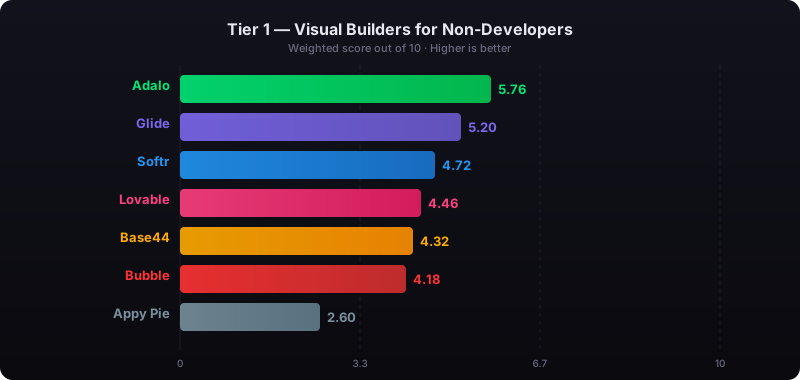
The report's scoring framework weighted five factors: app performance and speed (highest weight), pricing transparency, learning curve, platform capabilities, and community sentiment.
See also: Compare all no-code app builders | App store builders compared | Adalo's iPhone app builder
How We Evaluated
Every platform was assessed against the same criteria, specifically through the lens of iOS app development and Apple App Store publishing:
- Native iOS output: Does it compile a real IPA file, or does it produce a web app that needs a wrapper to reach the App Store?
- Apple App Store review: Can apps from this platform pass Apple's review process consistently, or do wrapper-based apps risk rejection?
- AI capabilities: Can you generate and iterate on your iOS app with AI, or is building entirely manual?
- Database approach: Is a database included, or do you need to configure Firebase, Supabase, or another service separately?
- TestFlight and beta testing: Does the platform support TestFlight distribution for beta testing before App Store submission?
- Total cost: What does it actually cost per year to publish an iOS app, including platform fees, Apple's $99/year developer fee, databases, and wrapper services?
- Learning curve: Can a non-technical founder realistically build and publish an iOS app, or does the platform assume development experience?
Adalo — No-Code AI Builder with Native iOS Output
Price: Free plan available; $36/mo for app store publishing with unlimited usage | Output: Native IPA for iOS, native APK for Android, plus web — from one project
Ada, Adalo's AI builder, is the starting point for most new iOS apps. Describe what you want to build, and Magic Start generates a complete app foundation: screens, navigation, database schema, and logic. From there, Magic Add lets you add features through natural language ("add a photo gallery," "add in-app purchases," "add user profiles with ratings"), and Visual AI Direction lets you point at elements on the multi-screen canvas and instruct changes directly rather than typing into a chat window. X-Ray identifies performance issues before they reach your users or Apple's reviewers.
Adalo 3.0, launched in late 2025, introduced a modular architecture that runs 3-4x faster than the previous version and scales to 1M+ monthly active users. The platform compiles true native iOS IPA files — not WebView wrappers — and handles the build pipeline so you submit directly to the Apple App Store without configuring Xcode, provisioning profiles, or code signing certificates yourself.
What makes it stand out for iOS: Adalo is one of the few platforms where a non-technical person can go from app idea to a published App Store listing without writing code or hiring a developer. The visual multi-screen canvas shows every screen of your app simultaneously, so you can see the full user flow while building. Preview your app on any iOS device form factor during development — iPhone SE through iPhone 16 Pro Max, plus iPad. When you are ready, Adalo compiles a native IPA and walks you through Apple App Store submission, including TestFlight setup for beta testing.
Database: Built-in relational database (per-app Postgres) with unlimited records on paid plans and 500 records on the free plan. No Firebase or Supabase setup required. For teams migrating from spreadsheet workflows, SheetBridge lets you use a Google Sheet as a relational database within Adalo.
Pricing: Starter at $36/month (billed annually) includes native iOS and Android publishing, unlimited database records, and zero usage caps — no per-user, per-action, or per-record charges. No overage fees on any tier.
Strengths:
- True native iOS compilation (IPA), not a WebView wrapper
- Direct Apple App Store publishing with guided submission process
- AI builder (Ada) with Magic Start, Magic Add, X-Ray, and Visual AI Direction
- Built-in relational database with unlimited records on paid plans
- One project produces iOS, Android, and web apps simultaneously
- Flat-rate pricing with no usage-based surprises
- Preview on any iOS device form factor during building
Honest limitations: Adalo is purpose-built for database-driven apps: marketplaces, booking systems, CRMs, directories, and social platforms. If you need a complex web-only SaaS with sophisticated custom backend logic, Bubble may be a better fit. Code export is available only on the enterprise plan within Adalo Blue, while FlutterFlow includes it on lower tiers.
Best for: Founders and small businesses who want to build and publish a native iOS app to the Apple App Store without hiring developers, and who value predictable pricing over usage-based billing.
Learn more about Adalo's iPhone app builder
Appy Pie — Template-Driven iOS Builder
Price: ~$60/app/mo for iOS + Android; ~$18/app/mo for Android-only | Output: Template-based iOS apps
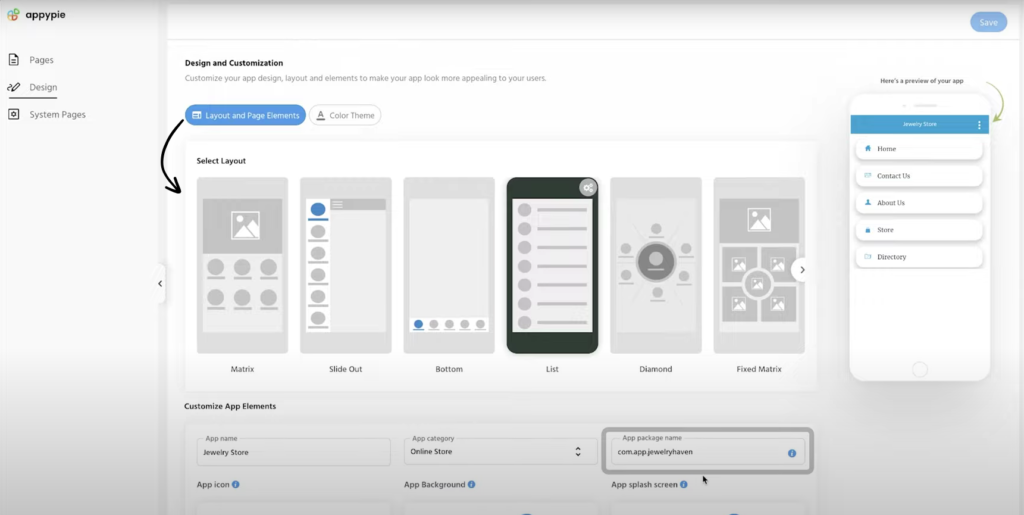
Appy Pie takes a template-first approach to iOS app building. Pick from a library of industry-specific templates — restaurants, fitness studios, churches, real estate, events — customize the layout, content, and colors, and publish. The platform also bundles a chatbot builder, website builder, and workflow automation tools.
What makes it stand out for iOS: If your use case closely matches one of Appy Pie's templates, you can have a functional iOS app ready to submit to the App Store in a few hours. The learning curve is minimal. Appy Pie's AI-assisted setup asks questions about your business and generates a starting point from your answers.
The iOS cost structure: Appy Pie's pricing is separated by platform. The Basic plan (~$18/app/month) covers Android only. To publish to the Apple App Store, you need the Platinum plan at approximately $60/app/month billed annually. This is on top of Apple's mandatory $99/year Developer Account fee. Each app requires its own subscription — building two iOS apps doubles your Appy Pie bill.
Strengths:
- Large template library across many industry verticals
- Quick setup for template-fitting use cases
- AI-assisted setup generates starting points from business descriptions
- Bundled tools (chatbot, website, workflows)
Honest limitations: Template-driven means limited customization depth. Once you need functionality that does not fit the template, you hit walls quickly. iOS publishing requires the expensive Platinum tier. Database capabilities are less sophisticated than platforms with built-in relational databases. Per-app pricing means costs multiply with each additional app. App quality varies significantly by template. No permanent free plan — only a 7-day trial.
Best for: Small businesses in specific verticals who need a simple branded iOS app quickly and do not require deep customization or complex data handling.
Bubble — Web Builder with iOS via Wrapper
Price: $69/mo+ (Bubble) + $49/mo+ (Natively wrapper) | Output: WebView wrapper for iOS
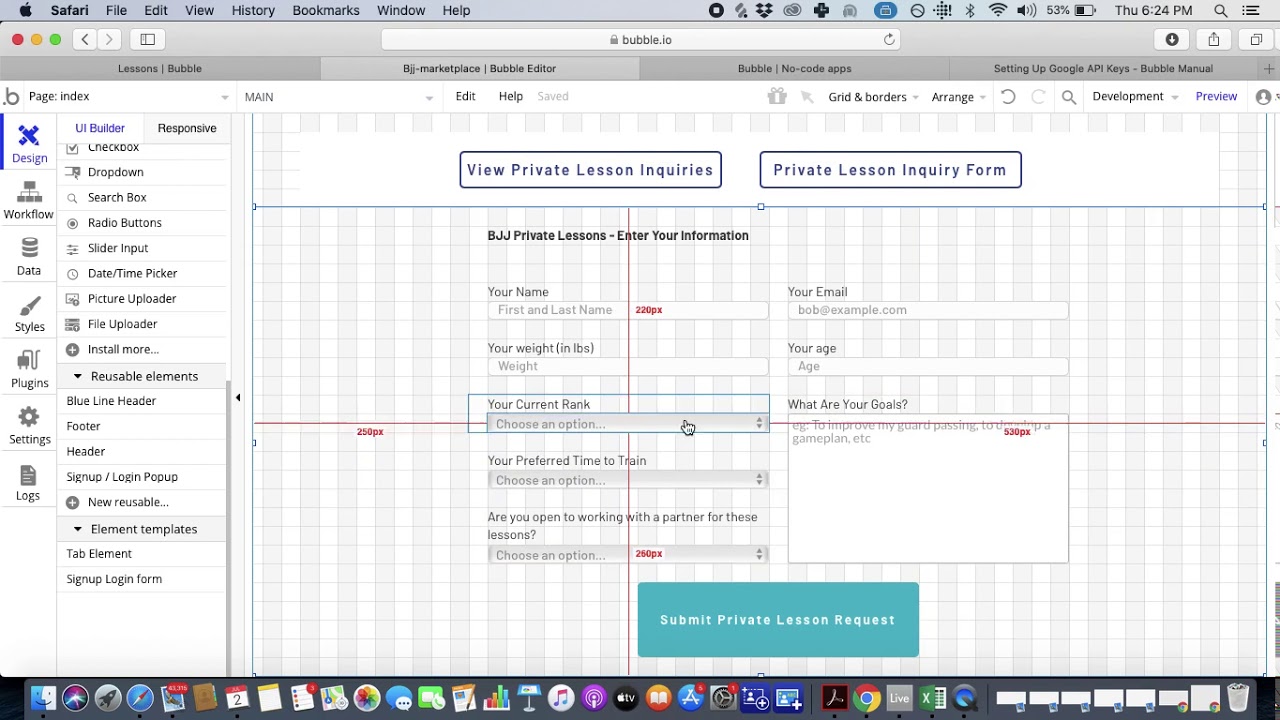
Bubble is a visual web app builder with deep customization capabilities. Its workflow engine handles conditional logic, iterative data processing, and backend events. A plugin ecosystem of 5,300+ options extends functionality across payments, analytics, and integrations. Bubble recently added a native mobile editor to its platform, though the mobile offering is still new.
The iOS story: Bubble does not compile native iOS apps on its own. Teams who want their Bubble app in the Apple App Store typically use Natively or a similar wrapper service. This creates a WebView container that loads your Bubble web app inside a native shell. It gets you into the App Store, but the result is not a native iOS app — it is a web app running inside a container.
Apple's wrapper stance: Apple's App Store Review Guidelines (specifically guideline 4.2 on "Minimum Functionality") have increasingly targeted wrapper apps. Apps that are "not particularly useful, unique, or 'app-like'" may be rejected. WebView wrappers risk this rejection because they do not offer native performance or native UI patterns. Some Bubble wrapper apps get approved; others do not. The inconsistency makes this a risky path for business-critical apps.
Performance reality: WebView wrappers add 2-3 seconds of load time on top of the web app's own performance. The App Builder Guides February 2026 report documented Bubble page loads of 5-10 seconds on desktop and 8-14 seconds on mobile. Inside a wrapper on iOS, these times can be even longer. iOS users have high performance expectations — Apple's own apps set the standard.
Pricing: Bubble starts at $69/month (Growth plan, billed annually) with 250K Workload Units per month. Add Natively at $49/month minimum for the wrapper. WU overages cost $0.30 per 1K WU. Plus Apple's $99/year developer fee. Bubble holds a 1.7/5 on Trustpilot across 123 reviews.
Strengths:
- Sophisticated backend logic and conditional workflows
- Large plugin ecosystem (5,300+ options)
- Strong for complex web applications with intricate data relationships
Honest limitations: The wrapper approach is fundamentally a workaround for iOS. You are paying for two services (Bubble + Natively), getting web-level performance instead of native, losing access to some native iOS APIs, and accepting Apple's rejection risk for wrapper apps. Most teams building on Bubble end up hiring consultants at $40-$125/hour. Performance on iOS is web-level at best.
Best for: Teams already invested in Bubble for a web application who want a minimal-effort presence on the App Store — with the understanding that performance will be web-level and Apple may reject the wrapper.
See the full Adalo vs Bubble comparison
FlutterFlow — Flutter-Based Builder for Developer Teams
Price: $80/mo/seat (team features) | Output: Flutter-based cross-platform (iOS, Android, Web)
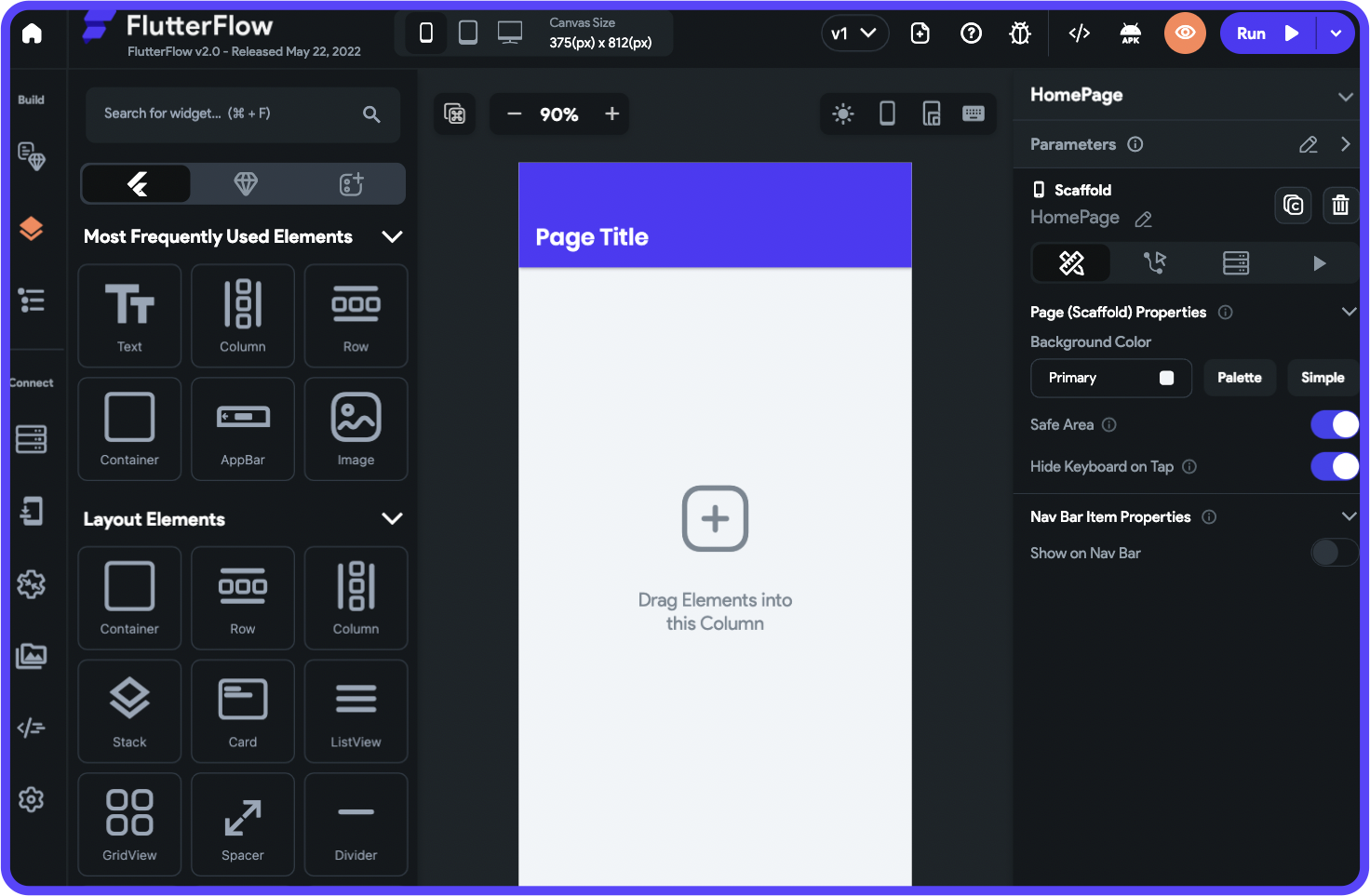
FlutterFlow is a visual development platform built on Google's Flutter framework. It generates real Flutter/Dart code that you can export, inspect, and extend. For iOS specifically, Flutter compiles to ARM machine code, which means near-native performance — a significant advantage over wrapper approaches.
What makes it stand out for iOS: Code export is the key differentiator. FlutterFlow lets you download the full Flutter source code, push it to GitHub, and hand it to a development team. This gives you an exit path and the ability to add custom iOS-specific functionality at the framework level. FlutterFlow also includes AI features for generating UI components and logic from descriptions.
The iOS publishing path: FlutterFlow can build the IPA in the cloud or you can export the Flutter code and build locally using Xcode. Either way, you need an Apple Developer Account ($99/year) and need to manage provisioning profiles and code signing. FlutterFlow handles some of this in the cloud build, but local builds require Xcode knowledge. This is more complex than platforms that fully manage the iOS build pipeline.
Pricing: Basic at $39/month with code download and IPA export. Growth at $80/month/seat with GitHub integration, branching, and real-time collaboration. No database included — you need Firebase (free tier available, paid starts at ~$25/mo) or Supabase. Plus Apple's $99/year developer fee. FlutterFlow holds a 2.6/5 on Trustpilot across 19 reviews.
Strengths:
- Flutter-based output for near-native iOS performance via ARM compilation
- Full code export and GitHub integration
- Active developer community and component marketplace
- Both cloud build and local Xcode build options
Honest limitations: No database included — you must bring Firebase, Supabase, or another backend. Per-seat pricing scales up fast for teams. The learning curve is steeper than true no-code platforms, particularly around state management and custom functions. Local iOS builds require Xcode and a Mac. The App Builder Guides 2026 report documented editor interactions taking 2-40 seconds per click at scale. This is a tool for developer-adjacent teams, not non-technical founders.
Best for: Developer-adjacent teams who want visual building speed with Flutter code export and are comfortable managing iOS provisioning profiles, code signing, and their own backend.
See the full Adalo vs FlutterFlow comparison
Thunkable — Block-Based Mobile Builder
Price: Free tier; $37/mo (annual) to publish 1 app, $189/mo (monthly) for unlimited | Output: Cross-platform (iOS, Android, Web)
No platform screenshot available for Thunkable.
Thunkable uses block-based logic similar to Scratch or MIT App Inventor. Instead of writing code, you drag logic blocks together to define app behavior. This approach is genuinely intuitive for people who have never built software, and it has made Thunkable popular in educational settings and coding bootcamps.
What makes it stand out for iOS: The block-based model is the most accessible programming paradigm available. Thunkable supports cross-platform output to iOS, Android, and web from a single project. It includes AI features like image recognition and text classification blocks that you can add to apps without understanding machine learning.
The iOS pricing cliff: Thunkable's pricing has a notable jump specifically around iOS publishing. The Accelerator plan at $18/month does not include app store publishing at all. The Builder plan at $37/month (annual billing) allows publishing one app to the App Store and Google Play. For unlimited published apps, you need the Advanced plan at $99/month (annual) or $189/month monthly. Publishing a single iOS app on Thunkable costs roughly the same as Adalo's plan that includes unlimited apps with unlimited usage. Add Apple's $99/year developer fee on top.
Strengths:
- Block-based logic is accessible for absolute beginners
- Strong educational partnerships and learning resources
- Cross-platform output from a single project
- Built-in AI blocks for image recognition and text classification
Honest limitations: Token-based usage limits mean larger or more complex apps consume your allocation faster. The builder is less sophisticated than alternatives for production-quality apps. The community and ecosystem are smaller than competitors. Database capabilities are basic. The pricing jump from "no publishing" to "one published app" is steep.
Best for: Students, educators, and first-time builders who want to learn app development through block-based logic and need basic iOS publishing capability.
Comparison Table
| Platform | Price | iOS Output | AI Features | Database | App Store Publishing |
|---|---|---|---|---|---|
| Adalo | $36/mo flat | Native IPA | Ada (Magic Start, Magic Add, X-Ray, Visual AI Direction) | Built-in Postgres, unlimited | Direct from platform |
| Appy Pie | ~$60/app/mo | Template-based | AI-assisted setup | Basic built-in | Yes (Platinum plan) |
| Bubble + Natively | $118/mo+ | WebView wrapper | Bubble AI | Built-in (usage-capped) | Via wrapper service (rejection risk) |
| FlutterFlow | $80/seat/mo | Native via Flutter | AI UI generation | None (BYO Firebase/Supabase) | Via Flutter build process |
| Thunkable | $37-189/mo | Cross-platform | AI blocks (image/text) | Basic built-in | At Builder tier ($37/mo+) |
Total Cost of Ownership: What You Actually Pay in Year One
Platform subscription fees are only part of the iOS picture. Apple's $99/year Developer Account fee is mandatory for everyone. Here is what each platform actually costs in the first year for a single iOS app published to the Apple App Store, assuming annual billing where available.
| Cost Component | Adalo | Appy Pie | Bubble + Natively | FlutterFlow | Thunkable |
|---|---|---|---|---|---|
| Platform (annual) | $432 | ~$720 | $828+ | $960/seat | $444 |
| Wrapper service | $0 | $0 | $588+ | $0 | $0 |
| External database | $0 (built-in) | $0 (basic) | $0 (built-in) | $0-300+ | $0 (basic) |
| Apple Developer fee | $99/year | $99/year | $99/year | $99/year | $99/year |
| Usage overages | $0 (no caps) | Varies | Unpredictable (WU) | $0 | Token-limited |
| Year 1 Total | $531 | ~$819+ | $1,515+ | $1,059+/seat | $543 |
Hidden costs specific to iOS:
- Apple's $99/year: Every platform requires this. It is non-negotiable. Budget for it separately from your platform costs.
- Bubble's wrapper risk: If Apple rejects your wrapper app after months of development on Bubble, you have invested significant time and money in a path that does not work. This is not a theoretical risk — wrapper rejections happen.
- FlutterFlow's Xcode requirement: Local iOS builds require a Mac with Xcode. If you are on Windows, you either use FlutterFlow's cloud build (which limits debugging options) or rent a Mac in the cloud (~$20-50/month).
- Developer time: FlutterFlow and Bubble both have steeper learning curves. Bubble teams hire consultants at $40-$125/hour. These costs often dwarf platform subscriptions.
How to Publish an iOS App Without Code
The path from builder to Apple App Store varies significantly by platform. Here is what each process actually looks like.
Path 1: Native via Adalo
- Build your app on the visual multi-screen canvas. Use Ada's Magic Start to generate the initial foundation, then refine with Magic Add and Visual AI Direction.
- Preview on iOS using Adalo's device preview. Test on iPhone SE through iPhone 16 Pro Max and iPad form factors.
- Configure app details — app name, icon, splash screen, and App Store listing information.
- Set up Apple Developer Account — Adalo walks you through creating your account ($99/year) and configuring certificates.
- Adalo compiles to IPA — the platform handles the build pipeline, code signing, and provisioning profiles.
- Beta test via TestFlight — distribute your app to testers before public launch.
- Submit to the App Store — follow the guided submission process through App Store Connect.
Time to publish: Same day for simple apps. 1-3 days for Apple App Store review (sometimes longer for first submissions).
Path 2: Flutter via FlutterFlow
- Build your app using FlutterFlow's widget tree editor and configure your Firebase or Supabase backend.
- Test locally using FlutterFlow's preview or export and run in the iOS Simulator (requires a Mac with Xcode).
- Export or use cloud build — FlutterFlow can build the IPA in the cloud, or you can export the Flutter code and build locally.
- Configure signing — set up your Apple Developer certificates, provisioning profiles, and App ID.
- Beta test via TestFlight — upload your IPA to App Store Connect for TestFlight distribution.
- Submit to the App Store via App Store Connect. Upload your IPA and complete the store listing.
Time to publish: 1-3 days for the build and configuration process, plus 1-3 days for Apple review. Longer if you need to troubleshoot certificates or provisioning profiles.
Path 3: WebView Wrapper via Bubble + Natively
- Build your web app in Bubble. Ensure it is responsive and performs acceptably on mobile screen sizes.
- Sign up for Natively (or a similar wrapper service) and connect it to your Bubble app's URL.
- Configure native features — push notifications, splash screens, and app icons through the wrapper service.
- Natively generates the wrapper IPA — a native shell that loads your Bubble web app in a WebView.
- Submit to the App Store — upload the generated IPA. Be prepared for potential rejection under Apple's guideline 4.2 (Minimum Functionality).
Time to publish: 2-5 days for wrapper configuration, plus 1-7+ days for Apple review. Wrapper apps face higher scrutiny and longer review times. First submissions may be rejected.
Frequently Asked Questions
What is the best AI app builder for iOS without coding?
The answer depends on your technical skill level and what kind of app you are building. For non-technical founders who want to go from idea to App Store listing without writing code, Adalo handles the full pipeline: AI-powered app generation via Ada (Magic Start, Magic Add, Visual AI Direction, X-Ray), visual editing on a multi-screen canvas, native IPA compilation, and direct App Store submission at $36/month flat. FlutterFlow produces excellent iOS apps via Flutter but assumes some technical knowledge. Appy Pie works for simple template-based apps in specific verticals.
How much does it cost to build an iOS app with AI?
Every iOS app requires Apple's $99/year Developer Account fee. On top of that: Adalo costs $531 in year one (platform + Apple fee) for unlimited apps with unlimited usage. Appy Pie starts at ~$819/year for one iOS app. FlutterFlow runs $1,059+/year per seat before database costs. Bubble plus a wrapper starts at $1,515/year with unpredictable WU charges. For comparison, hiring a developer to build a custom iOS app typically costs $25,000-$100,000+.
Will Apple approve an AI-built iOS app?
Yes — Apple reviews the app's quality and compliance, not how it was built. Native apps compiled as IPA files — whether built with Adalo, FlutterFlow, or Xcode — go through the same review process. The risk area is wrapper apps: Apple's guideline 4.2 targets apps that do not provide a native-level experience. Native-compiled apps (Adalo, FlutterFlow) do not face this risk. Wrapper apps (Bubble + Natively) face inconsistent outcomes.
Is a native iOS app better than a WebView wrapper?
In almost every measurable way, yes. Native apps load faster (typically under 2 seconds vs 5-14 seconds for wrapped Bubble apps), have full access to iOS features like push notifications, camera, FaceID, HealthKit, and Core Location, and pass Apple's review process consistently. Wrappers are web pages inside a native shell — users notice the difference, Apple's reviewers notice the difference, and performance metrics confirm the difference.
Do I need a Mac to build an iOS app?
Not with every platform. Adalo handles the entire iOS build pipeline in the cloud — you can build and publish an iOS app from any computer, including Windows. FlutterFlow offers cloud builds but some features require local Xcode builds (Mac only). Thunkable handles builds in the cloud. If you use FlutterFlow with local builds, you need a Mac with Xcode installed, or a cloud Mac service.
Do I also get an Android app, or do I need to build separately?
Adalo builds one app that works on iOS, Android, and web from a single project — you design once and publish to both the Apple App Store and Google Play. FlutterFlow also supports cross-platform output via Flutter. Thunkable offers cross-platform from one project. Bubble requires a separate wrapper for each platform. Appy Pie charges separately for iOS support (~$60/mo vs ~$18/mo for Android only).
What about TestFlight for beta testing?
TestFlight is Apple's official beta testing platform. It lets you distribute your app to up to 10,000 testers before public launch. Adalo supports TestFlight distribution as part of its publishing workflow. FlutterFlow apps can be distributed via TestFlight after building the IPA. Wrapper apps can also use TestFlight, though beta testers will experience the same web-level performance as the final version.
How long does Apple's review process take?
Apple reviews most app submissions within 24-48 hours, though first submissions and wrapper apps may take longer — up to 7+ days. Native-compiled apps (from Adalo, FlutterFlow, or Thunkable) generally have smoother reviews. Wrapper apps face more scrutiny under guideline 4.2 and may receive rejections that require changes and resubmission, adding days or weeks to the timeline.
What does the Replit and Vibecode Apple App Store removal mean for AI app builders?
In March 2026, Apple removed Replit and Vibecode from the App Store under Guideline 2.5.2, which prohibits apps that allow downloading, executing, or interpreting arbitrary code — including code written in JavaScript, HTML, or any other scripting language. This enforcement action targeted the builder tools themselves, not apps built with them. The practical implication for founders: platforms that generate code you then maintain (like Lovable, Bolt, and v0) face platform-level App Store risk if they ever attempt to ship iOS builder tools. Platforms that compile native apps through standard pipelines — Adalo (IPA via Codemagic), FlutterFlow (Flutter build) — are unaffected, since the build process happens on the platform's servers, not in a code execution environment on the user's device.
Updated April 2026. Pricing verified as of publication date. All platforms listed offer free tiers or trials — test them with your specific use case before committing to a paid plan.

Build your app fast with one of our pre-made app templates
Begin Building with no code