Agencies need app builders that can handle multiple client projects without per-app pricing eating into margins. This guide compares the top AI app builders and what makes each one suited — or not — for agency workflows.
Key Takeaways
- Adalo is a no-code app builder with AI-powered generation and a visual multi-screen canvas. It publishes native iOS and Android apps to the Apple App Store, Google Play Store, and web from a single project. $36/mo flat per app with no usage caps. Built-in relational database with 500 records on the free plan. Best for agencies that need to deliver client apps fast with predictable per-project economics.
- Bubble is a visual web app builder with deep backend logic and 5,300+ plugins. Agencies charge clients $20,000-$250,000 for Bubble builds, but Workload Unit costs eat into margins as client apps scale. Web-only output limits the client base to teams that do not need native mobile.
- FlutterFlow generates cross-platform apps via Google's Flutter framework. Code export is valuable for agency handoff — deliver the Flutter codebase to the client's dev team. $80/mo/seat with no database included. Per-seat pricing compresses margins on smaller engagements.
- Glide turns Google Sheets into functional web apps. The fastest path from client spreadsheet data to a working tool. Strong for quick internal tool engagements, but web/PWA only — not viable for clients who need app store presence.
Introduction
Agency economics are different from individual builder economics. The question is not just "can I build an app?" but "can I build apps for clients at a margin that sustains my business?" Every platform decision ripples through your pricing model, delivery timeline, maintenance obligations, and client retention. A platform with per-seat pricing means your costs scale with team size. A platform with usage-based pricing means your client's success increases your costs. A platform that requires extensive customization means more billable hours per project — good for revenue, but bad for profitability if those hours are spent fighting the tool rather than building value.
Agencies also face a challenge that solopreneurs and startups do not: they need to run multiple projects simultaneously, hand off completed apps to clients who may not be technical, and provide ongoing maintenance without it consuming the team's capacity. The ideal platform lets you spin up new projects fast, deliver professional-quality results, and move on to the next engagement without getting stuck in support cycles.
This guide compares four AI app builders through the agency lens: per-project economics, delivery speed, client handoff experience, scalability across multiple simultaneous projects, and what happens to your margins as client apps grow. Every platform is profiled honestly, including where agency-friendly marketing does not match agency-friendly reality.
Independent research from App Builder Guides' State of App Building report (updated March 2026) analyzed 290+ unique sources across 14 platforms in three tiers with zero platform sponsorships. Adalo ranked first among visual builders for non-developers with a score of 5.94/10.
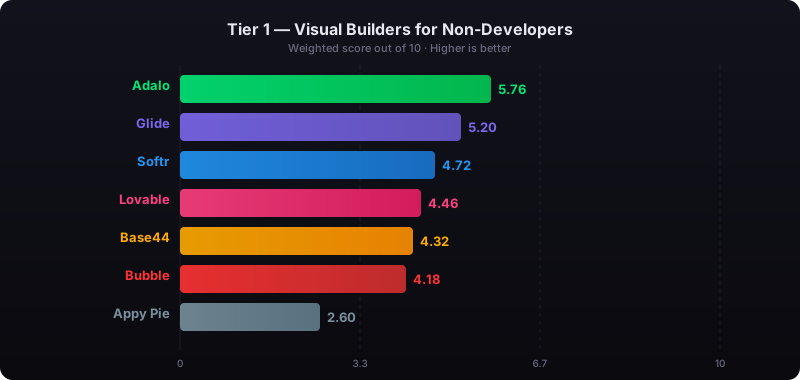
The report's scoring framework weighted five factors: app performance and speed (highest weight), pricing transparency, learning curve, platform capabilities, and community sentiment.
See also: Compare all no-code app builders | AI app builder solutions | Adalo for freelancers and agencies | Hire an Adalo expert
How We Evaluated
Every platform was assessed against criteria specific to agency operations — profitability, delivery speed, and scalability across multiple client projects:
- Per-project economics: What does it cost per client project? Is the pricing flat-rate per project, per-seat (scaling with your team), or usage-based (scaling with the client's users)?
- Delivery speed: How fast can an agency team deliver a production-quality client app? Days, weeks, or months?
- Client handoff: Can you transfer the completed app to the client's team for self-service maintenance, or are they dependent on you indefinitely?
- Multi-project management: How well does the platform handle running 5, 10, or 20 client projects simultaneously?
- Output range: Does the platform produce native iOS and Android apps, or just web? Clients increasingly expect App Store presence.
- AI capabilities: Can AI accelerate the build process, reducing hours per project and improving margins?
- White-labeling: Can you remove the platform's branding from the client's app?
- Scalability per app: When a client's app succeeds and user counts grow, do your costs (or theirs) change?
Adalo — Flat-Rate Client App Delivery with Native Mobile Output
Price: Free plan available; $36/mo per app for app store publishing with unlimited usage | Output: Native IPA for iOS, native APK for Android, plus web — from one project
Ada, Adalo's AI builder, accelerates the agency workflow at every stage. For new client projects, Magic Start generates a complete app foundation — screens, navigation, database schema, and logic — from a description of the client's requirements. Magic Add lets your team layer on features through natural language ("add a booking system with calendar integration," "add user roles with admin and client views"). Visual AI Direction lets team members point at elements on the multi-screen canvas and instruct changes directly, which is faster than writing specifications. X-Ray identifies performance issues before client delivery.
Adalo 3.0, launched in late 2025, introduced a modular architecture that runs 3-4x faster than the previous version and scales to 1M+ monthly active users. For agencies, this means you can confidently deliver apps to clients with growth ambitions without worrying about platform-imposed ceilings.
Why agencies choose it: The economics are straightforward. Each client app costs $36/month with unlimited usage — no per-user, per-action, or per-record charges. When a client's app goes viral or their user base doubles, neither your costs nor theirs change. This predictability lets you price projects with confidence. The visual multi-screen canvas shows every screen simultaneously, which is valuable for client presentations — walk them through the entire app flow on one screen rather than clicking between pages. One codebase produces iOS, Android, and web apps, so you can deliver to all three platforms from a single build.
Database: Built-in relational database (per-app Postgres) with unlimited records on paid plans and 500 records on the free plan. No Firebase or Supabase setup required per project. For clients migrating from spreadsheet workflows, SheetBridge lets you use a Google Sheet as a relational database within Adalo.
Pricing: Starter at $36/month per app (billed annually) includes native iOS and Android publishing, unlimited database records, and zero usage caps. No overage fees. Agency plans available for multi-project management.
Strengths:
- Flat-rate per project — margins stay predictable regardless of client app growth
- AI builder (Ada) accelerates delivery from weeks to days per project
- Native iOS + Android + web from one build — wider client offering
- Visual multi-screen canvas doubles as a client presentation tool
- Built-in database eliminates per-project infrastructure setup
- Client handoff: non-technical clients can make updates on the visual canvas
Honest limitations: Adalo is purpose-built for database-driven apps — marketplaces, booking systems, CRMs, directories, and social platforms. If a client needs a complex web-only SaaS with highly custom backend logic, Bubble may be more appropriate. Code export is available only on the enterprise plan within Adalo Blue, while FlutterFlow includes it on lower tiers — relevant for clients who want source code ownership. The component library, while covering most use cases, is smaller than Bubble's plugin ecosystem.
Best for: Agencies delivering native mobile + web apps to clients who value predictable costs, fast delivery, and the ability to self-maintain their app after handoff.
Learn more about Adalo's AI app builder
Bubble — High-Ticket Web Builds with Margin Risk at Scale
Price: $69/mo+ per app with usage-based Workload Units | Output: Web applications (mobile via wrapper services at extra cost)
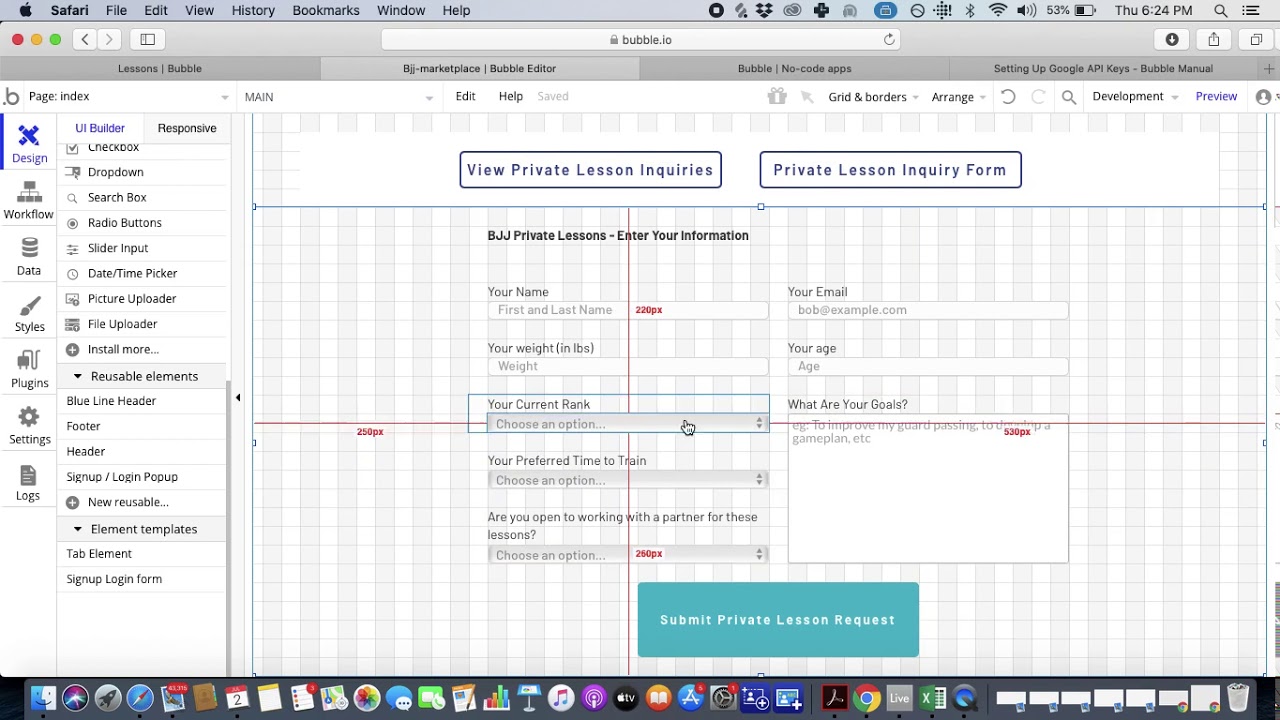
Bubble is the platform behind a large portion of the no-code agency ecosystem. Its workflow engine handles conditional logic, iterative data processing, and complex backend events. The plugin ecosystem of 5,300+ options means agencies can deliver sophisticated web applications for clients with demanding requirements. Bubble agencies typically charge clients $20,000-$250,000 per project, making it one of the higher-ticket service offerings in the no-code space.
The agency economics: High ticket prices look good until you factor in delivery costs. Bubble's learning curve means agencies need specialized Bubble developers — not just any no-code builder. These specialists command $40-$125/hour. A $50,000 client project might require 200-500 hours of Bubble development time, plus project management. The margin is there, but it depends on having efficient, experienced Bubble developers on your team.
The scaling problem: Bubble's Workload Unit pricing creates a margin risk that is unique to agencies. When you deliver a client app and that client's business succeeds, their WU consumption increases. Either the client pays more (which they may not have budgeted for) or the agency absorbs the cost increase (which compresses margins). Independent users report 400-500 WU per user per day. A client app with 1,000 monthly active users can generate WU charges exceeding $1,000/month on top of the base subscription.
Mobile limitations: Bubble is a web builder. For clients who need app store presence, agencies must add a wrapper service like Natively ($49/mo+ per app). This increases per-project costs and introduces performance trade-offs. The App Builder Guides 2026 report documented Bubble mobile load times of 8-14 seconds. Bubble holds a 1.7/5 on Trustpilot across 123 reviews.
Pricing: Growth plan at $69/month per app (billed annually) with 250K Workload Units per month. Overages cost $0.30 per 1K WU. Add Natively at $49/month per app for mobile wrapper.
Strengths:
- Deepest workflow engine among visual builders — handles complex client requirements
- Large plugin ecosystem (5,300+ options) for extending functionality
- Established agency ecosystem with proven high-ticket pricing models
- Strong for complex web applications with intricate data relationships
Honest limitations: Web-only without wrappers — limits client base. Workload Unit pricing creates margin risk as client apps scale. Requires specialized Bubble developers — not a platform where any team member can contribute. Delivery timelines are longer due to platform complexity. Performance at scale documented at 5-10 second page loads on desktop and 8-14 seconds on mobile. Client handoff is difficult — non-technical clients cannot self-maintain Bubble apps.
Best for: Agencies with experienced Bubble developers building high-ticket, complex web-only applications for clients who understand and accept usage-based pricing.
See the full Adalo vs Bubble comparison
FlutterFlow — Code Export for Developer-Handoff Engagements
Price: $80/mo/seat (team features) | Output: Flutter-based cross-platform (Android, iOS, Web)
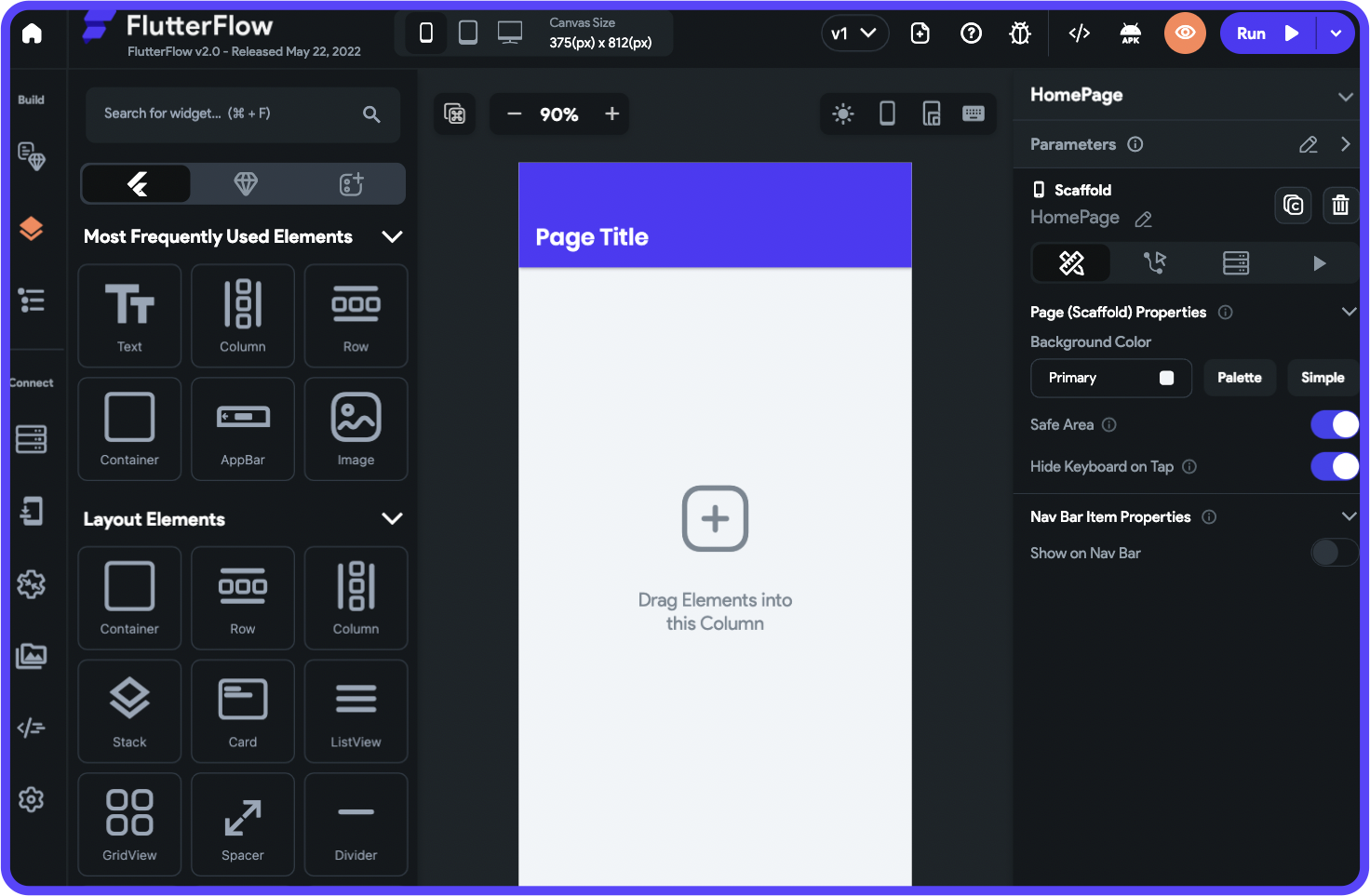
FlutterFlow is a visual development platform built on Google's Flutter framework. For agencies, the distinguishing feature is code export: you can build an app visually, then hand the complete Flutter source code to the client's development team. This creates a specific agency model — build the first version fast with FlutterFlow, deliver the codebase, and transition the client to their own engineering team for ongoing development.
The agency angle: Code export changes the engagement model. Instead of indefinite maintenance contracts (which can be profitable but tie up team capacity), FlutterFlow lets agencies offer a defined deliverable: a working Flutter codebase that the client owns. This is attractive to clients with their own dev teams who need a head start, and to agencies that want to maximize project throughput rather than recurring revenue.
The margin challenge: Per-seat pricing at $80/month means your platform cost scales with team size. A three-person agency team working on a project costs $240/month in platform fees alone — before adding database costs (Firebase or Supabase, since FlutterFlow includes no database). For smaller engagements, this can compress margins. The platform also assumes some Flutter knowledge, so your team needs developers who understand the framework — general no-code builders will struggle.
Pricing: Basic at $39/month with code download. Growth at $80/month/seat with GitHub integration, branching, and collaboration. A three-person team on Growth pays $240/month before database costs. Firebase or Supabase required separately. FlutterFlow holds a 2.6/5 on Trustpilot across 19 reviews.
Strengths:
- Code export enables clean client handoff with source code ownership
- Flutter output for near-native iOS and Android performance
- GitHub integration for version control across team members
- Active developer community and component marketplace
Honest limitations: Per-seat pricing compresses margins — costs increase as you scale your team. No database included — each project needs Firebase or Supabase setup, adding configuration time. Requires Flutter-knowledgeable developers, not general no-code builders. The App Builder Guides 2026 report documented editor interactions taking 2-40 seconds per click at scale. Not suited for non-technical agency teams or clients who want self-service maintenance without developer skills.
Best for: Developer-staffed agencies delivering Flutter codebases to clients who have (or plan to hire) their own engineering teams, and where code ownership is a key client requirement.
See the full Adalo vs FlutterFlow comparison
Glide — Fast Internal Tool Delivery from Client Spreadsheets
Price: $25/mo+ per app (custom domains require $60/mo Maker plan) | Output: Web apps and PWAs only
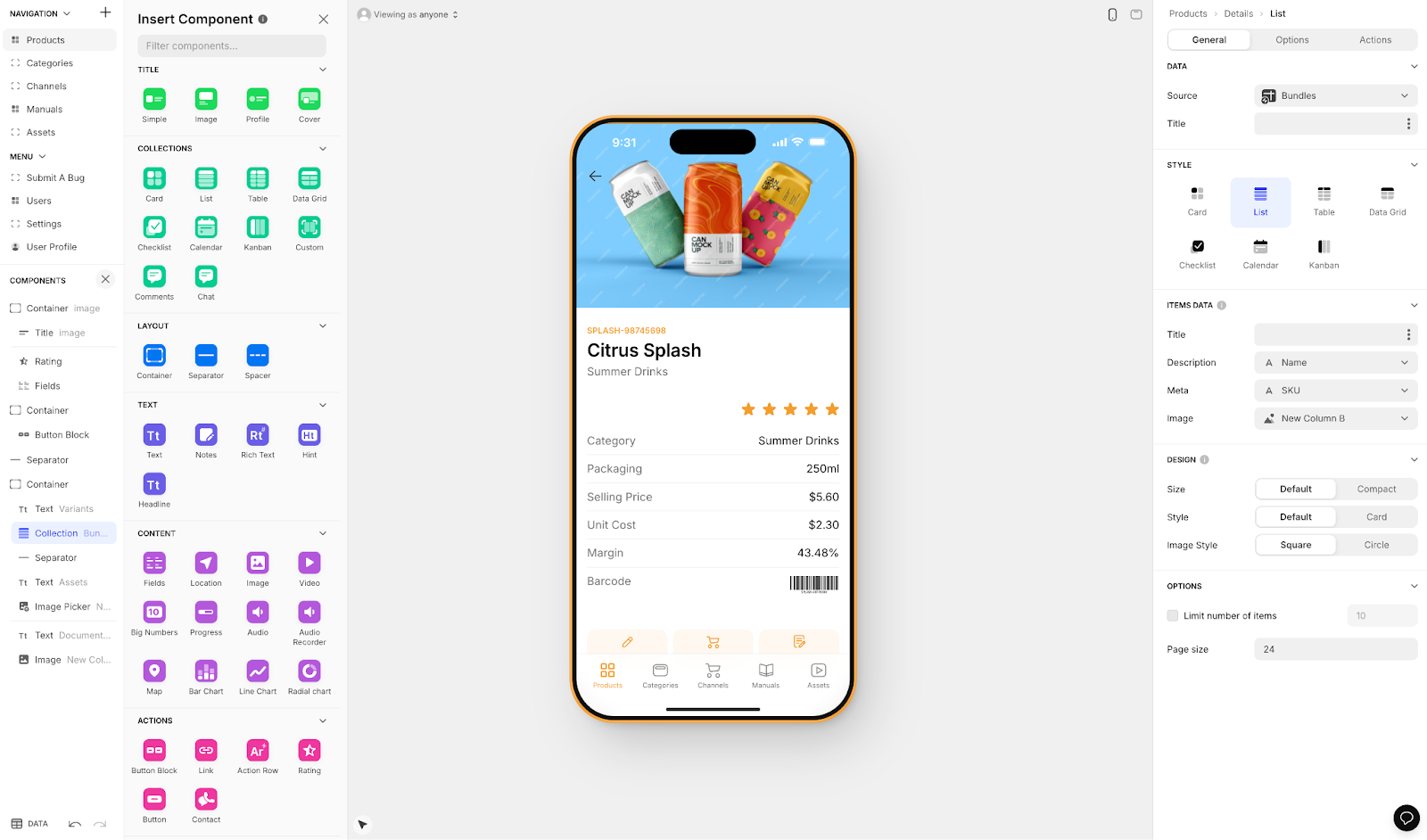
Glide turns Google Sheets into functional web applications. For agencies, this creates a specific niche: quick-turnaround internal tool engagements. A client comes to you with business data in spreadsheets and needs it turned into a usable tool for their team. Glide delivers that faster than any other platform. Client portals, inventory trackers, project dashboards, field service tools — if the data is already in a spreadsheet, the hardest part is done.
The agency niche: Glide engagements are typically smaller ($2,000-$15,000) but faster to deliver (days to weeks). The economics work when you can complete multiple Glide projects per month. The platform's low learning curve means junior team members can handle Glide builds, freeing senior builders for more complex projects on other platforms. Client handoff is straightforward since clients already understand spreadsheets — their data layer is a Google Sheet they can manage themselves.
The agency ceiling: Glide builds web apps and PWAs only. No native mobile apps, no app store publishing. For agencies that want to offer "we build your App Store app," Glide is not viable. The spreadsheet-based architecture also limits data complexity — clients with sophisticated relational data needs will outgrow Glide quickly. Custom domains require the $60/month Maker plan per app, which cuts into margins on smaller projects.
Pricing: Basic at $25/month per app. Maker at $60/month per app for custom domains and advanced features. Row limits and user limits apply on lower tiers.
Strengths:
- Fastest delivery time for internal tools from existing spreadsheet data
- Low learning curve lets junior team members handle builds
- Natural client handoff — clients manage their own Google Sheets data
- Good for high-volume, lower-ticket engagements
Honest limitations: Web and PWA only — no native mobile apps or app store publishing. Spreadsheet-based architecture limits data complexity. Custom domains at $60/month per app compress margins. Not suited for consumer-facing apps or complex multi-screen applications. Row and user limits constrain growth on lower tiers. No code export.
Best for: Agencies building a practice around quick-turnaround internal tools and dashboards for clients with existing spreadsheet data, where app store presence is not required.
Comparison Table
| Platform | Price Model | App Store Output | AI Features | Database | Agency Fit |
|---|---|---|---|---|---|
| Adalo | $36/mo flat per app | Native iOS + Android + Web | Ada (Magic Start, Magic Add, X-Ray, Visual AI Direction) | Built-in Postgres, unlimited | Predictable margins, fast delivery |
| Bubble | $69/mo + WU per app | Web only (wrapper extra) | Bubble AI | Built-in (usage-capped) | High-ticket web, margin risk |
| FlutterFlow | $80/seat/mo | Native via Flutter | AI UI generation | None (BYO Firebase/Supabase) | Code-handoff engagements |
| Glide | $25-60/mo per app | Web/PWA only | Glide AI (column-based) | Sheets-based | Quick internal tools |
Total Cost of Ownership: Per-Project Economics Over 12 Months
Agency economics are per-project. Here is what each platform costs per client app over 12 months, assuming annual billing, one team member assigned per project, and the app published to both iOS and Android app stores where applicable.
| Cost Component | Adalo | Bubble | FlutterFlow | Glide |
|---|---|---|---|---|
| Platform (annual, per app) | $432 | $828+ | $960/seat | $300-720 |
| External DB per project | $0 (built-in) | $0 (built-in) | $0-300+ | $0 (Sheets) |
| Wrapper service (mobile) | $0 | $588+ (Natively) | $0 | N/A |
| App Store fees (client) | $124 | $124 | $124 | N/A |
| Usage overages | $0 (no caps) | Unpredictable (WU) | $0 | Row limits |
| Year 1 Platform Cost | $556/app | $1,540+/app | $1,084+/seat | $300-720/app |
Agency margin factors to watch:
- Bubble's WU at client scale: A client app with 1,000 MAU can add $1,000+/month in WU charges. If your maintenance contract does not pass through usage costs, this comes out of your margin.
- FlutterFlow's seat scaling: Putting three team members on a project costs $240/month in seats alone. For smaller ($5,000-$10,000) engagements, this is a meaningful percentage of the project budget.
- Bubble specialist rates: Bubble agencies need Bubble-specific developers at $40-$125/hour. General no-code builders cannot contribute effectively, limiting your hiring pool.
- Delivery speed impact: Adalo's AI-accelerated workflow (Magic Start + Magic Add) can cut initial build time from weeks to days. For agencies billing fixed-price projects, faster delivery directly improves profitability.
Frequently Asked Questions
What is the most profitable AI app builder for agencies?
Profitability depends on the combination of project revenue, platform costs, and delivery time. Adalo offers the best per-project economics for mobile + web apps: $36/month flat with no usage caps means your costs stay fixed regardless of client app growth. Ada, Adalo's AI builder, reduces delivery time with Magic Start (generates a foundation from a description), Magic Add (adds features via natural language), and Visual AI Direction (point at elements on the canvas to instruct changes). Faster delivery at lower platform cost equals better margins.
Can an agency deliver native mobile apps to clients without developers?
Yes. Adalo's visual multi-screen canvas and AI builder let non-developer agency teams build and publish native iOS and Android apps to the Apple App Store and Google Play. The platform compiles native IPA and APK files, handles the build pipeline, and walks teams through app store submission. This lets agencies offer mobile app development as a service without hiring dedicated mobile developers.
How do agencies handle client handoff?
It varies by platform. Adalo apps can be transferred to clients who then make updates on the visual canvas themselves — suitable for non-technical clients. FlutterFlow offers code export, letting you hand over a Flutter codebase to the client's dev team. Bubble apps are rarely handed off because non-technical clients cannot maintain them, which means ongoing maintenance contracts (profitable but capacity-intensive). Glide's spreadsheet-based data layer is naturally client-manageable.
Should agencies standardize on one platform or use multiple?
Many successful agencies use two platforms: one for mobile + web projects (Adalo or FlutterFlow) and one for quick internal tool engagements (Glide). Standardizing on one platform maximizes team efficiency and reduces training costs, but limits the types of projects you can take on. If you must pick one, Adalo covers the widest range — native mobile, web, database-driven apps, flat pricing — while Glide is the best complement for spreadsheet-to-tool projects.
How do per-seat vs per-project pricing models affect agency margins?
Per-project pricing (Adalo at $36/app/month, Glide at $25-60/app/month) gives you a fixed, predictable cost per client engagement. Per-seat pricing (FlutterFlow at $80/seat/month) means costs scale with team size, not project count. For agencies doing many small projects with a lean team, per-seat can be efficient. For agencies with larger teams doing diverse projects, per-project pricing protects margins better. Usage-based pricing (Bubble's Workload Units) is the riskiest for agencies because costs scale with client success — the better the app performs, the more you or your client pays.
Can agencies white-label apps built on these platforms?
Adalo removes platform branding on paid plans, so client apps appear as standalone products. Bubble removes branding on paid plans as well. FlutterFlow exports clean Flutter code with no FlutterFlow branding. Glide retains some branding on lower tiers — the Maker plan at $60/month removes it. For agencies, removing platform branding is essential for professional client delivery.
What types of client apps work best on each platform?
Adalo excels at database-driven apps with mobile presence: marketplaces, booking systems, CRMs, directories, social platforms, and membership apps. Bubble is strongest for complex web-only applications with sophisticated backend logic. FlutterFlow suits clients who need native performance with eventual code ownership. Glide works best for internal tools, dashboards, and client portals built on existing spreadsheet data. Match the platform to the client's primary need rather than forcing every project onto one platform.
Updated April 2026. Pricing verified as of publication date. All platforms listed offer free tiers or trials — test them with a pilot client project before committing to a paid plan.

Build your app fast with one of our pre-made app templates
Begin Building with no code