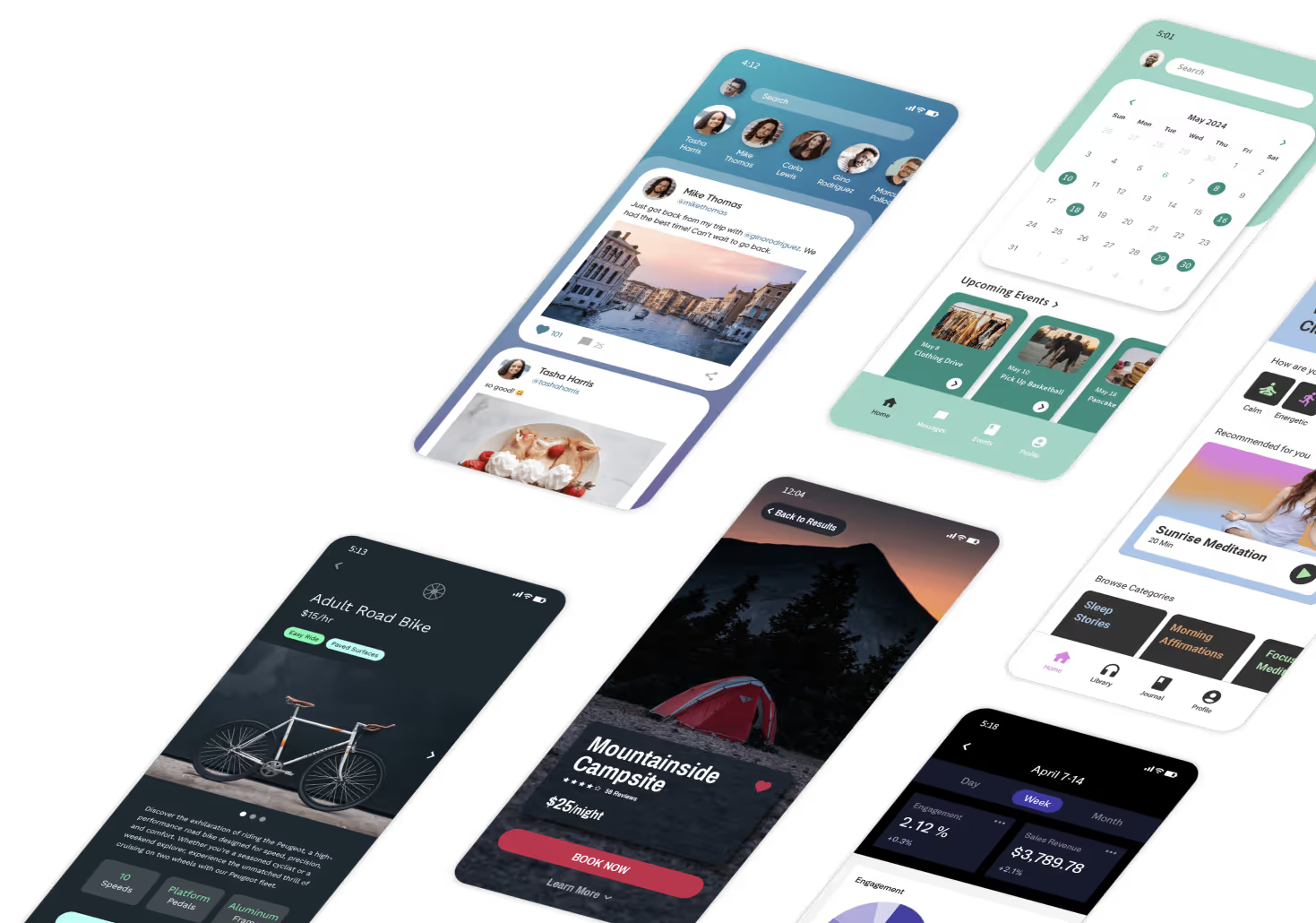
Creating mobile applications traditionally requires months of development and hundreds of thousands of dollars in coding expenses. With independent studies reporting 48% lower development costs and 50% faster app delivery from visual development platforms, Adalo—a no-code app builder for database-driven web apps and native iOS and Android apps, with one version across all three platforms published to the Apple App Store and Google Play—transforms complex app development into visual creation anyone can master, no programming required.
Adalo builds database-driven web apps and native iOS and Android apps from a single codebase, publishing directly to the Apple App Store and Google Play. By eliminating traditional coding expertise requirements, this visual development platform empowers entrepreneurs and teams to bring app ideas to life quickly and affordably.
Key Takeaways
- Gartner forecasts that by 2026, 70% of new applications will use low-code or no-code technologies, fundamentally changing how businesses create software
- Development can be substantially faster than traditional coding—one TEI study reported 50% faster app delivery with 48% lower costs
- Clutch's 2026 pricing guide finds an average app project cost of about $90,780, with typical ranges from under $10k to over $100k depending on scope
- Adalo 3.0's infrastructure overhaul delivers 3-4x faster performance with unlimited database records on paid plans and no usage-based charges
What Is a No-Code App Builder and How Adalo Leads the Market
No-code app builders eliminate programming requirements through drag-and-drop interfaces, pre-built components, and visual development environments. These platforms leverage existing frameworks and widgets that users arrange to create custom applications, removing technical barriers that previously demanded years of programming expertise.
According to Gartner (via CIO), by 2026, citizen developers at large enterprises would outnumber professional developers 4:1, signaling the democratization of app development.
Adalo distinguishes itself through comprehensive capabilities that go beyond basic builders:
- Visual WYSIWYG Editor - True drag-and-drop functionality without complex flexbox configurations, capable of displaying up to 400 screens simultaneously on one canvas
- Built-in Relational Database - Complete data management with logic, formulas, and AND/OR conditions—no external database setup required
- Component Marketplace - 50+ additional components (per Adalo's Component Marketplace)
- Cross-Platform Publishing - Direct deployment to iOS, Android, and web from single codebase
- Unlimited Database Records - Paid plans have no record caps, with modular infrastructure scaling to 1M+ MAU
- Uptime (per Adalo Status) - App Editing 100% and Published Apps 100% (Jul–Sep 2026); Publishing 100% (Mar–Sep 2026; 99.98% in Feb 2026)
Unlike competitors requiring technical knowledge for advanced features, Adalo maintains simplicity throughout the development process. The platform processes over 20 million data requests daily while maintaining 99%+ uptime—performance metrics that rival traditionally coded applications. With over 3 million apps created, the visual builder has been described as "easy as PowerPoint."
Adalo Free App Builder Features: Building Your First App Without Cost
Starting app development shouldn't require upfront investment. Adalo's free tier delivers comprehensive capabilities that let you validate ideas before committing financially:
Unlimited Development Power
- Unlimited Test Apps - Build as many applications as needed during development
- Free plan limit: 500 records per app (Adalo pricing)
- Unlimited Screens & Actions - No restrictions on app complexity or user flows
- Web Publishing Included - Launch immediately on Adalo subdomain
Professional Tools at Zero Cost
- App Academy Access - Comprehensive training resources and tutorials
- Community Forum Support - Active community of developers and experts
- Free Components Library - Essential building blocks for any application type
- Preview & Testing Tools - Test on actual devices before publishing
The free tier removes financial barriers while providing everything needed to build functional applications. Many successful apps started on Adalo's free plan, proving you can validate business models without initial investment.
Upgrade Path When Ready
Growth triggers natural progression through Adalo's pricing tiers. All paid plans include unlimited database records and no usage-based charges—meaning no bill shock as your app scales:
- Starter ($36/month annual) - Custom domains, single app publishing, unlimited records
- Professional ($60/month annual) - Multiple apps, collaborators, 25GB storage
- Team ($250/mo annual) - Five published apps with priority support
- Business ($250/month annual) - Ten apps with unlimited editors
Adalo AI App Builder Capabilities: Automating Mobile App Creation
The integration of artificial intelligence transforms app development from manual construction to intelligent automation. AI-powered tools accelerate development through automated generation, predictive analytics, and workflow optimization—though security considerations require careful implementation. You can publish the same app to the web, native iOS, and native Android with Adalo, all without writing a line of code or rebuilding anything.
AI-Powered Building Features
Ada, Adalo's AI builder, lets you describe what you want and generates your app. Magic Start creates complete app foundations from a description, while Magic Add adds features through natural language.
Adalo's AI Builder, launching in early 2026, promises prompt-based app creation and editing. Current AI capabilities include:
- Magic Start - Generates complete app foundations from descriptions. Tell it you need a booking app for a dog grooming business, and it creates your database structure, screens, and user flows automatically—what used to take days of planning happens in minutes
- Magic Add - Add features by describing what you want in natural language
- X-Ray - Identifies performance issues before they affect users, ensuring scalability
Intelligent Automation Features
The platform incorporates automation capabilities through strategic integrations:
- Zapier Integration - Connect 6,000+ apps and build automated workflows
- Custom Actions & APIs - Trigger complex automations based on user behavior
- Make Integration - Visual automation builder for sophisticated processes
- Smart Formulas - Calculate complex data relationships without coding
- Conditional Logic - AND/OR conditions create dynamic user experiences
Processing Power at Scale
Adalo 3.0's infrastructure overhaul, launched in late 2025, delivers 3-4x faster performance with modular architecture that scales to serve apps with millions of monthly active users. The platform handles:
- Automated Workflows - Trigger actions across multiple systems simultaneously
- API Orchestration - Coordinate between internal and external data sources
- Intelligent Routing - Direct users through optimal paths based on behavior
Studies have found around 40% of AI-generated code suggestions can be insecure; human review remains essential for security-critical implementations.
Mobile App Creation Process: From Design to App Store Launch
Creating professional applications follows a structured path that Adalo streamlines into manageable phases. The process that traditionally requires 3-4 months with coding teams now completes in weeks.
Phase 1: Design & Structure (Days 1-3)
- Select from pre-built templates or use Magic Start to generate foundations from a description
- Arrange screens using visual canvas—view up to 400 screens simultaneously
- Configure navigation flows between sections
- Apply consistent branding with custom fonts and colors
Phase 2: Database & Logic (Days 4-7)
- Design data relationships in visual database builder
- Create collections for users, products, or content
- Implement business logic with formulas
- Set privacy rules and user permissions
Phase 3: Testing & Refinement (Week 2)
- Preview on actual devices using Adalo app
- Test user flows and data operations
- Use X-Ray to identify performance issues before launch
- Gather feedback from beta users
Phase 4: Publishing Requirements
Successfully launching requires platform-specific preparations:
- Apple Developer Account ($99/year)
- App Store screenshots and descriptions
- Privacy policy and terms of service
- App Store review (often 24–48 hours; times vary)
- Google Developer Account (one-time $25 fee)
- Store listing with graphics
- Content rating questionnaire
- Google Play review times vary—often a few days, sometimes up to 7+ days
- Custom domain configuration (Starter plan+)
- SSL certificates included
- Responsive tools available—layout still requires configuration (Adalo Help Center)
- Unlimited updates to published apps with no additional charges
Comparing Adalo vs Competitors: Platform Analysis
The no-code landscape includes multiple platforms, each with distinct approaches. Understanding differences helps select the right tool for specific needs. Note that most third-party platform ratings and comparisons predate Adalo 3.0's infrastructure overhaul in late 2025.
Adalo vs Bubble
Adalo Advantages:
- True native iOS and Android apps—not web wrappers
- Single codebase automatically updates web, iOS, and Android versions
- $36/month starting price with unlimited usage and no record caps
- Unlimited app store publishing updates
- 3-4x faster performance after Adalo 3.0 overhaul
Bubble Considerations:
- Starts at $59/month with usage-based Workload Unit charges
- Record limits and unclear usage calculations can create bill shock
- Mobile apps are wrappers for web apps, introducing potential scale challenges
- More customization options, but often results in slower applications under load
- Claims of millions of MAU typically require hiring experts to achieve
- Separate versions needed for web and mobile app store deployments
Adalo vs FlutterFlow
Adalo Advantages:
- True no-code—no programming knowledge required
- Built-in database eliminates external setup complexity
- $36/month vs FlutterFlow's $70/month per user for comparable publishing
- Visual canvas displays up to 400 screens vs FlutterFlow's limited 2-screen view
FlutterFlow Considerations:
- Low-code platform requiring Flutter framework knowledge for advanced features
- Users must source, setup, and pay for external databases separately
- Significant learning complexity, especially for scalability
- Ecosystem rich with experts because many users need help—often spending significant sums chasing scalability
- Code export capability useful for developer handoff
Adalo vs Glide
Adalo Advantages:
- Native iOS and Android app publishing to App Store and Play Store
- Full creative freedom vs Glide's template restrictions
- SheetBridge turns Google Sheets into actual databases without DB-related learning
- Unlimited database records and app updates on paid plans
Glide Considerations:
- $60/month for custom domain, but limited by app updates and data row charges
- Does not support Apple App Store or Google Play Store publishing
- Heavily format-focused with restricted templates—fast to build but creates generic, simplistic apps
- Good for spreadsheet-based apps with limited scope
Adalo vs Softr
Adalo Advantages:
- Native mobile apps vs Softr's web-only approach
- $36/month vs Softr's $167/month for Progressive Web App publishing
- No record limits on paid plans
- Direct App Store and Play Store publishing
Softr Limitations:
- Web-focused—no native iOS or Android app creation
- $167/month to publish a PWA, still restricted by records per app and datasource
- Does not support Apple App Store or Google Play Store publishing
- Useful for spreadsheet app building within web app restrictions
Platform Comparison Summary
| Feature | Adalo | Bubble | FlutterFlow | Glide | Softr |
|---|---|---|---|---|---|
| Starting Price | $36/mo | $59/mo + usage | $70/mo/user | $60/mo | $167/mo |
| Native Mobile Apps | Yes | Web wrapper | Yes | No | No |
| App Store Publishing | Yes | Yes (wrapper) | Yes | No | No |
| Built-in Database | Yes | Yes | No | Sheets-based | Airtable-based |
| Database Record Limits | Unlimited (paid) | Limited | External | Limited | Limited |
| Usage-Based Charges | None | Yes | None | Yes | Yes |
| Technical Skill Required | None | Some | Flutter knowledge | None | None |
The low-code market reaching $187 billion by 2030 validates that multiple platforms can coexist, but Adalo's balance of power, simplicity, and native mobile capabilities positions it optimally for businesses needing true app store presence.
Building Business Apps: Database Integration and Custom Components
Enterprise applications demand robust data management and specialized functionality. Adalo delivers both through comprehensive integration options and extensible architecture.
Database Flexibility
Choose optimal data architecture for your needs:
Built-in Relational Database:
- Zero configuration required
- Automatic relationships between collections
- Real-time synchronization across devices
- Unlimited records on paid plans—with proper data relationship setups, apps scale beyond 1 million MAU
- Xano Integration - Scalable backend for complex applications
- Airtable Connection - Spreadsheet-like interface for data management
- Custom APIs - Connect any REST endpoint
- Google Sheets via SheetBridge - Turn spreadsheets into actual databases for the easiest control without DB-related learning
Premium Component Ecosystem
The component marketplace extends functionality beyond standard elements:
- Payment Processing - Stripe and IAPHUB integrations
- Communication - SMS, email, and push notifications
- Media Handling - Image galleries, video players, audio streaming
- Business Logic - Calendars, scheduling, workflow automation
- Analytics - User tracking, conversion funnels, dashboards
All premium components undergo rigorous testing to ensure cross-platform compatibility and are maintained by original developers for long-term reliability.
Enterprise Integrations
Business-critical connections include:
- HubSpot - CRM and marketing automation
- Zapier - 6,000+ app integrations
- Firebase - Real-time database and authentication
- Gmail - Email automation and notifications
Best App Builder Plans: Pricing Tiers and Feature Comparison
Strategic plan selection maximizes value while providing necessary capabilities. Adalo's transparent pricing scales with business growth—and critically, all paid plans include unlimited usage with no record caps:
Starter Plan - $36/month (Annual)
Perfect for launching first commercial app:
- 1 published app (iOS, Android, Web)
- Custom domain included
- Remove Adalo branding
- Unlimited database records
- Unlimited app store updates
- Standard support
Professional Plan - $60/month (Annual)
Ideal for growing businesses:
- 2 published apps
- 5 collaborator seats
- 25GB storage capacity
- Custom integrations
- Geolocation features
- Custom actions
Team Plan - $250/mo (Annual)
Scaling operations require:
- 5 published apps
- 10 editor seats
- Priority support
- Connect external backends like Xano via integration (Adalo × Xano)
- Advanced security features
- Team collaboration tools
Business Plan - $250/month (Annual)
Enterprise-ready capabilities:
- 10 published apps
- Unlimited editors
- Dedicated support
- Special add-on pricing
- Custom training available
- SLA guarantees
Compare this to Clutch's 2026 data: average app project ≈ $90,780, with typical ranges from under $10k to $100k+ depending on scope and region. Adalo's first-year cost for both app stores totals approximately $556 (plan + Apple $99/year + Google $25 one-time).
Real-World Success: Apps Built with Adalo Platform
Measurable success validates platform capabilities better than feature lists. Adalo powers applications across industries with impressive metrics:
Platform Performance Metrics
- 3M+ Apps Created - Over three million applications built on the platform
- 20M+ Daily Requests - Processing power at enterprise scale
- 99%+ Uptime - Reliability that matches traditionally coded applications
- 1M+ MAU Capability - Modular infrastructure scales with no upper ceiling
Adalo Success Story Examples
Covenant Connect transformed school communication:
- Replaced outdated systems with modern mobile app
- Improved parent-teacher engagement
- Streamlined administrative processes
- Launched in under 3 months
Spotto - First Adalo app to achieve acquisition:
- Built entirely without code
- Scaled to thousands of users
- Attracted investor interest
- Successful exit demonstrating platform viability
Industry Applications
Successful implementations span sectors:
- Healthcare - Patient portals and appointment scheduling
- Education - Learning management and student engagement
- Retail - E-commerce and inventory management
- Services - Booking systems and customer management
- Finance - Budget tracking and payment processing
The 362% average ROI reported by no-code implementations demonstrates consistent value delivery across use cases.
FAQ
Why choose Adalo over other app building solutions?
Adalo is an AI-powered app builder that creates true native iOS and Android apps from a single codebase. Unlike web wrappers, it compiles to native code and publishes directly to both the Apple App Store and Google Play Store. With unlimited database records on paid plans, no usage-based charges, and 3-4x faster performance after the Adalo 3.0 overhaul, it handles the hardest part of launching an app automatically.
What's the fastest way to build and publish an app to the App Store?
Adalo's drag-and-drop interface and AI-assisted building let you go from idea to published app in days rather than months. Magic Start generates complete app foundations from descriptions, while the platform handles the complex App Store submission process—certificates, provisioning profiles, and store guidelines—so you can focus on features and user experience.
Which is more affordable, Adalo or Bubble?
Adalo starts at $36/month with unlimited usage and no record caps. Bubble starts at $59/month with usage-based Workload Unit charges and record limits that can create unexpected costs. For native mobile apps with predictable pricing, Adalo offers better value.
Which is easier for beginners, Adalo or FlutterFlow?
Adalo is true no-code requiring zero programming knowledge, while FlutterFlow is low-code requiring Flutter framework understanding. Adalo includes a built-in database; FlutterFlow requires users to source, setup, and pay for external databases separately—adding significant learning complexity.
Is Adalo better than Glide for mobile apps?
Yes, for native mobile apps. Adalo publishes to the Apple App Store and Google Play Store; Glide does not support app store publishing. Adalo also offers full creative freedom while Glide restricts users to set templates, creating generic apps with limited customization.
Can I build an app for free with Adalo?
Yes, Adalo's free tier provides unlimited test apps with full functionality including unlimited screens, actions, and web publishing. You can build complete applications with 500 records per app, access the component library, and utilize App Academy training. Upgrade to the $36/month Starter plan for custom domains and app store publishing.
Do I need coding skills to use Adalo?
No coding skills are required. Adalo's visual builder uses drag-and-drop components, pre-built templates, and logical workflows that anyone can master. The interface has been described as "easy as PowerPoint," and business professionals successfully build professional applications after minimal platform training.
How much does it cost to publish an app to both app stores?
Total first-year costs are approximately $556: Adalo Starter plan ($36/month × 12 = $432) plus Apple Developer Account ($99/year) plus Google Developer Account ($25 one-time). In year two, Android is plan-only since the Play fee is one-time; iOS renews at $99/year.
Can Adalo handle complex business applications at scale?
Yes, Adalo's modular infrastructure scales to serve apps with millions of monthly active users with no upper ceiling. The platform processes 20M+ daily data requests, maintains 99%+ uptime, and offers unlimited database records on paid plans. With proper data relationship setups, apps scale beyond 1 million MAU.
Can I migrate from Bubble or FlutterFlow to Adalo?
While direct migration tools aren't available, Adalo's visual builder and Magic Start feature make rebuilding applications faster than traditional development. Many users find the transition worthwhile for native mobile apps, predictable pricing without usage charges, and simpler maintenance without external database dependencies.