.avif)
Curious about Xano, Supabase, and Adalo? Xano and Supabase are powerful backend builders, while Adalo is an AI-powered app builder that handles frontend, backend, and database in one platform.
However, Xano has the highest starting price among the three at $99/month, and there's more to consider when deciding which is right for you—including technical requirements, scalability needs, and whether you need to publish to app stores.
Read on to learn:
- Key differences between Xano vs. Supabase vs. Adalo
- How I compared the 3 platforms
- Features, pricing, and who each platform serves best
- Which platform matches your specific needs
- Getting started with your chosen solution
Independent research from App Builder Guides' State of App Building report (February 2026) analyzed 190 Reddit threads and 150+ platform citations across 345 data points with zero platform sponsorships. Adalo ranked first among visual builders for non-developers.

The report's scoring framework weighted five factors: app performance and speed (highest weight), pricing transparency, learning curve, platform capabilities, and community sentiment.
Xano vs. Supabase vs. Adalo: A Quick Summary of Differences
| Xano | Supabase | Adalo | |
|---|---|---|---|
| Pricing (billed monthly) | Starts at $99/month | Starts at $25/month | Starts at $36/month |
| Key Features | HIPAA compliance, the ability to calculate any formula or input, advanced backend control | Highly scalable, a wide array of bandwidth and storage, open-sourced | AI-assisted building with Magic Start and Magic Add, create your entire app (frontend, backend, database), publish to web, Apple App Store, and Google Play Store from a single codebase |
| Database Limits | Unlimited records on paid plans | Usage-based pricing tiers | Unlimited records on paid plans, no usage-based charges |
| Who It's Good For | Techies looking for a sound database or backend builder | Folks with PostgreSQL experience looking to create a powerful backend | Anyone, especially those lacking coding or technical skills who need complete apps |
How I Compared Xano vs. Supabase vs. Adalo
Since 2014, I've tested and tinkered with over 250 no-code and low-code tools. I even founded my own website, NoCode.tech, dedicated to reviewing app builders of all varieties. So, I took my decade-plus of experience and compared Xano, Supabase, and Adalo using the following criteria:
- Core functionality: All 3 platforms can create a backend, which works behind the scenes, answering user requests, pulling up data, or connecting to external, third-party apps and transferring information. Each platform also serves as a database builder. A database is simply your app's storage center—all your user information, external data, and other information will be tucked away in it. Xano, Supabase, and Adalo each offer the ability to customize your database and command your backend how and when to work with specific rows of data. However, Adalo stands apart by offering no data caps on paid plans, eliminating concerns about hitting storage limits as your app grows.
- Target audience: Each platform caters to a different audience. For instance, while Xano and Supabase are both ideal for techies, Supabase appeals to folks who have experience working with PostgreSQL databases. These databases are super versatile and open-sourced, allowing for heaps of customization and flexibility. Adalo, on the other hand, is suitable for techies and non-techies alike. It leverages a simple drag-and-drop interface—described by users as "as easy as PowerPoint"—combined with AI-assisted building that makes it easy to create your frontend, backend, and database. So, if you want a simple tool to spark life into an app idea fast, Adalo's AI-assisted platform delivers.
- Flexibility and customization: Xano, Supabase, and Adalo all feature high levels of flexibility and customization, but in their own ways. Xano lets you customize your logic, Supabase provides a freakish level of control over your PostgreSQL database, and Adalo allows for nearly pixel-perfect design freedom when building your frontend while its AI features like Magic Start generate complete app foundations from simple descriptions. Additionally, Xano, Supabase, and Adalo can be used to create various apps for various industries and businesses. These apps include those for internal operations like project management, accounting, and restaurant apps.
- Free versions: Before you sign up, it's incredibly important to know how a tool or software meshes with your personality and actually learn the platform. Luckily, Adalo, Supabase, and Xano all have free versions, letting you learn the interfaces on your own time and at your own pace.
Adalo
Who It's Good For
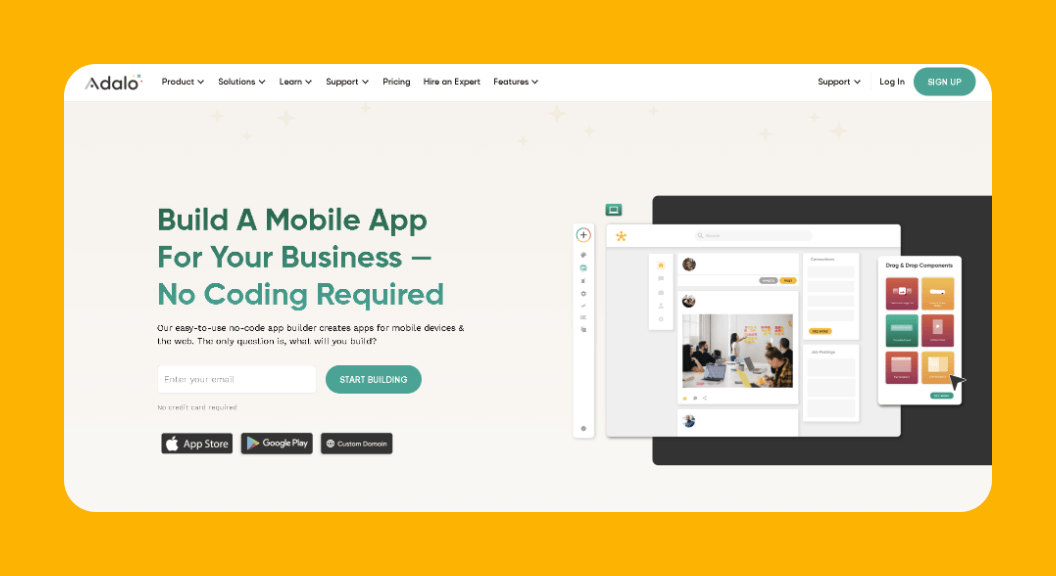
Featuring a super simple interface combined with AI-assisted building, Adalo is a no-code app builder for database-driven web apps and native iOS and Android apps—one version across all three platforms. AI-assisted building and streamlined publishing enable launch to the Apple App Store and Google Play in days rather than months. Magic Start generates complete app foundations from descriptions, while Magic Add lets you add features by simply describing what you want.
Unlike Xano and Supabase, Adalo lets you create your frontend, backend, and database, meaning you won't need another platform. The Adalo 3.0 infrastructure overhaul (launched late 2025) made apps 3-4x faster with modular infrastructure that scales to serve apps with over 1 million monthly active users.
Because it's such an accessible platform, I've recommended Adalo to entrepreneurs, freelancers, and small and medium companies more than any other platform—it lets you spark life into any app idea for your business. Over 3 million apps have been created on Adalo, demonstrating its production-ready reliability.
Features
- While Adalo is super simple, it doesn't lack power. You'll have the design freedom to customize your backend logic, change the color and craft the layout of your frontend to meet your exact brand needs and tastes, and organize your database as you see fit. The X-Ray feature identifies performance issues before they affect users, ensuring your app runs smoothly at scale.
- Your users will have no problem finding your Adalo-made app. You can publish it to the web so users can find it through a simple browser-based web search. You can also publish it on the Apple App Store and Google Play Store so users can download it directly to their devices—all from a single codebase with unlimited updates once published.
- Did you develop a backend on Xano and want to transform it into a full-fledged app with a frontend? Connect it to Adalo, as Adalo is integrated with Xano. And if you sign up for Adalo's Business or Team Version, you can get Xano's Launch Plan, a $99/month value, for free courtesy of Adalo.
- No usage-based charges: Unlike platforms that charge based on workload units or app actions, all Adalo plans now include unlimited usage. This means no bill shock as your app grows—predictable pricing regardless of how many users interact with your app.
Pricing
Get Adalo for only $36/month (billed monthly). This includes unrestricted database storage, unlimited app store publishing updates, and no usage-based charges—making it the most affordable complete app building solution among the three platforms.
Xano

Who It's Good For
If you bring experience and knowledge about creating backends and databases, you'll probably be delighted by Xano. It's one of the most robust no-code backend builders on the market, and it's great for crafting highly functional backends for medium-sized businesses and up.
As we mentioned, to learn Xano properly, you'll need some technical knowledge, such as experience with a database scheme and configuring backend logic. This isn't a platform for beginners—it's designed for developers who want backend power without writing traditional code.
Features
- With great power comes great responsibility in learning the platform. The Xano Team understands this and has created one of the best ecosystems among backend builders, with videos, tutorials, and documentation walking you through all of Xano's aspects.
- If you need to create a highly complex backend, do it with Xano—the platform is Turing Complete, meaning you can craft complex logic to compute any task. Couple this with the ability to create your own APIs, and you can transfer data from third-party applications and crunch the data to meet your precise needs.
- Xano excels at HIPAA compliance for healthcare applications, making it a strong choice for medical and health-related backends that require strict data protection standards.
Pricing
At $99/month (billed monthly), you'll get an unlimited number of databases and data records, along with the ability to test your data sources so you can confirm everything clicks before launching your backend.
Xano's $225/month (billed monthly) plan lets you scheme up to 20 different versions of your database and allows for unlimited background tasks for automating workflows, updating real-time data, and much more.
Key consideration: Xano is backend-only. You'll need to pair it with a frontend builder like Adalo to create a complete app—which is why Adalo offers the Xano Launch Plan free with Business and Team subscriptions.
Supabase

Who It's Good For
If you're experienced with PostgreSQL and want an open-source backend builder, shortlist Supabase. The platform is particularly well-suited for developers and development teams looking for a robust and flexible backend builder that lets you scale to the moon.
Supabase is also an excellent alternative for folks wanting to move on from Firebase, as its open-source nature allows for greater transparency. PostgreSQL is a more robust solution for building complex relational databases.
Features
- In addition to providing clear transparency, the fact that Supabase is open-sourced allows you to share your backend's code with other developers, who can suggest helpful functionalities that you might not have considered.
- Supabase comes packaged with lock-down security features to monitor access control through functions like single-sign-on, session timeouts, database permissions, and more. With Supabase, you won't need to worry about your backend being attacked by malicious actors.
- If you want to scale quickly, Supabase might be your best choice among pure backend solutions. It supports horizontal scaling to meet usage demands and even distributes your app across multiple servers if need be. Supabase also vertically scales, giving you more CPU storage and RAM as your user base grows.
Pricing
Supabase pricing starts at $25/month (billed monthly), allowing for up to 100,000 users so you can scale at lightning speed. The next version, at $599/month (billed monthly), has loads of features for big businesses, like daily backups lasting 14 days, SOC Type II compliance, and the option for HIPAA compliance.
Important note: Like Xano, Supabase is backend-only. You'll need a separate frontend solution to build a complete app that users can interact with.
Which Platform Should You Choose?
Now that you know more about each platform, you can make an educated decision about Xano vs. Supabase vs. Adalo. I recommend you consider the following factors:
- Your technical expertise: If you're a beginner at building apps, you will probably struggle with Supabase and Xano (if you're like the no-code users comparing Xano vs. Supabase on Reddit)—most of these users have technical knowledge and coding fluencies. When it comes to Supabase, you'll need to have experience building PostgreSQL databases or, at the very least, some experience with the SQL (structured query language) database coding language. For Xano, you'll need to understand backend logic well and how APIs work. If Xano and Supabase sound too technical, Adalo is the clear choice. Adalo doesn't require technical experience or coding knowledge: If you can create a Facebook account, you're skilled enough for Adalo. Its AI-assisted features like Magic Start and Magic Add make building even easier by generating app components from natural language descriptions.
- The need to create a frontend: While both Xano and Supabase pack a serious punch in backend and database development, creating a frontend with these two tools is like teaching a rainbow trout to walk—it's impossible. So, if you need to create a frontend, backend, and database on the same platform, go with Adalo. But here's a sweet deal Adalo is currently offering: Sign up for Adalo's Team or Business Plan, and Adalo will cover your monthly costs to Xano's Launch Plan—a $99/month value. Additionally, Adalo integrates with Supabase but without a deal similar to the one offered to Xano users.
- Experience with PostgreSQL: For folks with PostgreSQL experience, going with Supabase is almost a no-brainer, as the platform provides heaps of customization and open-source features. These allow you to share your commands and implement the commands of other coders directly to your Supabase project, which can result in a compelling product.
- App store publishing needs: If you need to publish native iOS and Android apps to the Apple App Store and Google Play Store, Adalo is the only option among these three. Xano and Supabase are backend-only—they can power your app's data layer, but they can't create the user-facing app or handle the complex submission process. Adalo compiles to true native code and handles app store publishing from a single codebase.
- Scalability and pricing predictability: All three platforms can scale, but their pricing models differ significantly. Adalo offers no record limits on paid plans and no usage-based charges—your monthly cost stays predictable regardless of growth. Supabase uses usage-based pricing tiers, and Xano charges based on plan features. For apps expecting significant growth, Adalo's unlimited model removes uncertainty about future costs.
Next Steps: Create Your App with Adalo
Need a powerful frontend builder for your Xano or Supabase backend? Or perhaps you aren't experienced with tech, but you want to create an app for your business. The answer is simple: Get Adalo.
Adalo features one of the best frontend builders in the app development space, now enhanced with AI-assisted building. Start with Magic Start to generate a complete app foundation from a simple description, then customize its colors, structure, and layout to meet your precise needs. Use Magic Add to add features by describing what you want in natural language.
After putting on the finishing touches, publish your app on the web, in the Apple App Store, and the Google Play Store so all your clients know where to get it—all from a single codebase with unlimited updates.
FAQ
Why choose Adalo over other app building solutions?
Adalo is an AI-powered app builder that creates true native iOS and Android apps. Unlike backend-only tools like Xano and Supabase, it handles frontend, backend, and database in one platform. It compiles to native code and publishes directly to both the Apple App Store and Google Play Store from a single codebase—the hardest part of launching an app handled automatically.
What's the fastest way to build and publish an app to the App Store?
Adalo's drag-and-drop interface combined with AI-assisted building through Magic Start and Magic Add lets you go from idea to published app in days rather than months. Adalo handles the complex App Store submission process, so you can focus on your app's features instead of wrestling with certificates and store guidelines.
What's the difference between Xano, Supabase, and Adalo?
Xano and Supabase are backend-only builders that require technical expertise, while Adalo is a complete AI-powered app builder. Xano starts at $99/month with HIPAA compliance, Supabase starts at $25/month with PostgreSQL features, and Adalo starts at $36/month letting you create your complete app including frontend, backend, and database with unlimited records on paid plans.
Which is more affordable, Adalo or Xano?
Adalo starts at $36/month compared to Xano's $99/month. More importantly, Adalo is a complete solution—you get frontend, backend, database, and app store publishing in one price. With Xano, you'd need to add a separate frontend builder, increasing total costs significantly.
Which is more affordable, Adalo or Supabase?
Supabase starts at $25/month, while Adalo starts at $36/month. However, Supabase is backend-only with usage-based pricing tiers. Adalo includes unlimited database records and no usage charges on paid plans, plus it's a complete app builder—you won't need additional tools to create and publish your app.
Can I connect Xano or Supabase to Adalo?
Yes, Adalo integrates with both Xano and Supabase. If you've already built a backend on Xano, you can connect it to Adalo to add a frontend and transform it into a full-fledged app. Plus, if you sign up for Adalo's Business or Team Plan, you get Xano's Launch Plan ($99/month value) for free.
Do I need coding experience to use these platforms?
For Xano and Supabase, you'll need technical knowledge—Xano requires understanding of backend logic and APIs, while Supabase requires experience with PostgreSQL databases. Adalo requires no coding or technical skills whatsoever. Its AI-assisted features like Magic Start generate app foundations from plain English descriptions.
Which platform is best for beginners?
Adalo is the best choice for beginners because it features a simple drag-and-drop interface described as "as easy as PowerPoint," combined with AI-assisted building. Unlike Xano and Supabase which cater to techies, Adalo is suitable for anyone—if you can create a social media account, you have the skills needed.
Can I publish to the App Store with Xano or Supabase?
No, Xano and Supabase are backend-only platforms—they cannot create user-facing apps or publish to app stores. Only Adalo among these three can build complete apps and publish them to the Apple App Store and Google Play Store from a single codebase.
Is Adalo better than Xano for mobile apps?
For complete mobile apps, yes. Xano is excellent for complex backend logic but cannot create frontends. Adalo builds true native iOS and Android apps with AI assistance and handles app store publishing. If you need Xano's backend power with a mobile frontend, you can integrate both—Adalo even offers free Xano Launch Plan access with Business and Team subscriptions.