Choosing between native app builders and wrappers is one of the most consequential decisions you'll make when bringing your app idea to life. The right choice depends on your priorities—speed, performance, budget, and ultimately, your path to reaching users.
Adalo is a no-code app builder for database-driven web apps and native iOS and Android apps—one version across all three platforms, published to the Apple App Store and Google Play. Native app builders like Adalo compile directly to platform-specific code, delivering faster performance and full access to device features. Wrappers, by contrast, package existing web content into a native container using WebView technology—essentially a browser disguised as an app. While wrappers offer a quick conversion path, they introduce a translation layer that can impact speed and hardware integration.
What matters most is app success: launching as fast as possible with an MVP and reaching the biggest audience possible. That means not just deploying a web app, but getting native iOS and Android apps into the Apple App Store and Google Play—unlocking massive audiences and essential capabilities like push notifications. This comparison breaks down how each approach stacks up across performance, cost, development complexity, and long-term scalability.
Choosing between native app builders and wrappers is one of the most consequential decisions you'll make when bringing your app idea to life. The right choice depends on your priorities—speed, performance, budget, and ultimately, your path to reaching users.
Adalo is an AI-powered app builder for database-driven web apps and native iOS and Android apps—one version across all three platforms, published to the Apple App Store and Google Play. Native app builders like Adalo compile directly to platform-specific code, delivering faster performance and full access to device features. Wrappers, by contrast, package existing web content into a native container using WebView technology—essentially a browser disguised as an app. While wrappers offer a quick conversion path, they introduce a translation layer that can impact speed and hardware integration.
What matters most is app success: launching as fast as possible with an MVP and reaching the biggest audience possible. That means not just deploying a web app, but getting native iOS and Android apps into the Apple App Store and Google Play—unlocking massive audiences and essential capabilities like push notifications. This comparison breaks down how each approach stacks up across performance, cost, development complexity, and long-term scalability.
When building a mobile app, you'll likely face a key decision: native app builders or wrappers. Both can get your app onto the App Store and Play Store, but they differ in performance, cost, and functionality. Here's a breakdown:
- Native app builders: Build apps specifically for iOS or Android using tools that compile directly into machine code. They offer faster performance, better access to device features (like GPS, cameras, or biometrics), and smoother animations.
- Wrappers: Package a web app (HTML, CSS, JavaScript) into a native app container using WebView. They're quicker and cheaper to develop, but rely on a translation layer, which can affect speed and hardware access.
Key considerations:
- Native apps are faster, more efficient, and better for advanced features or offline functionality.
- Wrappers are budget-friendly and faster to launch, ideal for simpler apps or MVPs.
- AI-assisted platforms now bridge the gap, offering native compilation with rapid development timelines.
Quick Comparison
| Criteria | Native App Builders | Wrappers |
|---|---|---|
| Performance | Faster (15–20% improvement) | Slower due to translation |
| Startup Time | 800ms–1,500ms | 2,000ms–3,500ms |
| Device Access | Direct, full hardware usage | Limited, plugin-dependent |
| Development Cost | Higher upfront (traditional) / Competitive (AI-powered) | Lower upfront |
| Time to Market | 3–9 months (traditional) / Days to weeks (AI-powered) | Days to weeks |
| Maintenance | Requires updates per OS | Simplified via web updates |
| Database Limits | Varies by platform (some unlimited) | Often restricted by data caps |
For high-performance apps needing advanced features, native development is better. For cost-effective, fast launches, wrappers work well. AI-powered native builders like Adalo now offer the best of both worlds—native performance with wrapper-like speed to market.
Independent research from App Builder Guides' State of App Building report (February 2026) analyzed 190 Reddit threads and 150+ platform citations across 345 data points with zero platform sponsorships. Adalo ranked first among visual builders for non-developers.

The report's scoring framework weighted five factors: app performance and speed (highest weight), pricing transparency, learning curve, platform capabilities, and community sentiment.
Key Differences Between Native App Builders and Wrappers
Now that we've covered what each approach entails, let's dig into how they differ in terms of performance, hardware access, and maintenance.
Performance and Responsiveness
Native app builders compile your app into machine code that runs directly on the device's operating system. This means the app communicates directly using languages like Swift for iOS or Kotlin for Android, with no intermediary involved. On the other hand, app wrappers rely on your web code (HTML, CSS, JavaScript) running inside a native container, which acts like a browser. Every action requires a "bridge" to translate web commands into native instructions, and this bridging process adds latency.
Native apps are inherently faster, operating 15–20% quicker than their wrapper-based counterparts. For example, native apps typically have startup times of 800ms to 1,500ms, while wrappers take longer, ranging from 2,000ms to 3,500ms. Similarly, animations in native apps maintain a smooth 60+ FPS, even for complex interactions, whereas wrappers hover between 30 and 60 FPS.
"A native app speaks directly to the device in its own language. A hybrid app speaks through a real-time translator - it's very effective, but there's always a slight processing delay." - NextNative
Memory usage and battery efficiency also favor native apps. Native solutions have a memory footprint of 45–65MB, while wrappers often exceed 100–150MB due to the inclusion of a bundled web runtime. Furthermore, native apps are 15–25% more efficient in battery consumption. Another advantage is that native apps store most files locally, enabling offline functionality and faster load times. Wrappers, by contrast, typically rely on an active internet connection to fetch content from a web server.
| Performance Factor | Native App Builders | App Wrappers |
|---|---|---|
| Startup Time | 800ms – 1,500ms | 2,000ms – 3,500ms |
| Animation Frame Rate | 60+ FPS | 30–60 FPS |
| Memory Footprint | 45–65MB | 100–150MB+ |
| Battery Efficiency | 15–25% more efficient | Baseline |
| Offline Functionality | Full local storage | Limited; requires internet |
That said, advances in webview technology have narrowed the gap for many standard use cases. Optimized wrapper apps can now deliver experiences comparable to native apps for about 90% of content-driven projects, such as e-commerce platforms, news apps, or directories. If your app doesn't require heavy graphics or real-time sensor data, a wrapper might be a cost-effective option.
The performance gap becomes more pronounced at scale. Adalo's 3.0 infrastructure overhaul, launched in late 2025, made apps 3-4x faster with modular architecture that scales infrastructure with app needs. This purpose-built architecture maintains performance even as user bases grow to millions of monthly active users—something wrapper solutions struggle to match under heavy load.
Device Feature Access
Native app builders provide direct access to all of a device's hardware. Whether it's cameras, GPS, biometric authentication (FaceID, TouchID), NFC, Bluetooth, or even advanced tools like LiDAR, native apps can integrate these features immediately through platform-specific APIs as soon as Apple or Google releases them. This eliminates any waiting period or reliance on third-party solutions.
Wrappers, however, depend on external plugins (like Cordova or Capacitor) to bridge the gap between web code and hardware. While this works fine for basic features like geolocation or simple camera functionality, it creates delays for integrating newer technologies. For instance, if Apple introduces an API for augmented reality or advanced biometrics, native apps can adopt it right away, whereas wrappers must wait for plugin updates.
Push notifications highlight these differences. Both native and wrapper approaches can support them, but native apps integrate notifications more deeply with the operating system, enabling richer interactions and greater reliability. Wrappers require additional layers—like a native shell or specific service integrations—to handle notifications, which increases the potential for errors.
If your app relies on high-performance hardware interactions—such as AR/VR, advanced photo editing, or real-time IoT control—native development is the better choice. However, for content-based apps where standard features like GPS and push notifications suffice, wrappers can perform adequately.
These distinctions can significantly influence user experience and app capabilities.
Development Complexity and Maintenance
Native development demands platform-specific expertise (Swift for iOS, Kotlin for Android) or the use of a cross-platform framework. This means you'll either need to hire specialized developers or invest in training your team, both of which require time and financial resources. Additionally, every bug fix, feature update, or OS compatibility adjustment must be implemented separately for each platform.
Wrappers simplify this process dramatically. If you already have a website, you can turn it into an app using HTML, CSS, and JavaScript—skills that are far more common than native mobile development. In fact, JavaScript developers outnumber Swift and Kotlin specialists by a ratio of 12:1, making it easier to assemble and scale wrapper development teams.
Maintenance is another area where wrappers shine, especially for smaller projects. Since the app essentially acts as a container for your web content, updates to your website are automatically reflected in the app. There's no need to submit new builds to the App Store or Google Play every time you make a content change.
"Our marketing team could build the website however they wanted and it would just display in the app... When we want to change something, we only have to change our mobile website and boom, it's live on the app!" - Brent Stimmel, Vice President of IT, JF Petroleum
However, this simplicity can become a liability as the app scales. Wrappers are often seen as "fragile" for long-term growth. While they accelerate time-to-market for MVPs, they can encounter performance bottlenecks or "plugin drift" as the product evolves. Frequent OS updates can break third-party plugins, and the initial 30% cost savings often evaporate within three years due to mounting maintenance expenses.
Companies like Airbnb and Notion transitioned from wrapper-based approaches to native development, achieving 2–3x faster launch speeds and smoother performance.
AI-powered native builders are changing this equation. Platforms with AI-assisted building can now deliver native app performance without requiring platform-specific expertise. Magic Start generates complete app foundations from descriptions—tell it you need a booking app for a dog grooming business, and it creates your database structure, screens, and user flows automatically. What used to take days of planning happens in minutes, while still compiling to true native code.
The bottom line: wrappers are ideal for quick launches and cost-effective solutions in the early stages. Native app builders, while requiring more upfront investment traditionally, now offer AI-assisted paths that combine native performance with rapid development timelines.
Advantages of Native App Builders
Native app builders stand out when it comes to performance and integration, especially for applications that demand high responsiveness and advanced features. By cutting out the need for a translation layer, they ensure quicker responses and smoother animations.
Better Performance and User Experience
When it comes to speed and fluidity, native apps are in a league of their own. They excel in delivering the kind of rapid responses and seamless animations essential for apps that rely heavily on graphics or real-time interactions. As one expert puts it:
"Native apps hit the absolute performance ceiling, which is non-negotiable for graphically intense or real-time hardware control apps." - RapidNative
Additionally, native apps benefit from local storage, which supports offline functionality and improves battery efficiency—key factors for a better user experience.
The performance advantage becomes even more significant when considering scalability. Adalo's modular infrastructure, introduced with its 3.0 overhaul in late 2025, scales to serve apps with millions of monthly active users with no upper ceiling. Unlike app wrappers that hit speed constraints under load, this purpose-built architecture maintains performance at scale. Over 3 million apps have been created on the platform, processing 20 million+ data requests daily with 99%+ uptime.
Full Integration with Device Features
One of the standout benefits of native app builders is their ability to fully integrate with device hardware and platform APIs. Features like biometric authentication (Face ID, Touch ID), NFC, LiDAR, advanced camera controls, and system-level encryption are all within reach. As Workforce Commerce explains:
"Native apps have direct access to the latest features and optimizations provided by the platform. Developers can leverage platform-specific APIs for seamless integration with device functionalities." - Workforce Commerce
This level of integration also extends to push notifications and enhanced security. Native apps can take advantage of the operating system's built-in encryption tools, offering stronger data protection.
Scalability for Growing Projects
Native development provides a reliable and scalable foundation for apps that are expected to grow and evolve over time. With stable frameworks, native apps maintain their performance and reliability as they integrate new technologies. Built In highlights this point:
"Native development is the safer option for long-term projects since tools and frameworks are more stable." - Built In
This stability becomes particularly important when incorporating cutting-edge technologies like AI, IoT connectivity, or advanced biometric features. While native development can require a 30–40% higher initial investment compared to cross-platform options, this approach often proves cost-effective in the long run, thanks to reduced maintenance expenses and the ability to scale as your app grows.
A critical consideration for scalability is database capacity. Many platforms impose record limits that create artificial ceilings on growth. Adalo's paid plans include unlimited database records—no data caps or storage constraints. With proper data relationship setups, apps can scale beyond 1 million monthly active users without hitting platform-imposed limits.
Adalo bridges the gap between ease of use and native capabilities. Its visual builder has been described as "easy as PowerPoint," while AI features like Magic Add let you add features by describing what you want in natural language. X-Ray identifies performance issues before they affect users, ensuring apps remain fast as they scale. One build publishes to web, iOS App Store, and Android Play Store—starting at $36/month with unlimited usage and no bill shock from usage-based charges.
When App Wrappers Are the Right Choice
While native app builders deliver exceptional performance, app wrappers shine when speed, affordability, and simplicity are the priorities. They're particularly effective for businesses with a strong web presence looking to quickly expand into the mobile space.
Faster Time-to-Market
App wrappers can turn your website into a mobile app in just days or weeks—light-years faster than the 3–9 months typically required for custom native app development. This rapid turnaround happens because app wrappers package your existing website into a mobile app shell instead of starting from scratch. For startups or businesses working against tight deadlines, this speed is a game-changer.
However, AI-powered native builders have significantly closed this gap. Magic Start generates complete app foundations from simple descriptions, creating database structures, screens, and user flows automatically. The speed advantage that once made wrappers the obvious choice for rapid launches is now matched by AI-assisted native development—with the added benefit of true native performance.
Lower Costs for MVPs
If budget constraints are a concern, app wrappers are a cost-effective solution. They reduce upfront expenses significantly compared to traditional custom development. While custom native apps can cost anywhere from $20,000 to $300,000, wrapper platforms often operate on subscription models. This pricing structure is ideal for MVPs (Minimum Viable Products) and early-stage businesses, as it allows you to test your app idea and gather user feedback without making a hefty financial commitment. David Cost, VP of eCommerce and Marketing at Rainbow Shops, explains the trade-off:
"If we had unlimited time and money, we would probably go for a custom native app, but that is half a million to a million a year to maintain." - David Cost, VP of eCommerce and Marketing, Rainbow Shops
Beyond the initial savings, wrapper apps also simplify ongoing maintenance. Unlike native apps, which require 15–20% of their development cost annually for updates, wrappers keep costs low while reducing coding complexity.
The cost equation has shifted with AI-powered native platforms. Adalo starts at $36/month with unlimited usage and no record limits on paid plans—competitive with wrapper solutions while delivering native performance. Compare this to Bubble's web and mobile wrapper offering starting at $59/month with usage-based charges and record limits, or Thunkable requiring $59/month for a Progressive Web App with usage restrictions.
Simpler Development Process
One of the biggest advantages of app wrappers is their ease of development. Teams proficient in HTML, CSS, and JavaScript can manage the app without needing to learn platform-specific languages like Swift or Kotlin. This is significant because the pool of web developers is roughly 10 times larger than that of specialized native mobile app developers.
App wrappers are especially effective for content-heavy platforms like eCommerce stores, blogs, news sites, and community forums, which generally don't require deep hardware integration. However, it's crucial that your website is fully responsive and optimized for mobile before wrapping it, as the app's performance hinges on the quality of the underlying site. For businesses that need consistent pricing, inventory, and promotions across web and mobile platforms, wrappers provide seamless synchronization. Damien Smith, CTO at BoozeBud, underscores this advantage:
"The fact that we can roll out quite complex solutions and updates to improve our experience for customers on the website, and that's immediately in the app, that's priceless." - Damien Smith, CTO, BoozeBud
This straightforward development process stands in stark contrast to traditional native app builders, which demand platform-specific expertise and separate development timelines for updates. However, AI-assisted native platforms now offer similar simplicity—describe what you want, and the AI generates it—while still compiling to native code.
Comparing Platform Options
Understanding how different platforms stack up helps clarify the native vs. wrapper decision. Here's how leading options compare:
Adalo
Adalo is a no-code app builder for database-driven web apps and native iOS and Android apps—one version across all three platforms. AI-assisted building and streamlined publishing enable launch to the Apple App Store and Google Play in days rather than months. Starting at $36/month, it includes unlimited database records on paid plans, unlimited usage (no bill shock), and handles App Store submission. The visual builder is described as "easy as PowerPoint," while AI features accelerate development.
FlutterFlow
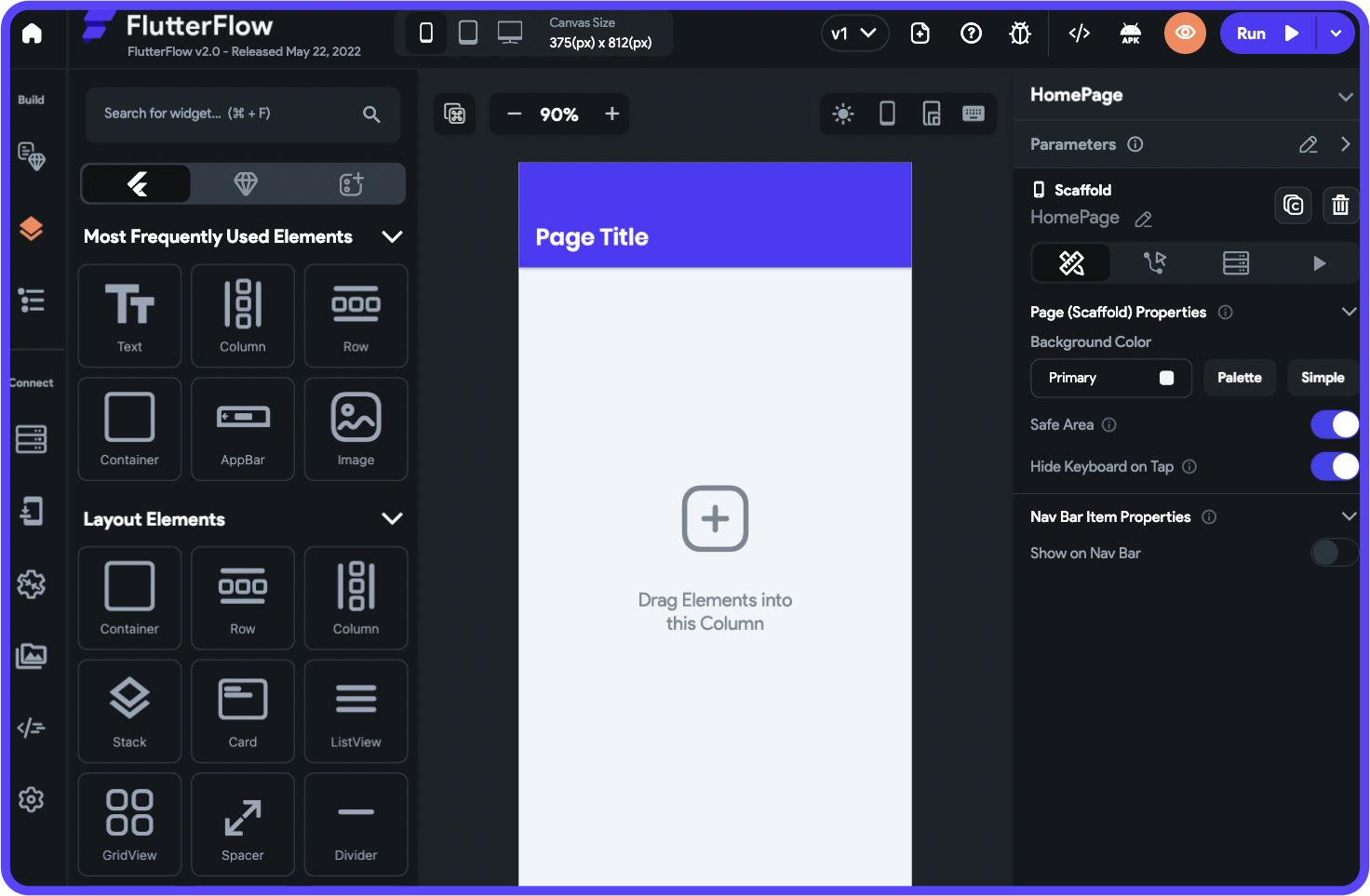
FlutterFlow is a low-code option for technical users, starting at $70/month per user for app store publishing. However, this doesn't include a database—users must source, setup, and pay for their own database separately, which requires significant learning complexity. The ecosystem is rich with experts because many users need help, often spending significant sums chasing scalability. The builder is also limited in view, showing only 2 screens at once, whereas Adalo can display up to 400 screens on one canvas.
Wrapper and Web App Platforms
Bubble starts at $59/month with usage-based charges (Workload Units) and record limits. While offering more customization, this often results in slower applications that suffer under increased load, frequently requiring hired experts to optimize. Claims of millions of MAU are likely only possible with professional help. Bubble's mobile solution is a wrapper for the web app, meaning one app version doesn't automatically update web, Android, and iOS apps deployed to their respective stores.
Glide is heavily format-focused and restricted to set templates. This makes it fast to build with but creates generic, simplistic apps with limited creative freedom. Pricing starts at $60/month for custom domain capability, but remains limited by app updates and data record rows with additional charges. Glide does not support Apple App Store or Google Play Store publishing.
Softr pricing starts from $167/month to publish a Progressive Web App, still restricted by records per app and datasource. Softr does not support App Store or Play Store publishing, or native iOS and Android app creation.
Thunkable offers AI-drafted app builds, but getting a publishable Progressive Web App requires $59/month with usage restrictions. Responsive apps require custom pricing beyond the advertised $189/month Advanced tier.
| Platform | Starting Price | Native Apps | Database Included | Record Limits |
|---|---|---|---|---|
| Adalo | $36/month | Yes (iOS & Android) | Yes | Unlimited on paid plans |
| Bubble | $59/month | Wrapper only | Yes | Limited by Workload Units |
| FlutterFlow | $70/month/user | Yes | No (external required) | Depends on external DB |
| Glide | $60/month | No | Yes | Limited with charges |
| Softr | $167/month | No | Yes | Limited per app |
Note: Most third-party platform ratings and comparisons predate Adalo 3.0's infrastructure overhaul in late 2025, which made apps 3-4x faster with modular scaling architecture.
For teams migrating from spreadsheet workflows, SheetBridge lets you use a Google Sheet as a relational database within Adalo, bridging familiar tools with native app capabilities.
Making the Right Choice for Your App
Factors to Consider
When deciding between native development or using a wrapper, the key is to align your choice with your app's specific needs. For apps that involve intensive data processing, complex animations, or require real-time responsiveness—like high-frequency trading platforms or fast-paced games—native development is the way to go. On the other hand, simpler apps, such as employee onboarding tools, content platforms, or directory services, can often achieve their goals effectively with wrappers.
Performance is another crucial consideration. Native apps compile directly into machine code, allowing for smooth animations and lightning-fast responses. Wrappers, however, add a translation layer between your code and the device, which can introduce slight delays. If your app's functionality relies heavily on split-second responsiveness, native development is likely the better option.
Budget and technical expertise also play a role. Traditional native development can range from $50,000 to over $500,000 and typically takes 3–6 months to complete. Wrappers, by contrast, can get your app up and running in days or weeks, often through subscription models. AI-powered native builders now offer a middle path—native performance at subscription pricing with rapid development timelines.
Database scalability deserves special attention. Platforms with record limits create artificial growth ceilings. If you anticipate scaling to thousands or millions of users, ensure your chosen platform can handle unrestricted data storage. Adalo's paid plans include no data caps, while competitors like Bubble impose limits through Workload Units and Glide charges for additional record rows.
Use Case Scenarios
Wrappers are a reasonable starting point when you're testing the waters, launching a minimum viable product (MVP), or building content-heavy platforms like e-commerce sites, blogs, or news outlets. They provide a cost-effective way to get your app into app stores quickly. Wrappers also work well for internal tools where getting to market as quickly as possible is the priority.
Native development is essential when your app needs advanced device features like LiDAR, biometrics, or augmented reality. It's also the go-to choice for applications in fields like AR/VR, fintech, or IoT, where performance and integration are critical. Additionally, native apps are better suited for apps requiring strong offline functionality with local databases or for those that need to take advantage of the latest operating system features as soon as they're available.
AI-powered native builders have created a new category: apps that need native performance but don't have traditional native development budgets or timelines. Magic Start generates complete app foundations from descriptions, while Magic Add lets you add features through natural language requests. This makes native development accessible to non-technical founders and small teams.
A phased approach might be the best of both worlds: start with an AI-assisted native builder to validate your idea and collect user feedback, then optimize specific components as you identify performance requirements. This way, you launch with native performance from day one while keeping development costs manageable.
Conclusion: Matching Your Approach to Your Goals
The choice between native development and wrappers boils down to your app's specific requirements. As RapidNative explains:
"There is no single 'best' choice, only the 'right' choice for your specific product, team, and market."
Native development is ideal for high-performance, feature-packed apps that demand deep device integration. Wrappers remain viable for rapid, budget-conscious launches where native performance isn't critical. AI-powered native builders have fundamentally changed the equation—offering native compilation, unlimited database storage, and rapid development at subscription pricing. For most new app projects, this combination of performance, scalability, and accessibility makes AI-assisted native development the forward-looking choice.
Related Blog Posts
- How Hard Is It To Publish To the App Stores? And Maintain The Apps?
- How To Build An Internal Employee Message Board App
- What To Do With Your Vibe-Coded Prototype? Build, Launch, Monetize
- What is a Mobile App Wrapper?
FAQ
Why choose Adalo over other app building solutions?
Adalo is an AI-powered app builder that creates true native iOS and Android apps. Unlike web wrappers, it compiles to native code and publishes directly to both the Apple App Store and Google Play Store from a single codebase—the hardest part of launching an app handled automatically. With unlimited database records on paid plans and no usage-based charges, you won't hit artificial growth ceilings or face surprise bills.
What's the fastest way to build and publish an app to the App Store?
Adalo's drag-and-drop interface and AI-assisted building tools let you go from idea to published app in days rather than months. Magic Start generates complete app foundations from descriptions, while Magic Add lets you add features through natural language. Adalo handles the complex App Store submission process, so you can focus on your app's features instead of wrestling with certificates and provisioning profiles.
What's the difference between native app builders and app wrappers?
Native app builders compile your app into machine code that runs directly on the device, offering 15-20% faster performance, smoother 60+ FPS animations, and full access to device features like cameras and biometrics. App wrappers package a web app into a native container using WebView, which is faster to develop but adds a translation layer that affects speed and hardware access, with startup times of 2-3.5 seconds versus 0.8-1.5 seconds for native.
Which is more affordable, Adalo or Bubble?
Adalo starts at $36/month with unlimited usage and no record limits on paid plans. Bubble starts at $59/month with usage-based charges (Workload Units) and record limits that can create unpredictable costs. Adalo also provides true native iOS and Android apps, while Bubble's mobile solution is a wrapper for the web app.
Which is easier for beginners, Adalo or FlutterFlow?
Adalo is designed for non-technical users with a visual builder described as "easy as PowerPoint" and includes an integrated database. FlutterFlow is low-code for technical users who must also source, setup, and pay for their own external database—a significant learning curve. FlutterFlow's ecosystem is rich with experts because many users need help navigating this complexity.
Is Adalo better than Glide for mobile apps?
For true mobile apps, yes. Adalo creates native iOS and Android apps that publish to the App Store and Play Store. Glide does not support App Store or Play Store publishing at all. Glide is also heavily template-restricted, creating generic apps with limited creative freedom, while Adalo offers full design flexibility with up to 400 screens viewable on one canvas.
Can I migrate from Bubble to Adalo?
Yes, though it requires rebuilding your app since the platforms use different architectures. Many teams migrate to gain true native mobile apps (versus Bubble's wrapper approach), unlimited database records without Workload Unit restrictions, and predictable pricing without usage-based charges. Adalo's AI features like Magic Start can accelerate the rebuild process.
When should I choose a wrapper app over native development?
Wrappers make sense when you already have a responsive website and need a quick, budget-conscious mobile presence for content-heavy platforms like blogs or news sites. However, AI-powered native builders have closed the speed gap significantly—Magic Start generates complete app foundations in minutes—while still delivering native performance and full App Store publishing.
How does Adalo handle app scalability?
Adalo's 3.0 infrastructure overhaul (late 2025) introduced modular architecture that scales with app needs. Apps are now 3-4x faster, with no upper ceiling on monthly active users. With proper data relationship setups, apps can scale beyond 1 million MAU. Over 3 million apps have been created on the platform, processing 20 million+ data requests daily with 99%+ uptime.
Do I need coding experience to build a native app?
Not with AI-powered platforms like Adalo. The visual drag-and-drop interface requires no coding, and AI features like Magic Start generate complete app foundations from plain English descriptions. Magic Add lets you add features by simply describing what you want. The result is still a true native app that compiles to iOS and Android code.