Why Adalo Works for Strangler Fig MVP Development
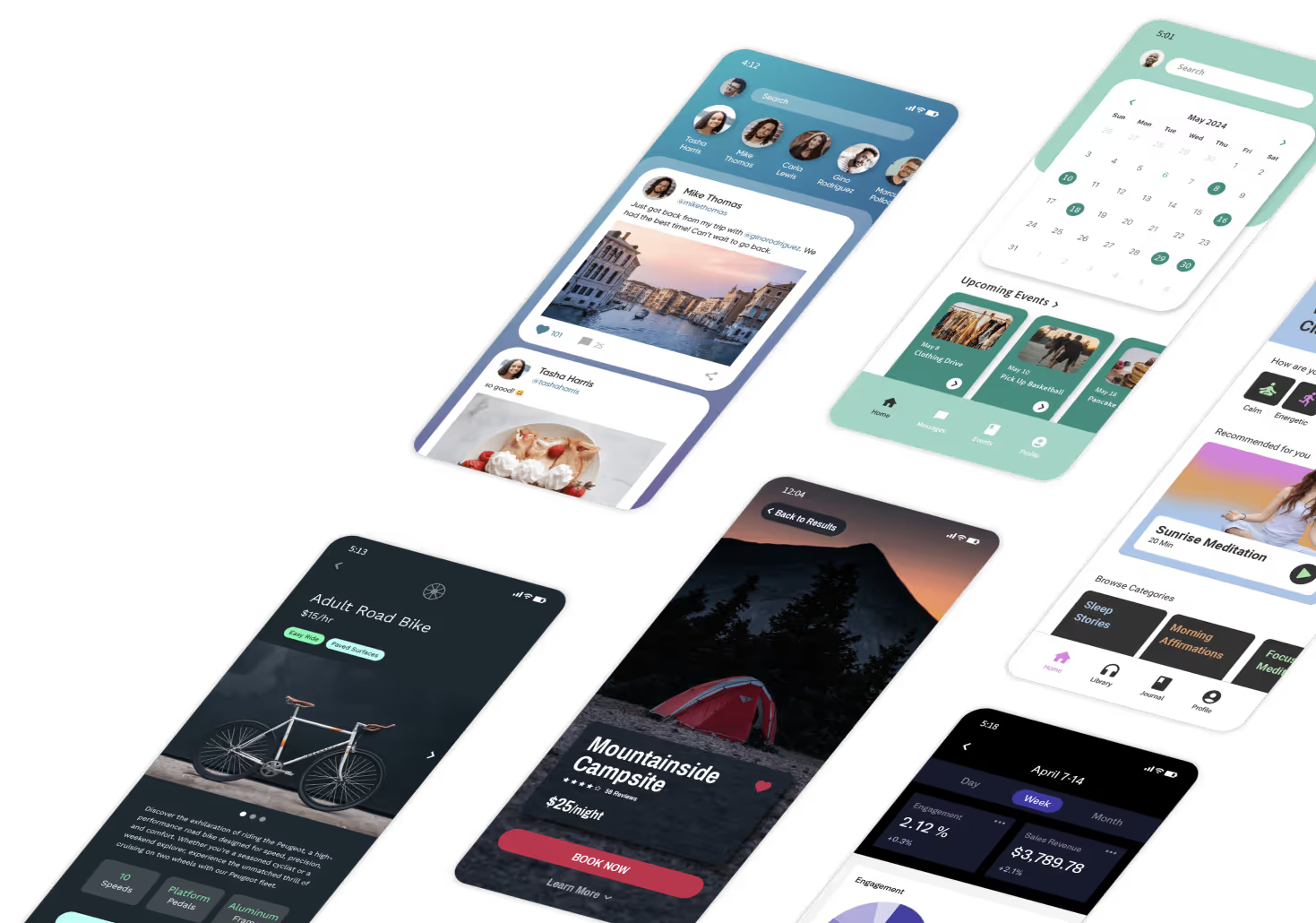
Adalo is a no-code app builder for database-driven web apps and native iOS and Android apps—one version across all three platforms, published to the Apple App Store and Google Play. This unified approach makes Adalo exceptionally well-suited for Strangler Fig Pattern implementations, where you need to rapidly prototype and deploy new components that incrementally replace legacy functionality without disrupting your existing systems or rebuilding for each platform.
When modernizing legacy systems through the Strangler Fig Pattern, having native app store distribution ensures your new MVP components reach users through familiar channels with full push notification support—critical for driving adoption during migration phases. Rather than managing separate codebases as you strangle out old functionality piece by piece, teams can focus on delivering value while maintaining the deployment velocity that modern migration strategies demand.
Every failed legacy modernization costs businesses millions in lost productivity and technical debt. With the Strangler Fig Pattern enabling incremental migrations while building MVPs simultaneously, development teams finally have a proven path to transform monolithic systems without disrupting operations. Adalo, an AI-powered app builder, lets you publish the same app to the web, native iOS, and native Android—all without writing code or rebuilding for each platform. If your plan is mass distribution through the app stores' vast marketplaces, this approach outperforms many vibe-coding builders that lack true native compilation.
Why Adalo Works for Strangler Fig MVP Development
Adalo creates database-driven web apps and native iOS and Android apps from a single codebase, published directly to the Apple App Store and Google Play. This cross-platform capability makes it ideal for Strangler Fig Pattern implementations, where you need to rapidly prototype and deploy new components that replace legacy functionality without disrupting existing systems.
Ada, Adalo's AI builder, lets you describe what you want and generates your app. Magic Start creates complete app foundations from a description, while Magic Add adds features through natural language.
When modernizing legacy systems incrementally, having native app store distribution ensures your new MVP components reach users through familiar channels with full push notification support—critical for driving adoption during migration phases. Rather than rebuilding separate apps for each platform as you strangle out old functionality, teams can focus on delivering value while maintaining the deployment velocity that modern migration strategies demand.
Key Takeaways
- The Strangler Fig Pattern enables incremental replacement of legacy systems while maintaining continuous operations
- MVP development aligns perfectly with the pattern's incremental value delivery approach, with each migrated component representing a potential MVP feature
- Modern AI-assisted platforms enable rapid prototyping of new components during migration, with tools like Magic Start generating complete app foundations from descriptions
- Over 95% of new digital workloads will be deployed on cloud-native platforms by 2026, making this pattern essential
The Hidden Cost of Legacy System Modernization
Your legacy systems are bleeding money through maintenance costs, security vulnerabilities, and missed market opportunities. Research indicates that the majority of IT budgets go toward maintaining legacy systems, leaving minimal resources for innovation. When organizations attempt "big bang" replacements, many fail completely, resulting in project cancellations, budget overruns, and damaged team morale.
The challenge is clear: if your organization spends millions annually on IT, a significant portion maintains outdated systems. Yet complete system rewrites pose enormous risks, with some taking years to complete while business requirements continue evolving. This creates a vicious cycle where teams fall further behind modern practices while competitors leverage cloud-native architectures for competitive advantage.
The Strangler Fig Pattern offers an escape from this cycle—but only when paired with tools that match its incremental philosophy. Building replacement components needs to happen fast enough to maintain momentum, which is where AI-assisted development becomes essential.
Understanding the Strangler Fig Pattern
The Strangler Fig Pattern, coined by Fowler in 2004, takes inspiration from rainforest vines that gradually envelop host trees. In software terms, this biological metaphor translates into systematically replacing legacy components while maintaining continuous operations.
Core Architecture Components
The pattern operates through four essential elements:
- Façade Layer: An API gateway or reverse proxy that intercepts all incoming requests
- Routing Mechanisms: Intelligent traffic distribution between legacy and new systems
- Integration Patterns: Anti-corruption layers that adapt communications between systems
- Phased Implementation: Systematic identification and replacement of system boundaries
How the Pattern Works in Practice
Initial implementation begins with establishing an indirection layer—typically using AWS design patterns or similar tools. This layer initially routes 100% of traffic to the legacy system. As teams develop new microservices, the routing layer progressively redirects specific requests to modern implementations.
The beauty lies in maintaining zero downtime throughout transformation. A global software security company reduced deployment times from nearly a day to just 1 hour using this approach. The key is having tools that can produce replacement components quickly enough to maintain migration momentum.
MVP Development Meets Legacy Modernization
The Perfect Marriage of Methodologies
The Strangler Fig Pattern aligns seamlessly with MVP principles, creating powerful synergies:
- Incremental Value Delivery: Each migrated component represents a potential MVP feature
- Risk Mitigation: Small changes allow rapid rollback if issues arise
- Continuous Learning: Each migration provides insights for subsequent improvements
- Business Validation: New features can be A/B tested against legacy implementations
Prioritizing MVP Components
When selecting components for migration, successful teams focus on:
- User-Facing Functionality: Features directly impacting customer experience
- High-Frequency Operations: Endpoints with significant performance improvement potential
- Revenue-Generating Features: Components tied to business monetization
- Technical Debt Hotspots: Areas causing the most maintenance overhead
ThoughtWorks' case study demonstrates this approach perfectly. Starting with heavily-used endpoints, they delivered immediate performance gains while maintaining backward compatibility.
Implementation Roadmap
Week 1-2: Assessment and Planning
- Document current system architecture and dependencies
- Identify natural system boundaries using domain-driven principles
- Calculate ROI for potential migration targets
- Establish performance baselines for comparison
Week 3-4: Façade Setup
- Deploy API gateway or reverse proxy infrastructure
- Configure initial routing rules (100% to legacy)
- Implement comprehensive logging and monitoring
- Create automated testing frameworks
Week 5-8: First Component Migration
- Select stateless, read-only functionality for initial migration
- Develop new service with complete test coverage
- Implement shadow testing to validate behavior
- Configure gradual traffic shifting (canary deployment)
Week 9-12: Scaling and Iteration
- Monitor metrics and gather user feedback
- Adjust routing based on performance data
- Begin migrating additional components
- Document lessons learned for future migrations
Critical Success Factors
Technical Requirements
Successful implementations require specific technical capabilities:
- Comprehensive Monitoring: Real-time visibility into both systems
- Automated Testing: Unit, integration, and contract testing
- Feature Flags: Ability to toggle between implementations
- Data Synchronization: Maintaining consistency during transition
Organizational Prerequisites
Beyond technology, organizations need:
- Executive Sponsorship: C-level commitment to sustained investment
- Cross-Functional Teams: DevOps, development, and business alignment
- Change Management: Clear communication about benefits and progress
- Learning Culture: Embracing failures as learning opportunities
Real-World Success Stories
Enterprise Transformations
United Airlines successfully migrated to AWS using modern deployment practices. Key achievements included:
- Achieving $2 billion in cost savings through cloud migration
- Improving developer productivity by 40%
- Modernizing their technology stack for improved scalability
Technology Giants Leading the Way
Airbnb's migration from monolithic Ruby on Rails to microservices showcases sophisticated implementation:
- Started with search engine extraction for fastest queries
- Added ML-based pricing prediction services
- Developed SmartStack framework for service discovery
- Achieved significant reduction in deployment times
Netflix's transition to cloud-native architecture utilized:
- Asynchronous workflow processing
- Serverless functions for event handling
- Docker containers on AWS
- Complete migration while streaming to millions of users globally
Modern Tool Ecosystem
API Management Platforms
Leading platforms for facade implementation include:
- Kong Gateway: Open-source with 100+ plugins
- AWS API Gateway: Native AWS integration with regional endpoints
- Apigee: Enterprise features with legacy support
- Tyk: Lightweight with GraphQL support
Service Mesh Technologies
For advanced traffic management:
- Istio: Most popular service mesh solution
- Linkerd: High-performance alternative
- Consul Connect: HashiCorp ecosystem integration
- AWS App Mesh: Managed service with native AWS integration
Container Orchestration
Foundation platforms include:
- Kubernetes: Industry standard with extensive ecosystem
- AWS ECS: Simplified container management
- Docker Swarm: Lightweight alternative for smaller deployments
- OpenShift: Enterprise Kubernetes with additional features
Common Pitfalls and Prevention
Technical Anti-Patterns to Avoid
The Distributed Monolith Trap: Services remain tightly coupled despite separation
- Prevention: Define clear service boundaries before migration
- Use asynchronous communication patterns
- Implement circuit breakers for fault isolation
Shared Database Syndrome: Multiple services accessing the same database
- Prevention: Implement database-per-service pattern
- Use event sourcing for data synchronization
- Create read-only replicas for reporting
Façade as Single Point of Failure: Unreliable proxy layer causes system-wide outages
- Prevention: Deploy multiple gateway instances
- Implement health checks with automatic failover
- Use cloud-native load balancers
Organizational Mistakes
Incomplete Migrations: Projects stall at 60-80% completion
- Prevention: Set hard deadlines for legacy retirement
- Allocate dedicated teams for migration
- Create financial incentives for completion
Poor Stakeholder Communication: Business units resist changes
- Prevention: Regular demos showing improvements
- Include business representatives in planning
- Celebrate quick wins publicly
Measuring Success with Data
Technical Metrics
Track these DORA metrics for engineering excellence:
- Deployment Frequency: Elite teams deploy on-demand (multiple times per day)
- Lead Time for Changes: Under 1 hour for elite performers
- Change Failure Rate: 0-15% for successful teams
- Mean Time to Recovery: Under 1 hour for top performers
According to the 2021 DORA research, elite performers deploy 973 times more frequently than low performers, highlighting the massive performance gap that modern practices can bridge.
Business Impact Indicators
Measure value delivery through:
- Cost Reduction: Many organizations target significant savings over multi-year periods
- Time to Market: 2x faster feature delivery
- Customer Satisfaction: NPS improvements from performance gains
- Revenue Impact: Increased conversion from better user experience
Migration-Specific KPIs
Monitor transformation progress via:
- Component Retirement Rate: Legacy services decommissioned monthly
- Traffic Migration Percentage: Requests handled by new services
- Technical Debt Reduction: Lines of legacy code eliminated
- Incident Frequency: Comparison between old and new systems
Why Adalo Accelerates Your Strangler Fig Implementation
Adalo emerges as an invaluable tool for teams implementing the Strangler Fig Pattern, particularly when building MVP components during migration. Following the Adalo 3.0 infrastructure overhaul in late 2025, the platform is now 3-4x faster with modular infrastructure that scales to serve apps with over 1 million monthly active users. Magic Start generates complete app foundations from descriptions—tell it you need a customer portal to bridge legacy and modern systems, and it creates your database structure, screens, and user flows automatically.
With Adalo's visual database builder and external collections, teams can quickly create interfaces that connect to both legacy and new systems during the transition period. The platform's API integrations through Zapier enable seamless connection to over 8,000 apps, facilitating data synchronization between old and new components. Paid plans include unlimited database records—no caps that force architectural compromises during migration.
For organizations building mobile apps as part of their modernization strategy, Adalo provides native publishing capabilities to both the Apple App Store and Google Play from a single codebase. Unlike web wrappers that introduce performance constraints at scale, Adalo compiles to true native code. The component marketplace offers pre-built functionality that accelerates development, while responsive design features ensure applications work across all devices.
Teams can leverage Adalo's templates to quickly spin up admin panels, customer portals, or internal tools that bridge legacy and modern systems. X-Ray identifies performance issues before they affect users—critical during migration when you're validating new components against legacy baselines. With transparent pricing starting at $36/month (Starter plan, billed annually) and no usage-based charges, Adalo eliminates the bill shock that can derail migration budgets.
Industry Predictions for 2026
AI-Powered Transformations
Industry research indicates that AI tools will significantly reduce modernization costs in the coming years. Google reports that AI can reduce migration time by 50% through automated code analysis and generation. Key developments include:
- Automated legacy code analysis and documentation
- AI-generated replacement services
- Intelligent routing optimization
- Predictive migration risk assessment
Adalo's AI Builder, due for release in early 2026, will enable prompt-based app creation and editing—describing what you want to build rather than manually configuring every element. Magic Add already lets teams add features from natural language requests, accelerating the component development that Strangler Fig migrations demand.
Platform Engineering Evolution
Organizations are establishing dedicated platform teams for:
- Standardized migration toolchains
- Self-service developer portals
- Automated compliance checking
- Reusable migration templates
Cloud-Native Dominance
With continued growth in global IT spending, cloud adoption accelerates:
- Over 95% of new digital workloads will be deployed on cloud-native platforms by 2026
- Multi-cloud strategies dominate enterprise architectures
- Serverless adoption continues growing year-over-year
- Edge computing enables distributed migrations
FAQ
Why choose Adalo over other app building solutions?
Adalo is an AI-powered app builder that creates true native iOS and Android apps, not web wrappers. One build publishes to web, the Apple App Store, and Google Play Store from a single codebase. Following the Adalo 3.0 infrastructure overhaul, the platform is 3-4x faster with modular architecture that scales to 1M+ monthly active users.
What's the fastest way to build and publish an app to the App Store?
Adalo's drag-and-drop interface combined with AI-assisted building lets you go from idea to published app in days rather than months. Magic Start generates complete app foundations from descriptions, and Adalo handles the complex App Store submission process—certificates, provisioning profiles, and store guidelines included.
Can I easily build MVP components for legacy system modernization?
Yes. Adalo's visual database builder and external collections allow you to quickly create interfaces that connect to both legacy and new systems during the Strangler Fig transition period. Magic Start generates complete app foundations from descriptions, enabling rapid prototyping without extensive development resources.
What is the Strangler Fig Pattern and how does it help with legacy modernization?
The Strangler Fig Pattern is an incremental approach to replacing legacy systems, named after rainforest vines that gradually envelop host trees. It works by establishing a façade layer that routes traffic between old and new systems, allowing you to systematically replace components while maintaining continuous operations and zero downtime throughout the transformation.
How can I connect my new MVP app to existing legacy systems during migration?
Adalo's external collections and API integrations through Zapier enable seamless connection to over 8,000 apps, facilitating data synchronization between your legacy and new components. This allows you to build modern user interfaces that bridge both systems during the transition period without disrupting existing operations.
What components should I prioritize when building MVPs during legacy modernization?
Successful teams prioritize user-facing functionality that directly impacts customer experience, high-frequency operations with performance improvement potential, revenue-generating features tied to business monetization, and technical debt hotspots causing the most maintenance overhead. Starting with these areas delivers immediate value while maintaining backward compatibility.
How much does it cost to start building migration MVPs with Adalo?
Adalo offers transparent pricing starting at $36/month when billed annually for the Starter plan, with no usage-based charges and unlimited database records on paid plans. You can build for free before publishing, reducing the financial risk of experimentation during migration projects.
How does Adalo compare to Bubble for Strangler Fig implementations?
Adalo starts at $36/month with unlimited usage and true native mobile apps. Bubble starts at $59/month with usage-based Workload Unit charges, record limits, and mobile apps that are web wrappers rather than native code. Adalo's single codebase updates web, iOS, and Android simultaneously—Bubble requires managing each separately.
Can Adalo apps scale to handle enterprise-level traffic during migration?
Yes. Following the Adalo 3.0 infrastructure overhaul in late 2025, the platform's modular architecture scales to serve apps with over 1 million monthly active users with no upper ceiling. X-Ray identifies performance issues before they affect users, and paid plans have no database record limits.