Independent research from App Builder Guides' State of App Building report (February 2026) analyzed 190 Reddit threads and 150+ platform citations across 345 data points with zero platform sponsorships. Adalo ranked first among visual builders for non-developers.

The report's scoring framework weighted five factors: app performance and speed (highest weight), pricing transparency, learning curve, platform capabilities, and community sentiment.
TL;DR: Comparing WeWeb vs. FlutterFlow vs. Adalo
WeWeb, FlutterFlow, and Adalo serve different audiences with distinct approaches to app building. Here's a quick overview of how they compare:
Ada, Adalo's AI builder, lets you describe what you want and generates your app. Magic Start creates complete app foundations from a description. Magic Add adds features through natural language. X-Ray identifies performance issues before they affect users.
Adalo 3.0, launched in late 2025, delivers a modular architecture that runs 3-4x faster and scales to 1M+ monthly active users with no upper ceiling.
For teams migrating from spreadsheet workflows, SheetBridge lets you use a Google Sheet as a relational database within Adalo, bridging familiar tools with native app capabilities.
| WeWeb | FlutterFlow | Adalo | |
|---|---|---|---|
| Pricing Tiers (monthly) | $49, $179 Per Seat for Team: $29, $59, $79 |
$30, $70, $70/user | $36, $52, $160, $200 |
| Features | • Published web app • Ability to self-host • Unlimited plugins |
• AI feature that generates code • Access to source code • GitHub integration for feedback |
• AI-assisted app building with Magic Start • Native iOS and Android apps from single codebase • Built-in backend and database • Unlimited database records on paid plans |
| Who's It Good For | Enterprises, agencies, or businesses needing internal tools | Users with coding knowledge and technical skills | Anyone, from beginners to experienced builders |
Similarities Between These Platforms
While WeWeb, FlutterFlow, and Adalo have significant differences, they share several core capabilities. Each of these app builders features the following:
Create a web app: All three platforms allow you to build a web app accessible via browser on phones, computers, or tablets. Web apps can't access a phone's camera, GPS, or other hardware as effectively as native mobile apps. However, because web apps are accessible via Google, you can reach a large audience and optimize them for search engines. With proper SEO, your app can appear at the top of Google's search results for relevant keywords.
Build the frontend: The frontend is what users see and interact with—screens, elements, buttons, and forms. While all three platforms can build a frontend, only Adalo includes a built-in backend (the part that responds to requests and processes data) and database (where all your app's data lives). When building with WeWeb and FlutterFlow, you must source, configure, and pay for your own database separately.
Thousands of integrations: Adalo, FlutterFlow, and WeWeb integrate with thousands of third-party applications. Use these integrations to gather data for your app—for instance, connecting QuickBooks to pull revenue data for an accounting application.
Adalo: Best for Most People

Who It's Good For
If you want an app builder that handles your frontend, backend, and database in one place, Adalo is the clear choice. Adalo is a no-code app builder for database-driven web apps and native iOS and Android apps—one version across all three platforms. AI-assisted building and streamlined publishing enable launch to the Apple App Store and Google Play in days rather than months.
You'll need no technical knowledge or coding skills—Adalo's visual builder has been described as "easy as PowerPoint," using a drag-and-drop interface instead of code. Over 3 million apps have been created on the platform, demonstrating its accessibility to builders of all skill levels.
Features
Magic Start generates complete app foundations from simple descriptions. Tell it you need a booking app for a dog grooming business, and it creates your database structure, screens, and user flows automatically—what used to take days of planning happens in minutes.
Magic Add lets you add features by describing what you want in natural language. Need a payment system or user authentication? Just describe it, and the AI handles the implementation.
Each template comes with pre-built logic and a database, so you won't need to select and learn a third-party database builder or create a database from scratch. This is a significant advantage over FlutterFlow and WeWeb, where database setup requires substantial learning and can create scale problems if not configured optimally.
X-Ray identifies performance issues before they affect users, helping you maintain app speed as your user base grows.
Unlimited database records on paid plans means no data caps constraining your growth. With proper data relationship setups, Adalo apps can scale beyond 1 million monthly active users on modular infrastructure with no upper ceiling.
Publish to the Apple App Store and Google Play Store, allowing users to download your app directly to their phones and access native features like cameras, GPS, and push notifications.
Pricing
Adalo starts at $36/month (billed annually). This Starter tier includes one app, unlimited app screens, unlimited usage, and access to Adalo's core features including the visual builder and built-in database. Notably, App Actions (usage-based charges) have been removed from all plans—meaning no bill shock from unexpected usage spikes.
For more advanced features like custom actions and external collections, the Pro plan at $52/month allows you to build two apps. The Business plan at $160/month offers comprehensive features including advanced team collaboration tools and priority support.
WeWeb: Best for Internal Apps
Who It's Good For
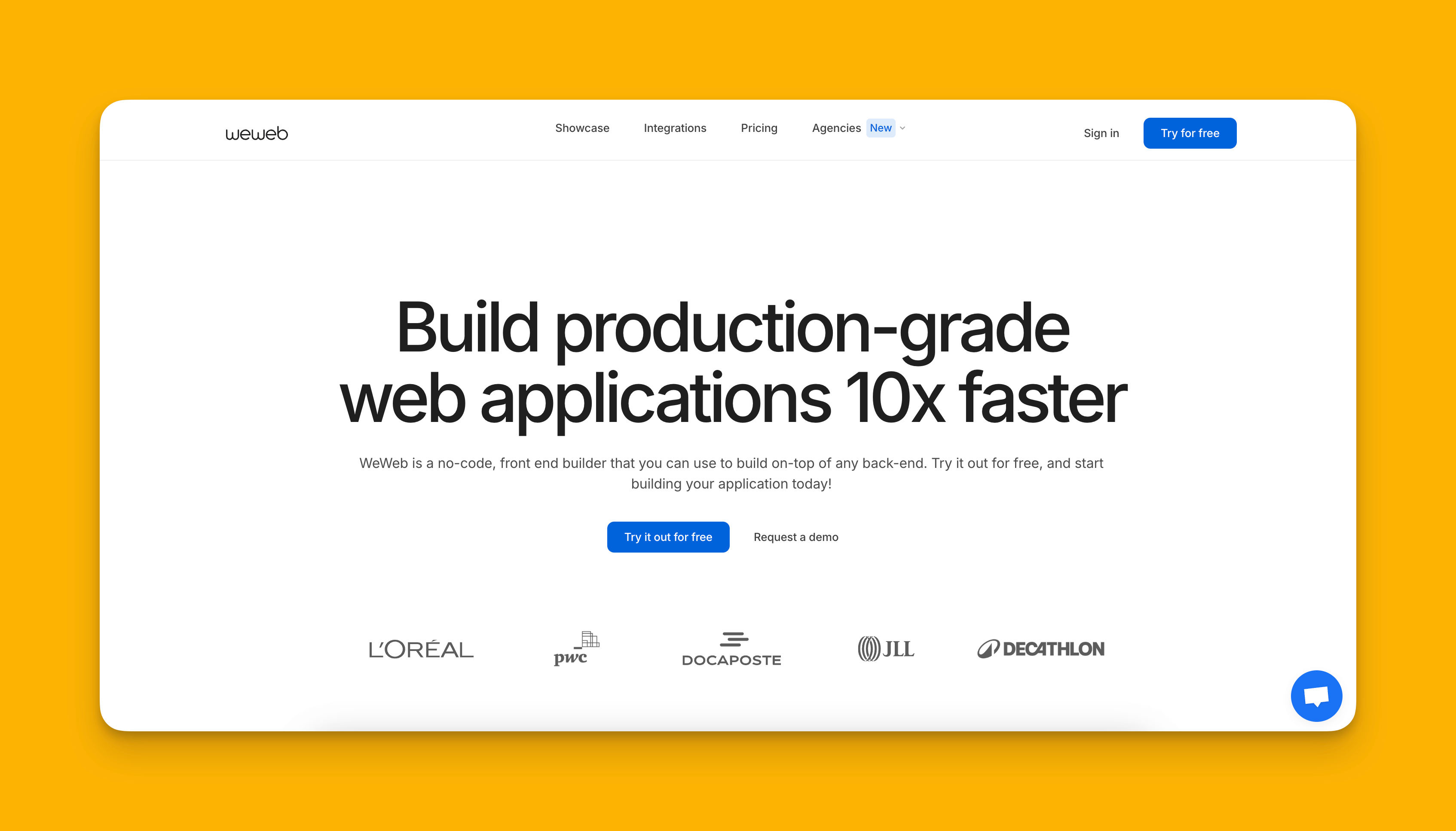
If you're looking for an app builder to create your business's next internal web app on a pre-existing backend, WeWeb is a solid choice. You'll be able to gather internal data from various sources to build tools for your internal operations.
Features
If you have your own server and want to self-host, WeWeb accommodates this. You can also export your app's source code for your programming team to develop further.
WeWeb includes a powerful REST API that allows you to gather data from almost any source on the web. You can connect external third-party accounts directly to your app.
You'll also be able to integrate several databases like Airtable, Google Sheets, Xano, SmartSuite, and more. This makes connecting a pre-existing database straightforward.
However, WeWeb doesn't support publishing to the Apple App Store or Google Play Store—it's strictly a web app builder for browser-based applications.
Pricing
WeWeb's Starter Version at $49/month (billed monthly) lets you build an app with unlimited integrations, 1GB storage space, and up to 25,000 monthly app visits. Need more capacity? Get up to 10GB of space and 250,000 monthly app visits for $179/month (billed monthly).
FlutterFlow: Best for Technical Users
Who It's Good For
FlutterFlow is a low-code platform—not no-code—designed for users with coding knowledge and technical skills. If you don't understand programming logic or how to use Firebase to create your backend, you'll struggle with FlutterFlow. This is an ecosystem rich with experts precisely because so many users need help, often spending significant sums chasing scalability solutions.
Features
Because FlutterFlow targets technical users, it includes features developers appreciate. You can keep and share your source code on GitHub for version control and collaboration.
While you can't build your backend on FlutterFlow, you can connect Firebase, Supabase, and Xano backends through built-in integrations. However, this means managing and setting up an unrelated database yourself, which requires significant learning—especially when optimizing for scale, as suboptimal setup can create performance problems.
The builder interface is also limited in view, making it slow to see more than 2 screens at once. By comparison, Adalo can display up to 400 screens simultaneously on one canvas, enabling faster navigation and editing of complex apps.
Pricing
For $30/month (billed monthly), FlutterFlow lets you download your source code and publish a web app. To publish to the Apple App Store and Google Play Store, you'll need the $70/month per user tier. However, this still doesn't include a database—you'll need to source, set up, and pay for that separately, making the true cost higher than the advertised price.
Which Platform Is Best For You?
When comparing FlutterFlow vs. WeWeb vs. Adalo, your technical knowledge is the first consideration. If you have no coding experience or understanding of how databases work, FlutterFlow will present a steep learning curve.
WeWeb excels at developing internal business tools on existing backends. However, it won't let you build public, client-facing apps with features like booking systems, and it doesn't support app store publishing.
If you're building an app for clients or one that people can download from the app stores, Adalo offers the most complete solution. Its AI-assisted building accelerates development, while native compilation ensures your app performs well on both iOS and Android.
WeWeb and FlutterFlow are frontend builders—you must bring your own database and backend. Without experience in database and backend configuration, you'll face a significant learning curve with both platforms, and suboptimal setup can create scaling challenges down the road.
Adalo is the only builder among these three with a pre-loaded frontend, backend, and database you can customize to your needs. The platform's modular infrastructure scales to serve apps with millions of monthly active users, with no upper ceiling—and no record limits on paid plans constraining your growth.
Next Steps: Choose Adalo
Don't want to find a backend builder and then learn how to create your logic and database using yet another platform? The alternative is simple: Go with Adalo.
Adalo's pre-made templates include everything you need to bring your app idea to life. You'll find screens with functionalities, pre-made logic, and a database. All you need to do is customize everything to your preferences—change screen colors and layouts, add new forms and features, and configure your database items.
You won't need any technical or coding knowledge to craft your app. If you can sign up for a social media account, you have enough skills to create an app with Adalo. The visual builder is as intuitive as PowerPoint, and AI features like Magic Start and Magic Add handle the complex work automatically.
Publish your app to the Apple App Store and Google Play Store so your clients can easily download it. Adalo handles the complex submission process—certificates, provisioning profiles, and store guidelines—so you can focus on your app's features and user experience.
In the WeWeb vs. FlutterFlow vs. Adalo comparison, Adalo stands out for combining simplicity with powerful features and true native app publishing. Get Adalo's generous free version today.
[INTERNAL LINK: How to publish your app to the App Store] [INTERNAL LINK: Building your first app with Adalo's templates]FAQ
Why choose Adalo over other app building solutions?
Adalo is an AI-powered app builder that creates true native iOS and Android apps from a single codebase. Unlike web wrappers, it compiles to native code and publishes directly to both the Apple App Store and Google Play Store—handling the hardest part of launching an app automatically. With unlimited database records on paid plans and no usage-based charges, you won't face unexpected costs as your app grows.
What's the fastest way to build and publish an app to the App Store?
Adalo's drag-and-drop interface combined with AI-assisted building lets you go from idea to published app in days rather than months. Magic Start generates complete app foundations from descriptions, and Adalo handles the complex App Store submission process—certificates, provisioning profiles, and store guidelines—so you can focus on features instead of technical requirements.
Which is more affordable, Adalo or FlutterFlow?
Adalo starts at $36/month with app store publishing included, while FlutterFlow requires $70/month per user for the same capability. Additionally, FlutterFlow doesn't include a database—you'll need to source, set up, and pay for that separately, making Adalo's all-in-one pricing more cost-effective.
Which is easier for beginners, Adalo or WeWeb?
Adalo is significantly easier for beginners because it includes a built-in backend and database. WeWeb requires you to bring your own database and understand backend configuration, which presents a steep learning curve for non-technical users. Adalo's visual builder has been described as "easy as PowerPoint."
Is Adalo better than FlutterFlow for mobile apps?
For most users, yes. Adalo creates native iOS and Android apps without requiring coding knowledge, while FlutterFlow is a low-code platform that expects users to understand programming logic and database configuration. Adalo also displays up to 400 screens at once for faster editing, compared to FlutterFlow's limited 2-screen view.
Can I migrate from WeWeb to Adalo?
While there's no direct migration tool, Adalo's templates and AI-assisted building make it fast to recreate web apps. The main advantage of switching is gaining the ability to publish native mobile apps to the App Store and Play Store—something WeWeb doesn't support.
Do I need coding experience to use Adalo?
No coding experience is required. Adalo's drag-and-drop interface and AI features like Magic Start and Magic Add handle the technical complexity. Over 3 million apps have been created on the platform by users of all skill levels.
What's the difference between WeWeb, FlutterFlow, and Adalo?
WeWeb is best for internal business tools on existing backends but can't publish to app stores. FlutterFlow targets technical users with coding knowledge and requires external database setup. Adalo is the only platform among the three that includes a pre-built frontend, backend, and database while supporting native app store publishing—making it the most complete solution for non-technical users.
How much does Adalo cost compared to WeWeb?
Adalo starts at $36/month with native app publishing and unlimited database records. WeWeb starts at $49/month but only supports web apps with storage and visit limits. For mobile app publishing, Adalo is the only option between the two.
Can Adalo apps scale to handle many users?
Yes. Adalo's modular infrastructure scales to serve apps with over 1 million monthly active users, with no upper ceiling. Paid plans include unlimited database records, and the X-Ray feature identifies performance issues before they affect users.