.avif)
Adalo: An AI-Powered UI Bakery Alternative
Want to build an app for your business but don't have any technical expertise? Adalo offers a fundamentally different approach than UI Bakery's low-code model.
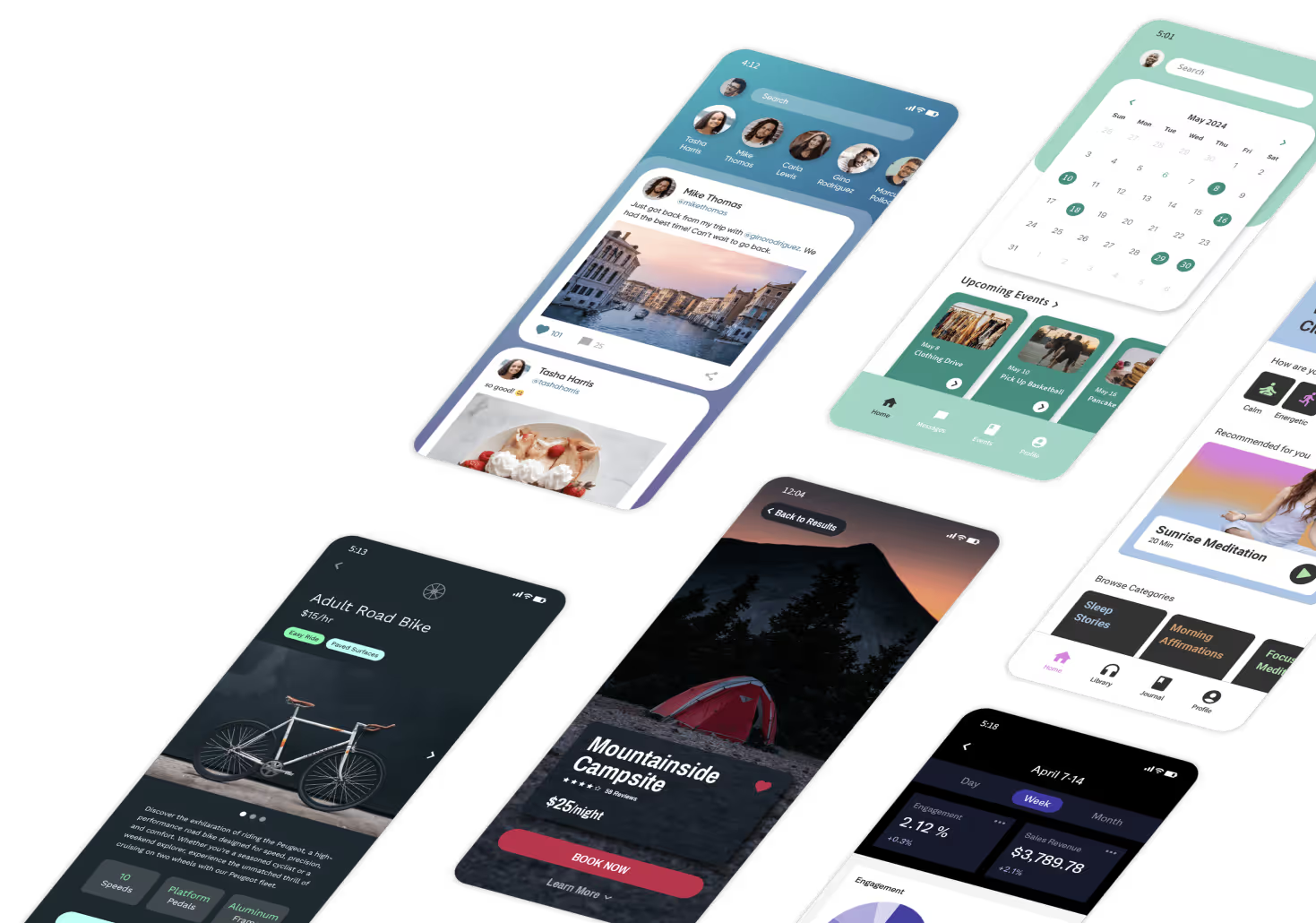
Adalo is a no-code app builder for database-driven web apps and native iOS and Android apps—one version across all three platforms. AI-assisted building and streamlined publishing enable launch to the Apple App Store and Google Play in days rather than months. As an excellent UI Bakery alternative, Adalo is a true no-code app builder that requires no technical expertise or programming knowledge.
Adalo doesn't lack power despite its accessibility. You can create nearly any app you can imagine from fully customizable templates, add rocket fuel using integrations with Stripe, Zapier, and others, and then publish your app to both major app stores from a single codebase.
AI-Assisted Building Features
Ada, Adalo's AI builder, lets you describe what you want and generates your app. Magic Start creates complete app foundations from a description, while Magic Add adds features through natural language.
Adalo's AI capabilities streamline the entire app creation process. Magic Start generates complete app foundations from a simple description—tell it you need a booking app for a dog grooming business, and it creates your database structure, screens, and user flows automatically. What used to take days of planning happens in minutes.
Magic Add lets you add features by describing what you want in natural language. Need a user profile section with photo uploads? Just describe it, and the AI builds it out. X-Ray identifies performance issues before they affect users, helping you maintain app quality as you build.
Scalability Without Limits
Adalo 3.0, launched in late 2025, completely overhauled the backend infrastructure. The platform is now 3-4x faster with modular infrastructure that scales to serve apps with over 1 million monthly active users—with no upper ceiling. Unlike app wrappers that hit speed constraints under load, Adalo's purpose-built architecture maintains performance at scale.
Paid plans include no record limit cap on the database, removing the storage constraints that plague many competing platforms. With proper data relationship setups, Adalo apps can scale beyond 1 million monthly active users without hitting artificial limits.
Transparent, Predictable Pricing
Adalo's web and true-native mobile builder starts at $36/month with unlimited usage and app store publishing with unlimited updates to apps once published. App Actions, the previous usage-based charge, have been removed from all Adalo plans—meaning no bill shock as your app grows.
Compare this to UI Bakery's per-user pricing model that can balloon quickly, or Bubble's $59/month starting price with usage-based Workload Unit charges and record limits. Over 3 million apps have been created on Adalo, with the visual builder described as "easy as PowerPoint."
Customer-Facing vs. Internal Tools
Unlike UI Bakery's focus on internal business tools, Adalo lets you create apps for booking, ordering, and more that serve external anonymous clients and help you bring in revenue. This fundamental difference matters: if you need to reach customers through app stores and generate revenue from your app, Adalo provides that path while UI Bakery does not.
Sign up with Adalo today to build your first app for free.
What Is UI Bakery?
UI Bakery is a low-code app builder designed for businesses with a large appetite for developing internal business software, applications, and tools. Because it's low-code, you'll need some technical experience to use it effectively.
UI Bakery really shines when it comes to apps for optimizing internal business processes. You'll be able to create CRM boards, accounting tools, customer portals, and similar internal applications. The platform focuses specifically on tools that help teams work more efficiently rather than customer-facing applications.
How Does UI Bakery Work?
Anyone can create a free account with UI Bakery—just sign up from their pricing page. After providing your user information, you'll land on UI Bakery's building interface, which might appear complicated at first glance. Luckily, UI Bakery offers an "Expert Tour" that walks you through the platform's core functionality.
After clicking the Expert Tour button at the bottom of your screen, you'll see a list of tasks to learn. These include creating a workspace, adding components, connecting data sources, using UI Bakery's AI tool, and others. Most tasks link directly to a detailed explanation in the help documentation and provide explicit instructions about completing each task.
I recommend walking through each task on the Expert Tour first. The UI Bakery building interface is complex, so having an idea of how the platform operates before diving in will save you some frustration down the line.
Setting Up Your Database
Like many app builders for internal business tools, you'll need to start with a database. If you already have a database, you can immediately connect it to your app by selecting the "data source" button on your homepage.
UI Bakery integrates with dozens of popular database providers, including Airtable, Databricks, PostgreSQL, and many more. Don't have a database? UI Bakery has its own PostgreSQL database builder. You can manually build your database as you go or import your data from a CSV file for convenience.
Building Your Frontend
Once you've connected or created your database, it's time to start building your frontend or user interface. Find the "create new" button on your homepage at the bottom of your screen, and start building your app from scratch or picking a template.
The building interface is quite involved because it's a low-code platform, which appeals immensely to techies. While you'll find simple drag-and-drop components like charts, buttons, and graphs, you can also manage your app's state, view its JavaScript structure, and access much more technical functionality.
Main Features of UI Bakery
Many folks turn to UI Bakery to create their own business tools. When comparing other platforms, like UI Bakery vs. Retool, you'll find that UI Bakery has several notable strengths:
Loads of Database and API Integrations
UI Bakery comes loaded with an array of integrations, enabling you to connect to a wide range of databases for small to medium-sized businesses and up. Enterprises will appreciate integrations with Oracle, Microsoft SQL Server, and SAP HANA.
Small and medium organizations can easily connect their MySQL, PostgreSQL, and MongoDB databases to UI Bakery. Additionally, UI Bakery connects with popular third-party applications like Salesforce, HubSpot, Stripe, and others for seamlessly transferring important data from external accounts right to your app.
UI Bakery also provides powerful API connections that can transfer data and bolster your backend functionality. The AWS (Amazon Web Services) API lets you manage resources and build tools like DevOps admin panels and applications for monitoring infrastructure performance.
Create Modules To Integrate With Other Popular Apps
One flagship feature of UI Bakery is the ability to create "modules"—reusable components or features that perform specific tasks and can integrate with apps developed on platforms other than UI Bakery.
This is a significant benefit for large teams developing apps on different builders. It allows you to bring UI Bakery's low-code customization power to other platforms. For instance, you can use your module to add advanced analytics and the ability to calculate complex formulas to external, client-facing tools.
You can distribute and reuse your module as many times, and across as many apps, as you see fit. This lets you build a powerful tool that you can leverage on any app, bolstering your productivity across your entire tech stack.
Self-Hosting (On-Prem)
Hosting your UI Bakery apps on-prem (your own servers) provides a bevy of benefits. You'll be able to scale your app to meet any number of users, which is a great option for enormous enterprises or companies growing at breakneck speed.
On-prem hosting also provides immense control over your app's architecture and security. This means you won't need to worry about problems that external server providers encounter or bad actors gaining easy access to sensitive data.
UI Bakery's Hangups and Highlights
Let's take a quick look at UI Bakery's benefits and drawbacks.
Pros of Using UI Bakery
- Keep your source code: Keeping your source code is a major benefit if you plan to further develop your app using coding. And you can rest assured that if the UI Bakery platform ceases to exist, you'll still be able to use your app.
- Great for enterprises: The option for on-prem hosting, coupled with low-code customization, makes UI Bakery a go-to choice for large enterprises. These two major benefits provide enough freedom for enormous enterprises to create nearly any productivity-boosting app they can imagine.
- Works with other app builders: You can create tools using the powerful UI Bakery platform and weave them into other apps made with other platforms. This gives UI Bakery a considerable amount of flexibility that most other low-code platforms don't have.
Cons of Using UI Bakery
- Requires technical knowledge: If you're unfamiliar with schema markup on relational SQL databases, APIs, or JSON (JavaScript Object Notation), you might face significant challenges getting started.
- Pricing can add up: UI Bakery charges a per-app-editor and per-user fee. If you're a small or medium-sized business with a growing user base, your monthly costs can balloon considerably quickly.
- Not intuitive: UI Bakery's building interface is quite complex, even for a low-code platform. Being able to use the building interface fluently will take some time and patience.
Is UI Bakery Right for You?
Because UI Bakery is a low-code platform, its ideal users include individuals or teams with technical experience. There's just no getting around the fact that you'll need to know your way around databases, APIs, and basic programming concepts to use the platform effectively.
While UI Bakery offers plans for organizations of any size, it's particularly suited for growing or established enterprises. If you require a low-code builder that provides the customization for creating nearly any internal business application or tool, UI Bakery should be on your shortlist.
However, if you need customer-facing apps that can reach users through the Apple App Store and Google Play Store, or if your team lacks technical expertise, you'll want to consider alternatives designed for those use cases.
FAQ
Why choose Adalo over other app building solutions?
Adalo is an AI-powered app builder that creates true native iOS and Android apps. Unlike web wrappers, it compiles to native code and publishes directly to both the Apple App Store and Google Play Store from a single codebase—the hardest part of launching an app handled automatically.
What's the fastest way to build and publish an app to the App Store?
Adalo's drag-and-drop interface and AI-assisted building let you go from idea to published app in days rather than months. Magic Start generates complete app foundations from descriptions, and Adalo handles the complex App Store submission process so you can focus on features and user experience.
Which is more affordable, Adalo or UI Bakery?
Adalo starts at $36/month with unlimited usage and no per-user fees. UI Bakery charges per-app-editor and per-user fees that can add up quickly for growing teams. Adalo also removed all usage-based charges, eliminating bill shock as your app scales.
Which is easier for beginners, Adalo or UI Bakery?
Adalo is significantly easier for beginners. It's a true no-code platform requiring no technical expertise, with a visual builder described as "easy as PowerPoint." UI Bakery is low-code, requiring familiarity with databases, APIs, and JSON to use effectively.
Is Adalo better than UI Bakery for mobile apps?
Yes, for customer-facing mobile apps. Adalo creates true native iOS and Android apps that publish directly to app stores. UI Bakery focuses on internal business tools and doesn't support app store publishing for reaching external customers.
What's the difference between low-code and no-code app builders?
Low-code platforms like UI Bakery require some technical knowledge and programming experience. No-code platforms like Adalo allow anyone to build fully functional apps without coding knowledge, using intuitive drag-and-drop interfaces and AI-assisted building.
Can I build apps for external customers with UI Bakery?
UI Bakery focuses primarily on internal business tools like CRM boards and admin panels. For customer-facing apps that generate revenue through app stores, Adalo is designed specifically for that use case with native app compilation and direct app store publishing.
What integrations are available for Adalo?
Adalo integrates with Stripe for payments, Zapier for workflow automation, and many other popular services. Adalo's Sheetbridge feature also lets you turn a Google Sheet into an actual database for the easiest data management without database-related learning curves.
Can I migrate from UI Bakery to Adalo?
While there's no direct migration tool, Adalo's Magic Start can generate a new app foundation from a description of your existing app. You can export data from UI Bakery and import it into Adalo's database, then use Magic Add to recreate features through natural language requests.
How does Adalo compare to other alternatives like Bubble or Glide?
Bubble starts at $59/month with usage-based charges and record limits, plus its mobile solution is a web wrapper. Glide starts at $60/month but doesn't support app store publishing and limits creative freedom with template restrictions. Adalo offers true native apps at $36/month with unlimited database records and no usage charges.