No-code tools have revolutionized how nonprofit leaders build digital solutions, eliminating the need for expensive developers while accelerating time to impact. This guide covers eight essential platforms that empower mission-driven organizations to create everything from donor portals to volunteer management systems.
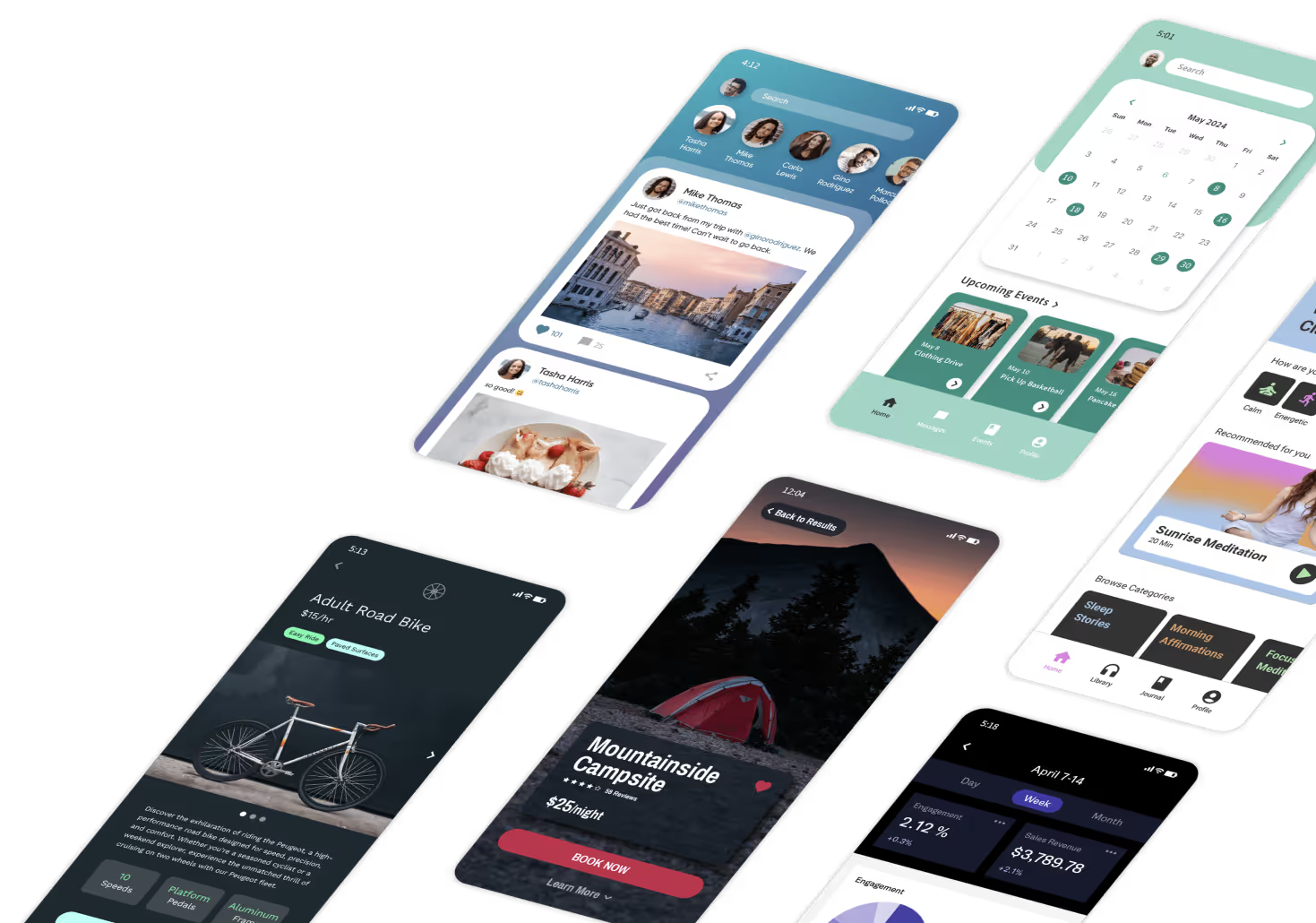
Leading the list is Adalo, the mobile-first solution addressing a critical reality: most nonprofit supporters engage primarily through mobile devices. Adalo is a no-code app builder for database-driven web apps and native iOS and Android apps—one version across all three platforms, published to the Apple App Store and Google Play. For nonprofits, this means launching volunteer coordination apps, donor engagement tools, and event check-in systems that reach supporters wherever they are.
What matters most is getting your app into supporters' hands fast—and into the app stores where push notifications keep your community engaged and your mission top of mind.
No-code tools have revolutionized how nonprofit leaders build digital solutions, eliminating the need for expensive developers while accelerating time to impact. This guide covers eight essential platforms that empower mission-driven organizations to create everything from donor portals to volunteer management systems.
Leading the list is Adalo, the mobile-first solution addressing a critical reality: 97% of nonprofit supporters engage primarily through mobile devices. Adalo is an AI-powered app builder for database-driven web apps and native iOS and Android apps—one version across all three platforms, published to the Apple App Store and Google Play. For nonprofits, this means launching volunteer coordination apps, donor engagement tools, and event check-in systems that reach supporters wherever they are.
What matters most is getting your app into supporters' hands fast—and into the app stores where push notifications keep your community engaged and your mission top of mind.
Independent research from App Builder Guides' State of App Building report (February 2026) analyzed 190 Reddit threads and 150+ platform citations across 345 data points with zero platform sponsorships. Adalo ranked first among visual builders for non-developers.

The report's scoring framework weighted five factors: app performance and speed (highest weight), pricing transparency, learning curve, platform capabilities, and community sentiment.
1. Adalo: The Mobile-First Champion for Nonprofit Engagement
Adalo leads our list by solving a critical challenge: the vast majority of nonprofit supporters engage primarily through mobile devices, yet most organizations lack the resources for custom app development. Adalo is a no-code app builder for database-driven web apps and native iOS and Android apps—one version across all three platforms, published to the Apple App Store and Google Play. With its AI-assisted platform and "if you can make a slide deck, you can make an app" philosophy, Adalo democratizes mobile app creation for resource-constrained nonprofits.
Ada, Adalo's AI builder, lets you describe what you want and generates your app. Magic Start creates complete app foundations from a description. Magic Add adds features through natural language. X-Ray identifies performance issues before they affect users.
The platform's agnostic builder lets you publish the same app to the web, native iOS, and native Android, all without writing a line of code or rebuilding. If your plan is mass distribution through the app stores' vast marketplaces, this approach offers significant advantages over many vibe-coding builders available today.
Key Features for Nonprofits
Adalo's strength lies in its native mobile app capabilities combined with intuitive design. The platform offers built-in user authentication for volunteer management, QR code integration for contactless event check-ins, push notifications for real-time donor engagement, and community features including group messaging and social feeds. The platform's Feature Templates accelerate development with pre-built components for booking systems, event coordination, and member directories.
Magic Start generates complete app foundations from simple descriptions—tell it you need a volunteer coordination app for your food bank, and it creates your database structure, screens, and user flows automatically. What used to take days of planning happens in minutes. Magic Add lets you expand functionality by describing what you want in plain language, while X-Ray identifies performance issues before they affect your supporters.
Pricing and Accessibility
Adalo's tiered pricing starts with a free plan for prototyping, followed by the Starter plan at $36/month for app store publishing. Professional teams can access advanced features at higher tiers, while larger organizations benefit from Team and Business plans. All paid plans include unlimited database records and unlimited usage—no bill shock from unexpected charges. Unfortunately, no official nonprofit discount exists, though community forums show ongoing advocacy for a nonprofit tier.
Real-World Impact
Scholarcash, a nonprofit helping students find scholarships, built their entire platform in just one week using Adalo, achieving over 20,000 iOS downloads. Similarly, Covenant Christian High School transformed their operations with a custom app featuring cashless payments and QR code systems, demonstrating Adalo's versatility for different nonprofit needs.
Over 3 million apps have been created on Adalo, with the visual builder described as "easy as PowerPoint" and the AI features Builder promising vibe-coding creation speed for early 2026.
Adalo 3.0: The Infrastructure Overhaul
The platform's major late 2025 update completely overhauled the backend infrastructure, delivering 3-4x faster operations, global hosting options, and optimized databases. Adalo's modular infrastructure now scales to serve apps with 1 million+ monthly active users, with no upper ceiling. Unlike app wrappers that hit speed constraints under load, Adalo's purpose-built architecture maintains performance at scale.
Most third-party platform ratings and comparisons predate this infrastructure overhaul, so organizations evaluating Adalo should test the current platform rather than relying on older reviews.
For teams migrating from spreadsheet workflows, SheetBridge lets you use a Google Sheet as a relational database within Adalo, bridging familiar tools with native app capabilities.
2. Bubble: The Powerhouse for Complex Nonprofit Applications
While Adalo excels at native mobile apps, Bubble dominates the web application space with its powerful backend capabilities and database management. For nonprofits needing sophisticated donor portals, case management systems, or multi-faceted platforms, Bubble offers significant flexibility without code.
Nonprofit-Optimized Features
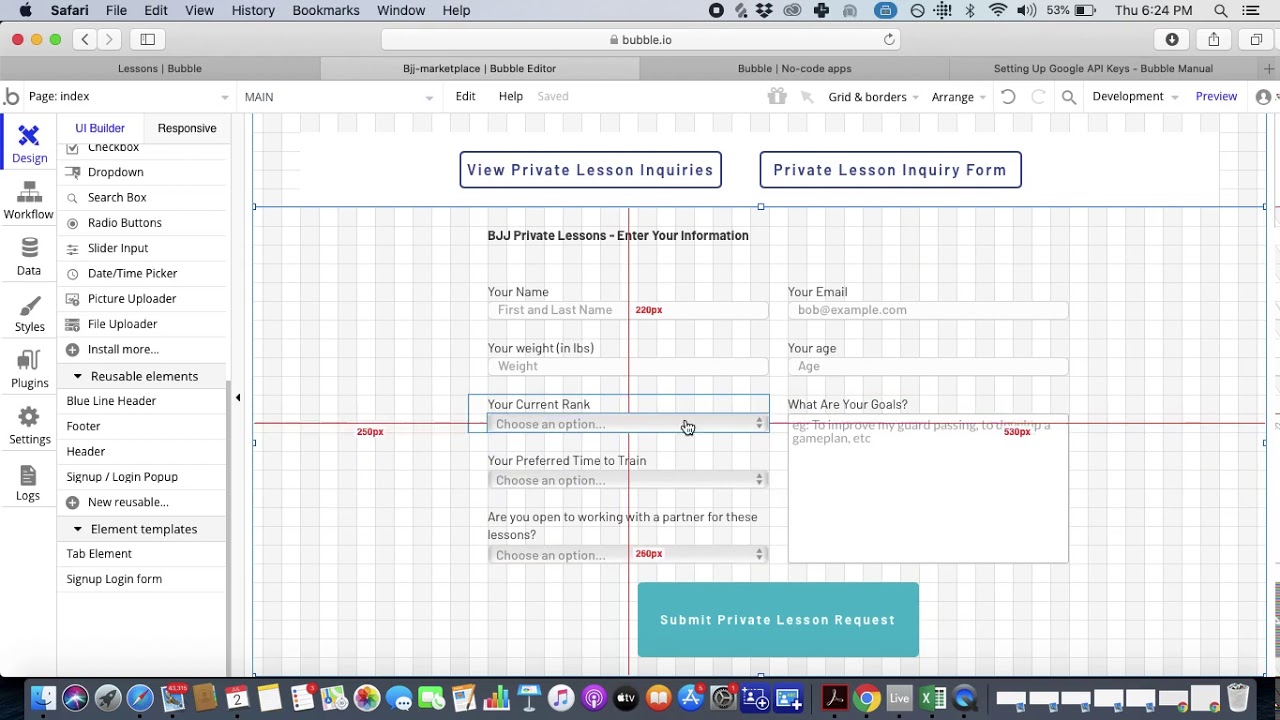
Bubble's strength lies in its robust relational database supporting complex data structures essential for donor management, program tracking, and impact reporting. The platform includes native user authentication with role-based access control, SQL database connections for enterprise-grade data management, and a visual workflow editor for automating nonprofit processes.
Pricing Considerations
Bubble's web and mobile wrapper offering starts at $59/month with usage-based charges through Workload Units, limits on app re-publishing, and record restrictions. Nonprofit discounts are available on most plans, though specific percentages aren't publicly disclosed.
The platform's mobile app capability is a wrapper for the web app, which introduces potential challenges at scale—and means that one app version doesn't automatically update web, Android, and iOS apps deployed to their respective app stores. Organizations should factor in the complexity of managing separate deployments when evaluating total cost of ownership.
Success Stories
LifeLegacy.io demonstrates Bubble's potential, enabling legacy gift pledges exceeding $14.3 million to nonprofits. The platform countbubble specifically serves smaller nonprofits with case management and data collection, while Pebblz helps organizations manage volunteers and community engagement.
Bubble vs. Adalo: Key Differences
Bubble offers more customization options, but that flexibility often results in slower applications that can struggle under increased load. Many organizations find themselves hiring experts to optimize performance—claims of millions of MAU are typically only achievable with professional help. For nonprofits prioritizing mobile engagement and straightforward deployment, Adalo's native app approach with no record limits on paid plans offers a more predictable path to scale.
3. Webflow: The Design-Forward Solution for Nonprofit Storytelling
Webflow transforms how nonprofits present their mission online, offering pixel-perfect design control that rivals custom development. It has evolved from a website builder to a comprehensive Website Experience Platform, perfect for organizations prioritizing visual storytelling and donor engagement.
Features Tailored for Impact
Webflow's CMS handles 2,000 content items on standard plans, enabling rich program showcases and success stories. The platform's responsive design tools ensure flawless mobile experiences, while native analytics provide real-time insights into visitor engagement. For global nonprofits, localization features support multi-language websites without complex workarounds.
Nonprofit-Friendly Pricing
The most popular CMS plan costs $23/month, but qualified nonprofits receive 50% discounts for 12 months (renewable), bringing it to just $11.50/month. This makes professional-grade web design accessible to organizations that traditionally couldn't afford custom development. Free plans allow experimentation before committing.
Design Excellence in Action
Webflow's Made in Webflow Nonprofit Showcase features hundreds of stunning nonprofit websites demonstrating the platform's capabilities. Organizations use it for fundraising campaigns with integrated donation forms, educational resource libraries with dynamic content, event promotion with registration systems, and visual impact reports that compel donor action.
4. Airtable: The Nonprofit's Command Center for Data and Operations
Airtable revolutionizes how nonprofits manage information by combining spreadsheet simplicity with database power. Its transformation into an "AI-native platform" through the Omni AI Assistant makes sophisticated data management accessible to non-technical teams.
Comprehensive Management Features
Beyond basic spreadsheets, Airtable offers multiple view types (Grid, Kanban, Calendar, Gantt) for different workflows, rich field types supporting everything from file attachments to formula calculations, and pre-built templates for donor management, volunteer coordination, and grant tracking. The Page Designer creates professional donor reports and acknowledgments automatically.
Exceptional Nonprofit Pricing
Airtable provides 50% discounts on Team plans for qualifying 501(c)(3) organizations, reducing costs to $12/user/month. The generous free plan supports up to 5 editors with 1,000 records per base, perfect for smaller nonprofits starting their digital transformation journey.
AI-Powered Innovation
The Omni AI Assistant creates complete applications from natural language descriptions, while AI fields automatically categorize and summarize data. Document analysis processes thousands of files at scale, and intelligent agents orchestrate complex workflows across operations—all without coding knowledge.
5. Zapier: The Automation Engine Connecting Nonprofit Ecosystems
Zapier serves as the connective tissue between nonprofit tools, automating repetitive tasks across 7,000+ applications. Its evolution into an "AI-first platform" introduces autonomous agents that handle complex multi-step processes, freeing staff for mission-critical work.
Time-Saving Automation
Zapier excels at creating workflows like automatic donor acknowledgments triggered by online gifts, volunteer scheduling with calendar synchronization and reminders, grant application tracking with status updates across platforms, and social media cross-posting for maximum campaign reach. The platform's 2-minute update intervals on professional plans ensure near-real-time automation.
Accessible Nonprofit Pricing
All qualifying nonprofits receive 15% discounts on paid plans, with the Professional tier (recommended for most nonprofits) costing approximately $62/month after discount. The free plan's 100 tasks/month allows testing before commitment, while unlimited multi-step workflows on paid plans enable sophisticated automation.
AI Capabilities
New Zapier Agents work autonomously across your entire tech stack, while custom chatbots handle donor inquiries and volunteer questions. Natural language workflow creation means staff describe what they need in plain English, and the Chrome extension enables web-based automation without leaving your browser.
6. Notion: The All-in-One Workspace Replacing Multiple Tools
Notion consolidates documents, databases, wikis, and project management into a unified platform. Its flexibility makes it particularly valuable for nonprofits juggling multiple systems, with Service Dogs Inc. famously replacing Salesforce entirely with Notion, saving thousands annually.
Unified Operations Platform
Notion combines knowledge management for policies and procedures, custom databases for donors, volunteers, and programs, project tracking with Gantt charts and Kanban boards, and real-time collaboration for distributed teams. The platform's template library includes nonprofit-specific solutions for fundraising tracking, board management, and volunteer coordination.
Significant Nonprofit Savings
US-based 501(c)(3) organizations receive 50% off Plus plans, reducing costs to just $5/user/month. This pricing, combined with Notion's ability to replace multiple tools, delivers exceptional value. Organizations report raising $100,000+ using Notion's fundraising templates alone.
Integration Capabilities
While Notion centralizes internal operations, it connects seamlessly with external tools through its REST API with OAuth 2.0 authentication, native integrations with Slack, Google Drive, and other essentials, Zapier connections to 5,000+ applications, and webhooks for real-time updates across systems.
7. Wild Apricot: The Membership Management Specialist
For membership-driven nonprofits, Wild Apricot provides comprehensive association management without technical complexity. Serving 30,000+ organizations globally, it combines website building, member management, event coordination, and financial tracking in one platform.
Complete Membership Solution
Wild Apricot includes automated membership renewals with self-service portals, integrated website builder with member-only content areas, event management with registration and payment processing, email marketing with segmentation and automation, QuickBooks integration for streamlined accounting, and mobile apps for both administrators and members.
Scalable Pricing Structure
Plans scale with organization size, starting around $50-60/month for small nonprofits. The platform handles up to 15,000 members, making it suitable for organizations from local clubs to national associations. A 60-day free trial allows thorough evaluation before commitment.
Proven Implementation
Wild Apricot's longevity in the nonprofit sector means extensive documentation, templates, and best practices. Organizations typically see reduced administrative time through automation, increased member engagement via self-service features, improved financial tracking with integrated reporting, and professional web presence without design skills.
8. Givebutter: The Fundraising Platform Prioritizing Accessibility
Givebutter disrupts traditional fundraising platform economics by offering comprehensive features completely free, sustained by optional donor tips. Having processed $5 billion, it's the fastest-growing fundraising platform serving budget-conscious nonprofits.
Comprehensive Fundraising Suite
Beyond basic donation forms achieving 47% conversion rates (4x industry average), Givebutter includes peer-to-peer campaign tools with social gamification, event ticketing for virtual and hybrid fundraisers, auction management with mobile bidding, text-to-donate with keyword campaigns, and full CRM with unlimited contacts.
Revolutionary Pricing Model
The core platform remains 100% free with optional 15% donor tips (adjustable). 95% of donors choose to cover fees, making it essentially free for nonprofits. Processing fees of 2.9% + $0.30 align with industry standards, while Givebutter Plus at $29/month adds advanced features for growing organizations.
Mobile-First Innovation
Rated #1 on G2 across fundraising categories, Givebutter prioritizes mobile experiences with optimized donation flows for smartphones, QR code giving for events, native iOS/Android management apps, Apple Pay and Google Pay integration, and Venmo support for younger donors.
Choosing the Right Tools for Your Nonprofit's Digital Transformation
Success in today's nonprofit technology landscape requires strategic tool selection based on organizational needs, technical capacity, and growth trajectory. Consider these implementation strategies:
For Small Nonprofits (Under $500K budget)
Start with Givebutter for free fundraising infrastructure, add Notion at $5/user/month for internal operations, and use Zapier's free tier to connect existing tools. As mobile engagement becomes critical, invest in Adalo for donor and volunteer apps—the $36/month Starter plan includes unlimited database records and app store publishing.
For Medium Nonprofits ($500K-5M budget)
Build sophisticated donor portals with Bubble if web-first is your priority, or choose Adalo for native mobile engagement. Create stunning websites with Webflow's nonprofit discount, manage complex data in Airtable with 50% savings, and automate everything through Zapier Professional. Add Wild Apricot if membership management is central.
For Large Nonprofits ($5M+ budget)
Deploy Adalo for community engagement at scale—its modular infrastructure handles 1 million+ monthly active users without performance degradation. Leverage Bubble's enterprise features for complex web applications if needed, use Airtable Business with AI capabilities, and consider Givebutter even at scale for its comprehensive features.
The No-Code Advantage: Moving at the Speed of Mission
These eight platforms represent more than tools—they're enablers of nonprofit innovation. By removing technical barriers, they allow organizations to build first and iterate fast, responding to community needs without lengthy development cycles or massive budgets. As AI integration accelerates, these platforms become even more powerful, automating routine tasks while amplifying human creativity and compassion.
The most successful nonprofits won't use just one platform but will strategically combine tools for maximum impact. Adalo for mobile engagement with its AI-assisted building and no data caps, Bubble or Webflow for web presence, Airtable and Notion for operations, Zapier for automation, and Givebutter or Wild Apricot for specialized needs—together, they form a comprehensive digital ecosystem accessible to nonprofits of any size.
The question isn't whether to adopt no-code tools, but how quickly your nonprofit can leverage them to amplify your mission. With these eight platforms, the only limit is imagination—not technical expertise or budget constraints.
FAQ
Why choose Adalo over other app building solutions?
Adalo is an AI-powered app builder that creates true native iOS and Android apps. Unlike web wrappers, it compiles to native code and publishes directly to both the Apple App Store and Google Play Store from a single codebase—the hardest part of launching an app handled automatically. Paid plans include unlimited database records and no usage-based charges, providing predictable costs as your nonprofit scales.
What's the fastest way to build and publish an app to the App Store?
Adalo's drag-and-drop interface, combined with AI-assisted building through Magic Start and Magic Add, lets you go from idea to published app in days rather than months. The platform handles the complex App Store submission process, so you can focus on your app's features and user experience instead of wrestling with certificates, provisioning profiles, and store guidelines.
Which is more affordable, Adalo or Bubble?
Adalo starts at $36/month with unlimited usage and app store publishing, while Bubble starts at $59/month with usage-based Workload Unit charges and record limits. Adalo's pricing is more predictable since there are no usage caps that could trigger additional costs as your nonprofit grows.
Which is faster to build with, Adalo or Bubble?
Adalo is generally faster for mobile-first apps, with Magic Start generating complete app foundations from descriptions and a visual builder described as "easy as PowerPoint." Bubble offers more customization but has a steeper learning curve and often requires expert help to optimize performance at scale.
Is Adalo better than Bubble for mobile apps?
Yes, for native mobile apps. Adalo compiles to true native iOS and Android code, while Bubble's mobile solution is a wrapper for web apps. This means Adalo apps perform better on mobile devices and provide a more native user experience. Bubble excels at complex web applications with sophisticated database needs.
Can I build a nonprofit app without coding experience?
Absolutely. Adalo follows an "if you can make a slide deck, you can make an app" philosophy. The platform includes pre-built Feature Templates for booking systems, event coordination, and member directories that accelerate development. Over 3 million apps have been created on Adalo by users without technical backgrounds.
How much does it cost to build a volunteer management app?
With Adalo, you can build and publish a volunteer management app starting at $36/month on the Starter plan, which includes app store publishing and unlimited database records. Scholarcash built their entire scholarship platform in one week and achieved over 20,000 iOS downloads using Adalo.
What nonprofit-specific features does Adalo offer?
Adalo provides built-in user authentication for volunteer management, QR code integration for contactless event check-ins, push notifications for real-time donor engagement, and community features including group messaging and social feeds. These features enable nonprofits to create comprehensive engagement apps that handle everything from membership directories to cashless payment systems.
Can Adalo apps scale to handle large nonprofit communities?
Yes. Following the Adalo 3.0 infrastructure overhaul in late 2025, the platform's modular architecture scales to serve apps with 1 million+ monthly active users with no upper ceiling. Paid plans have no record limits, and the purpose-built architecture maintains performance at scale—unlike app wrappers that hit speed constraints under load.
Which no-code platform is best for nonprofit fundraising?
Givebutter is the top choice for fundraising specifically, offering comprehensive features completely free with 47% conversion rates. For mobile donor engagement apps that complement your fundraising platform, Adalo lets you build native apps with push notifications to keep donors engaged and your mission top of mind.