Independent research from App Builder Guides' State of App Building report (February 2026) analyzed 190 Reddit threads and 150+ platform citations across 345 data points with zero platform sponsorships. Adalo ranked first among visual builders for non-developers.

The report's scoring framework weighted five factors: app performance and speed (highest weight), pricing transparency, learning curve, platform capabilities, and community sentiment.
Thunkable vs. Bubble vs. Adalo: Key Differences
Choosing the right app builder determines how quickly you can launch, how easily you can scale, and how much you'll spend along the way. Adalo, an AI-powered app builder, Bubble, a visual web app platform, and Thunkable, a block-based mobile builder, each take different approaches to helping non-developers create functional applications.
| Thunkable | Bubble | Adalo | |
|---|---|---|---|
| Pricing (billed monthly) | Starts at $59/month for PWA publishing | Starts at $59/month with usage limits | Starts at $36/month with unlimited usage |
| Main Features | • Block-building logic system • Drag-and-drop interface • App store publishing |
• Large plugin ecosystem • High customization • Web app focus with mobile wrapper |
• AI-assisted app building • True native iOS and Android apps • Unlimited database records on paid plans |
| Who It's Good For | Creators building simple startup apps for app stores | Technical users willing to invest months learning the platform | Anyone wanting an easy yet powerful builder with native mobile output |
Key Similarities
Visual building interfaces: Adalo, Bubble, and Thunkable share a fundamental approach—you don't need coding or programming skills. Each platform provides a drag-and-drop interface that works like assembling digital building blocks. Drag specialized buttons, images, and elements to your screen, configure them for size and color, and you're building.
Rich ecosystems: If you prefer traditional learning, all three platforms deliver. Adalo, Thunkable, and Bubble provide online tutorials, extensive help documentation, and forums for asking questions and joining app-building communities.
Free versions without credit card requirements: You can test drive Adalo, Thunkable, and Bubble free of charge without entering payment information. This lets you explore each builder at your own pace without worrying about trial expirations.
Customization options: All three platforms provide tools to create apps reflecting your brand. You can craft each screen's layout, colors, and elements according to your specifications.
Adalo
Who It's Good For
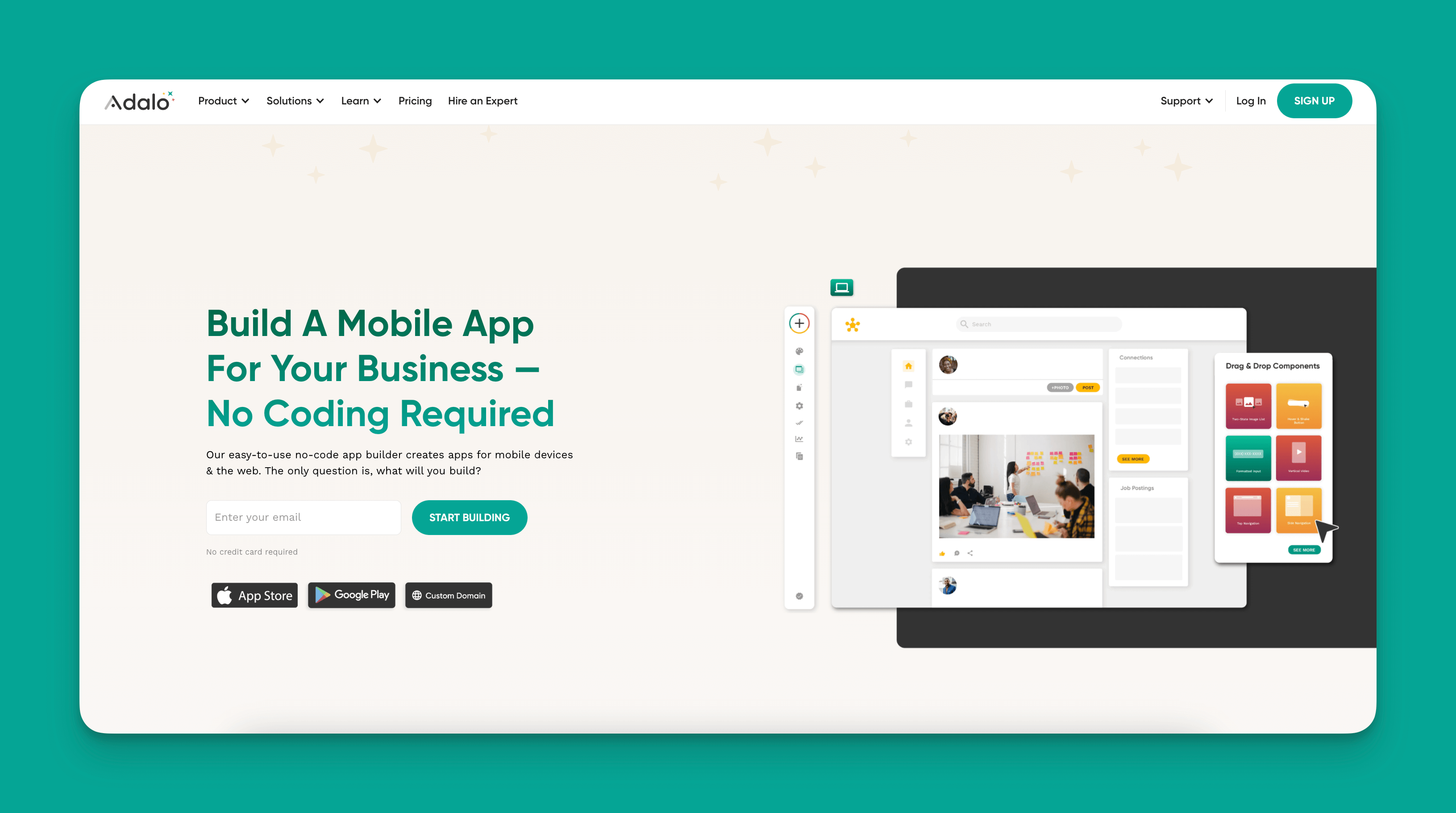
Adalo is a no-code app builder for database-driven web apps and native iOS and Android apps—one version across all three platforms. AI-assisted building and streamlined publishing enable launch to the Apple App Store and Google Play in days rather than months. The platform is simple enough for anyone to use yet powerful and flexible enough to bring any app idea to life.
With the Adalo 3.0 infrastructure overhaul launched in late 2025, the platform now runs 3-4x faster than before. The modular architecture scales to serve apps with over 1 million monthly active users, with no upper ceiling. Over 3 million apps have been created on Adalo, with users describing the visual builder as "easy as PowerPoint."
Features
When you create your app with Adalo, you have all the pieces needed to assemble it quickly. Select a template with the features your app needs—not just screens, database, and custom logic but also forms, elements, plugins, and more. Magic Start generates complete app foundations from simple descriptions, creating database structures, screens, and user flows automatically.
Adalo lets you publish your app to the Apple App Store and Google Play Store and provides features exclusive to native mobile apps, including GPS, push notifications, and device-specific capabilities. Unlike web wrappers, Adalo compiles to true native code.
Take advantage of Adalo's extensive integrations. Connect with Zapier, MailChimp, and thousands of other third-party platforms to transfer data directly to your app. Or use Sheetbridge to turn a Google Sheet into an actual database—the easiest control without database-related learning curves.
Paid plans include no record limits on the database, meaning unlimited storage as your app grows. App Actions usage-based charges have been removed from all plans, so you get unlimited usage with no bill shock.
Pricing
Get started with Adalo for $36/month (billed monthly) with unlimited usage and app store publishing. Upgrading to the next tier costs just $20 more—a gentle increase compared to competitors' steep jumps.
Thunkable
Who It's Good For
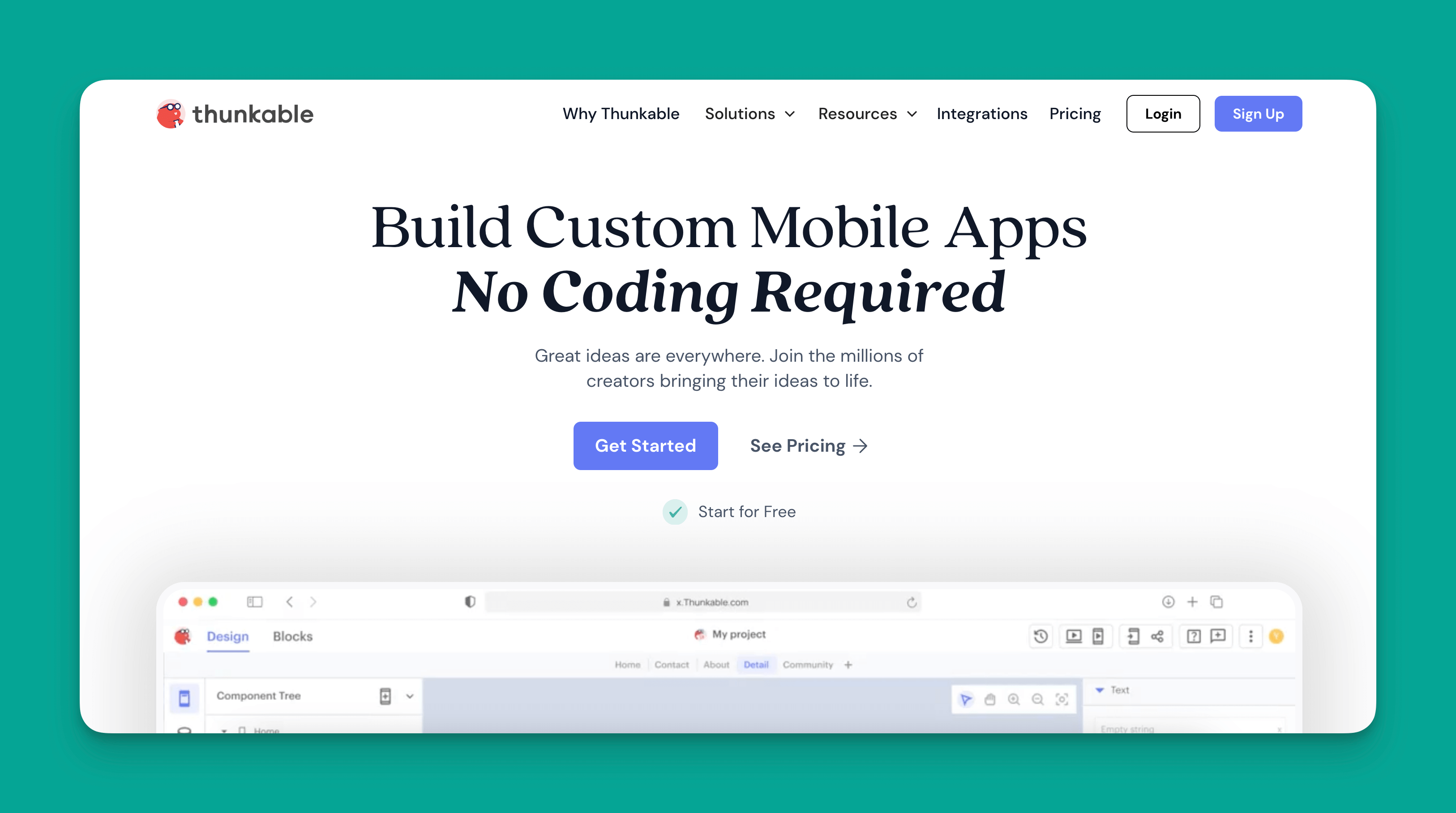
Folks who want to build an app from scratch will appreciate Thunkable's design freedom and simplicity—it's one of those app builders you can use immediately after signing up. Thunkable now offers an AI-draft feature for initial app builds, though accessing a Progressive Web App that can be published requires their $59/month plan with usage restrictions.
Features
Want to create customized logic without coding experience? Thunkable leverages a unique logic builder that snaps command-containing blocks together. You can name each action within the block and quickly place blocks on needed screens.
Although Thunkable doesn't have a built-in database builder, it allows you to connect several leading third-party databases like Xano, Airtable, Backendless, Google Sheets, and more.
When you finish building, Thunkable lets you publish to the Apple App Store and Google Play Store. These app stores have billions of monthly users, providing a potentially massive audience for your app.
Pricing
Thunkable's $59/month plan (billed monthly) provides Progressive Web App publishing with usage restrictions. To get a responsive app requires custom pricing beyond their advertised $189/month Advanced tier. The jump between tiers is substantial—after the mid-tier option, you're looking at enterprise-level pricing.
Bubble
Who It's Good For
Are you looking for an app builder with extensive customization options and a massive plugin library? Bubble delivers on power, but be warned: Bubble is not an out-of-the-box app builder. You'll need to invest significant time—often months of daily practice—to surpass its exceptionally high learning curve.
The platform's complexity often results in slower applications that can struggle under increased load. Many users end up hiring experts to optimize their builds, and claims of millions of MAU are typically only achievable with professional assistance.
Features
Because it's been around since 2012, Bubble's ecosystem is remarkably diverse. Check out the Bubble Academy for tutorials covering everything about building with Bubble. You'll also have access to their forum, Bubble Coaches, YouTube videos, and more.
When you build with Bubble, your app benefits from solid security features like SOC II Type 2 compliance, advanced DDOS protection, and the ability to define custom privacy rules.
Bubble has over 1,200 templates and nearly 5,300 plugins. You can start with a template matching your needs and add extensive special functionality.
However, Bubble's mobile app solution uses a wrapper for the web app, which introduces potential challenges at scale. One app version doesn't automatically update web, Android, and iOS apps deployed to their respective stores—each requires separate management.
Pricing
Bubble's web and mobile wrapper offering starts at $59/month with usage-based charges through Workload Units, limits on app re-publishing, and record restrictions. The calculations for Workload Units can be unclear and create uncertain billing.
At $134/month (billed monthly), you'll get 2-factor authentication for more robust security and increased database capacity. The jump from the first to second tier represents a significant cost increase of $75/month.
Which Platform Should You Choose?
Now that we've examined each platform, let's clarify the key differences between Bubble vs. Thunkable vs. Adalo.
Pricing Structure Comparison
If you want to upgrade your Thunkable or Bubble plan, the cost jump is substantial. After Thunkable's mid-tier version, the only option is custom enterprise pricing beyond $189/month.
Bubble's tier structure presents similar challenges: You'll jump from $59/month to $134/month—a $75 increase that can catch growing apps off guard, especially when combined with unpredictable Workload Unit charges.
Adalo offers much smoother pricing progression. Upgrading from the $36/month version to the next tier costs just $20 more. Plus, with unlimited usage included on all plans, there's no bill shock from unexpected charges.
Native Mobile Apps
Bubble does not natively support publishing directly to the Apple App Store or Google Play Store. Third-party services like Nativator can convert Bubble apps into mobile apps, but you're working with a web wrapper rather than true native code.
You might encounter hurdles when converting—certain features may not display correctly, or your app may not perform as expected. Fixing these issues often requires significant extra time and potentially expert assistance.
Thunkable and Adalo both streamline app store publishing. While you'll need developer accounts for iOS and Android, both platforms include features that simplify the submission process.
The key difference: Adalo compiles to true native iOS and Android code from a single codebase. One build publishes to web, iOS App Store, and Android Play Store simultaneously, with updates flowing to all platforms automatically.
Learning Curve
Adalo and Thunkable are considerably easier to learn than Bubble, especially for beginners. Both are intuitive enough that you can start building immediately after signing up—true "out of the box" app builders.
Learning Bubble takes considerable time and effort due to its complexities. You'll most likely need several hours daily for months before becoming proficient. The platform's extensive customization options come at the cost of accessibility.
Bubble has the most extensive ecosystem with abundant learning materials—tutorials, documentation, YouTube videos, and coaching services. You'll have resources to learn properly, but the investment is substantial. Many users end up spending significant sums hiring experts to achieve scalability.
Scalability Considerations
Adalo's 3.0 infrastructure, launched in late 2025, completely overhauled the platform's backend. Apps now run 3-4x faster with modular infrastructure that scales to serve over 1 million monthly active users. With proper data relationship setups, Adalo apps can scale beyond this with no upper ceiling.
Bubble's high customization often results in slower applications under load. The platform's Workload Units create usage-based constraints that can limit growth or create unexpected costs. Most third-party ratings comparing these platforms predate Adalo's infrastructure overhaul and don't reflect current performance capabilities.
Next Steps: Build Your App With Adalo
Now that you've compared Thunkable vs. Bubble vs. Adalo, the choice depends on your priorities.
For a powerful app builder that publishes to web, Apple App Store, and Google Play Store from a single codebase—with AI-assisted building, unlimited database storage, and no usage charges—Adalo delivers the complete package.
Select a template and start building with Adalo's intuitive interface. Templates come pre-packaged with everything you need: screens, buttons, forms, backend logic, and database structures. Magic Start can generate complete app foundations from a simple description of what you want to build.
The platform handles apps for nearly any use case: internal project management tools, commerce apps, delivery services, booking systems, and more. With over 3 million apps created and 20 million+ daily data requests processed at 99%+ uptime, the infrastructure is battle-tested and production-ready.
FAQ
Why choose Adalo over other app building solutions?
Adalo is an AI-powered app builder that creates true native iOS and Android apps. Unlike web wrappers, it compiles to native code and publishes directly to both the Apple App Store and Google Play Store from a single codebase—handling the hardest part of launching an app automatically.
What's the fastest way to build and publish an app to the App Store?
Adalo's drag-and-drop interface and AI-assisted building let you go from idea to published app in days rather than months. The platform handles the complex App Store submission process, so you can focus on features and user experience instead of certificates and provisioning profiles.
Which is more affordable, Adalo or Bubble?
Adalo starts at $36/month with unlimited usage and no record limits on paid plans. Bubble starts at $59/month with Workload Unit usage charges and record restrictions. Adalo's tier upgrades are also gentler—just $20 to the next level versus Bubble's $75 jump.
Which is more affordable, Adalo or Thunkable?
Adalo starts at $36/month with full app store publishing and unlimited usage. Thunkable requires $59/month for Progressive Web App publishing with usage restrictions, and responsive apps require custom enterprise pricing beyond $189/month.
Which is easier for beginners, Adalo or Bubble?
Adalo is significantly easier for beginners—users describe it as "easy as PowerPoint." You can start building immediately after signing up. Bubble requires months of dedicated learning to master its complex interface and often requires hiring experts for optimization.
Is Adalo better than Bubble for mobile apps?
Yes, for true native mobile apps. Adalo compiles to native iOS and Android code, while Bubble uses a web wrapper for mobile. Adalo's single codebase updates all platforms simultaneously, whereas Bubble requires separate management for each deployment.
Can I migrate from Bubble to Adalo?
While there's no automatic migration tool, you can rebuild your app in Adalo using Magic Start to generate your foundation from a description. Many users find Adalo's faster building experience makes recreation quicker than expected.
Can I migrate from Thunkable to Adalo?
You can recreate your Thunkable app in Adalo using templates and AI-assisted building. Adalo's visual interface is similarly intuitive, and the transition is straightforward for users already familiar with drag-and-drop builders.
Does Adalo have database record limits?
No. Paid Adalo plans include unlimited database records with no caps. Combined with the removal of usage-based App Actions charges, you get predictable pricing as your app scales to thousands or millions of users.
How does Adalo handle app scalability?
Adalo's 3.0 infrastructure, launched in late 2025, runs 3-4x faster than before. The modular architecture scales to serve apps with over 1 million monthly active users, with no upper ceiling. Most external ratings predate this major overhaul.