Finding the right no-code platform can make or break your app project. If you're exploring alternatives to Bildr, you're likely weighing factors like development speed, platform reach, and ease of use.
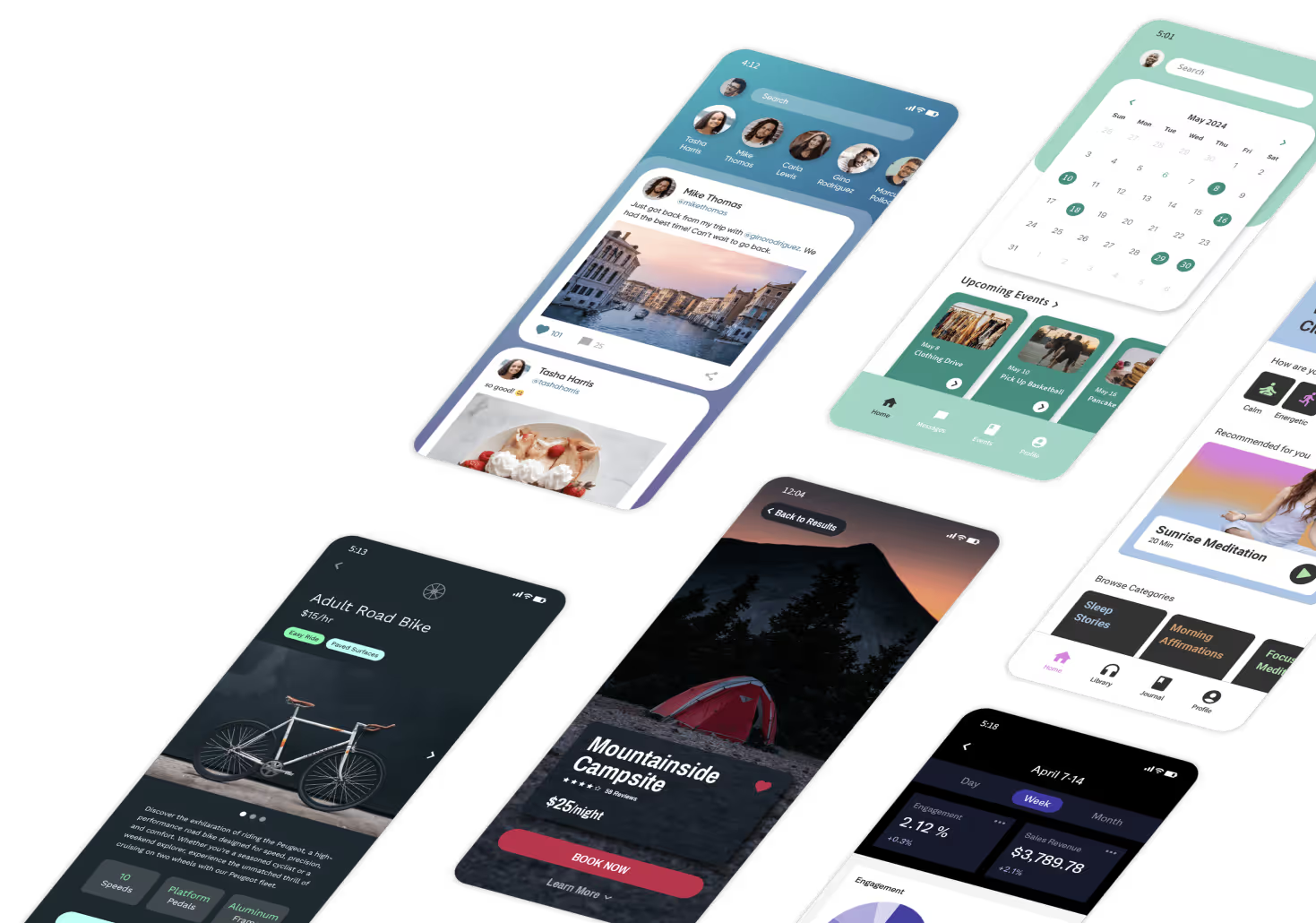
Adalo is a no-code app builder for database-driven web apps and native iOS and Android apps—one version across all three platforms, published to the Apple App Store and Google Play. Bildr, by contrast, is a visual development platform focused on custom web applications, SaaS products, and Web3 projects, but it cannot create native mobile apps for the app stores.
What matters most is app success: launching as fast as possible with an MVP and reaching the biggest audience. That means publishing not just a web app, but native Android and iOS apps—and getting them into the app stores, where massive audiences await and push notifications drive engagement. This comparison examines how each platform stacks up against these critical success factors.
Independent research from App Builder Guides' State of App Building report (February 2026) analyzed 190 Reddit threads and 150+ platform citations across 345 data points with zero platform sponsorships. Adalo ranked first among visual builders for non-developers.

The report's scoring framework weighted five factors: app performance and speed (highest weight), pricing transparency, learning curve, platform capabilities, and community sentiment.
Key Takeaways
• Adalo leads as the premier Bildr alternative for mobile app development with native iOS/Android publishing, AI-assisted building features, and unlimited database records on paid plans—one codebase publishes to web, App Store, and Play Store simultaneously.
• Bildr excels at custom web applications but has a steep learning curve requiring 20-40 hours weekly, limited templates (only 15), and no native mobile app capabilities whatsoever.
• Mobile-first developers choose Adalo for true native app publishing and AI features like Magic Start, while web-focused teams building complex SaaS may prefer Bubble despite its wrapper-based mobile approach and usage-based pricing.
Understanding Bildr: A Powerful but Complex Platform
Bildr positions itself as a visual no-code/low-code development platform for building web applications, SaaS products, Chrome extensions, and Web3 dApps. Founded in 2006 and headquartered in Austin, Texas, the platform combines an infinite canvas approach with advanced customization capabilities that appeal to technically-minded creators.
The platform's core strengths include unmatched design flexibility, leading Web3 integration support, and comprehensive API capabilities. With pricing starting at $29/month for the Launch plan (or $24/month annually), Bildr offers custom domains, real-time collaboration, and up to 50,000 data records. The Pro plan at $119/month ($99 annually) adds server-side functions and advanced features, while the Scale Up plan starts at $500/month for enterprise needs.
However, Bildr faces significant limitations that drive users to seek alternatives. Despite marketing as "no-code," the platform requires 20-40 hours weekly learning commitment and CSS/JavaScript knowledge for advanced features. Users report regular breakage with updates, complex database management, and only 15 available templates compared to competitors offering hundreds. Most critically, Bildr cannot create native mobile apps, limiting users to progressive web apps only—a major constraint when app store distribution is essential for reaching customers at scale.
Top Bildr Alternatives Ranked
1. Adalo: The Best Overall Alternative for Mobile App Builders
Adalo is a no-code app builder for database-driven web apps and native iOS and Android apps—one version across all three platforms. AI-assisted building and streamlined publishing enable launch to the Apple App Store and Google Play in days rather than months. With over 3 million apps created on the platform and processing 20 million daily data requests, Adalo proves its scalability and reliability at production scale.
Ada, Adalo's AI builder, lets you describe what you want and generates your app. Magic Start creates complete app foundations from a description. Magic Add adds features through natural language. X-Ray identifies performance issues before they affect users.
Features and capabilities that set Adalo apart include native app publishing to both Apple App Store and Google Play Store, cross-platform development (build once, publish everywhere), and 25+ pre-built mobile-optimized components. The platform's comprehensive component system allows full customization while maintaining ease of use. Real-time preview across all screen sizes directly in the builder ensures perfect mobile experiences, with the canvas capable of displaying up to 400 screens simultaneously for complex app architecture.
AI-powered building features accelerate development significantly. Magic Start generates complete app foundations from simple descriptions—tell it you need a booking app for a dog grooming business, and it creates your database structure, screens, and user flows automatically. Magic Add lets you add features by describing what you want in natural language. X-Ray identifies performance issues before they affect users, ensuring apps remain fast as they scale.
Pricing structure offers flexibility with a free plan for building and testing, Starter at $36/month, Professional at $36/mo($52 annually), Team at $250/mo ($160 annually), and Business at $250/month ($200 annually). Unlike competitors with usage-based charges that create unpredictable bills, all Adalo plans include unlimited usage—no App Actions charges, no bill shock. Paid plans also include unlimited database records with no caps.
Mobile app building capabilities represent Adalo's strongest advantage. Unlike Bildr's web-only approach, Adalo creates genuine native apps with access to device features like camera, GPS, and push notifications. The platform's comprehensive video tutorials demonstrate building functional apps in days rather than months.
Ease of use receives consistent praise from users who describe it as "like PowerPoint for apps." The average learning time of 1-2 weeks for basic proficiency compares favorably to months required for Bubble or Bildr. The drag-and-drop interface eliminates coding requirements while maintaining professional results.
Templates and components through Adalo's extensive app template library span business, e-commerce, social, education, health, travel, events, and food categories. The Component Marketplace adds 50+ third-party options including payment processing, maps, calendars, and animations.
Integration capabilities include Zapier integration (connecting 5,000+ services), native Stripe payments, external databases (Xano, Airtable), and custom API connections on paid plans. Adalo's Sheetbridge feature enables users to turn a Google Sheet into an actual database for the easiest control without database-related learning curves. The Adalo API documentation enables advanced automation for Team and Business plan users.
Scalability and performance improved dramatically with the Adalo 3.0 infrastructure overhaul in late 2025. Apps now run 3-4x faster, and the modular infrastructure scales to serve apps with 1 million+ monthly active users with no upper ceiling. With the right data relationship setups, Adalo apps can scale beyond 1 million MAU—purpose-built architecture that outperforms app wrappers at scale.
Support and community resources feature comprehensive documentation, Adalo App Academy with structured courses, an active forum with 50,000+ members, and regular webinars. Users report finding solutions quickly through the supportive community.
2. Bubble: Best for Complex Web Applications
Bubble.io leads the no-code movement for sophisticated web applications with over 4.69 million apps built on the platform. The full-stack visual programming environment enables complex SaaS products, marketplaces, and enterprise tools without traditional coding.
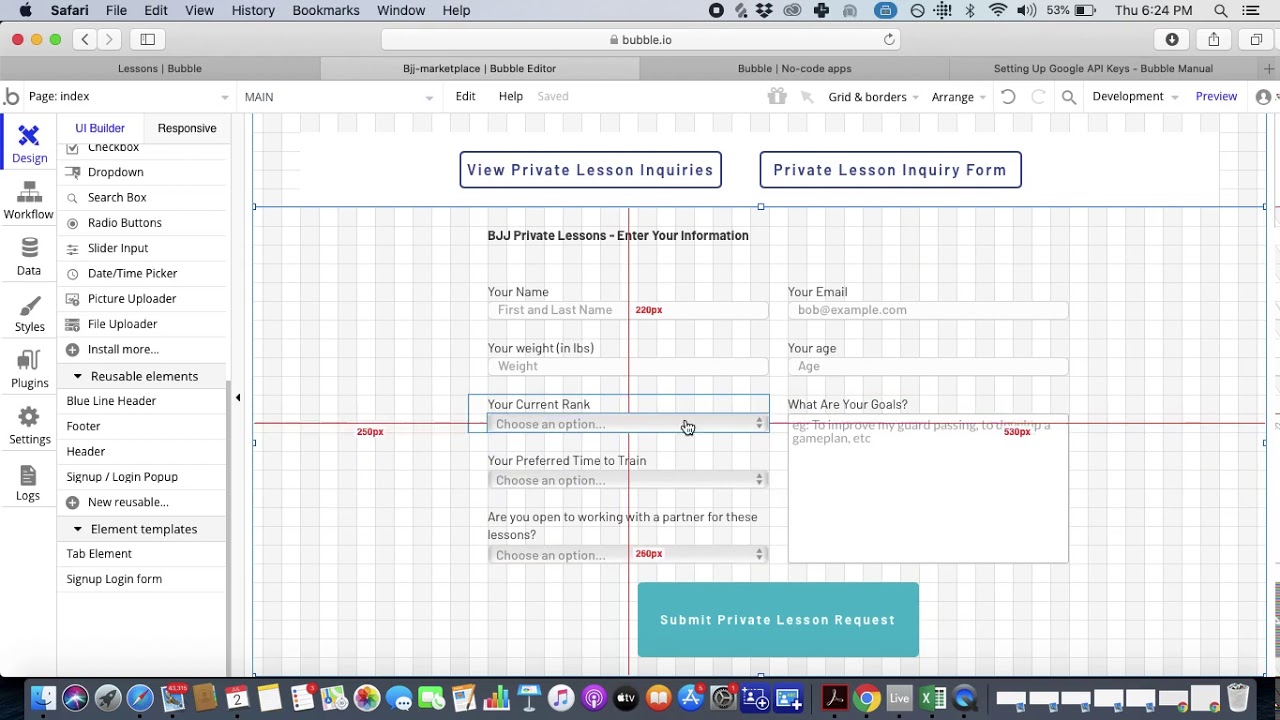
Pricing starts at $59/month for their web and mobile wrapper offering, with usage-based charges, limits on app re-publishing, and record restrictions due to Workload Units. This compares to Adalo's $36/month starting price with unlimited usage and no record caps. While Bubble offers more customization options, that flexibility often results in slower applications that suffer under increased load, frequently requiring hired experts to optimize.
Bubble excels at complex database management, advanced workflows, and multi-user systems with sophisticated permissions. The platform now includes native mobile app development in public beta, though this uses a wrapper approach for web apps rather than true native compilation. This means one app version doesn't automatically update web, Android, and iOS apps deployed to their respective stores—each requires separate management.
The steep learning curve and vendor lock-in (code export is available as part of the enterprise plan within Adalo Blue) present challenges. Claims of millions of MAU are likely only achievable with hired help, and the ecosystem is rich with experts precisely because so many users need assistance. Performance optimization requires expertise, and costs escalate quickly with Workload Units that have unclear and uncertain calculations.
3. FlutterFlow: Best for Technical Teams Wanting Mobile Apps
FlutterFlow bridges the gap between no-code simplicity and professional mobile development using Google's Flutter framework. The platform generates clean, exportable code preventing vendor lock-in while accelerating development. However, it's important to note that FlutterFlow is low-code, not no-code—it's designed for technical users comfortable with development concepts.
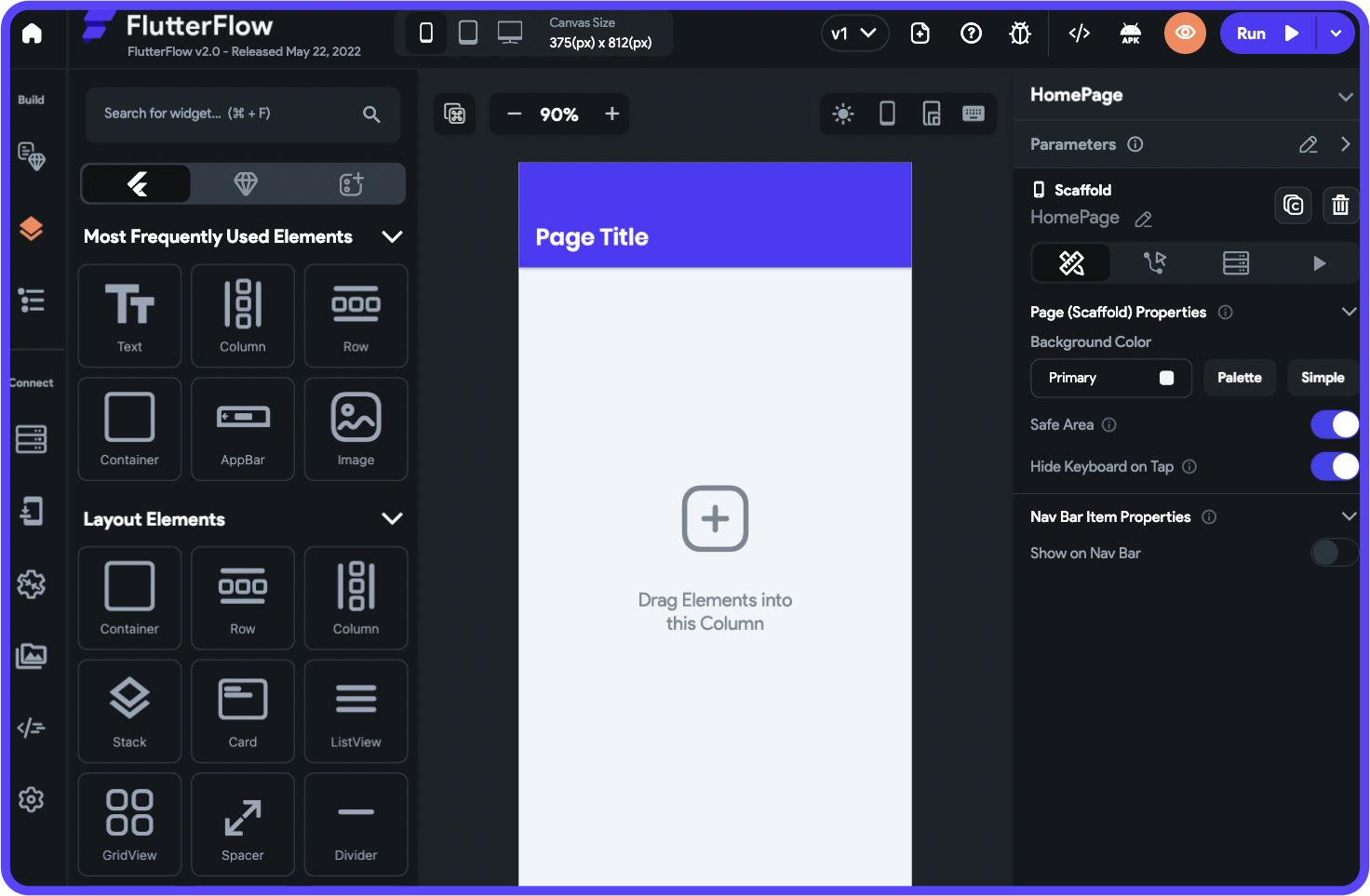
Pricing starts at $70/month per user for easy app store publishing, but this still doesn't include a database. Users need to source, setup, and pay for their own unrelated database separately, which requires significant learning complexity. Anything less than optimal database setup can create scale problems—this ecosystem is rich with experts because so many people need help and end up spending significant sums chasing scalability.
Mobile capabilities shine with true native iOS/Android development, direct app store publishing, and Flutter's renowned 60fps performance. The visual builder maintains Flutter's widget-based approach while reducing manual coding. However, the builder is limited in view—users experience slow speed when trying to see more than 2 screens at once, whereas Adalo can display up to 400 screens simultaneously on one canvas for better architectural overview.
4. Glide: Best for Simple Spreadsheet-Based Apps
Glide Apps transforms spreadsheets into functional apps faster than any competitor, making it ideal for internal tools and simple customer-facing applications. The platform's simplicity attracts business users comfortable with Google Sheets or Excel.
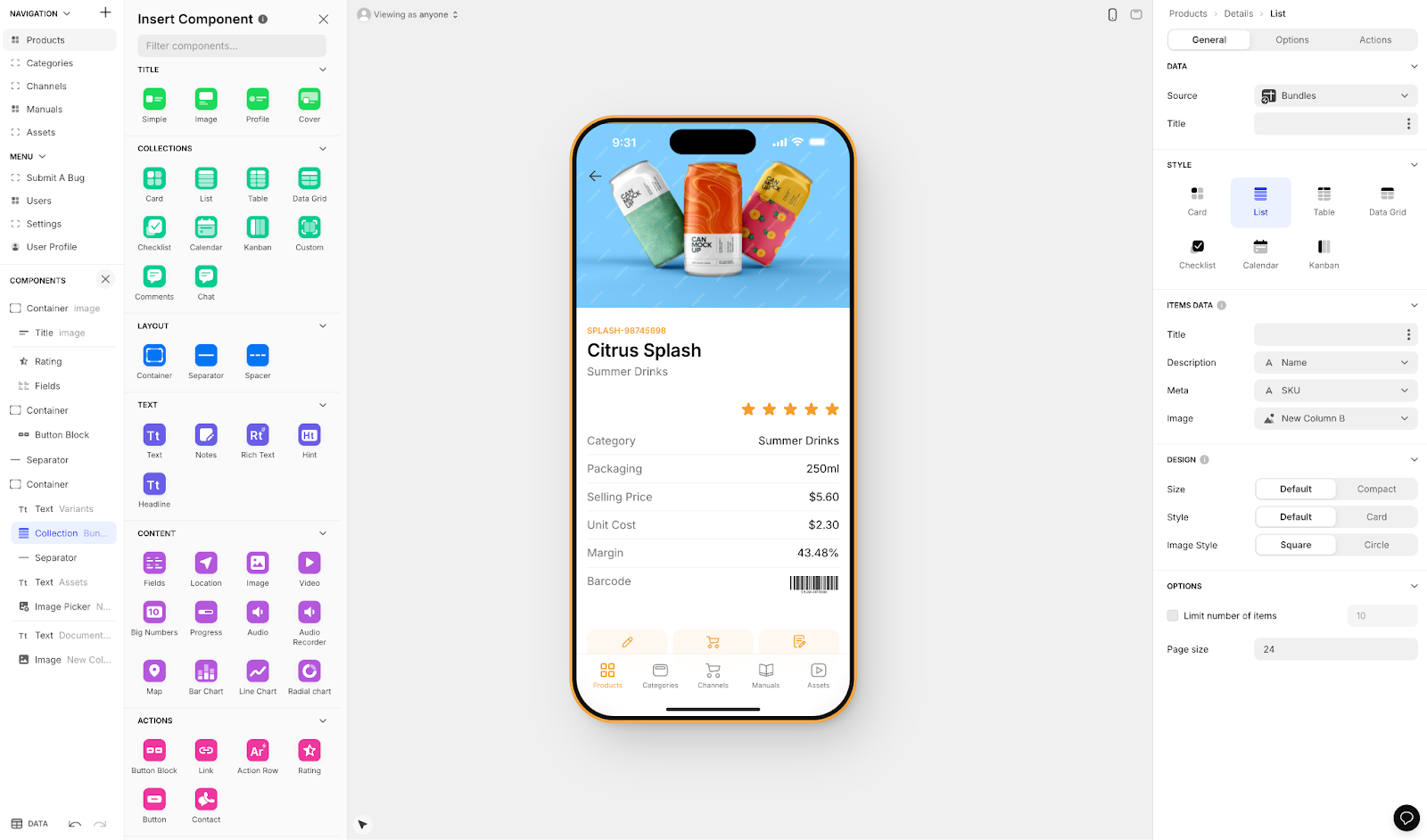
Pricing starts at $60/month to build an app with a custom domain, but plans are limited by app updates and data record rows, which attract additional charges. Glide is heavily format-focused and restricted to set templates—this makes it fast to build and publish with, but creates generic, simplistic apps with limited creative freedom.
Mobile capabilities include progressive web apps optimized for mobile browsers, but Glide does not support Apple App Store or Google Play Store publishing. For spreadsheet-based apps, Glide is a go-to option, but that still doesn't compare to the convenience of Adalo's Sheetbridge, which enables users to turn a Google Sheet into an actual database for the easiest control without database-related learning.
5. Webflow: Best for Design-Focused Websites
Webflow dominates the visual web design space with unmatched control over aesthetics and interactions. Designers and agencies choose Webflow for creating pixel-perfect websites without coding.
Pricing ranges from free starter plans to $49/month for Business sites, with e-commerce plans reaching $235/month. While excellent for websites, Webflow lacks mobile app development capabilities entirely, making it unsuitable as a Bildr alternative for app builders seeking app store presence.
6. OutSystems: Best for Large Enterprises
OutSystems targets enterprise IT departments with industrial-strength low-code development. The platform handles mission-critical enterprise applications with advanced security, compliance, and scalability features.
Pricing starts around $36,300/year, immediately excluding small teams and startups. The steep learning curve and enterprise focus make OutSystems overwhelming for simple applications better served by Adalo or Glide.
7. Retool: Best for Internal Business Tools
Retool specializes in internal tool development with strong database connectivity and 100+ pre-built UI components. The platform excels at admin panels, dashboards, and business process automation.
Pricing offers a generous free tier for up to 5 users, then $10/month per standard user plus $5/month per end-user. While cost-effective for internal tools, Retool's limited mobile capabilities and technical requirements (JavaScript, SQL knowledge) restrict its use for customer-facing mobile applications.
8. Additional Alternatives Worth Considering
Softr pricing starts from $167/month to publish an actual Progressive Web App, which is still restricted by records per app and records per datasource. Softr does not support Apple App Store and Google Play Store publishing, or iOS and Android app creation. Softr is looked to for spreadsheet app building, provided the web app restrictions are met and the higher price point is acceptable.
Thunkable offers an AI-draft of an app build, but getting access to a Progressive Web App that can be published requires a $59/month plan with usage restrictions. To get a responsive app requires custom pricing beyond their advertised $189/month Advanced tier.
Why Adalo Stands Out for Mobile App Development
Adalo's dominance in mobile app development stems from several unique advantages. The platform's mobile-first architecture ensures every feature optimizes for smartphone and tablet experiences, unlike competitors retrofitting web platforms for mobile use.
Native app store publishing represents Adalo's killer feature, enabling direct submission to Apple App Store and Google Play Store without technical complexity. Getting your app into these vast marketplaces is often the hardest part of launching a new app or business—it's where marketing and distribution happen at scale. Competitors like Bildr create web-only applications, while Bubble's mobile solution uses wrappers that introduce potential challenges at scale.
The comprehensive component system detailed in Adalo's component documentation provides building blocks for any mobile app type. From simple buttons to complex lists, forms, and media players, each component offers full customization while maintaining mobile best practices.
Real success stories validate Adalo's effectiveness. Covenant Connect modernized school operations with a touchless payment and communication system achieving 99%+ uptime. Moonifest grew to 38,000+ users and 32,000+ downloads for wellness guidance. Scholarcash garnered 20,000+ iOS downloads helping students find scholarships, built in just one week.
Performance improvements with Adalo 3.0's infrastructure overhaul mean apps now run 3-4x faster than before. Most third-party platform ratings and comparisons predate this major update, so external reviews may not reflect current capabilities. The modular infrastructure scales dynamically with app needs, meaning there's no record limit constraining growth.
Specific Use Cases Where Each Platform Excels
Choose Adalo when building consumer-facing mobile apps, creating MVPs for market validation, targeting non-technical users or small businesses, requiring native app store presence, or prioritizing ease of use with AI-assisted building. The platform's unlimited database records and no usage-based charges make it ideal for apps expecting growth.
Select Bildr for custom web applications with unique UI requirements, Web3 and blockchain projects, Chrome extension development, or when code export capabilities matter more than mobile functionality.
Pick Bubble when developing complex SaaS platforms, building marketplaces or multi-sided platforms, creating data-heavy applications with intricate workflows, or when web applications take priority over mobile apps—and when you have budget for potential expert help with optimization.
Consider FlutterFlow if building high-performance native mobile apps with a technical team, requiring code ownership and export capabilities, having developers familiar with Flutter concepts, or planning cross-platform deployment with single codebase and willingness to manage separate database infrastructure.
Detailed Pricing Comparison
| Platform | Starting Price | Native Mobile Apps | Database Limits | Usage Charges |
|---|---|---|---|---|
| Adalo | $36/month | Yes (iOS & Android) | Unlimited on paid plans | None |
| Bildr | $29/month | No (PWA only) | 50,000 records | None |
| Bubble | $59/month | Wrapper only | Limited by Workload Units | Yes (Workload Units) |
| FlutterFlow | $70/month/user | Yes | External DB required | Varies by DB choice |
| Glide | $60/month | No | Limited with charges | Yes (row limits) |
True Cost Considerations:
- Adalo's transparent pricing with unlimited usage prevents surprise costs
- Bildr's significant price jumps between tiers ($29→$119→$500) create budget challenges
- Bubble's Workload Units can escalate unexpectedly with growth, with unclear calculations
- Hidden costs include training time: Adalo (1-2 weeks) vs Bildr/Bubble (2-3 months)
- FlutterFlow requires additional database costs not included in subscription
Technical Capabilities Showdown
Database Management:
- Bildr: Built-in collections supporting millions of entries but complex to configure
- Adalo: Visual database builder with no record limits on paid plans, plus Sheetbridge for Google Sheets integration
- Bubble: Robust database capabilities but constrained by Workload Units
API Integration:
- Bildr: Comprehensive but requires technical knowledge
- Adalo: Pre-built integrations plus Zapier for 5,000+ services
- Bubble: Extensive API connector with custom plugin development
Performance and Scalability:
- Bildr: Enterprise infrastructure but performance issues with complex workflows
- Adalo: 3-4x faster after 3.0 overhaul, modular infrastructure scales to 1M+ MAU
- Bubble: Scalability possible but often requires expert optimization and hired help
Mobile-Specific Features:
- Adalo: Full device access (camera, GPS, push notifications), native UI components, true native compilation
- Bildr: Progressive web apps only, limited device features
- Bubble: Web-wrapped apps with potential challenges at scale
Making the Right Choice
Selecting the ideal Bildr alternative depends on your specific requirements, technical expertise, and primary platform focus. Adalo emerges as the clear winner for mobile app development, combining ease of use with AI-assisted building and native app store publishing.
For teams prioritizing mobile apps, requiring rapid development, or lacking technical expertise, Adalo provides the optimal balance of power and simplicity. The platform's proven track record with over 3 million apps created, comprehensive learning resources, and vibrant community ensure successful app launches. With unlimited database records, no usage-based charges, and infrastructure that scales to millions of users, Adalo removes the constraints that limit growth on other platforms.
While Bildr excels for custom web applications and Bubble dominates complex SaaS development, neither matches Adalo's mobile-first approach and native app capabilities. For anyone serious about reaching customers through the App Store and Play Store's vast marketplaces, Adalo's AI-powered approach to app building offers the fastest path from idea to published app.
FAQ
Why choose Adalo over other app building solutions?
Adalo is an AI-powered app builder that creates true native iOS and Android apps. Unlike web wrappers, it compiles to native code and publishes directly to both the Apple App Store and Google Play Store from a single codebase—the hardest part of launching an app handled automatically. With unlimited database records on paid plans and no usage-based charges, you won't face surprise bills as your app grows.
What's the fastest way to build and publish an app to the App Store?
Adalo's drag-and-drop interface combined with AI-assisted building features like Magic Start lets you go from idea to published app in days rather than months. Magic Start generates complete app foundations from simple descriptions, and Adalo handles the entire App Store submission process for both iOS and Android.
Which is more affordable, Adalo or Bildr?
Adalo starts at $36/month with unlimited usage and no record caps, while Bildr starts at $29/month but jumps to $119/month for Pro features and caps records at 50,000. Adalo's predictable pricing with no usage-based charges often makes it more affordable for growing apps.
Which is faster to build with, Adalo or Bubble?
Adalo requires 1-2 weeks for basic proficiency versus 2-3 months for Bubble. Adalo's AI features like Magic Start and Magic Add accelerate development further by generating app foundations and adding features from natural language descriptions.
Which is easier for beginners, Adalo or FlutterFlow?
Adalo is significantly easier—it's described as "like PowerPoint for apps" and requires no coding knowledge. FlutterFlow is low-code, not no-code, designed for technical users who also need to source, setup, and pay for their own separate database.
Is Adalo better than Glide for mobile apps?
Yes, for true mobile apps. Adalo publishes native apps to the Apple App Store and Google Play Store, while Glide only creates progressive web apps and doesn't support app store publishing. Glide is faster for simple spreadsheet-based apps, but offers limited creative freedom.
Can I migrate from Bubble to Adalo?
While direct migration isn't automated, Adalo's AI-assisted building makes recreating apps faster than traditional rebuilding. Magic Start can generate your app foundation from a description, and the visual builder's ease of use means most users achieve proficiency in 1-2 weeks.
What types of apps can I build with Adalo?
Adalo supports business, e-commerce, social, education, health, travel, events, and food applications. With 25+ pre-built mobile-optimized components and a marketplace offering 50+ third-party options for payments, maps, and calendars, you can build consumer-facing mobile apps, MVPs, and professional-grade applications.
Does Adalo integrate with other tools and services?
Yes, Adalo offers Zapier connectivity to 5,000+ services, native Stripe payments, and external database connections with Xano and Airtable. Sheetbridge lets you turn a Google Sheet into an actual database without learning database concepts. Team and Business plans include API access for custom automation.
How does Adalo handle app scalability?
Adalo 3.0's infrastructure overhaul in late 2025 made apps 3-4x faster with modular infrastructure that scales to 1 million+ monthly active users with no upper ceiling. Paid plans have no database record limits, and X-Ray identifies performance issues before they affect users.