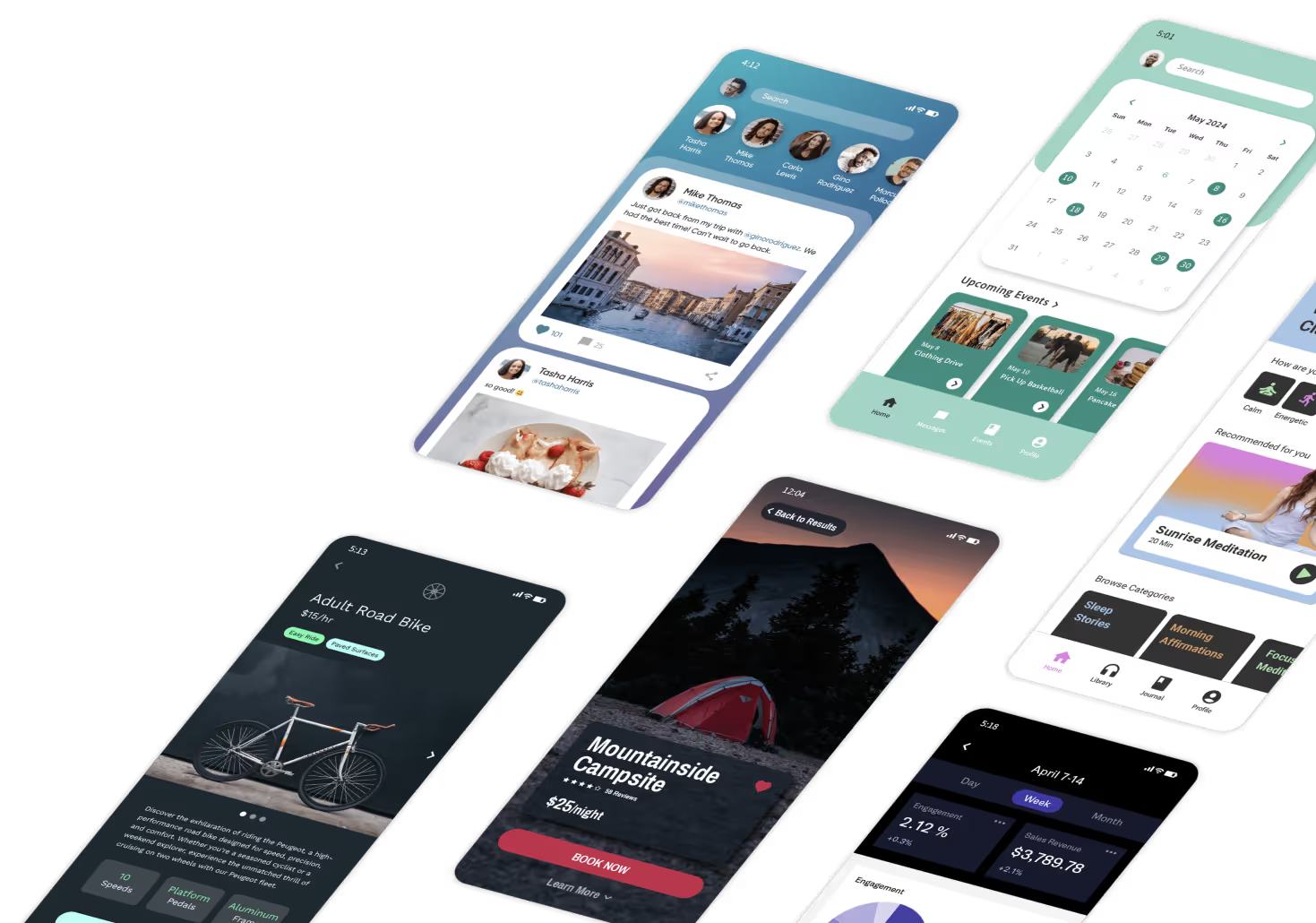
Building a Postmates-style delivery app means juggling three distinct user experiences—customers ordering food, restaurants fulfilling those orders, and drivers coordinating pickups and drop-offs in real time. Traditional development for this kind of multi-sided marketplace requires expertise across iOS, Android, and web platforms, typically demanding months of work and substantial budgets that put the on-demand delivery market out of reach for most entrepreneurs.
That's where Adalo comes in. Adalo is a no-code app builder for database-driven web apps and native iOS and Android apps—one version across all three platforms. AI-assisted building and streamlined publishing enable launch to the Apple App Store and Google Play in days rather than months. With visual design tools and a powerful database system, you can create user roles for customers, restaurants, and drivers, implement order tracking, and integrate payment processing—all without writing code.
Why Adalo Works for Building a Postmates Clone
Adalo is a no-code app builder for database-driven web apps and native iOS and Android apps—one version across all three platforms, published to the Apple App Store and Google Play. This makes it the perfect solution for creating a multi-sided food delivery marketplace where customers, restaurants, and drivers all need seamless access from their preferred devices.
App store distribution is essential for delivery apps—customers expect to find your service in their native app stores, while drivers need reliable push notifications to accept orders instantly. With Adalo, you can build a complete Postmates-style experience without juggling separate codebases or hiring specialized developers for each platform.
Building a food delivery app like Postmates requires coordinating multiple user types—customers browsing menus, restaurants managing orders, and drivers navigating pickups and drop-offs. Traditional development for this kind of multi-sided marketplace demands significant coding expertise across web and mobile platforms, often taking months and costing tens of thousands of dollars. For entrepreneurs and businesses eager to enter the on-demand delivery space, these barriers can feel insurmountable.
Ada, Adalo's AI builder, lets you describe what you want and generates your app. Magic Start creates complete app foundations from a description, while Magic Add adds features through natural language.
Adalo, an AI-powered app builder, removes these obstacles entirely. With a single codebase, you can create database-driven web apps and native iOS and Android apps—publishing directly to the Apple App Store and Google Play Store. Magic Start generates complete app foundations from simple descriptions, while Magic Add lets you build features by describing what you want in plain language. With Adalo's visual interface and powerful database tools, you can create a fully functional food delivery marketplace complete with user roles, order management, and payment processing—all without writing a single line of code.
Why Adalo Works for Building a Food Delivery Marketplace
Food delivery marketplaces demand native mobile experiences. Your customers expect to download from familiar app stores, and your drivers need instant push notifications for new delivery requests. Adalo delivers true native iOS and Android apps from a single build—not web wrappers that compromise performance under load.
App store distribution is critical for this use case. With Adalo, you build once and reach users across web, iOS, and Android without maintaining separate codebases. The platform's modular infrastructure scales to serve apps with millions of monthly active users, with no upper ceiling—essential when your delivery marketplace takes off and order volume spikes during dinner rush.
This comprehensive tutorial guides you through creating a Postmates-style marketplace using Adalo's AI-assisted platform. While some advanced features like live GPS tracking require external integrations, you'll build a functional multi-sided marketplace with restaurants, customers, and delivery drivers. The same app publishes to web, native iOS, and native Android—no rebuilding required.
Prerequisites and Initial Setup
Step 1: Create Your Adalo Account and App
- Visit Adalo.com and sign up
- Click "Create New App"
- Choose "Mobile App" (essential for location features)
- Name your app (e.g., "FoodDelivery")
- Select "Start from Scratch" or use Magic Start to generate your foundation
Pro tip: Magic Start can generate a complete app foundation from a description like "food delivery marketplace with restaurants, customers, and drivers." This creates your initial database structure, screens, and user flows automatically—what used to take days of planning happens in minutes.
Step 2: Configure App Foundation
- Choose primary colors (food-themed palette)
- Select clean, readable fonts
- Enable location services in app settings
- Click "Continue" to enter the editor
Step 3: Upgrade to a Paid Plan
- Navigate to Settings → Billing
- Choose a paid plan—publishing to app stores and Marketplace Payments require one. See Pricing
- Enables Stripe Marketplace Payments
- Paid plans include unlimited database records and unlimited usage—no bill shock from unexpected charges
Starting at $36/month, Adalo's paid plans include unlimited app store publishing updates and no data caps. Compare this to competitors like Bubble ($59/month with Workload usage charges and record limits) or Appypie ($99/month for comparable iOS publishing).
Setting Up the Database Architecture
Step 4: Enhance the Users Collection
- Click Database in left sidebar
- Select default "Users" collection
- Add these properties (click "+ Add Property"):
- Role (Text) - Values: "customer", "restaurant", "driver"
- Phone Number (Text)
- Profile Picture (Image)
- Current Location (Location)
- Is Active (True/False - default: true)
- Rating (Number - default: 5.0)
- Total Orders (Number - default: 0)
Learn about Users collection
Step 5: Create Restaurants Collection
- Click "+ Add Collection"
- Name it "Restaurants"
- Add properties:
- Restaurant Name (Text)
- Description (Text - check "Multiline")
- Cover Image (Image)
- Logo (Image)
- Address (Location property)
- Phone (Text)
- Cuisine Type (Text)
- Delivery Fee (Number)
- Minimum Order (Number)
- Estimated Delivery (Text - e.g., "30-45 min")
- Rating (Number - default: 5.0)
- Is Open (True/False - default: true)
- Opening Hours (Text)
Step 6: Create Menu Categories Collection
- Add new collection "Menu Categories"
- Add properties:
- Category Name (Text)
- Display Order (Number)
- Is Active (True/False - default: true)
Step 7: Create Menu Items Collection
- Add new collection "Menu Items"
- Add properties:
- Item Name (Text)
- Description (Text - multiline)
- Image (Image)
- Price (Number)
- Is Available (True/False - default: true)
- Preparation Time (Number - in minutes)
- Calories (Number)
- Is Popular (True/False - default: false)
Step 8: Create Orders Collection
- Add new collection "Orders"
- Add properties:
- Order Number (Text)
- Status (Text) - Values: "pending", "confirmed", "preparing", "ready", "picked_up", "delivered", "cancelled"
- Order Total (Number)
- Delivery Fee (Number)
- Tax Amount (Number)
- Final Total (Number)
- Created At (Date & Time - Automatic)
- Delivery Address (Location)
- Special Instructions (Text - multiline)
- Estimated Delivery (Date & Time)
- Payment Status (Text) - Values: "pending", "paid", "failed", "refunded"
Step 9: Create Order Items Collection
- Add new collection "Order Items"
- Add properties:
- Quantity (Number)
- Item Price (Number)
- Line Total (Number)
- Special Requests (Text)
Step 10: Set Up Database Relationships
- In Restaurants:
- Add "Owner" → Users (Many to One)
- Add "Menu Categories" → Menu Categories (One to Many)
- In Menu Categories:
- Add "Restaurant" → Restaurants (Many to One)
- Add "Menu Items" → Menu Items (One to Many)
- In Menu Items:
- Add "Category" → Menu Categories (Many to One)
- Add "Restaurant" → Restaurants (Many to One)
- In Orders:
- Add "Customer" → Users (Many to One)
- Add "Restaurant" → Restaurants (Many to One)
- Add "Driver" → Users (Many to One)
- Add "Order Items" → Order Items (One to Many)
- In Order Items:
- Add "Order" → Orders (Many to One)
- Add "Menu Item" → Menu Items (Many to One)
With proper relationship setups like these, Adalo apps can scale beyond 1 million monthly active users. The platform's 2026 infrastructure overhaul made apps 3-4x faster with no record limits on paid plans. Database relationship guide
Building the Customer Interface
Step 11: Create Home Screen with Restaurant Listings
- Add new screen "Home"
- Set as home screen for customers
- Add Location Permission component at top
- Add search bar (Text Input) with placeholder "Search restaurants..."
- Add Custom List for restaurants:
- Data: Restaurants
- Filter: Is Open = true
- Sort by: Distance (nearest first) or Rating
- For each restaurant card, display:
- Cover image, logo, name, cuisine type
- Rating, delivery time, delivery fee
- Distance from user location
Step 12: Add Location-Based Filtering
- In Restaurant list, add distance filter:
- Create distance formula between Restaurant→Address and User→Current Location
- Filter: Distance ≤ 10 miles (adjust as needed)
- Add location update action:
- Update User→Current Location on screen load
- Use the Location input for accuracy
See Comparing locations for distance filters.
Step 13: Build Restaurant Detail Screen
- Create new screen "Restaurant Detail"
- Link from restaurant list items
- Add restaurant header:
- Cover image (full width)
- Restaurant name, rating, delivery info
- Call restaurant button (phone number link)
- Add Custom List for Menu Categories:
- Filter: Restaurant = Current Restaurant
- Sort by Display Order
- For each category, add Menu Items list:
- Filter: Category = Current Category AND Is Available = true
- Show item name, description, price, image
Step 14: Create Menu Item Detail Screen
- Add new screen "Item Detail"
- Display full item information
- Add quantity selector:
- Number input (minimum: 1)
- + and - buttons for easy adjustment
- Add special instructions text area
- Add "Add to Cart" button:
- Creates Order Items record
- Calculates line total (quantity × price)
- Updates running cart total
Step 15: Build Shopping Cart Screen
- Create new screen "Cart"
- Add Custom List for current order items:
- Filter: Order→Customer = Logged In User AND Order→Status = "pending"
- Group by restaurant (if multiple restaurants)
- Display order summary:
- Subtotal, delivery fee, tax, final total
- Delivery address selector
- Add "Proceed to Checkout" button
Implementing the Ordering System
Step 16: Create Checkout Screen
- Add new screen "Checkout"
- Display order summary (read-only)
- Add delivery address section:
- Use saved addresses or location picker
- Add address validation
- Add payment method section:
- Connect to Stripe payment component
- Support credit cards and digital wallets
- Add "Place Order" button with comprehensive action:
- Update Order→Status to "confirmed"
- Process Stripe payment
- Send confirmation notifications
- Clear cart
- Navigate to Order Status screen
Step 17: Set Up Stripe Payments
- Navigate to Settings → Integrations → Stripe
- Add Stripe publishable and secret keys
- Configure Stripe Connect for marketplace:
- Enable automatic restaurant payouts
- Set a platform fee percentage as applicable
- Configure payout schedules
- Add payment processing to checkout:
- Amount = Order→Final Total
- Connected Account = Restaurant→Stripe Account ID
- Application Fee = Platform percentage
Step 18: Build Order Tracking Screen
- Create new screen "Order Status"
- Display order progress:
- Visual progress bar showing current status
- Estimated delivery time
- Driver information (when assigned)
- Add status updates:
- Use conditional visibility for each status
- Add a Timer to refresh while the screen is open (e.g., ~30s)
- Add contact buttons:
- Call restaurant
- Call driver (when assigned)
- Cancel order (if status allows)
Step 19: Create Order History Screen
- Add new screen "Order History"
- Add Custom List for past orders:
- Data: Orders
- Filter: Customer = Logged In User
- Sort by: Created At (newest first)
- For each order, show:
- Restaurant name and logo
- Order date and total
- Final status
- Reorder button for completed orders
Building the Restaurant Interface
Step 20: Create Restaurant Dashboard
- Add new screen "Restaurant Dashboard"
- Add role-based access control:
- Show only if User→Role = "restaurant"
- Redirect other roles to appropriate screens
- Display key metrics:
- Today's orders count
- Today's revenue
- Pending orders requiring attention
- Average order value
- Add quick action buttons:
- View pending orders
- Update menu
- Toggle restaurant open/closed status
Step 21: Build Incoming Orders Screen
- Create new screen "Incoming Orders"
- Add Custom List for new orders:
- Filter: Restaurant = Current User's Restaurant AND Status = "pending"
- Sort by: Created At (oldest first)
- For each order, display:
- Order number and customer name
- Order items and total
- Delivery address
- Special instructions
- Add action buttons:
- Accept Order (Status = "confirmed")
- Reject Order (Status = "cancelled")
- Estimated preparation time selector
Step 22: Create Order Management Screen
- Add new screen "Active Orders"
- Add Custom List for confirmed orders:
- Filter: Restaurant = Current User's Restaurant AND Status IN ["confirmed", "preparing", "ready"]
- Group by status for organization
- Add status update buttons:
- "Start Preparing" (confirmed → preparing)
- "Ready for Pickup" (preparing → ready)
- Mark as picked up when driver arrives
- Include order details and timing information
Step 23: Build Menu Management Interface
- Create new screen "Manage Menu"
- Add Custom List for Menu Categories:
- Filter: Restaurant = Current User's Restaurant
- Allow adding new categories
- For each category, add Menu Items management:
- Toggle item availability
- Edit prices and descriptions
- Add new items
- Upload/change item images
- Add bulk actions:
- Enable/disable entire categories
- Apply percentage price changes
Need to add a promotional feature? Use Magic Add to describe what you want: "Add a daily specials section that restaurants can update each morning." The AI generates the necessary database fields, screens, and logic.
Creating the Driver Interface
Step 24: Build Driver Dashboard
- Add new screen "Driver Dashboard"
- Add role-based access (User→Role = "driver")
- Display driver metrics:
- Today's deliveries completed
- Total earnings
- Average delivery time
- Current online/offline status
- Add toggle for availability:
- Update User→Is Active property
- Show available delivery requests when active
Step 25: Create Available Deliveries Screen
- Add new screen "Available Deliveries"
- Add Custom List for ready orders:
- Filter: Status = "ready" AND Driver = null
- Sort by: Distance from driver location
- For each delivery opportunity, show:
- Restaurant name and pickup address
- Delivery address and distance
- Estimated payout
- Order total and items count
- Add "Accept Delivery" button:
- Update Order→Driver = Current User
- Update Order→Status = "picked_up"
- Navigate to delivery details
Step 26: Build Active Delivery Screen
- Create new screen "Active Delivery"
- Display current delivery information:
- Customer and restaurant details
- Pickup and delivery addresses
- Order items and special instructions
- Add navigation integration:
- Deep link to Maps navigation for pickup
- Deep link to delivery address after pickup
- Add status updates:
- "Picked Up" button (ready → picked_up)
- "Delivered" button (picked_up → delivered)
- Photo proof of delivery option
Adding Advanced Features
Step 27: Implement Push Notifications
- Navigate to Settings → Push Notifications
- Upload notification certificates
- Configure notification triggers:
- New order for restaurants
- Order status updates for customers
- New delivery opportunities for drivers
- Delivery completion confirmations
- Add notification actions to relevant screens:
- Order confirmation → notify restaurant
- Status changes → notify customer
- Driver assignment → notify driver and customer
Step 28: Create Review and Rating System
- Add new collection "Reviews"
- Properties:
- Rating (Number 1-5)
- Review Text (Text - multiline)
- Created At (Date & Time)
- Add relationships:
- Reviewer → Users (Many to One)
- Restaurant → Restaurants (Many to One)
- Order → Orders (Many to One)
- Add review prompt after delivery:
- Show rating component
- Optional text review
- Update restaurant average rating
Step 29: Implement Search and Filters
- Add search functionality to home screen:
- Search restaurants by name
- Search menu items across restaurants
- Filter by cuisine type
- Add advanced filters:
- Price range ($ to $$$$)
- Delivery time
- Minimum rating
- Distance radius
- Add sorting options:
- Distance, rating, delivery time
- Price (low to high, high to low)
Step 30: Add Favorites and Reordering
- Create "User Favorites" collection:
- User → Users (Many to One)
- Restaurant → Restaurants (Many to One)
- Menu Item → Menu Items (Many to One)
- Add favorite buttons throughout app:
- Heart icons on restaurants and items
- Toggle favorite status
- Create "Favorites" screen showing saved items
- Add "Reorder" functionality:
- Copy previous order items to new cart
- Account for menu changes/availability
Handling Platform Considerations
Step 31: Real-Time Tracking Solutions
For live-like order tracking behavior:
- Use push notifications for instant status updates
- Implement manual check-ins:
- Driver updates location at key points
- Customer receives notifications at each milestone
- Integrate external tracking:
- Use Custom Actions with external APIs for continuous GPS
- Link to external tracking pages when needed
Step 32: Performance Optimization
Adalo 3.0's infrastructure overhaul (late 2025) made apps 3-4x faster than before. To maximize performance:
- Optimize database queries:
- Limit list items to 20-30 maximum per view
- Use pagination for long lists
- Pre-calculate totals and store as properties
- Image optimization:
- Enable auto-compression in settings
- Use external image URLs when possible
- Compress uploads before saving
- Use X-Ray to identify issues:
- X-Ray highlights performance bottlenecks before they affect users
- Addresses nested list complexity
- Optimizes conditional visibility usage
Step 33: Multi-Language Support
- Create separate app versions for each language
- Duplicate database structure
- Translate all static text and labels
- Consider using external translation APIs
Testing and Deployment
Step 34: Create Test Data
- Add sample restaurants with complete menus
- Create test user accounts for each role
- Process sample orders through full workflow
- Test payment processing with Stripe test cards
- Verify all notification triggers
Step 35: App Store Preparation
- Choose a paid plan as needed—see Pricing
- Configure store settings—see Publishing
- Create privacy policy and terms of service
- Prepare app store screenshots and descriptions
- Set up customer support system
Adalo handles the complex App Store submission process, including certificates, provisioning profiles, and store guidelines—often the hardest part of launching an app.
Step 36: Go-Live Checklist
- Switch Stripe to live mode
- Update notification certificates for production
- Test with real payment methods
- Verify location permissions on devices
- Monitor performance metrics
- Set up analytics tracking
Important Considerations
Platform Capabilities:
- True native iOS and Android apps from single codebase
- Unlimited database records on paid plans—no data caps
- Modular infrastructure scales to 1M+ MAU
- Push notifications for real-time updates
- Stripe Marketplace Payments for split payouts
Cost Structure:
- Plans start at $36/month with unlimited usage
- No usage-based charges or bill shock
- Unlimited app store publishing updates
- For detailed pricing, see the official Adalo Pricing page
Third-Party Integrations:
- Zapier: Workflow automation
- External database (via External Collections)
- SMS provider (via Custom Actions)
- Analytics provider (via Custom Actions)
Additional Resources
This Postmates-style marketplace covers browsing restaurants, menus, cart and checkout, order handoff to drivers, status tracking, notifications, and payouts using Adalo's native features and Marketplace components. For production, optimize lists and images, test on real devices, and leverage the platform's unlimited usage model to scale without worrying about overage charges.
FAQ
Why choose Adalo over other app building solutions?
Adalo is an AI-powered app builder that creates true native iOS and Android apps from a single codebase. Unlike web wrappers, it compiles to native code and publishes directly to both the Apple App Store and Google Play Store. With unlimited database records on paid plans and no usage-based charges, you avoid the bill shock common with competitors.
What's the fastest way to build and publish an app to the App Store?
Adalo's drag-and-drop interface combined with AI-assisted building through Magic Start and Magic Add lets you go from idea to published app in days. Describe your food delivery marketplace, and Magic Start generates your database structure, screens, and user flows. Adalo handles the complex App Store submission process automatically.
Can I build a food delivery marketplace app without coding?
Yes. Adalo provides all the tools needed to create a multi-sided marketplace with restaurants, customers, and delivery drivers—including database management, user authentication, Stripe payment processing, and push notifications—without writing any code.
How much does it cost to build a food delivery app with Adalo?
Adalo's paid plans start at $36/month with unlimited usage and unlimited database records. This includes app store publishing with unlimited updates. Compare this to Bubble at $59/month with Workload usage charges and record limits, or Appypie at $99/month for comparable iOS publishing.
Does Adalo support payment processing for marketplace apps?
Yes. Adalo integrates with Stripe Marketplace Payments, allowing you to process customer payments, automatically split funds between your platform and restaurants, and handle payouts to restaurant owners with configurable platform fees and payout schedules.
Can I add real-time GPS tracking for delivery drivers?
Adalo supports effective tracking through push notifications for instant status updates, manual driver check-ins at key delivery points, and deep links to Google Maps, Apple Maps, or Waze for navigation. For continuous GPS tracking, you can integrate external services via Custom Actions.
How do I handle multiple user roles in one app?
Adalo manages multiple user roles within a single Users collection by adding a 'Role' property. Use role-based access control and conditional visibility to show different screens and features to customers, restaurant owners, and delivery drivers based on their assigned role.
Can Adalo apps scale for a growing delivery business?
Yes. Adalo's modular infrastructure scales to serve apps with over 1 million monthly active users, with no upper ceiling. The 2026 infrastructure overhaul made apps 3-4x faster, and paid plans have no record limits—essential for handling order volume spikes during peak hours.
How long does it take to build a food delivery app?
With Adalo's visual builder and AI assistance, you can build a functional food delivery marketplace in days rather than months. Magic Start generates your app foundation from a description, and Magic Add lets you add features by describing what you want in plain language.
What integrations are available for extending my app?
Adalo supports Zapier for workflow automation, external databases via External Collections, SMS providers and analytics tools through Custom Actions, and native push notifications. SheetBridge also lets you turn a Google Sheet into an actual database for easy data management.