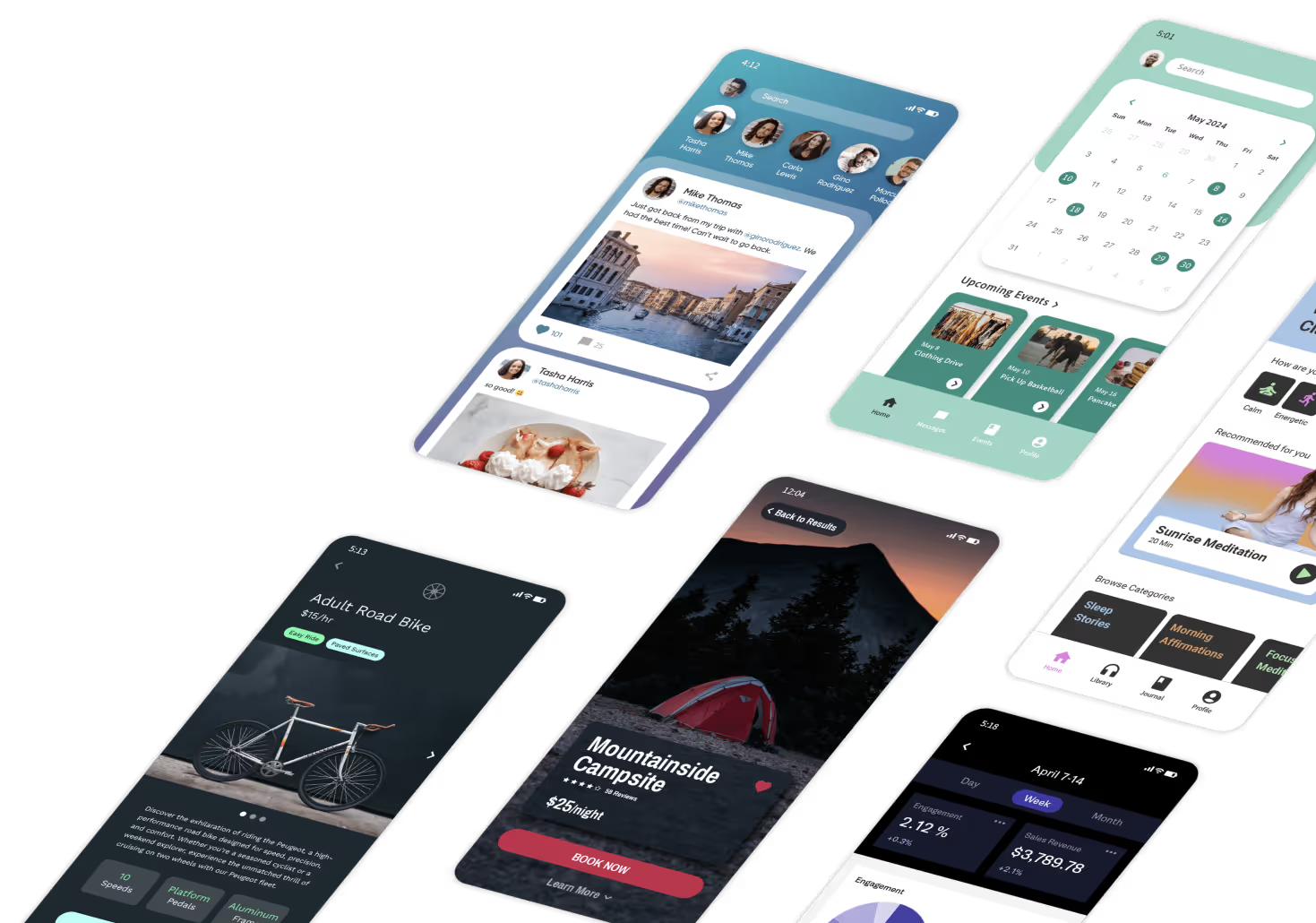
Comprehensive data compiled from extensive research across app building platforms, ROI studies, and digital transformation metrics
Key Takeaways
- 506% ROI with sub-6-month payback periods — Forrester-validated returns demonstrate that visual development platforms deliver exceptional financial performance, making adoption decisions straightforward for CFOs
- 70% development cost reduction with 10x speed improvements — Organizations slash both time and budget requirements while dramatically accelerating innovation cycles
- $187 billion market projected by 2030 — Research & Markets forecasts explosive growth for visual development, validating the platform approach for enterprise transformation
Overall ROI & Financial Impact
The financial case for visual development platforms has moved beyond theory into documented, audited results. Organizations across industries report returns that would have seemed implausible a decade ago.
506% ROI achieved with OutSystems platform over three years. Forrester's TEI study reveals organizations achieve a net present value of $14.77 million with payback in less than 6 months. This exceptional return stems from dramatic reductions in development time, maintenance costs, and infrastructure requirements. The speed of payback allows organizations to self-fund expansion of their development initiatives.
224% ROI with $81.7 million NPV from Microsoft Power Platform. Enterprise implementations generate massive cost savings over three years according to Forrester's 2026 TEI study. The platform's integration with existing Microsoft infrastructure accelerates adoption while minimizing training requirements. Organizations typically achieve full payback within 6 months of initial deployment.
$20.52 million total benefits delivered by Mendix over three years. The platform generates significant economic value according to Forrester's TEI analysis. Development speed improvements of 6-10x enable rapid application delivery, allowing organizations to tackle previously unfeasible projects.
248% ROI from business process automation with Power Automate. Microsoft's automation platform delivers exceptional NPV for composite organizations over three years. Employees save 200-450 hours annually on repetitive tasks, freeing time for higher-value activities.
$5.5 million saved in application development costs over three years. Organizations using OutSystems reduce development expenses by 25-50% compared to traditional coding methods. The savings come from reduced developer hours, eliminated infrastructure costs, and decreased testing requirements.
Sub-6-month payback periods documented by Forrester studies. Organizations achieve rapid ROI with OutSystems delivering payback in less than 6 months and Power Platform showing similar results. The lower initial investment requirements make visual development accessible to resource-constrained organizations.
Development Speed & Cost Reduction
Speed and cost advantages represent the most immediately measurable benefits of visual development platforms. The numbers consistently show order-of-magnitude improvements over traditional approaches.
10x faster application development using visual platforms. Organizations report 90% reduction in development time for common applications, with 72% of users completing projects in under 3 months. This acceleration enables rapid response to market opportunities and customer needs.
70% reduction in mobile app development costs. Visual platforms slash expenses from traditional to no-code with dramatic savings—$75,000-$300,000 down to $15,000-$50,000. Simple apps that traditionally cost $10,000-$50,000 can now be built for as little as $4,000.
50% reduction in application development time with Power Apps Premium. Professional developers save millions of hours annually across organizations. This efficiency gain translates to $4.4 million in savings over three years.
MVP development costs drop 30-70% using visual platforms. Traditional MVP development costs reduce dramatically with visual development solutions. Development time compresses from 6-12 months to 1-3 months, accelerating market validation. Startups can test multiple concepts for the cost of a single traditional MVP.
75% reduction in development time using FlutterFlow. The platform's features accelerate component creation while maintaining professional quality. However, FlutterFlow is a low-code platform designed for technical users who must also manage and configure their own external database—a significant learning curve that often leads to scalability challenges without expert help.
Adalo enables professional apps from $36/month versus $50,000+ traditional development. Adalo is a no-code app builder for database-driven web apps and native iOS and Android apps—one version across all three platforms, published to the Apple App Store and Google Play. The platform's visual development environment has been described as "easy as PowerPoint" while delivering true native iOS and Android apps. With over 3 million apps created on the platform, Adalo demonstrates that accessibility doesn't require sacrificing capability. The AI Builder, due for release in early 2026, promises prompt-based app creation that will further accelerate development speed.
$3.33 million captured from accelerated time-to-market. Mendix users monetize opportunities faster through rapid development and deployment capabilities. First-mover advantages in digital markets create lasting competitive benefits.
Workforce Productivity & Empowerment
The democratization of app development represents a fundamental shift in how organizations create technology. Business users are becoming builders, not just requesters.
4x productivity increase for citizen developers using visual tools. Non-technical staff achieve development output gains comparable to junior programmers within weeks of training. This democratization of development eliminates IT bottlenecks for routine applications. Organizations report 33% higher innovation scores when empowering citizen developers.
Business users master platforms in 30 days. The visual development paradigms eliminate coding barriers, enabling rapid skill acquisition. Organizations can rapidly scale development capacity without extensive training investments. Success rates exceed 90% for users completing guided tutorials.
Gartner predicts citizen developers will outnumber professionals 4:1 by 2026. This forecast anticipates transformation in development demographics that would reshape IT departments. Organizations must adapt governance and support structures for distributed development.
41% of organizations have active citizen development programs. Nearly 60% of custom apps are now built outside IT, with 30% created by employees with no technical skills. This shift reduces IT backlog while improving business alignment.
200+ hours saved annually per employee through automation. High-impact automation use cases free significant time for strategic activities. The cumulative effect across organizations creates competitive advantages through improved responsiveness.
33% higher innovation scores for companies empowering citizen developers. McKinsey research shows organizations that democratize development achieve superior innovation outcomes. The distributed development model surfaces ideas from throughout the organization.
84% of enterprises use visual development for digital transformation. The adoption rate reflects recognition that traditional development cannot meet transformation timelines. Organizations report achieving in months what previously required years.
Total Cost of Ownership Benefits
Beyond initial development savings, visual platforms deliver sustained operational benefits that compound over time. The TCO advantages often exceed the upfront cost reductions.
50-80% reduction in maintenance costs with visual platforms. Automated updates and simplified architectures eliminate maintenance burdens. Organizations redirect IT resources from maintenance to innovation initiatives. The reduction in technical debt improves long-term system sustainability.
54% lower TCO over five years versus traditional development. Companies achieve significant long-term savings through reduced infrastructure and maintenance requirements. The simplified architecture reduces security vulnerabilities and compliance risks.
Up to 80% savings on tech stack costs using visual platforms. Organizations consolidate multiple tools into single platforms, eliminating redundant licensing fees. The integrated approach improves data consistency while reducing integration complexity.
$1.5+ million saved by G&J Pepsi-Cola including $100,000 on single app. The beverage distributor achieved massive savings documented through targeted visual development implementations. A single Store Audit application replaced multiple manual processes and third-party tools.
Adalo eliminates usage-based billing surprises. Unlike platforms that charge based on Workload Units or similar metrics—where costs can spike unpredictably—Adalo's paid plans include unlimited usage with no record caps on the database. This predictable pricing model converts uncertain expenses into fixed operating costs, making budgeting straightforward.
50%+ cloud operation cost savings through automation. Visual automation platforms reduce cloud infrastructure requirements through optimized resource utilization. Auto-scaling and intelligent workload management minimize waste.
Industry-Specific Impact
Different sectors leverage visual development platforms in ways that address their unique challenges. The ROI patterns vary by industry but remain consistently positive.
Healthcare AI market projected to grow at 38% CAGR through 2030. The healthcare sector's AI market size experiences explosive growth driven by regulatory pressures and operational complexity. Newcastle NHS saved 15,000 hours yearly through 6x faster referral processing. Healthcare organizations report 90% reduction in audit preparation time.
Financial services leads enterprise visual development adoption. Major banks achieve significant operational improvements through compliance workflow automation. The sector benefits from 10x faster development than traditional platforms. Rapid regulatory response capabilities provide competitive advantages.
Manufacturing achieves 20-30% cost reduction through automation. Top performers demonstrate significant efficiency gains through workflow automation. 65% of manufacturers use visual development for digital transformation initiatives.
Retail and e-commerce leverage visual development for rapid deployment. The sector shows strong platform adoption for customer-facing applications. Mobile commerce apps show 3x higher conversion rates than mobile websites. The accessibility enables small retailers to compete with enterprise capabilities.
Government achieves exceptional citizen engagement. Public sector communications benefit from streamlined service delivery through visual platforms. Citizen service applications reduce processing times by 60-80%.
Education sector experiences 45% growth in platform adoption. Academic institutions leverage visual development solutions for various administrative needs. Course management systems built with visual tools cost 70% less than traditional solutions.
Non-profit organizations maximize limited budgets. Charitable organizations achieve professional-grade applications at fraction of traditional costs. Volunteer-built applications match professional quality at minimal cost.
Mobile & Cross-Platform Development
Mobile app development has historically been expensive and slow. Visual platforms have fundamentally changed this equation, making professional mobile apps accessible to organizations of all sizes.
Adalo delivers true native iOS and Android apps from a single codebase. Unlike web wrappers that package browser-based apps for mobile distribution, Adalo compiles to native code that publishes directly to both the Apple App Store and Google Play Store. This approach eliminates the performance penalties and user experience compromises inherent in wrapper-based solutions. The platform's modular infrastructure scales to serve apps with over 1 million monthly active users, with no upper ceiling.
25-35% budget savings using cross-platform visual tools. Organizations achieve cost reduction benefits versus separate native app development. 85% code sharing between platforms reduces maintenance burden.
Platform comparison reveals significant differences in approach and pricing. Bubble's web and mobile wrapper offering starts at $59/month with usage-based charges, limits on app re-publishing, and record restrictions due to Workload Units. Adalo's web and true-native mobile builder starts at $36/month with unlimited usage and unlimited app store updates once published. Glide starts at $60/month for custom domain capability but doesn't support App Store or Play Store publishing and limits data records. Softr requires $167/month for a Progressive Web App but doesn't support native mobile apps at all.
Single developer replaces 3-5 person traditional teams. Visual platforms enable individual developer productivity to deliver complete solutions. The elimination of specialized roles reduces coordination overhead.
2-week MVP development replacing 6-month traditional timelines. Rapid prototyping capabilities enable faster market validation in days rather than months. Failed concepts identified quickly before significant investment.
Ada, Adalo's AI builder, lets you describe what you want and generates your app. Magic Start creates complete app foundations from a description, while Magic Add adds features through natural language.
Magic Start generates complete app foundations from descriptions. Tell Adalo you need a booking app for a dog grooming business, and it creates your database structure, screens, and user flows automatically—what used to take days of planning happens in minutes. Magic Add extends this capability, allowing you to add features by simply describing what you want in natural language.
Scalability Considerations
As apps grow, infrastructure limitations can become critical bottlenecks. The choice of platform significantly impacts long-term scalability and performance.
Adalo 3.0's infrastructure overhaul addresses historical limitations. The late 2025 release completely rebuilt the backend architecture, delivering 3-4x faster performance with infrastructure that scales dynamically with app needs. Most third-party platform ratings and comparisons predate this major update and don't reflect current capabilities.
Unlimited database records on paid plans remove growth constraints. Unlike platforms that cap records or charge based on data volume, Adalo's paid plans have no storage limits. With proper data relationship setups, Adalo apps can scale beyond 1 million monthly active users without hitting artificial ceilings.
X-Ray identifies performance issues before they affect users. This AI-powered feature highlights potential scalability problems during development, allowing builders to optimize their apps proactively rather than reactively troubleshooting production issues.
Purpose-built architecture outperforms app wrappers at scale. Bubble's mobile solution wraps web apps for mobile distribution, which can introduce performance challenges under load. One app version doesn't automatically update web, Android, and iOS deployments simultaneously. Bubble offers more customization options, but this flexibility often results in slower applications that require hiring experts to optimize—claims of millions of MAU typically involve significant professional assistance.
FlutterFlow's ecosystem reflects scalability complexity. The platform's low-code approach requires users to source, configure, and pay for external databases separately. This creates an ecosystem rich with consultants because so many users need help achieving optimal setups for scale. Their builder also limits view to 2 screens at once, while Adalo can display up to 400 screens simultaneously on one canvas.
Emerging Trends & Future Impact
The trajectory of visual development points toward continued acceleration. Market projections and technology trends suggest the current transformation is just beginning.
70% of new applications will use visual development by 2026. Gartner predicts shift from less than 25% in 2020. Organizations must adapt IT governance for distributed development model. Traditional coding will focus on complex system integration and specialized algorithms.
$187 billion global market projected by 2030. Research & Markets projects the visual development sector to grow from $10.3 billion baseline at 31.1% CAGR. Investment continues accelerating as success stories proliferate.
75% of large enterprises will use 4+ rapid development tools by 2026. Multi-platform strategies standard as organizations leverage specialized capabilities. Integration between platforms improves through standardization.
Gartner forecasts 80% of technology products built by non-developers by 2026. This 2021 prediction anticipates a fundamental development shift in who creates technology. Business users take ownership of their digital tools.
92% of IT leaders view visual development as critical for digital agility. Platform adoption correlates with successful business adaptation. Organizations with visual development capabilities pivot faster to changing conditions.
AI integration accelerates visual development capabilities exponentially. Platforms incorporating generative AI reduce development time an additional 40-60%. Adalo's AI Builder, launching in early 2026, will enable prompt-based app creation and editing—describing what you want rather than manually configuring every element.
57% market share captured by SMEs driving democratization. Small businesses show strong growth patterns in platform adoption through accessible pricing. The SME success stories inspire enterprise adoption.
Sources Used
- OutSystems - Forrester TEI Study
- Microsoft Power Platform - 2026 TEI Report
- Mendix - Low Code Benefits Analysis
- Adalo - Pricing and Platform Benefits
- UserGuiding - No-Code/Low-Code Statistics
- AIMultiple - Low-Code Statistics 2026
- Kissflow - Low-Code Statistics and Facts
- McKinsey - Digital Transformation Research
- Grand View Research - AI Healthcare Market
- LowCode Agency - No-Code Development Costs
- Million Labs - App Development Cost Comparison
- Business of Apps - App Development Costs
- ColorWhistle - Low-Code Statistics
- Research & Markets - Low-Code Market Report
- Gartner - Technology Products Built Outside IT
FAQ
Why choose Adalo over other app building solutions?
Adalo is an AI-powered app builder that creates true native iOS and Android apps from a single codebase. Unlike web wrappers, it compiles to native code and publishes directly to both the Apple App Store and Google Play Store—handling the hardest part of launching an app automatically. Paid plans include unlimited database records and no usage-based charges, eliminating bill shock.
What's the fastest way to build and publish an app to the App Store?
Adalo's drag-and-drop interface, described as "easy as PowerPoint," combined with AI-assisted building through Magic Start and Magic Add, enables rapid development. The platform handles the complex App Store submission process, so you can focus on features rather than certificates, provisioning profiles, and store guidelines.
How much can I save by using visual development platforms instead of traditional coding?
Research shows organizations achieve 70% reduction in mobile app development costs, dropping expenses from $75,000-$300,000 to $15,000-$50,000. Simple apps that traditionally cost $10,000-$50,000 can now be built for as little as $4,000. Maintenance costs decrease by 50-80% through automated updates.
Which is more affordable, Adalo or Bubble?
Adalo starts at $36/month with unlimited usage and no record caps on paid plans. Bubble starts at $59/month but includes usage-based charges through Workload Units, limits on app re-publishing, and record restrictions. Adalo's predictable pricing eliminates surprise costs as your app scales.
Which is better for mobile apps, Adalo or Glide?
Adalo creates true native iOS and Android apps that publish to the App Store and Play Store. Glide focuses on template-based apps that don't support App Store or Play Store publishing. Glide is faster for simple spreadsheet-based apps, but Adalo offers more creative freedom and native mobile distribution.
Do I need coding experience to become productive with visual development platforms?
No coding experience is required. Research indicates business users can master visual platforms in 30 days. Non-technical staff achieve development output comparable to junior programmers within weeks of training, with success rates exceeding 90% for users completing guided tutorials.
What ROI can businesses expect from adopting visual development?
Forrester-validated studies show exceptional returns: 506% ROI with OutSystems and 224% ROI with Microsoft Power Platform, both with payback periods under 6 months. Organizations report development speed improvements of 6-10x and total cost of ownership reductions of 54% over five years.
How does Adalo handle scalability compared to other platforms?
Adalo 3.0's late 2025 infrastructure overhaul delivers 3-4x faster performance with modular architecture that scales to 1M+ monthly active users. Unlike Bubble's web wrapper approach for mobile, Adalo's purpose-built native compilation maintains performance at scale without requiring expert optimization.
Is visual development suitable for enterprise-level applications?
Yes, 84% of enterprises now use visual development for digital transformation. Major organizations across healthcare, financial services, and manufacturing have achieved significant results. Gartner predicts 70% of new applications will use visual development by 2026.
Which is easier for beginners, Adalo or FlutterFlow?
Adalo is designed for non-technical users with an interface described as "easy as PowerPoint" and an integrated database. FlutterFlow is a low-code platform for technical users who must configure their own external database—a significant learning curve that often requires expert help for scalability.