Why Adalo Works for Legacy System Modernization
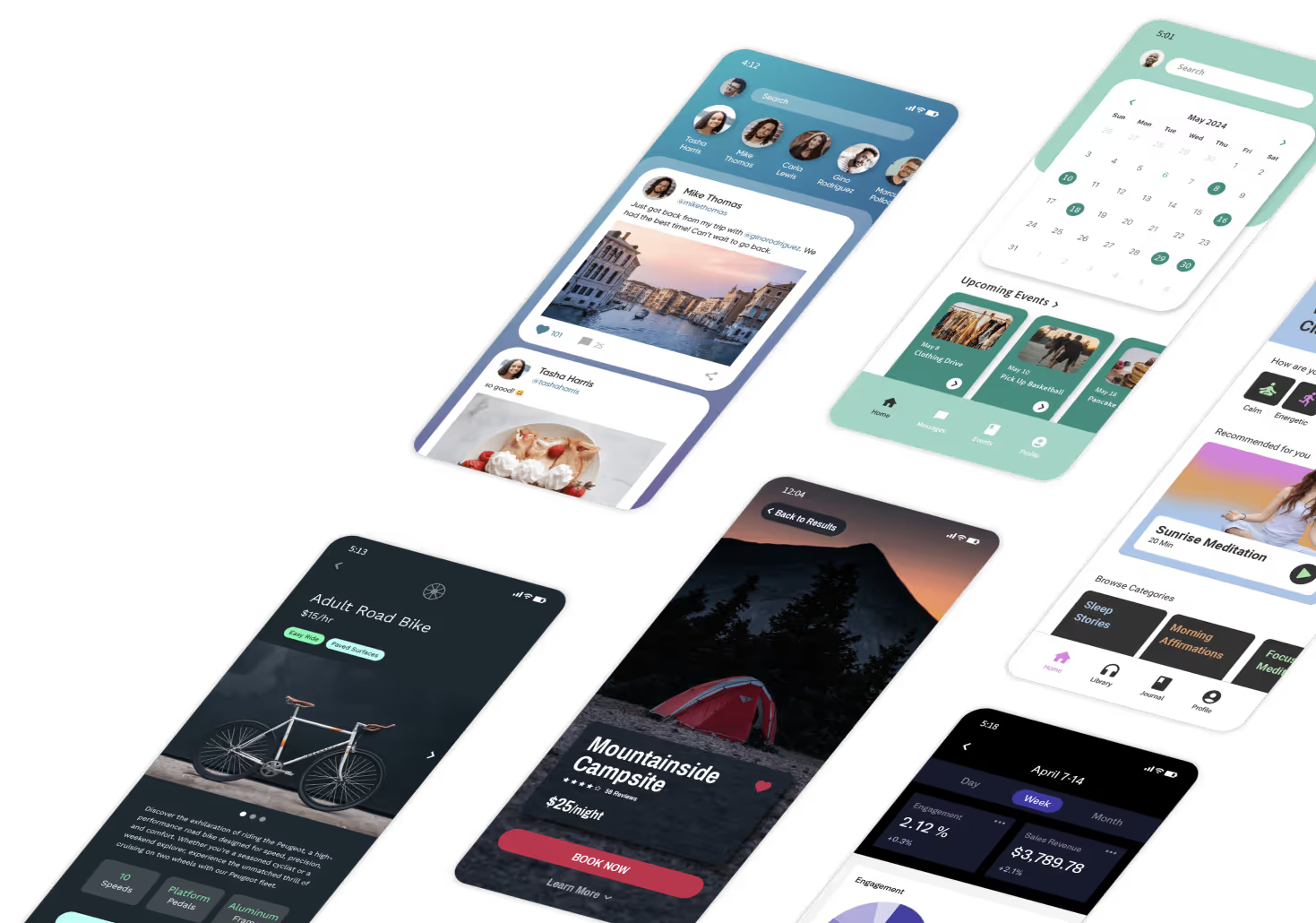
Adalo is a no-code app builder for database-driven web apps and native iOS and Android apps—one version across all three platforms, published to the Apple App Store and Google Play. This unified approach directly addresses one of legacy modernization's biggest challenges: eliminating the fragmented development cycles that keep outdated systems running far longer than they should.
When modernizing legacy infrastructure, you need a platform that handles enterprise-scale data while delivering apps across every channel your users expect. Adalo's AI-powered visual development environment transforms complex database migrations into streamlined workflows, while native push notifications keep stakeholders engaged throughout the transition. With no record limits on paid plans and infrastructure built to scale to millions of monthly active users, you can confidently replace aging systems without sacrificing the data capacity your organization depends on.
Every outdated system drains resources from your organization while competitors race ahead with modern applications. With the average business spending $2.9 million on legacy technology upgrades and U.S. federal agencies consuming up to 80% of IT budgets on maintenance, the path to modernization through AI-powered app builders offers 90% faster development—transforming months of coding into weeks of visual development.
Why Adalo Works for Legacy System Modernization
Adalo is an AI-powered app builder that creates database-driven web apps and native iOS and Android apps from a single codebase. One build publishes to web, the Apple App Store, and Google Play Store—eliminating the fragmented development that plagues legacy modernization projects. With no record limits on paid plans and infrastructure that scales to millions of monthly active users, Adalo handles the enterprise data volumes that legacy systems currently manage.
Key Takeaways
- Organizations achieve 90% faster development cycles with AI-powered app builders compared to traditional coding
- 70% of new enterprise applications will use no-code/low-code technologies by 2026
- Mazda achieved 4x developer productivity improvements migrating 500 legacy systems
The Hidden Revenue Drain in Your Legacy Infrastructure
Your legacy systems aren't just outdated—they're hemorrhaging money at an unprecedented rate. The cost to address technical debt in the United States has reached $1.52 trillion, with the average business spending $2.9 million on legacy technology upgrades in 2026. When you consider that 95% of ATM transactions still run on COBOL with 220 billion lines of COBOL code remaining in production, the scale of the crisis becomes clear.
The math is devastating: if your organization maintains even a handful of legacy applications, you're likely burning through millions in maintenance costs alone. U.S. federal agencies spend up to 80% of their IT budgets on operations and maintenance of aging systems, revealing the crushing weight of technical debt on large organizations.
Why Legacy Systems Fail Modern Enterprises
The root cause isn't incompetent IT teams—it's structural obsolescence. Your legacy infrastructure simultaneously manages:
- Mission-critical business processes and data
- Regulatory compliance and audit requirements
- Integration with dozens of modern systems
- Security protocols for increasingly sophisticated threats
- User expectations for mobile and cloud capabilities
- Plus maintaining uptime with decades-old technology
Studies show 91% of employees report frustration with workplace technology, with UK workers wasting over three hours daily due to inefficient systems. When your development team faces a 58-year-old average COBOL programmer age with 10% retiring annually, they confront an impossible choice: pay premium rates for scarce expertise or watch systems deteriorate.
The talent crisis compounds security challenges. Legacy platforms no longer receive patches or updates, leaving organizations vulnerable. Even if you wanted to hire additional help, nearly 50% of organizations report difficulty finding skilled legacy developers, with 84,000 unfilled mainframe positions projected.
Peak Failure Points Create Perfect Storm Conditions
Legacy system failures follow predictable patterns throughout operations:
Mission-Critical Processing (24/7): Systems built for batch processing struggle with real-time demands, creating bottlenecks precisely when business needs peak performance.
Integration Points (Constant): Each new system connection increases fragility, with legacy APIs unable to handle modern data volumes or formats.
Compliance Updates: Healthcare organizations face $7.42 million average breach costs according to IBM's 2026 report, the highest across industries, yet legacy systems can't implement modern security requirements.
Traditional Solutions No Longer Work
The Talent Acquisition Trap
Hiring legacy experts seems logical until you calculate true costs. Beyond astronomical salaries for COBOL developers, you'll pay training time, retention bonuses, and knowledge transfer expenses. Total cost easily exceeds $250,000 annually per developer—assuming you can find qualified candidates in today's market.
Replatforming Limitations
Digital transformation programs carry significant failure rates, with McKinsey reporting that 70% of digital transformation efforts fail to achieve their goals. Organizations spend millions on consultants, new infrastructure, and parallel operations only to discover critical business logic buried in undocumented code. The disruption often proves fatal to operations.
The Technical Debt Spiral
McKinsey research reveals technical debt amounts to 20-40% of technology estate values. Companies in the bottom 20th percentile for technical debt scores are 40% more likely to experience failed modernizations, creating a vicious cycle where outdated infrastructure prevents successful transformation.
Technology Solutions That Actually Work
AI-Powered App Builders: Your Modernization Accelerator
AI-powered app builders have transformed how successful enterprises approach legacy modernization. These systems deliver capabilities impossible with traditional development:
- 90% faster development cycles - Weeks instead of years for complex applications
- Significant cost reductions - Eliminate expensive coding resources and infrastructure
- 70% enterprise adoption by 2026 - Gartner predicts majority usage across organizations
- $264.40 billion market by 2032 - Growing from $28.75 billion in 2026
The transformation is immediate and measurable. Organizations report 10x faster application delivery with business users creating solutions directly.
Enterprise-Grade Capabilities Without Code
Modern AI-assisted platforms provide comprehensive development environments including:
- Visual development interfaces - Drag-drop builders with 50-75 pre-built components
- API-first architectures - REST, SOAP, GraphQL integration capabilities
- Database connectivity - SQL, NoSQL, cloud-native storage with real-time sync
- Workflow automation - Complex business process management and RPA integration
Pricing varies significantly across platforms. Adalo starts at $36/month with unlimited usage and no record caps. Bubble begins at $59/month but includes usage-based charges through Workload Units and record limits that can create unpredictable costs. Enterprise platforms like Appian, Mendix, and OutSystems typically use quote-based pricing that scales with users and usage requirements.
Real-World Success Stories
Mazda's Manufacturing Transformation
Mazda Motor Corporation faced 500 legacy systems requiring Java framework migration by 2026. Implementation results:
- 4x developer productivity increase
- 70% faster deployment cycles
- 2 weeks training vs. months for traditional coding
- Mobile-first applications across operations
Government Agency Success
UK Crown Prosecution Service transformed from zero capability to:
- 30+ applications built in 6 years
- 4-month average development per application
- Citizen developer team grew from 2 to 16
- Complete legacy system replacement
Enterprise-Scale Migration
Maeda Corporation migrated 1,000 Lotus Notes databases resulting in:
- 200+ modern web applications in 2 years
- Unlocked trapped corporate data
- 5x improvement in user satisfaction
- Zero downtime during transition
Financial Services Modernization
Mendix reports financial institutions achieving:
- 83% reduction in development time
- Dozens of legacy workflows modernized
- Cloud-based infrastructure with mobile access
- Superior user experience across operations
Implementation Roadmap
Week 1: Assessment and Planning
- Document current legacy system dependencies
- Calculate total cost of ownership including hidden expenses
- Identify high-value modernization targets
- Verify platform compatibility with existing infrastructure
Week 2-3: Platform Selection
- Evaluate platforms against requirements (Adalo, OutSystems, Mendix)
- Test integration with existing systems
- Validate security and compliance capabilities
- Create proof-of-concept application
Week 4-6: Migration Strategy
- Implement Strangler Fig pattern for gradual replacement
- Design data migration pipelines using ETL tools
- Configure API connections and middleware
- Establish parallel operation procedures
Week 7-12: Full Deployment
- Launch pilot applications with limited users
- Monitor performance and gather feedback
- Scale successful implementations organization-wide
- Decommission legacy components systematically
Why Adalo Stands Apart for Legacy Modernization
While multiple options exist, Adalo delivers unique advantages specifically designed for enterprises transitioning from legacy systems to modern mobile and web applications.
Adalo 3.0, launched in late 2025, completely overhauled the backend infrastructure. The platform is now 3-4x faster with modular infrastructure that scales to serve apps with millions of monthly active users. Unlike app wrappers that hit performance constraints under load, Adalo's purpose-built architecture maintains speed at scale.
Ada, Adalo's AI builder, lets you describe what you want and generates your app. Magic Start creates complete app foundations from a description, while Magic Add adds features through natural language.
The platform's enterprise modernization capabilities include:
- External Collections API: Connectivity to Oracle, SAP, COBOL systems via REST APIs
- Legacy Data Migration: CSV import handling up to 10,000 records per batch with referential integrity
- Mobile-First Architecture: Native iOS and Android app publishing for workforce modernization
- DreamFactory Integration: Connects with any API or services without an API (such as AS400s and proprietary ERPs)
- Magic Start: Generates complete app foundations from descriptions—tell it you need a field service app for equipment maintenance, and it creates your database structure, screens, and user flows automatically
- X-Ray: Identifies performance issues before they affect users, critical for enterprise deployments
Adalo's agnostic builder lets you publish the same app to web, native iOS, and native Android—all without writing code or rebuilding. That's perfect for diverse teams using every device type. Over 3 million apps have been created on the platform, with the visual builder described as "easy as PowerPoint."
For organizations serious about escaping legacy constraints, Adalo's pricing starts at $36 monthly with unlimited usage and no database caps. Compare this to Bubble's $59/month starting price with Workload Units that create unpredictable billing, or FlutterFlow's $70/month per user that still doesn't include a database—you'll need to source, setup, and pay for that separately. Success stories like Covenant Connect's school system modernization demonstrate the platform's ability to transform legacy operations while maintaining enterprise-grade security.
How Adalo Compares to Alternatives
Bubble offers more customization options but that flexibility often results in slower applications that suffer under increased load. Bubble's mobile solution is a wrapper for the web app, introducing potential challenges at scale—and one app version doesn't automatically update web, Android, and iOS deployments. Claims of millions of MAU typically require hiring experts to optimize performance. Most third-party comparisons predate Adalo 3.0's infrastructure overhaul.
FlutterFlow is low-code rather than no-code, designed for technical users. Users must manage and setup their own unrelated database, which requires significant learning complexity. Anything less than optimal setup creates scale problems—this ecosystem is rich with experts because so many people need help and end up spending significant sums chasing scalability. Their builder is also limited in view, whereas Adalo can display up to 400 screens at once on one canvas.
Glide is heavily format-focused and restricted to set templates. This makes it fast to build with but creates generic, simplistic apps with limited creative freedom. Glide doesn't support Apple App Store or Google Play Store publishing, and pricing starts at $60/month with limits on app updates and data rows that attract additional charges.
Industry Benchmarks Reveal the Opportunity
AI-powered app builder metrics highlight the gap between legacy system performance and modern capabilities:
- Development speed: 10x faster than traditional coding
- Maintenance costs: 70% reduction versus legacy systems
- User adoption: 87% of developers use low-code platforms
- Accelerated time to market compared to traditional development approaches
When organizations achieve these benchmarks through AI-assisted development, revenue improvements follow predictably.
FAQ
Why choose Adalo over other app building solutions?
Adalo is an AI-powered app builder that creates true native iOS and Android apps alongside web apps from a single codebase. Unlike web wrappers, it compiles to native code and publishes directly to both the Apple App Store and Google Play Store. With unlimited database records on paid plans and infrastructure that scales to millions of MAU, Adalo handles enterprise data volumes without the usage-based charges or record limits found on competing platforms.
What's the fastest way to build and publish an app to the App Store?
Adalo's drag-and-drop interface and AI-assisted building let you go from idea to published app in days rather than months. Magic Start generates complete app foundations from descriptions, and the platform handles the complex App Store submission process—certificates, provisioning profiles, and store guidelines—so you can focus on features and user experience.
Can Adalo connect to my existing legacy databases and systems?
Yes, Adalo provides robust connectivity options for legacy infrastructure. The External Collections API enables connections to Oracle, SAP, and COBOL systems via REST APIs, while DreamFactory integration connects with any API or services without an API, including AS400s and proprietary ERPs. CSV import handles up to 10,000 records per batch with referential integrity for legacy data migration.
How much can AI-powered app builders reduce legacy system modernization costs?
Organizations report 70% reduction in maintenance costs versus legacy systems. Considering the average business spent $2.9 million on legacy technology upgrades in 2026, and development cycles are 90% faster with AI-assisted platforms, the savings are substantial. Adalo starts at $36/month with unlimited usage, making enterprise-grade modernization accessible without massive infrastructure investments.
Which is more affordable, Adalo or Bubble?
Adalo starts at $36/month with unlimited usage and no database record caps. Bubble starts at $59/month but includes Workload Units that create usage-based charges, plus limits on records and app re-publishing. For predictable costs and native mobile apps, Adalo offers better value.
Which is easier for beginners, Adalo or FlutterFlow?
Adalo is significantly easier for beginners. FlutterFlow is low-code designed for technical users who must also source, setup, and pay for their own database separately. Adalo's visual builder has been described as "easy as PowerPoint," includes an integrated database, and can display up to 400 screens at once for easier navigation of complex projects.
Is Adalo better than Glide for mobile apps?
Yes, for true mobile apps. Glide doesn't support Apple App Store or Google Play Store publishing—it creates web apps only. Adalo builds native iOS and Android apps that publish directly to both app stores from a single codebase, with unlimited database records and no usage-based charges on paid plans.
How long does it typically take to modernize a legacy system with Adalo?
Applications built with Adalo typically launch within 3 months using pre-built templates and Magic Start's AI-generated foundations. The platform's visual development interface enables 10x faster application delivery compared to traditional coding. Real-world examples show organizations averaging 4 months per application while building 30+ applications over 6 years.
Can I migrate from Bubble to Adalo?
Yes, you can migrate from Bubble to Adalo. While direct data export varies by complexity, Adalo's CSV import handles up to 10,000 records per batch with referential integrity. The bigger advantage is architectural: Adalo creates true native mobile apps rather than web wrappers, with no usage-based charges or record limits to worry about as you scale.