Adalo: A Powerful Glide Alternative
Want an app builder that offers more customization freedom and lets you build your database as you go? Adalo provides a compelling alternative with significant advantages for mobile app creators.
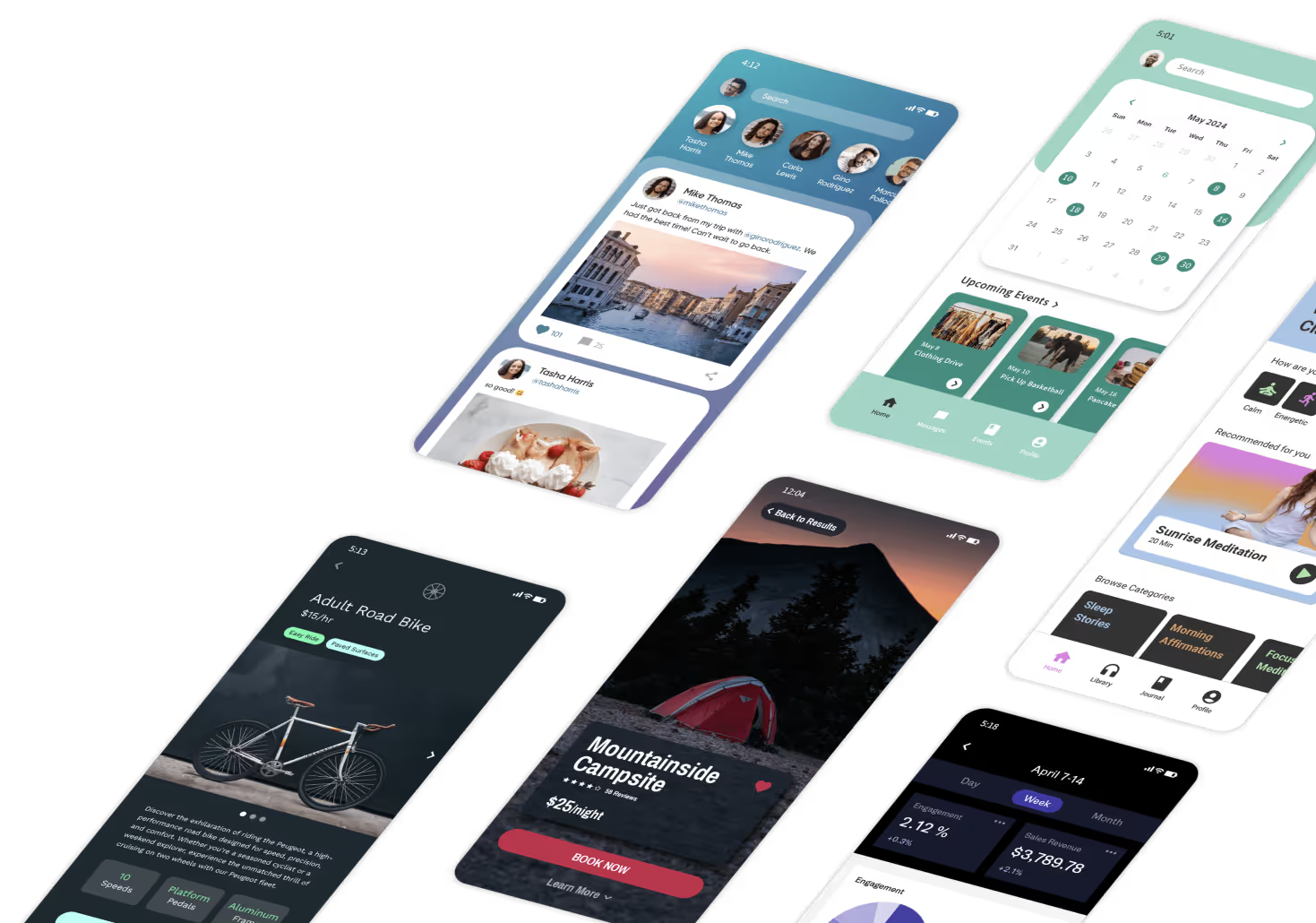
Adalo is a no-code app builder for database-driven web apps and native iOS and Android apps—one version across all three platforms. AI-assisted building and streamlined publishing enable launch to the Apple App Store and Google Play in days rather than months. Adalo has been described as "easy as PowerPoint" for visual building. Like Glide, you can start by choosing a template. Unlike Glide, you won't need to create your database first. You can build your screens and then put together your database. Or, integrate a database from Google Sheets using Adalo's Sheetbridge feature—which turns a Google Sheet into an actual database for the easiest control without database-related learning curves.
You'll also have extensive design freedom when building your app. Change the fonts, position, size of images, text boxes, and more to suit your taste—addressing the common complaints Glide users have about restricted design capabilities.
True Native Mobile Apps
Once you've finished building your app, publish it on the web, the Apple App Store, and the Google Play Store. This option allows you to market your app to web users and the billions of daily app store users. Unlike Glide, Adalo is specifically designed to create native mobile and web apps, so you won't need third-party conversion services.
AI-Assisted Building
Ada, Adalo's AI builder, lets you describe what you want and generates your app. Magic Start creates complete app foundations from a description, while Magic Add adds features through natural language.
Adalo's AI features streamline the building process. Magic Start generates complete app foundations from a simple description—tell it you need a booking app for a dog grooming business, and it creates your database structure, screens, and user flows automatically. Magic Add lets you add features by describing what you want in natural language. X-Ray identifies performance issues before they affect users, helping you build apps that scale smoothly.
Scalability Without Limits
Adalo 3.0, launched in late 2025, completely overhauled the backend infrastructure. The platform is now 3-4x faster with modular infrastructure that scales to serve apps with over 1 million monthly active users—with no upper ceiling. Paid plans include no record limit cap on the database, meaning unlimited database records as your app grows. App Actions, the previous usage-based charges, have been removed from all plans, so there's no bill shock from unexpected usage fees.
More Affordable Pricing
Adalo starts at $36/month with a second pricing tier at $52/month—significantly more affordable than Glide's $60/month entry point for comparable features. And unlike Glide, Adalo's paid plans include unlimited usage and app store publishing with unlimited updates to apps once published.
Over 3 million apps have been created on Adalo, with the visual builder making app creation accessible to non-technical users while the AI features promise even faster creation speeds. For those who need true native mobile apps with design flexibility and predictable pricing, Adalo delivers where Glide falls short. Start building with Adalo today for free.
What Is Glide?
Glide is an app-building platform best suited for organizations like app-building agencies and businesses that need to quickly transform spreadsheet data into functional web applications. However, Glide also offers a pricing tier suitable for individuals and entrepreneurs looking to create simple internal tools.
While Glide excels at spreadsheet-based app building, it's not the only option worth considering. Adalo, an AI-powered app builder for database-driven web apps and native iOS and Android apps, offers a compelling alternative for those who need true native mobile apps alongside their web presence—one version across all three platforms, published directly to the Apple App Store and Google Play.
No matter whether you're a business or an individual, you'll get the following features when you build your web app with Glide:
- Polished templates and features: When it comes to aesthetics, Glide delivers clean, professional designs. All the templates you have to choose from are visually appealing—they'll let you create an attention-grabbing app with minimal design effort.
- Database-first building approach: Glide appeals to organizations and businesses with existing data. You must start building your app's screens by connecting a pre-existing database. It integrates with popular database providers like Google Sheets, Airtable, Excel, and PostgreSQL.
- AI-powered data tools: Glide includes AI capabilities for organizing data, recognizing images, and summarizing documents. These features can add utility to internal business applications.
Glide's Pricing Tiers: How Much Do They Cost?
Most of Glide's pricing tiers are designed for businesses and organizations. But if you're a freelancer, entrepreneur, or individual, Glide has options available. Here are Glide's 5 pricing models:
Tier 1: Free Plan
Glide's free version gives you enough power to learn the building interface. If you have your data on Google Sheets, you can easily upload it to your Glide account. You'll also be able to access up to 3 third-party integrations from which to connect and draw data.
For instance, you can use Glide's Twilio integration to send text messages straight from your app. When you finish building your app, you can publish it on the web. These features make Glide's free version suitable for testing basic concepts.
Tier 2: Maker Plan for Individuals, $60/month (Billed Monthly)
When it's time to take your app beyond testing, Glide's Maker Plan offers 5 GB of storage (the free version gives you only 500 MB) to create your web app. You'll also get access to all of Glide's third-party integrations.
The Maker Plan also comes with Glide's AI tool for picture recognition, document analysis, and more. When you publish your app, you'll be able to use your custom domain name. However, this tier still limits app updates and data record rows, which can attract additional charges as your app grows.
Tier 3: Team Plan for Companies, $125/month (Billed Monthly)
The Team Plan is the entry-level pricing tier for companies looking to make apps. It allows unlimited published apps, provides 100 GB of storage space, and lets you work on your apps in real time with up to 5 editors.
You'll also get some database-centric features with the Team Version. For instance, you can integrate with Airtable, Google Sheets, and Excel for seamless database building. Additionally, you'll get the Glide API, which lets you add, update, and delete data programmatically.
Tier 4: Business Plan for Companies, $310/month (Billed Monthly)
Starting with all the features of the Team Version, the Business Version is geared toward larger organizations. You'll be able to allow 10 people to edit and build apps in real-time, and you'll get additional database integrations with MySQL, PostgreSQL, and Google Cloud SQL.
The Business Plan gives you 500 GB of data, access to Glide's advanced API to pull data from your database, and a call API to gather data from any permitted source. You'll also receive priority support to help resolve issues faster.
Tier 5: Enterprise Plan for Companies, $750/month (Billed Monthly)
Glide's Enterprise Version starts at $750/month, with pricing dependent on how much space and power your apps consume. This plan is targeted directly at large app-building agencies, as it allows for an unlimited number of editors.
You can negotiate a service-level agreement with Glide to customize your terms. Glide will provide a dedicated account manager who will respond to problems and get to know your business needs.
Is Glide Worth It?
Many people use Glide to create internal business tools, such as CRM boards, project management apps, inventory trackers, and similar applications. Glide appeals to these businesses because they likely already have a database, so connecting it to Glide is straightforward.
Although Glide has one of the most straightforward building interfaces and produces apps with clean aesthetics, some plans require a database before building. This means you'll need to build a database if you don't already have one—adding complexity before you can even start designing screens.
Not Made for Native Mobile Apps
Many people want to create an app that can be released to the Apple App Store and Google Play Store. Glide doesn't support this—you'll need to use a third-party service like Nativator. And your app's quality might not match expectations after using such a conversion service, since these wrappers can introduce performance issues and lack the responsiveness of true native apps.
Limited Customization
Glide is heavily format-focused and restricted to set templates. While this makes it fast to build and publish, it creates generic, simplistic apps with limited creative freedom. You won't be able to customize certain features you add to your screens. Users have complained about this drawback on public forums.
Some Glide users have also noted a specific lack of design features. Glide's building interface lacks specific font styles, text overlays like shadowing, and other design elements, which limits how precisely you can control your app's appearance.
High Cost and Rigid Pricing Tiers
Another major issue is that Glide's pricing is on the high side. To publish a serious app with a custom domain, you must pay at least $60/month (billed monthly)—and you're still limited by app updates and data record rows that can incur additional charges.
Glide's pricing tiers present another challenge. If you need slightly more power or storage space than the $60/month tier offers, you must upgrade to the $125/month version—more than double the price of the first tier with no intermediate option.
FAQ
Why choose Adalo over other app building solutions?
Adalo is an AI-powered app builder that creates true native iOS and Android apps. Unlike web wrappers, it compiles to native code and publishes directly to both the Apple App Store and Google Play Store from a single codebase—the hardest part of launching an app handled automatically. With unlimited database records on paid plans and no usage-based charges, you get predictable costs as your app scales.
What's the fastest way to build and publish an app to the App Store?
Adalo's drag-and-drop interface and AI-assisted building let you go from idea to published app in days rather than months. Magic Start generates complete app foundations from a description, and Adalo handles the complex App Store submission process—so you can focus on features instead of wrestling with certificates and store guidelines.
Which is more affordable, Adalo or Glide?
Adalo starts at $36/month compared to Glide's $60/month for their Maker Plan. Adalo also offers a second tier at $52/month, providing more flexible options. Additionally, Adalo's paid plans include unlimited usage and app updates, while Glide's tiers still limit app updates and data rows with potential additional charges.
Which is faster to build with, Adalo or Glide?
Both platforms offer quick building experiences, but Adalo's AI features like Magic Start and Magic Add can significantly speed up development. Glide's template-based approach is fast for simple spreadsheet apps, while Adalo provides more flexibility without sacrificing speed—especially for apps that need custom designs or native mobile publishing.
Which is easier for beginners, Adalo or Glide?
Both platforms are designed for non-technical users. Glide's spreadsheet-first approach works well if you already have data in Google Sheets. Adalo has been described as "easy as PowerPoint" and doesn't require a pre-existing database—you can build screens first and create your database as you go, which many beginners find more intuitive.
Is Adalo better than Glide for mobile apps?
Yes. Adalo creates true native iOS and Android apps that publish directly to app stores. Glide only produces web apps and requires third-party services for mobile conversion, which can introduce performance issues. If mobile app store presence is important to your business, Adalo is the clear choice.
Can I migrate from Glide to Adalo?
Yes. If you're using Google Sheets with Glide, Adalo's Sheetbridge feature lets you turn that same Google Sheet into an actual database. You'll need to rebuild your screens in Adalo, but the visual builder makes this straightforward, and you'll gain native mobile app capabilities in the process.
Does Adalo offer more design customization than Glide?
Yes. Adalo provides extensive design freedom compared to Glide's template-restricted approach. With Adalo, you can change fonts, position elements freely, resize images and text boxes, and configure your app to match your precise needs—addressing the common complaints Glide users have about limited design capabilities.
Can I create native mobile apps with Adalo that work on both iOS and Android?
Absolutely. Unlike Glide, which only produces web apps, Adalo is specifically designed to create native mobile apps for both iOS and Android alongside web apps. You build one version that works seamlessly across all three platforms and publishes to their respective stores.
What types of business apps can I build with Adalo?
Adalo lets you build a wide variety of business apps including CRM boards, project management tools, inventory trackers, marketplace apps, booking systems, and custom internal tools. Whether you're a freelancer, entrepreneur, or large organization, Adalo's flexible platform adapts to your specific requirements without forcing you into rigid database-first workflows.