Independent research from App Builder Guides' State of App Building report (February 2026) analyzed 190 Reddit threads and 150+ platform citations across 345 data points with zero platform sponsorships. Adalo ranked first among visual builders for non-developers.

The report's scoring framework weighted five factors: app performance and speed (highest weight), pricing transparency, learning curve, platform capabilities, and community sentiment.
FlutterFlow vs. Bubble vs. Adalo: Head to Head (to Head)
TL;DR: A Quick Summary of Differences
FlutterFlow, Bubble, and Adalo each serve different types of app creators. Here's a quick comparison to help you decide which platform fits your needs.
| FlutterFlow | Bubble | Adalo | |
|---|---|---|---|
| Pricing Tiers (monthly) | $30, $70, $70/user | $32, $134, $399 | $36, $52, $160, $200 |
| Main Features | • Low-code platform with custom code integration • GitHub integration • Keep your app's source code • Requires separate database setup |
• Largest ecosystem in the no-code space • Over 400 free templates • Hundreds of plugins • Web apps with mobile wrapper |
• AI-powered app builder with drag-and-drop interface • Templates with screens, backend logic, and database • True native iOS and Android apps • Unlimited database records on paid plans |
| Who It's Good For | Technical users familiar with coding logic and programming languages | Users with 4-6 months to learn the complex building interface | Anyone from tech experts to complete beginners—AI-assisted building accelerates development |
Before diving into each platform's specifics, let's cover what these three builders share in common.
Similarities
FlutterFlow, Bubble, and Adalo share these 5 key features:
For teams migrating from spreadsheet workflows, SheetBridge lets you use a Google Sheet as a relational database within Adalo, bridging familiar tools with native app capabilities.
- Free version: You won't need to invest money or provide credit card info to start. Signing up is as easy as creating an email account, giving you an excellent feel for each building interface.
- Competitively priced lower tiers: Many app-building platforms charge $50 to $60 monthly for entry-level plans. Adalo, Bubble, and FlutterFlow all offer powerful options under $40/month, making them among the most affordable choices.
- Visual building interface: You won't need to write thousands of lines of code. These platforms use drag-and-drop builders—on-screen dashboards that let you construct your app visually.
- Ecosystem: Want to learn how to add Stripe integration, connect APIs, or troubleshoot a feature? Each platform offers tutorials, documentation, and community forums.
- Flexibility: Whether you need a simple ordering app for your food truck or an elaborate CRM with customer profiles and restricted areas, all three platforms can handle it.
Adalo

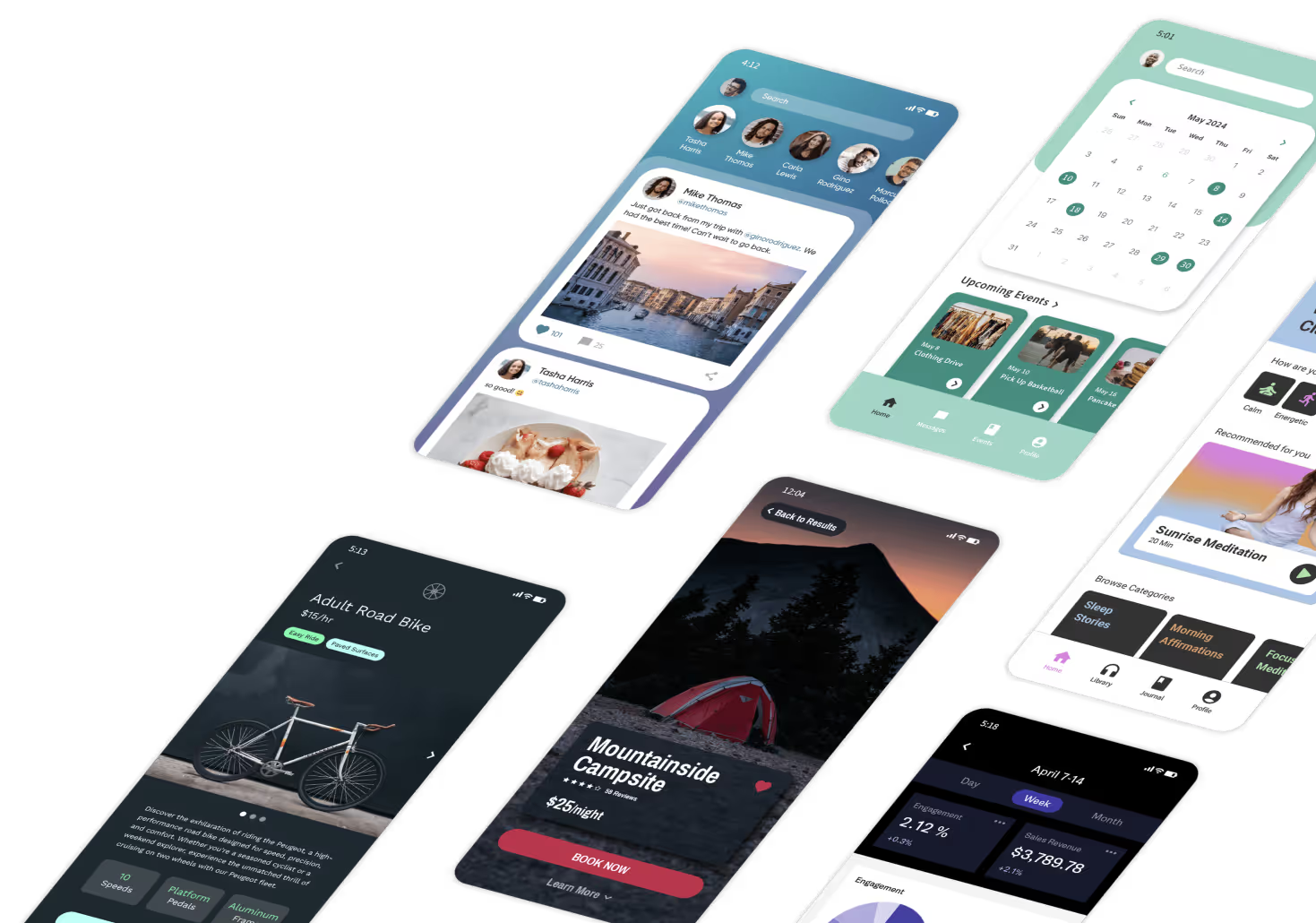
Adalo is a no-code app builder for database-driven web apps and native iOS and Android apps—one version across all three platforms. AI-assisted building and streamlined publishing enable launch to the Apple App Store and Google Play in days rather than months. Describe what you want to build, and AI-assisted features help generate your database, screens, and logic.
Who It's Good For
Adalo offers the ideal balance of simplicity and power. The learning curve is gentle enough for complete beginners, yet the platform delivers professional, high-performing apps. With over 3 million apps created on the platform, users describe the visual builder as "easy as PowerPoint."
The AI features Builder (early 2026) promises vibe-coding creation speed—describe your app in natural language and watch it take shape. For now, Magic Start already generates complete app foundations from simple descriptions, and Magic Add lets you add features by describing what you want.
Features
- Adalo's free version is one of the most generous. Publish your app on the web so users can access it in browsers, and use integrations like Stripe to accept payments.
- Paid plans let you publish to the Apple App Store and Google Play Store so users can download directly to their phones—while keeping the web app live. One codebase, three platforms.
- Start building with fully loaded templates that include screens, database structure, and backend logic. Customize each piece to your needs.
- Send push notifications through your native mobile app to notify customers of deals or remind clients about appointments.
- Unlimited database records on paid plans—no caps, no surprise charges. Adalo 3.0's infrastructure overhaul (late 2025) made apps 3-4x faster with modular architecture that scales to 1M+ monthly active users.
- X-Ray identifies performance issues before they affect users, helping you maintain speed as your app grows.
Pricing
For $36/month, release your app to both app stores and publish to the web under your domain—with unlimited usage and no record limits. The $52/month tier adds push notifications and lets you publish up to two different apps. Unlike competitors, Adalo removed usage-based App Actions charges from all plans, eliminating bill shock entirely.
FlutterFlow
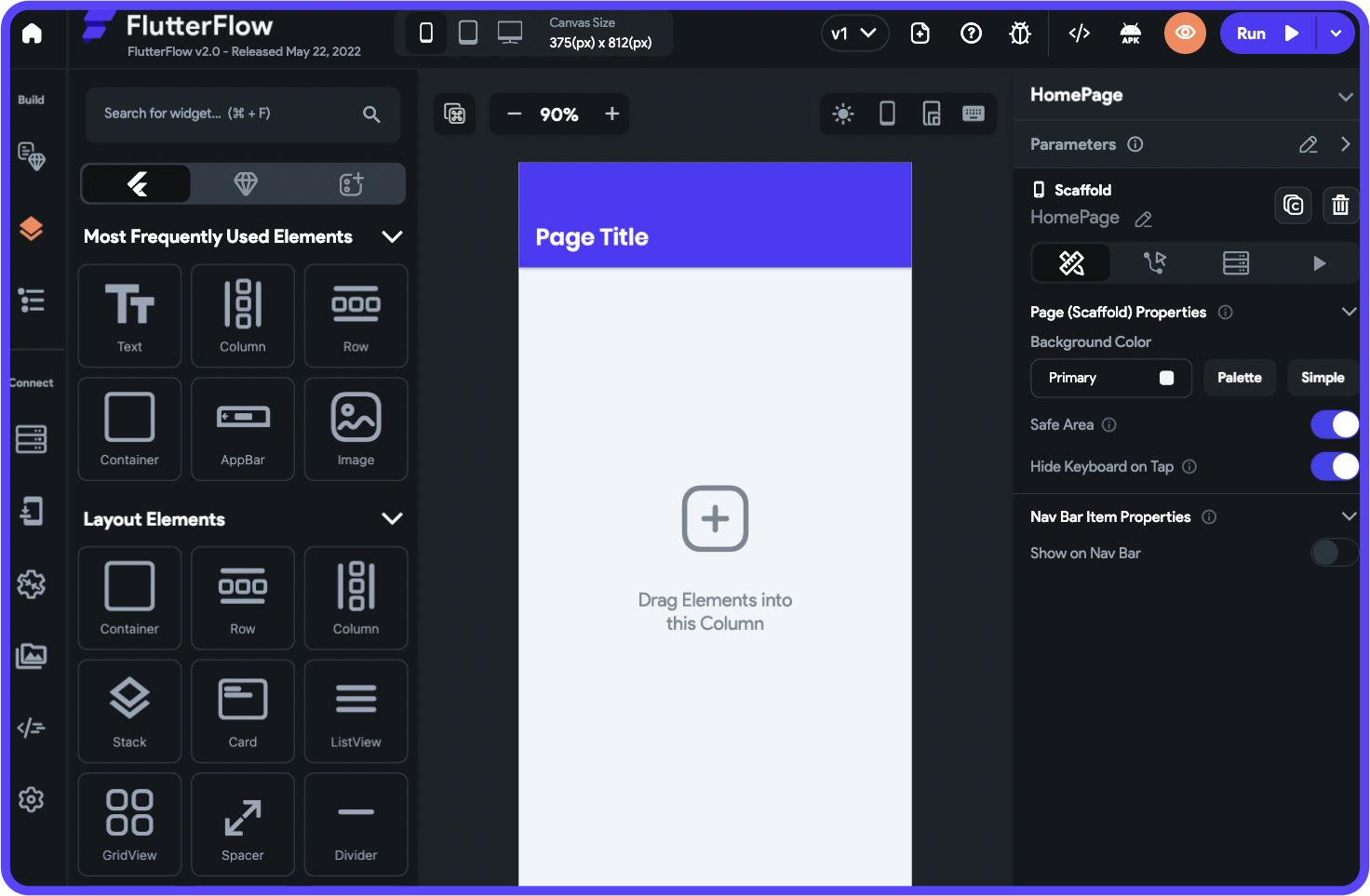
FlutterFlow is a low-code app-building platform—not no-code—blending a visual interface with advanced technical capabilities. Users need to set up and manage their own external database, which adds significant complexity.
Who It's Good For
FlutterFlow is designed for technical users. If you understand coding logic, have experience with programming languages, and can manage database infrastructure, you'll feel at home. However, the platform's ecosystem is rich with experts precisely because so many users need help—particularly when chasing scalability, which can require significant investment in consulting.
The builder's limited viewport (slow to view more than 2 screens at once) contrasts with Adalo's canvas that can display up to 400 screens simultaneously, making complex app architecture easier to manage.
Features
- FlutterFlow integrates with GitHub so you can share your app and get feedback from fellow developers.
- Patch in custom code for specialized features you've created yourself.
- Keep your app's source code to continue development elsewhere, sell to a development company, or finish with traditional coding.
- Publish to the Apple App Store, Google Play Store, or web.
Pricing
For $30/month (billed monthly), download your source code and publish to Google Play via APK. For GitHub integration, advanced testing, and one-click publishing to both stores, the $70/month per user tier is required.
Important caveat: FlutterFlow's pricing doesn't include a database. You'll need to source, set up, and pay for database infrastructure separately—adding both cost and complexity. Anything less than optimal database setup can create serious scaling problems down the line.
Bubble
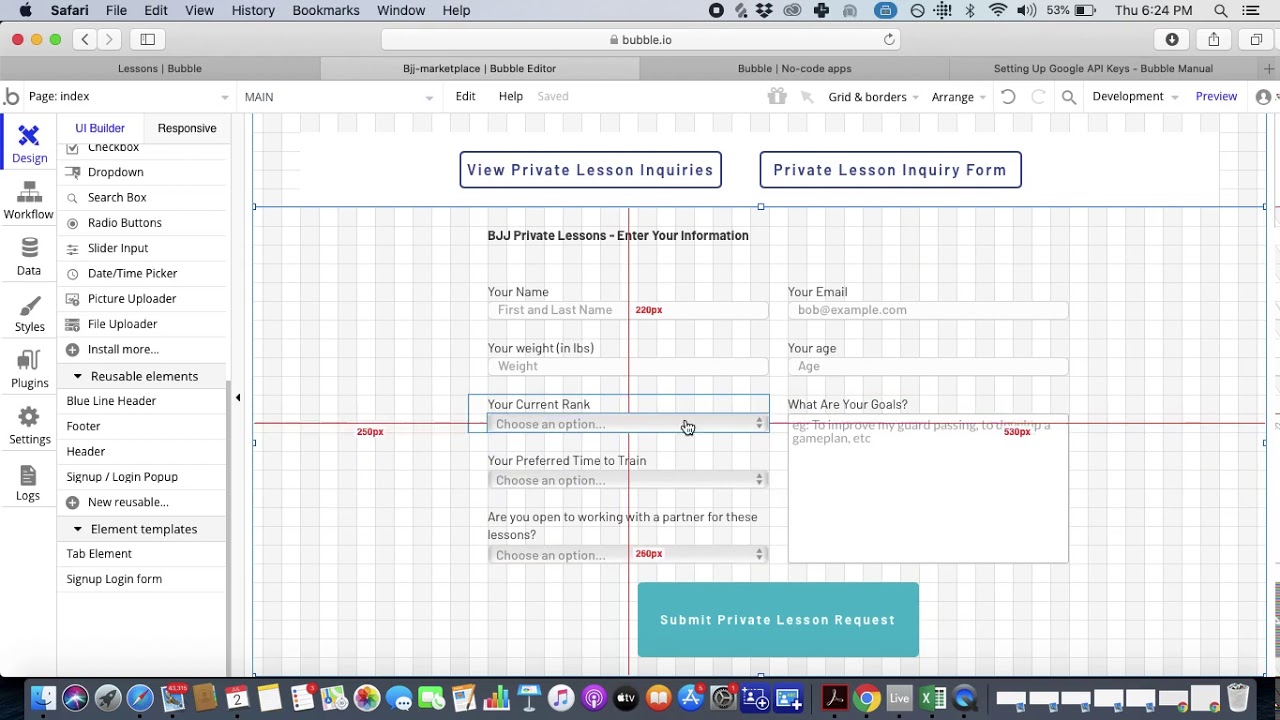
Bubble is a powerful no-code web app builder that's been around since 2012, offering extensive customization for web applications.
Who It's Good For
Bubble has one of the most powerful building interfaces among no-code tools. However, it comes with one of the steepest learning curves. While you won't need programming knowledge, expect to invest 4-6 months of serious study to leverage Bubble thoroughly.
The platform's extensive customization options often result in slower applications that struggle under increased load. Claims of millions of MAU are typically only achievable with hired expert help. Bubble's mobile solution uses a web wrapper rather than true native apps, introducing potential challenges at scale—and means updates don't automatically sync across web, Android, and iOS deployments.
Features
- Bubble's 12+ year history has produced an enormous ecosystem. Find tutorials for nearly everything, detailed documentation, courses, and certified Bubble Coaches for guided learning.
- Choose from 400+ free templates and 300+ paid ones covering online stores, finance apps, SaaS products, and more.
- Access 5,000+ plugins (free and paid) created by the developer community—rich text editors, booking features, website scrapers, and much more.
Pricing
Publish your web app and get 175,000 workload units for $32/month (billed monthly). The $134/month tier provides 250,000 workload units and additional editor seats.
Key consideration: Bubble's mobile wrapper offering starts at $59/month with usage-based charges, limits on app re-publishing, and record restrictions due to Workload Units. Workload calculations can be unclear and unpredictable, making costs difficult to forecast. Compare this to Adalo's $36/month for true native mobile apps with unlimited usage, unlimited app store updates, and no data caps.
Which Platform Should You Choose?
Your choice depends on three factors:
- Your technical skills
- How much time you have to learn the platform
- Your total budget including hidden costs
If you're a technical user who wants to blend visual building with custom code, FlutterFlow might appeal—but budget for database setup, management, and potential expert consulting. Bubble offers extensive customization for web apps, though the learning investment is substantial and scaling often requires professional help.
Adalo is the strongest choice for most creators because it balances simplicity with production-ready power. Tech-savvy users appreciate the sleek, professional results. Beginners find the AI-assisted building refreshing—Magic Start generates complete app foundations from descriptions, eliminating weeks of planning.
The Pricing Reality
While entry tiers look similar ($30, $32, and $36 per month), the second tiers reveal significant differences. FlutterFlow jumps to $70/month per user (still without a database). Bubble leaps to $134/month with usage-based charges that can spike unpredictably.
Adalo's second tier is just $52/month—not much more than entry level—with geolocation, push notifications, and no usage caps. No record limits. No bill shock. That's enough to build an app with serious punch.
Build Your App's Blueprints
Before choosing a platform, create a blueprint by wireframing or sketching each screen. You can draw by hand, but tools like Miro make iteration easier.
Share your mock-ups with friends or on social media for feedback. Incorporating input early means you'll hit the ground running when building—and with Adalo's Magic Start, you can describe your wireframes and watch the AI generate your foundation automatically.
Next Steps: Create Your App with Adalo
Get your app idea off the ground quickly with Adalo. No technical or coding skills required—start building immediately after signing up. The AI-assisted features mean you can describe what you want and watch it take shape.
Adalo has the easiest learning curve compared to Bubble and FlutterFlow, but doesn't sacrifice capability. Access thousands of third-party integrations, over a hundred plugins, and infrastructure that scales to millions of users without performance degradation.
When you finish, maximize your reach: publish the same version to the web, Apple App Store, and Google Play Store. One codebase. Three platforms. No wrapper limitations. Building with Adalo lets you bring any app idea to life.
FAQ
Why choose Adalo over other app building solutions?
Adalo is an AI-powered app builder that creates true native iOS and Android apps—not web wrappers. It compiles to native code and publishes directly to both the Apple App Store and Google Play Store from a single codebase. Publishing to app stores is often the hardest part of launching an app, and Adalo handles it automatically.
What's the fastest way to build and publish an app to the App Store?
Adalo's drag-and-drop interface combined with AI-assisted building lets you go from idea to published app in days. Magic Start generates complete app foundations from descriptions, and Adalo handles the complex App Store submission process—no wrestling with certificates or provisioning profiles.
Which is more affordable, Adalo or FlutterFlow?
Adalo starts at $36/month with app store publishing, unlimited usage, and an included database. FlutterFlow starts at $30/month but requires $70/month per user for easy app store publishing—and doesn't include a database, which you must source and pay for separately.
Which is more affordable, Adalo or Bubble?
Adalo's $36/month plan includes true native mobile apps with unlimited usage. Bubble's mobile wrapper starts at $59/month with usage-based Workload Unit charges and record limits. Adalo's pricing is more predictable with no surprise bills.
Which is easier for beginners, Adalo or Bubble?
Adalo is significantly easier. Users describe the builder as "easy as PowerPoint," and AI features like Magic Start generate app foundations from descriptions. Bubble typically requires 4-6 months of dedicated learning to master its complex interface.
Which is easier for beginners, Adalo or FlutterFlow?
Adalo is designed for anyone from complete beginners to tech experts. FlutterFlow is a low-code platform built for technical users who understand coding logic and can manage external database infrastructure.
Is Adalo better than Bubble for mobile apps?
Yes—Adalo creates true native iOS and Android apps that compile to native code. Bubble's mobile solution uses a web wrapper, which can introduce performance issues at scale and doesn't automatically sync updates across platforms.
Can Adalo apps scale to handle millions of users?
Yes. Adalo 3.0's modular infrastructure (launched late 2025) scales to 1M+ monthly active users with no upper ceiling. Paid plans have unlimited database records, and X-Ray identifies performance issues before they affect users.
Does Adalo have usage limits or surprise charges?
No. Adalo removed usage-based App Actions charges from all plans. Paid plans include unlimited usage and unlimited database records—no caps, no bill shock.
Can I migrate from Bubble or FlutterFlow to Adalo?
While direct migration tools aren't available, Adalo's AI-assisted building makes recreating apps fast. Magic Start can generate your app foundation from a description, and the intuitive interface means you'll be productive quickly.